
CCSDS Space Packet Protocol APID Extension 11042017 Jonathan
- Slides: 14
CCSDS Space Packet Protocol APID Extension 11/04/2017 Jonathan Wilmot Jonathan. J. Wilmot@NASA. gov 301 -286 -2623 1
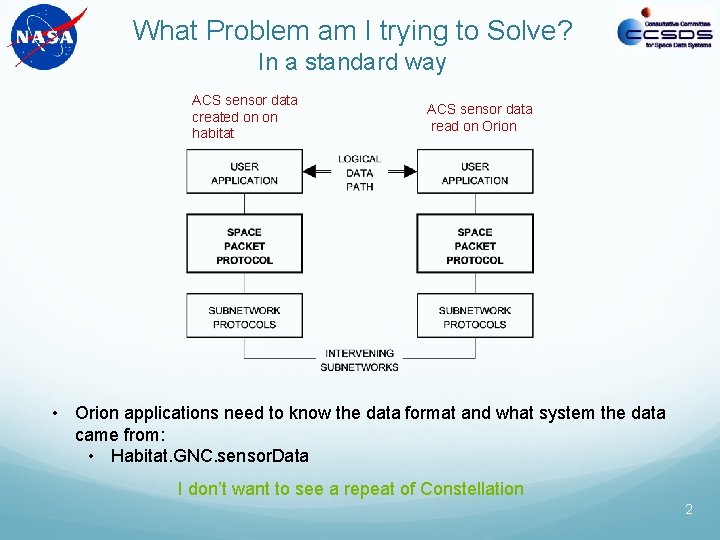
What Problem am I trying to Solve? In a standard way ACS sensor data created on on habitat ACS sensor data read on Orion • Orion applications need to know the data format and what system the data came from: • Habitat. GNC. sensor. Data I don’t want to see a repeat of Constellation 2
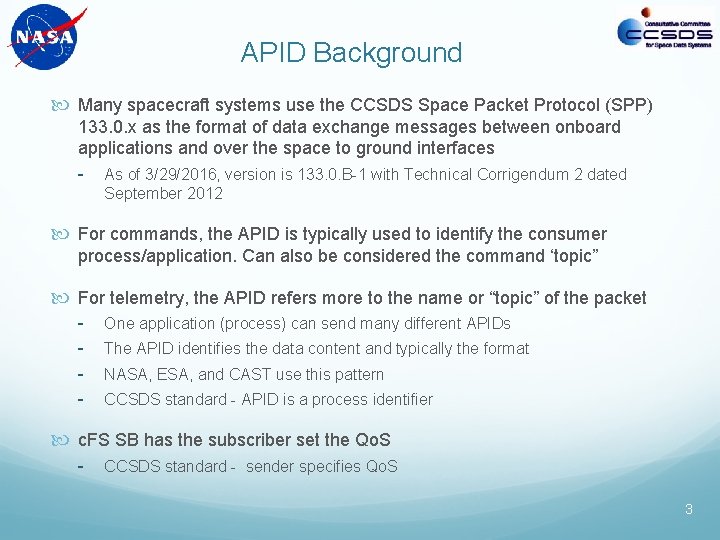
APID Background Many spacecraft systems use the CCSDS Space Packet Protocol (SPP) 133. 0. x as the format of data exchange messages between onboard applications and over the space to ground interfaces As of 3/29/2016, version is 133. 0. B 1 with Technical Corrigendum 2 dated September 2012 For commands, the APID is typically used to identify the consumer process/application. Can also be considered the command ‘topic” For telemetry, the APID refers more to the name or “topic” of the packet One application (process) can send many different APIDs The APID identifies the data content and typically the format NASA, ESA, and CAST use this pattern CCSDS standard APID is a process identifier c. FS SB has the subscriber set the Qo. S CCSDS standard sender specifies Qo. S 3
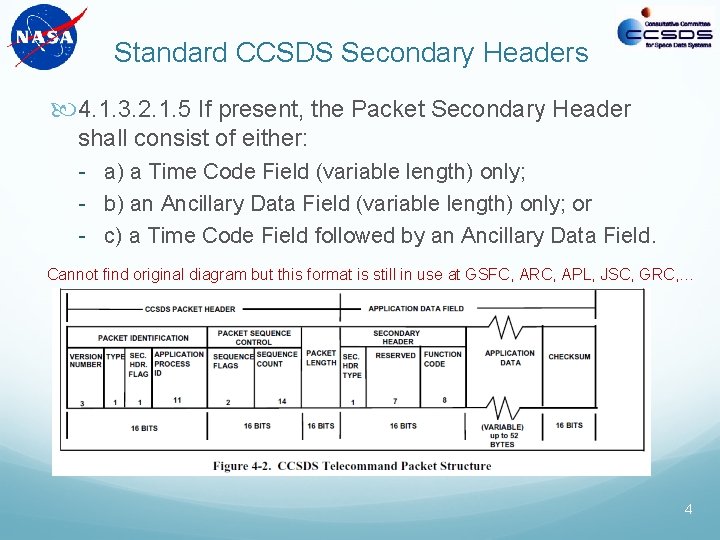
Standard CCSDS Secondary Headers 4. 1. 3. 2. 1. 5 If present, the Packet Secondary Header shall consist of either: a) a Time Code Field (variable length) only; b) an Ancillary Data Field (variable length) only; or c) a Time Code Field followed by an Ancillary Data Field. Cannot find original diagram but this format is still in use at GSFC, ARC, APL, JSC, GRC, … 4
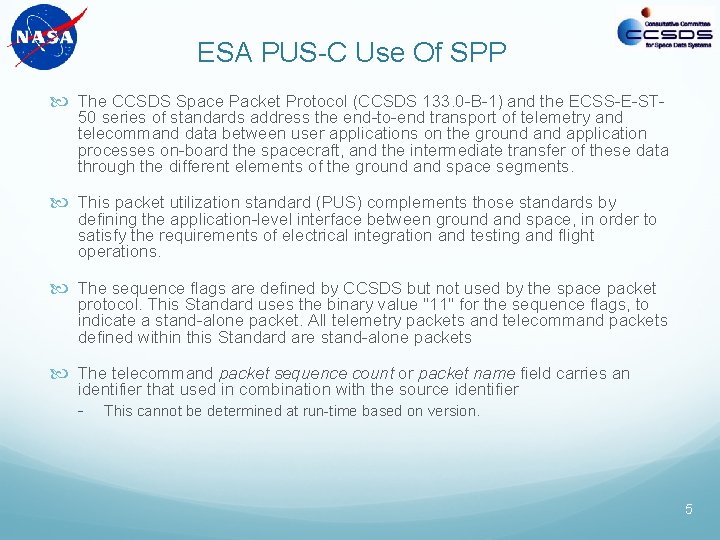
ESA PUS C Use Of SPP The CCSDS Space Packet Protocol (CCSDS 133. 0 B 1) and the ECSS E ST 50 series of standards address the end to end transport of telemetry and telecommand data between user applications on the ground application processes on board the spacecraft, and the intermediate transfer of these data through the different elements of the ground and space segments. This packet utilization standard (PUS) complements those standards by defining the application level interface between ground and space, in order to satisfy the requirements of electrical integration and testing and flight operations. The sequence flags are defined by CCSDS but not used by the space packet protocol. This Standard uses the binary value "11" for the sequence flags, to indicate a stand alone packet. All telemetry packets and telecommand packets defined within this Standard are stand alone packets The telecommand packet sequence count or packet name field carries an identifier that used in combination with the source identifier This cannot be determined at run time based on version. 5
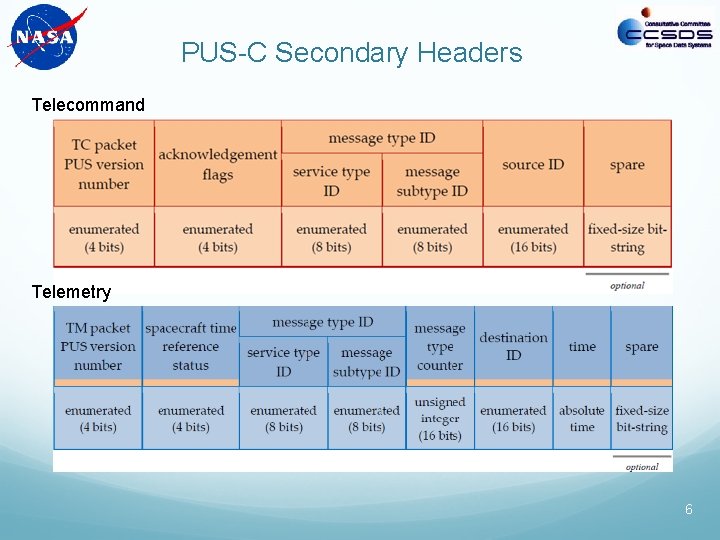
PUS C Secondary Headers Telecommand Telemetry 6
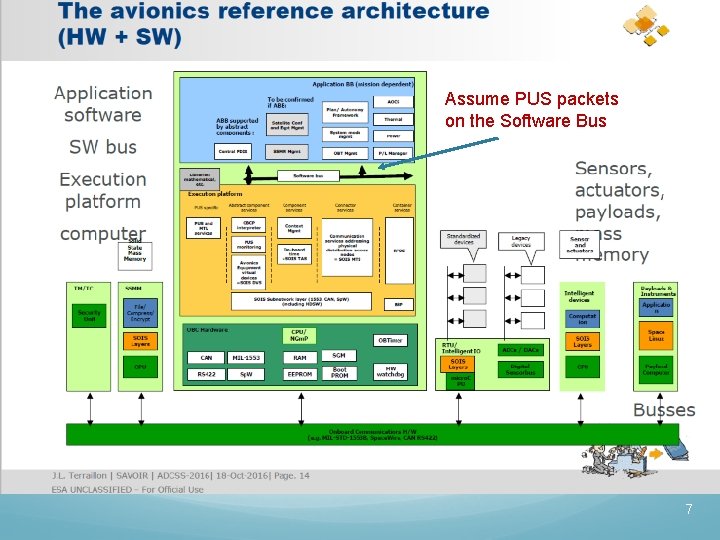
Assume PUS packets on the Software Bus 7
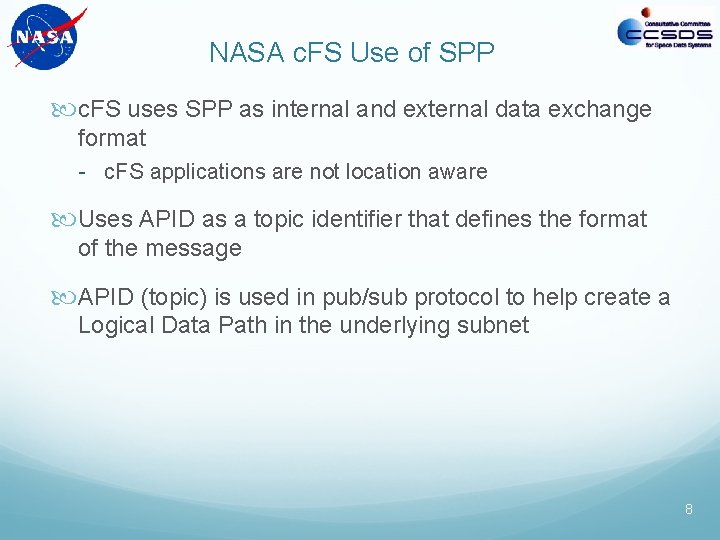
NASA c. FS Use of SPP c. FS uses SPP as internal and external data exchange format c. FS applications are not location aware Uses APID as a topic identifier that defines the format of the message APID (topic) is used in pub/sub protocol to help create a Logical Data Path in the underlying subnet 8
What’s the Problem? Allocation and management of APIDs during development Early block assignments to subsystems Ripple effects of APID changes to code, documentation, tests, ground systems… Larger systems of systems are running out of APIDs Example: Habitat and Orion docked Formation flying, distributed, cluster satellites, small satellites Includes multi processor, multi core, and partitioned systems In CCSDS, the spacecraft ID is in the WAN frame and is stripped off as the packet goes up the protocol stack Applications receiving Space Packets do not know how to interpret the packet unless the know the domain (i. e. spacecraft id) SPP Primary Header flag indicates there is a secondary header, but application cannot determine format 9
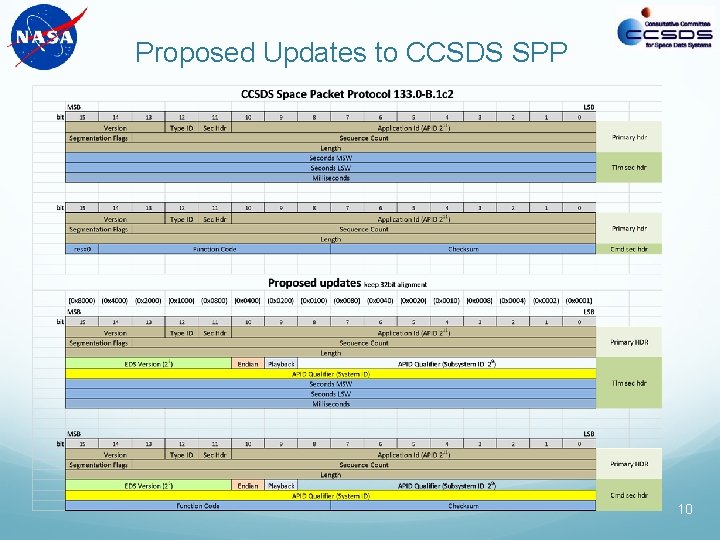
Proposed Updates to CCSDS SPP 10
Primary Header Field Definitions (1) CCSDS version – Version of CCSDS Space Packet Protocol used to create this packet (23 = 8) Currently set to 0 indicating version 1 Type ID – Indicates packet is a command or telemetry Secondary Header Flag – Indicates packet contains a secondary header When combined with the Type ID format of secondary header is known For c. FS always set to 1 indicating secondary header is present Application ID (APID) – Indicates source application/process of that packet (211 = 2047) APID = 2047 is fill packet When combined with Type ID allows 4094 unique packet identifiers 11
Primary Header Field Definitions (2) Sequence Flags – Indicates that this packet encapsulates a larger packet ‘ 00’ if the Space Packet contains a continuation segment of User Data ‘ 01’ if the Space Packet contains the first segment of User Data ‘ 10’ if the Space Packet contains the last segment of User Data ‘ 11’ if the Space Packet contains unsegmented User Data. NASA c. FS SB and ESA PUS use ’ 11’ to avoid complexities of encapsulation mechanisms Packet Sequence Count Continuous incrementing counter (modulo 16384) c. FS implements this for telemetry packets Unused for c. FS command packets • Avoids issues with command from multiple applications (Many to one) Stored command ground command sequencing 12
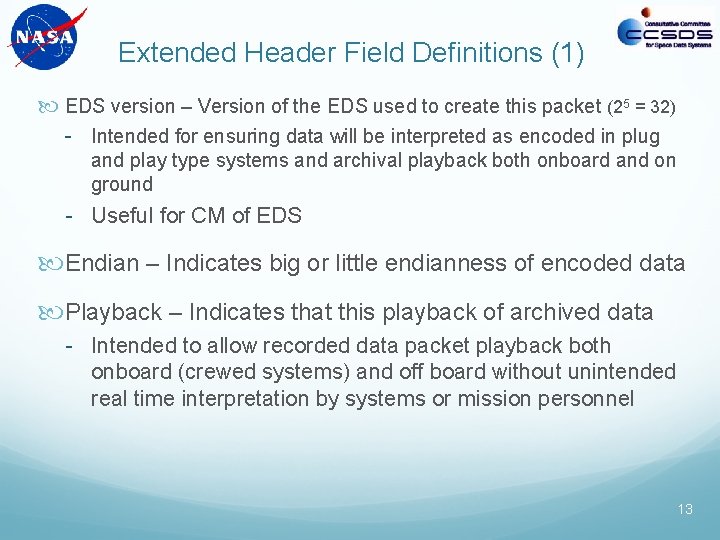
Extended Header Field Definitions (1) EDS version – Version of the EDS used to create this packet (25 = 32) Intended for ensuring data will be interpreted as encoded in plug and play type systems and archival playback both onboard and on ground Useful for CM of EDS Endian – Indicates big or little endianness of encoded data Playback – Indicates that this playback of archived data Intended to allow recorded data packet playback both onboard (crewed systems) and off board without unintended real time interpretation by systems or mission personnel 13
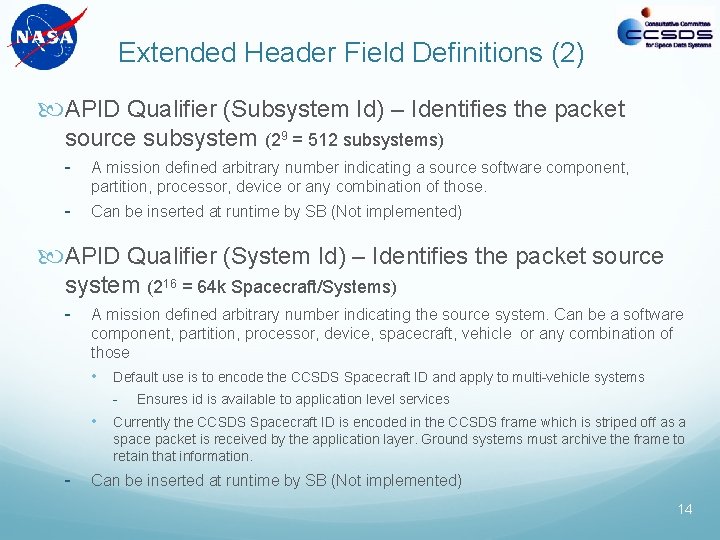
Extended Header Field Definitions (2) APID Qualifier (Subsystem Id) – Identifies the packet source subsystem (29 = 512 subsystems) A mission defined arbitrary number indicating a source software component, partition, processor, device or any combination of those. Can be inserted at runtime by SB (Not implemented) APID Qualifier (System Id) – Identifies the packet source system (216 = 64 k Spacecraft/Systems) A mission defined arbitrary number indicating the source system. Can be a software component, partition, processor, device, spacecraft, vehicle or any combination of those • Default use is to encode the CCSDS Spacecraft ID and apply to multi vehicle systems Ensures id is available to application level services • Currently the CCSDS Spacecraft ID is encoded in the CCSDS frame which is striped off as a space packet is received by the application layer. Ground systems must archive the frame to retain that information. Can be inserted at runtime by SB (Not implemented) 14