
CCRS Quarterly Meeting 3 Unpacking the Learning Progressions




![Sample 2 D & 3 D Geometry Progression § 19 [K-G 3] § 26](https://slidetodoc.com/presentation_image_h/b3eacb3117c9e7a9600ad5da55be505e/image-29.jpg "Sample 2 D & 3 D Geometry Progression § 19 [K-G 3] § 26")
- Slides: 37
CCRS Quarterly Meeting # 3 Unpacking the Learning Progressions http: //alex. state. al. us/ccrs/
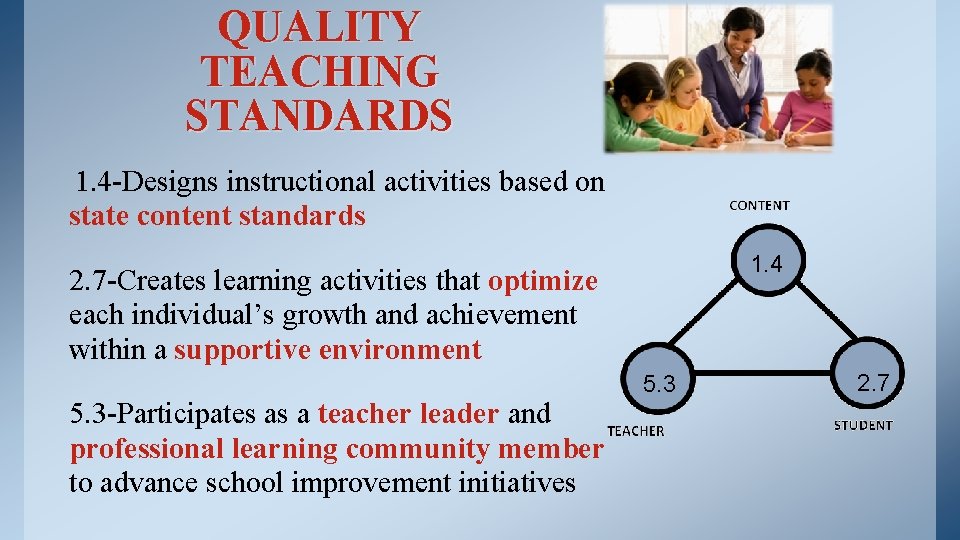
QUALITY TEACHING STANDARDS 1. 4 -Designs instructional activities based on state content standards 1. 4 2. 7 -Creates learning activities that optimize each individual’s growth and achievement within a supportive environment 5. 3 -Participates as a teacher leader and professional learning community member to advance school improvement initiatives 5. 3 2. 7
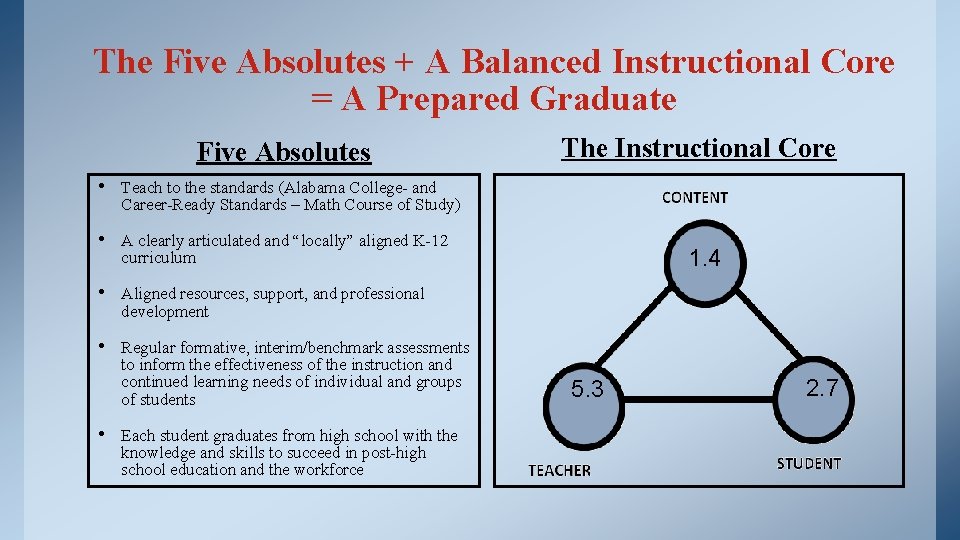
The Five Absolutes + A Balanced Instructional Core = A Prepared Graduate Five Absolutes The Instructional Core • Teach to the standards (Alabama College- and Career-Ready Standards – Math Course of Study) • A clearly articulated and “locally” aligned K-12 1. 4 curriculum • Aligned resources, support, and professional development • Regular formative, interim/benchmark assessments to inform the effectiveness of the instruction and continued learning needs of individual and groups of students • Each student graduates from high school with the knowledge and skills to succeed in post-high school education and the workforce 5. 3 2. 7
Outcomes Participants will: q Reflect on Next Steps from QM #2 q Review and deepen understanding of the Geometry Learning Progression and how the content is sequenced within and across the grades (coherence) q Examine specific mathematical content along “Standards Progressions” to uncover necessary shifts in when topics are addressed and mastered. q Illustrate, using tasks, how math content develops over time and discuss how the progressions in the standards can be used to inform planning, teaching, and learning
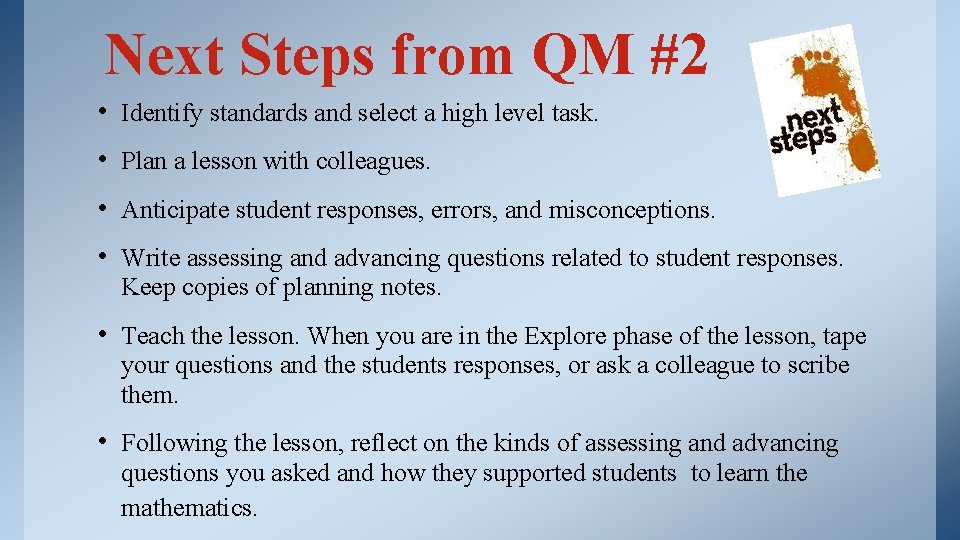
Next Steps from QM #2 • Identify standards and select a high level task. • Plan a lesson with colleagues. • Anticipate student responses, errors, and misconceptions. • Write assessing and advancing questions related to student responses. Keep copies of planning notes. • Teach the lesson. When you are in the Explore phase of the lesson, tape your questions and the students responses, or ask a colleague to scribe them. • Following the lesson, reflect on the kinds of assessing and advancing questions you asked and how they supported students to learn the mathematics.
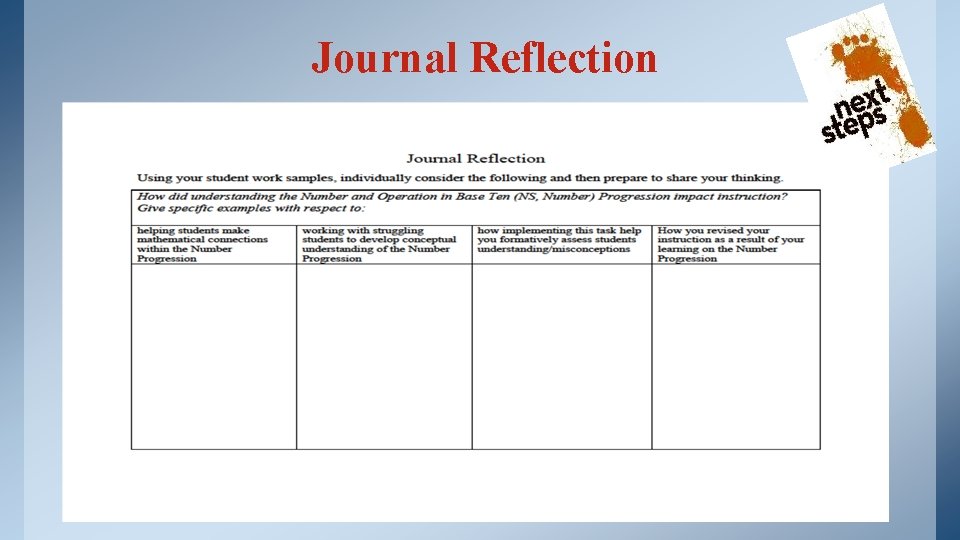
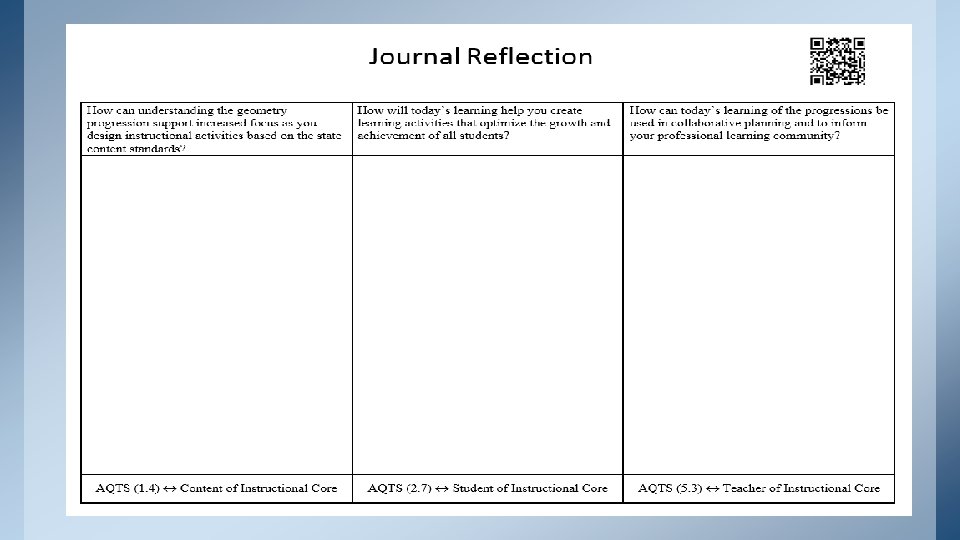
Journal Reflection
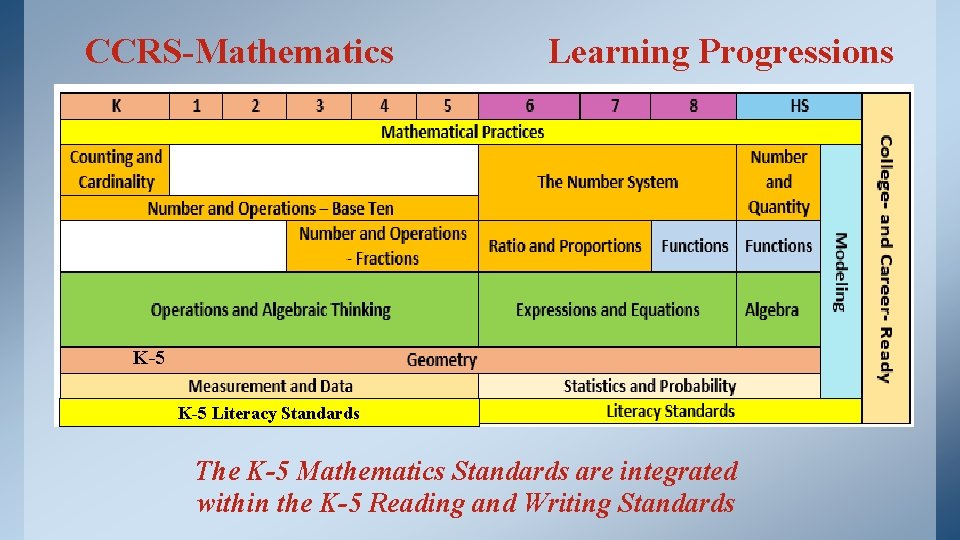
CCRS-Mathematics Learning Progressions K-5 Literacy Standards The K-5 Mathematics Standards are integrated within the K-5 Reading and Writing Standards
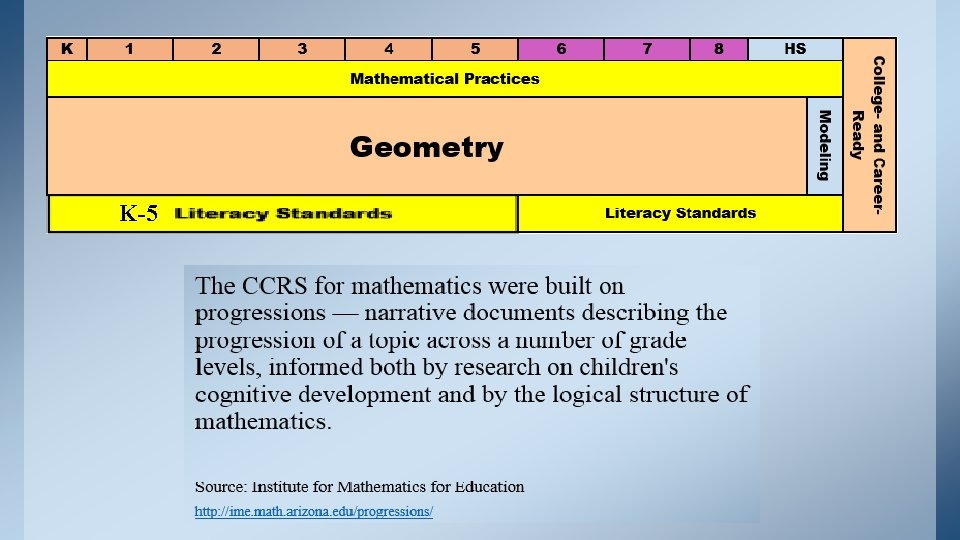
K-5
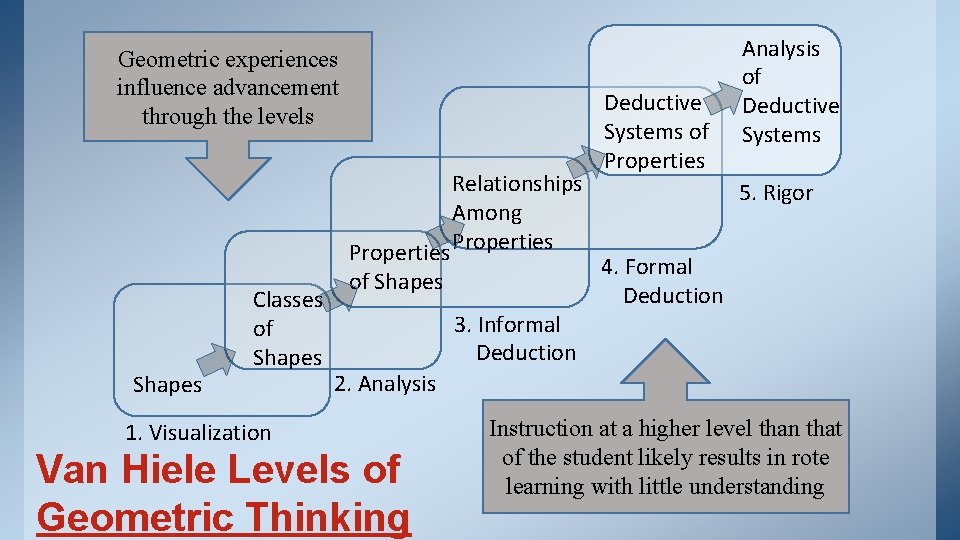
Geometric experiences influence advancement through the levels Relationships Among Properties Shapes Classes of Shapes 1. Visualization of Shapes 3. Informal Deduction Deductive Systems of Properties Analysis of Deductive Systems 5. Rigor 4. Formal Deduction 2. Analysis Van Hiele Levels of Geometric Thinking Instruction at a higher level than that of the student likely results in rote learning with little understanding
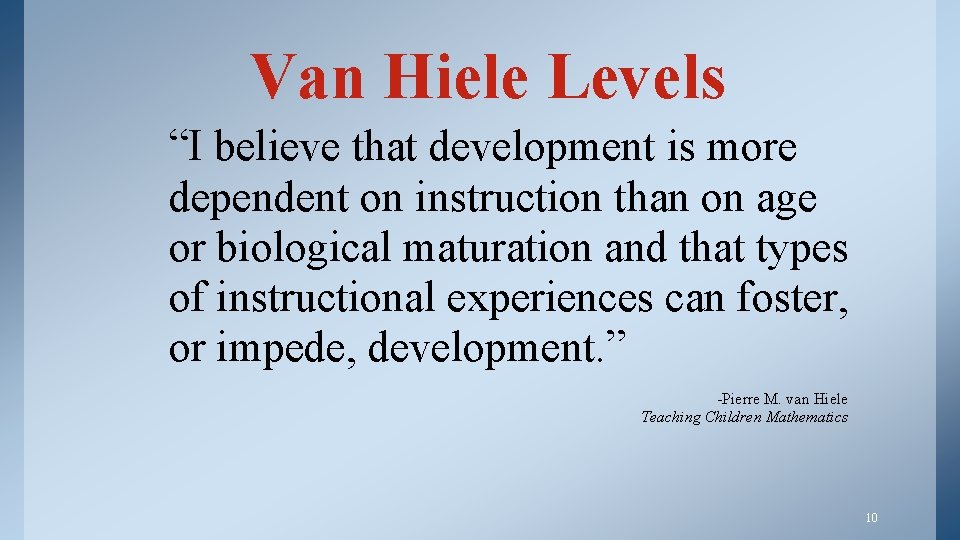
Van Hiele Levels “I believe that development is more dependent on instruction than on age or biological maturation and that types of instructional experiences can foster, or impede, development. ” -Pierre M. van Hiele Teaching Children Mathematics 10
K-5 Geometry : Anticipation Guide INDIVIDUAL , TABLE GROUP & WHOLE GROUP DISCUSSION
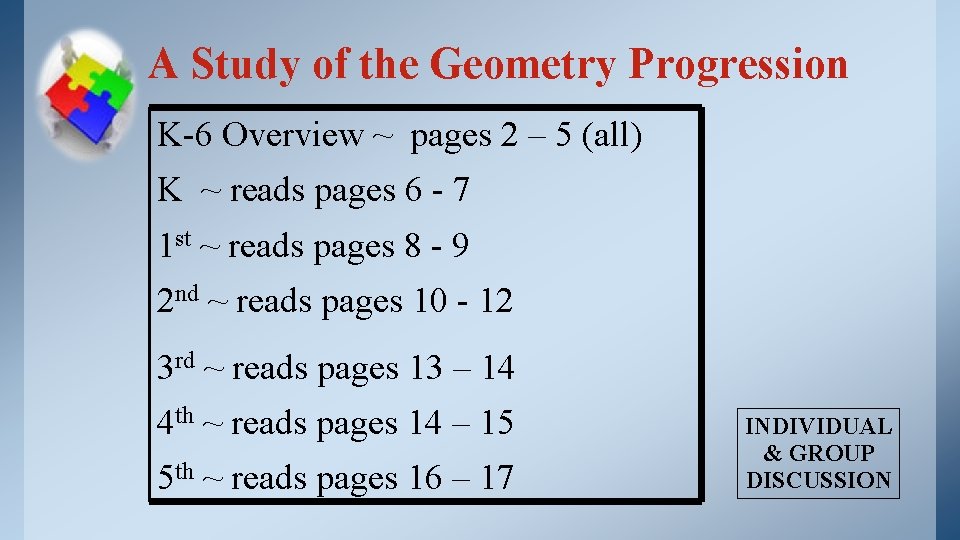
A Study of the Geometry Progression K-6 Overview ~ pages 2 – 5 (all) K ~ reads pages 6 - 7 1 st ~ reads pages 8 - 9 2 nd ~ reads pages 10 - 12 3 rd ~ reads pages 13 – 14 4 th ~ reads pages 14 – 15 5 th ~ reads pages 16 – 17 INDIVIDUAL & GROUP DISCUSSION
K-6 Geometry : Anticipation Guide WHOLE GROUP DISCUSSION
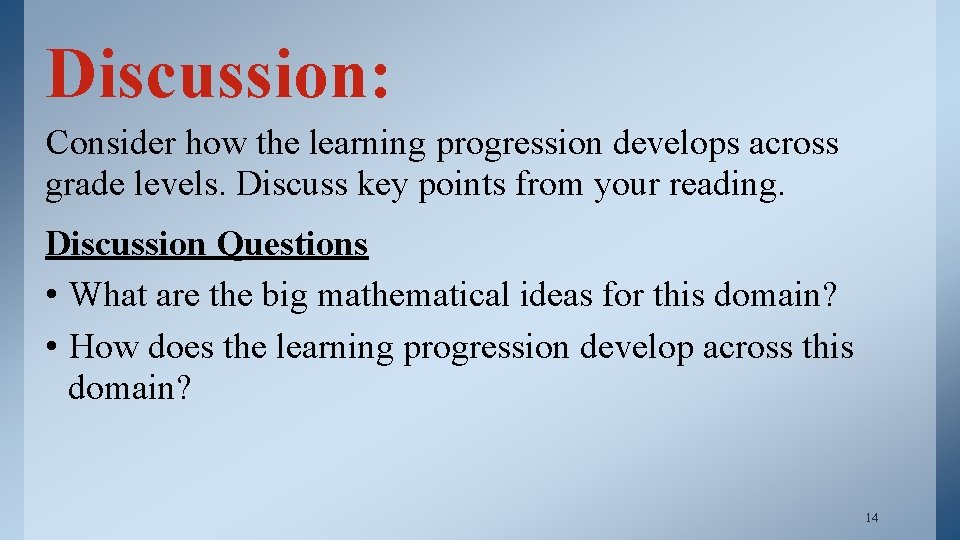
Discussion: Consider how the learning progression develops across grade levels. Discuss key points from your reading. Discussion Questions • What are the big mathematical ideas for this domain? • How does the learning progression develop across this domain? 14
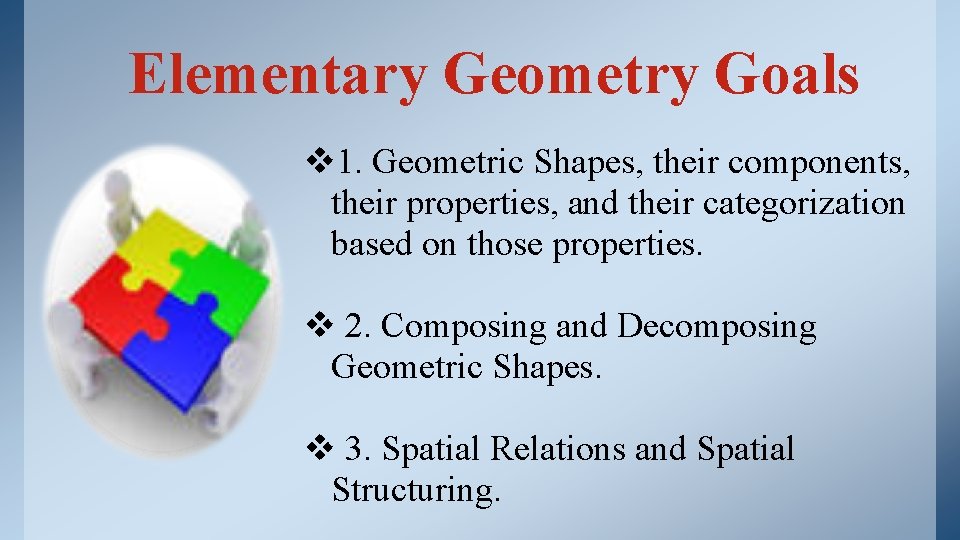
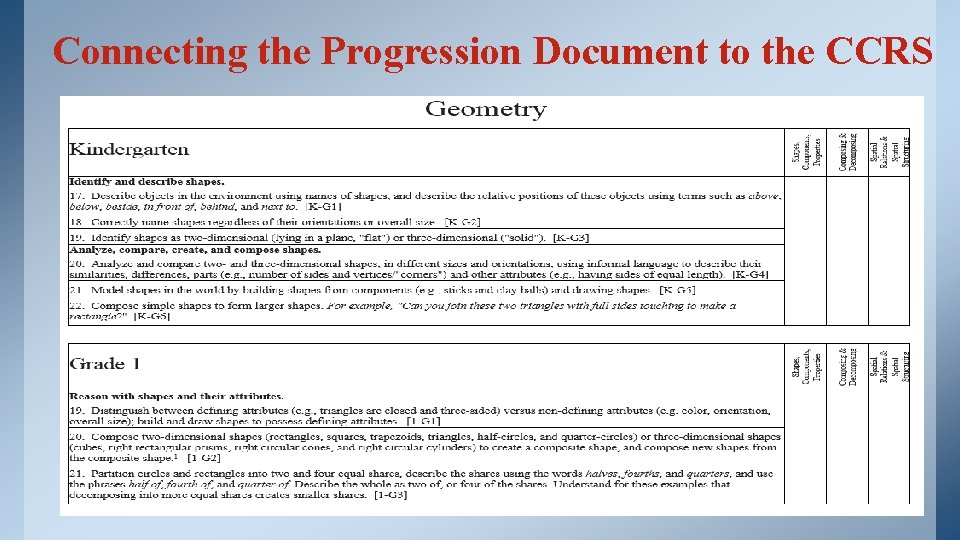
Elementary Geometry Goals v 1. Geometric Shapes, their components, their properties, and their categorization based on those properties. v 2. Composing and Decomposing Geometric Shapes. v 3. Spatial Relations and Spatial Structuring.
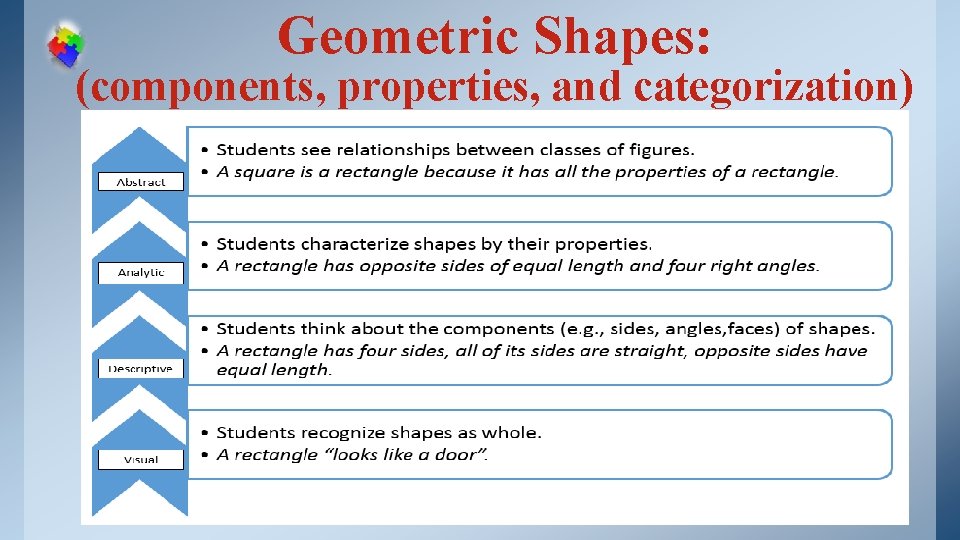
Geometric Shapes: (components, properties, and categorization)
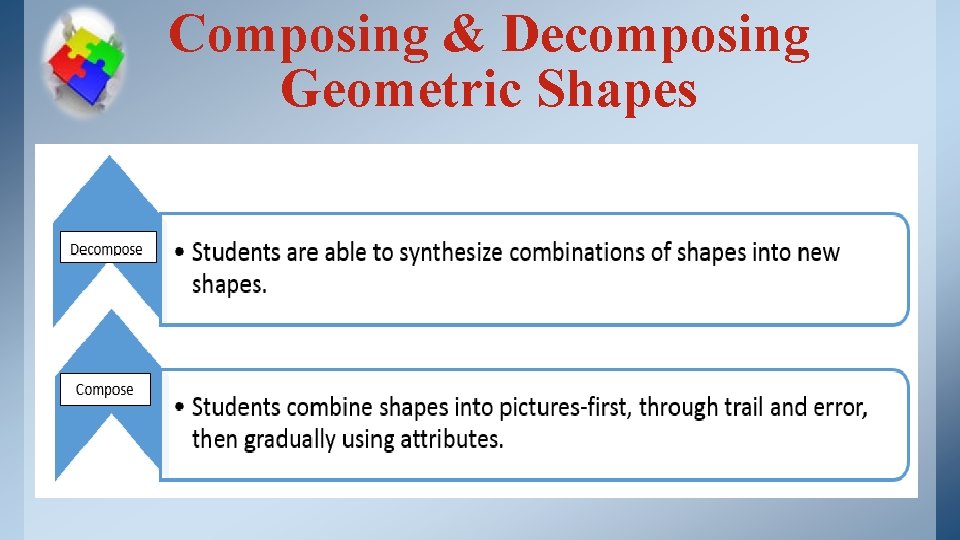
Composing & Decomposing Geometric Shapes
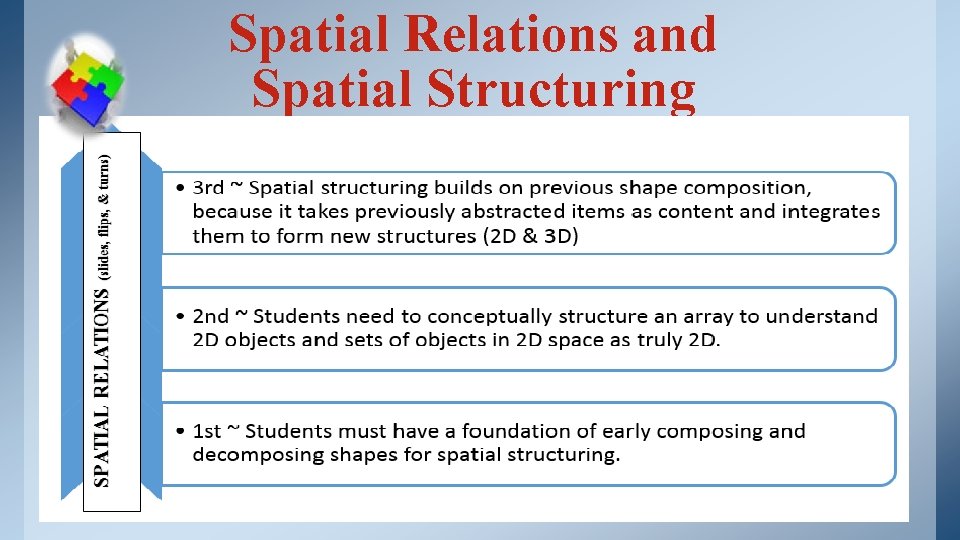
Spatial Relations and Spatial Structuring
Connecting the Progression Document to the CCRS
Reflection: How might understanding the geometry progression and looking at the standards impact instruction? Give specific examples with respect to: • collaboratively planning lessons • helping students make mathematical connections • working with struggling students, Sp. Ed and ELL • using formative assessment and revising instruction
LUNCH
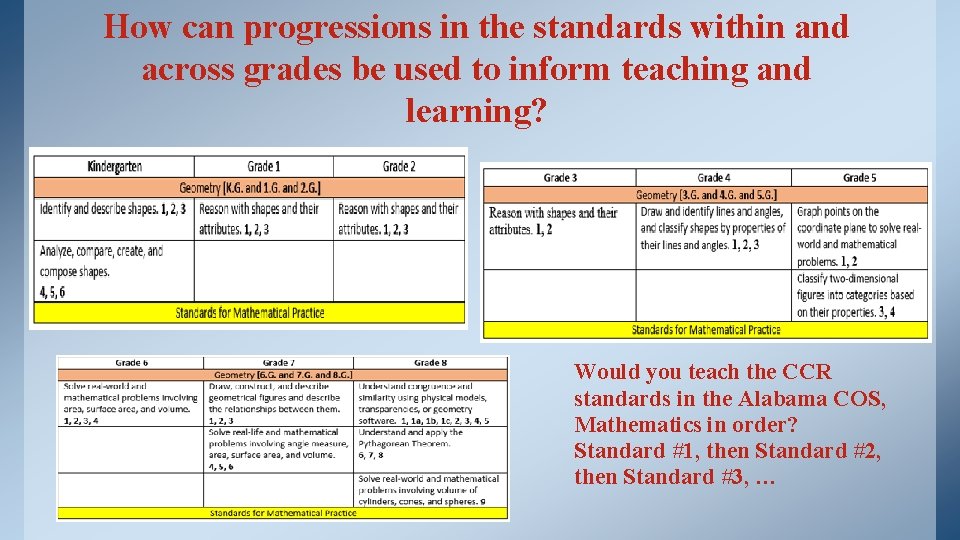
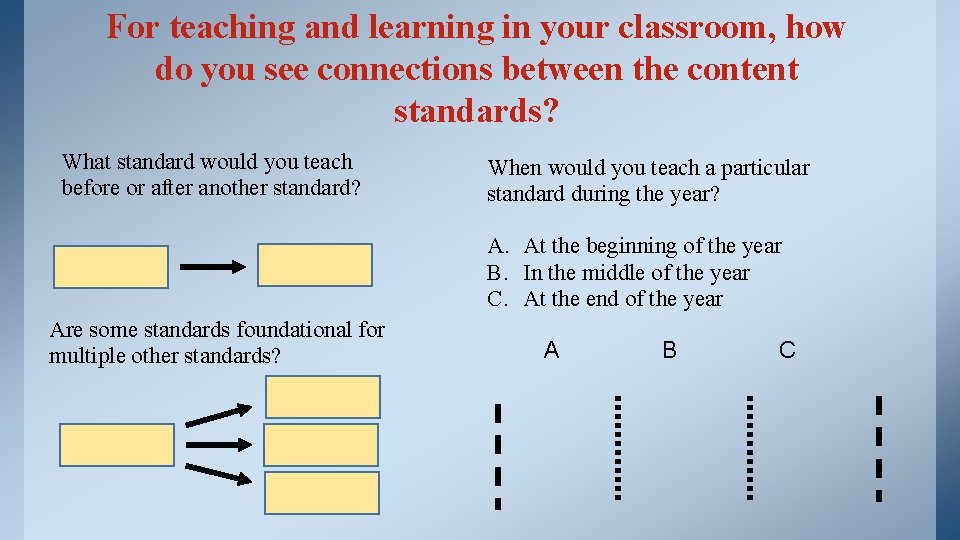
How can progressions in the standards within and across grades be used to inform teaching and learning? Would you teach the CCR standards in the Alabama COS, Mathematics in order? Standard #1, then Standard #2, then Standard #3, …
For teaching and learning in your classroom, how do you see connections between the content standards? What standard would you teach before or after another standard? When would you teach a particular standard during the year? A. At the beginning of the year B. In the middle of the year C. At the end of the year Are some standards foundational for multiple other standards? A B C
The Wire Diagram Activity • Locate a standard in your grade band that requires students to build upon previous knowledge. • Determine what standards from earlier grades must be mastered in order for students to be successful in this new learning. • Refer to the progression document that supports your thinking.
Why is professional peer discussion about progressions important for the teaching and learning process?
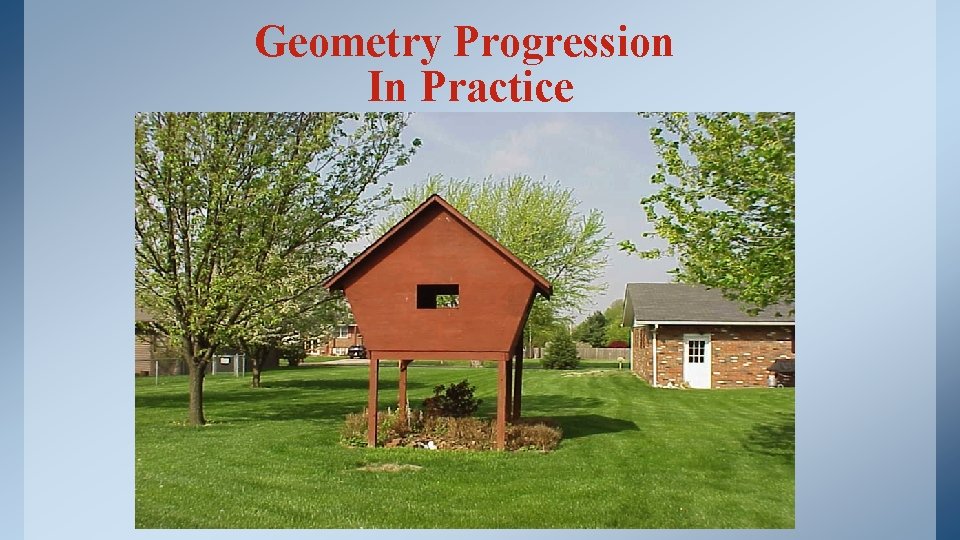
Geometry Progression In Practice
Strong Focus on Geometry § Analyze characteristics and properties of 2 D and 3 D geometric shapes and develop mathematical arguments about geometric relationships; § Specify locations and describe spatial relationships using coordinate geometry and other representational systems; § Apply transformations and use symmetry to analyze mathematical situations; § Use visualization, spatial reasoning, and geometric modeling to solve problems.
Sample 2 D & 3 D Geometry Progression § 19 [K-G 3] § 26 [5 -G 4] 20 [K-G 4] § 22 [6 -G 2] § 20 [1 -G 2] § 13 [7 -G 3] § 24 [2 -G 1] § 24 [8 -G 9] § 24 [3 -G 1] § Geometry 39 [G-MG 1]; Precalculus 38 [G-GMD 2] § 26 [4 -G 1]
2 D and 3 D Geometry Through the Grades
Greater Coherence with Tasks As you explore your assigned task, discuss the following: 1. Identify the Standards for Mathematical Practice that are central to the task. Are they handled in a grade-appropriate way, and are they well connected to the content being addressed? 2. How can teachers use the task or adjust it to provide appropriate level and type of scaffolding, differentiation, intervention and support for a broad range of learners? Does the task or can it be modified to: • Support diverse cultural and linguistic backgrounds, interests and styles? • Provide extra supports for students working below grade level? • Provide extensions for students with high interest or working above grade level? 3. Should the teacher use this task as an assessment? Why or why not? What kind of assessment?
Group Discussion: • Are there any aspects of your own thinking and/or practice that our work today has caused you to consider or reconsider? Explain. • How will today’s learning help you as you work with: – Collaborative Planning – Struggling students (Special Ed and ELL, etc) – Formative assessment? • With respect to CCRS Math, what would you like more information/learning on?
Reflection: 1. ) ONE thing (at least) that you learned in this session about the CCRS 2. ) ONE suggestion/tip for me as I continue to help teachers dissect and understand the CCRS 34
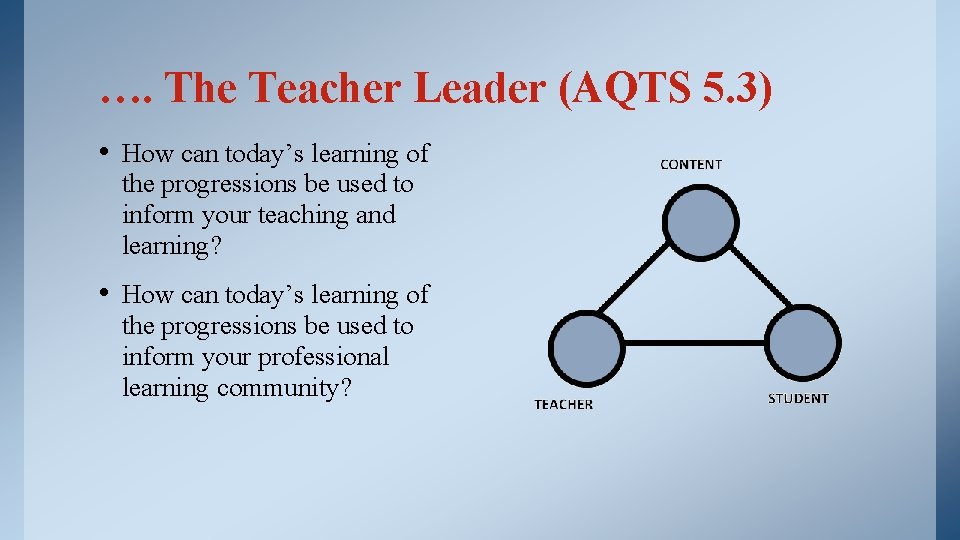
…. The Teacher Leader (AQTS 5. 3) • How can today’s learning of the progressions be used to inform your teaching and learning? • How can today’s learning of the progressions be used to inform your professional learning community?
Wrapping up…. . Prepare for District Team Planning
References: • “The Structure is the Standards” Daro, Mc. Callum, Zimba (2012) http: //commoncoretools. me/2012/02/16/the-structure-is-the-standards/ • www. illustrativemathematics. org • K– 8 Publishers’ Criteria for the Common Core State Standards for Mathematics (2013)