
CCNA RS Improved Instructional Approach Jeremy Creech Program

- Slides: 17
CCNA R&S: Improved Instructional Approach Jeremy Creech Program Manager, Learning Experience Development July 30, 2013
• Why Change? • Learning for Mastery • Toolbox of Options • Teaching New Instructional Approach © 2013 Cisco and/or its affiliates. All rights reserved. Cisco Public 2
How can we best incorporate instructional research findings to improve our student outcomes? What past instructional challenges can we resolve? How can we help our students succeed in transitioning from ICT classroom to ICT job? © 2013 Cisco and/or its affiliates. All rights reserved. Cisco Public 3
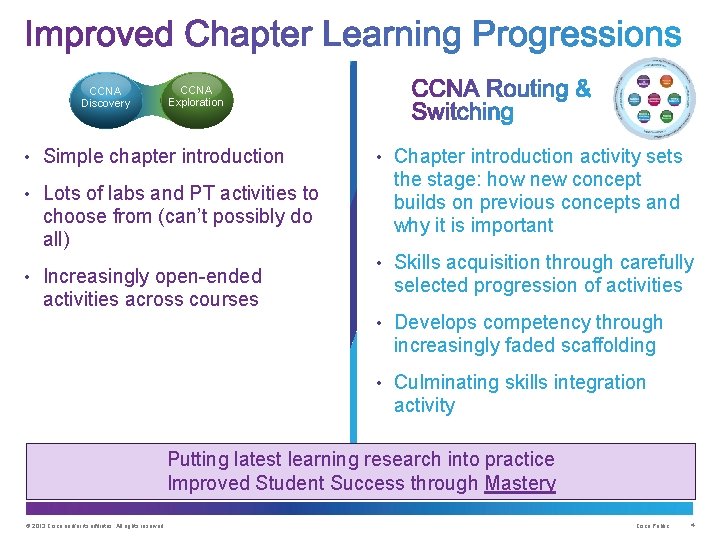
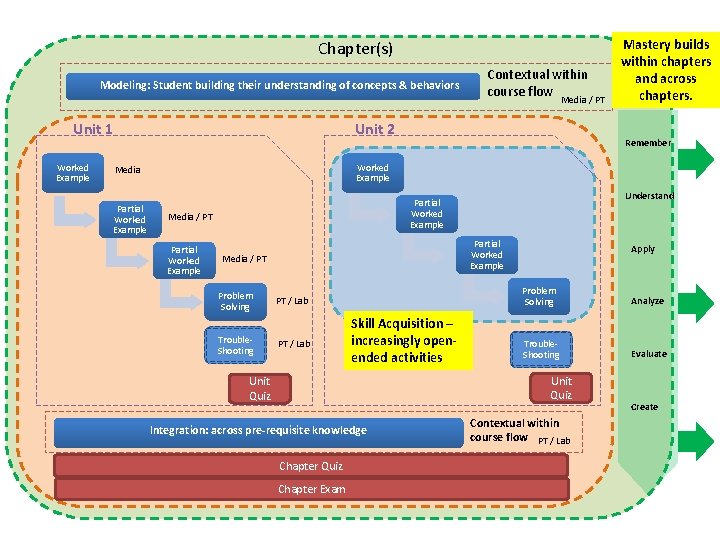
CCNA Discovery CCNA Exploration • Simple chapter introduction • Lots of labs and PT activities to choose from (can’t possibly do all) • Increasingly open-ended activities across courses • Chapter introduction activity sets the stage: how new concept builds on previous concepts and why it is important • Skills acquisition through carefully selected progression of activities • Develops competency through increasingly faded scaffolding • Culminating skills integration activity Putting latest learning research into practice Improved Student Success through Mastery © 2013 Cisco and/or its affiliates. All rights reserved. Cisco Public 4
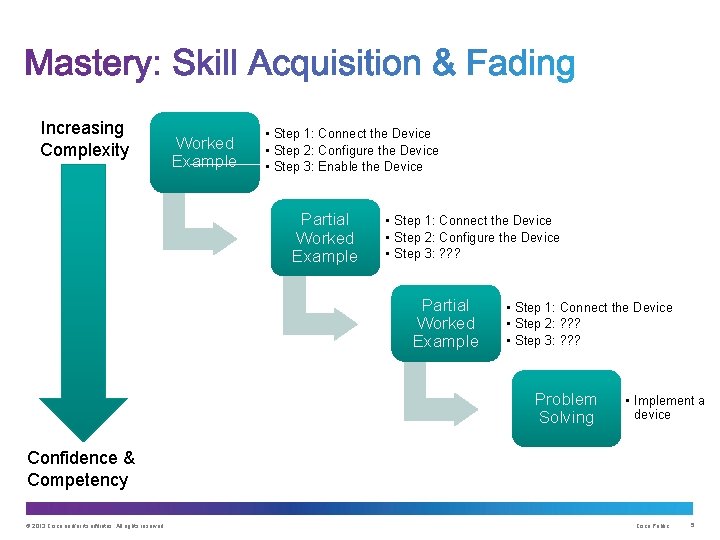
Increasing Complexity Worked Example • Step 1: Connect the Device • Step 2: Configure the Device • Step 3: Enable the Device Partial Worked Example • Step 1: Connect the Device • Step 2: Configure the Device • Step 3: ? ? ? Partial Worked Example • Step 1: Connect the Device • Step 2: ? ? ? • Step 3: ? ? ? Problem Solving • Implement a device Confidence & Competency © 2013 Cisco and/or its affiliates. All rights reserved. Cisco Public 5
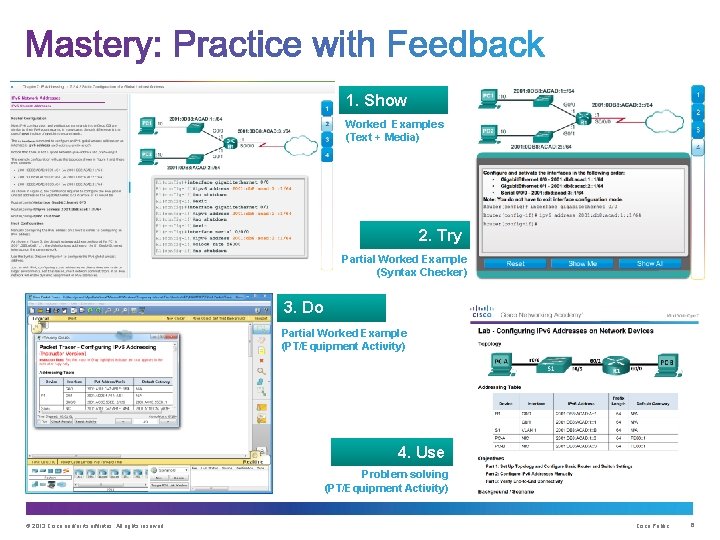
1. Show Worked Examples (Text + Media) 2. Try Partial Worked Example (Syntax Checker) 3. Do Partial Worked Example (PT/Equipment Activity) 4. Use Problem-solving (PT/Equipment Activity) © 2013 Cisco and/or its affiliates. All rights reserved. Cisco Public 6
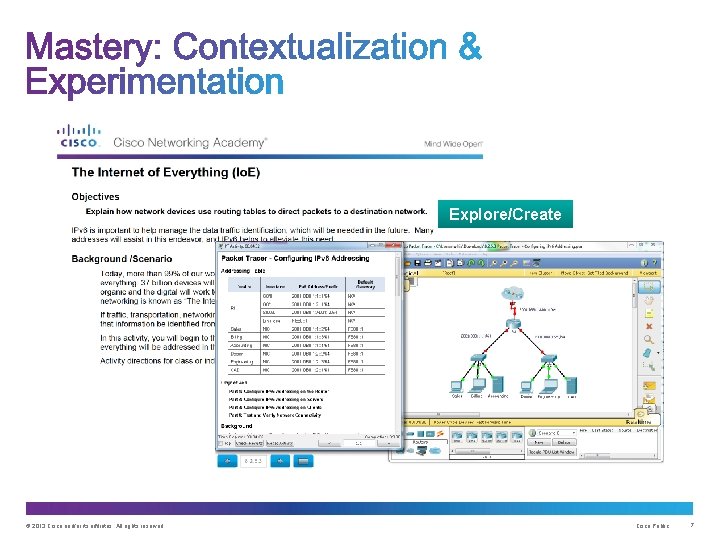
Explore/Create © 2013 Cisco and/or its affiliates. All rights reserved. Cisco Public 7
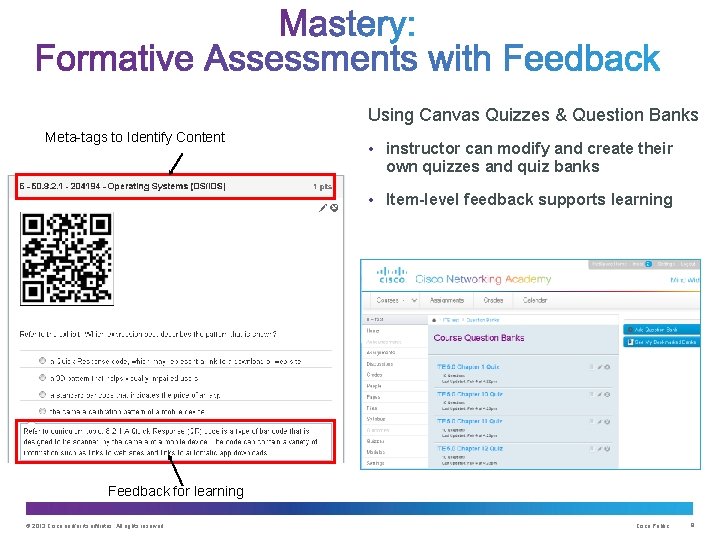
Using Canvas Quizzes & Question Banks Meta-tags to Identify Content • instructor can modify and create their own quizzes and quiz banks • Item-level feedback supports learning Feedback for learning © 2013 Cisco and/or its affiliates. All rights reserved. Cisco Public 8
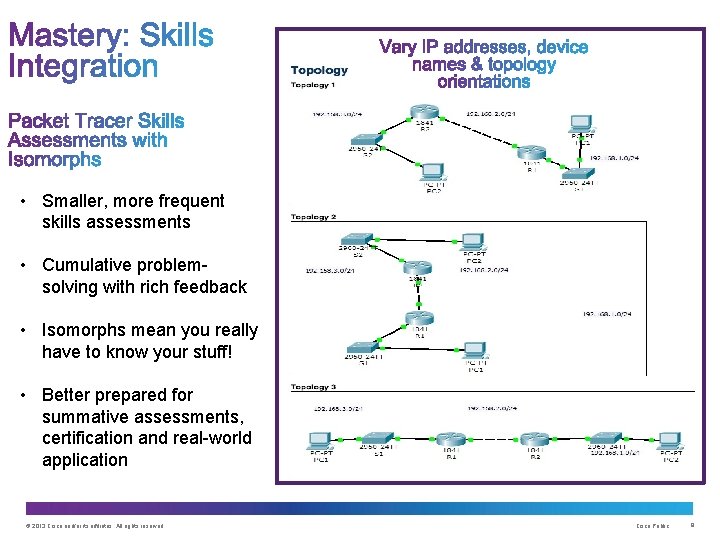
• Smaller, more frequent skills assessments • Cumulative problemsolving with rich feedback • Isomorphs mean you really have to know your stuff! • Better prepared for summative assessments, certification and real-world application © 2013 Cisco and/or its affiliates. All rights reserved. Cisco Public 9
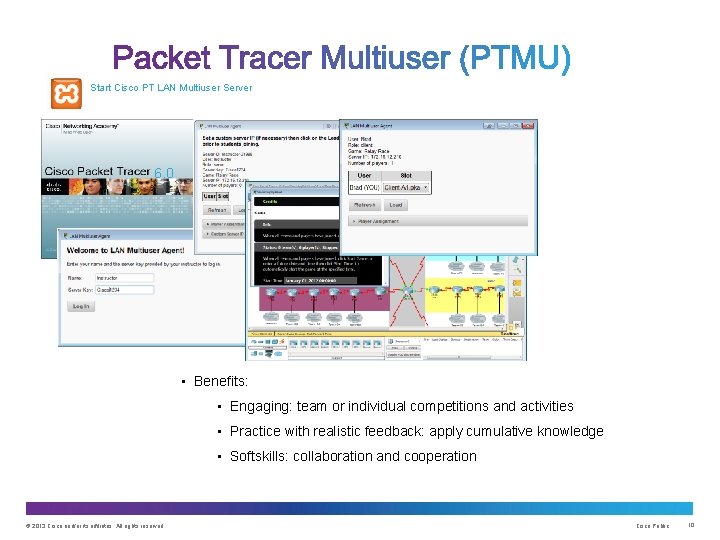
Start Cisco PT LAN Multiuser Server 6. 0 • Benefits: • Engaging: team or individual competitions and activities • Practice with realistic feedback: apply cumulative knowledge • Softskills: collaboration and cooperation © 2013 Cisco and/or its affiliates. All rights reserved. Cisco Public 10
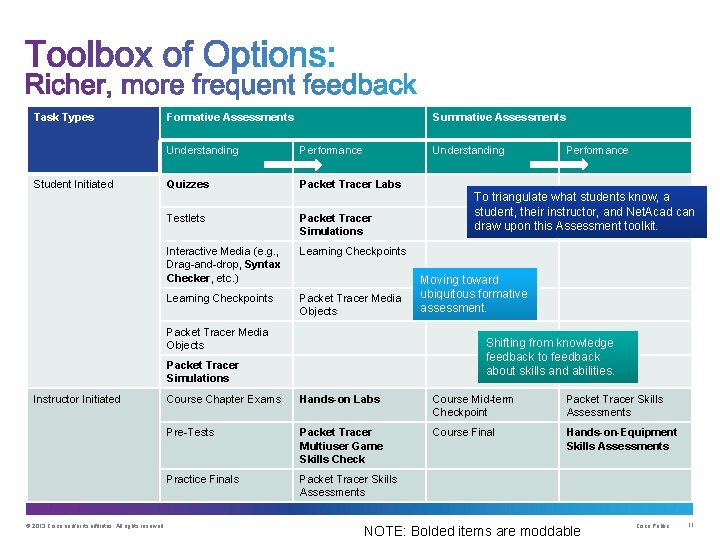
Task Types Student Initiated Formative Assessments Summative Assessments Understanding Performance Understanding Quizzes Packet Tracer Labs Testlets Packet Tracer Simulations Interactive Media (e. g. , Drag-and-drop, Syntax Checker, etc. ) Learning Checkpoints Packet Tracer Media Objects © 2013 Cisco and/or its affiliates. All rights reserved. To triangulate what students know, a student, their instructor, and Net. Acad can draw upon this Assessment toolkit. Moving toward ubiquitous formative assessment. Shifting from knowledge feedback to feedback about skills and abilities. Packet Tracer Simulations Instructor Initiated Performance Course Chapter Exams Hands-on Labs Course Mid-term Checkpoint Packet Tracer Skills Assessments Pre-Tests Packet Tracer Multiuser Game Skills Check Course Final Hands-on-Equipment Skills Assessments Practice Finals Packet Tracer Skills Assessments NOTE: Bolded items are moddable Cisco Public 11
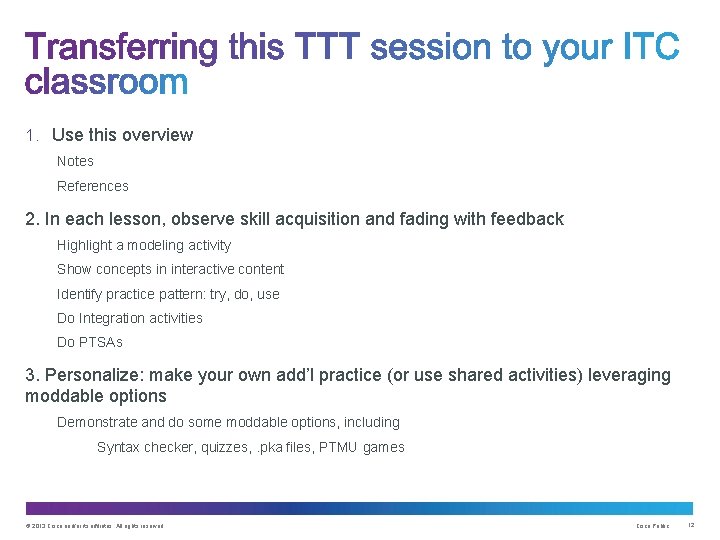
1. Use this overview Notes References 2. In each lesson, observe skill acquisition and fading with feedback Highlight a modeling activity Show concepts in interactive content Identify practice pattern: try, do, use Do Integration activities Do PTSAs 3. Personalize: make your own add’l practice (or use shared activities) leveraging moddable options Demonstrate and do some moddable options, including Syntax checker, quizzes, . pka files, PTMU games © 2013 Cisco and/or its affiliates. All rights reserved. Cisco Public 12
Thank you.
Chapter(s) Modeling: Student building their understanding of concepts & behaviors Contextual within course flow Media / PT Unit 2 Unit 1 Worked Example Remember Worked Example Media Partial Worked Example Mastery builds within chapters and across chapters. Media / PT Partial Worked Example Understand Partial Worked Example Media / PT Problem Solving Trouble. Shooting PT / Lab Skill Acquisition – increasingly openended activities Apply Problem Solving Analyze Trouble. Shooting Evaluate Unit Quiz Integration: across pre-requisite knowledge Chapter Quiz Chapter Exam Contextual within course flow PT / Lab Create
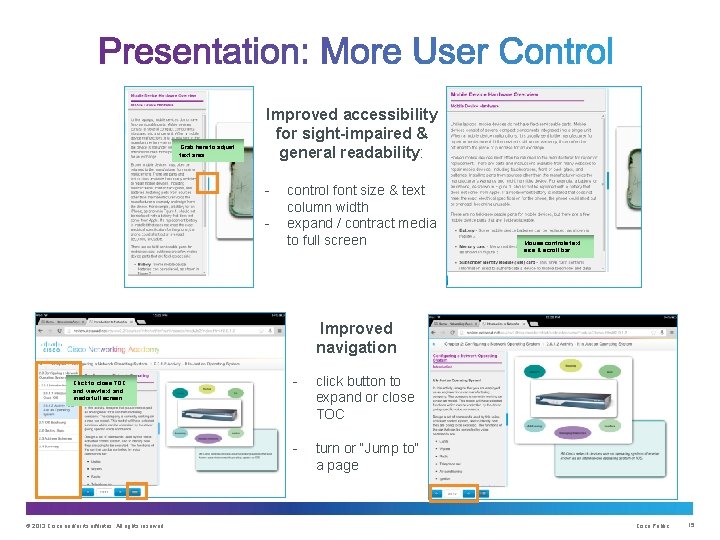
Grab here to adjust text area Improved accessibility for sight-impaired & general readability: - control font size & text column width expand / contract media to full screen Mouse controls text size & scroll bar Improved navigation Click to close TOC and view text and media full screen © 2013 Cisco and/or its affiliates. All rights reserved. - click button to expand or close TOC - turn or “Jump to” a page Cisco Public 15
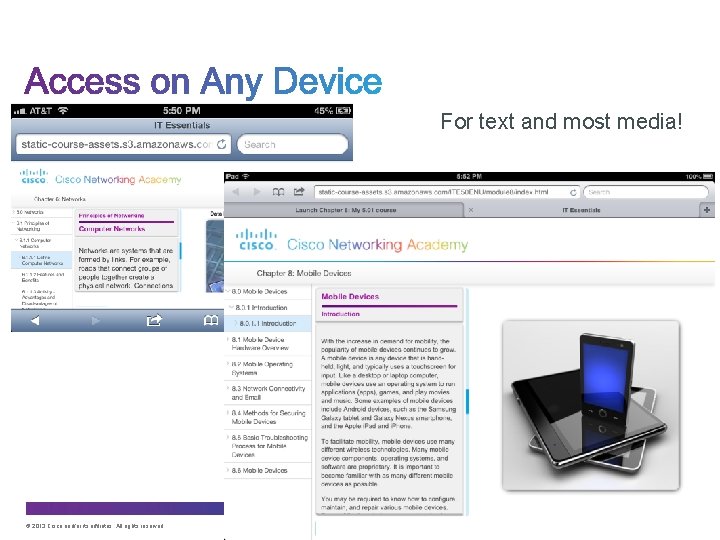
For text and most media! © 2013 Cisco and/or its affiliates. All rights reserved. Cisco Public 16
• Anderson, Terry. (2008). Theory and Practice of Online Learning (second edition). Edmonton, AB, CAN: Athabasca University Press. • Atkinson, R. , & Renkl, A. (2003). Structuring the Transition From Example Study to Problem Solving in Cognitive Skill Acquisition: A Cognitive Load Perspective. Educational Psychologist, 38(1), 15 -22. • Barrows, H. S. , & Tamblyn, R. (1976) An evaluation of problem-based learning in small groups using a simulated patient. Journal of Medical Education, 51(1), 52 -54. • Brooks, J. (2002). Schooling for Life: Reclaiming the Essence of Learning. Alexandria, VA, USA: Association for Supervision & Curriculum Development. • Brooks, J. , & Brooks, M. (1999). In Search of Understanding: The Case for Constructivist Classrooms, with a new introduction by the authors. Alexandria, VA, USA: Association for Supervision & Curriculum Development. • Carlile, O. , Jordan, A. , & Stack, A. (2008). Approaches to Learning: A Guide for Teachers. Berkshire, GBR: Open University Press. • Clark, D. R. (2010). Bloom's Taxonomy of Learning Domains. Retrieved Aug 25, 2012 from http: //www. nwlink. com/~donclark/hrd/bloom. html. • Gingell, J. , & Winch, C. (1999). Key Concepts in the Philosophy of Education. Florence, KY, USA: Routledge. • Howell, C. , & Savin-Baden, M. (2004). Foundations of Problem Based Learning. Berkshire, GBR: Mc. Graw-Hill Education. • Kirsner, K. , & Speelman, C. (2005). Beyond the Learning Curve: The Construction of Mind. Oxford, GBR: Oxford University Press, UK. • Van. Lehn, K. (1996). Cognitive Skill Acquisition. Annual Review of Psychology, 55(1), 513 -539. © 2013 Cisco and/or its affiliates. All rights reserved. Cisco Public 17