
CCNA 1 Chapter 6 Part 1 Ethernet Technologies
- Slides: 20
CCNA 1 Chapter 6, Part 1 Ethernet Technologies By Your Name Copyright 2003 www. ciscopress. com
Objectives • 10 Mbps and 100 Mbps • 1000 Mbps and Gigabit Ethernet Copyright 2003 www. ciscopress. com
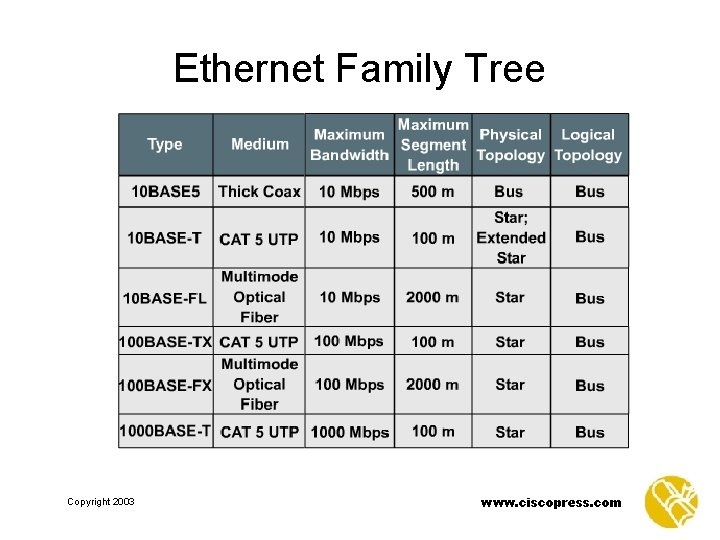
Ethernet Family Tree Copyright 2003 www. ciscopress. com
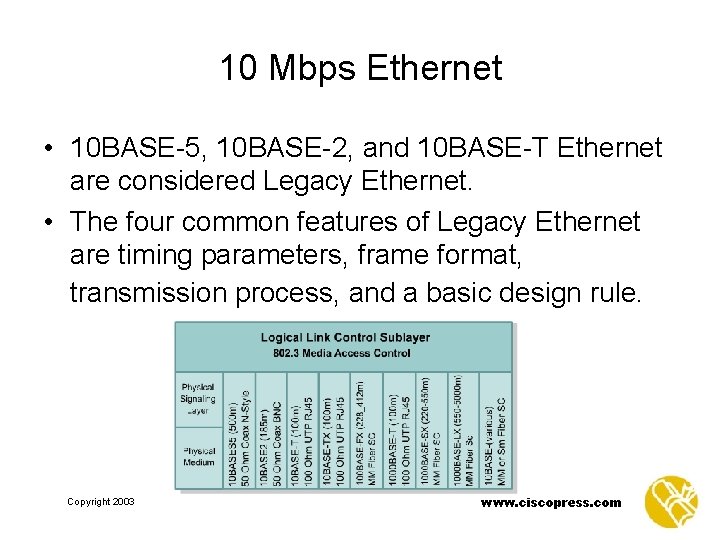
10 Mbps Ethernet • 10 BASE-5, 10 BASE-2, and 10 BASE-T Ethernet are considered Legacy Ethernet. • The four common features of Legacy Ethernet are timing parameters, frame format, transmission process, and a basic design rule. Copyright 2003 www. ciscopress. com
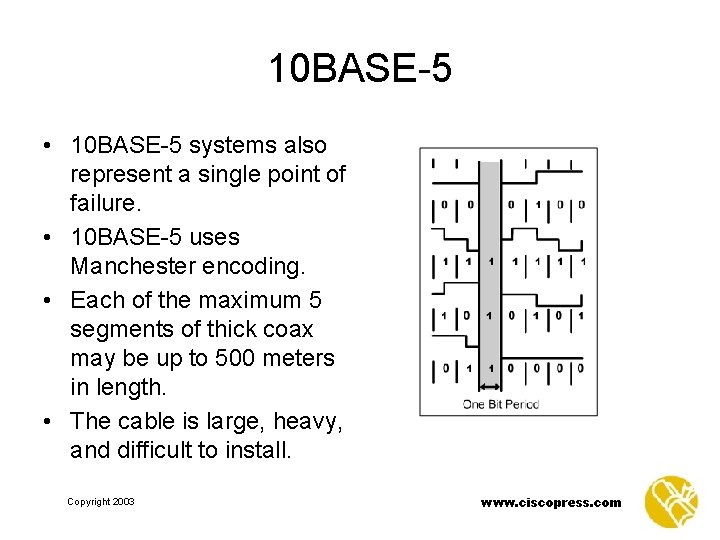
10 BASE-5 • 10 BASE-5 systems also represent a single point of failure. • 10 BASE-5 uses Manchester encoding. • Each of the maximum 5 segments of thick coax may be up to 500 meters in length. • The cable is large, heavy, and difficult to install. Copyright 2003 www. ciscopress. com
10 BASE-2 • 10 BASE-2 also uses Manchester encoding. • Only 1 station can transmit at a time; otherwise a collision will occur. • It uses half duplex. • The maximum transmission rate is 10 Mbps. • There may be up to 30 stations on any individual 10 BASE-2 segment. Copyright 2003 www. ciscopress. com
10 BASE-T • 10 BASE-T also uses Manchester encoding. • 10 BASE-T uses cheaper and easier-to-install Category 3 unshielded twisted-pair (UTP) copper cable rather than coax cable. • Half duplex or full duplex is a configuration choice. • 10 BASE-T carries 10 Mbps of traffic in halfduplex mode and 20 Mbps in full-duplex mode. Copyright 2003 www. ciscopress. com
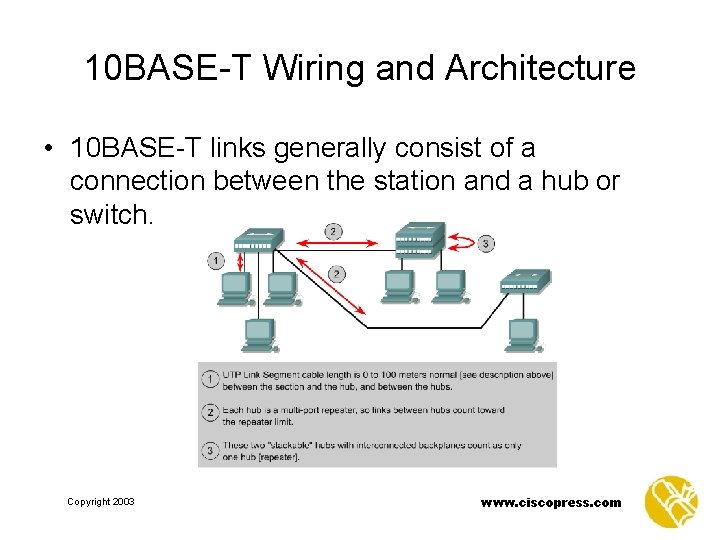
10 BASE-T Wiring and Architecture • 10 BASE-T links generally consist of a connection between the station and a hub or switch. Copyright 2003 www. ciscopress. com
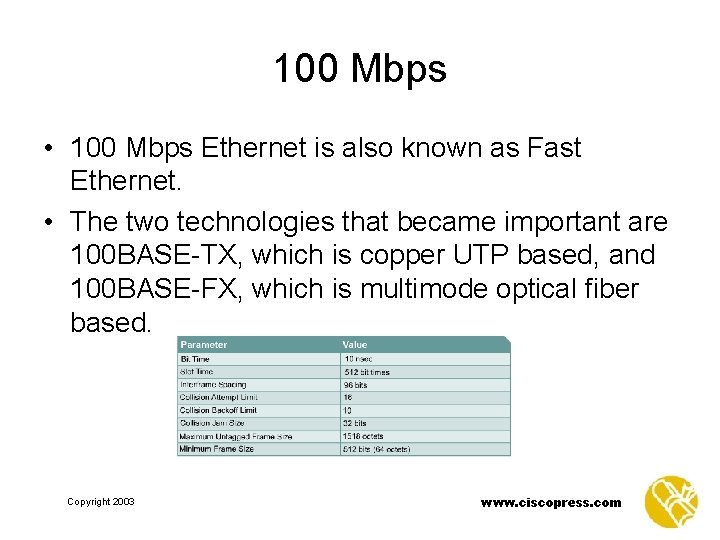
100 Mbps • 100 Mbps Ethernet is also known as Fast Ethernet. • The two technologies that became important are 100 BASE-TX, which is copper UTP based, and 100 BASE-FX, which is multimode optical fiber based. Copyright 2003 www. ciscopress. com
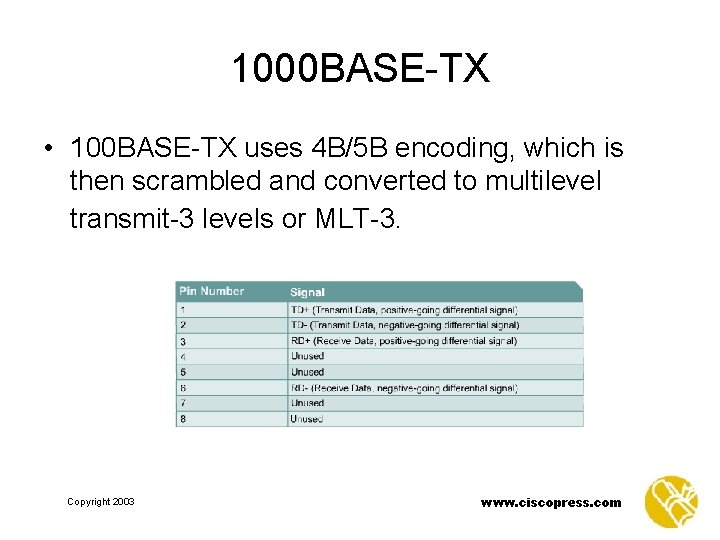
1000 BASE-TX • 100 BASE-TX uses 4 B/5 B encoding, which is then scrambled and converted to multilevel transmit-3 levels or MLT-3. Copyright 2003 www. ciscopress. com
1000 BASE-FX • A fiber version desired for backbone applications as well as connections between floors and buildings where copper is less desirable, and also in high noise environments Copyright 2003 www. ciscopress. com
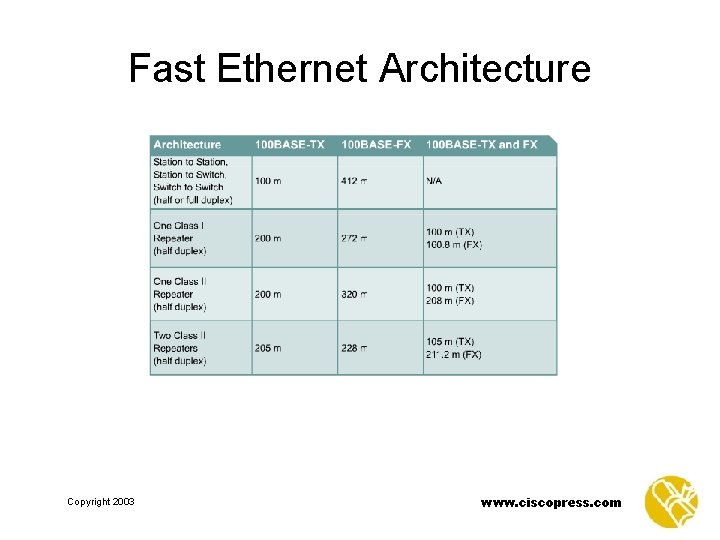
Fast Ethernet Architecture Copyright 2003 www. ciscopress. com
1000 Mbps and 10 Gigabit Ethernet Copyright 2003 www. ciscopress. com
1000 Mbps Ethernet • The 1000 Mbps Ethernet or Gigabit Ethernet standards represent transmission using both fiber and copper media. • The 1000 BASE-X standard (IEEE 802. 3 z) specifies a 1 -Gbps full duplex over optical fiber. • The 1000 BASE-T standard (IEEE 802. 3 ab) uses a media of Category 5 or higher UTP. • 1000 BASE-TX, 1000 BASE-SX, and 1000 BASELX use the same timing parameters. Copyright 2003 www. ciscopress. com
1000 BASE-T • 1000 BASE-T standard is interoperable with 10 BASE-T and 100 BASE-TX. • 1000 BASE-T uses all 4 pairs of wires instead of the traditional 2 pairs of wires used by 10 BASET and 100 BASE-TX. – This provides 250 Mbps per pair. With all 4 wire pairs, this provides the desired 1000 Mbps. Copyright 2003 www. ciscopress. com
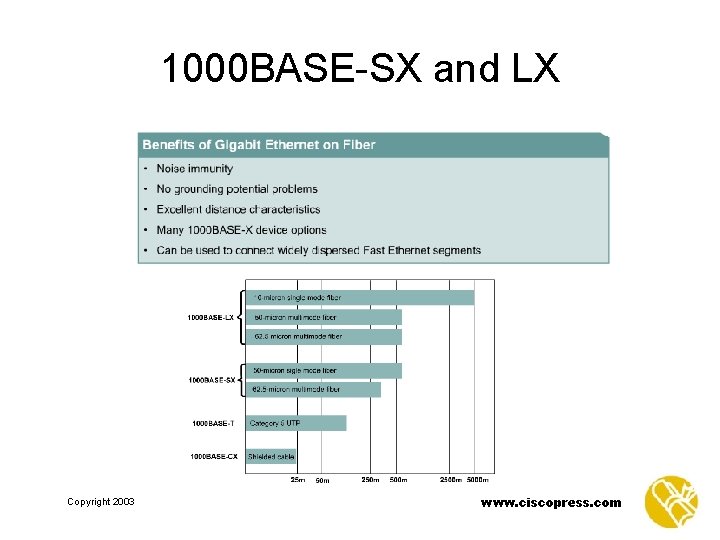
1000 BASE-SX and LX Copyright 2003 www. ciscopress. com
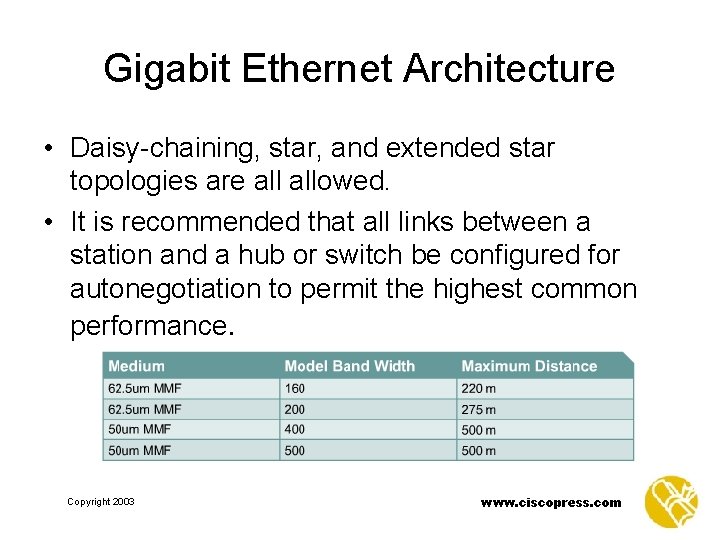
Gigabit Ethernet Architecture • Daisy-chaining, star, and extended star topologies are allowed. • It is recommended that all links between a station and a hub or switch be configured for autonegotiation to permit the highest common performance. Copyright 2003 www. ciscopress. com
10 Gigabit Ethernet • IEEE 802. 3 ae was adapted to include 10 -Gbps full-duplex transmission over fiber-optic cable. • When usingle-mode fiber as the transmission medium, the maximum transmission distance is 40 kilometers (25 miles). • Some discussions between IEEE members have begun that suggest the possibility of standards for 40 -, 80 -, and even 100 -Gbps Ethernet. Copyright 2003 www. ciscopress. com
10 Gigabit Ethernet Architectures • 10 Gigabit Ethernet uses two separate encoding steps. • The encoded data provides synchronization, efficient usage of bandwidth, and improved signal-to-noise ratio characteristics. • All 10 Gb. E varieties use optical fiber media. Copyright 2003 www. ciscopress. com
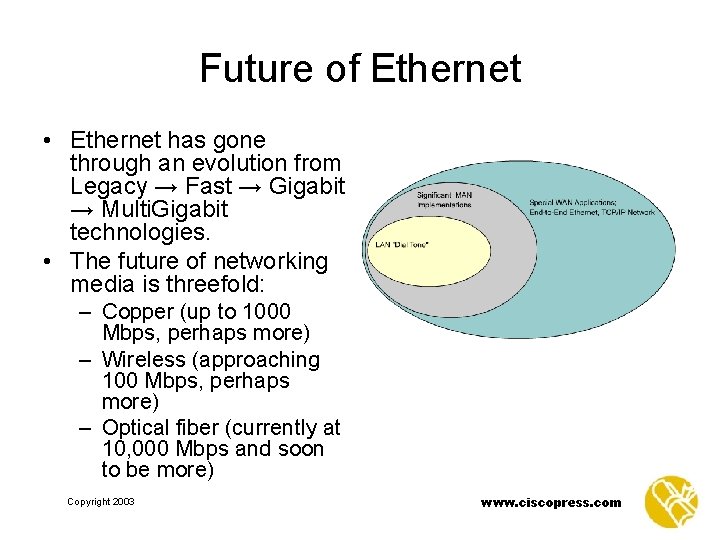
Future of Ethernet • Ethernet has gone through an evolution from Legacy → Fast → Gigabit → Multi. Gigabit technologies. • The future of networking media is threefold: – Copper (up to 1000 Mbps, perhaps more) – Wireless (approaching 100 Mbps, perhaps more) – Optical fiber (currently at 10, 000 Mbps and soon to be more) Copyright 2003 www. ciscopress. com