
CCET Waste Management Strategy Development Consultation and Formulation
- Slides: 31
CCET Waste Management Strategy Development: Consultation and Formulation Process Matthew Hengesbaugh, Policy Researcher IGES Sustainable Consumption and Production Area Mainstreaming Disaster Waste Management Symposium Osaka City Government/UNEP-IETC 14 February 2017 11
Presentation Outline 1. Background: WM Challenges 2. IGES-UNEP Collaborating Centre on Environmental Technologies (CCET) 3. Strategy Formulation in Myanmar and Cambodia 22
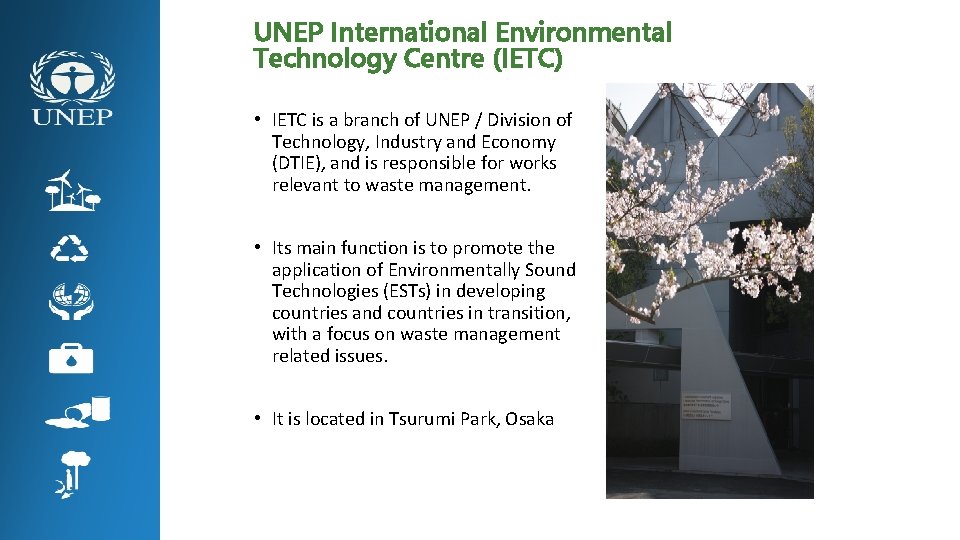
3 3 Institute of Global Environmental Strategies • Founded in 1998 under the initiative of Japanese government and with the support of Kanagawa Prefecture. • Purpose: To conduct innovative policy development and strategic research for environmental measures, reflecting the results of research into political decisions for realizing sustainable development both in the Asia-Pacific region and globally. • HQ:Hayama, Kanagawa Pref. • Employees: 175 > Researchers 100 > Foreign Researchers 42% • Ranked as 38 th out of 6, 500 research institutions across the globe. (2014, Univ. Pennsylvania) • 15/210 in Climate Change Research(2013)
UNEP International Environmental Technology Centre (IETC) • IETC is a branch of UNEP / Division of Technology, Industry and Economy (DTIE), and is responsible for works relevant to waste management. • Its main function is to promote the application of Environmentally Sound Technologies (ESTs) in developing countries and countries in transition, with a focus on waste management related issues. • It is located in Tsurumi Park, Osaka
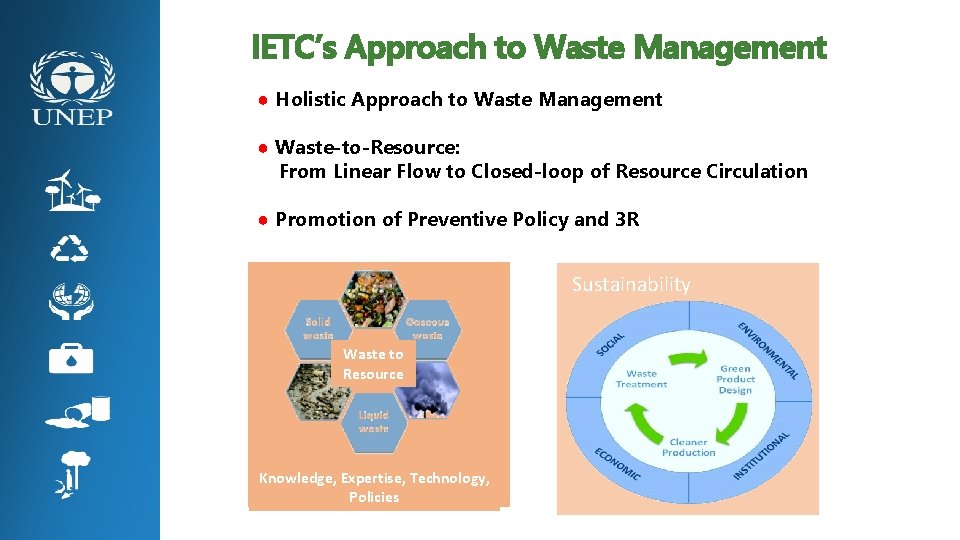
IETC’s Approach to Waste Management ● Holistic Approach to Waste Management ● Waste-to-Resource: From Linear Flow to Closed-loop of Resource Circulation ● Promotion of Preventive Policy and 3 R Sustainability Waste to Resource Knowledge, Expertise, Technology, Policies
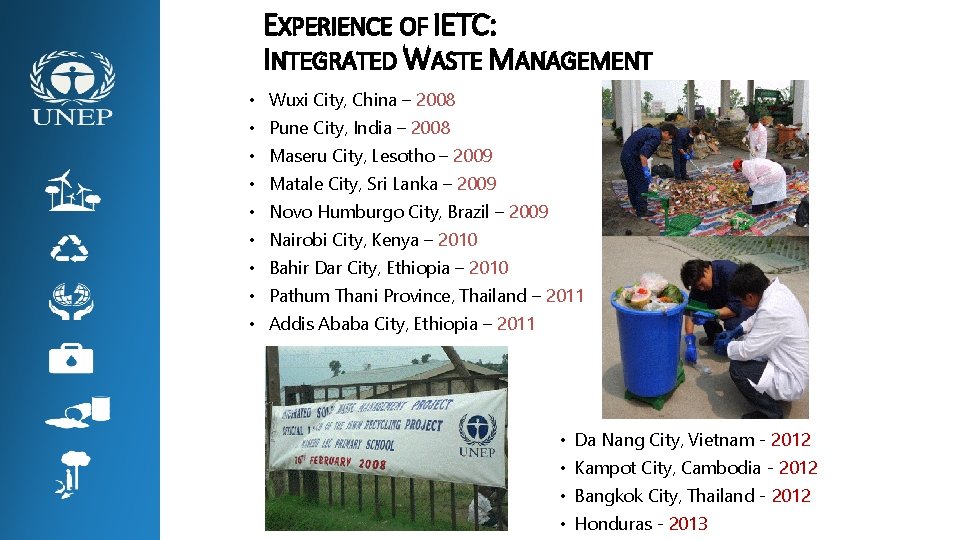
EXPERIENCE OF IETC: INTEGRATED WASTE MANAGEMENT • Wuxi City, China – 2008 • Pune City, India – 2008 • Maseru City, Lesotho – 2009 • Matale City, Sri Lanka – 2009 • Novo Humburgo City, Brazil – 2009 • Nairobi City, Kenya – 2010 • Bahir Dar City, Ethiopia – 2010 • Pathum Thani Province, Thailand – 2011 • Addis Ababa City, Ethiopia – 2011 • Da Nang City, Vietnam - 2012 • Kampot City, Cambodia - 2012 • Bangkok City, Thailand - 2012 • Honduras - 2013
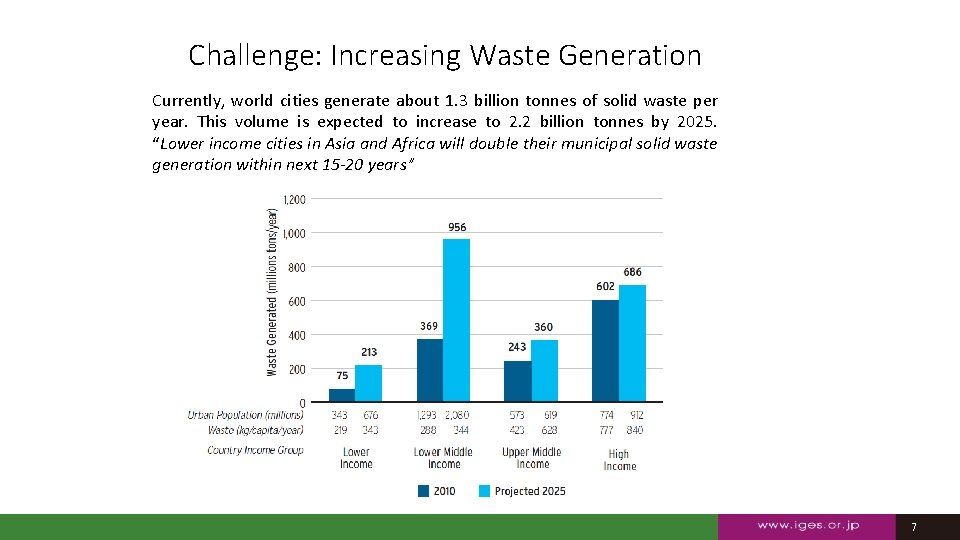
Challenge: Increasing Waste Generation Currently, world cities generate about 1. 3 billion tonnes of solid waste per year. This volume is expected to increase to 2. 2 billion tonnes by 2025. “Lower income cities in Asia and Africa will double their municipal solid waste generation within next 15 -20 years” 77
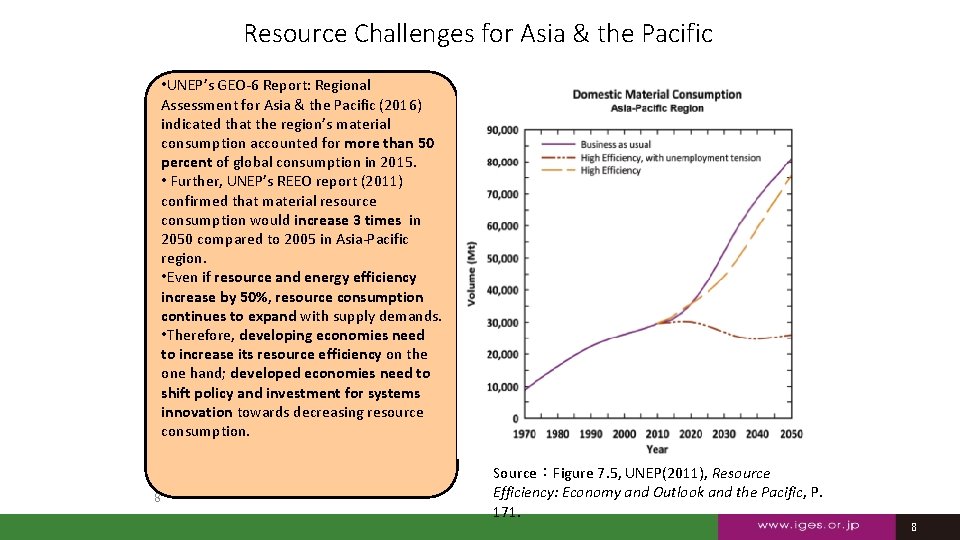
Resource Challenges for Asia & the Pacific • UNEP’s GEO-6 Report: Regional Assessment for Asia & the Pacific (2016) indicated that the region’s material consumption accounted for more than 50 percent of global consumption in 2015. • Further, UNEP’s REEO report (2011) confirmed that material resource consumption would increase 3 times in 2050 compared to 2005 in Asia-Pacific region. • Even if resource and energy efficiency increase by 50%, resource consumption continues to expand with supply demands. • Therefore, developing economies need to increase its resource efficiency on the one hand; developed economies need to shift policy and investment for systems innovation towards decreasing resource consumption. 8 Source:Figure 7. 5, UNEP(2011), Resource Efficiency: Economy and Outlook and the Pacific, P. 171. 88
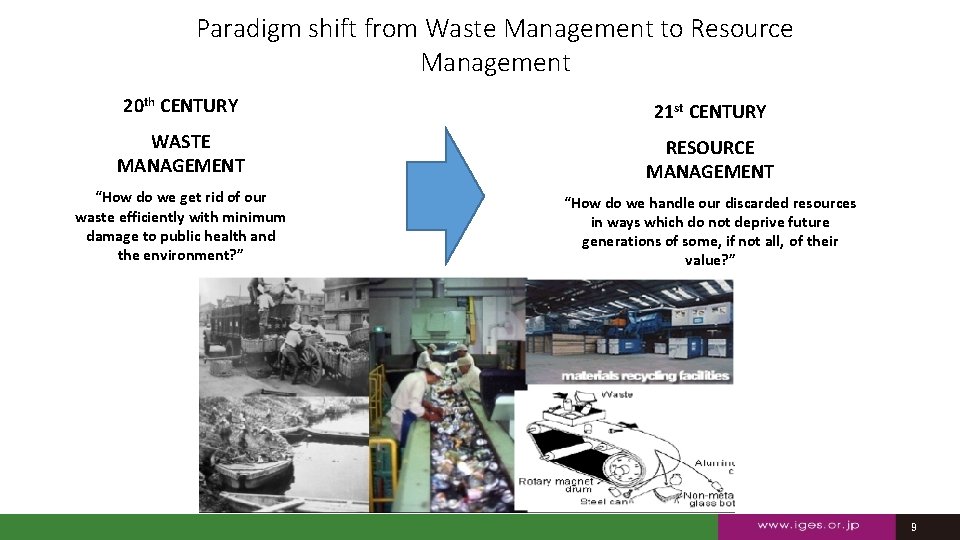
Paradigm shift from Waste Management to Resource Management 20 th CENTURY 21 st CENTURY WASTE MANAGEMENT RESOURCE MANAGEMENT “How do we get rid of our waste efficiently with minimum damage to public health and the environment? ” “How do we handle our discarded resources in ways which do not deprive future generations of some, if not all, of their value? ” 99
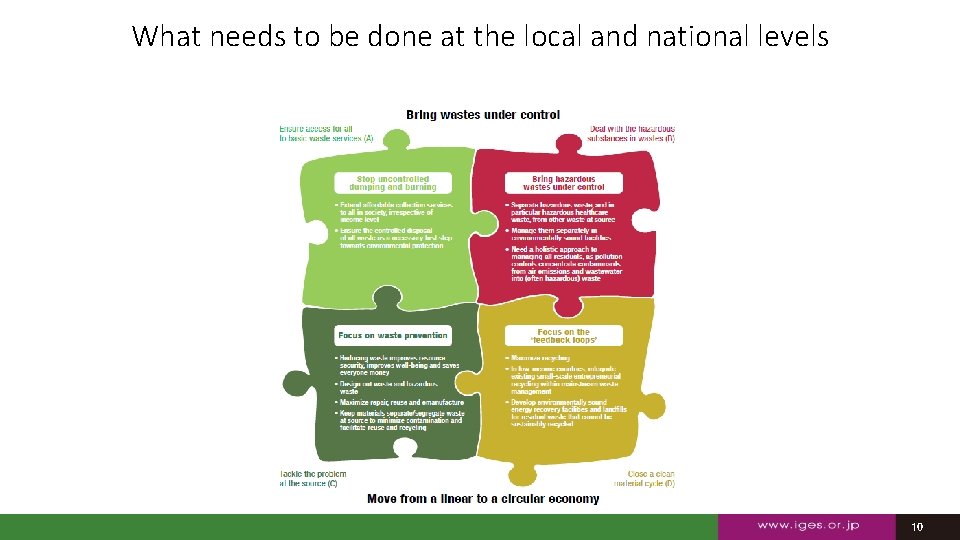
What needs to be done at the local and national levels 10 10
11 11 IGES-UNEP Collaborating Centre on Environmental Technologies (CCET)
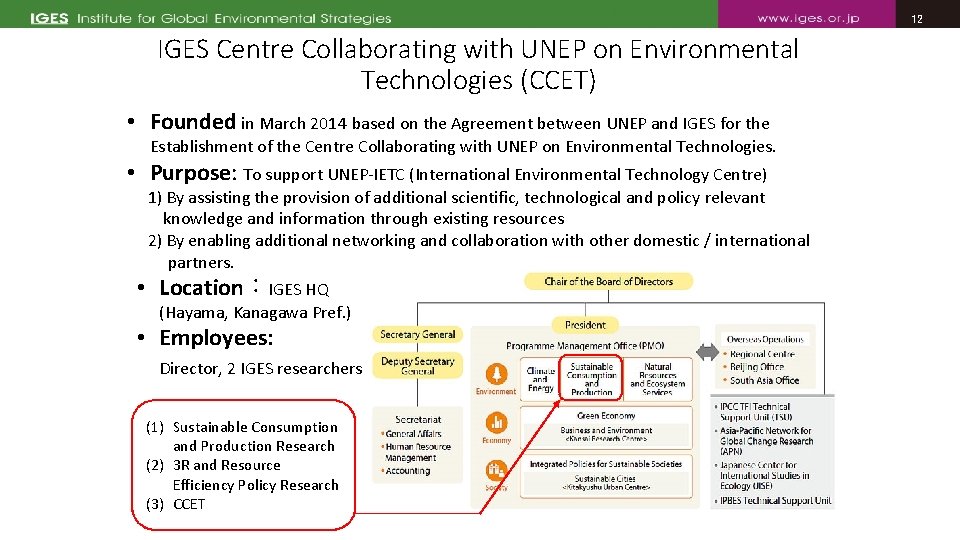
12 12 IGES Centre Collaborating with UNEP on Environmental Technologies (CCET) • Founded in March 2014 based on the Agreement between UNEP and IGES for the Establishment of the Centre Collaborating with UNEP on Environmental Technologies. • Purpose: To support UNEP-IETC (International Environmental Technology Centre) 1) By assisting the provision of additional scientific, technological and policy relevant knowledge and information through existing resources 2) By enabling additional networking and collaboration with other domestic / international partners. • Location:IGES HQ (Hayama, Kanagawa Pref. ) • Employees: Director, 2 IGES researchers (1) Sustainable Consumption and Production Research (2) 3 R and Resource Efficiency Policy Research (3) CCET
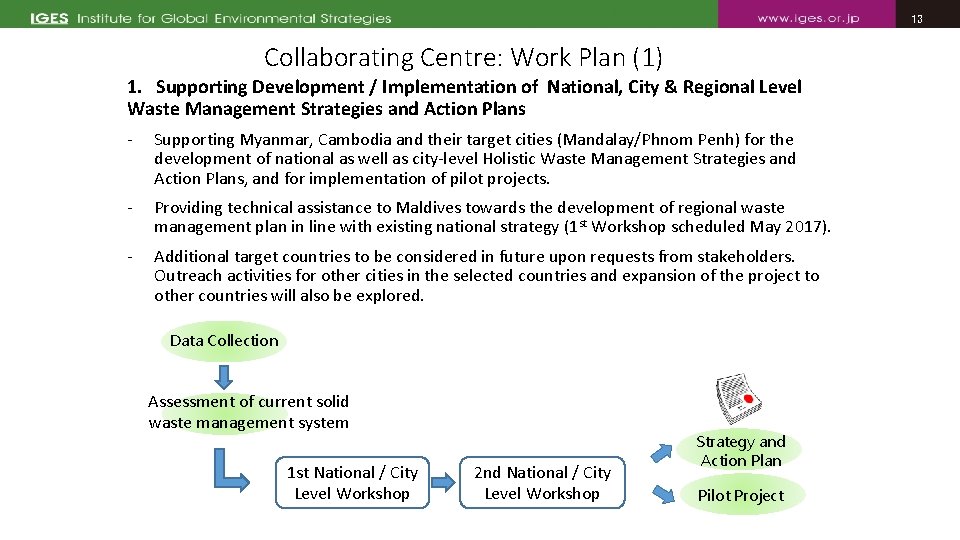
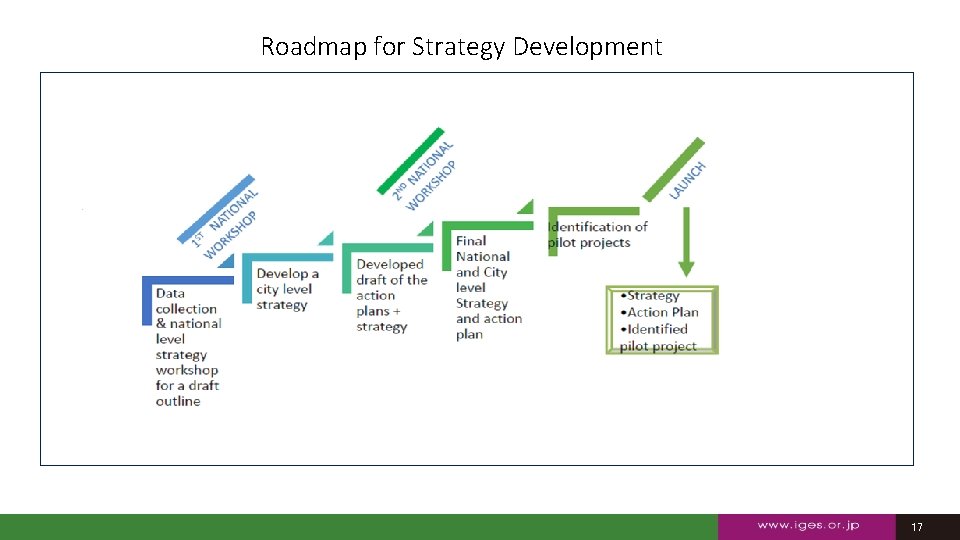
13 13 Collaborating Centre: Work Plan (1) 1. Supporting Development / Implementation of National, City & Regional Level Waste Management Strategies and Action Plans - Supporting Myanmar, Cambodia and their target cities (Mandalay/Phnom Penh) for the development of national as well as city-level Holistic Waste Management Strategies and Action Plans, and for implementation of pilot projects. - Providing technical assistance to Maldives towards the development of regional waste management plan in line with existing national strategy (1 st Workshop scheduled May 2017). - Additional target countries to be considered in future upon requests from stakeholders. Outreach activities for other cities in the selected countries and expansion of the project to other countries will also be explored. Data Collection Assessment of current solid waste management system 1 st National / City Level Workshop 2 nd National / City Level Workshop Strategy and Action Plan Pilot Project
14 14 Collaborating Centre: Work Plan (2) 2.Contribution to development of Knowledge-hub and Curriculum for Waste Management • Collected data, policy information and technical knowledge gained through above activities will be provided to IETC as the contribution to its Waste Management Knowledge-hub. Centre will provide case study materials for the curriculum IETC plans to develop in collaboration with Kyoto University, Asian Institute of Technology (Thailand), Tongji University (China), TERI University (India), and University of New South Wales (Australia). The Centre will also conduct workshops.
15 15 Collaborating Centre: Work Plan (3) 3.Supporting IETC’s Outreach • In order to support IETC’s outreach effort to relevant stakeholders in Japan, the Centre will provide assistance through organizing its own event(s) in Japan, setting-up exhibition booth in relevant events, engage in publicity, organizing websites, and providing Japanese contents. • The Agreement between UNEP and IGES stipulates that CCET can also engage in projects partly or entirely financed by external funding, in addition to the projects mandated by the above Project Cooperation Agreement (PCA). The Center will also seek the possibility of conducting projects financed by government agencies, development assistance institutions, international organizations and private parties.
Strategy Formulation Process 16 16
Roadmap for Strategy Development 17 17
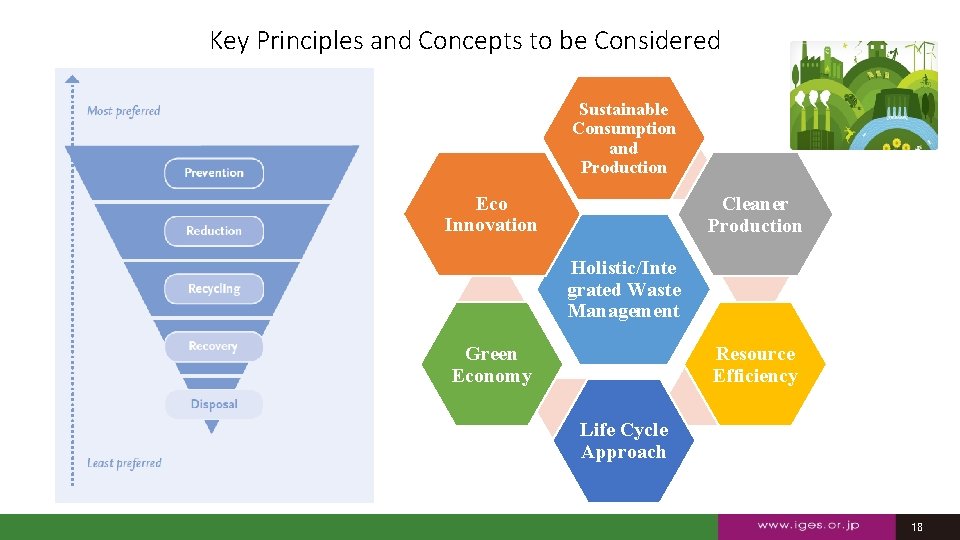
Key Principles and Concepts to be Considered Sustainable Consumption and Production Eco Innovation Cleaner Production Holistic/Inte grated Waste Management Resource Efficiency Green Economy Life Cycle Approach 18 18
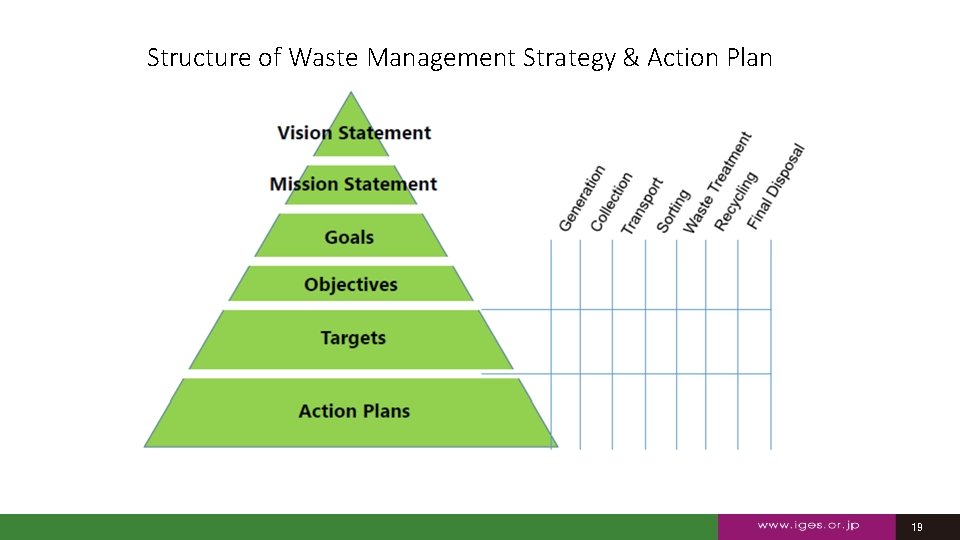
Structure of Waste Management Strategy & Action Plan 19 19
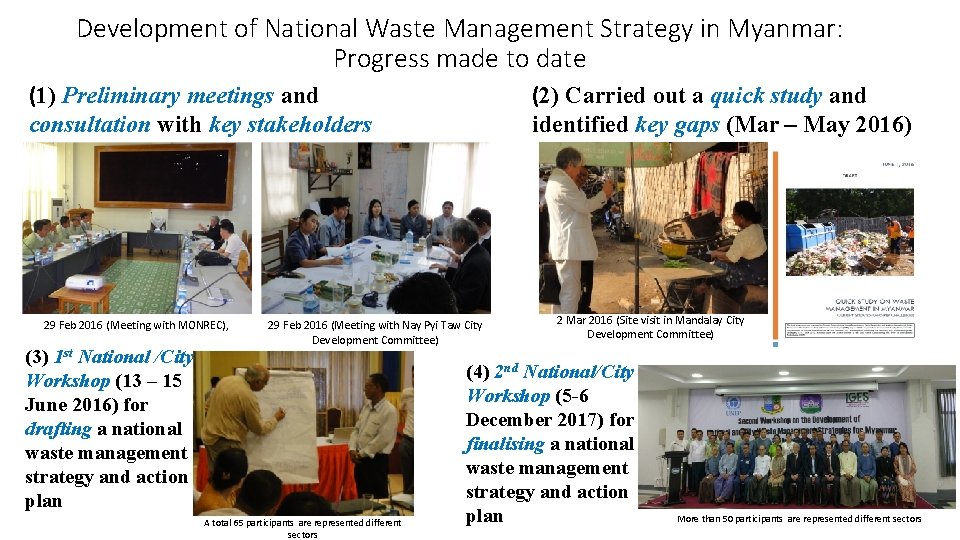
Development of National Waste Management Strategy in Myanmar: Progress made to date (1) Preliminary meetings and consultation with key stakeholders 29 Feb 2016 (Meeting with MONREC), (3) 1 st National /City Workshop (13 – 15 June 2016) for drafting a national waste management strategy and action plan (2) Carried out a quick study and identified key gaps (Mar – May 2016) 29 Feb 2016 (Meeting with Nay Pyi Taw City Development Committee) A total 65 participants are represented different sectors 2 Mar 2016 (Site visit in Mandalay City Development Committee) (4) 2 nd National/City Workshop (5 -6 December 2017) for finalising a national waste management strategy and action plan More than 50 participants are represented different sectors
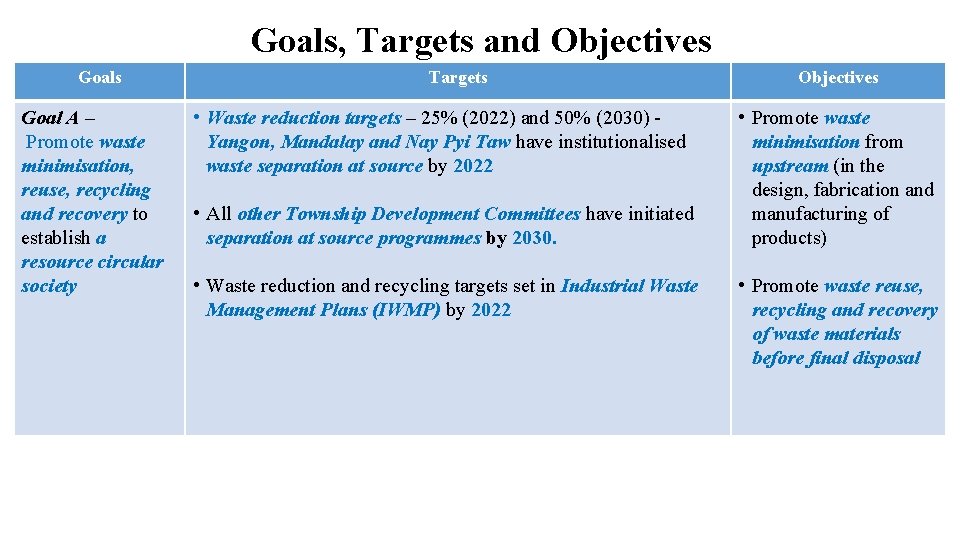
Goals, Targets and Objectives Goal A – Promote waste minimisation, reuse, recycling and recovery to establish a resource circular society Targets • Waste reduction targets – 25% (2022) and 50% (2030) Yangon, Mandalay and Nay Pyi Taw have institutionalised waste separation at source by 2022 • All other Township Development Committees have initiated separation at source programmes by 2030. • Waste reduction and recycling targets set in Industrial Waste Management Plans (IWMP) by 2022 Objectives • Promote waste minimisation from upstream (in the design, fabrication and manufacturing of products) • Promote waste reuse, recycling and recovery of waste materials before final disposal
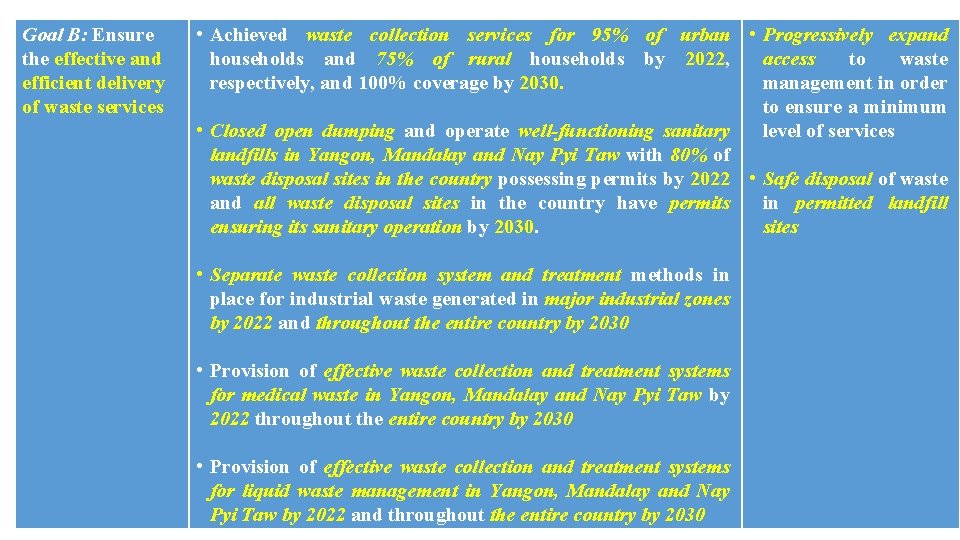
Goal B: Ensure the effective and efficient delivery of waste services • Achieved waste collection services for 95% of urban • Progressively expand households and 75% of rural households by 2022, access to waste respectively, and 100% coverage by 2030. management in order to ensure a minimum • Closed open dumping and operate well-functioning sanitary level of services landfills in Yangon, Mandalay and Nay Pyi Taw with 80% of waste disposal sites in the country possessing permits by 2022 • Safe disposal of waste and all waste disposal sites in the country have permits in permitted landfill ensuring its sanitary operation by 2030. sites • Separate waste collection system and treatment methods in place for industrial waste generated in major industrial zones by 2022 and throughout the entire country by 2030 • Provision of effective waste collection and treatment systems for medical waste in Yangon, Mandalay and Nay Pyi Taw by 2022 throughout the entire country by 2030 • Provision of effective waste collection and treatment systems for liquid waste management in Yangon, Mandalay and Nay Pyi Taw by 2022 and throughout the entire country by 2030
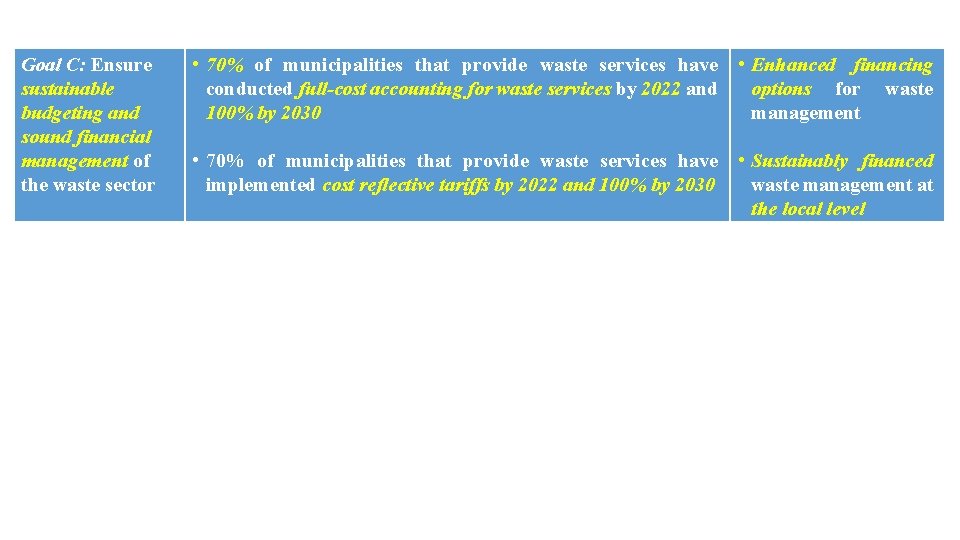
Goal C: Ensure sustainable budgeting and sound financial management of the waste sector • 70% of municipalities that provide waste services have • Enhanced financing conducted full-cost accounting for waste services by 2022 and options for waste 100% by 2030 management • 70% of municipalities that provide waste services have • Sustainably financed implemented cost reflective tariffs by 2022 and 100% by 2030 waste management at the local level
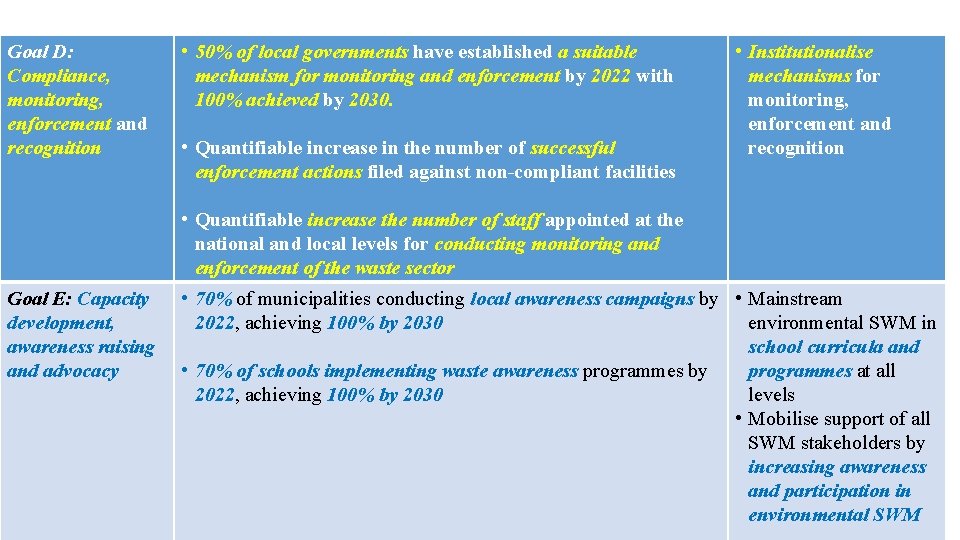
Goal D: Compliance, monitoring, enforcement and recognition • 50% of local governments have established a suitable mechanism for monitoring and enforcement by 2022 with 100% achieved by 2030. • Quantifiable increase in the number of successful enforcement actions filed against non-compliant facilities • Institutionalise mechanisms for monitoring, enforcement and recognition • Quantifiable increase the number of staff appointed at the national and local levels for conducting monitoring and enforcement of the waste sector Goal E: Capacity development, awareness raising and advocacy • 70% of municipalities conducting local awareness campaigns by • Mainstream 2022, achieving 100% by 2030 environmental SWM in school curricula and • 70% of schools implementing waste awareness programmes by programmes at all 2022, achieving 100% by 2030 levels • Mobilise support of all SWM stakeholders by increasing awareness and participation in environmental SWM
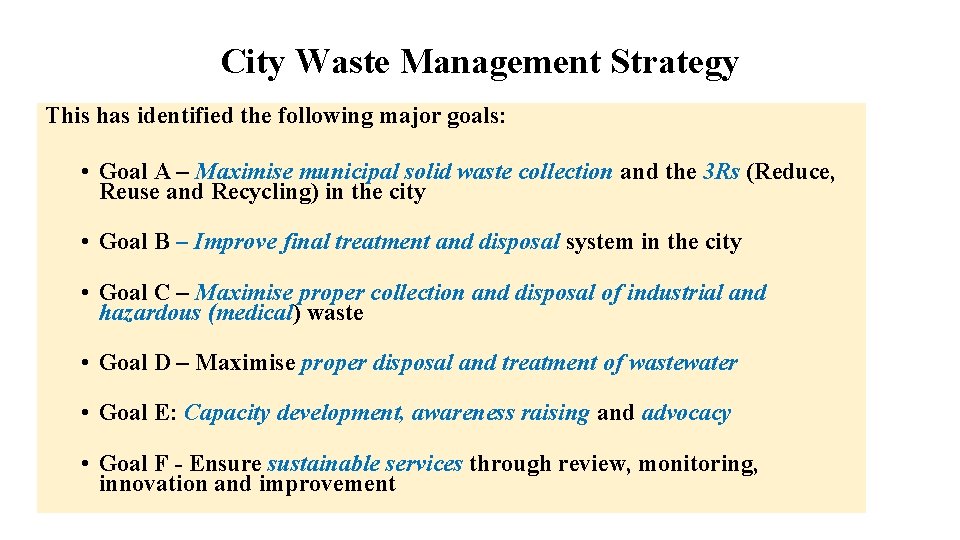
City Waste Management Strategy This has identified the following major goals: • Goal A – Maximise municipal solid waste collection and the 3 Rs (Reduce, Reuse and Recycling) in the city • Goal B – Improve final treatment and disposal system in the city • Goal C – Maximise proper collection and disposal of industrial and hazardous (medical) waste • Goal D – Maximise proper disposal and treatment of wastewater • Goal E: Capacity development, awareness raising and advocacy • Goal F - Ensure sustainable services through review, monitoring, innovation and improvement
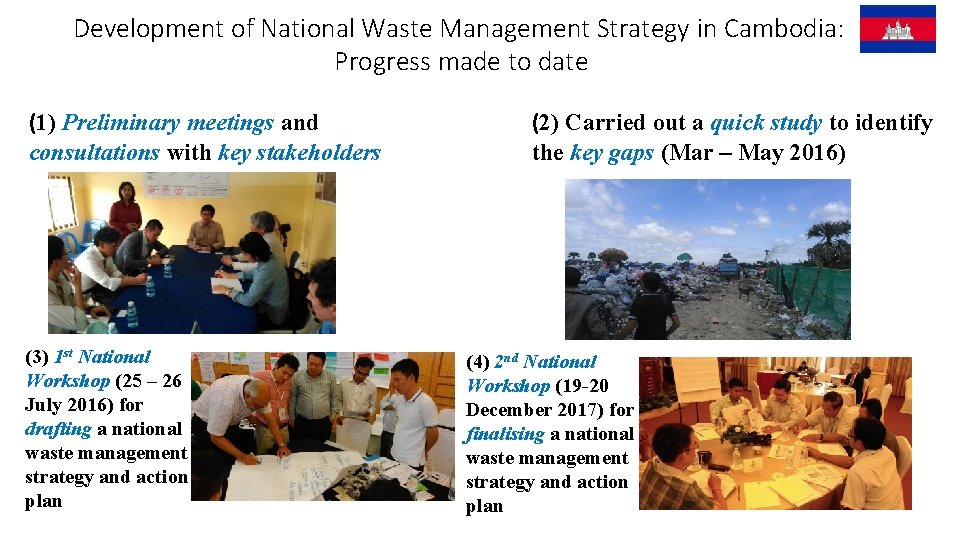
Development of National Waste Management Strategy in Cambodia: Progress made to date (1) Preliminary meetings and consultations with key stakeholders (3) 1 st National Workshop (25 – 26 July 2016) for drafting a national waste management strategy and action plan (2) Carried out a quick study to identify the key gaps (Mar – May 2016) (4) 2 nd National Workshop (19 -20 December 2017) for finalising a national waste management strategy and action plan
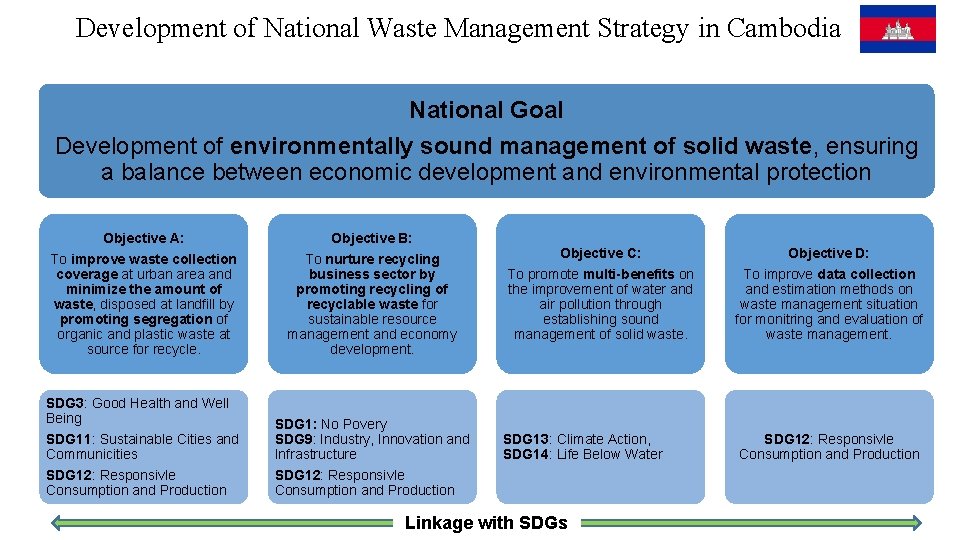
Development of National Waste Management Strategy in Cambodia National Goal Development of environmentally sound management of solid waste, ensuring a balance between economic development and environmental protection Objective A: Objective B: To improve waste collection coverage at urban area and minimize the amount of waste, disposed at landfill by promoting segregation of organic and plastic waste at source for recycle. To nurture recycling business sector by promoting recycling of recyclable waste for sustainable resource management and economy development. SDG 3: Good Health and Well Being SDG 11: Sustainable Cities and Communicities SDG 12: Responsivle Consumption and Production SDG 1: No Povery SDG 9: Industry, Innovation and Infrastructure SDG 12: Responsivle Consumption and Production Objective C: Objective D: To promote multi-benefits on the improvement of water and air pollution through establishing sound management of solid waste. To improve data collection and estimation methods on waste management situation for monitring and evaluation of waste management. SDG 13: Climate Action, SDG 14: Life Below Water Linkage with SDGs SDG 12: Responsivle Consumption and Production
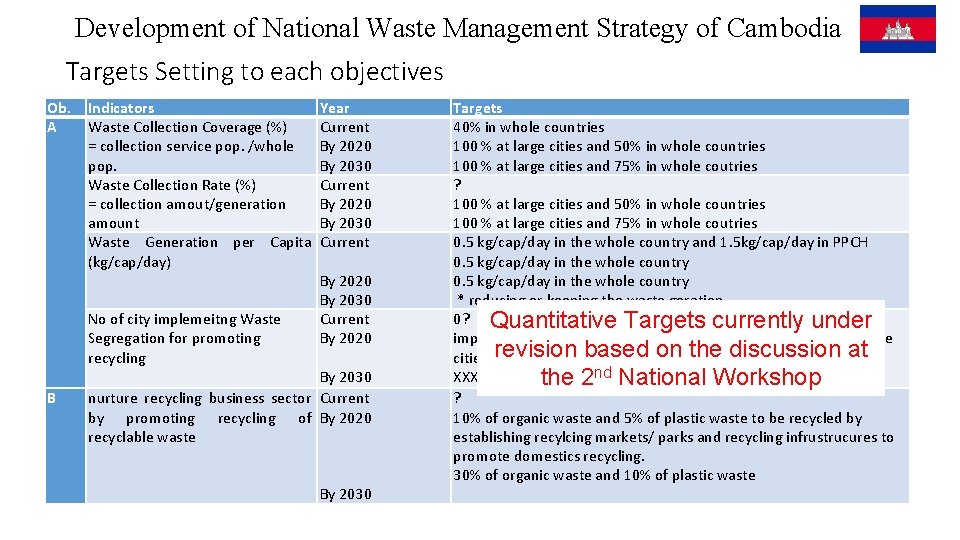
Development of National Waste Management Strategy of Cambodia Targets Setting to each objectives Ob. A B Indicators Year Waste Collection Coverage (%) Current = collection service pop. /whole By 2020 pop. By 2030 Waste Collection Rate (%) Current = collection amout/generation By 2020 amount By 2030 Waste Generation per Capita Current (kg/cap/day) By 2020 By 2030 No of city implemeitng Waste Current Segregation for promoting By 2020 recycling By 2030 nurture recycling business sector Current by promoting recycling of By 2020 recyclable waste By 2030 Targets 40% in whole countries 100 % at large cities and 50% in whole countries 100 % at large cities and 75% in whole coutries ? 100 % at large cities and 50% in whole countries 100 % at large cities and 75% in whole coutries 0. 5 kg/cap/day in the whole country and 1. 5 kg/cap/day in PPCH 0. 5 kg/cap/day in the whole country * reducing or keeping the waste geration 0? Quantitative Targets currently under implementation of the waste separation at source for MSW at large cities revision based on the discussion at XXX the 2 nd National Workshop ? 10% of organic waste and 5% of plastic waste to be recycled by establishing recylcing markets/ parks and recycling infrustrucures to promote domestics recycling. 30% of organic waste and 10% of plastic waste
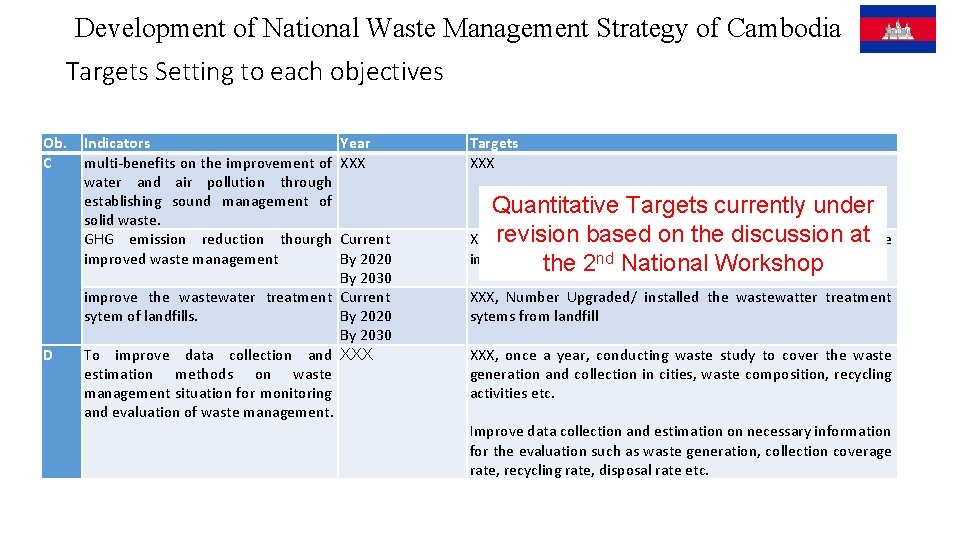
Development of National Waste Management Strategy of Cambodia Targets Setting to each objectives Ob. C D Indicators Year multi-benefits on the improvement of XXX water and air pollution through establishing sound management of solid waste. GHG emission reduction thourgh Current improved waste management By 2020 By 2030 improve the wastewater treatment Current sytem of landfills. By 2020 By 2030 To improve data collection and XXX estimation methods on waste management situation for monitoring and evaluation of waste management. Targets XXX Quantitative Targets currently under revision based on the discussion at XXX, Avoid GHG emission from landfills by reducing oranic waste into uncontrolled landfills. nd National Workshop the 2 XXX, Number Upgraded/ installed the wastewatter treatment sytems from landfill XXX, once a year, conducting waste study to cover the waste generation and collection in cities, waste composition, recycling activities etc. Improve data collection and estimation on necessary information for the evaluation such as waste generation, collection coverage rate, recycling rate, disposal rate etc.
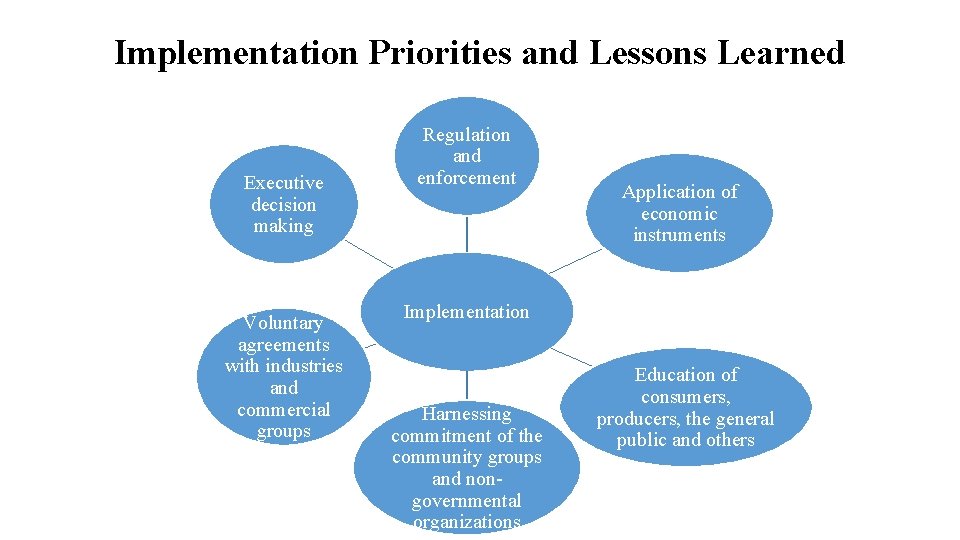
Implementation Priorities and Lessons Learned Executive decision making Voluntary agreements with industries and commercial groups Regulation and enforcement Application of economic instruments Implementation Harnessing commitment of the community groups and nongovernmental organizations Education of consumers, producers, the general public and others
Thank you for your kind attention! 31 31