
CCEA Level 3 Certificate for Classroom Assistant QFC





- Slides: 31
CCEA Level 3 Certificate for Classroom Assistant (QFC) Unit 5 Support Assessment for Learning
House keeping • • • Time 6. 30 – 9. 00 No phones Break 7. 15 – 7. 30 Attendance phone 028 90 315674 Moira Cullen ma. cullen@newstartedu. org. uk Geraldine Telford g. telford@newstartedu. org. uk
Introduction • In Unit 5, learners investigate the purpose of assessment for learning. They explore ways to monitor learner participation and progress by reviewing their strategies and achievements. • Required Reading • Louise Burnham, Brenda Baker (2011). Supporting Teaching and Learning In Schools (Secondary). London: Heinemann. 100 - 111.
Specification at a Glance The table below summarises the structure of this qualification. All SIX units are mandatory Content Assessment Unit 1: Communication and professional relationships with children, young people and adults Portfolio of Evidence with Centre Assessment and External Moderation 2 January and Summer Unit 2: Schools as Organisations Portfolio of Evidence with Centre Assessment and External Moderation 3 January and Summer Unit 3: Understand how to safeguard Portfolio of Evidence with Centre Assessment and the wellbeing of children and young External Moderation people 3 January and Summer Unit 4: Support learning activities Portfolio of Evidence with Centre Assessment and External Moderation 4 January and Summer Unit 5: Support assessment for Unit 5: Support assessment for Portfolio of Evidence with Centre Assessment and External Moderation 4 January and Summer learning Unit 6: Understand child and young person development Credit Value Availability
What is learning and how does it happen?
What is learning and how does it happen? • Learning is something that happens in the mind of the learner … it’s something they do. • We talk about learning as a product – as the outcome of teaching. • Af. L focuses on learning as a process, giving pupils the opportunity to reflect and make sense of their recent learning experiences. • It makes sense that if learning is a process that must happen in the minds of learners, then anything we can do to help them take skilful charge of their learning is a good idea.
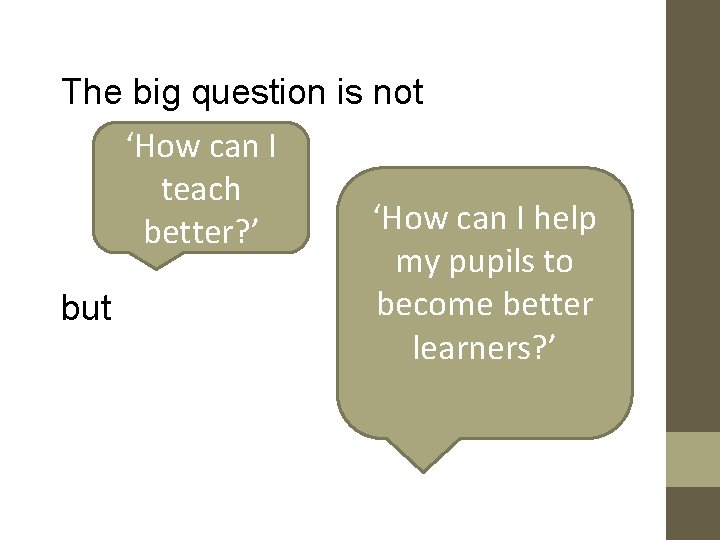
The big question is not ‘How can I teach ‘How can I help better? ’ my pupils to become better but learners? ’
Learning Intentions for this session • You will: • be able to answer the question ‘What is Af. L? ’; • know the pedagogical context for Af. L; • know some of the outcomes of research into Af. L practice in classrooms and across schools; • have an awareness of the key areas of classroom practice associated with Af. L; • know where to access further information.
Unit Learning Outcomes 1. Understand the purpose and characteristics of assessment for learning(Af. L) 2. Be able to use assessment strategies to promote learning 3. Be able to support learners in reviewing their learning strategies and achievements 4. Be able to contribute to reviewing assessment for learning
1. Understand the purpose and characteristics of assessment for learning (Af. L) • 1. 1 Compare and contrast the roles of the teacher and learning support practitioner in assessment of learners’ achievements • 1. 2 Summarise the difference between formative and summative assessment. • 1. 3 Explain the importance and benefits of assessment for learning • 1. 4 Explain how assessment for learning can contribute to planning for future learning carried out by: • (a)the teacher • (b)the learners • (c) the learning support practitioner
1. 1 Compare and contrast the roles of the teacher and learning support practitioner in assessment of learners’ achievements • Role of the teacher: • One of the main responsibilities of the teacher is to monitor and assess pupil achievement. They will need to know how all children in their class are progressing and be able to report back to parents and other staff. • Teachers will plan lessons and schemes of work which should set out clear objectives so that learner progress can be measured. • Role of the learning support practitioner: • Assessment is an ongoing process which will take different forms and the responsibility of the learning support practitioner is to support teachers with the process.
What is Af. L • Assessment for learning is the process of seeking and interpreting evidence for use by learners and their teachers to decide where the learners are in their learning, where they need to go next, and how best to get them there. • - Assessment Reform Group (2002)
What is Af. L Based On? Based on the constructivist view, which says: ‘However neatly we may design, package and deliver learning experiences, in the end learning is a process that is instigated and managed by the learner. It’s the learner who constructs the learning. ’ ‘How can I help my pupils to become better learners? ’
Black and Wiliam's definition of Assessment for Learning: • Any assessment for which the first priority in its design and practice is to serve the purpose of promoting pupil’s learning. “Assessment explicitly designed to promote learning is the single most powerful tool we have for raising achievement. ” Beyond the Black Box, Assessment Reform Group, 1999)
Main Elements • 4 key elements of practice: • a focus on the learning (Learning Intentions Success Criteria) • effective questioning (significance of questioning to improve learning); • formative feedback (feedback that moves learning forward); • scaffolding reflection (developing self-critical, reflective learners Peer- and Self-Assessment and Self-Evaluation).
Activity 2 Answer the following questions
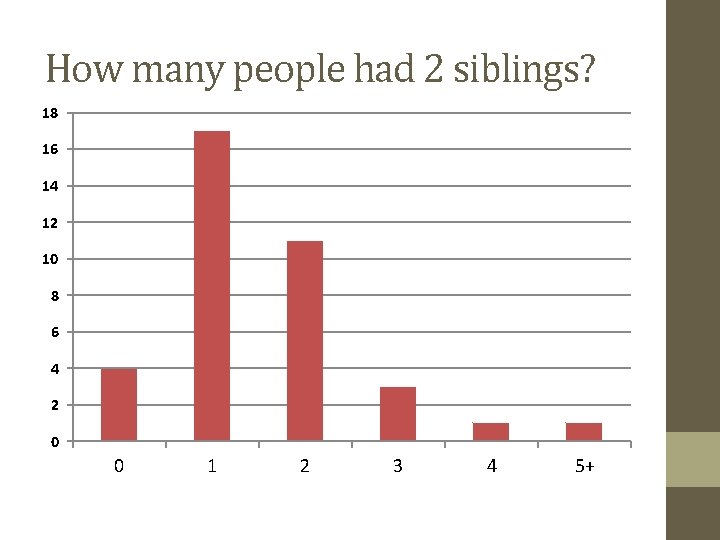
How many people had 2 siblings? 18 16 14 12 10 8 6 4 2 0 0 1 2 3 4 5+
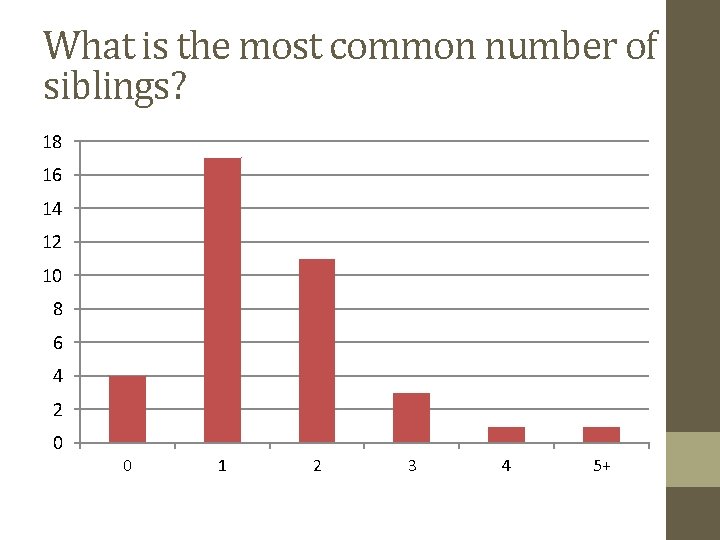
What is the most common number of siblings? 18 16 14 12 10 8 6 4 2 0 0 1 2 3 4 5+
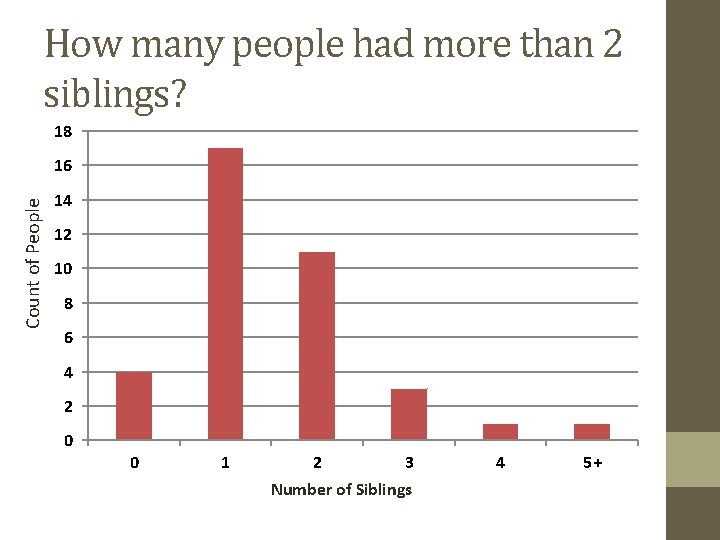
How many people had more than 2 siblings? 18 Count of People 16 14 12 10 8 6 4 2 0 0 1 2 3 Number of Siblings 4 5+
Why Use Af. L in Your Classroom? • Research shows that AFL helps students • • understand the reason and focus for learning; recognise success in learning; identify and work towards a goal; and understand how to make improvements and achieve their goals.
Black and Wiliam. ‘Inside the Black Box’, (1998) • reviewed 250 research articles on assessment from 160 journals published over a nine-year period • they concluded: • The giving of marks and the grading function are overemphasised, while the giving of useful advice and the learning function are underemphasised. • Assessment approaches are often used in which pupils are compared with one another. Pupils interpret the prime purpose of these to be competition, not personal improvement. • Consequently, assessment feedback from these approaches teaches low-achieving pupils that they lack ‘ability’, causing them to believe that they are not able to learn.
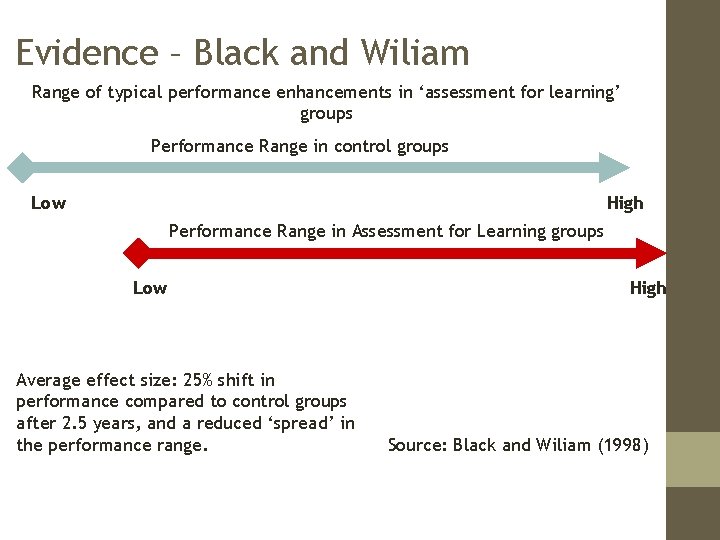
Evidence – Black and Wiliam Range of typical performance enhancements in ‘assessment for learning’ groups Performance Range in control groups Low High Performance Range in Assessment for Learning groups Low Average effect size: 25% shift in performance compared to control groups after 2. 5 years, and a reduced ‘spread’ in the performance range. High Source: Black and Wiliam (1998)
Importance and benefits of assessment for learning (1. 3) • There are well-documented benefits reported here in N. I. , including: • AFL leads to: • increased self-esteem and confidence among pupils when solving problems; • greater resilience and independence in the face of challenges; • improvements in learning skills and performance; and • an increasing ability to assess their own performance.
1. 3 Explain the importance and benefits of assessment for learning • There is much research that indicates several reasons for people not doing as well as they should these include: • The low self-esteem and confidence, leading them to avoid challenge; • lack of resilience, leading them to give up when they encounter difficulty; and • lack of ability to assess their own performance accurately, which means they underestimate or overestimate themselves. • Comparing these with the benefits noted, you can easily see the potential Assessment for Learning has for influencing success.
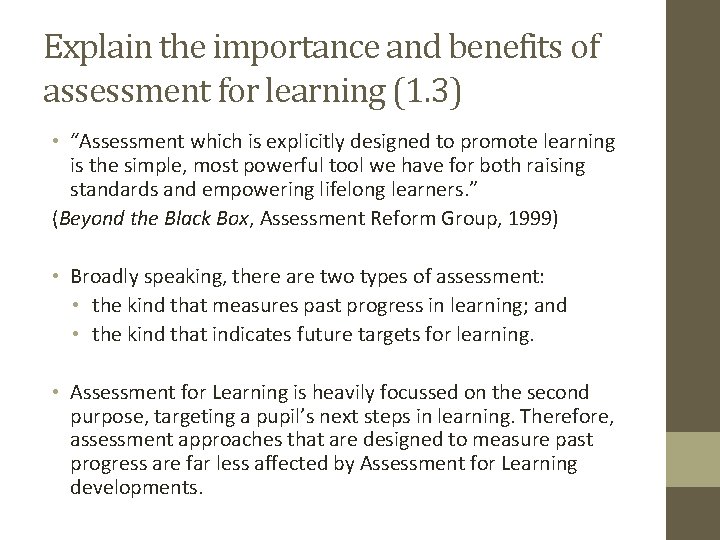
Explain the importance and benefits of assessment for learning (1. 3) • “Assessment which is explicitly designed to promote learning is the simple, most powerful tool we have for both raising standards and empowering lifelong learners. ” (Beyond the Black Box, Assessment Reform Group, 1999) • Broadly speaking, there are two types of assessment: • the kind that measures past progress in learning; and • the kind that indicates future targets for learning. • Assessment for Learning is heavily focussed on the second purpose, targeting a pupil’s next steps in learning. Therefore, assessment approaches that are designed to measure past progress are far less affected by Assessment for Learning developments.
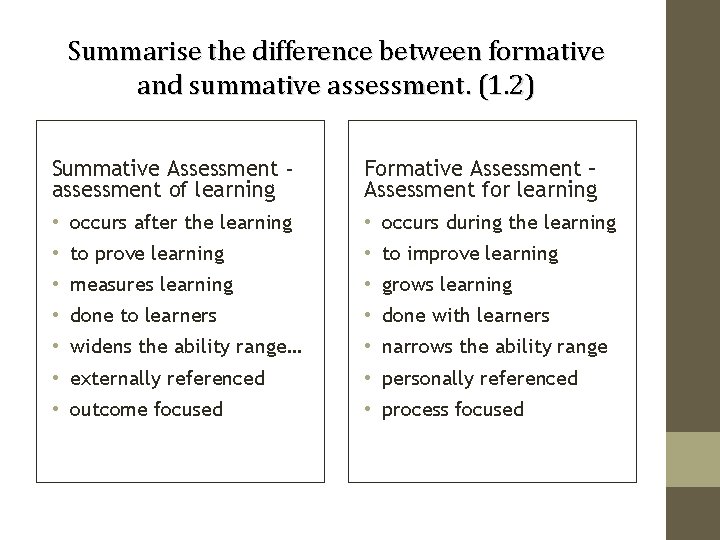
Summarise the difference between formative and summative assessment. (1. 2) Summative Assessment assessment of learning Formative Assessment – Assessment for learning • occurs after the learning • occurs during the learning • to prove learning • to improve learning • measures learning • grows learning • done to learners • done with learners • widens the ability range… • narrows the ability range • externally referenced • personally referenced • outcome focused • process focused
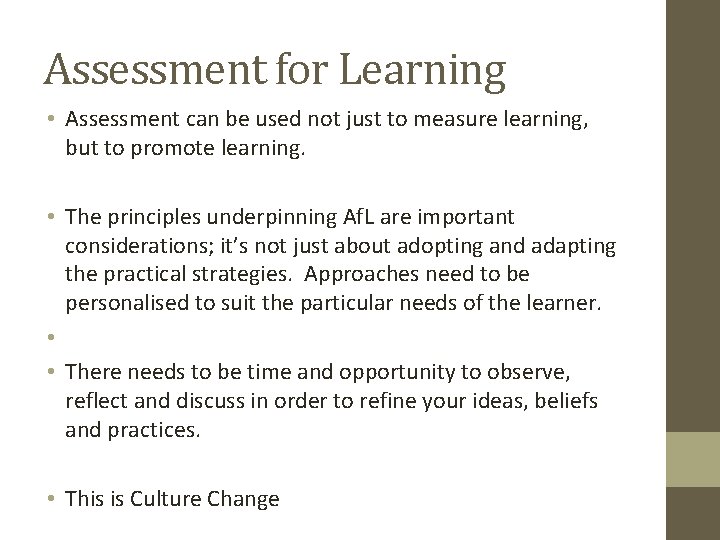
Assessment for Learning • Assessment can be used not just to measure learning, but to promote learning. • The principles underpinning Af. L are important considerations; it’s not just about adopting and adapting the practical strategies. Approaches need to be personalised to suit the particular needs of the learner. • • There needs to be time and opportunity to observe, reflect and discuss in order to refine your ideas, beliefs and practices. • This is Culture Change
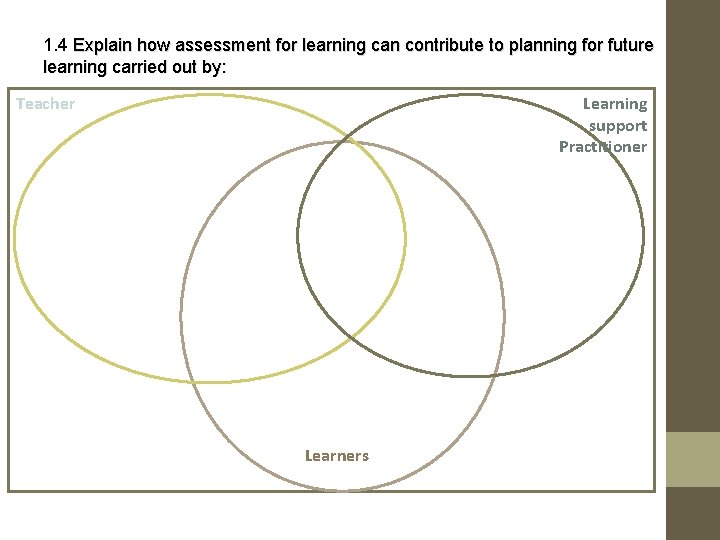
1. 4 Explain how assessment for learning can contribute to planning for future learning carried out by: Learning support Practitioner Teacher Learners
1. 4 Explain how assessment for learning can contribute to planning for future learning carried out by: • (a) the teacher (b) the learners (c) the learning support practitioner
Af. L Summary • is formative assessment; • seeks to improve learning rather than prove it; • can significantly and measurably improve pupil performance; and • requires understanding, careful planning and gradual integration to be meaningful and successful. • There is much successful practice in schools already. It’s not all new! • It’s as much a change in culture as a change in practice in classrooms.
Further information Publications: Inside the Black Box, Raising Standards Through Classroom Assessment (Paul Black and Dylan Wiliam, 1998) Assessment and Learning in the Secondary School (Ted Wragg, 2001) Websites: www. aaia. org. uk Formative Assessment in the Secondary Classroom (Shirley Clarke, 2005) www. qca. org. uk Formative Assessment in Action: Weaving the Elements Together (Shirley Clarke, 2005) http: //arg. educ. cam. ac. uk www. slamnet. org. uk