
CCEA Curriculum Monitoring Programme 201819 DRAFT Overview June
- Slides: 24
CCEA Curriculum Monitoring Programme 2018/19: DRAFT Overview June 2020
Key Objectives In 2018/19, CCEA nitiated curriculum monitoring programme to: • establish the current level of understanding and engagement with the statutory curriculum in the education system; • seek views on he extent to which he curriculum as been embedded n schools; • identify any aps between intended curriculum, implemented curriculum and achieved curriculum (UNESCO, 2017); • establish ommunication nd feedback mechanisms between CCEA nd the school system; and • inform next steps in curriculum and qualifications development and support. DRAFT June 2020
Focus The monitoring programme was designed to allow CEA o hear the views of teachers and other stakeholders about the curriculum. CCEA ought iews on: • the implementation of the curriculum – benefits and challenges; • progression and continuity across key stage transitions; • the ffectiveness and relevance f the Cross-Curricular Skills and the Thinking Skills and Personal Capabilities; • assessing progress; and • awareness/usefulness of CCEA curriculum support materials nd areas to prioritise in the future. DRAFT June 2020
Responses The report reflects the views of: • 382 questionnaire respondents; • 82 focus group participants; • 231 interviews from 52 school visits; and • around 300 participants in 28 subject advisory group meetings. DRAFT June 2020
Key Messages: You Said… Curriculum • The aim, objectives and ethos of the curriculum remain sound, and it’s time to encourage schools to refocus and reflect on the curriculum. • There may be a narrowing of pupils’ curriculum experience at post-primary. • We need to ensure that the curriculum is accessible for pupils with SEN and other vulnerable groups. • There may be a need for further curriculum guidance to ensure effective pupil progression. • Digital skills within the curriculum needs to keep pace with societal and technological change, and teachers require access to professional development opportunities for digital skills. DRAFT June 2020
Key Messages: You Said… Assessment • There are issues with how the curriculum can be validly and reliably assessed and measured. • Curriculum provision is being impacted by external assessment, with a focus on examination preparation at Key Stage 4 and Post-16. • The Thinking Skills and Personal Capabilities may not be fully valued because there are not mechanisms in place for them to be assessed. • We need to ensure that qualifications recognise the achievement of all pupils and provide access to a range of pathways. DRAFT June 2020
Key Messages: You Said… Progression • Transitions remain a challenge, including from primary to postprimary. • There is a disconnect between pupils’ experience of the curriculum up to Key Stage 3 and qualifications at Key Stage 4. DRAFT Support • Teachers want to remain up to date and have access to professional learning opportunities. • It is difficult to find resources on the CCEA website. June 2020
Key Findings – Implementation • The curriculum aim, objectives and ethos are well received, especially at primary • Variation in the extent of awareness and understanding of the NI Curriculum in system – need to refocus and keep up to date • Pupil experience may vary – dependent on school leadership and teacher confidence • There is a potential dichotomy/tension between flexibility and inconsistency DRAFT June 2020
Key Findings – Implementation • Only 47. 1% at post-primary agreed that the NI Curriculum prepares learners for future life and work • Learning for Life and Work is not valued • Importance of developing pupils as creative thinkers and independent learners • Impact of external assessments on implementation • Narrowing of curriculum experience DRAFT June 2020
Questions for Exploration • How do we ensure that everyone has an understanding of the NI Curriculum? • How can teachers feel assured in their curriculum delivery without compromising flexibility? – What level of support/guidance/prescription is required? DRAFT • Why do post-primary teachers feel our learners are not being adequately prepared for life and work? June 2020
Progression • Curriculum framework generally provides an appropriate balance between knowledge, understanding and skills • Transitions – are challenging; leadership is required • Transfer test – impact on curriculum • Levels of progression – used at primary but problematic for post-primary • Key Stage 3 – not valued as not ‘examined’ • Key Stage 4 – concerns about connections with earlier key stages and balance between delivery of content and skills development • Longer term consequences on pupils’ capacity to cope with independent learning, university etc. DRAFT June 2020
Questions for Exploration • How can efficient flow of information between schools be facilitated? • What are the characteristics of a broad and balanced curriculum offer? • How do we promote skills development in the context of high stakes assessment and qualifications? DRAFT • Does Key Stage 3 provide an effective basis for progression? • Is there too much prescription at Key Stage 4 and/or too little at Key Stage 3? June 2020
Cross-Curricular Skills and TS&PC • Positive response (97%+ provide opportunities for development and 90%+ has impact on pupil learning) • Viewed as built into planning and having an impact • Thinking Skills and Personal Capabilities (TS&PC) seen as innovative and relevant to future professional/personal development - but may not be explicitly implemented • Using Mathematics, Using ICT and Being Creative less embedded in some areas at post-primary • Some skills have natural links with some subjects more than others • Impact of union action on understanding and embedding DRAFT June 2020
Using ICT and Digital Skills • Significant shifts in policy and practice; identified as key economic area for Northern Ireland/skills gap • Recognition of need for ICT as a cross-curricular skill – entitlement to basic skills, to ensure all pupils have exposure to the breadth of digital skills required for the future • Views expressed on discrete and timetabled provision for Digital Skills, especially at Key Stage 3 • Pupil experience – may be inconsistent and is linked to access to resources, teacher confidence and competence DRAFT June 2020
Questions for Exploration • To what extent are Thinking Skills and Personal Capabilities explicitly developed and embedded? How can they be validly assessed? • To what extent do current approaches to ICT deliver appropriate breadth and range of digital skills required for the future? Should there be discrete (timetabled) provision for digital skills/ICT? • How can different partners help to provide sustainable solutions, building teacher confidence in delivering digital skills? DRAFT June 2020
Assessment • Range of assessment methods and Assessment for Learning are embedded • Levels of Progression – primary (85%) v post-primary (50%) usage and value • Internal standardisation/CCEA resources (tasks and exemplification) used to support assessment • Summative tests preferred at post-primary • Multiple demands for data affect curriculum provision • Impact of high stakes assessments/parental expectations • Impact of industrial action; hard to evaluate assessment if not implemented DRAFT June 2020
Questions for Exploration • How can we reinforce and build on teachers’ assessment literacy? DRAFT • Post-primary teachers prefer summative testing BUT recognise negative impact of an undue focus on ‘teaching to the test’ – how can we mitigate these effects? June 2020
Subject Advisory Groups: Common Themes • There are opportunities for pupil progression and development of skills, but these are not uniform, particularly as not all subjects are covered by Areas of Learning at Key Stage 3 • Gap in approach between Key Stages 3 and 4 – in skills and content – Tension between degree of prescribed content at Key Stage 3 and Key Stage 4 – Examination content prioritised over skills development • Assessment methods are generally valid and reliable but there are logistical issues • Respondents also identified issues with budgets, resources and timetabling DRAFT June 2020
Questions for Exploration • How do we ensure appropriate balance between content and skills at Key Stage 3 and Key Stage 4? • Are formal GCSE/GCE qualifications and assessment methods appropriate for all learners? DRAFT June 2020
Curriculum Support and Resources • Main methods used to develop own practice: informal reading/social media • Preference for face-to-face engagement and value of professional dialogue • Teachers want access to current research and pedagogy • Identified need for Teacher Professional Learning – refresh and refocus on NI Curriculum, tailored to different levels of experience • Extent of awareness of, and engagement with, CCEA resources? Time pressures and website navigation • Satisfaction with CCEA Resources: Primary 70% v Key Stage 3 40% – why? DRAFT June 2020
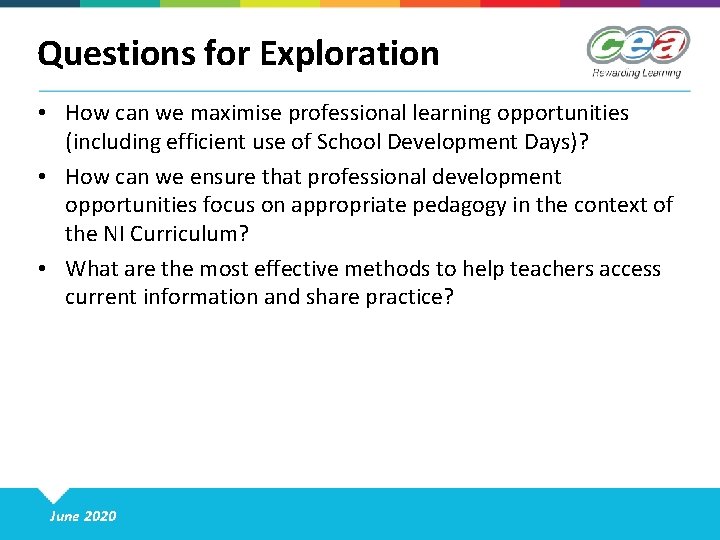
Questions for Exploration • How can we maximise professional learning opportunities (including efficient use of School Development Days)? • How can we ensure that professional development opportunities focus on appropriate pedagogy in the context of the NI Curriculum? • What are the most effective methods to help teachers access current information and share practice? DRAFT June 2020
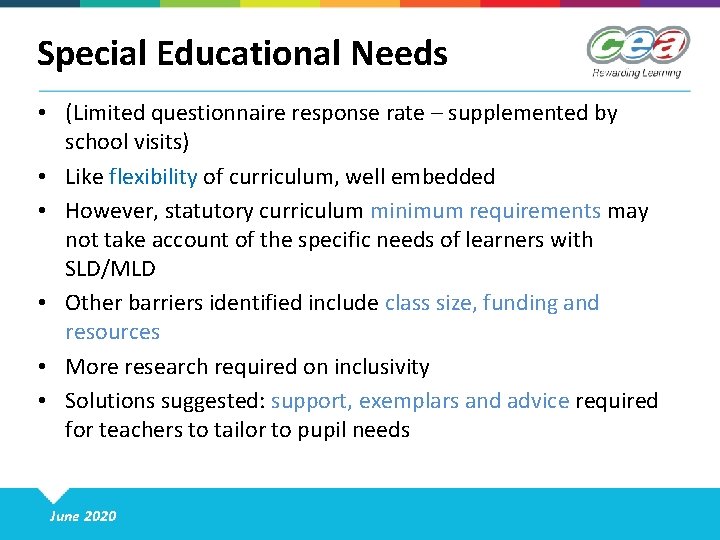
Special Educational Needs • (Limited questionnaire response rate – supplemented by school visits) • Like flexibility of curriculum, well embedded • However, statutory curriculum minimum requirements may not take account of the specific needs of learners with SLD/MLD • Other barriers identified include class size, funding and resources • More research required on inclusivity • Solutions suggested: support, exemplars and advice required for teachers to tailor to pupil needs DRAFT June 2020
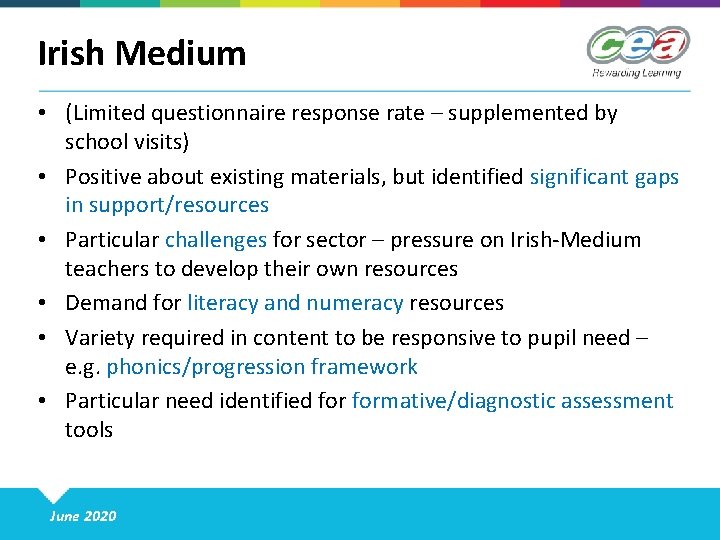
Irish Medium • (Limited questionnaire response rate – supplemented by school visits) • Positive about existing materials, but identified significant gaps in support/resources • Particular challenges for sector – pressure on Irish-Medium teachers to develop their own resources • Demand for literacy and numeracy resources • Variety required in content to be responsive to pupil need – e. g. phonics/progression framework • Particular need identified formative/diagnostic assessment tools DRAFT June 2020
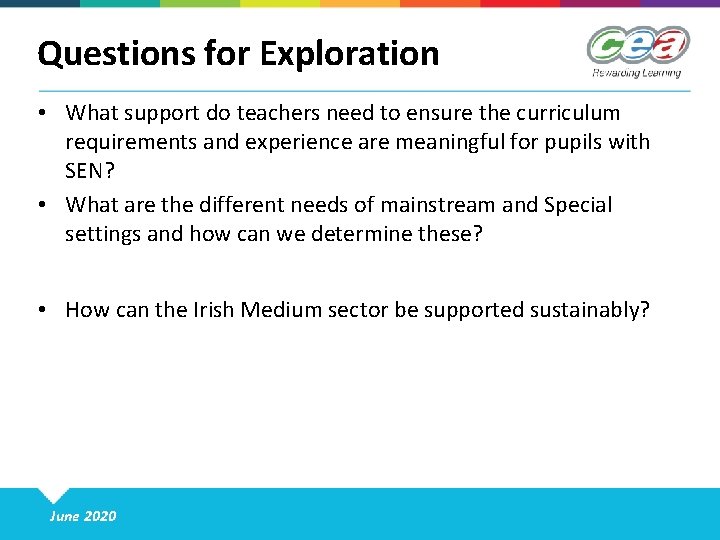
Questions for Exploration • What support do teachers need to ensure the curriculum requirements and experience are meaningful for pupils with SEN? • What are the different needs of mainstream and Special settings and how can we determine these? DRAFT • How can the Irish Medium sector be supported sustainably? June 2020