
CCDs in Astronomy History of CCDs How do
- Slides: 31
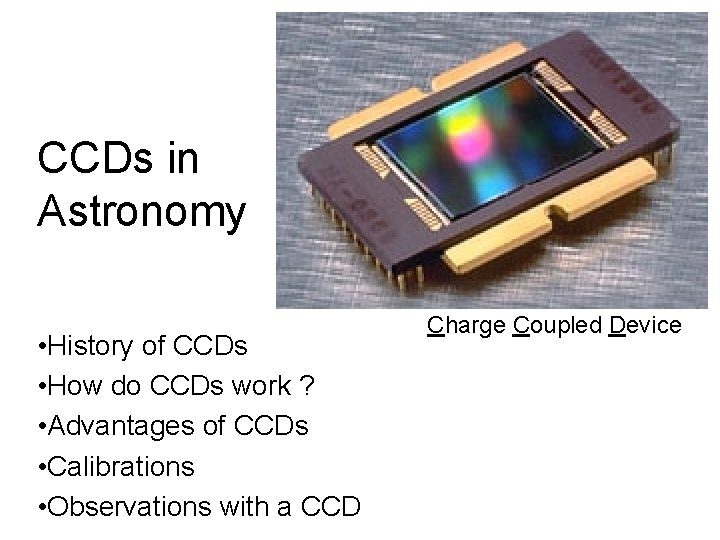
CCDs in Astronomy • History of CCDs • How do CCDs work ? • Advantages of CCDs • Calibrations • Observations with a CCD Charge Coupled Device
Photographic Imaging • Photographic Plates: 100 mm thick emulsion spread over a glass base • Solidified gelatin w/silver halide salt grains • “Pixel size” (grain size): 6 mm • How it works: multiple photons strike silver halide grains – give off electrons and form silver atoms within grains • Developing converts exposed grains into opaque silver
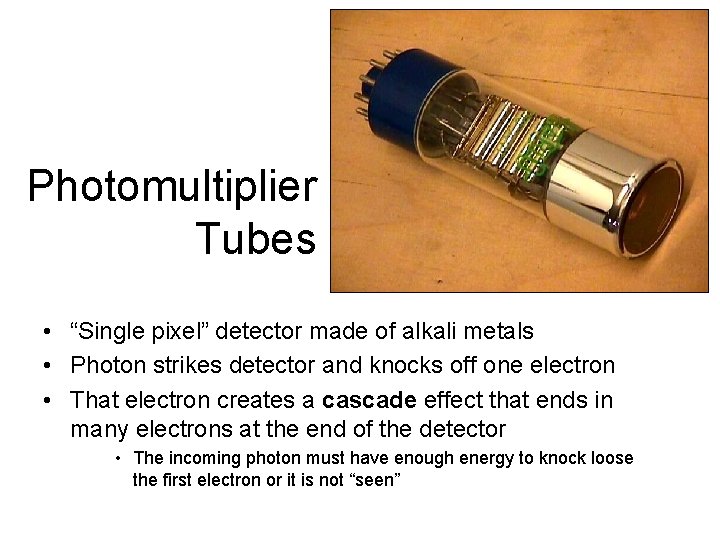
Photomultiplier Tubes • “Single pixel” detector made of alkali metals • Photon strikes detector and knocks off one electron • That electron creates a cascade effect that ends in many electrons at the end of the detector • The incoming photon must have enough energy to knock loose the first electron or it is not “seen”
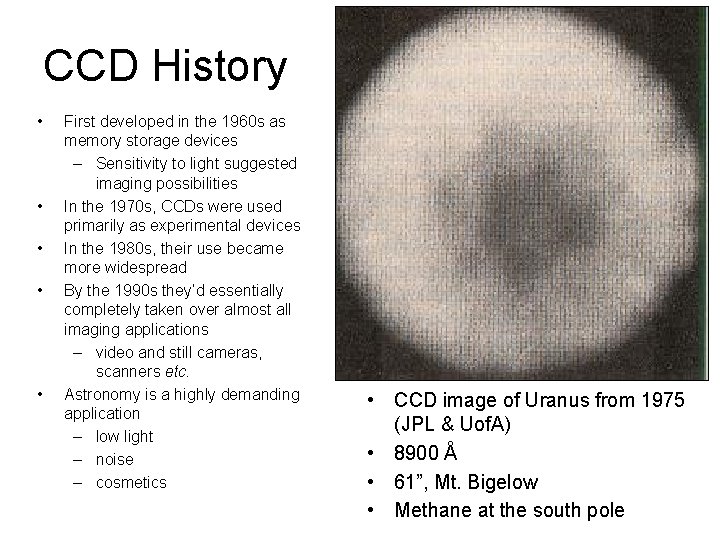
CCD History • • • First developed in the 1960 s as memory storage devices – Sensitivity to light suggested imaging possibilities In the 1970 s, CCDs were used primarily as experimental devices In the 1980 s, their use became more widespread By the 1990 s they’d essentially completely taken over almost all imaging applications – video and still cameras, scanners etc. Astronomy is a highly demanding application – low light – noise – cosmetics • CCD image of Uranus from 1975 (JPL & Uof. A) • 8900 Å • 61”, Mt. Bigelow • Methane at the south pole
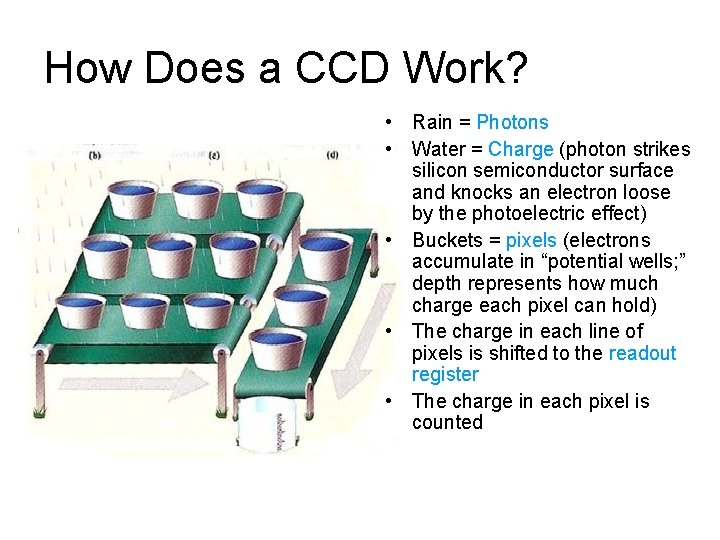
How Does a CCD Work? • Rain = Photons • Water = Charge (photon strikes silicon semiconductor surface and knocks an electron loose by the photoelectric effect) • Buckets = pixels (electrons accumulate in “potential wells; ” depth represents how much charge each pixel can hold) • The charge in each line of pixels is shifted to the readout register • The charge in each pixel is counted
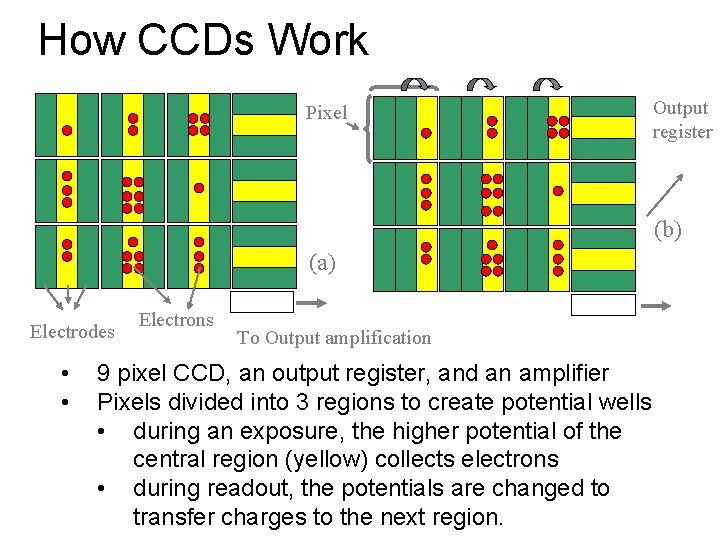
How CCDs Work Pixel Output register (b) (a) Electrodes • • Electrons To Output amplification 9 pixel CCD, an output register, and an amplifier Pixels divided into 3 regions to create potential wells • during an exposure, the higher potential of the central region (yellow) collects electrons • during readout, the potentials are changed to transfer charges to the next region.
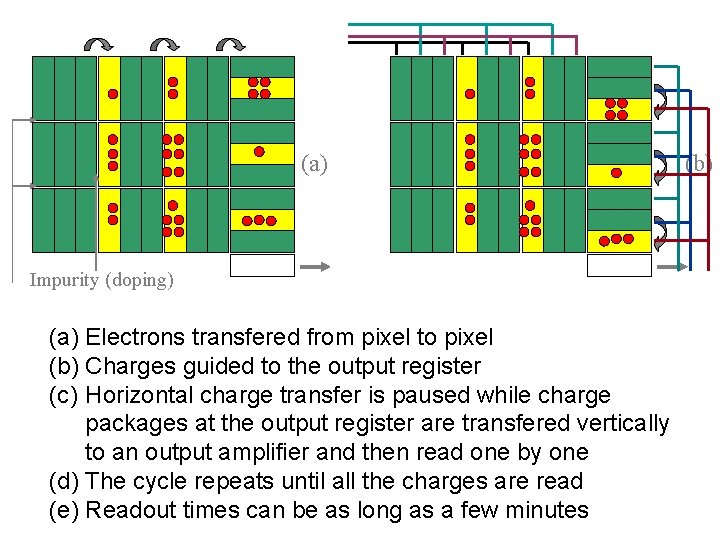
(a) Impurity (doping) (a) Electrons transfered from pixel to pixel (b) Charges guided to the output register (c) Horizontal charge transfer is paused while charge packages at the output register are transfered vertically to an output amplifier and then read one by one (d) The cycle repeats until all the charges are read (e) Readout times can be as long as a few minutes (b)
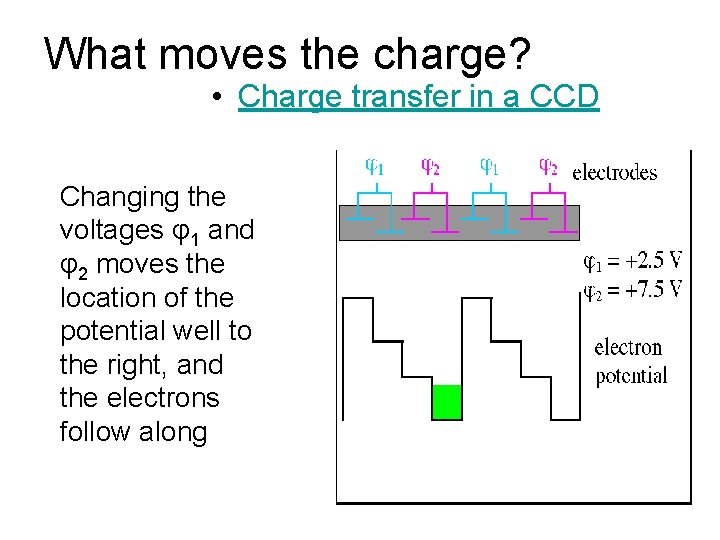
What moves the charge? • Charge transfer in a CCD Changing the voltages φ1 and φ2 moves the location of the potential well to the right, and the electrons follow along
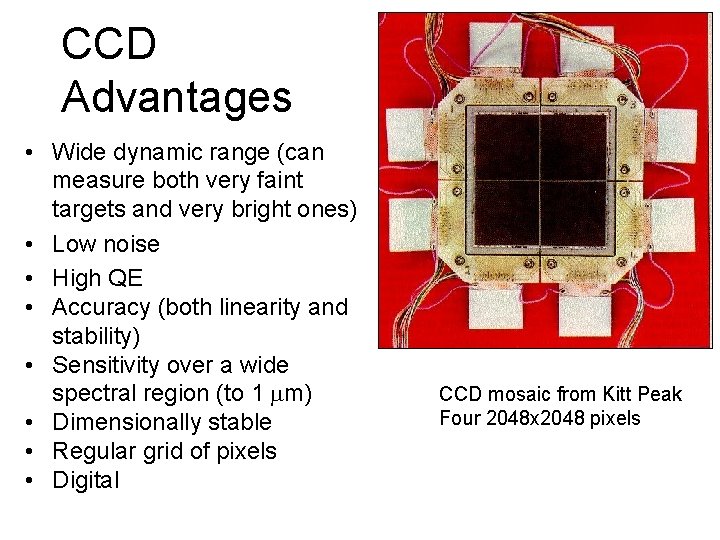
CCD Advantages • Wide dynamic range (can measure both very faint targets and very bright ones) • Low noise • High QE • Accuracy (both linearity and stability) • Sensitivity over a wide spectral region (to 1 mm) • Dimensionally stable • Regular grid of pixels • Digital CCD mosaic from Kitt Peak Four 2048 x 2048 pixels
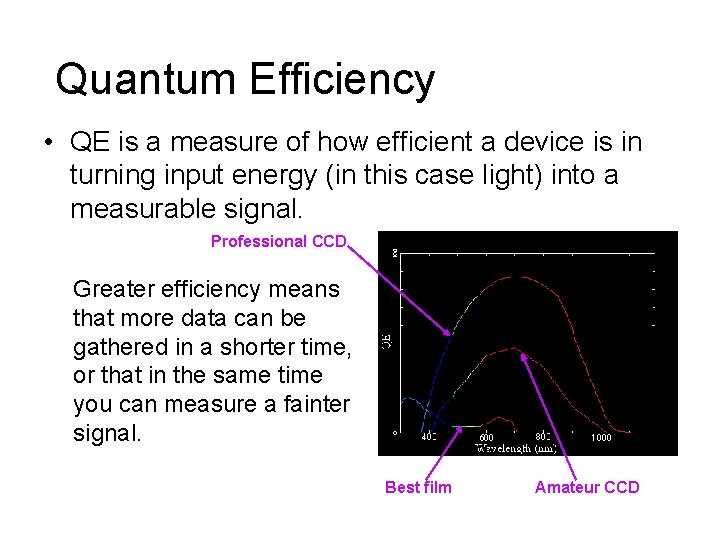
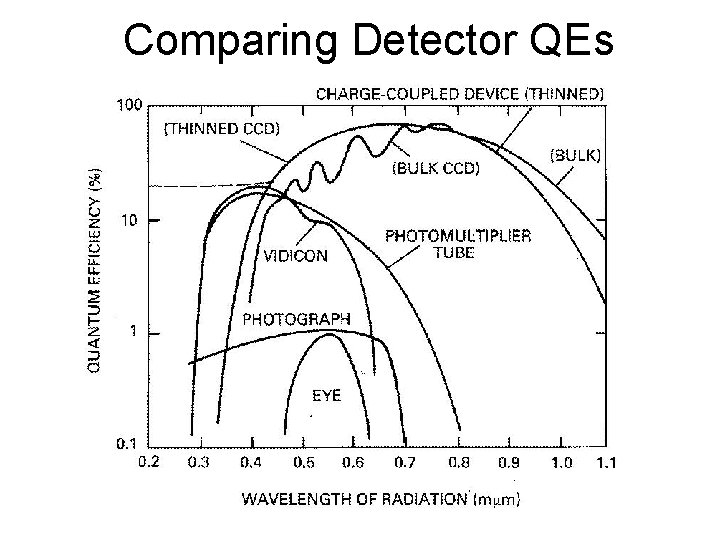
Quantum Efficiency • QE is a measure of how efficient a device is in turning input energy (in this case light) into a measurable signal. Professional CCD Greater efficiency means that more data can be gathered in a shorter time, or that in the same time you can measure a fainter signal. Best film Amateur CCD
Comparing Detector QEs
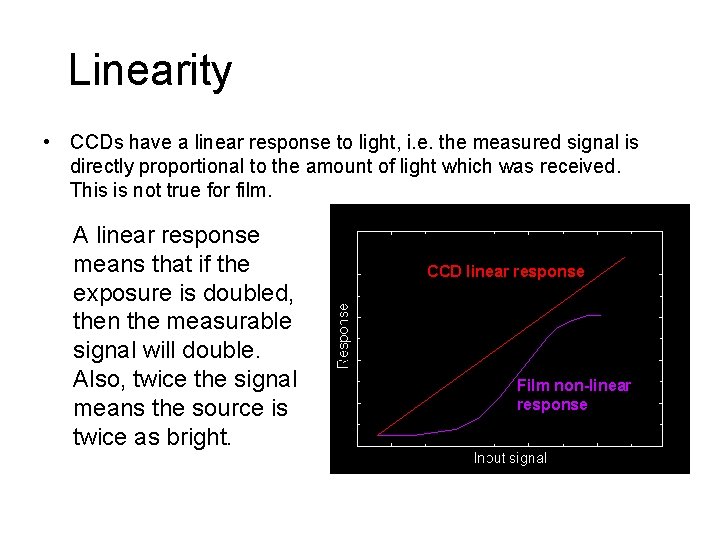
Linearity • CCDs have a linear response to light, i. e. the measured signal is directly proportional to the amount of light which was received. This is not true for film. A linear response means that if the exposure is doubled, then the measurable signal will double. Also, twice the signal means the source is twice as bright. CCD linear response Film non-linear response
Designing a CCD • Most commercial CCDs are “front-side illuminated” – A 3 -d circuit on a base of silicon (the light sensitive layer) – Light has to go through the circuitry, which causes losses • Astronomical CCDs are “back-side illuminated” with QEs of 90% or greater – silicon is be thinned to a few tens of microns – need to support the silicon. – some charge diffusion in the silicon • Anti-reflection coating applied to the CCD surface reduces loses • Front-side illuminated CCDs have low blue QE – devices can be coated with “Lumigen” – an organic substance similar to the “glow” in highlighter markers (Lumigen converts blue/UV photons to 520 nm, where the CCD has higher QE)
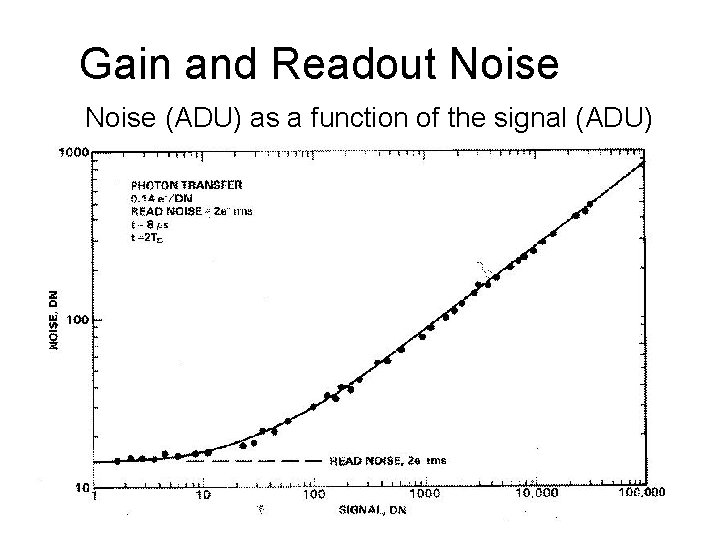
Readout Noise • How accurately can we measure the number of photons detected by a CCD pixel? • A CCD has an analog output – Photons are converted to a charge and then to a voltage for measurement. – An amplifier on the CCD boosts the signal to a useful level • Is it possible to measure exactly how many photons fell on each pixel? – No. The noise inherent in the conversion and amplification process introduces some noise – The lowest noise CCDs now used in astronomy have a readout noise (RMS error ~2 e–)
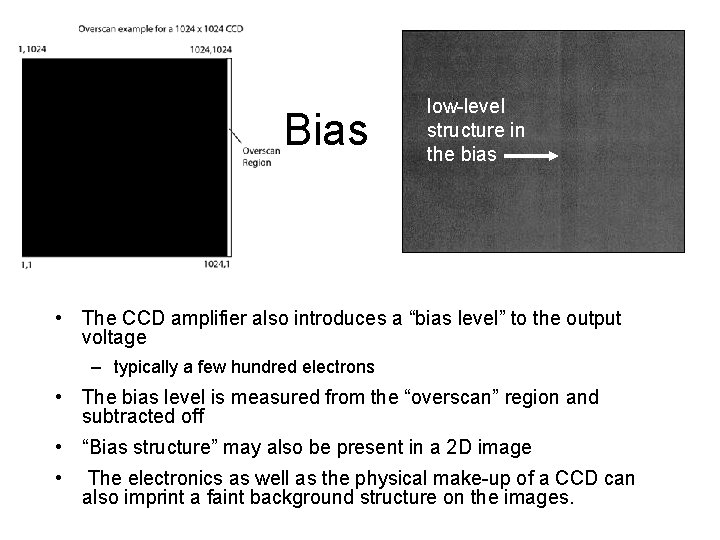
Bias low-level structure in the bias • The CCD amplifier also introduces a “bias level” to the output voltage – typically a few hundred electrons • The bias level is measured from the “overscan” region and subtracted off • “Bias structure” may also be present in a 2 D image • The electronics as well as the physical make-up of a CCD can also imprint a faint background structure on the images.
Charge Transfer Efficiency (CTE) • How efficiently can charge be moved across the pixels and the readout register? Will every electron be moved or will some be lost? The earliest CCDs had a CTE of only ~98% Today CTE is typically better than 99· 995% in commercial devices (“ 4 nines”) Much higher in scientific devices - 99· 9999% (5 -6 “nines”). Poor CTE means that not all of the photons which arrived on the CCD will be counted, and the further from the readout register the worse the effect.
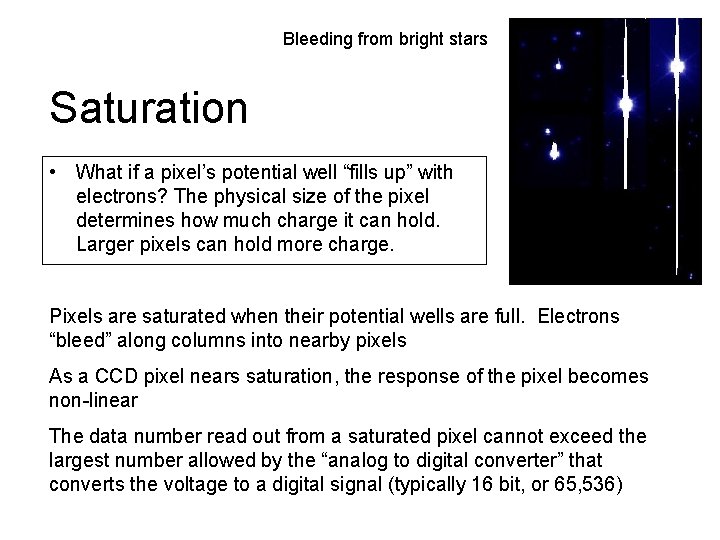
Bleeding from bright stars Saturation • What if a pixel’s potential well “fills up” with electrons? The physical size of the pixel determines how much charge it can hold. Larger pixels can hold more charge. Pixels are saturated when their potential wells are full. Electrons “bleed” along columns into nearby pixels As a CCD pixel nears saturation, the response of the pixel becomes non-linear The data number read out from a saturated pixel cannot exceed the largest number allowed by the “analog to digital converter” that converts the voltage to a digital signal (typically 16 bit, or 65, 536)
Thermal Noise or Dark Current • The finite temperature of the CCD leads to the production of thermally induced electrons in the silicon – Dark current increases linearly with time • A function of the temperature of the CCD – CCDs cooled to around 170°K (-100°C) to reduce thermal noise • Dark current can be removed with careful calibration
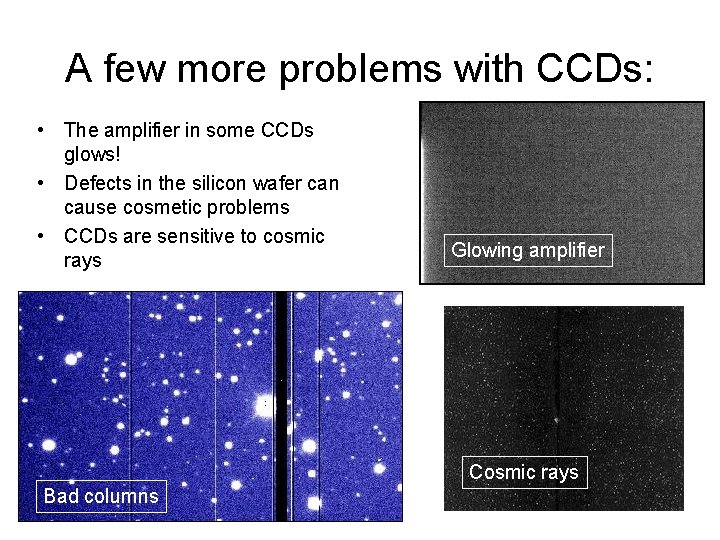
A few more problems with CCDs: • The amplifier in some CCDs glows! • Defects in the silicon wafer can cause cosmetic problems • CCDs are sensitive to cosmic rays Glowing amplifier Cosmic rays Bad columns
CCD Characterization • CCDs are characterized before they are put on a telescope. The parameters which are needed are: • The amplifier gain – how many electrons per count. • The linearity of the amplifier and electronics – there will always be some slight variation from perfection. • QE and CTE – how good is the CCD. • Any cosmetic or electronic blemishes (“trapping sites”, etc. ) – every CCD is unique!
Gain and Readout Noise (ADU) as a function of the signal (ADU)
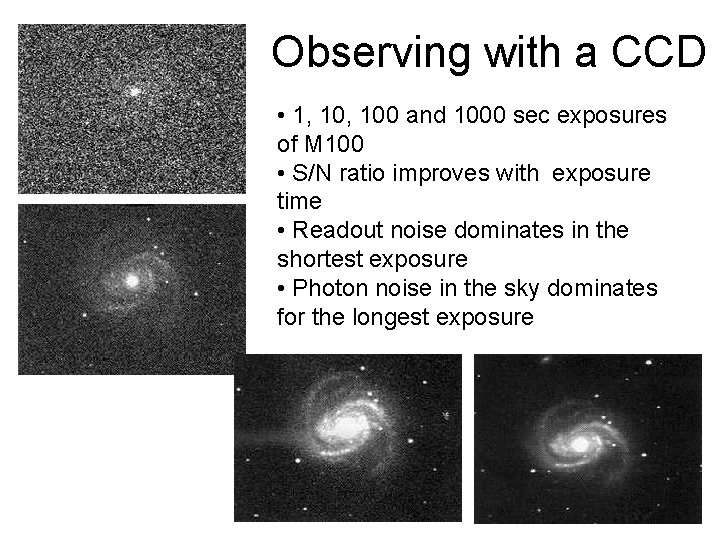
Observing with a CCD • 1, 100 and 1000 sec exposures of M 100 • S/N ratio improves with exposure time • Readout noise dominates in the shortest exposure • Photon noise in the sky dominates for the longest exposure
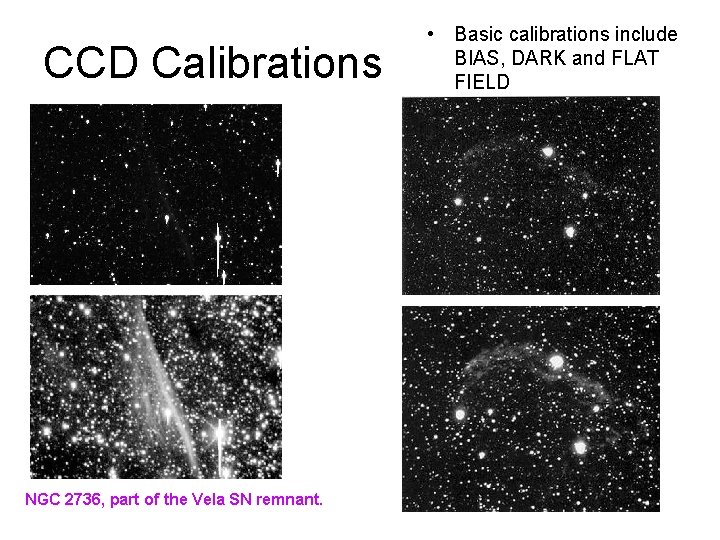
CCD Calibrations NGC 2736, part of the Vela SN remnant. • Basic calibrations include BIAS, DARK and FLAT FIELD
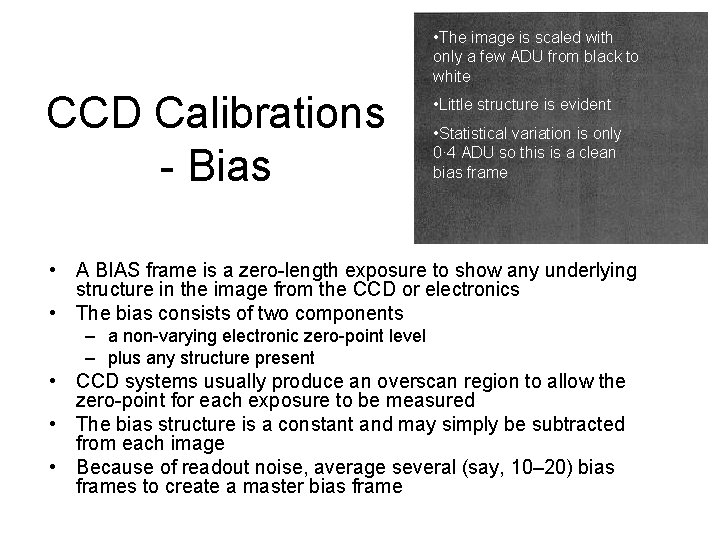
• The image is scaled with only a few ADU from black to white CCD Calibrations - Bias • Little structure is evident • Statistical variation is only 0· 4 ADU so this is a clean bias frame • A BIAS frame is a zero-length exposure to show any underlying structure in the image from the CCD or electronics • The bias consists of two components – a non-varying electronic zero-point level – plus any structure present • CCD systems usually produce an overscan region to allow the zero-point for each exposure to be measured • The bias structure is a constant and may simply be subtracted from each image • Because of readout noise, average several (say, 10– 20) bias frames to create a master bias frame
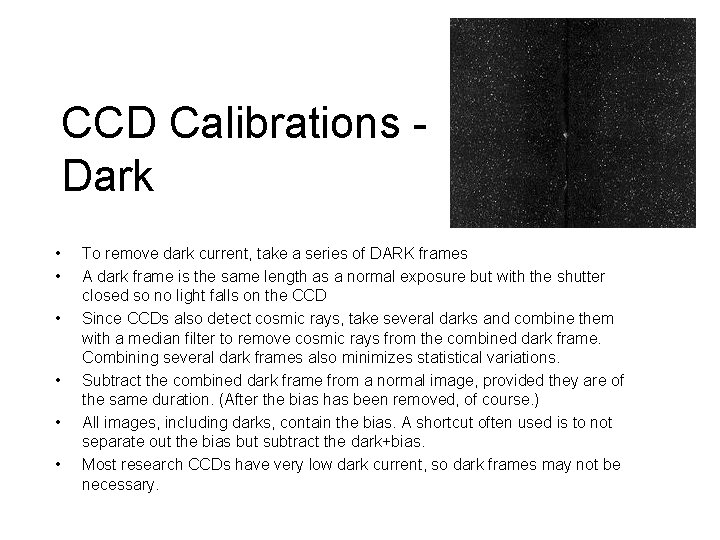
CCD Calibrations Dark • • • To remove dark current, take a series of DARK frames A dark frame is the same length as a normal exposure but with the shutter closed so no light falls on the CCD Since CCDs also detect cosmic rays, take several darks and combine them with a median filter to remove cosmic rays from the combined dark frame. Combining several dark frames also minimizes statistical variations. Subtract the combined dark frame from a normal image, provided they are of the same duration. (After the bias has been removed, of course. ) All images, including darks, contain the bias. A shortcut often used is to not separate out the bias but subtract the dark+bias. Most research CCDs have very low dark current, so dark frames may not be necessary.
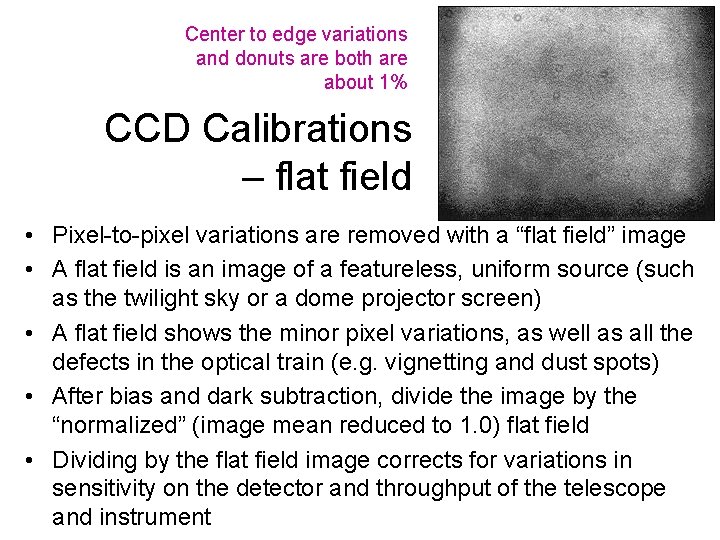
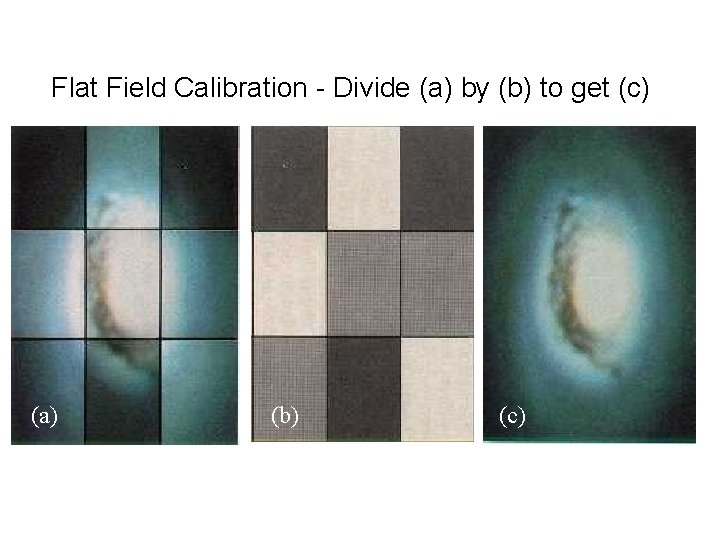
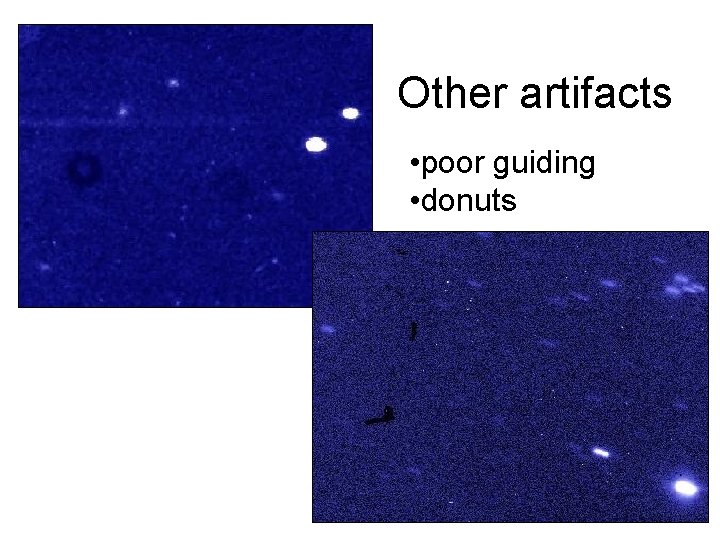
Center to edge variations and donuts are both are about 1% CCD Calibrations – flat field • Pixel-to-pixel variations are removed with a “flat field” image • A flat field is an image of a featureless, uniform source (such as the twilight sky or a dome projector screen) • A flat field shows the minor pixel variations, as well as all the defects in the optical train (e. g. vignetting and dust spots) • After bias and dark subtraction, divide the image by the “normalized” (image mean reduced to 1. 0) flat field • Dividing by the flat field image corrects for variations in sensitivity on the detector and throughput of the telescope and instrument
Flat Field Calibration - Divide (a) by (b) to get (c) (a) (b) (c)
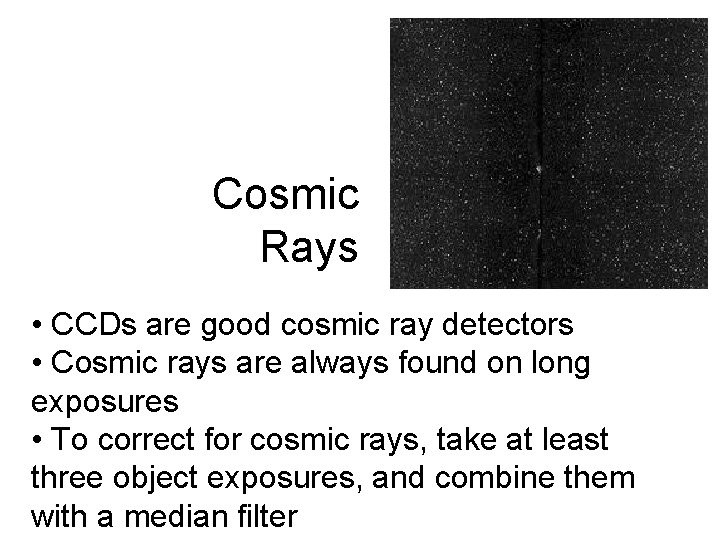
Cosmic Rays • CCDs are good cosmic ray detectors • Cosmic rays are always found on long exposures • To correct for cosmic rays, take at least three object exposures, and combine them with a median filter
Other artifacts • poor guiding • donuts
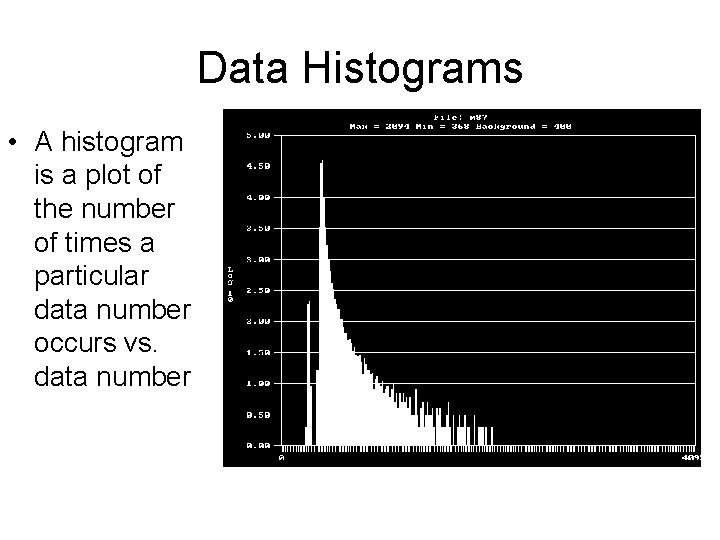
Data Histograms • A histogram is a plot of the number of times a particular data number occurs vs. data number
Sources Kodak KAF-1302 E(LE) CCD - Image courtesy of Eastman Kodak Company. KODAK is a trademark. http: //www. kodak. com/US/en/digital/ccd/kaf 1302 ELE. shtml Other images © Steven Lee http: //www. aao. gov. au/local/www/sl/ Bob O'Connell's Fall 2003 Lecture Notes U. Florida notes on electronic cameras. The_Electronic_Camera_in_Astronomy. ppt Notes from the Max Planck Institute: http: //www. mpiahd. mpg. de/70 CM/lecture/prak_astro. ppt