
CCDs Current Developments Part 1 Deep Depletion CCDs

- Slides: 43
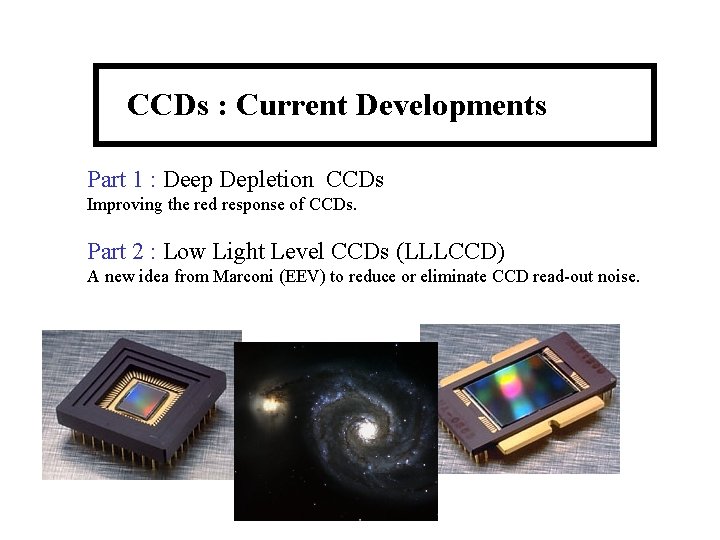
CCDs : Current Developments Part 1 : Deep Depletion CCDs Improving the red response of CCDs. Part 2 : Low Light Level CCDs (LLLCCD) A new idea from Marconi (EEV) to reduce or eliminate CCD read-out noise.
Part 1 : Deep Depletion CCDs Improving the red response of CCDs.
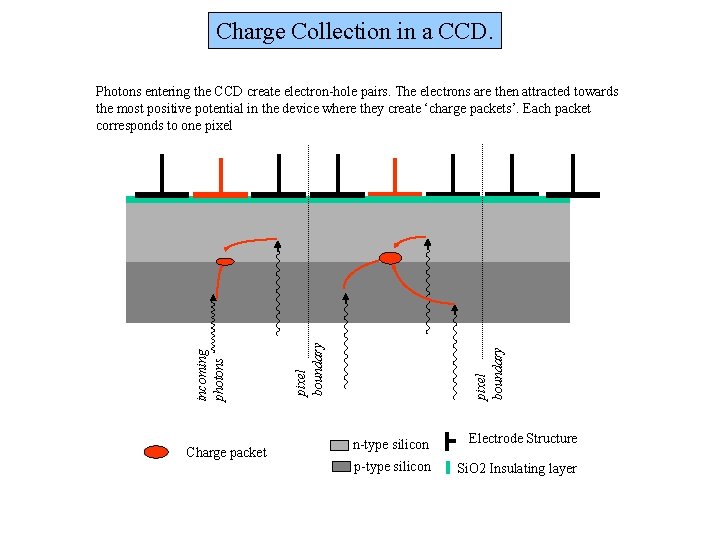
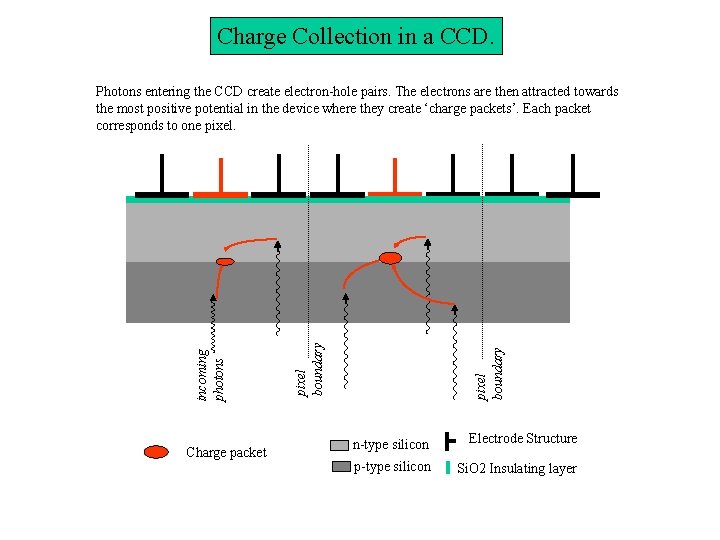
Charge Collection in a CCD. Charge packet pixel boundary incoming photons Photons entering the CCD create electron-hole pairs. The electrons are then attracted towards the most positive potential in the device where they create ‘charge packets’. Each packet corresponds to one pixel n-type silicon Electrode Structure p-type silicon Si. O 2 Insulating layer
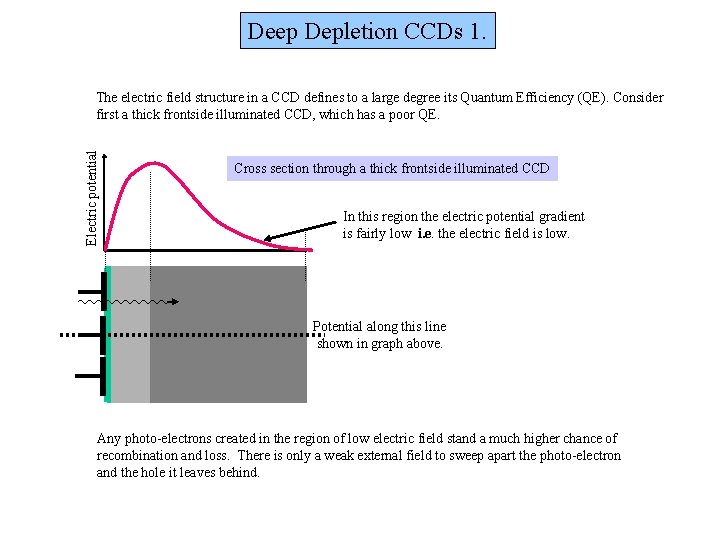
Deep Depletion CCDs 1. Electric potential The electric field structure in a CCD defines to a large degree its Quantum Efficiency (QE). Consider first a thick frontside illuminated CCD, which has a poor QE. Cross section through a thick frontside illuminated CCD In this region the electric potential gradient is fairly low i. e. the electric field is low. Potential along this line shown in graph above. Any photo-electrons created in the region of low electric field stand a much higher chance of recombination and loss. There is only a weak external field to sweep apart the photo-electron and the hole it leaves behind.
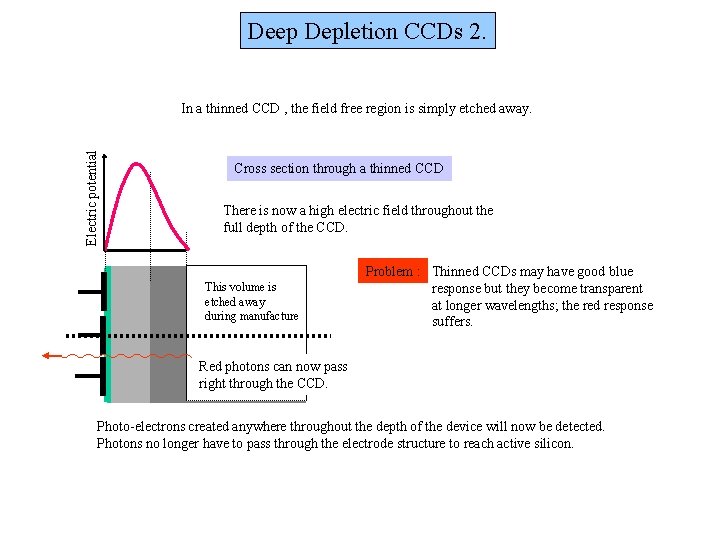
Deep Depletion CCDs 2. Electric potential In a thinned CCD , the field free region is simply etched away. Cross section through a thinned CCD There is now a high electric field throughout the full depth of the CCD. This volume is etched away during manufacture Problem : Thinned CCDs may have good blue response but they become transparent at longer wavelengths; the red response suffers. Red photons can now pass right through the CCD. Photo-electrons created anywhere throughout the depth of the device will now be detected. Photons no longer have to pass through the electrode structure to reach active silicon.
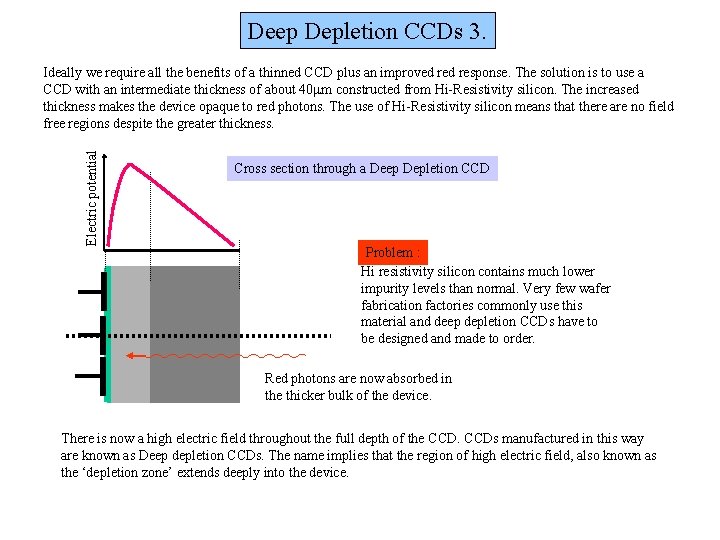
Deep Depletion CCDs 3. Electric potential Ideally we require all the benefits of a thinned CCD plus an improved response. The solution is to use a CCD with an intermediate thickness of about 40 mm constructed from Hi-Resistivity silicon. The increased thickness makes the device opaque to red photons. The use of Hi-Resistivity silicon means that there are no field free regions despite the greater thickness. Cross section through a Deep Depletion CCD Problem : Hi resistivity silicon contains much lower impurity levels than normal. Very few wafer fabrication factories commonly use this material and deep depletion CCDs have to be designed and made to order. Red photons are now absorbed in the thicker bulk of the device. There is now a high electric field throughout the full depth of the CCDs manufactured in this way are known as Deep depletion CCDs. The name implies that the region of high electric field, also known as the ‘depletion zone’ extends deeply into the device.
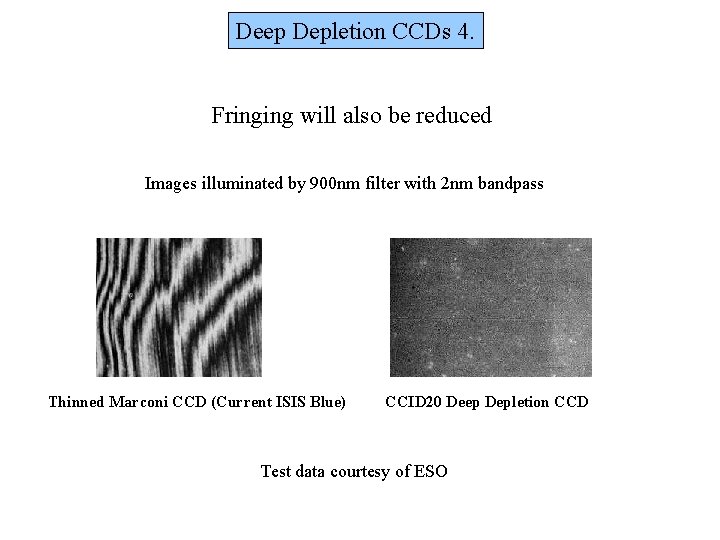
Deep Depletion CCDs 4. Fringing will also be reduced Images illuminated by 900 nm filter with 2 nm bandpass Thinned Marconi CCD (Current ISIS Blue) CCID 20 Deep Depletion CCD Test data courtesy of ESO
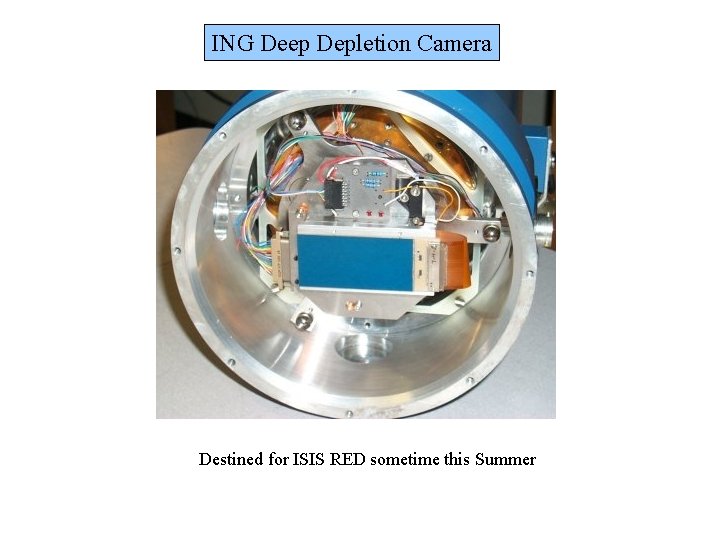
ING Deep Depletion Camera Destined for ISIS RED sometime this Summer
Part 2 : Low Light Level CCDs (LLLCCDs) A new idea from Marconi that creates internal electron gain in a CCD and reduces read-noise to sub-electron levels.
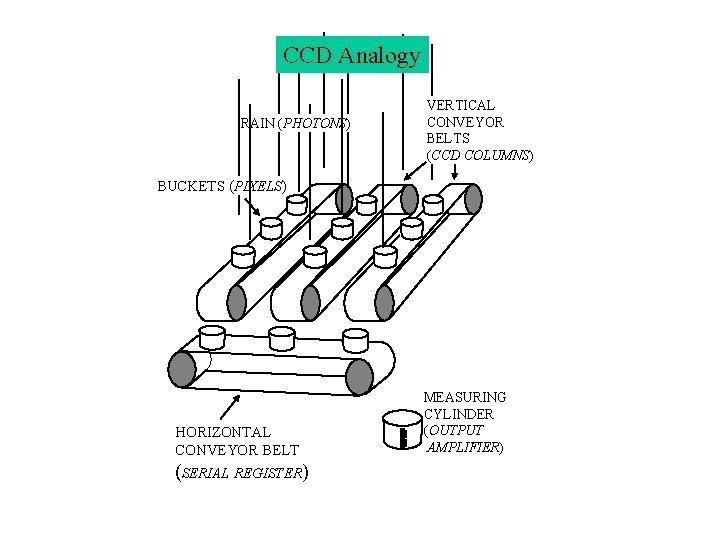
CCD Analogy RAIN (PHOTONS) VERTICAL CONVEYOR BELTS (CCD COLUMNS) BUCKETS (PIXELS) HORIZONTAL CONVEYOR BELT (SERIAL REGISTER) MEASURING CYLINDER (OUTPUT AMPLIFIER)
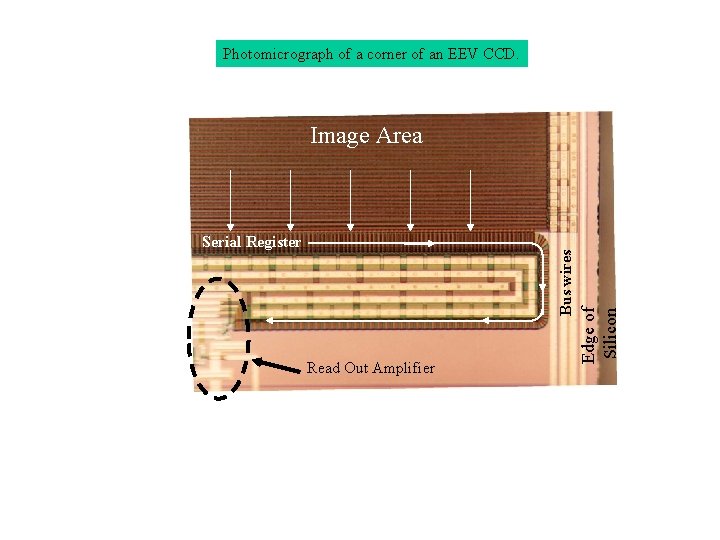
Photomicrograph of a corner of an EEV CCD. Bus wires Serial Register Read Out Amplifier Edge of Silicon Image Area
Charge Collection in a CCD. Charge packet pixel boundary incoming photons Photons entering the CCD create electron-hole pairs. The electrons are then attracted towards the most positive potential in the device where they create ‘charge packets’. Each packet corresponds to one pixel. n-type silicon Electrode Structure p-type silicon Si. O 2 Insulating layer
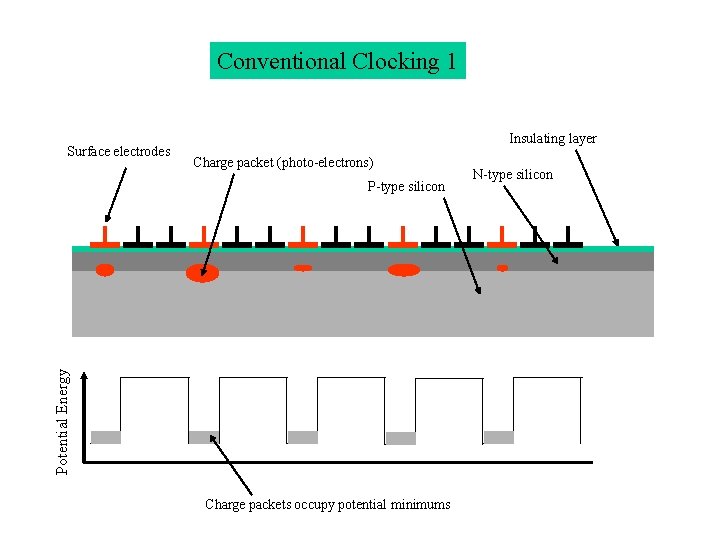
Conventional Clocking 1 Surface electrodes Insulating layer Charge packet (photo-electrons) Potential Energy P-type silicon Charge packets occupy potential minimums N-type silicon
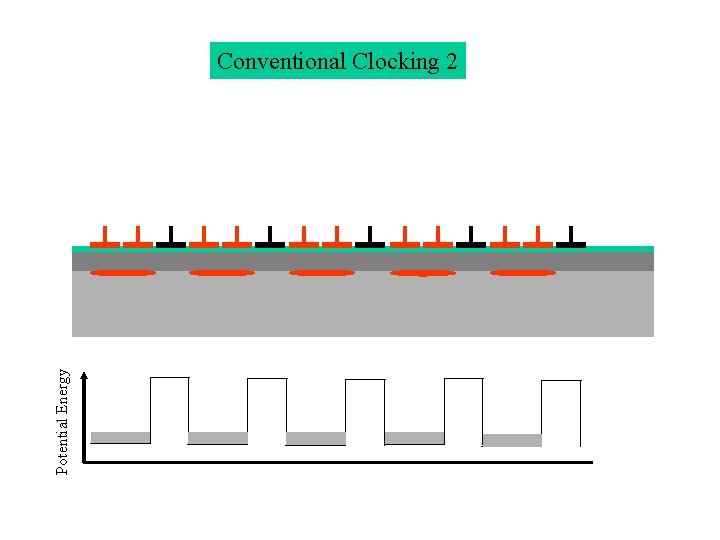
Potential Energy Conventional Clocking 2
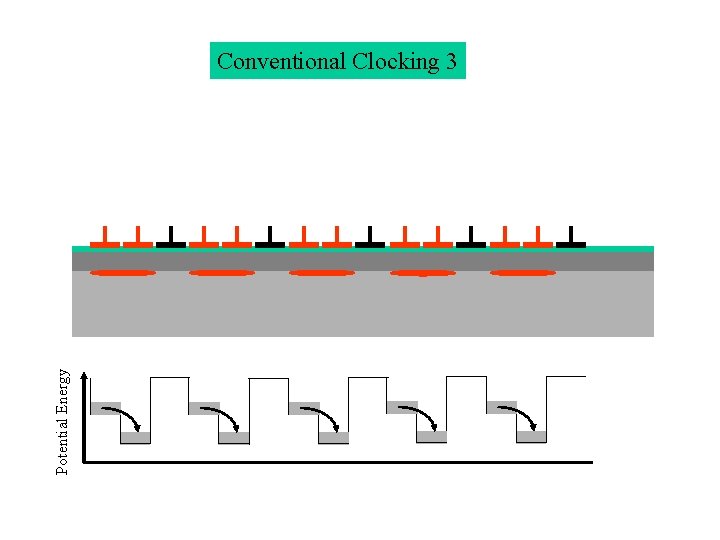
Potential Energy Conventional Clocking 3
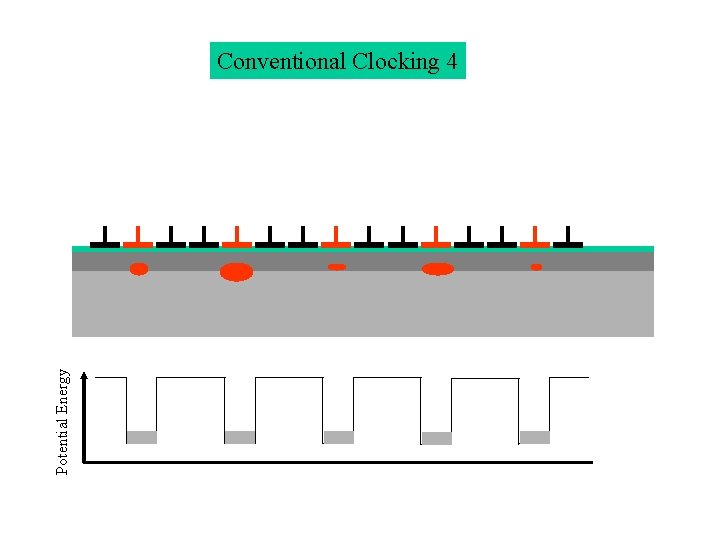
Potential Energy Conventional Clocking 4
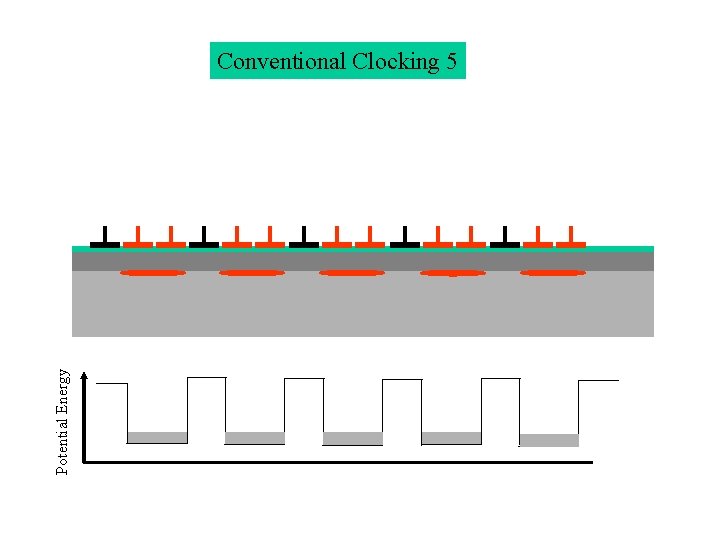
Potential Energy Conventional Clocking 5
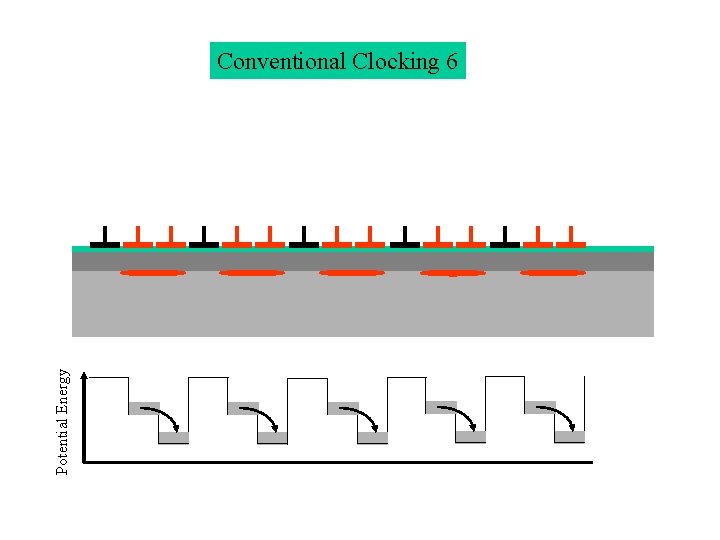
Potential Energy Conventional Clocking 6
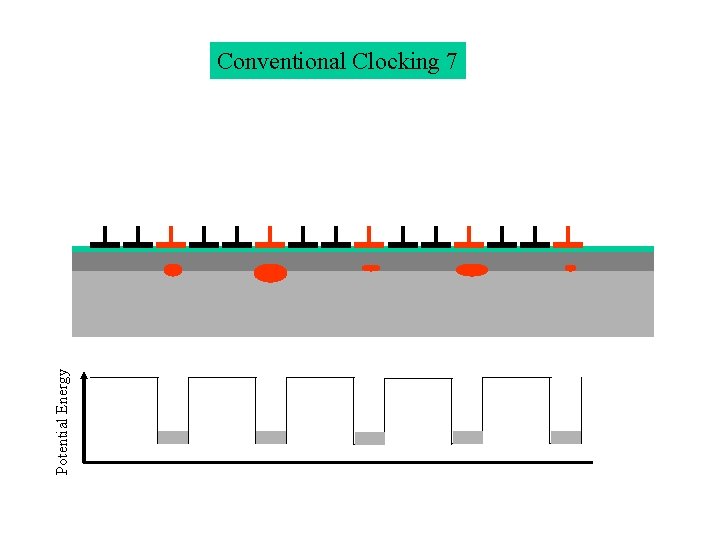
Potential Energy Conventional Clocking 7
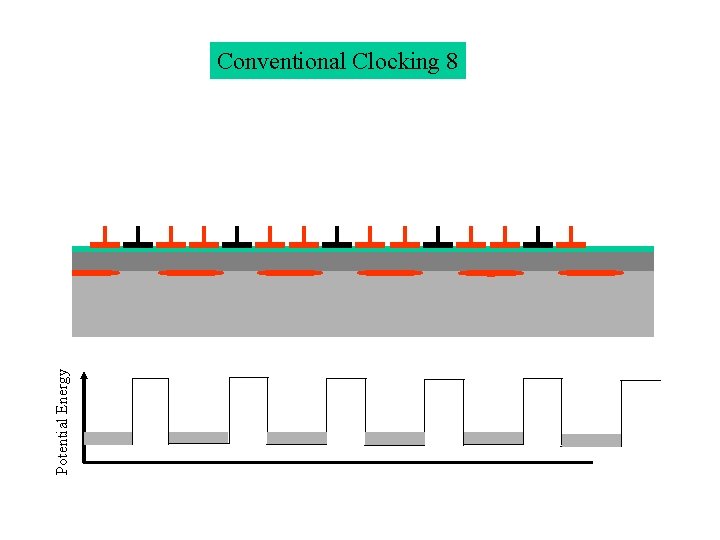
Potential Energy Conventional Clocking 8
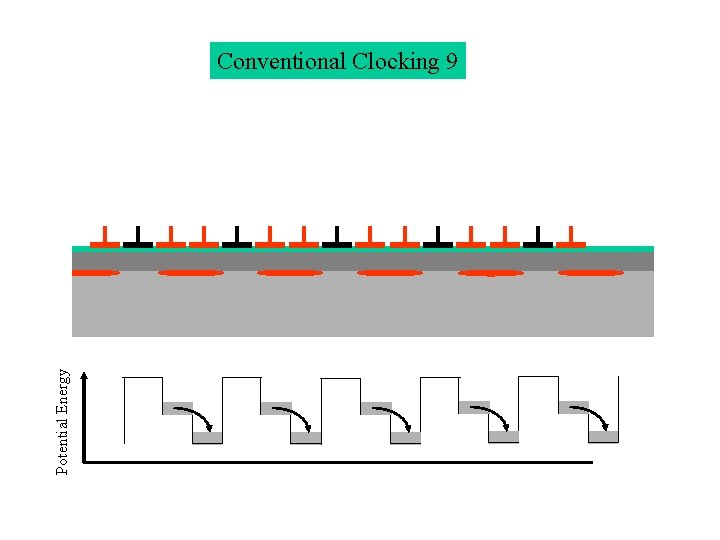
Potential Energy Conventional Clocking 9
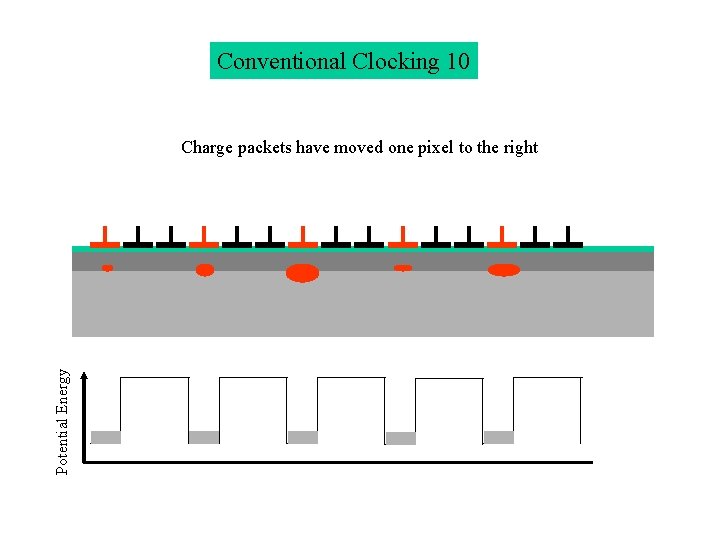
Conventional Clocking 10 Potential Energy Charge packets have moved one pixel to the right
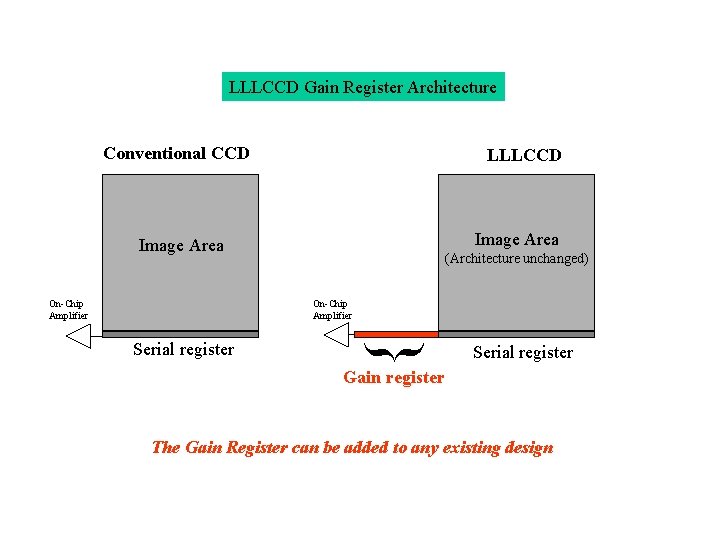
LLLCCD Gain Register Architecture Conventional CCD LLLCCD Image Area On-Chip Amplifier Serial register { On-Chip Amplifier (Architecture unchanged) Serial register Gain register The Gain Register can be added to any existing design
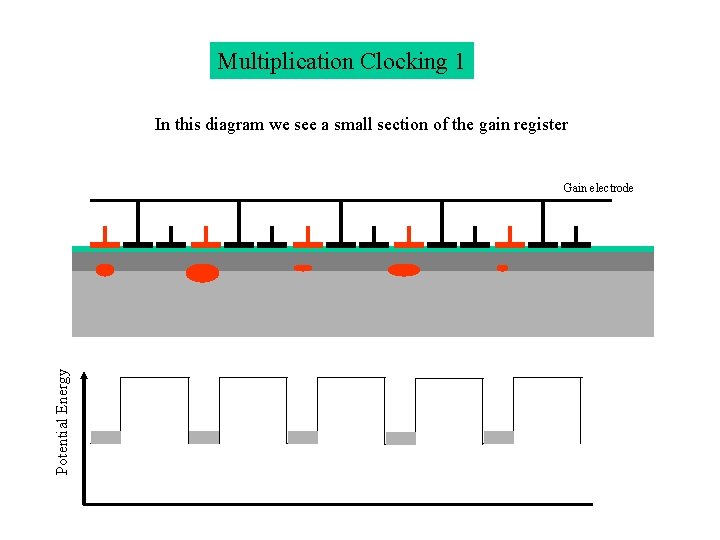
Multiplication Clocking 1 In this diagram we see a small section of the gain register Potential Energy Gain electrode
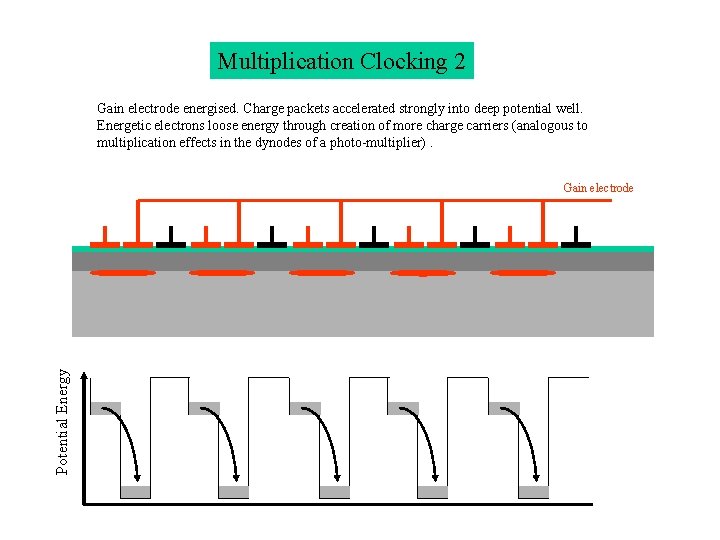
Multiplication Clocking 2 Gain electrode energised. Charge packets accelerated strongly into deep potential well. Energetic electrons loose energy through creation of more charge carriers (analogous to multiplication effects in the dynodes of a photo-multiplier). Potential Energy Gain electrode
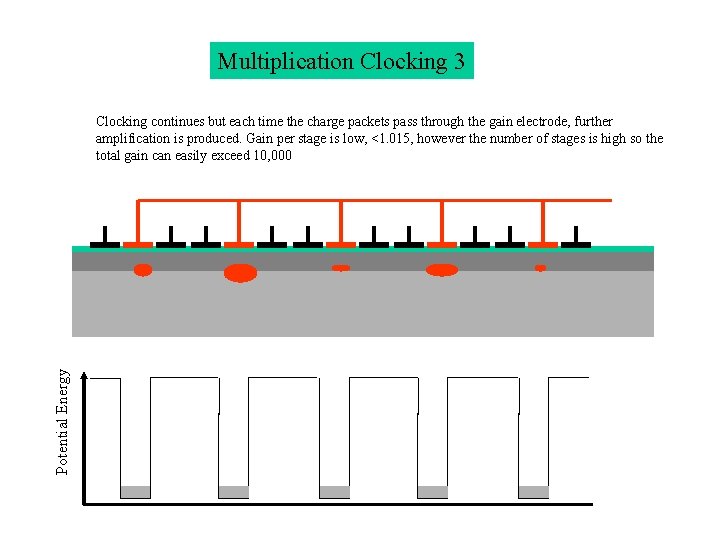
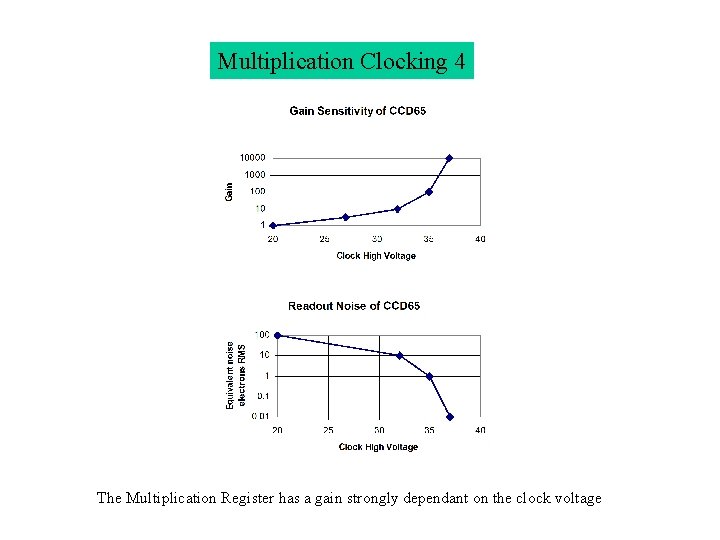
Multiplication Clocking 3 Potential Energy Clocking continues but each time the charge packets pass through the gain electrode, further amplification is produced. Gain per stage is low, <1. 015, however the number of stages is high so the total gain can easily exceed 10, 000
Multiplication Clocking 4 The Multiplication Register has a gain strongly dependant on the clock voltage
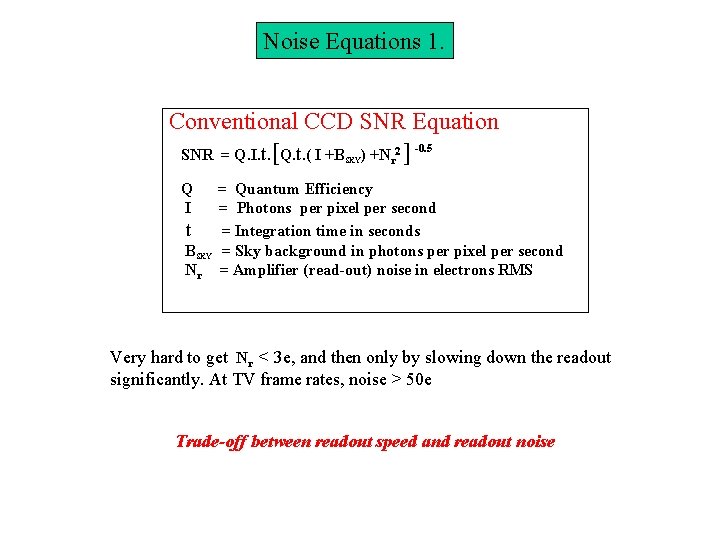
Noise Equations 1. Conventional CCD SNR Equation SNR = Q. I. t. [Q. t. ( I +B ) +Nr 2 ] -0. 5 SKY Q I t BSKY Nr = Quantum Efficiency = Photons per pixel per second = Integration time in seconds = Sky background in photons per pixel per second = Amplifier (read-out) noise in electrons RMS Very hard to get Nr < 3 e, and then only by slowing down the readout significantly. At TV frame rates, noise > 50 e Trade-off between readout speed and readout noise
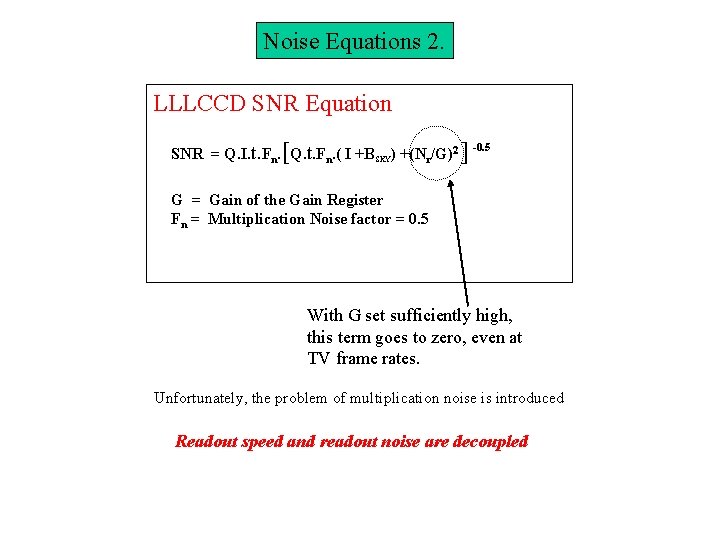
Noise Equations 2. LLLCCD SNR Equation SNR = Q. I. t. Fn. [Q. t. Fn. ( I +BSKY) +(Nr/G)2 ] -0. 5 G = Gain of the Gain Register Fn = Multiplication Noise factor = 0. 5 With G set sufficiently high, this term goes to zero, even at TV frame rates. Unfortunately, the problem of multiplication noise is introduced Readout speed and readout noise are decoupled
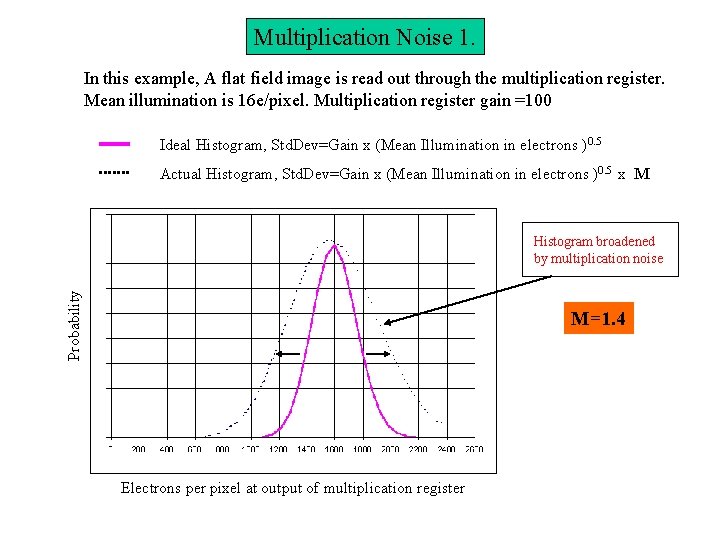
Multiplication Noise 1. In this example, A flat field image is read out through the multiplication register. Mean illumination is 16 e/pixel. Multiplication register gain =100 Ideal Histogram, Std. Dev=Gain x (Mean Illumination in electrons )0. 5 Actual Histogram, Std. Dev=Gain x (Mean Illumination in electrons )0. 5 x M Probability Histogram broadened by multiplication noise M=1. 4 Electrons per pixel at output of multiplication register
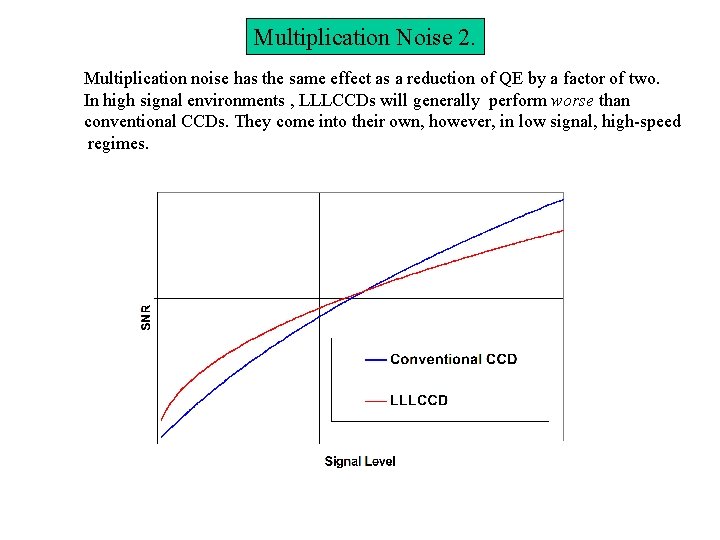
Multiplication Noise 2. Multiplication noise has the same effect as a reduction of QE by a factor of two. In high signal environments , LLLCCDs will generally perform worse than conventional CCDs. They come into their own, however, in low signal, high-speed regimes.
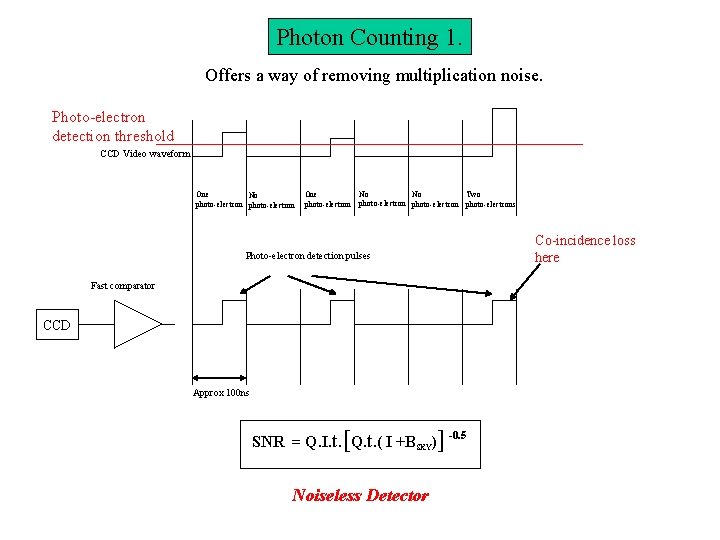
Photon Counting 1. Offers a way of removing multiplication noise. Photo-electron detection threshold CCD Video waveform One No photo-electron One photo-electron No No Two photo-electrons Photo-electron detection pulses Fast comparator CCD Approx 100 ns SNR = Q. I. t. [Q. t. ( I +BSKY)] -0. 5 Noiseless Detector Co-incidence loss here
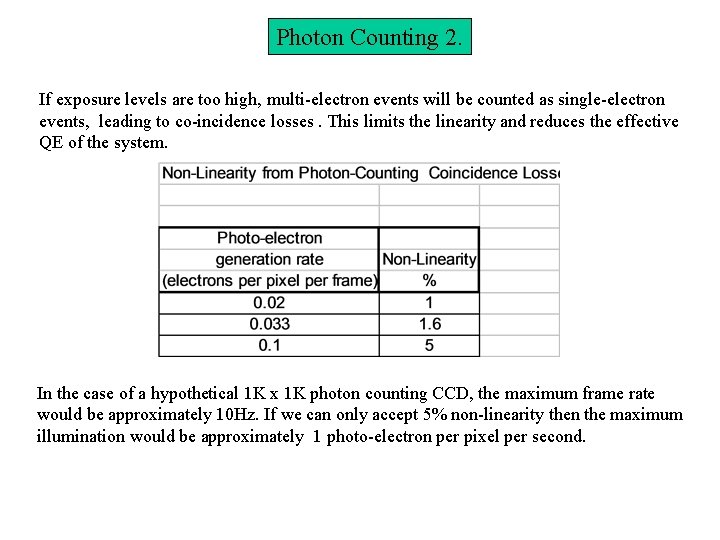
Photon Counting 2. If exposure levels are too high, multi-electron events will be counted as single-electron events, leading to co-incidence losses. This limits the linearity and reduces the effective QE of the system. In the case of a hypothetical 1 K x 1 K photon counting CCD, the maximum frame rate would be approximately 10 Hz. If we can only accept 5% non-linearity then the maximum illumination would be approximately 1 photo-electron per pixel per second.
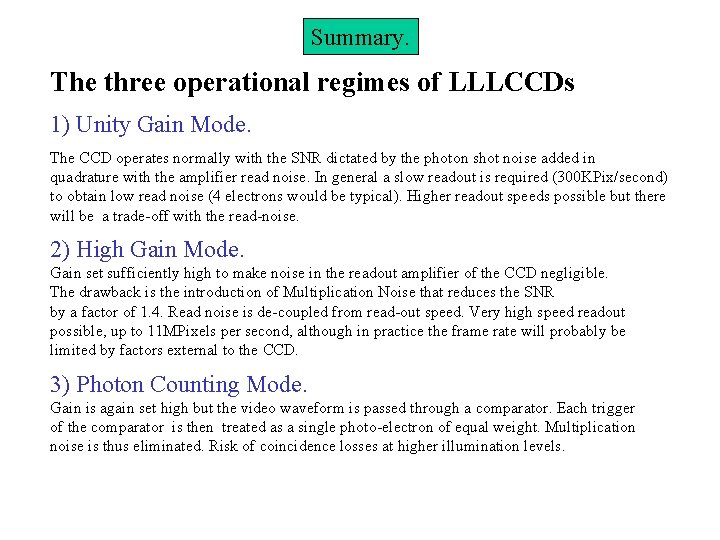
Summary. The three operational regimes of LLLCCDs 1) Unity Gain Mode. The CCD operates normally with the SNR dictated by the photon shot noise added in quadrature with the amplifier read noise. In general a slow readout is required (300 KPix/second) to obtain low read noise (4 electrons would be typical). Higher readout speeds possible but there will be a trade-off with the read-noise. 2) High Gain Mode. Gain set sufficiently high to make noise in the readout amplifier of the CCD negligible. The drawback is the introduction of Multiplication Noise that reduces the SNR by a factor of 1. 4. Read noise is de-coupled from read-out speed. Very high speed readout possible, up to 11 MPixels per second, although in practice the frame rate will probably be limited by factors external to the CCD. 3) Photon Counting Mode. Gain is again set high but the video waveform is passed through a comparator. Each trigger of the comparator is then treated as a single photo-electron of equal weight. Multiplication noise is thus eliminated. Risk of coincidence losses at higher illumination levels.
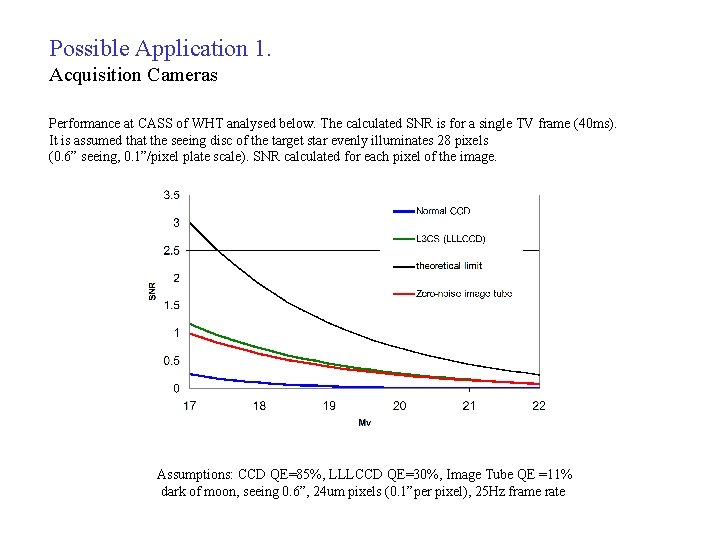
Possible Application 1. Acquisition Cameras Performance at CASS of WHT analysed below. The calculated SNR is for a single TV frame (40 ms). It is assumed that the seeing disc of the target star evenly illuminates 28 pixels (0. 6” seeing, 0. 1”/pixel plate scale). SNR calculated for each pixel of the image. Assumptions: CCD QE=85%, LLLCCD QE=30%, Image Tube QE =11% dark of moon, seeing 0. 6”, 24 um pixels (0. 1”per pixel), 25 Hz frame rate
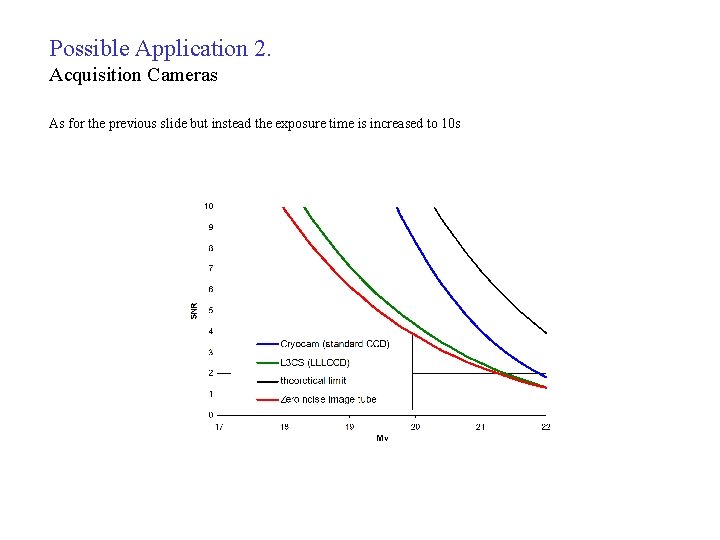
Possible Application 2. Acquisition Cameras As for the previous slide but instead the exposure time is increased to 10 s
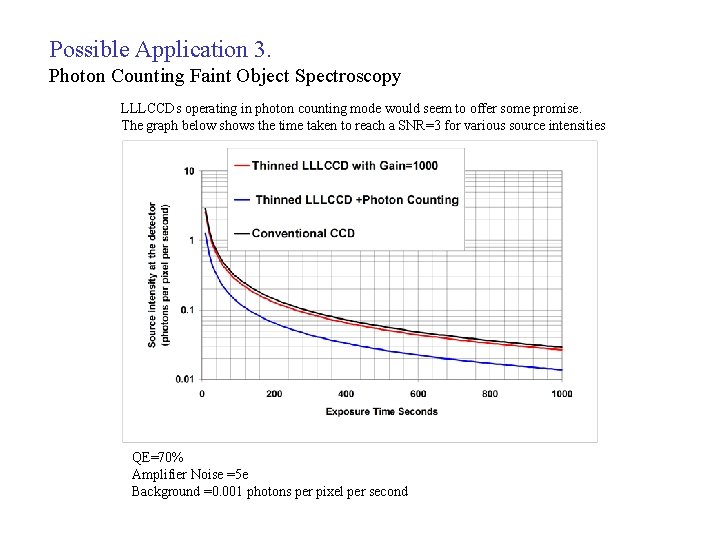
Possible Application 3. Photon Counting Faint Object Spectroscopy LLLCCDs operating in photon counting mode would seem to offer some promise. The graph below shows the time taken to reach a SNR=3 for various source intensities QE=70% Amplifier Noise =5 e Background =0. 001 photons per pixel per second
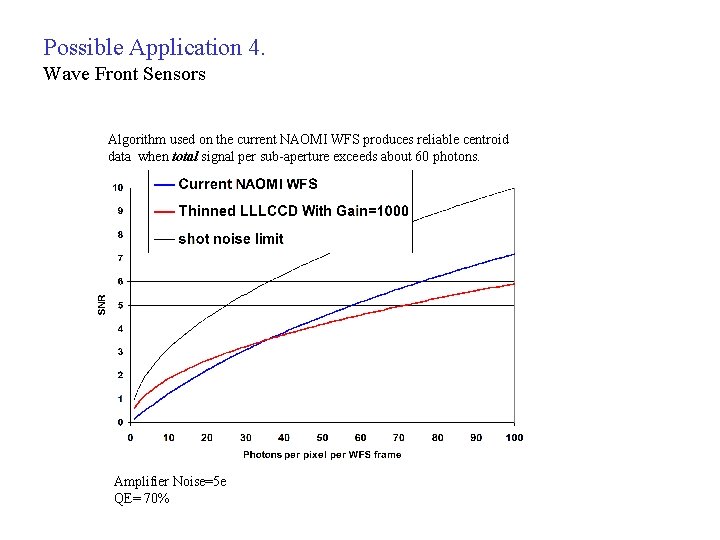
Possible Application 4. Wave Front Sensors Algorithm used on the current NAOMI WFS produces reliable centroid data when total signal per sub-aperture exceeds about 60 photons. Amplifier Noise=5 e QE= 70%
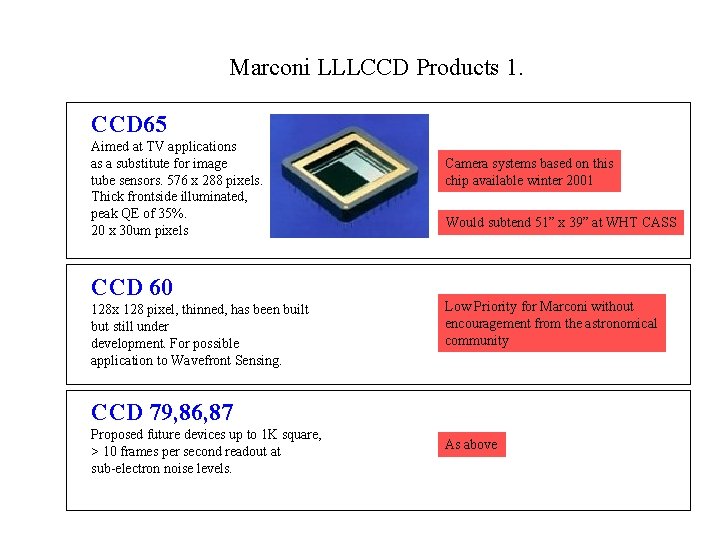
Marconi LLLCCD Products 1. CCD 65 Aimed at TV applications as a substitute for image tube sensors. 576 x 288 pixels. Thick frontside illuminated, peak QE of 35%. 20 x 30 um pixels CCD 60 128 x 128 pixel, thinned, has been built but still under development. For possible application to Wavefront Sensing. Camera systems based on this chip available winter 2001 Would subtend 51” x 39” at WHT CASS Low Priority for Marconi without encouragement from the astronomical community CCD 79, 86, 87 Proposed future devices up to 1 K square, > 10 frames per second readout at sub-electron noise levels. As above
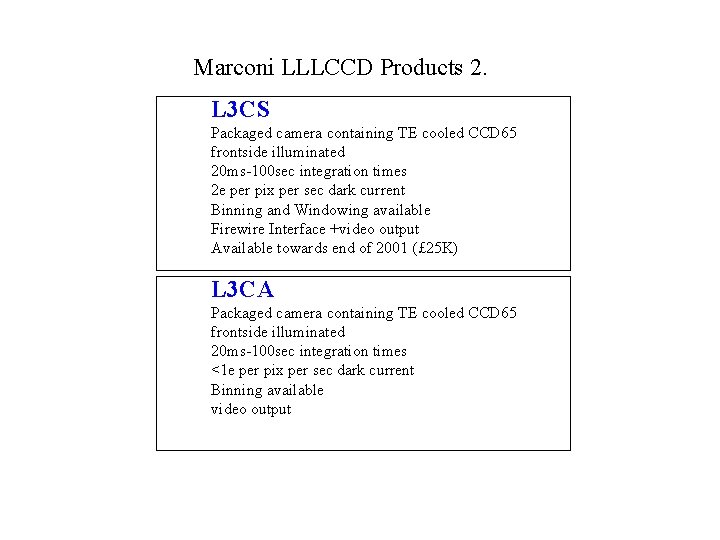
Marconi LLLCCD Products 2. L 3 CS Packaged camera containing TE cooled CCD 65 frontside illuminated 20 ms-100 sec integration times 2 e per pix per sec dark current Binning and Windowing available Firewire Interface +video output Available towards end of 2001 (£ 25 K) L 3 CA Packaged camera containing TE cooled CCD 65 frontside illuminated 20 ms-100 sec integration times <1 e per pix per sec dark current Binning available video output
Lecture slides available on the ING web: http: //www. ing. iac. es/~smt/LLLCCD/lllccd. htm