
CCAP A Strategic Tool for Managing Capacity of
![Inter-Cell Interference l Parameters needed: – m: Path Loss Exponent [4] – sigma_s: Standard](https://slidetodoc.com/presentation_image_h2/a8a57c49628095755928c29dcb15dca9/image-16.jpg "Inter-Cell Interference l Parameters needed: – m: Path Loss Exponent [4] – sigma_s: Standard")
![Subscriber Performance l Parameters needed: – erl_user: user load in Erlangs [0. 025] –](https://slidetodoc.com/presentation_image_h2/a8a57c49628095755928c29dcb15dca9/image-19.jpg "Subscriber Performance l Parameters needed: – erl_user: user load in Erlangs [0. 025] –")
- Slides: 25
CCAP: A Strategic Tool for Managing Capacity of CDMA Networks Teleware Co. Ltd. in cooperation with Washington University, Saint Louis, Missouri, USA
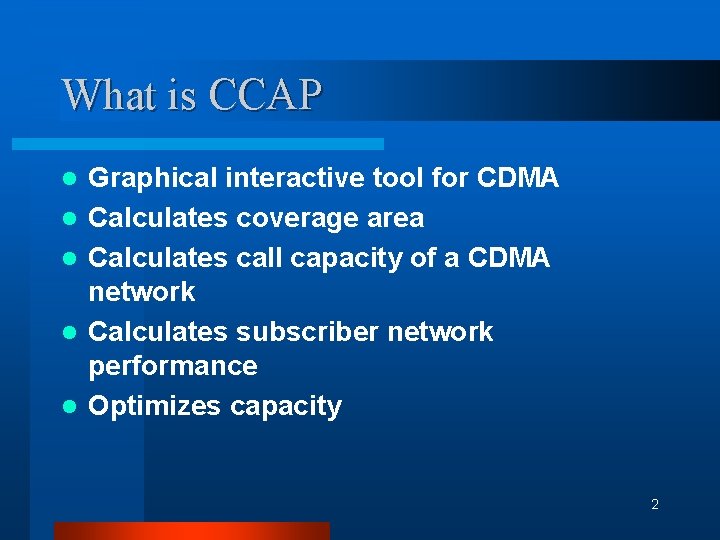
What is CCAP l l l Graphical interactive tool for CDMA Calculates coverage area Calculates call capacity of a CDMA network Calculates subscriber network performance Optimizes capacity 2
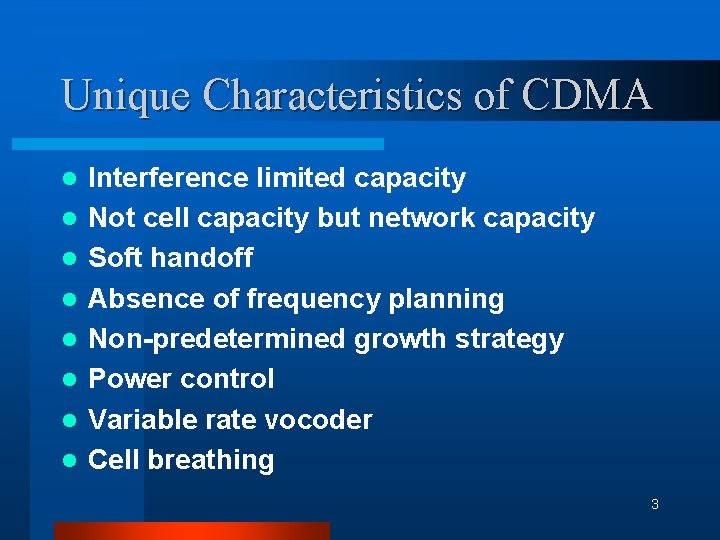
Unique Characteristics of CDMA l l l l Interference limited capacity Not cell capacity but network capacity Soft handoff Absence of frequency planning Non-predetermined growth strategy Power control Variable rate vocoder Cell breathing 3
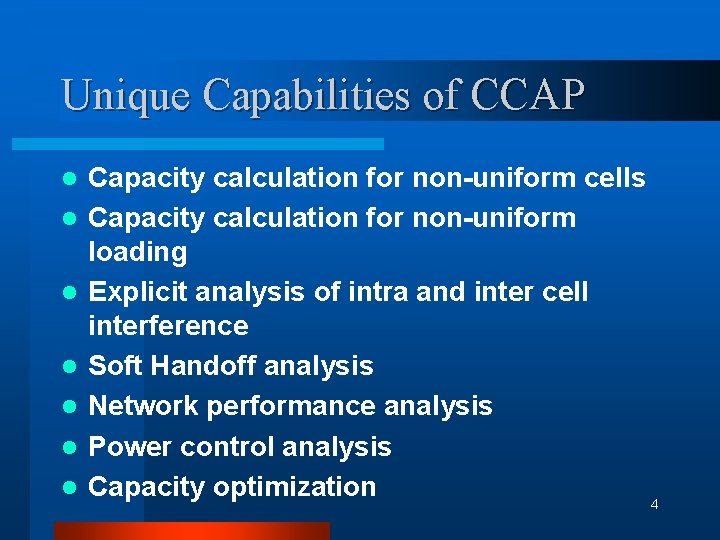
Unique Capabilities of CCAP l l l l Capacity calculation for non-uniform cells Capacity calculation for non-uniform loading Explicit analysis of intra and inter cell interference Soft Handoff analysis Network performance analysis Power control analysis Capacity optimization 4
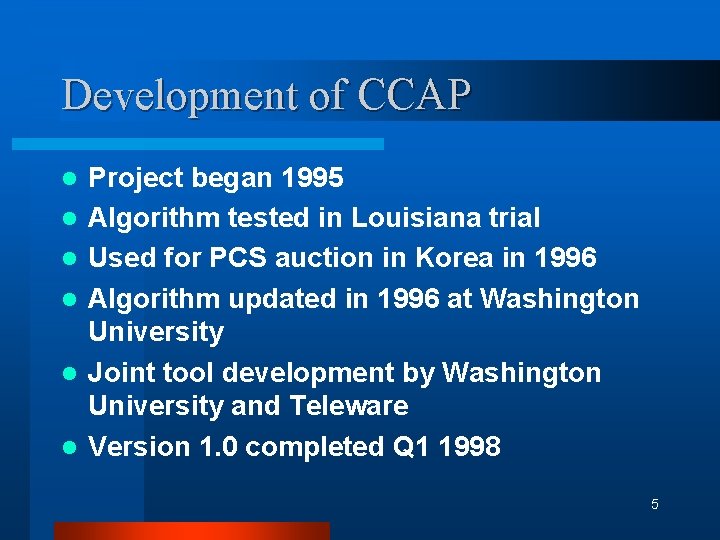
Development of CCAP l l l Project began 1995 Algorithm tested in Louisiana trial Used for PCS auction in Korea in 1996 Algorithm updated in 1996 at Washington University Joint tool development by Washington University and Teleware Version 1. 0 completed Q 1 1998 5
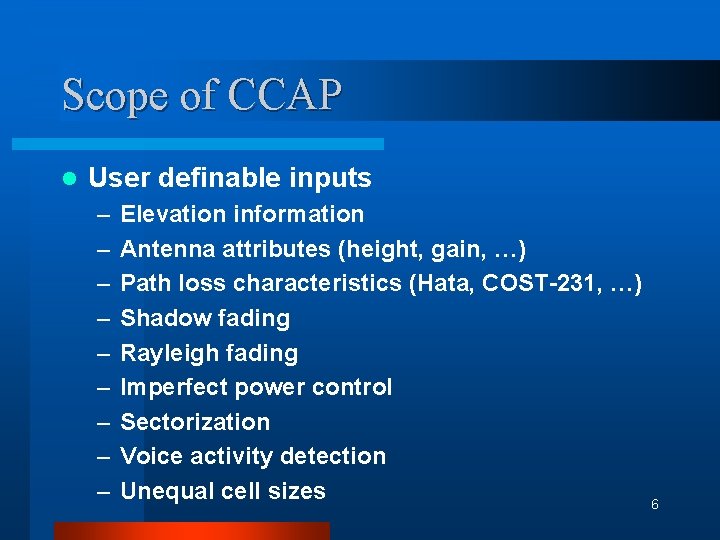
Scope of CCAP l User definable inputs – – – – – Elevation information Antenna attributes (height, gain, …) Path loss characteristics (Hata, COST-231, …) Shadow fading Rayleigh fading Imperfect power control Sectorization Voice activity detection Unequal cell sizes 6
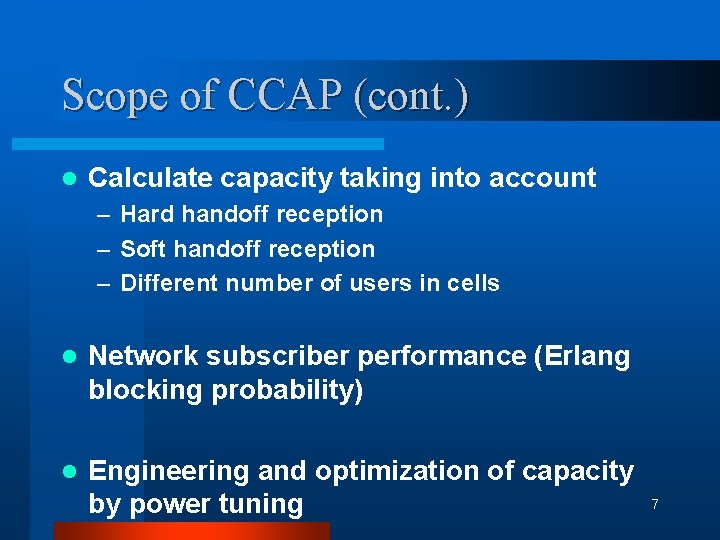
Scope of CCAP (cont. ) l Calculate capacity taking into account – Hard handoff reception – Soft handoff reception – Different number of users in cells l Network subscriber performance (Erlang blocking probability) l Engineering and optimization of capacity by power tuning 7
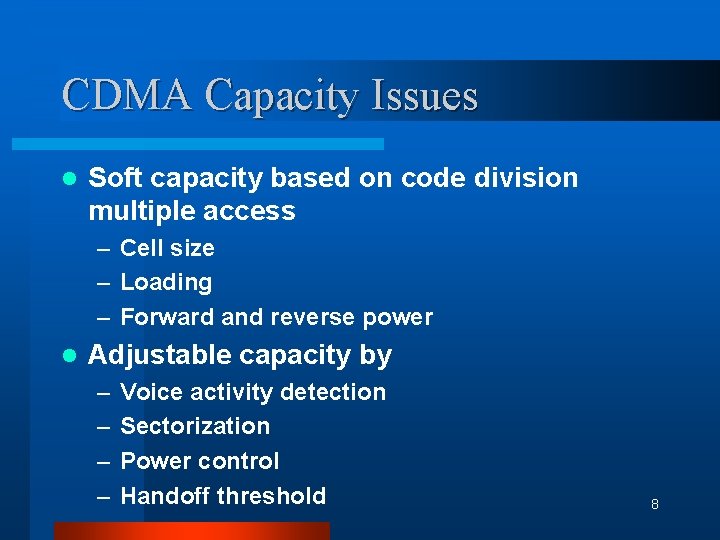
CDMA Capacity Issues l Soft capacity based on code division multiple access – Cell size – Loading – Forward and reverse power l Adjustable capacity by – – Voice activity detection Sectorization Power control Handoff threshold 8
CDMA Capacity Issues (cont. ) l Power control: transmitted signal power of mobiles are received at the base station with the same value – Open loop: Input from the base station is measured at the mobile – Closed loop: Power of the mobile user as received at the base station is measured. The mobile is told to increase or decrease the transmitted power and by how much. 9
CDMA Capacity Issues (cont. ) l Path loss models: mean signal strength as a function of distance – Hata model – COST-231 l Multipath Fading: replicas of the signal arrive at the receiver 10
CDMA Capacity Issues (cont. ) l Shadow fading: is modeled by a log normal distribution l Rayleigh fading: fast-fluctuations around those resulting from perturbations caused by shadow fading 11
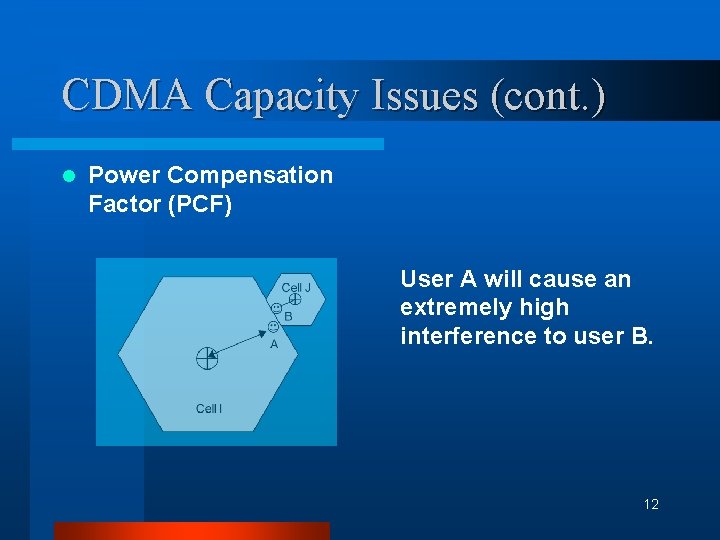
CDMA Capacity Issues (cont. ) l Power Compensation Factor (PCF) User A will cause an extremely high interference to user B. 12
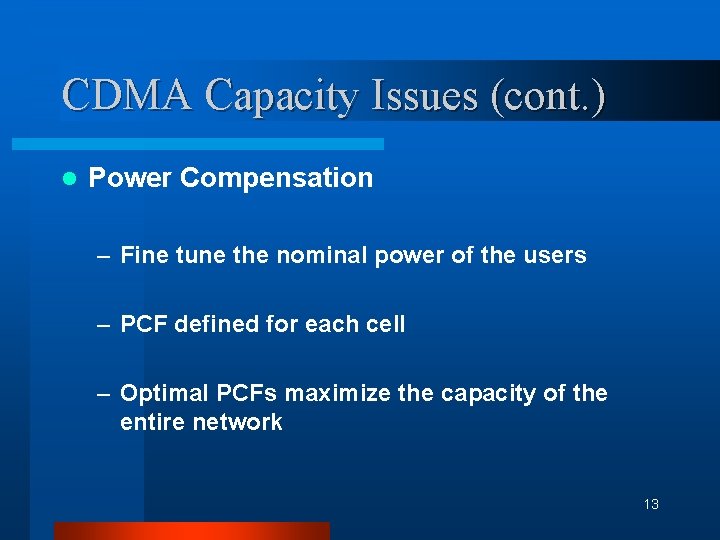
CDMA Capacity Issues (cont. ) l Power Compensation – Fine tune the nominal power of the users – PCF defined for each cell – Optimal PCFs maximize the capacity of the entire network 13
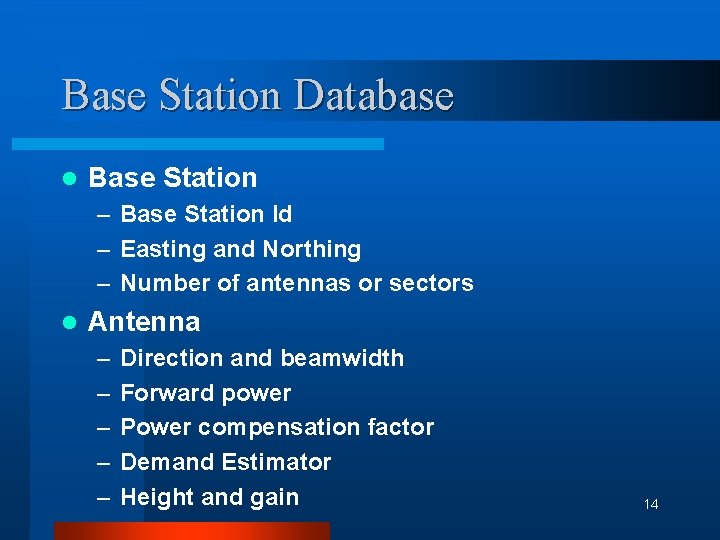
Base Station Database l Base Station – Base Station Id – Easting and Northing – Number of antennas or sectors l Antenna – – – Direction and beamwidth Forward power Power compensation factor Demand Estimator Height and gain 14
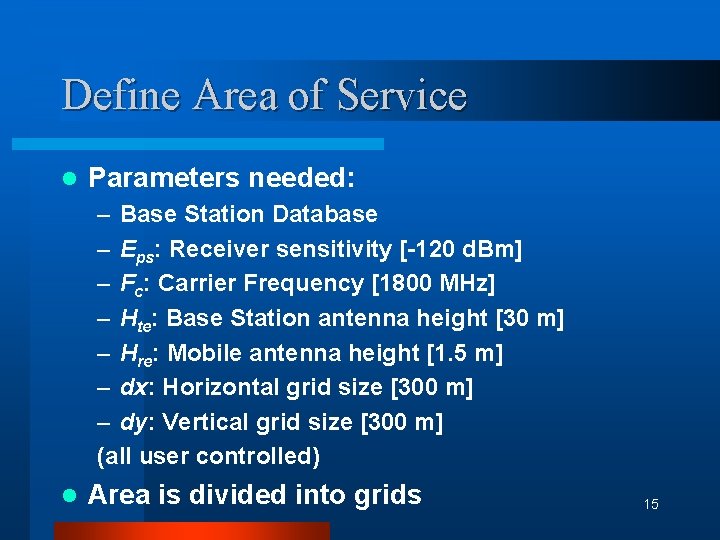
Define Area of Service l Parameters needed: – Base Station Database – Eps: Receiver sensitivity [-120 d. Bm] – Fc: Carrier Frequency [1800 MHz] – Hte: Base Station antenna height [30 m] – Hre: Mobile antenna height [1. 5 m] – dx: Horizontal grid size [300 m] – dy: Vertical grid size [300 m] (all user controlled) l Area is divided into grids 15
Inter-Cell Interference l Parameters needed: – m: Path Loss Exponent [4] – sigma_s: Standard deviation for the shadow fading [6 d. B] – Rayleigh: [0] for off [1] for on – Alpha: Total number of users in a cell divided by the minimum number of users in every cell. l Fij: interference of cell I on cell J is obtained. 16
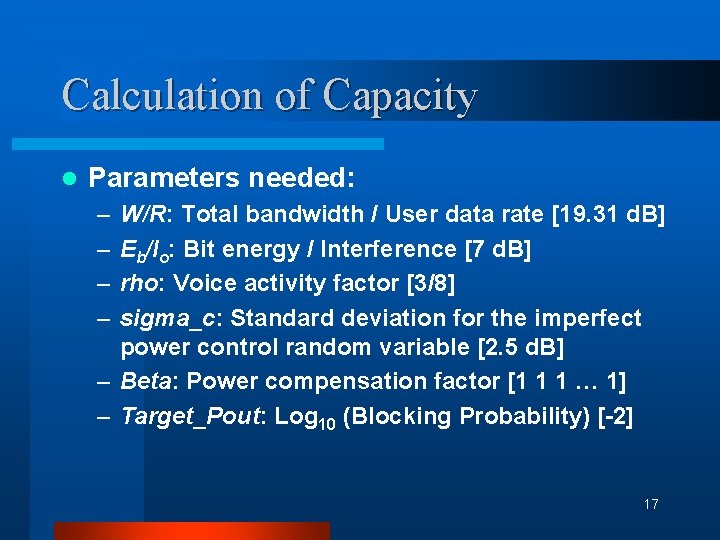
Calculation of Capacity l Parameters needed: – – W/R: Total bandwidth / User data rate [19. 31 d. B] Eb/Io: Bit energy / Interference [7 d. B] rho: Voice activity factor [3/8] sigma_c: Standard deviation for the imperfect power control random variable [2. 5 d. B] – Beta: Power compensation factor [1 1 1 … 1] – Target_Pout: Log 10 (Blocking Probability) [-2] 17
Calculation of Capacity (cont. ) l Call capacity is calculated for each cell. l Smallest value defines the capacity of the network. 18
Subscriber Performance l Parameters needed: – erl_user: user load in Erlangs [0. 025] – N is the number of trunks or channels [1] – B is the blocking probability [0. 01] l Maximum sustainable subscribers per cell l Subscriber network performance 19
Optimizing Capacity l Parameters needed: – Initial Power Control Factor – Same inputs as for capacity calculation l The gradient descent algorithm is used. 20
Considerations for Fading l The inter cell interference - shadow fading and Rayleigh fading l Power control overcomes both large scale path loss and shadow fading but not Rayleigh fading 21
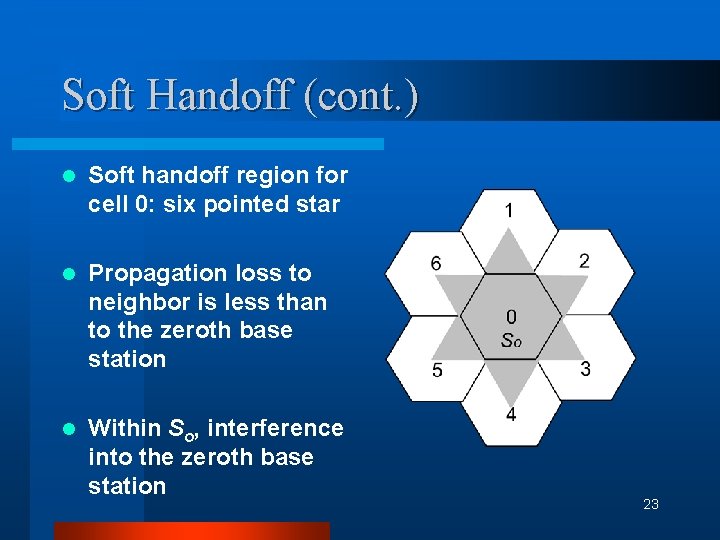
Soft Handoff l User is permitted to be in soft handoff to its two nearest cells. l Better frame received by either base station is accepted by the network. 22
Soft Handoff (cont. ) l Soft handoff region for cell 0: six pointed star l Propagation loss to neighbor is less than to the zeroth base station l Within So, interference into the zeroth base station 23
Power Compensation Factor Initial default value is 1 for every cell l Optimize capacity by optimizing the PCF l New PCF is the factor that the nominal power needs to be increased by for every cell l Each PCF is used by its Base Station in the Closed Loop Power Control l 24
CCAP Report l Interference pattern l Call capacity l Optimal power control factors l Optimal capacity l Subscriber network performance 25