
CC 5212 1 PROCESAMIENTO MASIVO DE DATOS OTOO

![Bigtable: an idea of performance [2006] • Values are 1 Kb in size (blocks](https://slidetodoc.com/presentation_image/135d9a2104454659925f816e3c35c350/image-39.jpg "Bigtable: an idea of performance [2006] • Values are 1 Kb in size (blocks")
![Bigtable: an idea of performance [2006] • Values are 1 Kb in size (blocks](https://slidetodoc.com/presentation_image/135d9a2104454659925f816e3c35c350/image-40.jpg "Bigtable: an idea of performance [2006] • Values are 1 Kb in size (blocks")
![Bigtable: examples in Google [2006]](https://slidetodoc.com/presentation_image/135d9a2104454659925f816e3c35c350/image-41.jpg "Bigtable: examples in Google [2006]")

- Slides: 75
CC 5212 -1 PROCESAMIENTO MASIVO DE DATOS OTOÑO 2016 Lecture 11: No. SQL II Aidan Hogan aidhog@gmail. com
RECAP: NOSQL
No. SQL
No. SQL vs. Relational Databases What are the big differences between relational databases and No. SQL systems? What are the trade-offs?
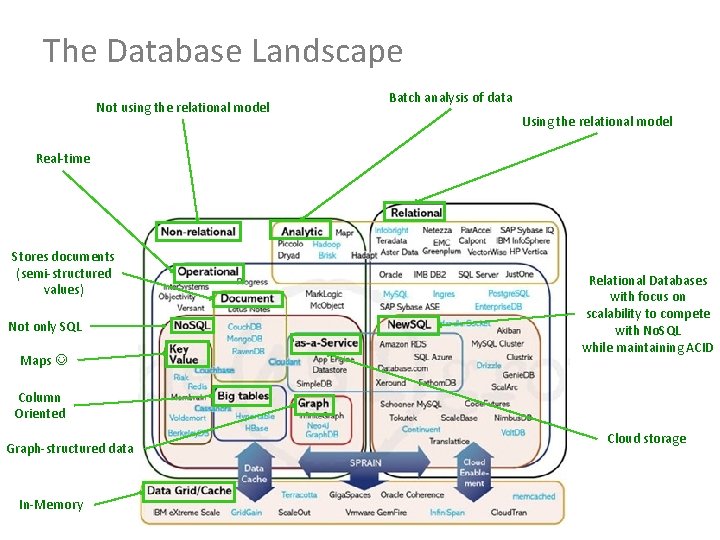
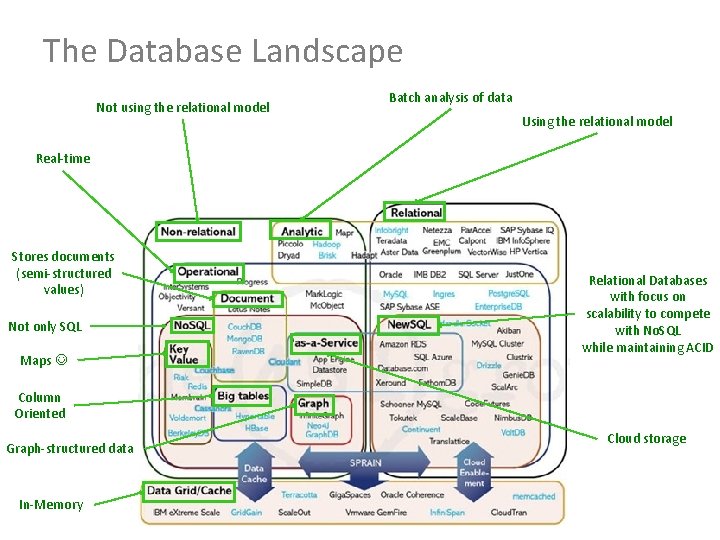
The Database Landscape Not using the relational model Batch analysis of data Using the relational model Real-time Stores documents (semi-structured values) Not only SQL Maps Relational Databases with focus on scalability to compete with No. SQL while maintaining ACID Column Oriented Graph-structured data In-Memory Cloud storage
RECAP: KEY–VALUE
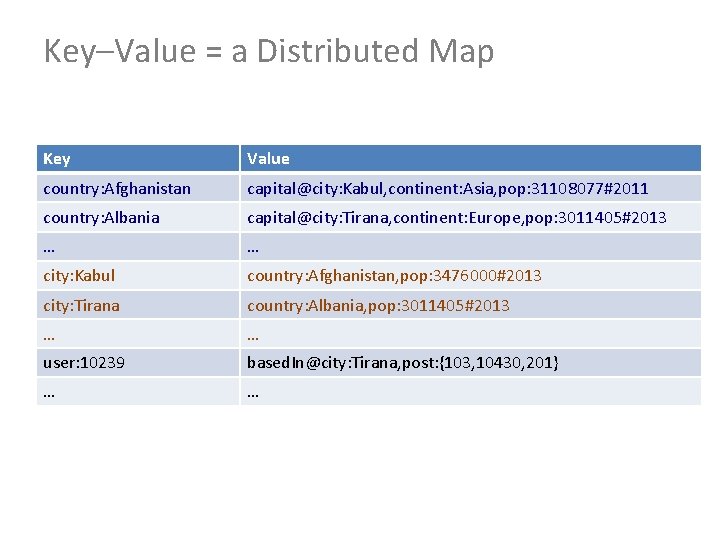
Key–Value = a Distributed Map Key Value country: Afghanistan capital@city: Kabul, continent: Asia, pop: 31108077#2011 country: Albania capital@city: Tirana, continent: Europe, pop: 3011405#2013 … … city: Kabul country: Afghanistan, pop: 3476000#2013 city: Tirana country: Albania, pop: 3011405#2013 … … user: 10239 based. In@city: Tirana, post: {103, 10430, 201} … …
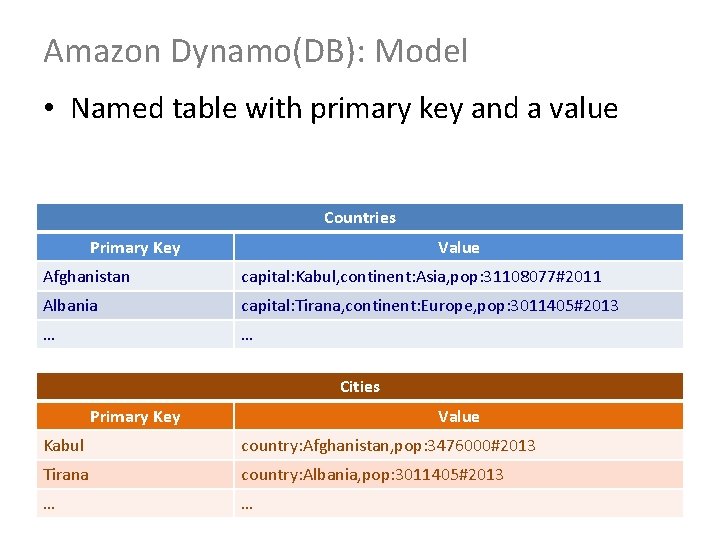
Amazon Dynamo(DB): Model • Named table with primary key and a value Countries Primary Key Value Afghanistan capital: Kabul, continent: Asia, pop: 31108077#2011 Albania capital: Tirana, continent: Europe, pop: 3011405#2013 … … Cities Primary Key Value Kabul country: Afghanistan, pop: 3476000#2013 Tirana country: Albania, pop: 3011405#2013 … …
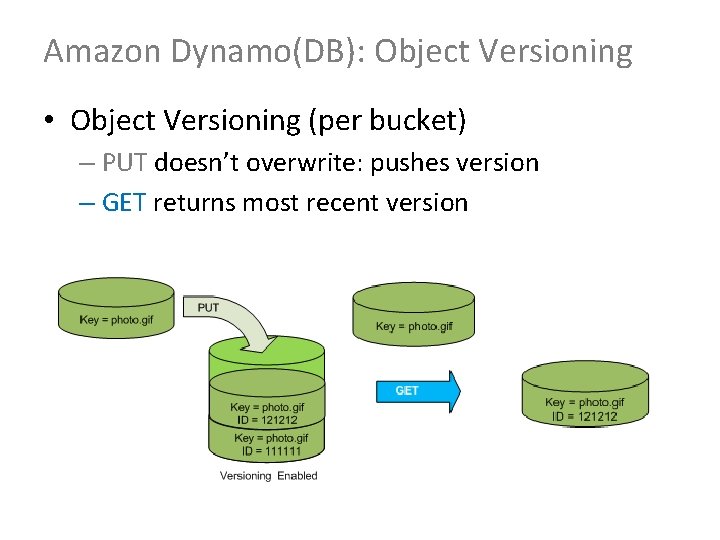
Amazon Dynamo(DB): Object Versioning • Object Versioning (per bucket) – PUT doesn’t overwrite: pushes version – GET returns most recent version
Other Key–Value Stores
RECAP: DOCUMENT STORES
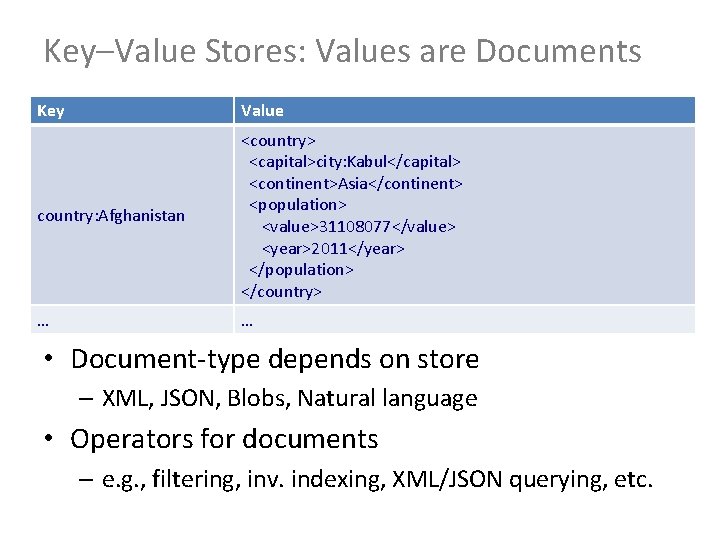
Key–Value Stores: Values are Documents Key Value country: Afghanistan <country> <capital>city: Kabul</capital> <continent>Asia</continent> <population> <value>31108077</value> <year>2011</year> </population> </country> … … • Document-type depends on store – XML, JSON, Blobs, Natural language • Operators for documents – e. g. , filtering, inv. indexing, XML/JSON querying, etc.
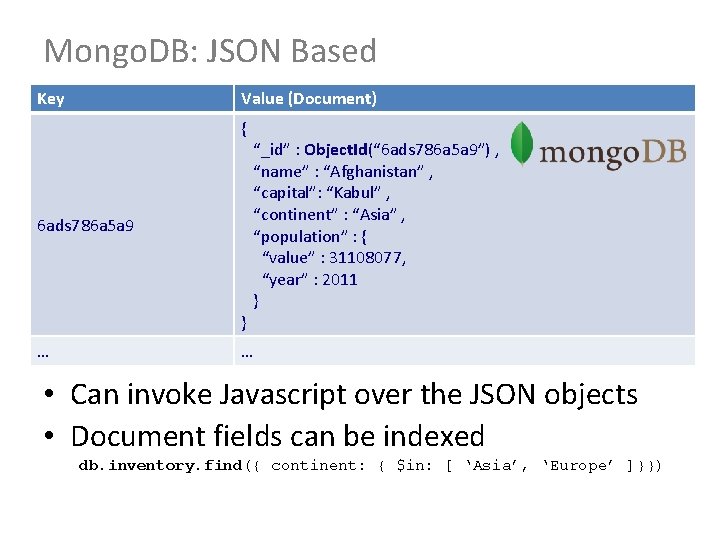
Mongo. DB: JSON Based Key Value (Document) { 6 ads 786 a 5 a 9 o … } “_id” : Object. Id(“ 6 ads 786 a 5 a 9”) , “name” : “Afghanistan” , “capital”: “Kabul” , “continent” : “Asia” , “population” : { “value” : 31108077, “year” : 2011 } … • Can invoke Javascript over the JSON objects • Document fields can be indexed db. inventory. find({ continent: { $in: [ ‘Asia’, ‘Europe’ ]}})
Document Stores
TABLULAR / COLUMN FAMILY
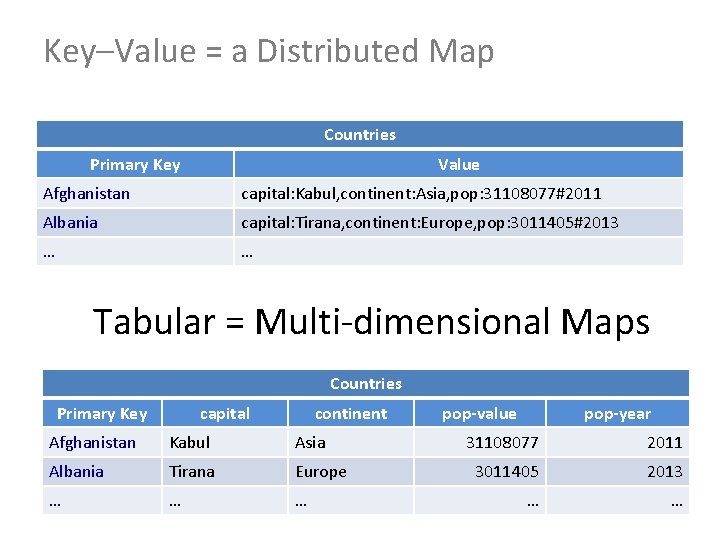
Key–Value = a Distributed Map Countries Primary Key Value Afghanistan capital: Kabul, continent: Asia, pop: 31108077#2011 Albania capital: Tirana, continent: Europe, pop: 3011405#2013 … … Tabular = Multi-dimensional Maps Countries Primary Key capital continent Afghanistan Kabul Asia Albania Tirana Europe … … … pop-value pop-year 31108077 2011 3011405 2013 … …
Bigtable: The Original Whitepaper Why did they write another paper? Map. Reduce solves everything, right? Map. Reduce authors
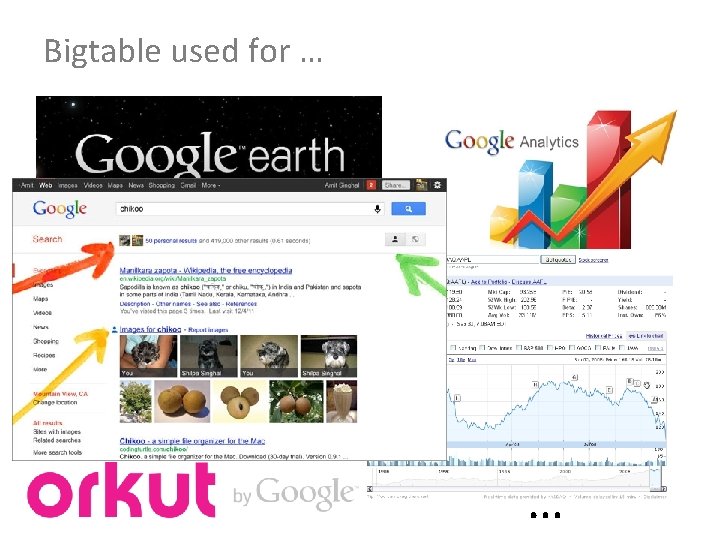
Bigtable used for … …
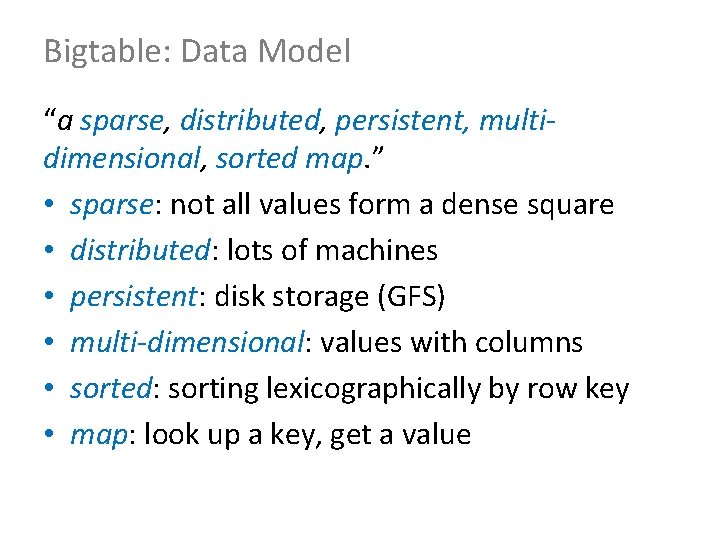
Bigtable: Data Model “a sparse, distributed, persistent, multidimensional, sorted map. ” • sparse: not all values form a dense square • distributed: lots of machines • persistent: disk storage (GFS) • multi-dimensional: values with columns • sorted: sorting lexicographically by row key • map: look up a key, get a value
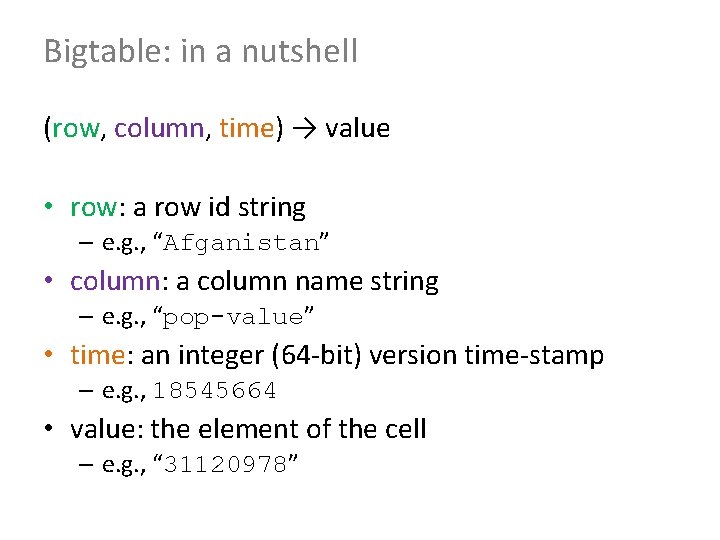
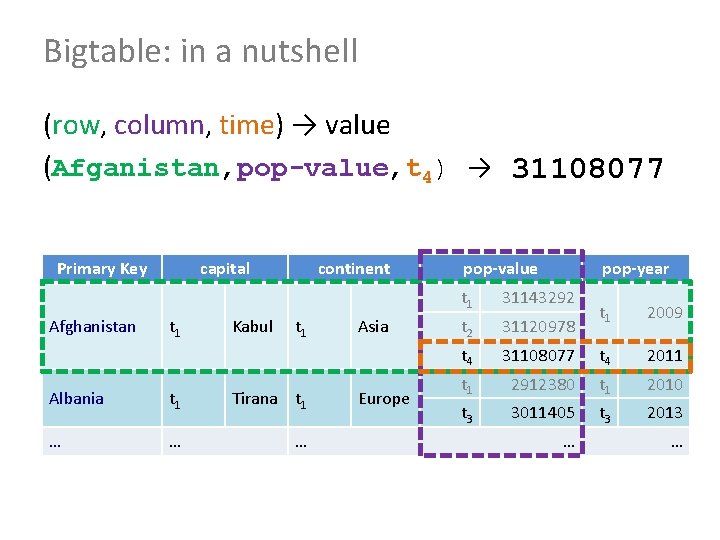
Bigtable: in a nutshell (row, column, time) → value • row: a row id string – e. g. , “Afganistan” • column: a column name string – e. g. , “pop-value” • time: an integer (64 -bit) version time-stamp – e. g. , 18545664 • value: the element of the cell – e. g. , “ 31120978”
Bigtable: in a nutshell (row, column, time) → value (Afganistan, pop-value, t 4) → 31108077 Primary Key Afghanistan capital t 1 Kabul continent t 1 Albania t 1 Tirana t 1 … … … Asia Europe pop-value pop-year t 1 31143292 t 2 31120978 t 4 t 1 2009 31108077 t 4 2011 t 1 2912380 t 1 2010 t 3 3011405 t 3 2013 … …
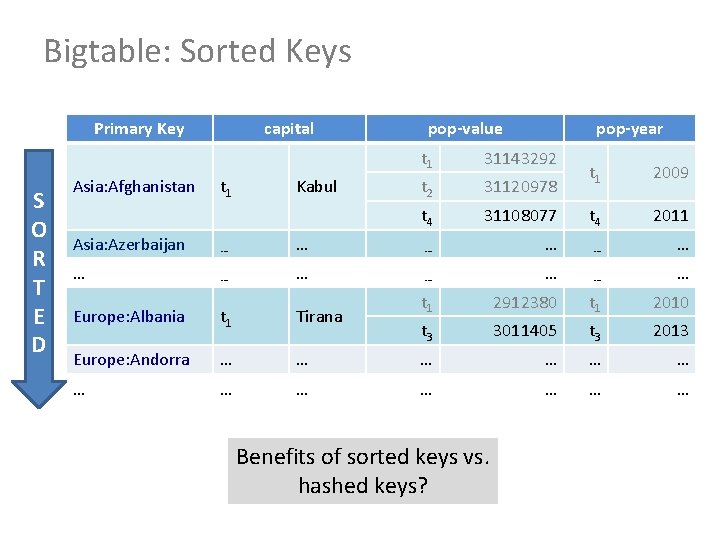
Bigtable: Sorted Keys Primary Key S O R T E D Asia: Afghanistan capital t 1 Kabul pop-value pop-year t 1 31143292 t 2 31120978 t 4 t 1 2009 31108077 t 4 2011 Asia: Azerbaijan … … … … t 1 2912380 t 1 2010 t 3 3011405 t 3 2013 Europe: Albania t 1 Tirana Europe: Andorra … … … … Benefits of sorted keys vs. hashed keys?
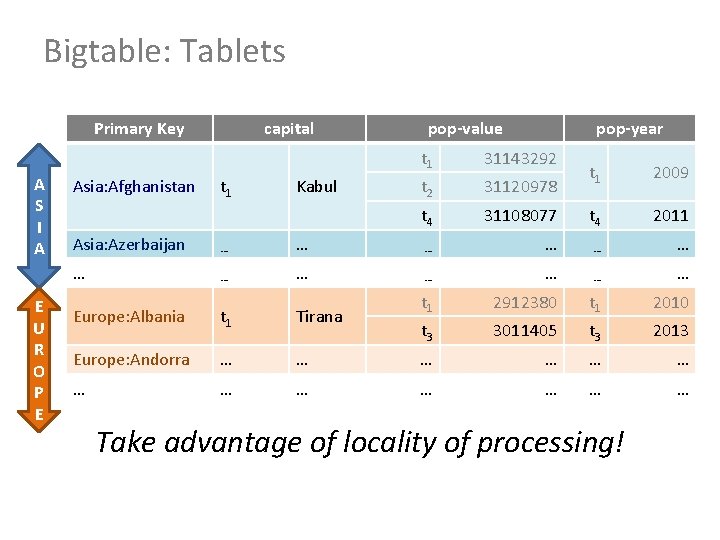
Bigtable: Tablets Primary Key A S I A E U R O P E Asia: Afghanistan capital t 1 Kabul pop-value pop-year t 1 31143292 t 2 31120978 t 4 t 1 2009 31108077 t 4 2011 Asia: Azerbaijan … … … … t 1 2912380 t 1 2010 t 3 3011405 t 3 2013 Europe: Albania t 1 Tirana Europe: Andorra … … … … Take advantage of locality of processing!
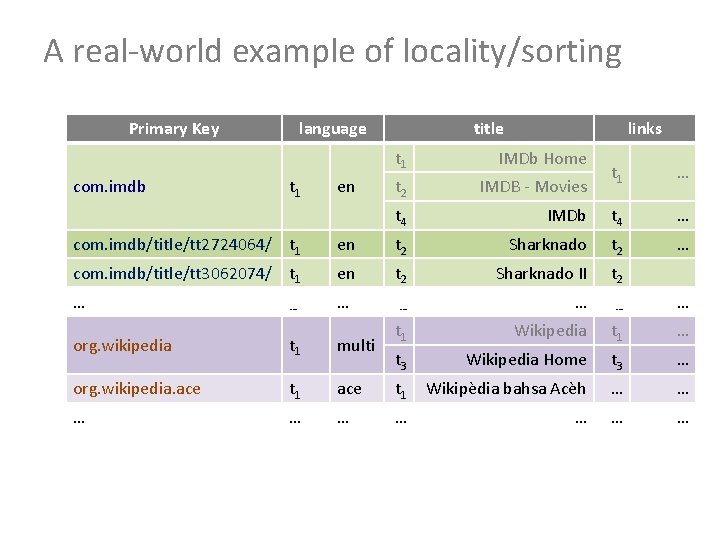
A real-world example of locality/sorting Primary Key com. imdb language t 1 en title links t 1 IMDb Home t 2 IMDB - Movies t 4 t 1 … IMDb t 4 … … com. imdb/title/tt 2724064/ t 1 en t 2 Sharknado t 2 com. imdb/title/tt 3062074/ t 1 en t 2 Sharknado II t 2 … … … … org. wikipedia t 1 multi t 1 Wikipedia t 1 … t 3 Wikipedia Home t 3 … org. wikipedia. ace t 1 Wikipèdia bahsa Acèh … … … … …
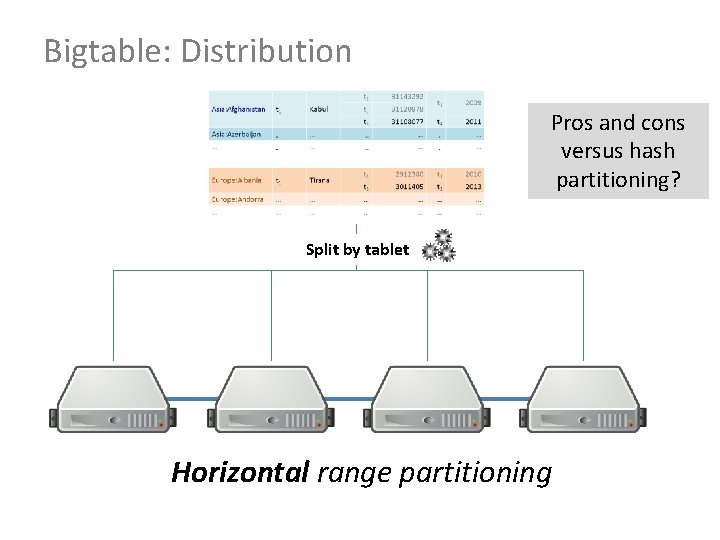
Bigtable: Distribution Pros and cons versus hash partitioning? Split by tablet Horizontal range partitioning
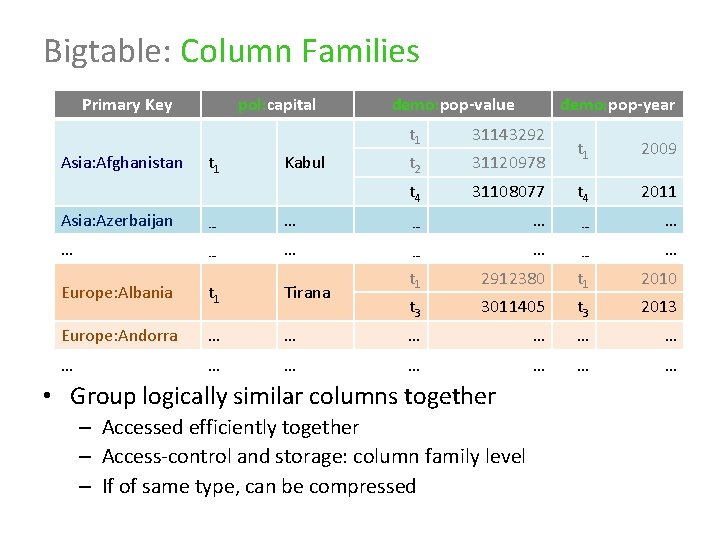
Bigtable: Column Families Primary Key Asia: Afghanistan pol: capital t 1 Kabul demo: pop-value demo: pop-year t 1 31143292 t 2 31120978 t 4 t 1 2009 31108077 t 4 2011 Asia: Azerbaijan … … … … t 1 2912380 t 1 2010 t 3 3011405 t 3 2013 Europe: Albania t 1 Tirana Europe: Andorra … … … … • Group logically similar columns together – Accessed efficiently together – Access-control and storage: column family level – If of same type, can be compressed
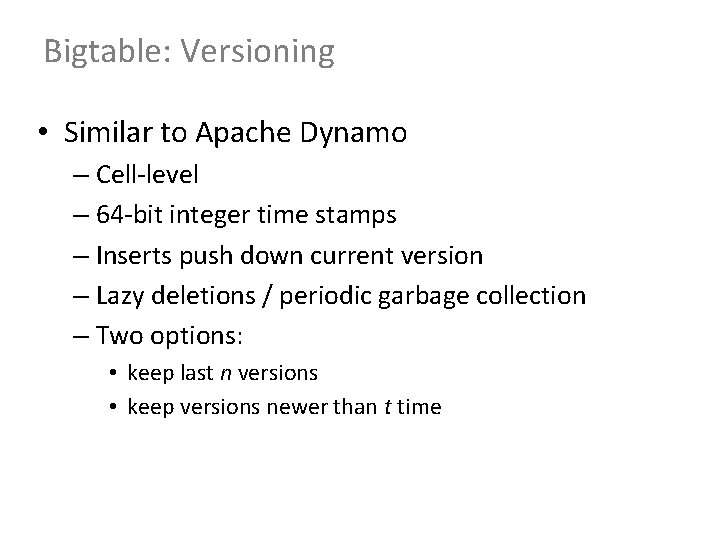
Bigtable: Versioning • Similar to Apache Dynamo – Cell-level – 64 -bit integer time stamps – Inserts push down current version – Lazy deletions / periodic garbage collection – Two options: • keep last n versions • keep versions newer than t time
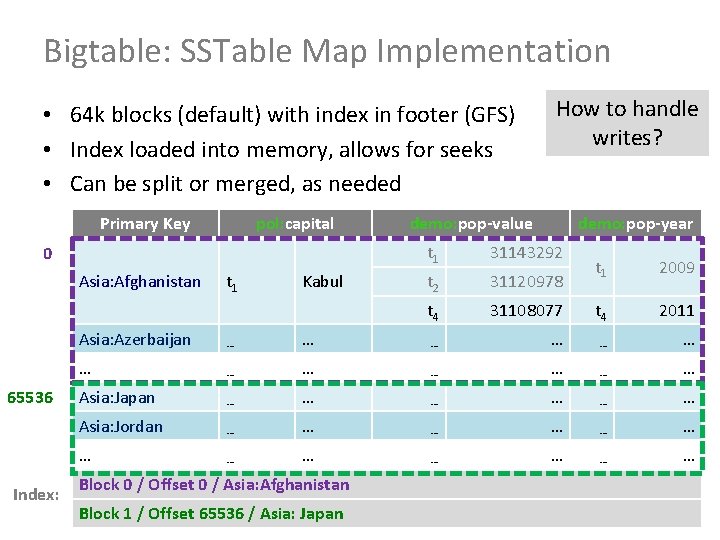
Bigtable: SSTable Map Implementation • 64 k blocks (default) with index in footer (GFS) • Index loaded into memory, allows for seeks • Can be split or merged, as needed Primary Key pol: capital 0 Asia: Afghanistan 65536 Index: t 1 Kabul How to handle writes? demo: pop-value demo: pop-year t 1 31143292 t 2 31120978 t 4 t 1 2009 31108077 t 4 2011 Asia: Azerbaijan … … … … Asia: Japan … … … Asia: Jordan … … … … Block 0 / Offset 0 / Asia: Afghanistan Block 1 / Offset 65536 / Asia: Japan
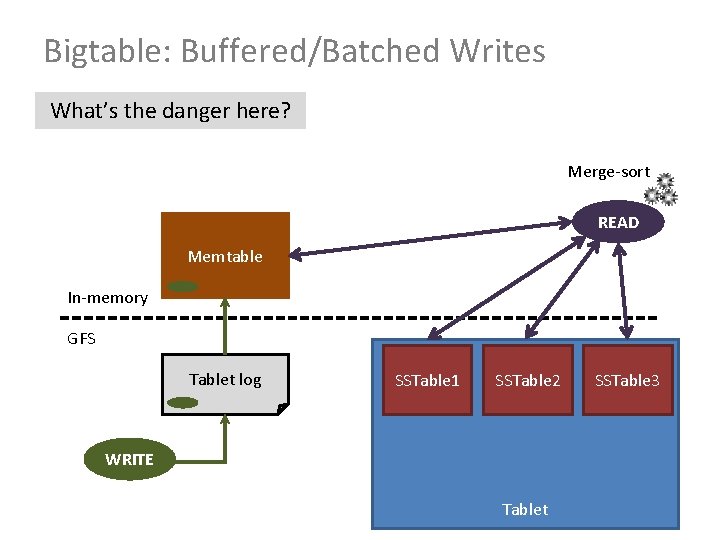
Bigtable: Buffered/Batched Writes What’s the danger here? Merge-sort READ Memtable In-memory GFS Tablet log SSTable 1 SSTable 2 WRITE Tablet SSTable 3
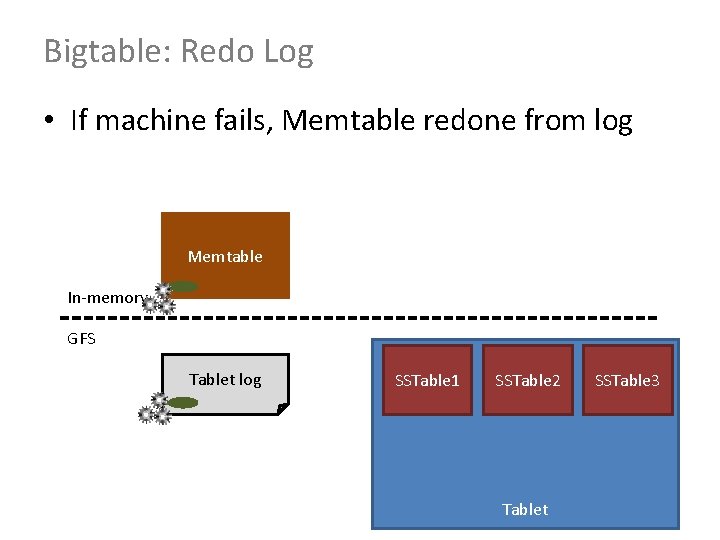
Bigtable: Redo Log • If machine fails, Memtable redone from log Memtable In-memory GFS Tablet log SSTable 1 SSTable 2 Tablet SSTable 3
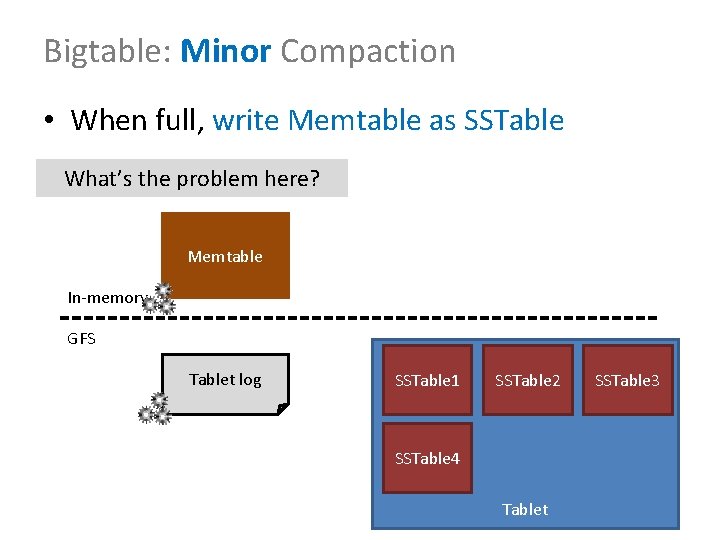
Bigtable: Minor Compaction • When full, write Memtable as SSTable What’s the problem here? Memtable In-memory GFS Tablet log SSTable 1 SSTable 2 SSTable 4 Tablet SSTable 3
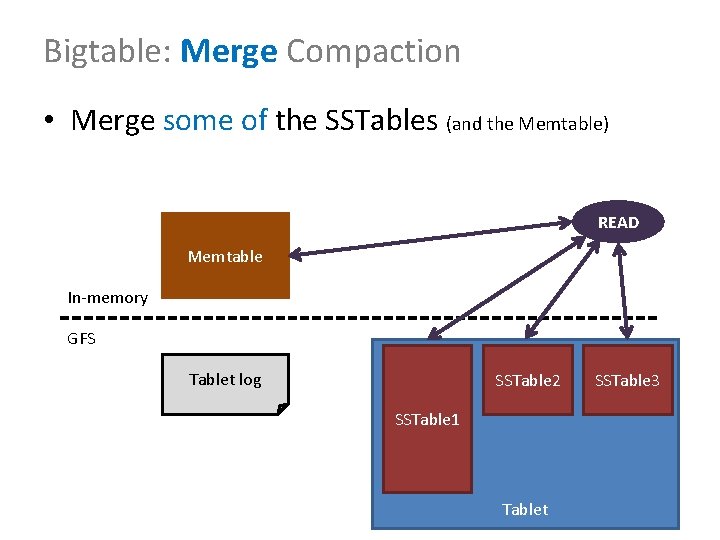
Bigtable: Merge Compaction • Merge some of the SSTables (and the Memtable) READ Memtable In-memory GFS Tablet log SSTable 1 SSTable 2 SSTable 1 SSTable 4 Tablet SSTable 3
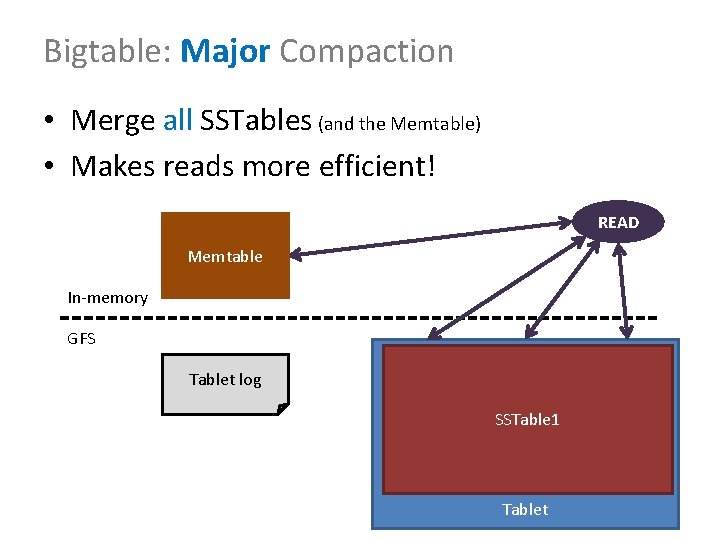
Bigtable: Major Compaction • Merge all SSTables (and the Memtable) • Makes reads more efficient! READ Memtable In-memory GFS Tablet log SSTable 1 SSTable 2 SSTable 1 SSTable 4 Tablet SSTable 3
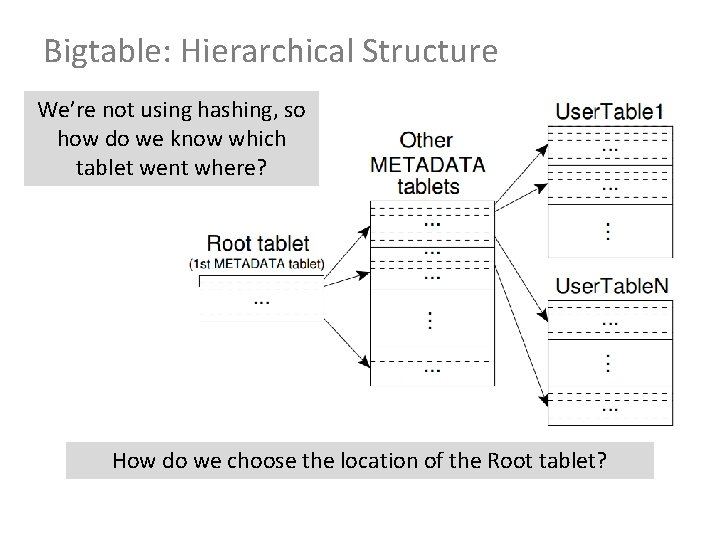
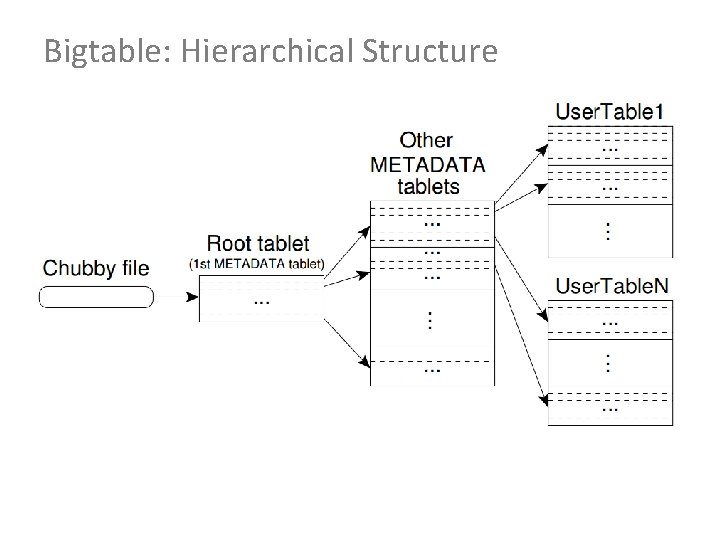
Bigtable: Hierarchical Structure We’re not using hashing, so how do we know which tablet went where? How do we choose the location of the Root tablet?
Bigtable: Hierarchical Structure
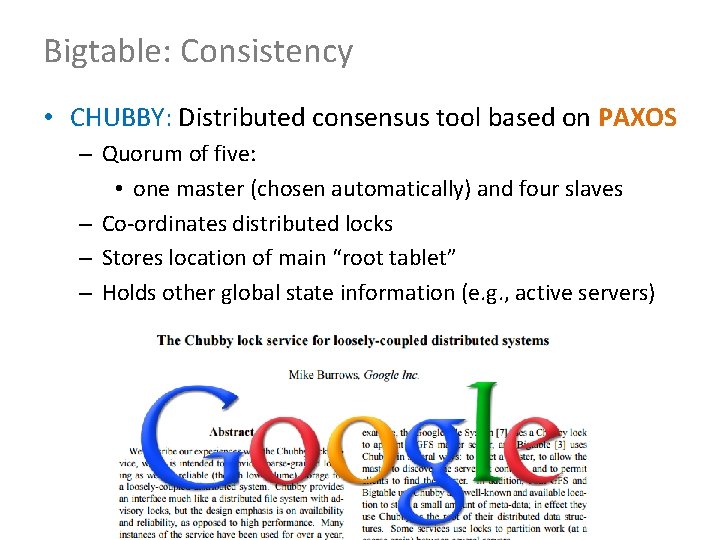
Bigtable: Consistency • CHUBBY: Distributed consensus tool based on PAXOS – Quorum of five: • one master (chosen automatically) and four slaves – Co-ordinates distributed locks – Stores location of main “root tablet” – Holds other global state information (e. g. , active servers)
Bigtable: A Bunch of Other Things • Locality groups: Group multiple column families together; assigned a separate SSTable • Select storage: SSTables can be persistent or in -memory • Compression: Applied on SSTable blocks; custom compression can be chosen • Caches: SSTable-level and block-level • Bloom filters: Find negatives cheaply …
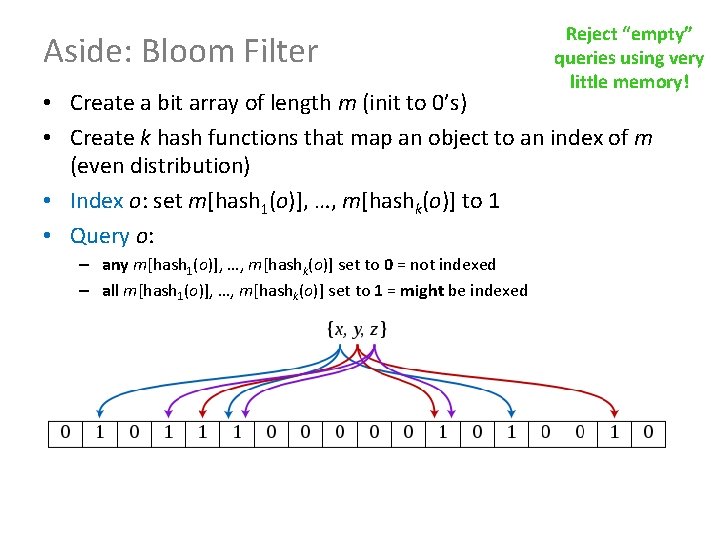
Aside: Bloom Filter Reject “empty” queries using very little memory! • Create a bit array of length m (init to 0’s) • Create k hash functions that map an object to an index of m (even distribution) • Index o: set m[hash 1(o)], …, m[hashk(o)] to 1 • Query o: – any m[hash 1(o)], …, m[hashk(o)] set to 0 = not indexed – all m[hash 1(o)], …, m[hashk(o)] set to 1 = might be indexed
Bigtable: an idea of performance [2006] • Values are 1 Kb in size (blocks 64 Kb) • Values are aggregate over all machines Why are random (disk) reads so slow? The read sizes are 1 kb, but a different 64 kb block must be sent over the network (almost) every time
Bigtable: an idea of performance [2006] • Values are 1 Kb in size (blocks 64 Kb) • Average values/second per server: • Adding more machines does add a cost! • But overall performance does increase
Bigtable: examples in Google [2006]
Bigtable: Apache HBase Open-source implementation of Bigtable ideas
Similar ideas in Cassandra
The Database Landscape Not using the relational model Batch analysis of data Using the relational model Real-time Stores documents (semi-structured values) Not only SQL Maps Relational Databases with focus on scalability to compete with No. SQL while maintaining ACID Column Oriented Graph-structured data In-Memory Cloud storage
GRAPH DATABASES
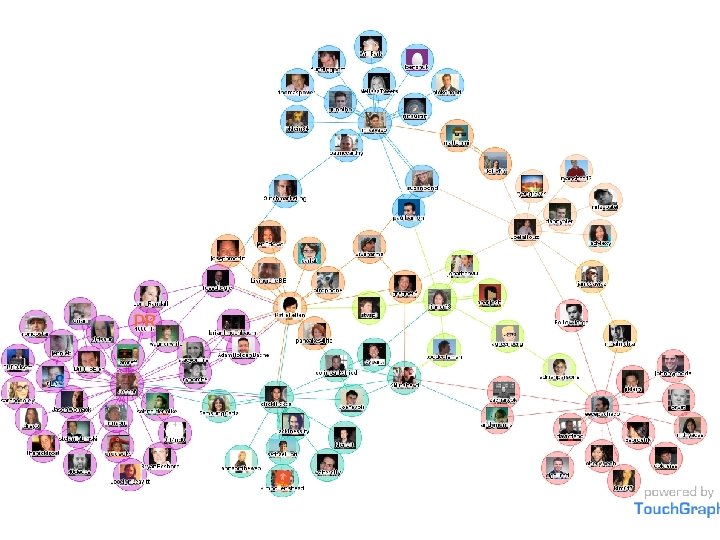
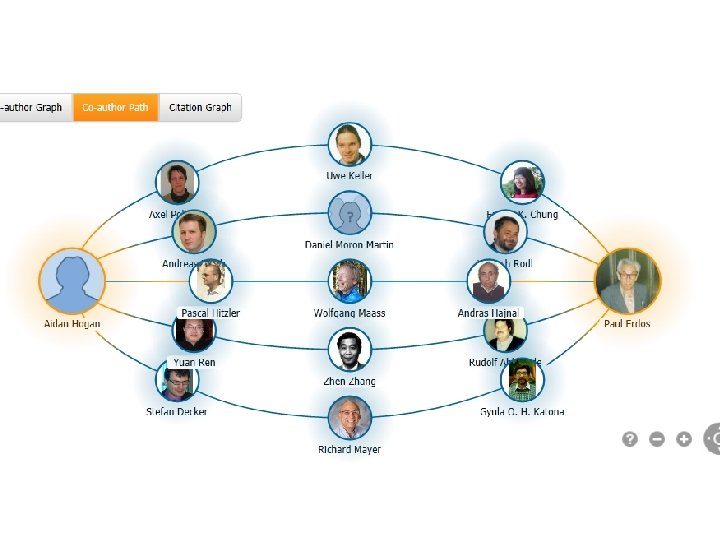
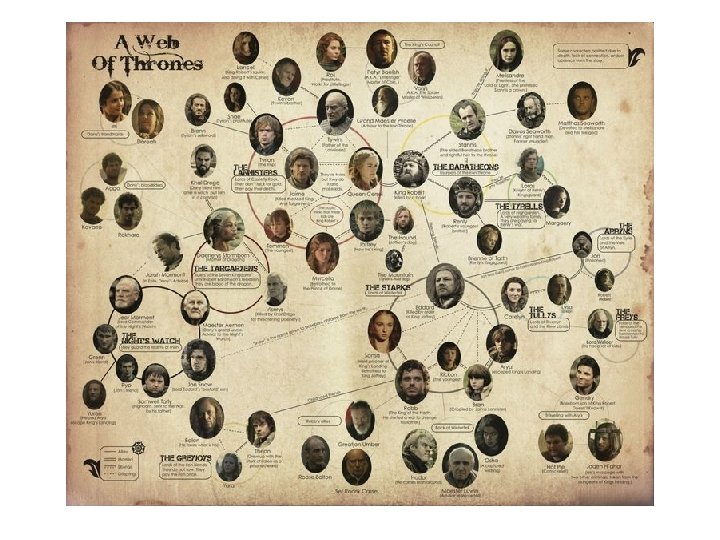
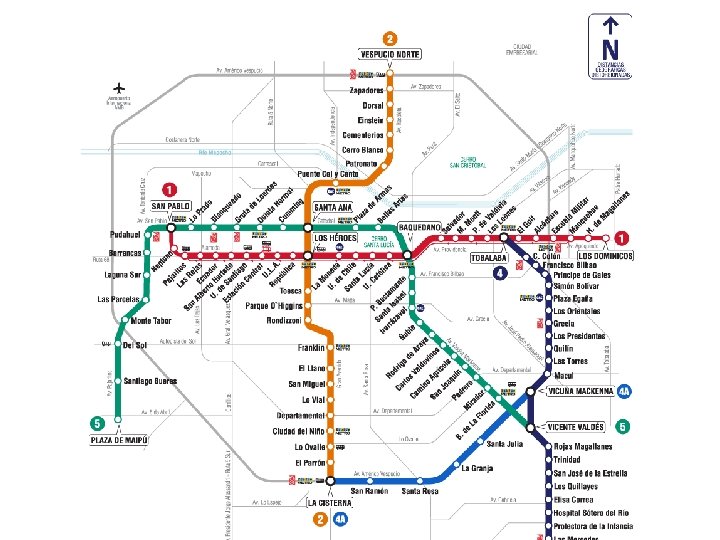
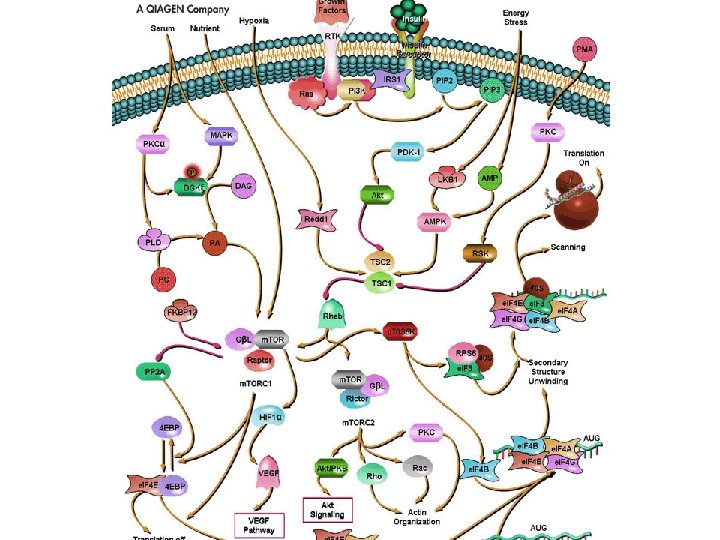
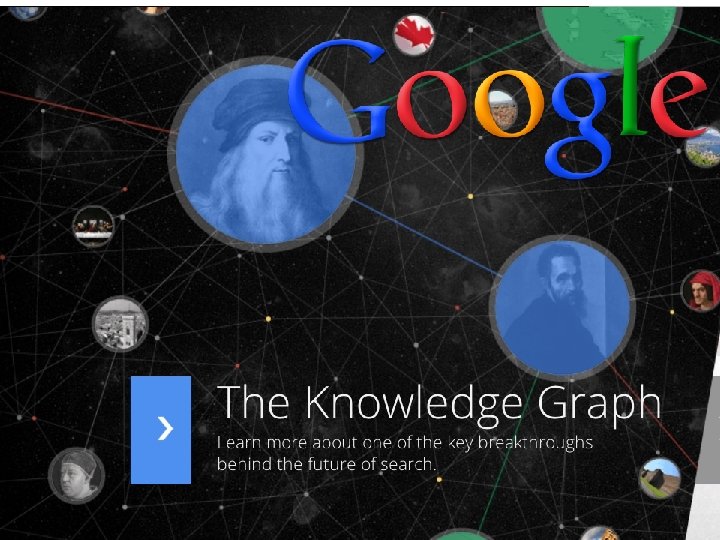
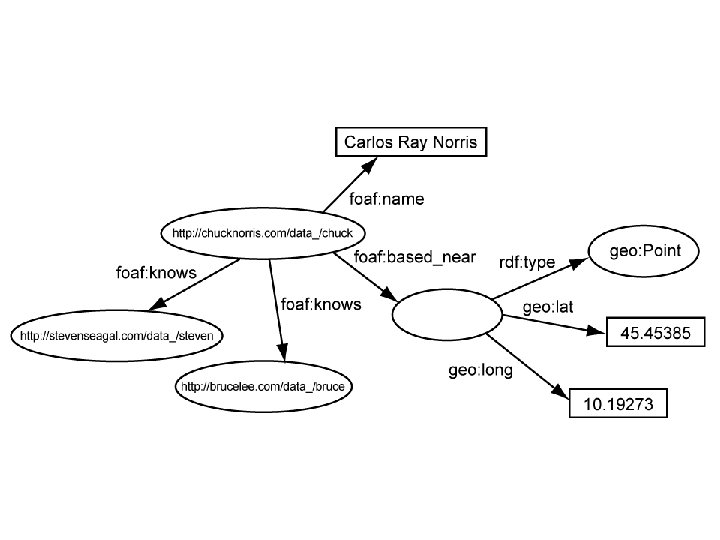
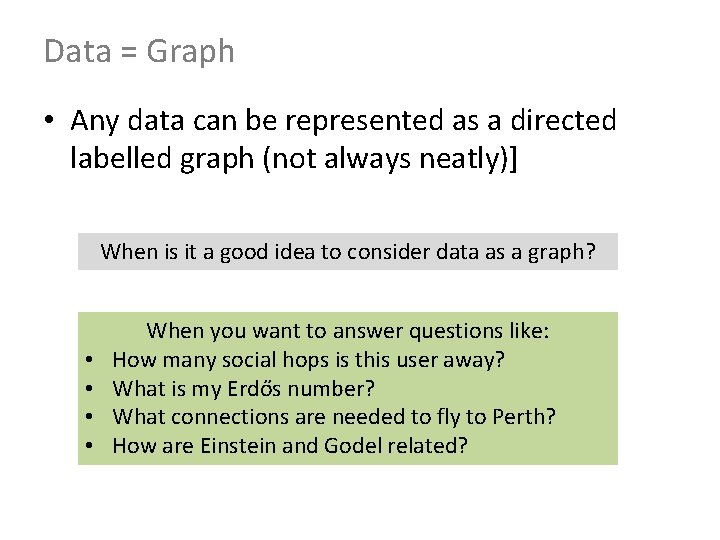
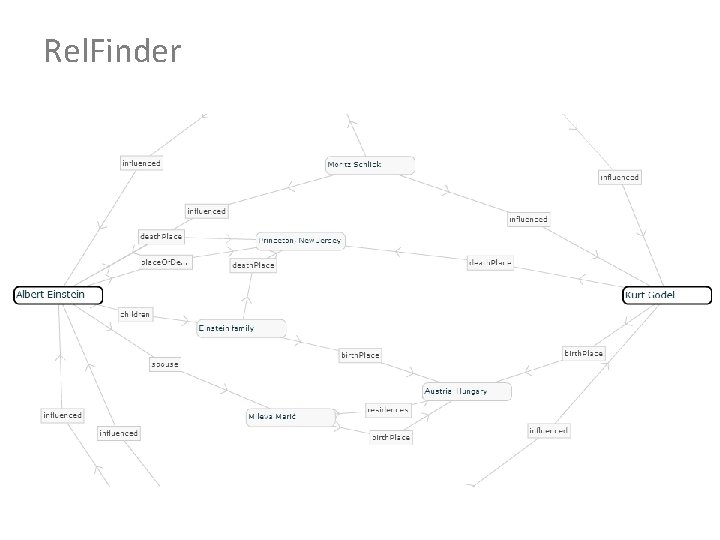
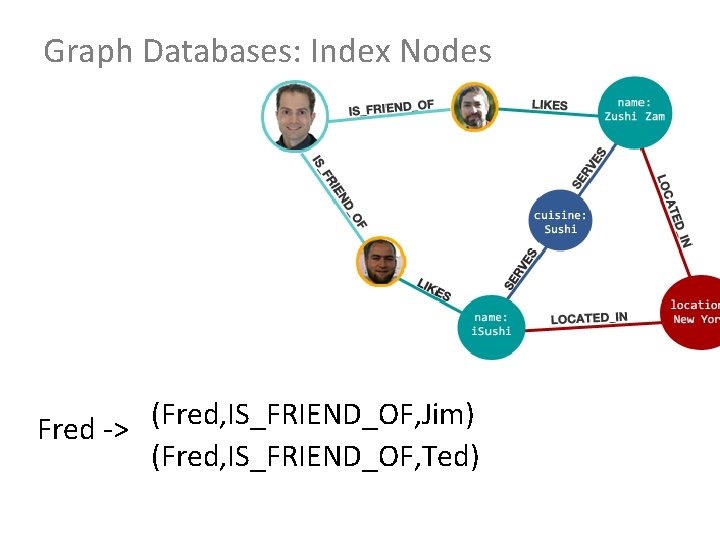
Data = Graph • Any data can be represented as a directed labelled graph (not always neatly)] When is it a good idea to consider data as a graph? • • When you want to answer questions like: How many social hops is this user away? What is my Erdős number? What connections are needed to fly to Perth? How are Einstein and Godel related?
Rel. Finder
Leading Graph Database
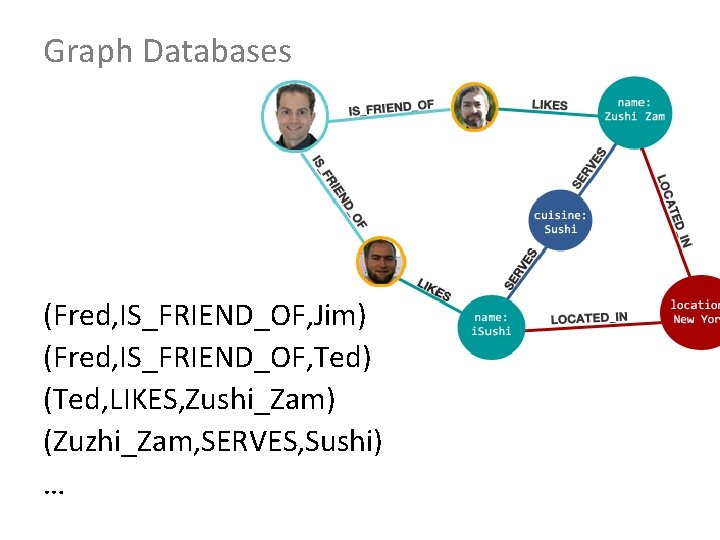
Graph Databases (Fred, IS_FRIEND_OF, Jim) (Fred, IS_FRIEND_OF, Ted) (Ted, LIKES, Zushi_Zam) (Zuzhi_Zam, SERVES, Sushi) …
Graph Databases: Index Nodes (Fred, IS_FRIEND_OF, Jim) Fred -> (Fred, IS_FRIEND_OF, Ted)
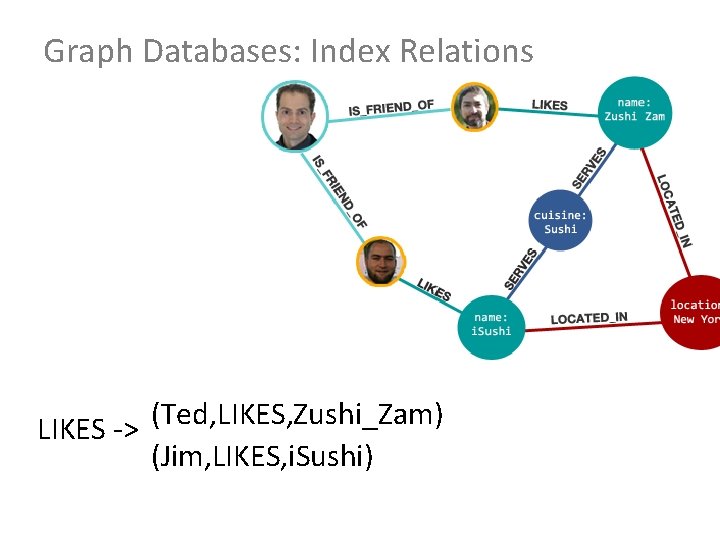
Graph Databases: Index Relations (Ted, LIKES, Zushi_Zam) LIKES -> (Jim, LIKES, i. Sushi)
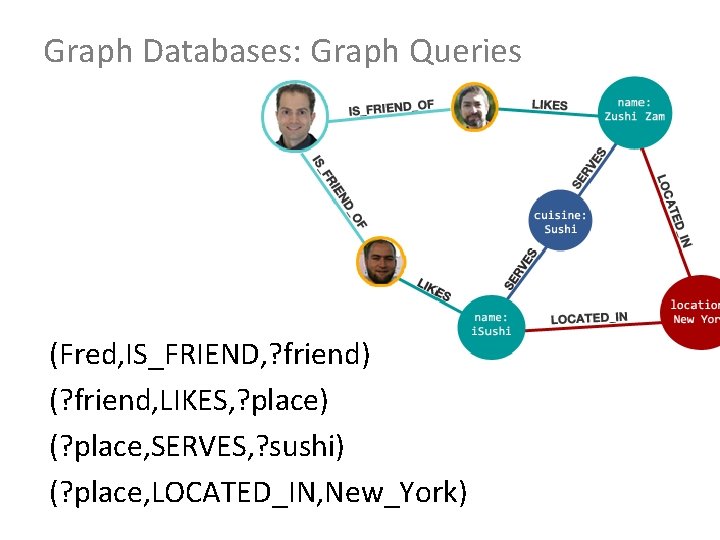
Graph Databases: Graph Queries (Fred, IS_FRIEND, ? friend) (? friend, LIKES, ? place) (? place, SERVES, ? sushi) (? place, LOCATED_IN, New_York)
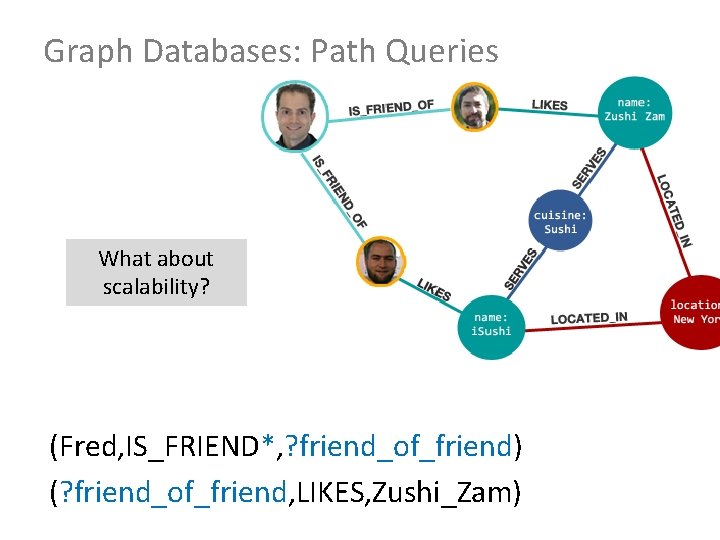
Graph Databases: Path Queries What about scalability? (Fred, IS_FRIEND*, ? friend_of_friend) (? friend_of_friend, LIKES, Zushi_Zam)
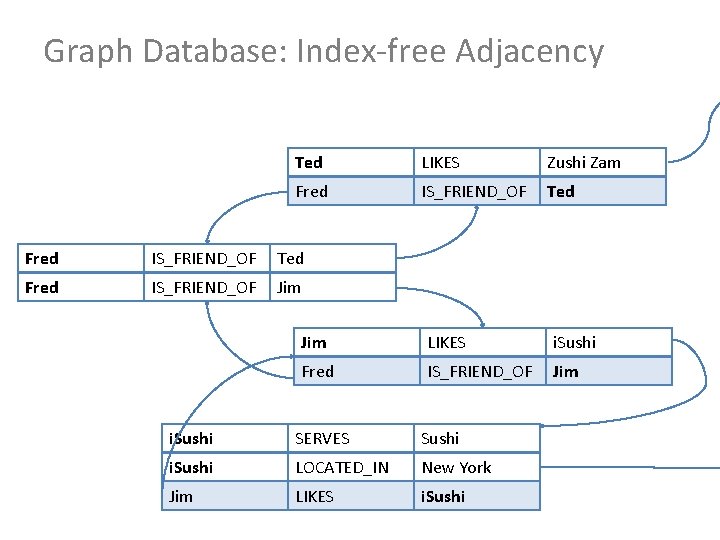
Graph Database: Index-free Adjacency Ted LIKES Zushi Zam Fred IS_FRIEND_OF Ted Fred IS_FRIEND_OF Jim LIKES i. Sushi Fred IS_FRIEND_OF Jim i. Sushi SERVES Sushi i. Sushi LOCATED_IN New York Jim LIKES i. Sushi
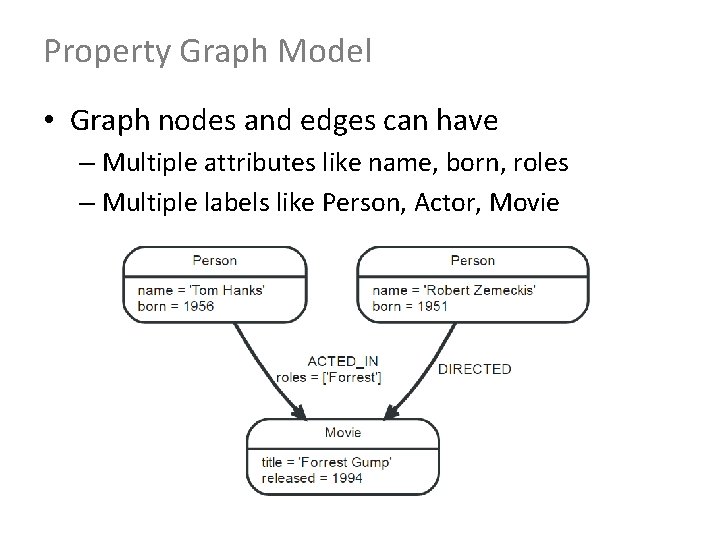
Property Graph Model • Graph nodes and edges can have – Multiple attributes like name, born, roles – Multiple labels like Person, Actor, Movie
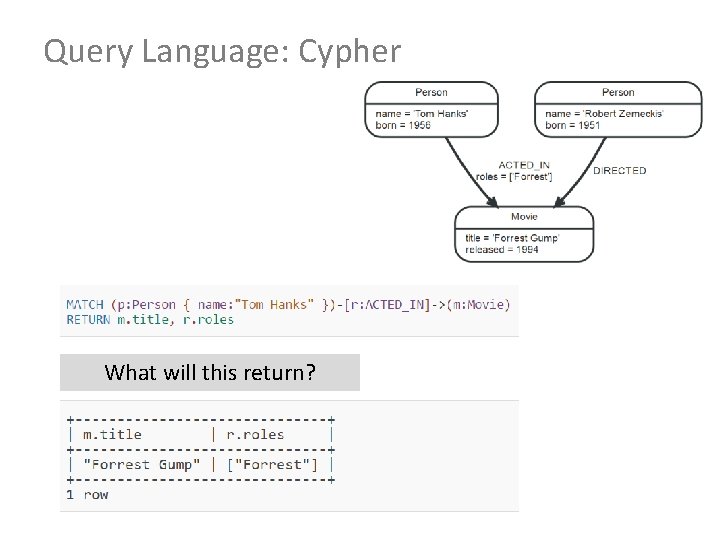
Query Language: Cypher What will this return?
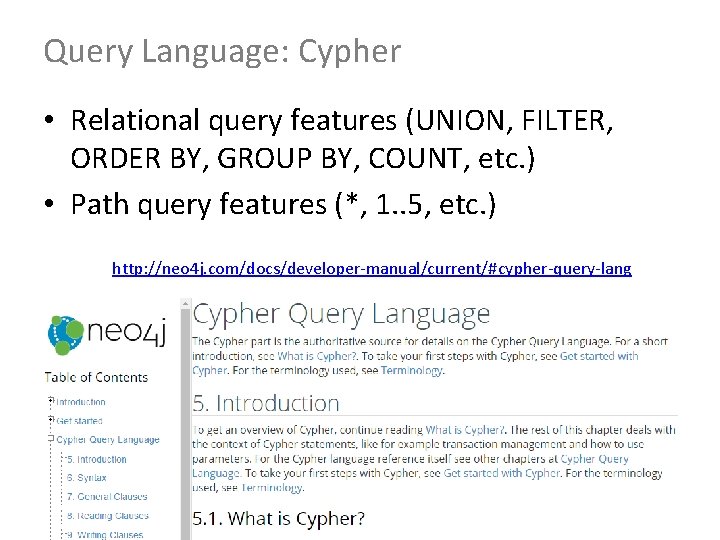
Query Language: Cypher • Relational query features (UNION, FILTER, ORDER BY, GROUP BY, COUNT, etc. ) • Path query features (*, 1. . 5, etc. ) http: //neo 4 j. com/docs/developer-manual/current/#cypher-query-lang
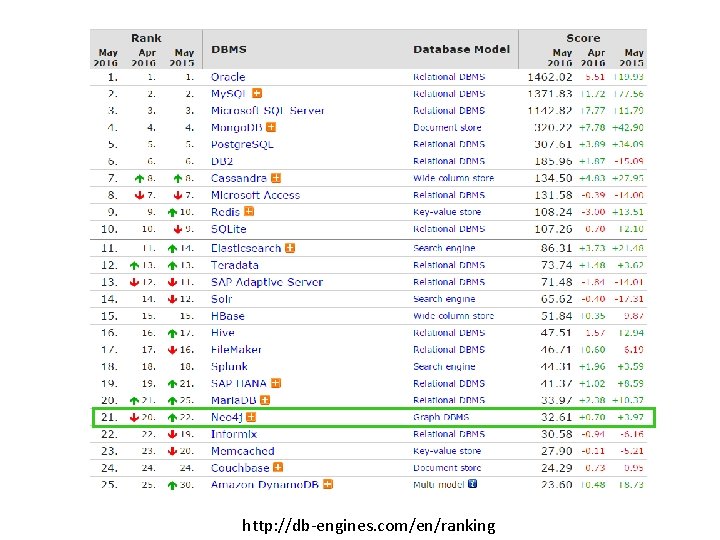
http: //db-engines. com/en/ranking
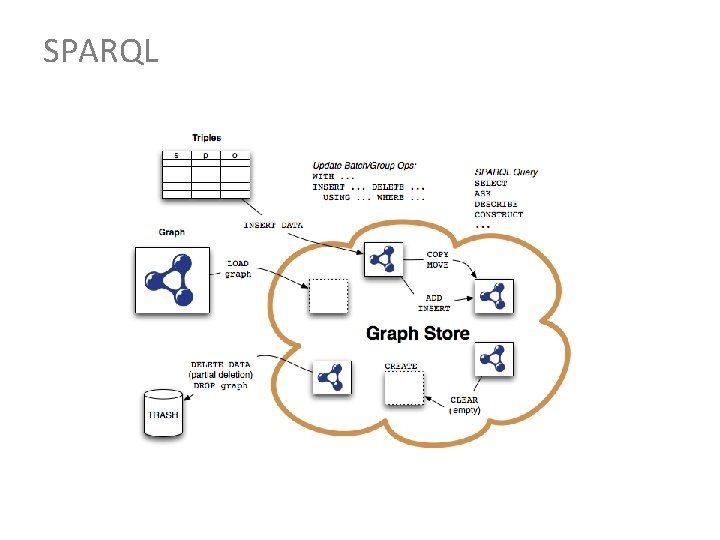
SPARQL
http: //db-engines. com/en/ranking
RECAP
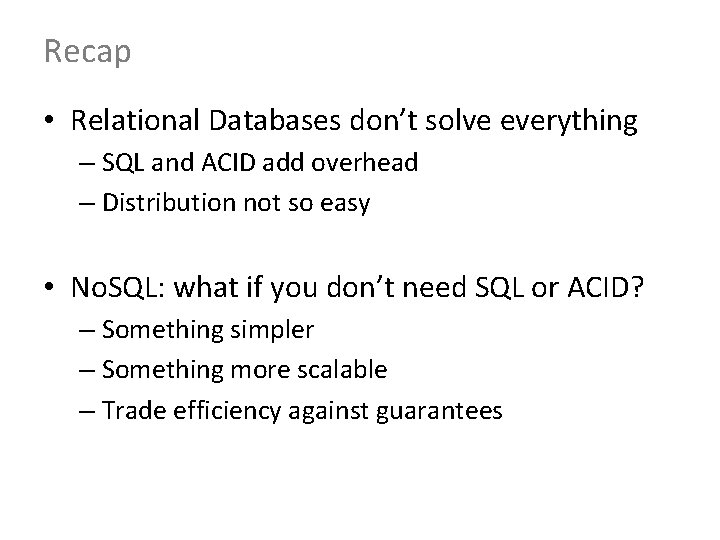
Recap • Relational Databases don’t solve everything – SQL and ACID add overhead – Distribution not so easy • No. SQL: what if you don’t need SQL or ACID? – Something simpler – Something more scalable – Trade efficiency against guarantees
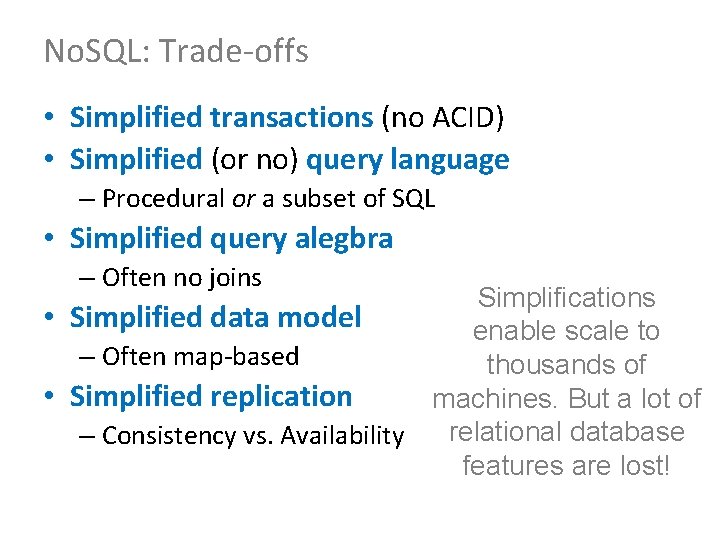
No. SQL: Trade-offs • Simplified transactions (no ACID) • Simplified (or no) query language – Procedural or a subset of SQL • Simplified query alegbra – Often no joins Simplifications • Simplified data model enable scale to – Often map-based thousands of • Simplified replication machines. But a lot of relational database – Consistency vs. Availability features are lost!
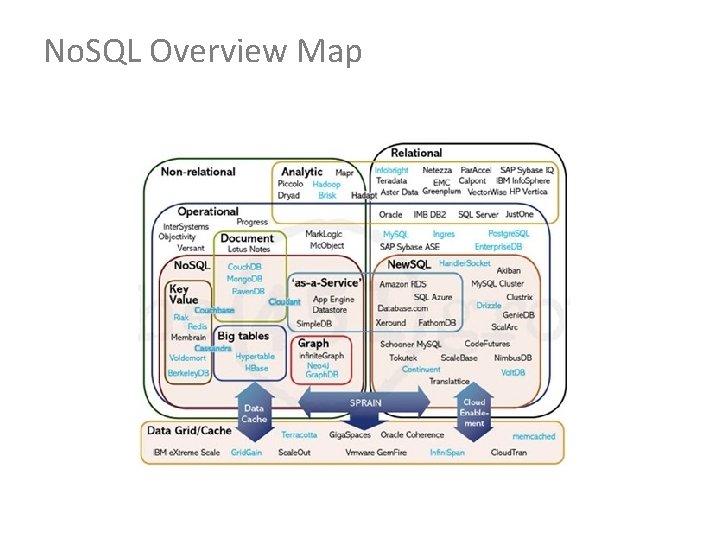
No. SQL Overview Map
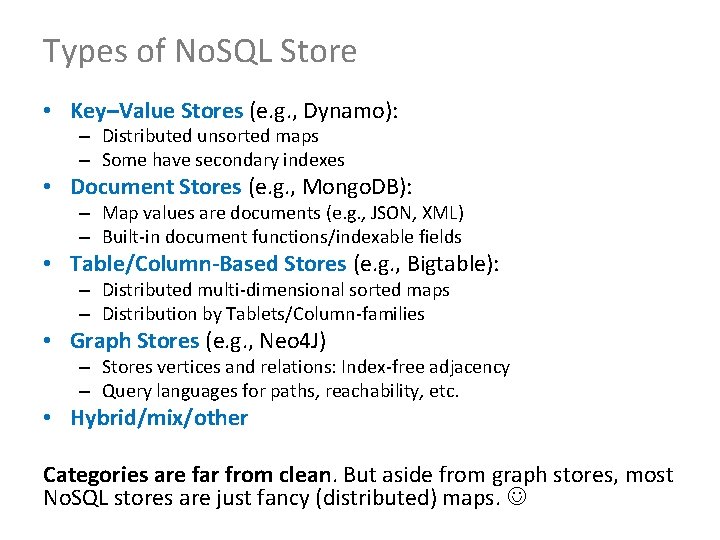
Types of No. SQL Store • Key–Value Stores (e. g. , Dynamo): – Distributed unsorted maps – Some have secondary indexes • Document Stores (e. g. , Mongo. DB): – Map values are documents (e. g. , JSON, XML) – Built-in document functions/indexable fields • Table/Column-Based Stores (e. g. , Bigtable): – Distributed multi-dimensional sorted maps – Distribution by Tablets/Column-families • Graph Stores (e. g. , Neo 4 J) – Stores vertices and relations: Index-free adjacency – Query languages for paths, reachability, etc. • Hybrid/mix/other Categories are far from clean. But aside from graph stores, most No. SQL stores are just fancy (distributed) maps.
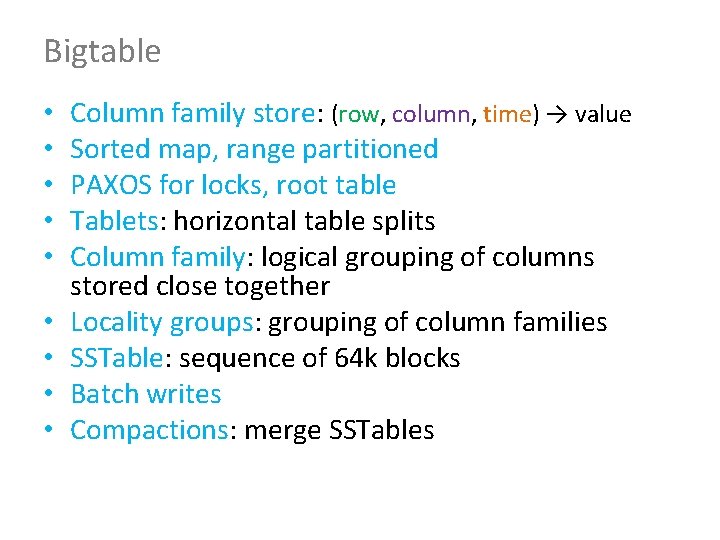
Bigtable • • • Column family store: (row, column, time) → value Sorted map, range partitioned PAXOS for locks, root table Tablets: horizontal table splits Column family: logical grouping of columns stored close together Locality groups: grouping of column families SSTable: sequence of 64 k blocks Batch writes Compactions: merge SSTables
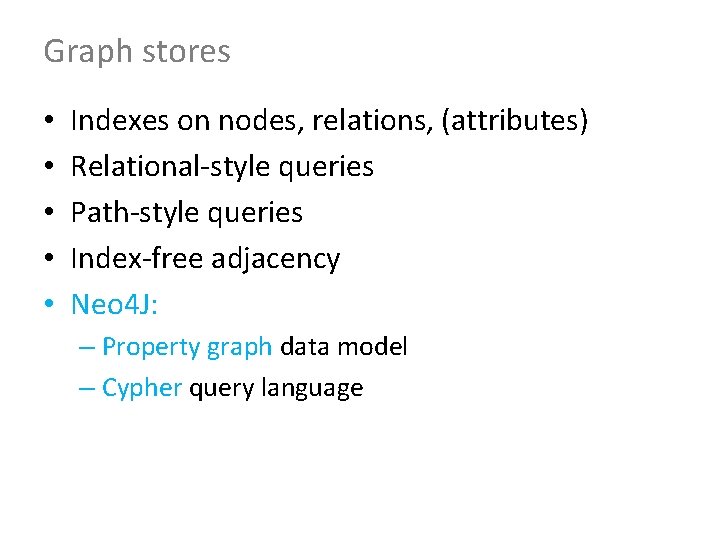
Graph stores • • • Indexes on nodes, relations, (attributes) Relational-style queries Path-style queries Index-free adjacency Neo 4 J: – Property graph data model – Cypher query language
Questions ?