
CC 5 Unit 2 Development in Behaviourism Watson
CC 5 : Unit 2: Development in Behaviourism (Watson)
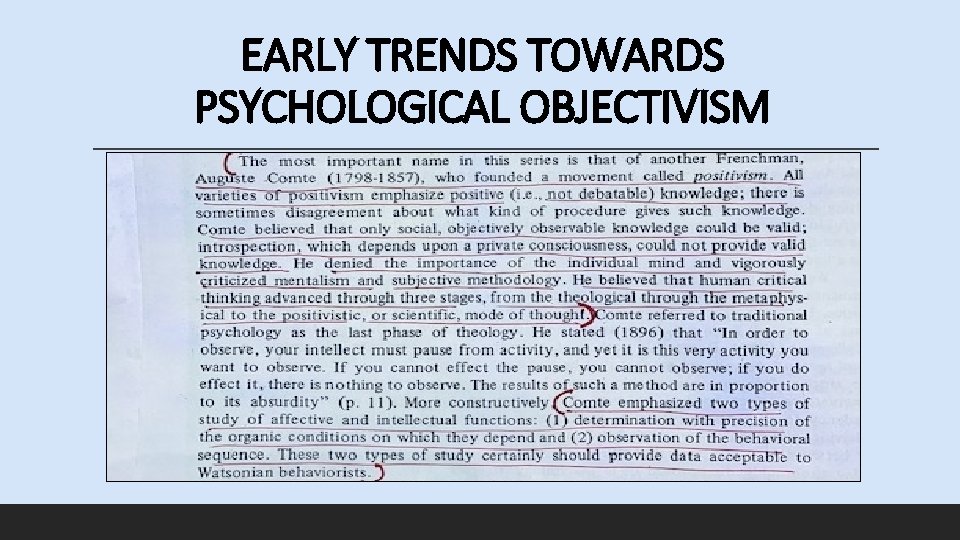
EARLY TRENDS TOWARDS PSYCHOLOGICAL OBJECTIVISM
Animal Psychology Darwinian evolutionary theory has been in the development of psychology as a science and particularly as a background factor determining the form of functional psychology. The theory also gave great impetus to the study of animal psychology , which in turn was perhaps the most important single factor which led Watson to formulate his behavioural psychology. Jacques Loeb (1859 -1924) is the next important man in the development of animal psychology. Loeb , a German biologist , came to the United States in 1891 and spent greater part of his professional career there. Loeb is responsible for the concept of tropism , or forced movement , as an explanatory factor in animal behavior. In a tropism , the response is a direct function of the stimulus and is in this sense forced. Loeb felt that all the behavior of the lowest animal forms is tropistic and that a considerable proportion of the behavior of higher form is also.
Animal Psychology In America E. L Thorndike was working with animals. In this he was not alone. Robert M. Yerkes (1876 – 1956) began his animal investigations in 1900. Yerkes studied crabs , turtles, frogs , dancing mice , rats , worms and the like and finally man. His research on apes is the most significant ; it is comprehensively summarized in Chimpanzees : A Laboratory Colony (1943). Yerkes at one time collaborated with Watson in the development of visual techniques for animals.

Watsonian Behaviorism Although John Broadus Watson (1878 – 1958) , the founder of American behaviourism , began graduate study in philosophy at the University of Chicago , he changed over to psychology & neurology , and after receiving his doctor’s degree , joined the teaching staff and set up one of the early animal laboratories. In 1908 he be came full professor at John Hopkins University. By 1912 he was well known for many studies on animal behavior. As a teacher of Psychology he became more & more disgusted with “ intangibles & unapprochables” and was determined to teach a psychology dealing with concrete facts. Another cause of his irritation was the ambiguous state of animal psychology , his field of research.
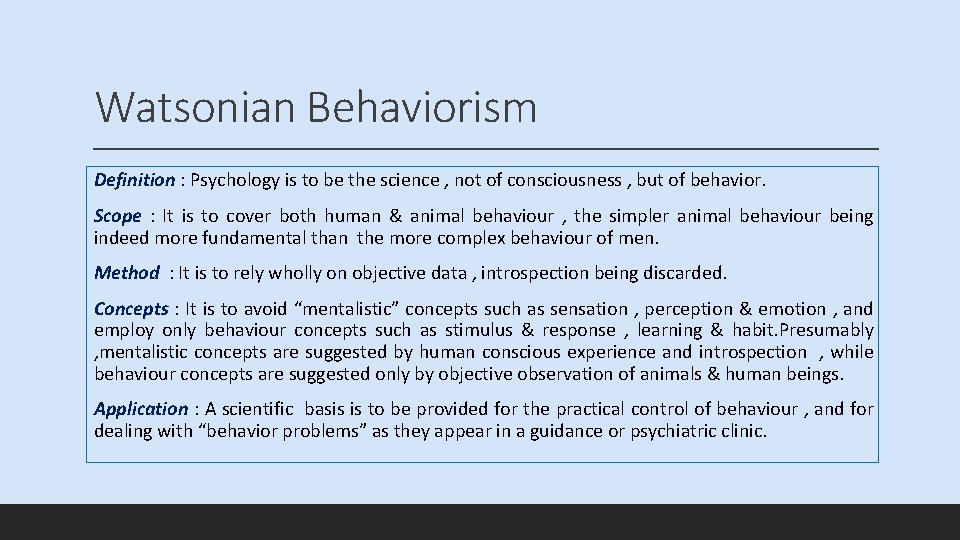
Watsonian Behaviorism Definition : Psychology is to be the science , not of consciousness , but of behavior. Scope : It is to cover both human & animal behaviour , the simpler animal behaviour being indeed more fundamental than the more complex behaviour of men. Method : It is to rely wholly on objective data , introspection being discarded. Concepts : It is to avoid “mentalistic” concepts such as sensation , perception & emotion , and employ only behaviour concepts such as stimulus & response , learning & habit. Presumably , mentalistic concepts are suggested by human conscious experience and introspection , while behaviour concepts are suggested only by objective observation of animals & human beings. Application : A scientific basis is to be provided for the practical control of behaviour , and for dealing with “behavior problems” as they appear in a guidance or psychiatric clinic.
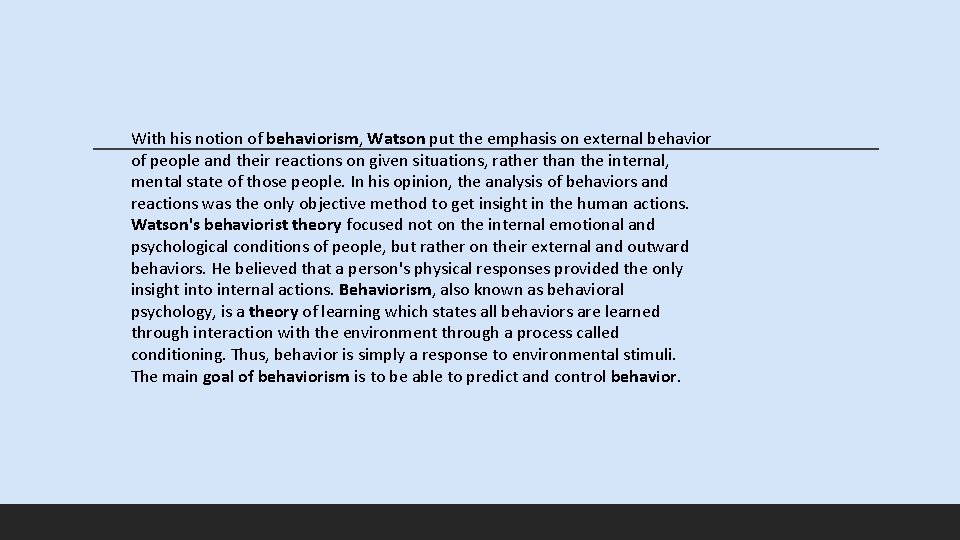
With his notion of behaviorism, Watson put the emphasis on external behavior of people and their reactions on given situations, rather than the internal, mental state of those people. In his opinion, the analysis of behaviors and reactions was the only objective method to get insight in the human actions. Watson's behaviorist theory focused not on the internal emotional and psychological conditions of people, but rather on their external and outward behaviors. He believed that a person's physical responses provided the only insight into internal actions. Behaviorism, also known as behavioral psychology, is a theory of learning which states all behaviors are learned through interaction with the environment through a process called conditioning. Thus, behavior is simply a response to environmental stimuli. The main goal of behaviorism is to be able to predict and control behavior.
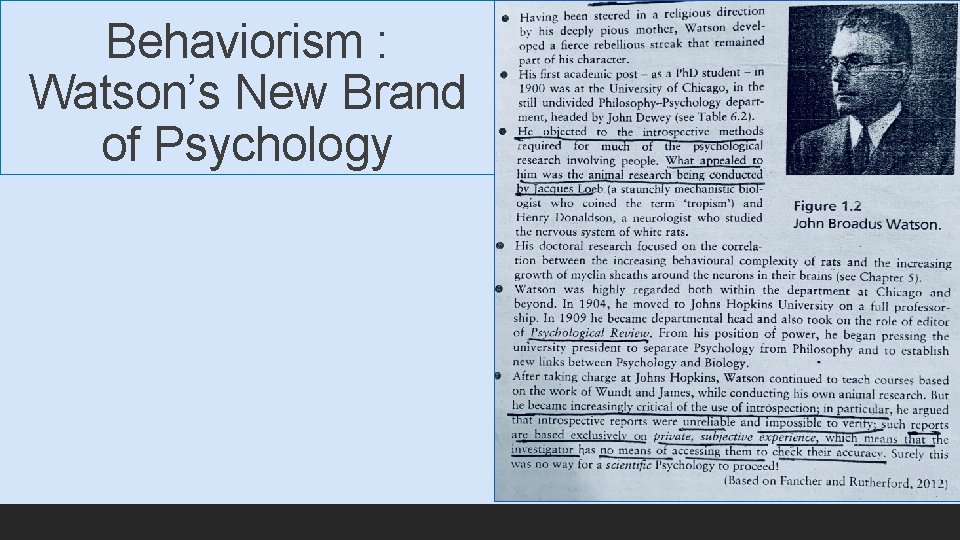
Behaviorism : Watson’s New Brand of Psychology
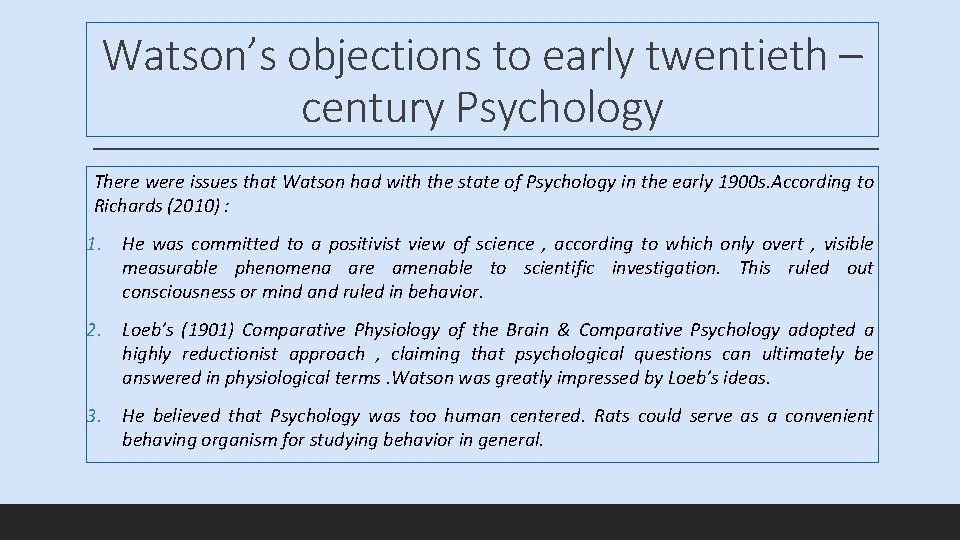
Watson’s objections to early twentieth – century Psychology There were issues that Watson had with the state of Psychology in the early 1900 s. According to Richards (2010) : 1. He was committed to a positivist view of science , according to which only overt , visible measurable phenomena are amenable to scientific investigation. This ruled out consciousness or mind and ruled in behavior. 2. Loeb’s (1901) Comparative Physiology of the Brain & Comparative Psychology adopted a highly reductionist approach , claiming that psychological questions can ultimately be answered in physiological terms. Watson was greatly impressed by Loeb’s ideas. 3. He believed that Psychology was too human centered. Rats could serve as a convenient behaving organism for studying behavior in general.
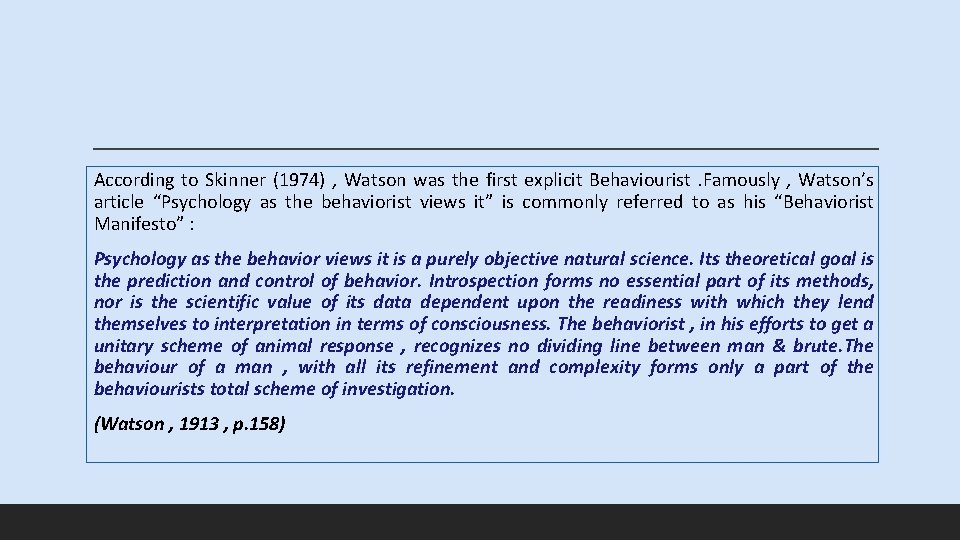
According to Skinner (1974) , Watson was the first explicit Behaviourist. Famously , Watson’s article “Psychology as the behaviorist views it” is commonly referred to as his “Behaviorist Manifesto” : Psychology as the behavior views it is a purely objective natural science. Its theoretical goal is the prediction and control of behavior. Introspection forms no essential part of its methods, nor is the scientific value of its data dependent upon the readiness with which they lend themselves to interpretation in terms of consciousness. The behaviorist , in his efforts to get a unitary scheme of animal response , recognizes no dividing line between man & brute. The behaviour of a man , with all its refinement and complexity forms only a part of the behaviourists total scheme of investigation. (Watson , 1913 , p. 158)
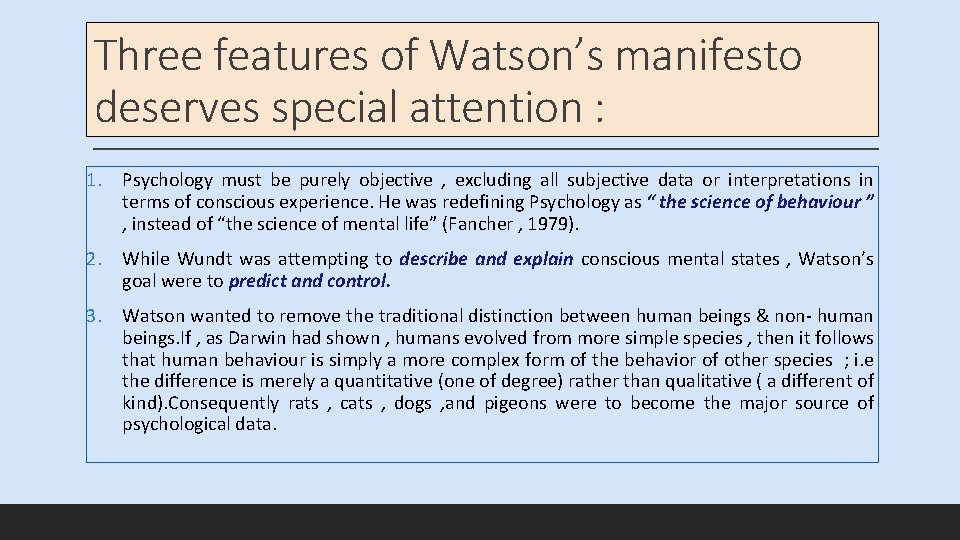
Three features of Watson’s manifesto deserves special attention : 1. Psychology must be purely objective , excluding all subjective data or interpretations in terms of conscious experience. He was redefining Psychology as “ the science of behaviour ” , instead of “the science of mental life” (Fancher , 1979). 2. While Wundt was attempting to describe and explain conscious mental states , Watson’s goal were to predict and control. 3. Watson wanted to remove the traditional distinction between human beings & non- human beings. If , as Darwin had shown , humans evolved from more simple species , then it follows that human behaviour is simply a more complex form of the behavior of other species ; i. e the difference is merely a quantitative (one of degree) rather than qualitative ( a different of kind). Consequently rats , cats , dogs , and pigeons were to become the major source of psychological data.
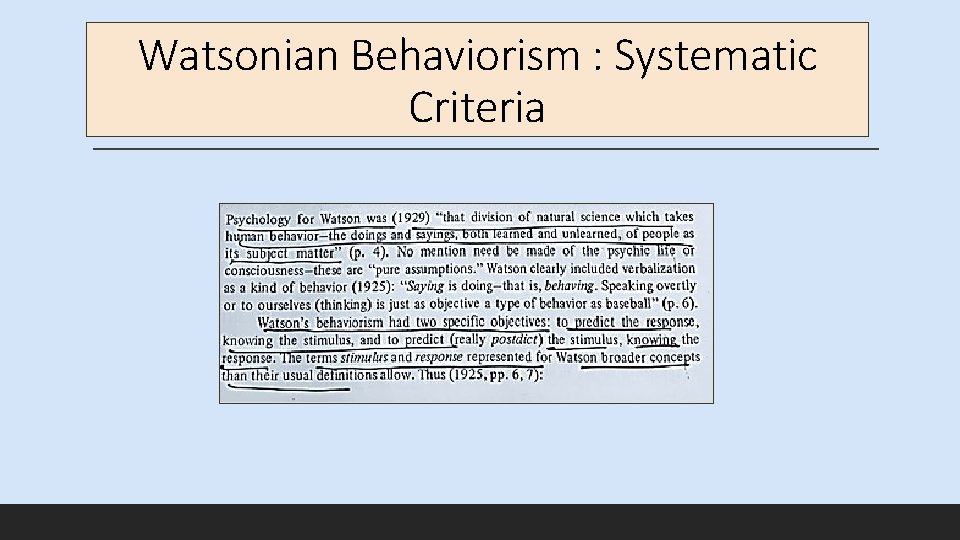
Watsonian Behaviorism : Systematic Criteria
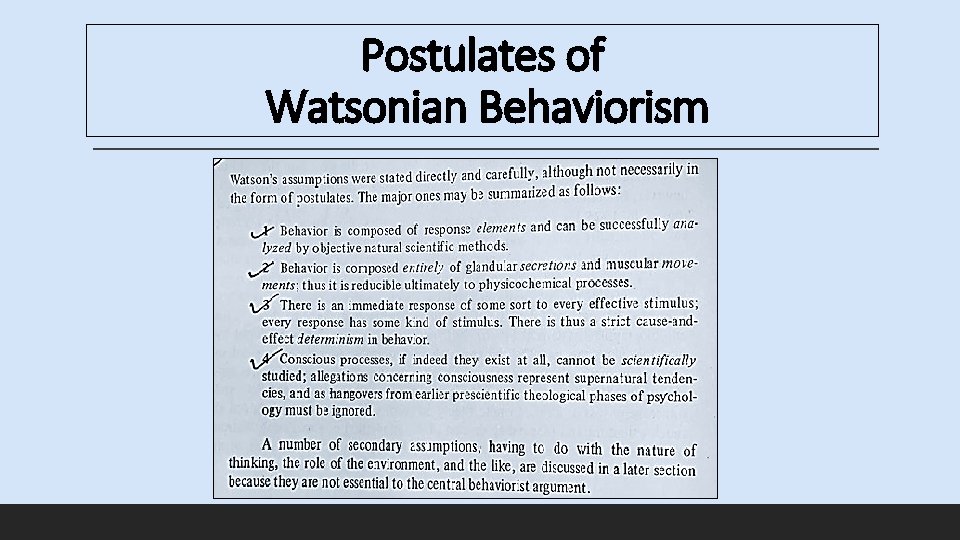
Postulates of Watsonian Behaviorism
Behaviorism _ Watsons new brand of psychology Conditioned emotional reactions - Albert’s Study The term conditioned emotional response (CER) can refer to a specific learned behavior or a procedure commonly used in classical or Pavlovian conditioning research. It may also be called "conditioned suppression" or "conditioned fear response (CFR). " It is an "emotional response" that results from classical conditioning, usually from the association of a relatively neutral stimulus with a painful or fear-inducing unconditional stimulus. As a result, the formerly neutral stimulus elicits fear. For example, if seeing a dog (a neutral stimulus) is paired with the pain of being bitten by the dog (unconditioned stimulus), seeing a dog may become a conditioned stimulus that elicits fear (conditioned response). In 1920 John B. Watson and Rosalie Rayner demonstrated such fear conditioning in the Little Albert experiment. They started with a 9 -month boy called “Albert”, who was unemotional but was made to cry by the loud noise (unconditioned stimulus) of a hammer striking a steel bar. Albert initially showed no fear of a white rat (neutral stimulus), but after the sight of the rat had been accompanied five times by the loud noise, he cried and tried to escape the rat, showing that the rat had become a conditioned stimulus for fear. Although the Watson and Rayner work with Little Albert clearly falls under the broad umbrella of "conditioned fear" they did not use the term CER and thought they were applying more general conditioning principles to human behavior.
Little Peter and the beginnings of behavior therapy "Little Peter" experiment While attending a speech by leading behavioral psychologist, John B. Watson, Cover Jones became interested in his most famous study, the "Little Albert experiment". In this experiment, an infant was classically conditioned to express a fearful response when a white rat was presented along with a loud noise that shocked the child. Cover Jones began to wonder if the techniques used by Watson could be used to make children less fearful of a stimulus, in essence reversing his findings. These thoughts led to her most cited work, a study of the removal of a fear of rabbits through conditioning conducted on a three-year-old named Peter at Columbia University. She treated Peter's fear of a white rabbit by "direct conditioning", in which a pleasant stimulus (food) was associated with the rabbit. Cover Jones began her experiment with the goal of finding the most effective way to eliminate irrational fears in children. Peter was chosen for the study because in all other aspects of infant life he was considered to be normal except for his fear of rabbits. Peter was not only afraid of rabbits; Cover Jones showed he would also cry when presented with other similar items such as feathers, a fur coat, a fur rug and cotton. She conducted her experiments using a range of different treatments in order to eliminate the fear response in Peter. She described her methods used in the Peter study as "patient, meticulous and painstaking procedures", in order to understand what was taking place. This is a method that she learned from her mentor Watson. She initiated the study with the rabbit being 12 feet from Peter, and brought the rabbit closer until it was nibbling on Peter's fingers. As the rabbit was gradually brought closer to Peter with the presence of his favorite food (candy), his fear subsided and he eventually was able to touch the rabbit without crying. After curing Peter of his phobia, Cover Jones wrote and published a paper about the experiment titled "A Laboratory Study of Fear: The Case of Peter (1924)". Though now considered to be a revolutionary experiment, at the time it was largely dismissed and was not even written up as Cover Jones's dissertation. This study by Cover Jones is considered by some to be a defining landmark in behavioral therapy and was a breakthrough in how behaviorism could be studied and manipulated in the laboratory. Due to the rediscovery of this research in the 1970 s, Cover Jones was considered "the mother of behavioral therapy" by her friend Wolpe and other colleagues. Additionally, this study was important for the development of the idea and technique of desensitization, now often used to cure phobias by repeatedly exposing a person with a phobia to a series of stimuli that approximate the feared object
Little Peter and the beginnings of behavior therapy : the fear removing strategies 1. Flooding ( a form of forced reality testing) 2. Systematic Desensitization ( the fear is gradually extinguishged by exposing the person to increasingly frightening forms of the feared stimulus in combination with a pleasurable stimulus /activity – or more commonly today , a state of deep muscle relaxation. 3. Modelling , involves the person another person (the model) interacting with feared stimulus without fear.
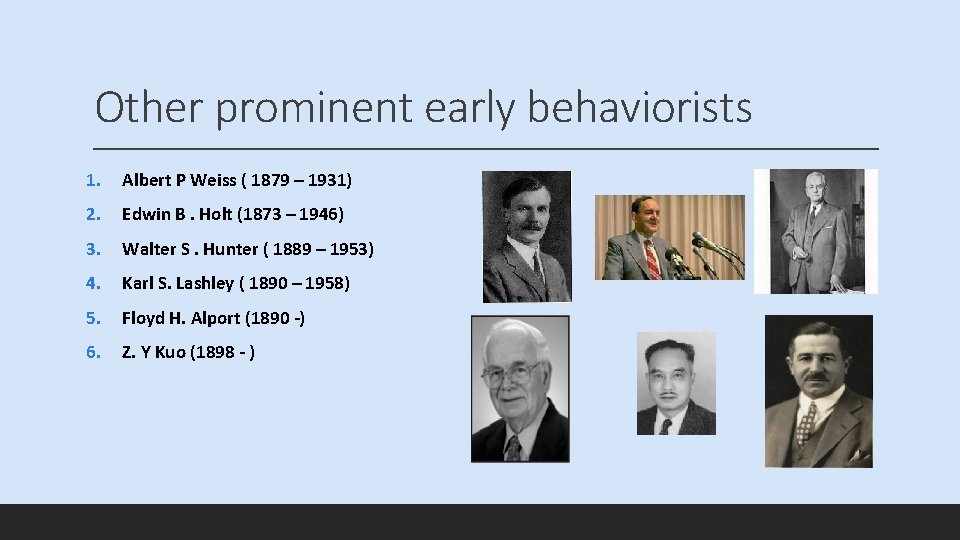
Other prominent early behaviorists 1. Albert P Weiss ( 1879 – 1931) 2. Edwin B. Holt (1873 – 1946) 3. Walter S. Hunter ( 1889 – 1953) 4. Karl S. Lashley ( 1890 – 1958) 5. Floyd H. Alport (1890 -) 6. Z. Y Kuo (1898 - )
Behaviorism Antecedent influences : Towards a science of behavior
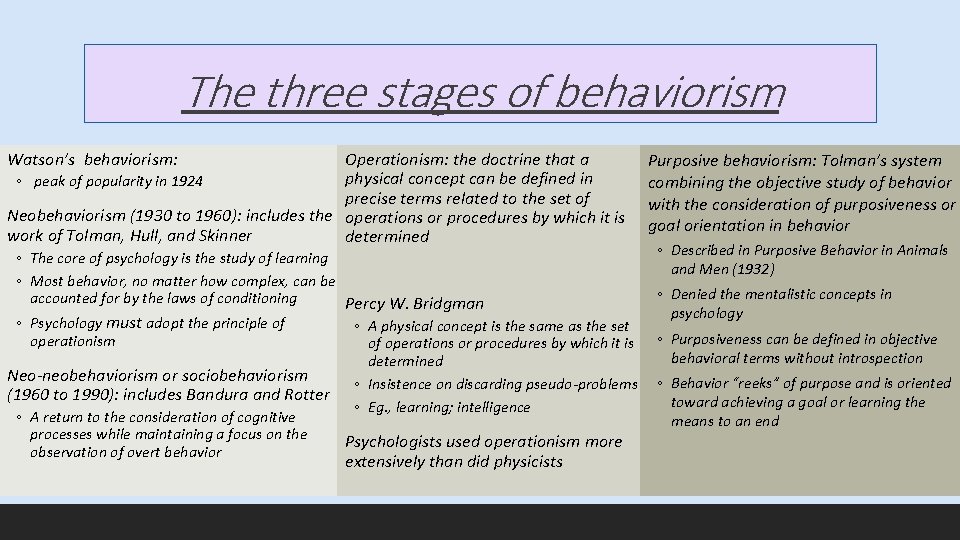
The three stages of behaviorism Watson’s behaviorism: Operationism: the doctrine that a physical concept can be defined in ◦ peak of popularity in 1924 precise terms related to the set of Neobehaviorism (1930 to 1960): includes the operations or procedures by which it is work of Tolman, Hull, and Skinner determined ◦ The core of psychology is the study of learning ◦ Most behavior, no matter how complex, can be accounted for by the laws of conditioning Percy W. Bridgman ◦ Psychology must adopt the principle of ◦ A physical concept is the same as the set operationism of operations or procedures by which it is determined Neo-neobehaviorism or sociobehaviorism ◦ Insistence on discarding pseudo-problems (1960 to 1990): includes Bandura and Rotter ◦ Eg. , learning; intelligence ◦ A return to the consideration of cognitive processes while maintaining a focus on the Psychologists used operationism more observation of overt behavior extensively than did physicists Purposive behaviorism: Tolman’s system combining the objective study of behavior with the consideration of purposiveness or goal orientation in behavior ◦ Described in Purposive Behavior in Animals and Men (1932) ◦ Denied the mentalistic concepts in psychology ◦ Purposiveness can be defined in objective behavioral terms without introspection ◦ Behavior “reeks” of purpose and is oriented toward achieving a goal or learning the means to an end
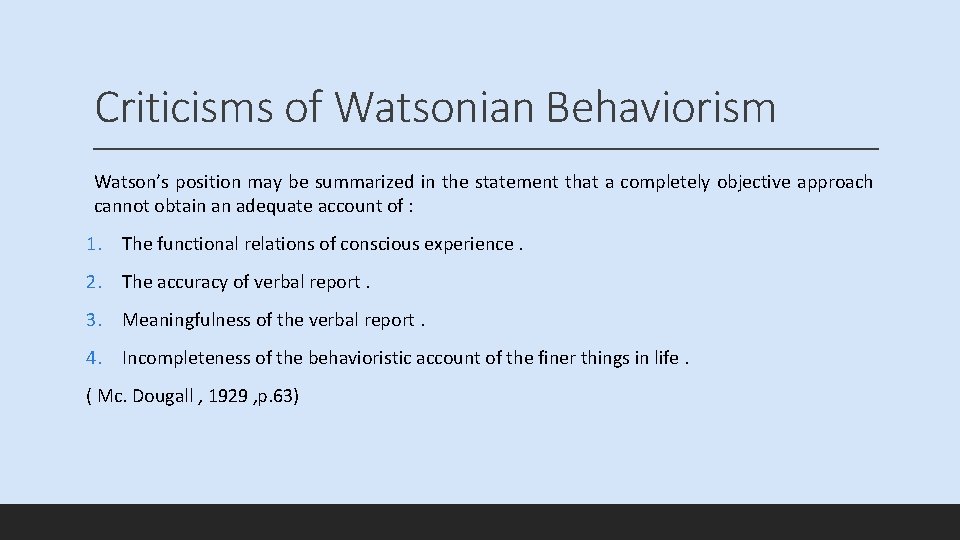
Criticisms of Watsonian Behaviorism Watson’s position may be summarized in the statement that a completely objective approach cannot obtain an adequate account of : 1. The functional relations of conscious experience. 2. The accuracy of verbal report. 3. Meaningfulness of the verbal report. 4. Incompleteness of the behavioristic account of the finer things in life. ( Mc. Dougall , 1929 , p. 63)
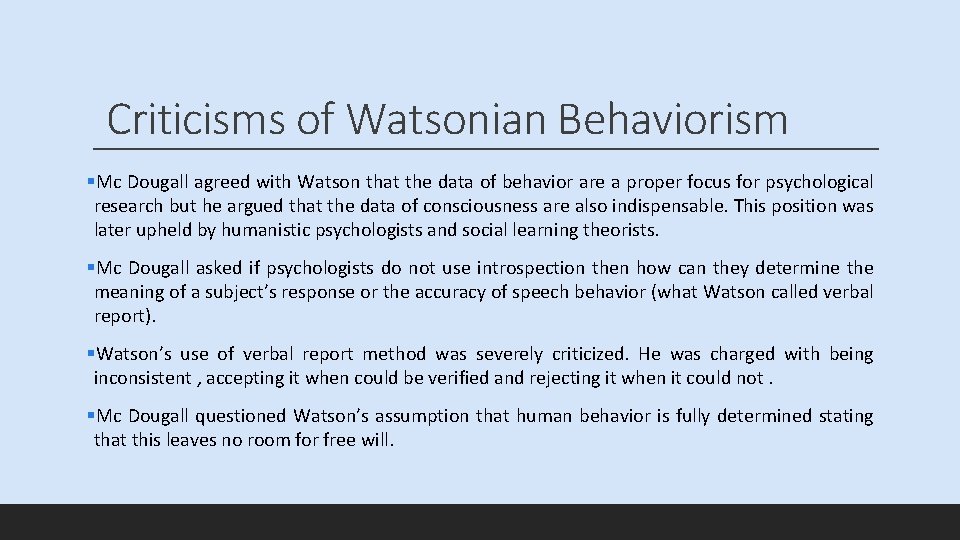
Criticisms of Watsonian Behaviorism §Mc Dougall agreed with Watson that the data of behavior are a proper focus for psychological research but he argued that the data of consciousness are also indispensable. This position was later upheld by humanistic psychologists and social learning theorists. §Mc Dougall asked if psychologists do not use introspection then how can they determine the meaning of a subject’s response or the accuracy of speech behavior (what Watson called verbal report). §Watson’s use of verbal report method was severely criticized. He was charged with being inconsistent , accepting it when could be verified and rejecting it when it could not. §Mc Dougall questioned Watson’s assumption that human behavior is fully determined stating that this leaves no room for free will.

Thank You
- Slides: 22