
CC 5 7 Bonding p 83 88 Key
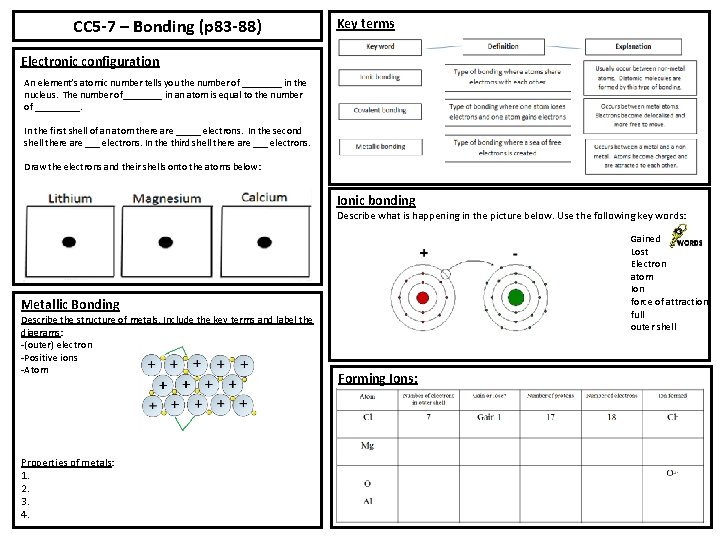
CC 5 -7 – Bonding (p 83 -88) Key terms Electronic configuration An element’s atomic number tells you the number of ____ in the nucleus. The number of____ in an atom is equal to the number of _____. In the first shell of an atom there are _____ electrons. In the second shell there are ___ electrons. In the third shell there are ___ electrons. Draw the electrons and their shells onto the atoms below: Ionic bonding Describe what is happening in the picture below. Use the following key words: Gained Lost Electron atom Ion force of attraction full outer shell Metallic Bonding Describe the structure of metals. Include the key terms and label the diagrams: -(outer) electron -Positive ions -Atom Properties of metals: 1. 2. 3. 4. Forming Ions:
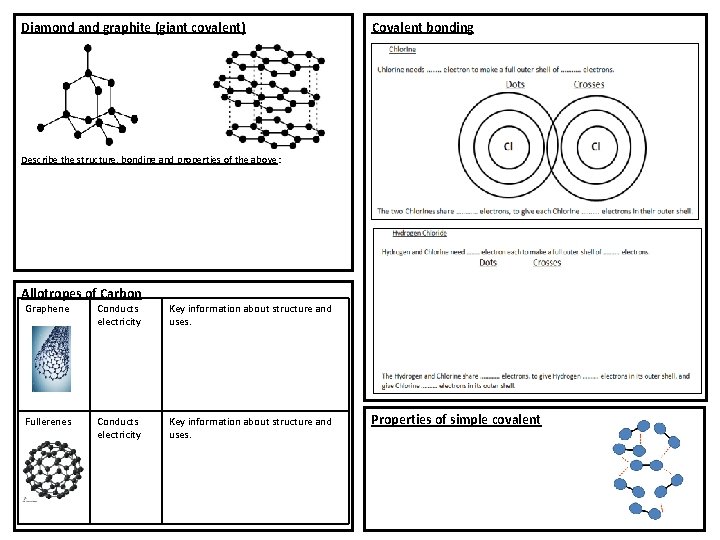
Diamond and graphite (giant covalent) Covalent bonding Describe the structure, bonding and properties of the above: Allotropes of Carbon Graphene Conducts electricity Key information about structure and uses. Fullerenes Conducts electricity Key information about structure and uses. Properties of simple covalent
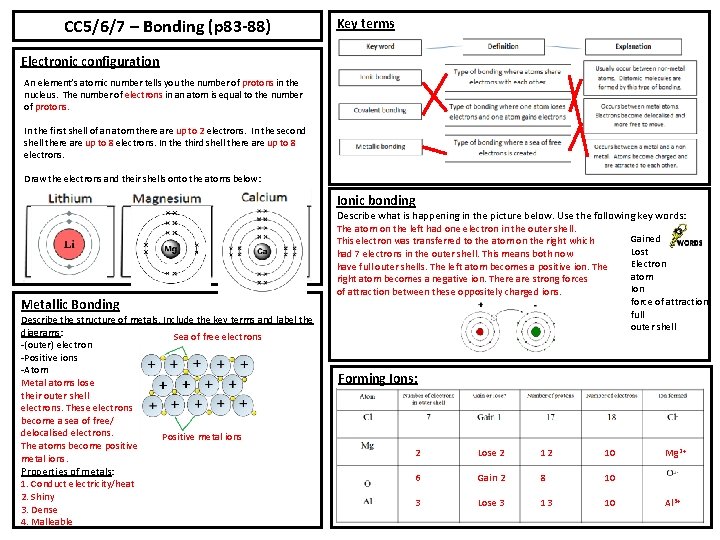
CC 5/6/7 – Bonding (p 83 -88) Key terms Electronic configuration An element’s atomic number tells you the number of protons in the nucleus. The number of electrons in an atom is equal to the number of protons. In the first shell of an atom there are up to 2 electrons. In the second shell there are up to 8 electrons. In the third shell there are up to 8 electrons. Draw the electrons and their shells onto the atoms below: Ionic bonding Metallic Bonding Describe the structure of metals. Include the key terms and label the diagrams: Sea of free electrons -(outer) electron -Positive ions -Atom Metal atoms lose their outer shell electrons. These electrons become a sea of free/ delocalised electrons. Positive metal ions The atoms become positive metal ions. Properties of metals: 1. Conduct electricity/heat 2. Shiny 3. Dense 4. Malleable Describe what is happening in the picture below. Use the following key words: The atom on the left had one electron in the outer shell. Gained This electron was transferred to the atom on the right which Lost had 7 electrons in the outer shell. This means both now Electron have full outer shells. The left atom becomes a positive ion. The atom right atom becomes a negative ion. There are strong forces Ion of attraction between these oppositely charged ions. force of attraction full outer shell Forming Ions: 2 Lose 2 12 10 6 Gain 2 8 10 3 Lose 3 13 10 Mg 2+ Al 3+

Diamond and graphite (giant covalent) Covalent bonding 1 Describe the structure, bonding and properties of the above: Both structures are made of covalent bonds between carbon atoms. In graphite (right) each carbon atom forms 3 covalent bonds. This leaves one outer shell electron free. This free electron means that graphite can conduct electricity. It also means it is soft as there are only weak bonds between layers due to the free electrons. In diamond (left) each carbon atom forms 4 covalent bonds giving it a full outer shell and no free electrons. This means diamond is strong and cannot conduct electricity. Allotropes of Carbon Graphene Fullerenes Conducts electricity Key information about structure and uses. Very strong and conductors of electricity. Used as semiconductors in electronic circuits. Their strength makes them useful in reinforcing structures where exceptional lightness and strength are needed for example, the frame of a tennis racket. They're also used as a platform for industrial catalysts. Key information about structure and uses. made from carbon atoms joined together to make balls of carbon. The molecules of Buckminster Fullerene are spherical and are also known as 'buckyballs' – formula C 60. Used in drug delivery 8 1 8 2/8 1 Properties of simple covalent Low melting and boiling point due to weak forces between molecules, usually gasses at room temperature. Not able to conduct electricity due to lack of charged particles or free electrons. Most cannot dissolve. 2
- Slides: 4