
CC 410 System Programming Dr Manal Helal Fall
- Slides: 30
CC 410: System Programming Dr. Manal Helal – Fall 2014 – Lecture 3
Learning Objectives • Study More SIC Programming Examples • Understand CISC Machines • Understand RISC Machines 2
1. 3. 3 SIC Programming Examples 3
1. 3. 3 SIC Programming Examples 4
1. 3. 3 SIC Programming Examples 5
1. 3. 3 SIC Programming Examples 6
1. 3. 3 SIC Programming Examples 7
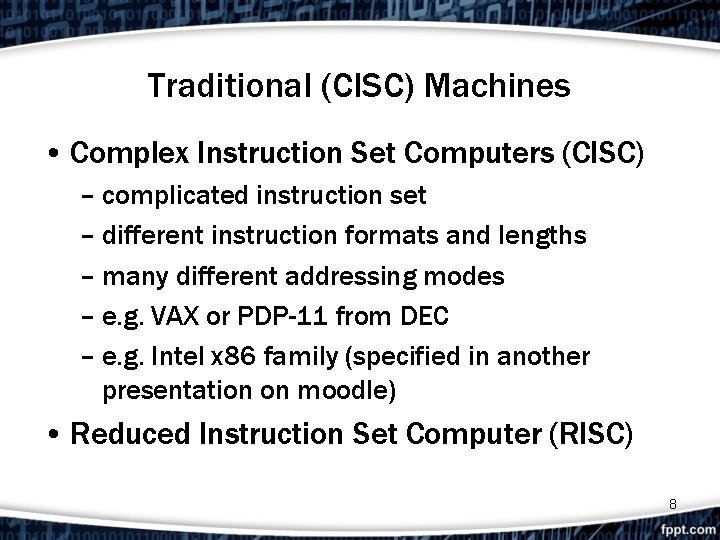
Traditional (CISC) Machines • Complex Instruction Set Computers (CISC) – complicated instruction set – different instruction formats and lengths – many different addressing modes – e. g. VAX or PDP-11 from DEC – e. g. Intel x 86 family (specified in another presentation on moodle) • Reduced Instruction Set Computer (RISC) 8
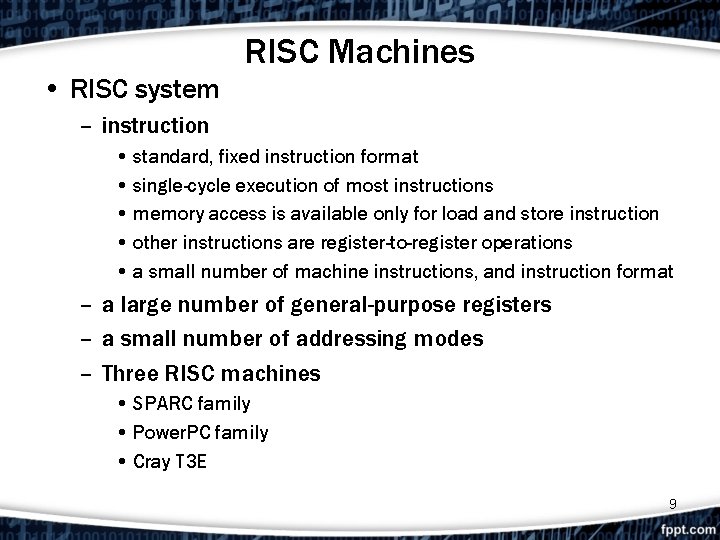
RISC Machines • RISC system – instruction • standard, fixed instruction format • single-cycle execution of most instructions • memory access is available only for load and store instruction • other instructions are register-to-register operations • a small number of machine instructions, and instruction format – a large number of general-purpose registers – a small number of addressing modes – Three RISC machines • SPARC family • Power. PC family • Cray T 3 E 9
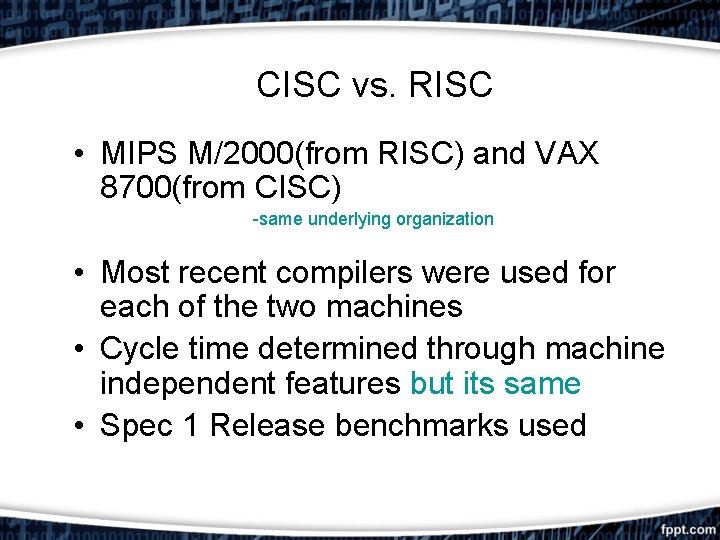
CISC vs. RISC • MIPS M/2000(from RISC) and VAX 8700(from CISC) -same underlying organization • Most recent compilers were used for each of the two machines • Cycle time determined through machine independent features but its same • Spec 1 Release benchmarks used
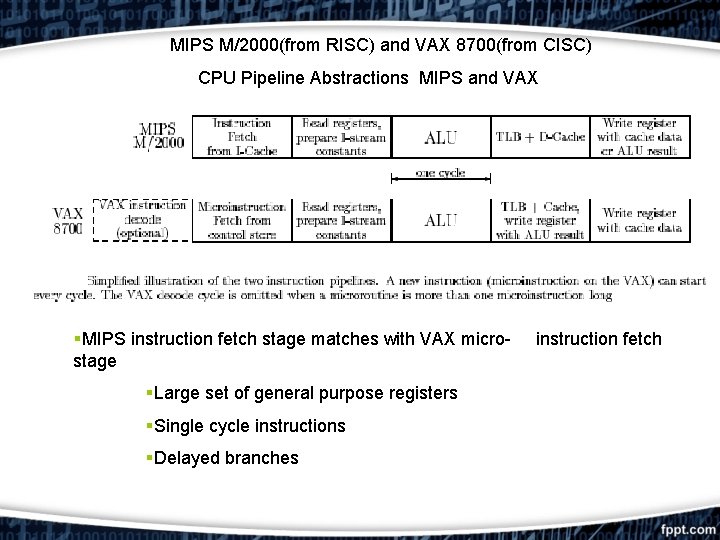
MIPS M/2000(from RISC) and VAX 8700(from CISC) CPU Pipeline Abstractions MIPS and VAX §MIPS instruction fetch stage matches with VAX microstage §Large set of general purpose registers §Single cycle instructions §Delayed branches instruction fetch
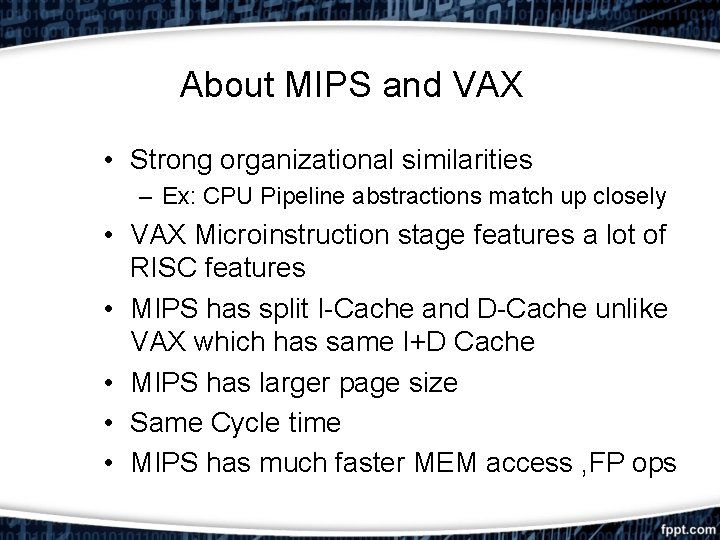
About MIPS and VAX • Strong organizational similarities – Ex: CPU Pipeline abstractions match up closely • VAX Microinstruction stage features a lot of RISC features • MIPS has split I-Cache and D-Cache unlike VAX which has same I+D Cache • MIPS has larger page size • Same Cycle time • MIPS has much faster MEM access , FP ops
No Big Difference Now! • Common Goal of High Performance will bring them together – Incorporating each other’s features – Incorporating similar functional units. • Branch Prediction • OOE (Out of Order Executio) etc
An exception • Embedded Processors – CISC is unsuitable – MIPS/watt ratio – Power consumption – Heat dissipation – Simple Hardware = integrated peripherals
From CISC to RISC (1) • What Intel, the most famous CISC advocates, and HP do in IA-64: – Migrate to a Common Instruction Set. – Creating Small Instructions – More concise Instruction Set. – Shorter Pipeline – Lower Clock Cycle
From CISC to RISC (2) • What Intel, the most famous CISC advocates, and HP do in IA-64: – Abandon the Out-of-order Execution In Hardware – Depend on Compiler to Handle Instruction Execution Order. Shifting the Complexity to Software.
From CISC to RISC (3) • AMD Use Microcode and Direct Execution to Handle Control in Athlon • CISC Datapaths Support Other RISC-like Features (such as register-to-register addressing and an expanded register count).
From RISC to CISC (1) • Additional registers • On-chip caches (which are clocked as fast as the processor) • Additional functional units for superscalar execution
From RISC to CISC (2) • Additional "non-RISC" (but fast) instructions • On-chip support for floating-point operations • Increased pipeline depth
CISC and RISC • Incorporating Same Features – Complex Multi-level Cache – Branch Prediction – Out-of-order Execution
CISC vs RISC • Hard to Distinguish Now. Boundary is getting vague. • Academia don’t Care • Industry doesn’t Care (Except for Advertisements)
RISC vs CISC • Which one is better for general-purpose microprocessor design? • It does not matter because – The main factor driving general-purpose microprocessor design has been the peculiar economics of semiconductor manufacturing
IC Manufacturing Economics OPTIONAL SLIDES
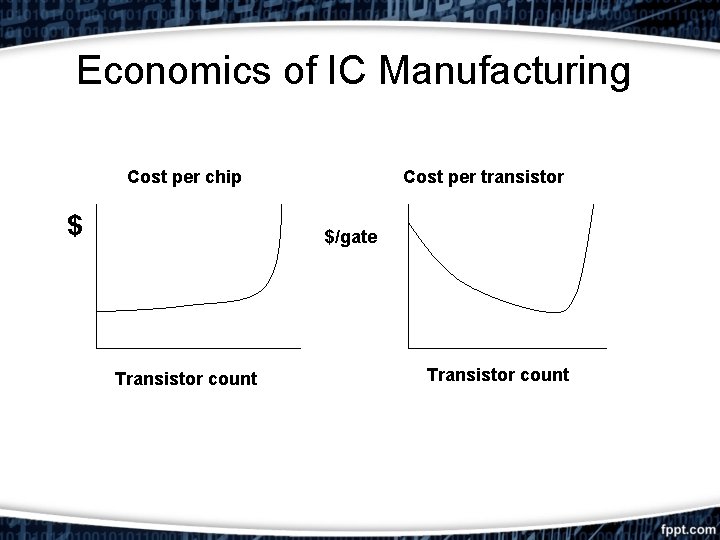
Economics of IC Manufacturing Cost per chip $ Cost per transistor $/gate Transistor count
The graph tells us. . . • These curves strongly favor designs near the knee of the curve • All microprocessors in a certain time have roughly the same number of transistors • Key design tradeoff: what to do with a given number of transistors?
RISC vs CISC: 500 k transistors • For a few years in the late 80’s, designers had a choice: – CISC CPU and no on-chip cache – RISC CPU and on-chip cache • On-chip cache was probably a slightly better choice, giving RISC several years of modest advantage • It is not RISC who gave better performance at this certain period; it was about the on-chip cache!
RISC vs CISC: 2 M transistors • Now possible to have both CISC and onchip cache • CISC can challenge RISC and it even has more advantage • RISC chips become more CISC-like
Even More Transistors • Then more transistors became available than single CISC CPU and reasonable cache could use… What now? – Multi-processor chips? – Superscalar? – VLIW?
Convergence: 5 M transistors • Superscalar won. But – It is really hard to pipeline and schedule superscalar computations when instruction cycles, word-lengths differ, and when there are 100 s of different instructions – Compilers used only a small subset of instructions • This pushed CISC designs to be more RISC-like
Even more: 50 M transistors • The economy of IC manufacturing have been making RISC and CISC go together • Maybe one day these two become historic terms and ? ISC will prevail