
CC 1001 K CARRY OUT SAFE WORKING PRACTICES
- Slides: 9
CC 1001 K CARRY OUT SAFE WORKING PRACTICES
MANUAL HANDLING n The Manual Handling Regulations 1992. n These regulations apply to a wide range of manual handling activities. n Manual Handling covers lifting, lowering, pushing, pulling or carrying. n The Regulations give advice to Employers, Managers and Employees on how to reduce the risk of injury from manual handling.
Employers Responsibilities n TO AVOID : the employer is to avoid the need for Manual Handling as far as is reasonably practical. n TO ASSESS: the employer has to assess the risk of injury from any manual handling that cant be avoided. n TO REDUCE: they have a duty to reduce the risk of injury as far as is practical.
EMPLOYEES RESPONSIBILITIES n n n Employees have to : Follow systems of work that have been laid down for their safety. Make proper use of any safety equipment that has been provided. Co operate on any Health and Safety matters. Inform the employer of any hazardous or dangerous handling tasks. Take care that their own activities do not put other people at risk.
AVOID Do you need to move it at all? n Can you do the job with the item where it is? n Can you get something delivered directly to your workplace? n Can you move it with handling aids eg. Pallet truck, wheel barrow, hoist.
ASSESS n The employer must assess any job involving manual handling by considering 4 points. n THE LOAD n THE WORKING ENVIRONMENT. n THE EMPLOYEE. n THE TASK.
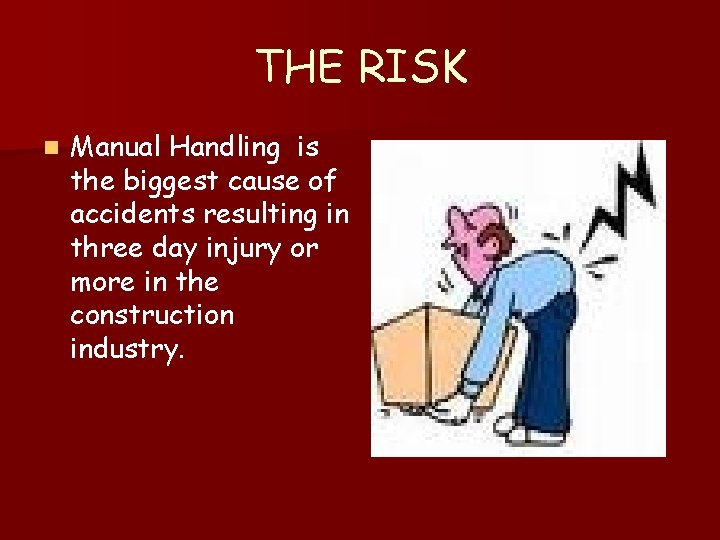
THE RISK n Manual Handling is the biggest cause of accidents resulting in three day injury or more in the construction industry.
Kinetic lifting n n Everyone has a different capability to lift loads. The maximum suggested weight for a fit, healthy male to lift is 25 kg. Kinetic lifting is a technique to lift a load smoothly using the strongest muscles of the legs and thighs. Bent knees allow the back to retain its normal shape and not take any of the strain.
REMEMBER n n n n Where possible, split a load into smaller parts to make it easier to lift it. Safe lifting uses the muscles of the thighs and legs. This is called Kinetic Lifting. Always assess the load first. If there is a risk of injury, use another method of lifting. The back is vulnerable to injury if you do not lift a load correctly. Manual Handling Operations Regulations 1992.