
CBT Insights Tools for Justice Professionals Part I
CBT Insights & Tools for Justice Professionals Part I Wednesday June 15, 2016
Cognitive Behavioral Therapy (CBT) CBT is a general psycho-therapeutic approach -Social Learning Theory origins -Present focused problem solving approach -Emphasizes interaction of thoughts, feelings & behavior Basis of many effective, time-limited interventions for behavioral health disorders & other problems 2 10/7/2020 2
Part I Learning Objectives Key elements of CBT Compatible practices & approaches Specific CBT interventions/tools 10/7/2020 3
Topics we will cover in Part I CBT’s central elements Research on outcomes & benefits Practice components critical to success Tools & worksheets to try before next webinar 10/7/2020 4
Background on CBT • Useful for myriad psycho/social/behavioral & medical issues • To alleviate emotional distress & promote positive change • Present focus - learned behaviors can be unlearned • Impact of irrational thinking, faulty learning & automatic thoughts on feelings & behaviors • Helper & client collaboration – active, directive, structured, brief • Goals: Improved emotional states & behavior; accurate, rational thinking; increased self-efficacy 10/7/2020 5

The CBT Model Maps the relationship between behaviors, thoughts/beliefs & emotions – to clarify patterns & ways to change them 6
CBT: Theoretical Influences • Rogers: Person-centered therapeutic alliance • Bandura: Social Learning Theory • Skinner: Behavioral reinforcement • Miller & Rollnick : Motivational Interviewing 10/7/2020 7
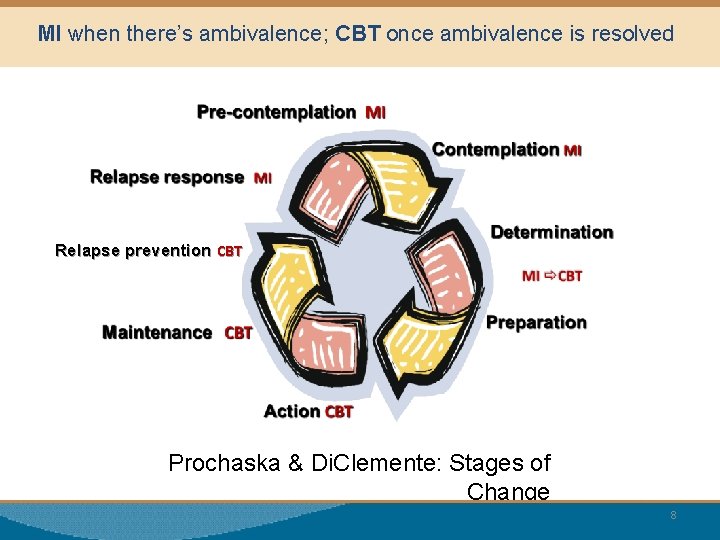
MI when there’s ambivalence; CBT once ambivalence is resolved Relapse prevention CBT Prochaska & Di. Clemente: Stages of Change 8
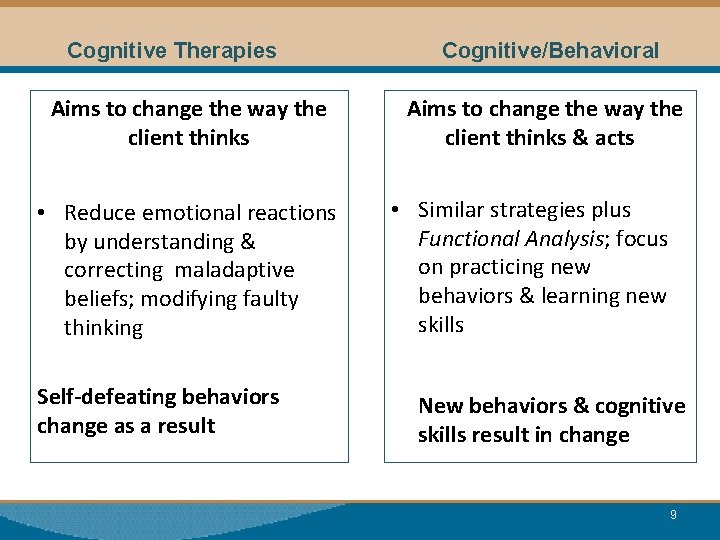
Cognitive Therapies Aims to change the way the client thinks Cognitive/Behavioral Aims to change the way the client thinks & acts • Reduce emotional reactions by understanding & correcting maladaptive beliefs; modifying faulty thinking • Similar strategies plus Functional Analysis; focus on practicing new behaviors & learning new skills Self-defeating behaviors change as a result New behaviors & cognitive skills result in change 9
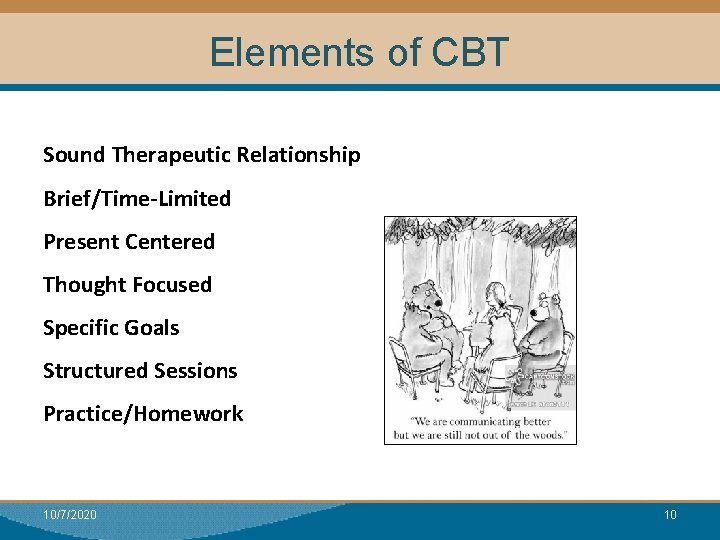
Elements of CBT Sound Therapeutic Relationship Brief/Time-Limited Present Centered Thought Focused Specific Goals Structured Sessions Practice/Homework 10/7/2020 10
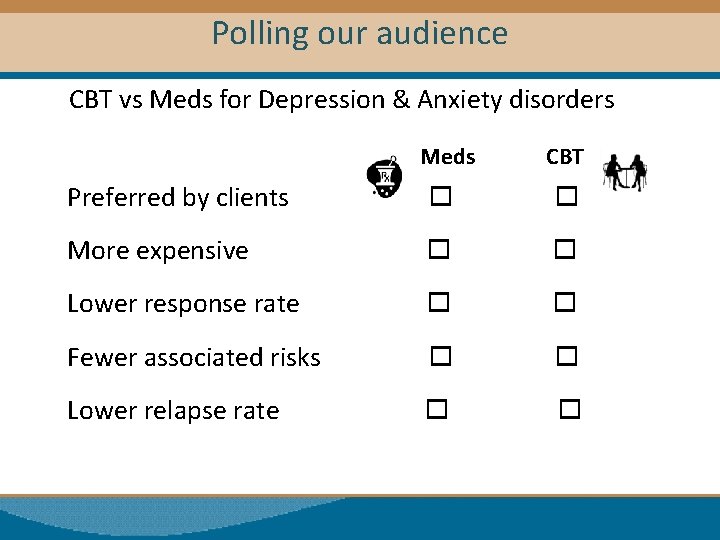
Polling our audience CBT vs Meds for Depression & Anxiety disorders Meds CBT Preferred by clients More expensive Lower response rate Fewer associated risks Lower relapse rate
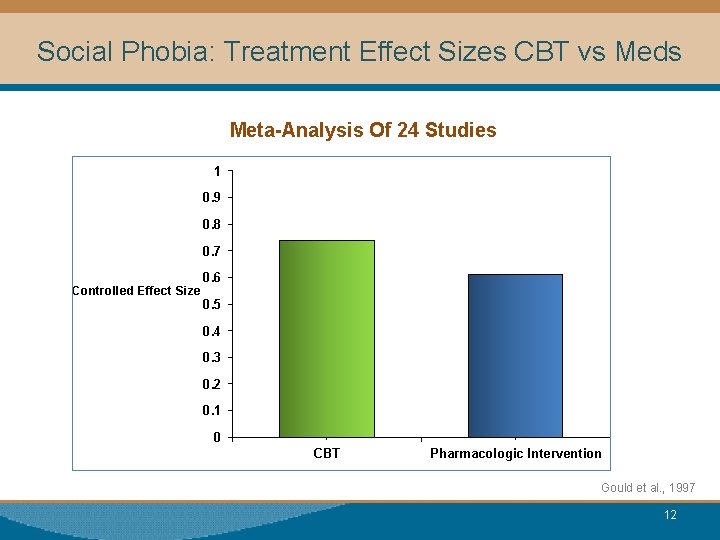
Social Phobia: Treatment Effect Sizes CBT vs Meds Meta-Analysis Of 24 Studies 1 0. 9 0. 8 0. 7 Controlled Effect Size 0. 6 0. 5 0. 4 0. 3 0. 2 0. 1 0 CBT 10/7/2020 Pharmacologic Intervention Gould et al. , 1997 12
CBT for Treatment of Major Depression • Recent meta-analysis indicates psychotherapy is preferred 3: 1 to pharmacotherapy for depression (Mc. Hugh et al. , 2013, J Clin Psychiatry) • CBT is more cost-effective than pharmacotherapy over follow-up periods (Dobson et al. 2009; Hollon et al. 200 x) • Long-term maintenance of gains-CBT has a strong enduring effect over time; lower relapse rate (Cuijpers et al. , 2013, BMJ open; Tyrell & Elliot, 2016) • Response rate higher? Outcome research on response to antidepressants (STAR*D Study, 2009) 13
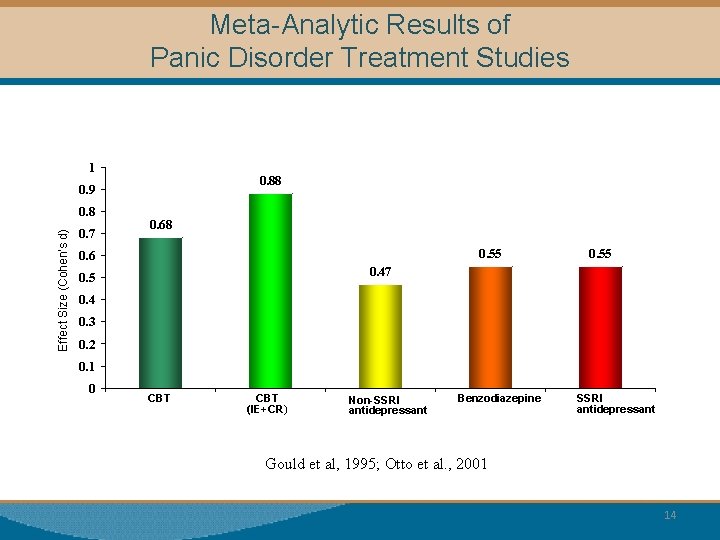
Meta-Analytic Results of Panic Disorder Treatment Studies 1 0. 88 0. 9 Effect Size (Cohen’s d) 0. 8 0. 7 0. 68 0. 55 0. 6 0. 55 0. 47 0. 5 0. 4 0. 3 0. 2 0. 1 0 CBT (IE+CR) Non-SSRI antidepressant Benzodiazepine SSRI antidepressant Gould et al, 1995; Otto et al. , 2001 14
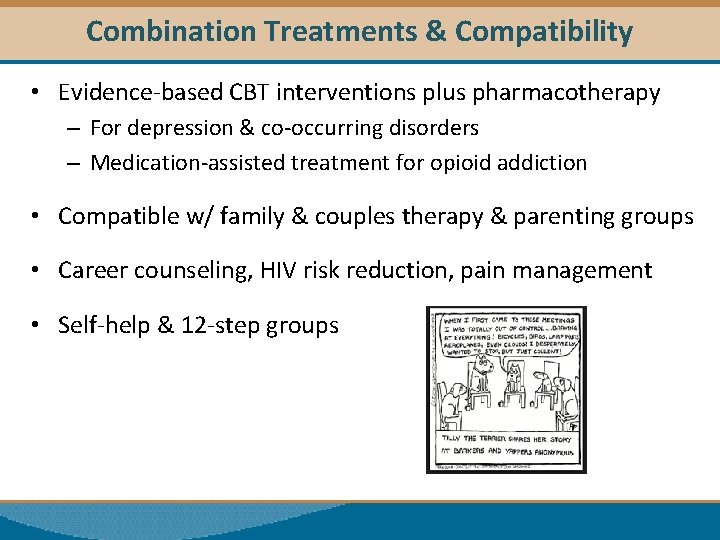
Combination Treatments & Compatibility • Evidence-based CBT interventions plus pharmacotherapy – For depression & co-occurring disorders – Medication-assisted treatment for opioid addiction • Compatible w/ family & couples therapy & parenting groups • Career counseling, HIV risk reduction, pain management • Self-help & 12 -step groups 15
What the Research Tells Us • CBT is very effective; results achieved in a short period (16 – 22 sessions average) • Evidence-based treatment for anxiety disorders & depression • Effective reshaping cognition related to criminality, substance use disorders, and trauma. Core components of therapy & sessions are required for CBT to work! 10/7/2020 16
Key Components of CBT • Functional analysis – ID thoughts, feelings, behaviors before & after difficult circumstances • Skills training – learn, model, rehearse, observe, effective strategies for coping • Cognitive modification – specific & general strategies
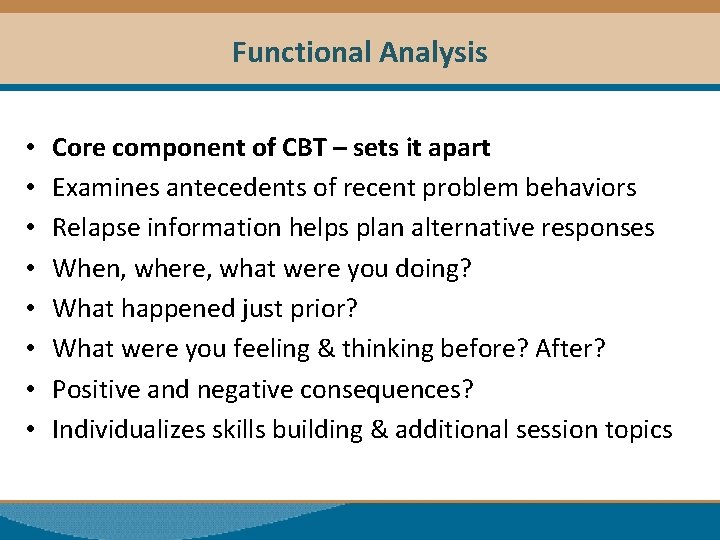
Functional Analysis • • Core component of CBT – sets it apart Examines antecedents of recent problem behaviors Relapse information helps plan alternative responses When, where, what were you doing? What happened just prior? What were you feeling & thinking before? After? Positive and negative consequences? Individualizes skills building & additional session topics 18
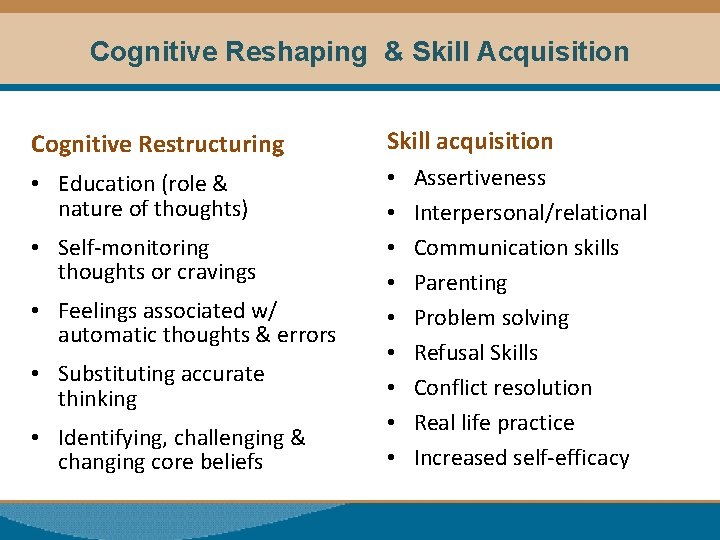
Cognitive Reshaping & Skill Acquisition Cognitive Restructuring Skill acquisition • Education (role & nature of thoughts) • • • Self-monitoring thoughts or cravings • Feelings associated w/ automatic thoughts & errors • Substituting accurate thinking • Identifying, challenging & changing core beliefs Assertiveness Interpersonal/relational Communication skills Parenting Problem solving Refusal Skills Conflict resolution Real life practice Increased self-efficacy
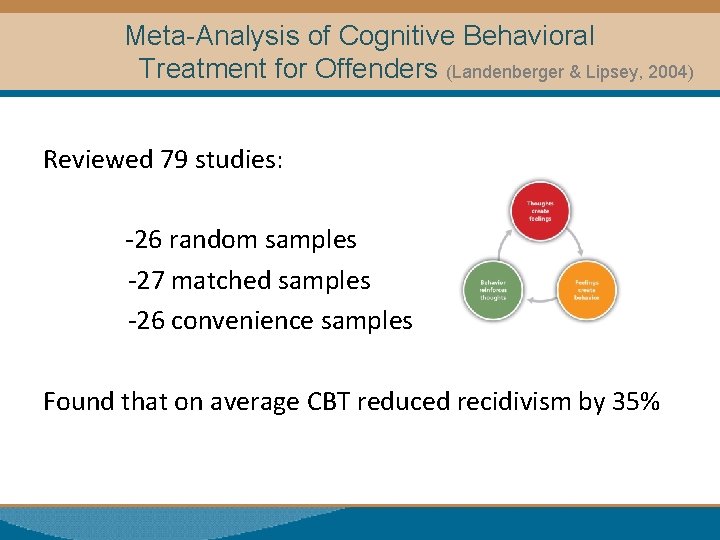
Meta-Analysis of Cognitive Behavioral Treatment for Offenders (Landenberger & Lipsey, 2004) Reviewed 79 studies: -26 random samples -27 matched samples -26 convenience samples Found that on average CBT reduced recidivism by 35% 20
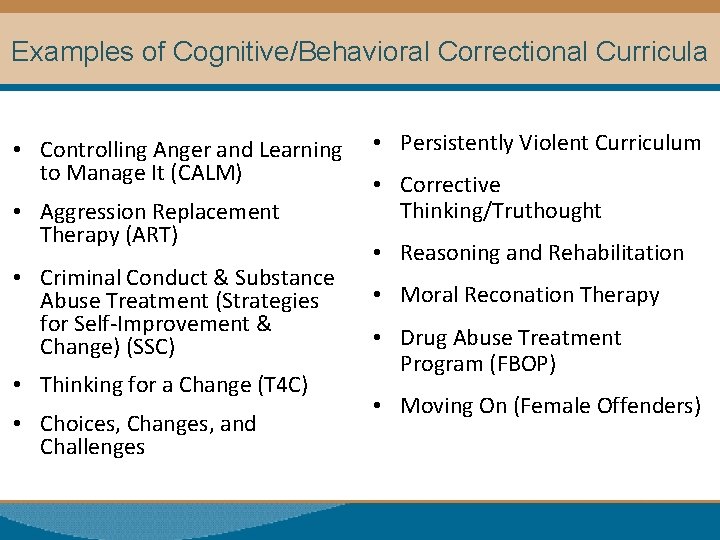
Examples of Cognitive/Behavioral Correctional Curricula • Controlling Anger and Learning to Manage It (CALM) • Aggression Replacement Therapy (ART) • Criminal Conduct & Substance Abuse Treatment (Strategies for Self-Improvement & Change) (SSC) • Thinking for a Change (T 4 C) • Choices, Changes, and Challenges 21 • Persistently Violent Curriculum • Corrective Thinking/Truthought • Reasoning and Rehabilitation • Moral Reconation Therapy • Drug Abuse Treatment Program (FBOP) • Moving On (Female Offenders)
Effective behavioral models: How do you get to Carnegie Hall? • Structured social learning - new skills & behavioral are modeled & rehearsed • Cognitive behavioral groups target criminogenic risk factors • Family based approaches train clients to use appropriate techniques 22
Topics Part II will cover & ‘homework’ More examples of CBT evidence-based interventions for substance abuse & trauma Structure & components of group sessions that increase effectiveness Using individualized techniques, tools & worksheets Compatible practice guidelines & useful resources ‘Homework’ – Look over one of the worksheets; try filling it out, or test it with clients. Think about the two follow-up discussion questions for next time. . 10/7/2020 23
Questions? Questions about content or homework, email nmiller@ahpnet. com For more information on RSAT training & technical assistance, email Jon Grand, RSAT TA Coordinator at jgrand@ahpnet. com or visit: http: //www. rsat-tta. com Thank you! 10/7/2020 24
- Slides: 24