
CBSE Notes Class 10 Geography Chapter 4 Agriculture
CBSE Notes Class 10 Geography Chapter 4 - Agriculture Presented By: Roshan Shetty

Class 10 - Geography Discover Agriculture Two-thirds of India’s population is engaged in agricultural activities. Agriculture is a primary activity, which produces most of the food raw material for various industries. In Geography Chapter 4 – Agriculture, you will CBSE Notes Class 10 study the various types of farming, cropping patterns and major crops grown in India. In the end, you will know how much Agriculture contributes to the National Economy, Employment and Output. You can also download these notes in PDF for offline reading as well. 2
Types of Farming Primitive Subsistence Farming Intensive Subsistence Farming Commercial Farming 3
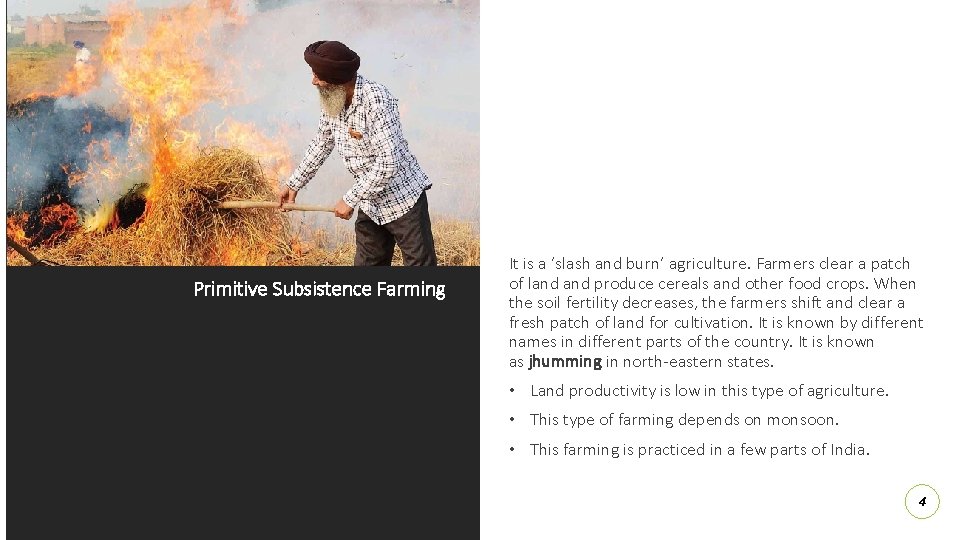
Primitive Subsistence Farming It is a ‘slash and burn’ agriculture. Farmers clear a patch of land produce cereals and other food crops. When the soil fertility decreases, the farmers shift and clear a fresh patch of land for cultivation. It is known by different names in different parts of the country. It is known as jhumming in north-eastern states. • Land productivity is low in this type of agriculture. • This type of farming depends on monsoon. • This farming is practiced in a few parts of India. 4
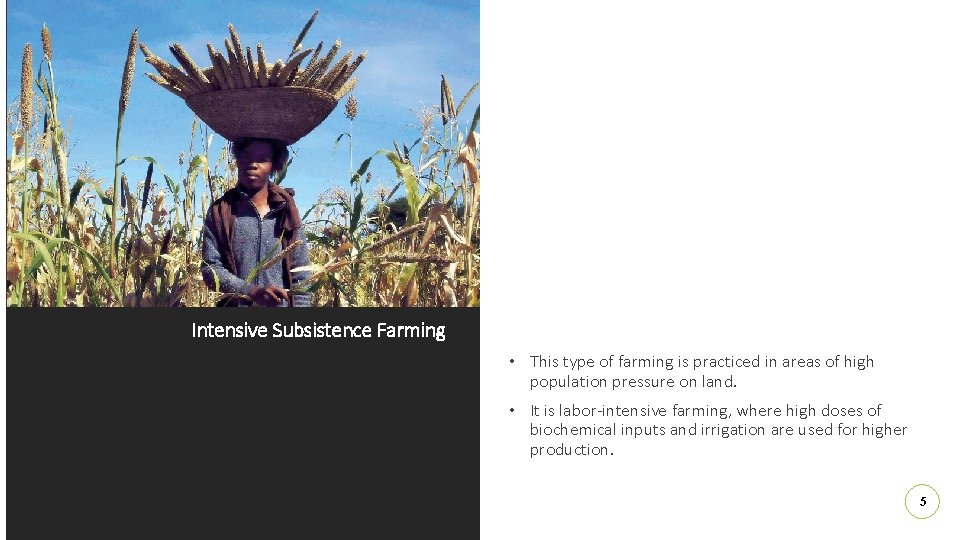
Intensive Subsistence Farming • This type of farming is practiced in areas of high population pressure on land. • It is labor-intensive farming, where high doses of biochemical inputs and irrigation are used for higher production. 5
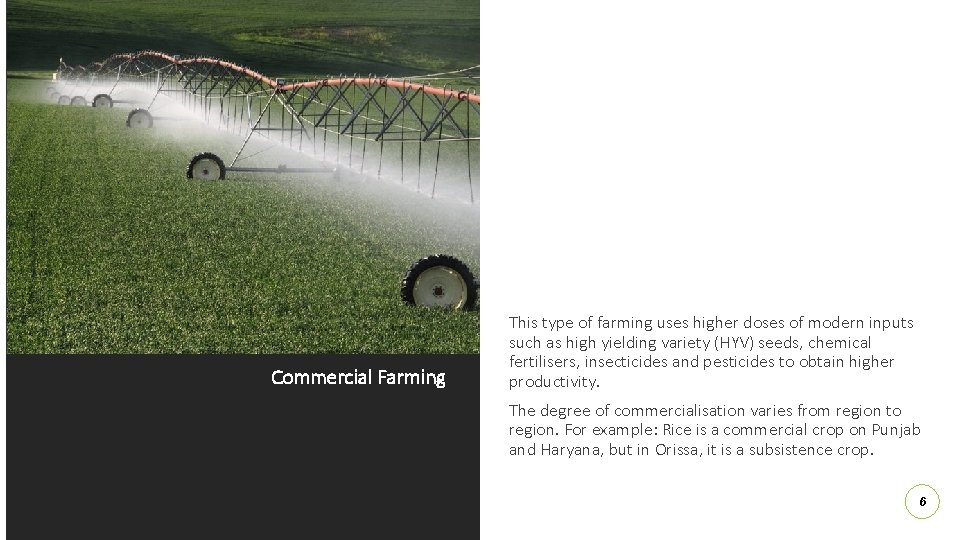
Commercial Farming This type of farming uses higher doses of modern inputs such as high yielding variety (HYV) seeds, chemical fertilisers, insecticides and pesticides to obtain higher productivity. The degree of commercialisation varies from region to region. For example: Rice is a commercial crop on Punjab and Haryana, but in Orissa, it is a subsistence crop. 6
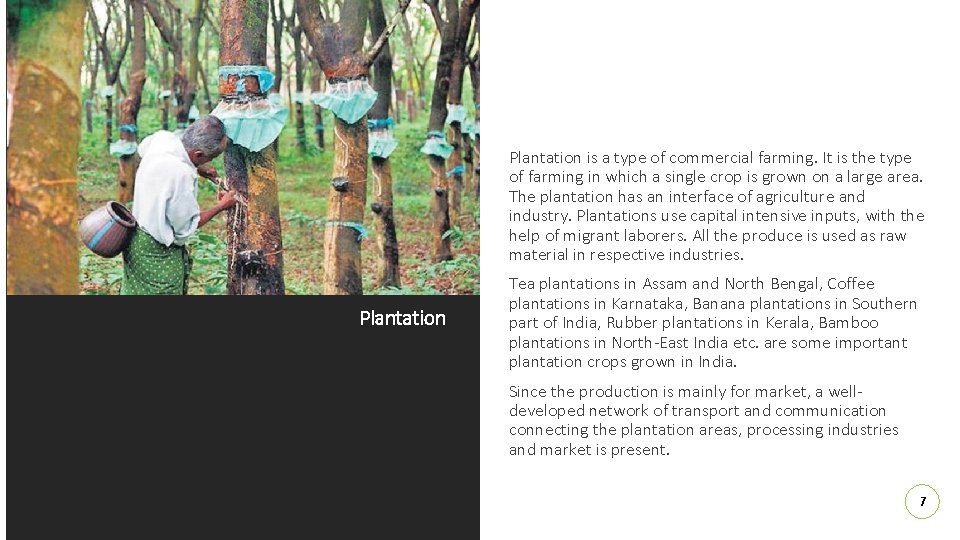
Plantation is a type of commercial farming. It is the type of farming in which a single crop is grown on a large area. The plantation has an interface of agriculture and industry. Plantations use capital intensive inputs, with the help of migrant laborers. All the produce is used as raw material in respective industries. Plantation Tea plantations in Assam and North Bengal, Coffee plantations in Karnataka, Banana plantations in Southern part of India, Rubber plantations in Kerala, Bamboo plantations in North-East India etc. are some important plantation crops grown in India. Since the production is mainly for market, a welldeveloped network of transport and communication connecting the plantation areas, processing industries and market is present. 7

Cropping Pattern Rabi Wheat, Barley, Peas, Gram and Mustard. Kharif Paddy, Maize, Jowar, Bajra, Tur, Moong, Urad, Cotton, Jute, Groundnut and Soyabean. Zaid Watermelon, Muskmelon, Cucumber, Vegetables and Fodder crops 8
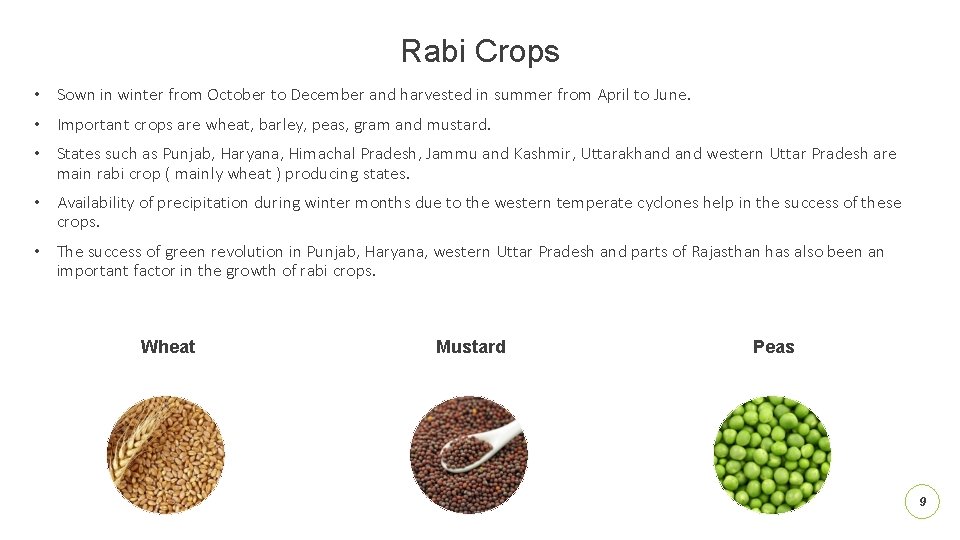
Rabi Crops • Sown in winter from October to December and harvested in summer from April to June. • Important crops are wheat, barley, peas, gram and mustard. • States such as Punjab, Haryana, Himachal Pradesh, Jammu and Kashmir, Uttarakhand western Uttar Pradesh are main rabi crop ( mainly wheat ) producing states. • Availability of precipitation during winter months due to the western temperate cyclones help in the success of these crops. • The success of green revolution in Punjab, Haryana, western Uttar Pradesh and parts of Rajasthan has also been an important factor in the growth of rabi crops. Wheat Mustard Peas 9
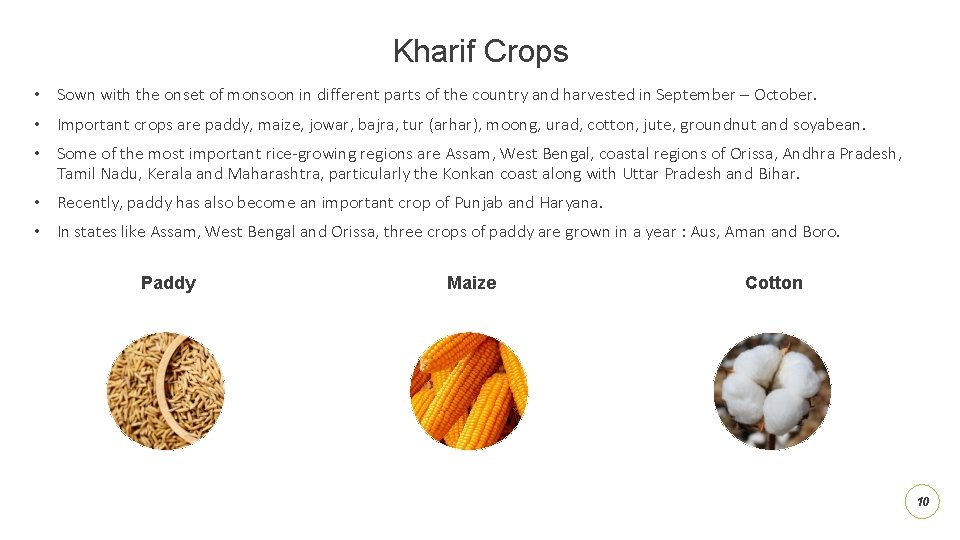
Kharif Crops • Sown with the onset of monsoon in different parts of the country and harvested in September – October. • Important crops are paddy, maize, jowar, bajra, tur (arhar), moong, urad, cotton, jute, groundnut and soyabean. • Some of the most important rice-growing regions are Assam, West Bengal, coastal regions of Orissa, Andhra Pradesh, Tamil Nadu, Kerala and Maharashtra, particularly the Konkan coast along with Uttar Pradesh and Bihar. • Recently, paddy has also become an important crop of Punjab and Haryana. • In states like Assam, West Bengal and Orissa, three crops of paddy are grown in a year : Aus, Aman and Boro. Paddy Maize Cotton 10
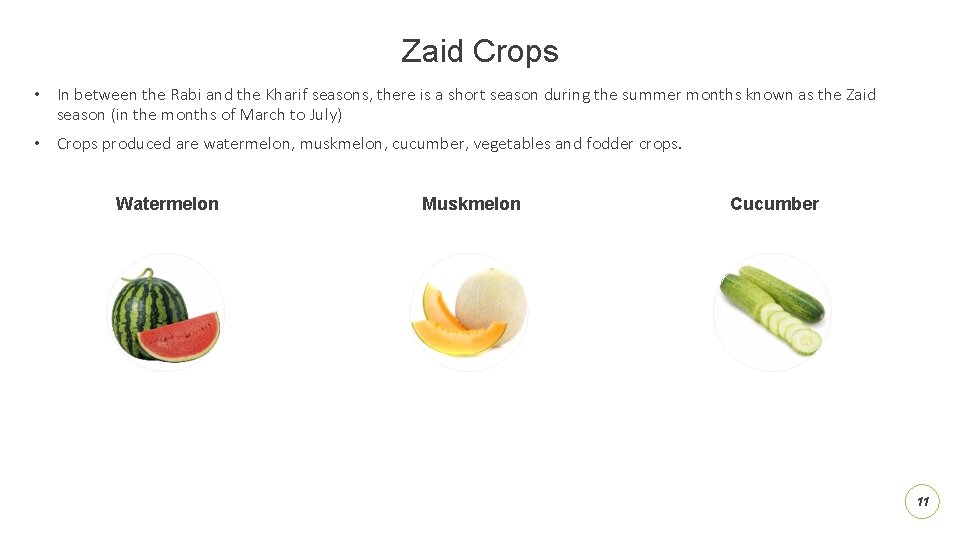
Zaid Crops • In between the Rabi and the Kharif seasons, there is a short season during the summer months known as the Zaid season (in the months of March to July) • Crops produced are watermelon, muskmelon, cucumber, vegetables and fodder crops. Watermelon Muskmelon Cucumber 11
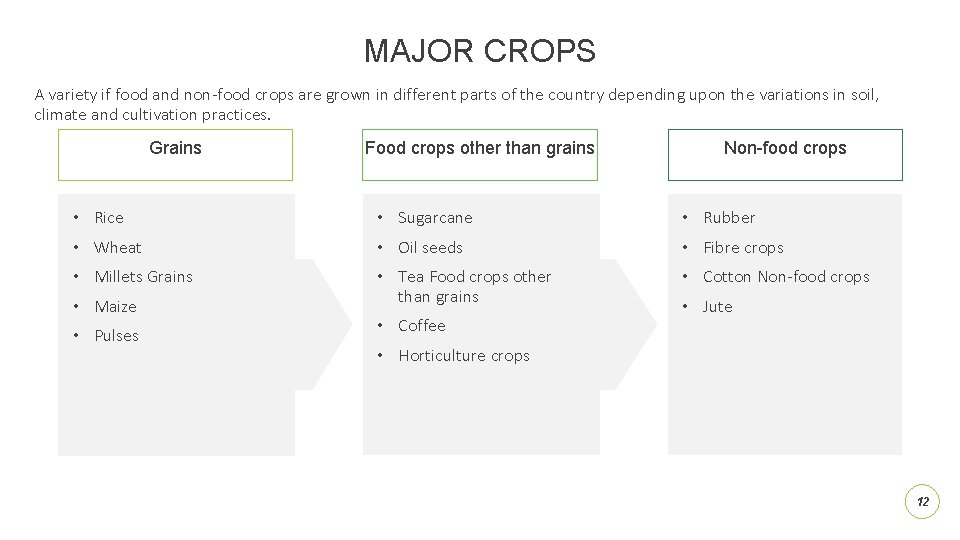
MAJOR CROPS A variety if food and non-food crops are grown in different parts of the country depending upon the variations in soil, climate and cultivation practices. Grains Food crops other than grains Non-food crops • Rice • Sugarcane • Rubber • Wheat • Oil seeds • Fibre crops • Millets Grains • Tea Food crops other than grains • Cotton Non-food crops • Maize • Pulses • Coffee • Jute • Horticulture crops 12
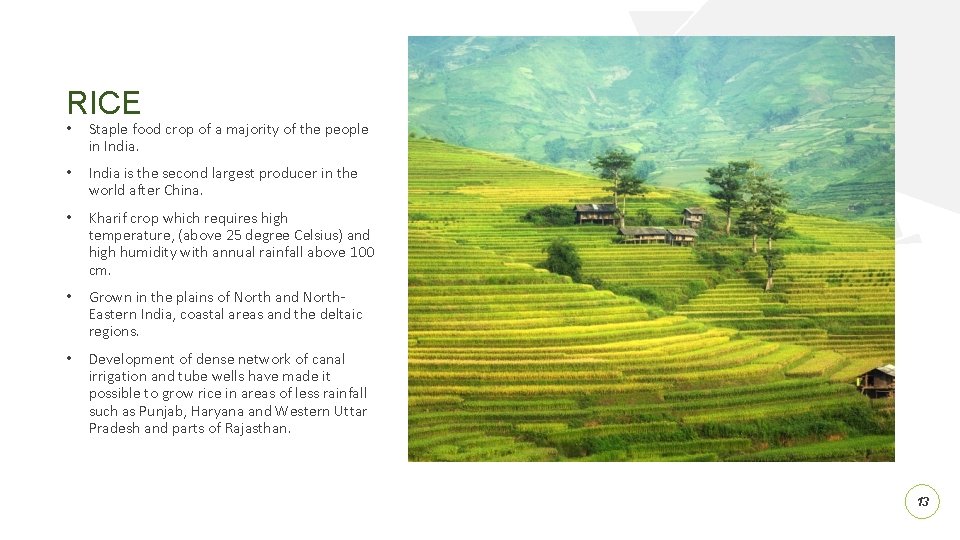
RICE • Staple food crop of a majority of the people in India. • India is the second largest producer in the world after China. • Kharif crop which requires high temperature, (above 25 degree Celsius) and high humidity with annual rainfall above 100 cm. • Grown in the plains of North and North. Eastern India, coastal areas and the deltaic regions. • Development of dense network of canal irrigation and tube wells have made it possible to grow rice in areas of less rainfall such as Punjab, Haryana and Western Uttar Pradesh and parts of Rajasthan. 13
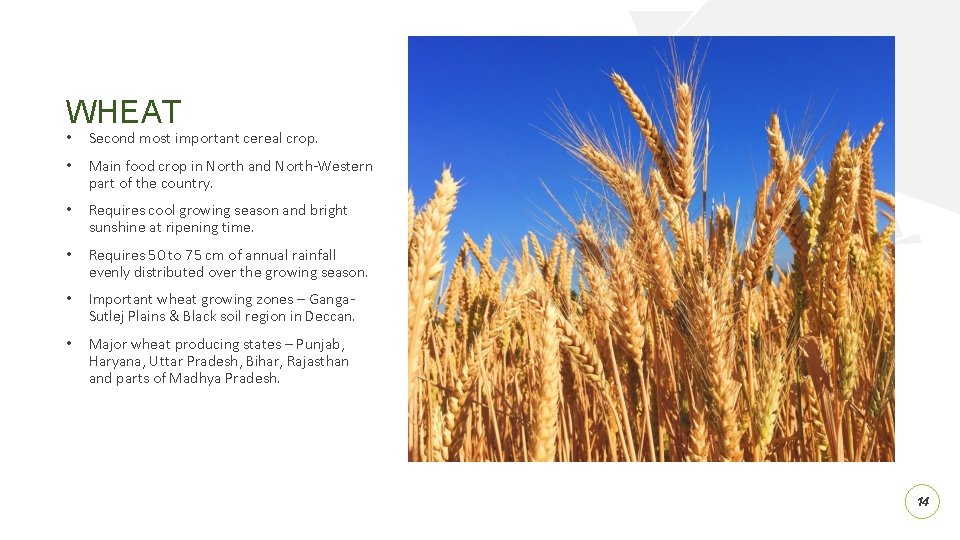
WHEAT • Second most important cereal crop. • Main food crop in North and North-Western part of the country. • Requires cool growing season and bright sunshine at ripening time. • Requires 50 to 75 cm of annual rainfall evenly distributed over the growing season. • Important wheat growing zones – Ganga. Sutlej Plains & Black soil region in Deccan. • Major wheat producing states – Punjab, Haryana, Uttar Pradesh, Bihar, Rajasthan and parts of Madhya Pradesh. 14
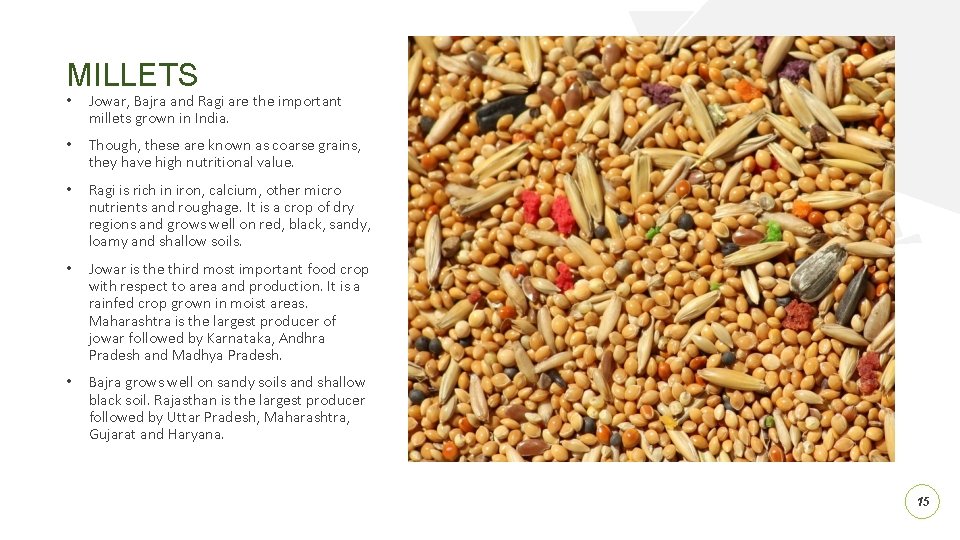
MILLETS • Jowar, Bajra and Ragi are the important millets grown in India. • Though, these are known as coarse grains, they have high nutritional value. • Ragi is rich in iron, calcium, other micro nutrients and roughage. It is a crop of dry regions and grows well on red, black, sandy, loamy and shallow soils. • Jowar is the third most important food crop with respect to area and production. It is a rainfed crop grown in moist areas. Maharashtra is the largest producer of jowar followed by Karnataka, Andhra Pradesh and Madhya Pradesh. • Bajra grows well on sandy soils and shallow black soil. Rajasthan is the largest producer followed by Uttar Pradesh, Maharashtra, Gujarat and Haryana. 15
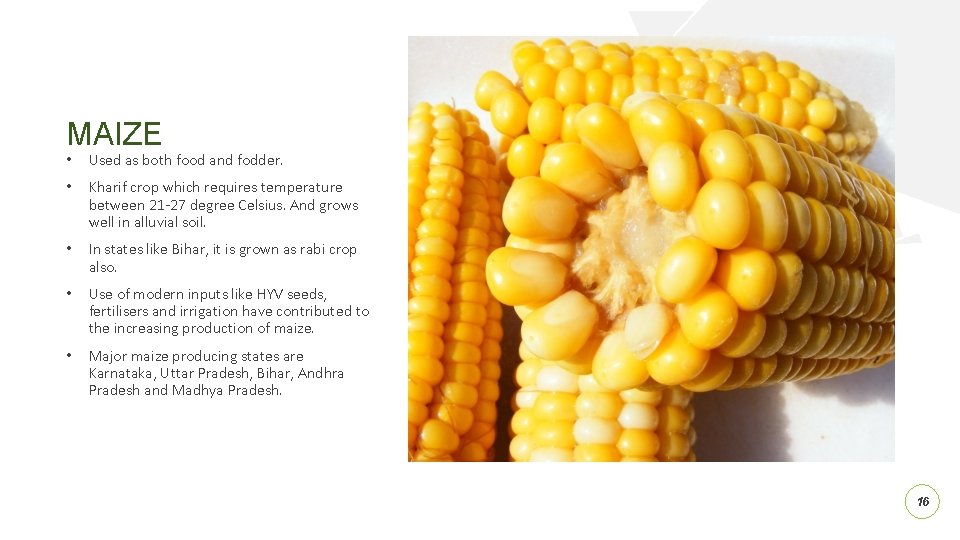
MAIZE • Used as both food and fodder. • Kharif crop which requires temperature between 21 -27 degree Celsius. And grows well in alluvial soil. • In states like Bihar, it is grown as rabi crop also. • Use of modern inputs like HYV seeds, fertilisers and irrigation have contributed to the increasing production of maize. • Major maize producing states are Karnataka, Uttar Pradesh, Bihar, Andhra Pradesh and Madhya Pradesh. 16
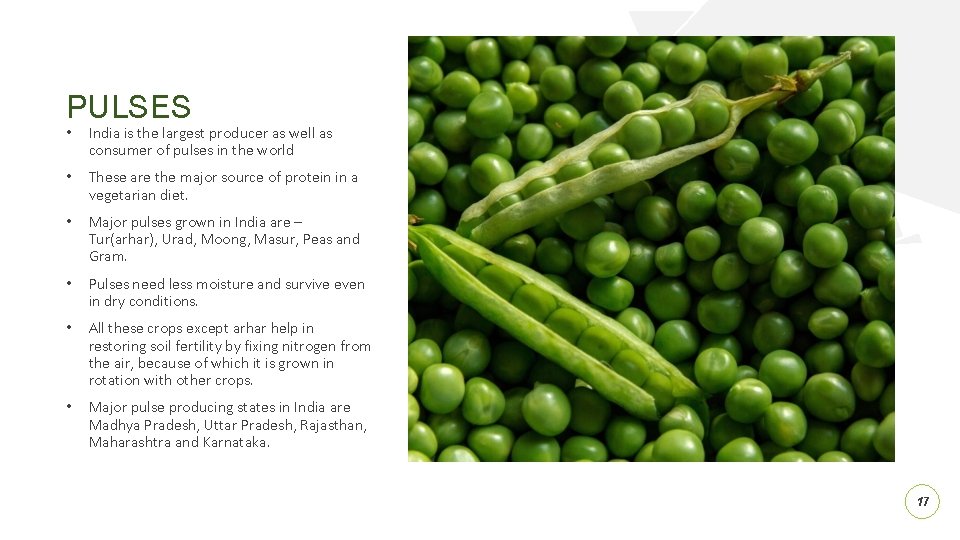
PULSES • India is the largest producer as well as consumer of pulses in the world • These are the major source of protein in a vegetarian diet. • Major pulses grown in India are – Tur(arhar), Urad, Moong, Masur, Peas and Gram. • Pulses need less moisture and survive even in dry conditions. • All these crops except arhar help in restoring soil fertility by fixing nitrogen from the air, because of which it is grown in rotation with other crops. • Major pulse producing states in India are Madhya Pradesh, Uttar Pradesh, Rajasthan, Maharashtra and Karnataka. 17
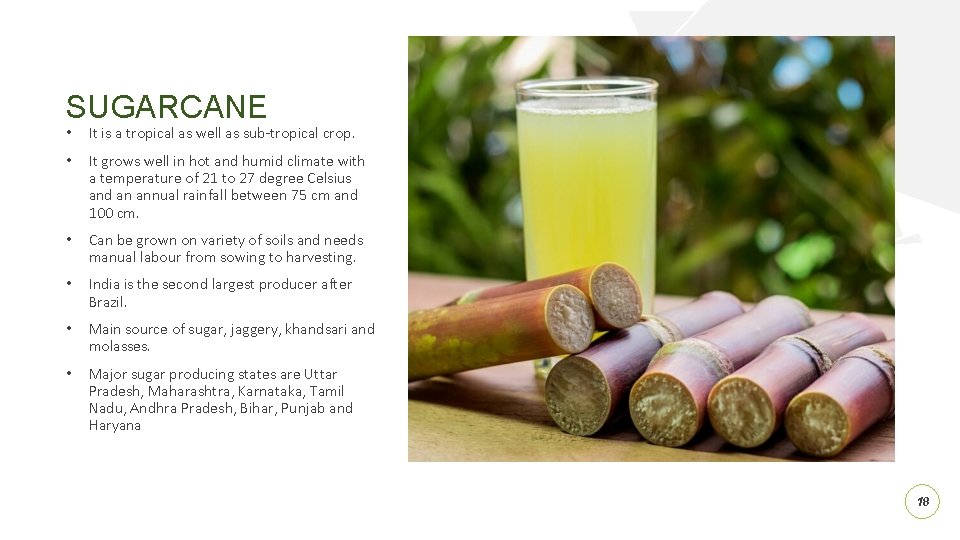
SUGARCANE • It is a tropical as well as sub-tropical crop. • It grows well in hot and humid climate with a temperature of 21 to 27 degree Celsius and an annual rainfall between 75 cm and 100 cm. • Can be grown on variety of soils and needs manual labour from sowing to harvesting. • India is the second largest producer after Brazil. • Main source of sugar, jaggery, khandsari and molasses. • Major sugar producing states are Uttar Pradesh, Maharashtra, Karnataka, Tamil Nadu, Andhra Pradesh, Bihar, Punjab and Haryana 18
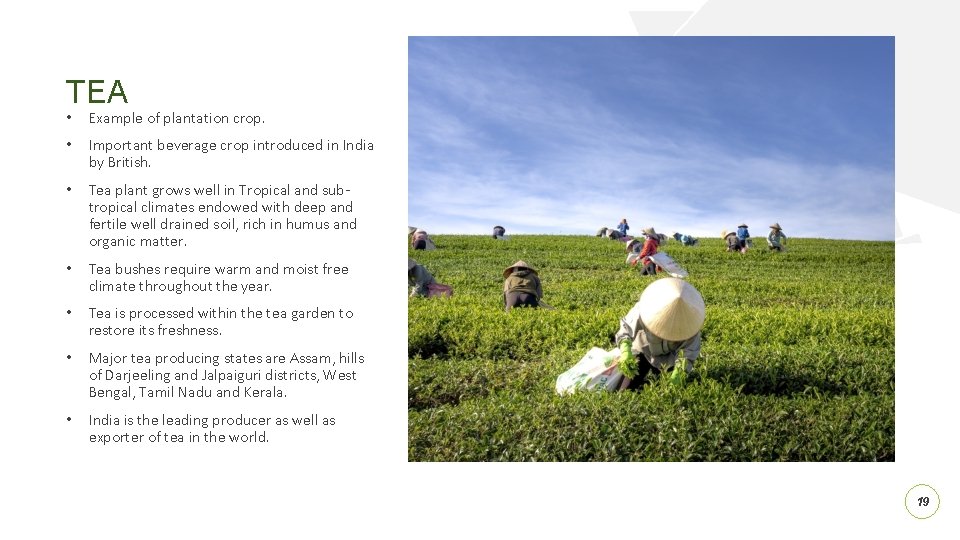
TEA • Example of plantation crop. • Important beverage crop introduced in India by British. • Tea plant grows well in Tropical and subtropical climates endowed with deep and fertile well drained soil, rich in humus and organic matter. • Tea bushes require warm and moist free climate throughout the year. • Tea is processed within the tea garden to restore its freshness. • Major tea producing states are Assam, hills of Darjeeling and Jalpaiguri districts, West Bengal, Tamil Nadu and Kerala. • India is the leading producer as well as exporter of tea in the world. 19
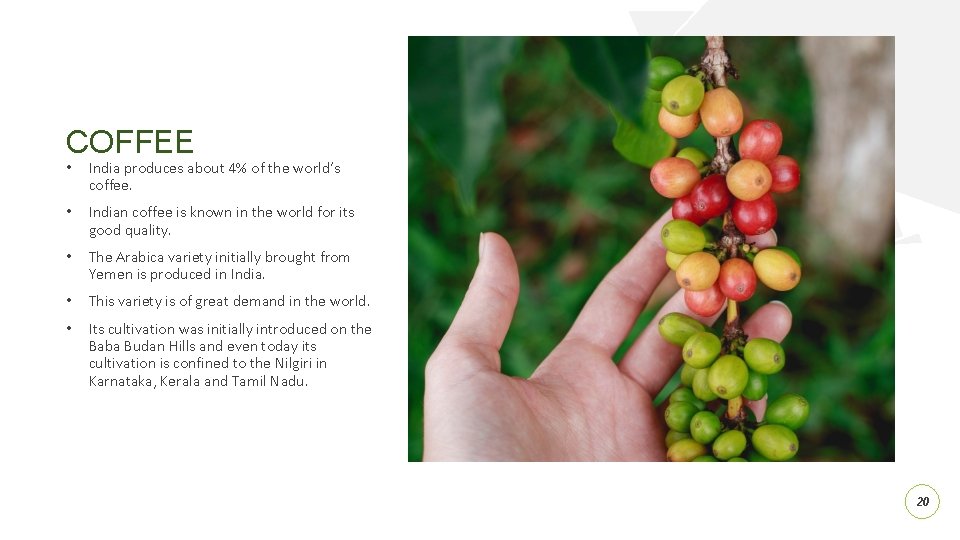
COFFEE • India produces about 4% of the world’s coffee. • Indian coffee is known in the world for its good quality. • The Arabica variety initially brought from Yemen is produced in India. • This variety is of great demand in the world. • Its cultivation was initially introduced on the Baba Budan Hills and even today its cultivation is confined to the Nilgiri in Karnataka, Kerala and Tamil Nadu. 20
Horticulture Crops India is a producer of tropical as well as temperate fruits. Major crops produced are pea, cauliflower, onion, cabbage, tomato, brinjal and potato. Some of the famous horticulture crops grown in India are: • Mangoes of Maharashtra, Andhra Pradesh, Telangana, Uttar Pradesh and West Bengal Oranges of Nagpur and Cherrapunjee (Meghalaya), bananas of Kerala, Mizoram, Maharashtra and Tamil Nadu. • Lichi and Guava of Uttar Pradesh and Bihar • Pineapples of Meghalaya • Grapes of Andhra Pradesh, Telangana and Maharashtra • Apples, pears, apricots and walnuts of Jammu and Kashmir and Himachal Pradesh 21
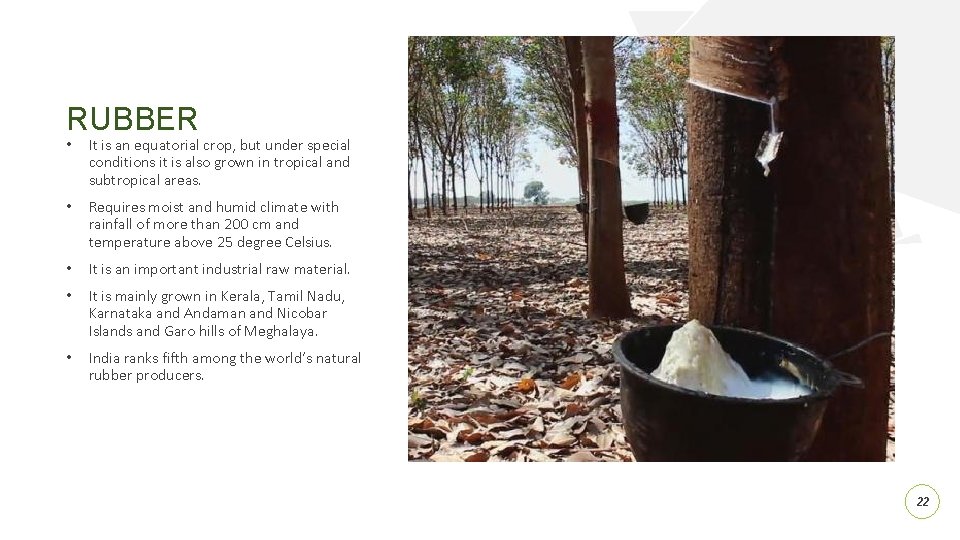
RUBBER • It is an equatorial crop, but under special conditions it is also grown in tropical and subtropical areas. • Requires moist and humid climate with rainfall of more than 200 cm and temperature above 25 degree Celsius. • It is an important industrial raw material. • It is mainly grown in Kerala, Tamil Nadu, Karnataka and Andaman and Nicobar Islands and Garo hills of Meghalaya. • India ranks fifth among the world’s natural rubber producers. 22
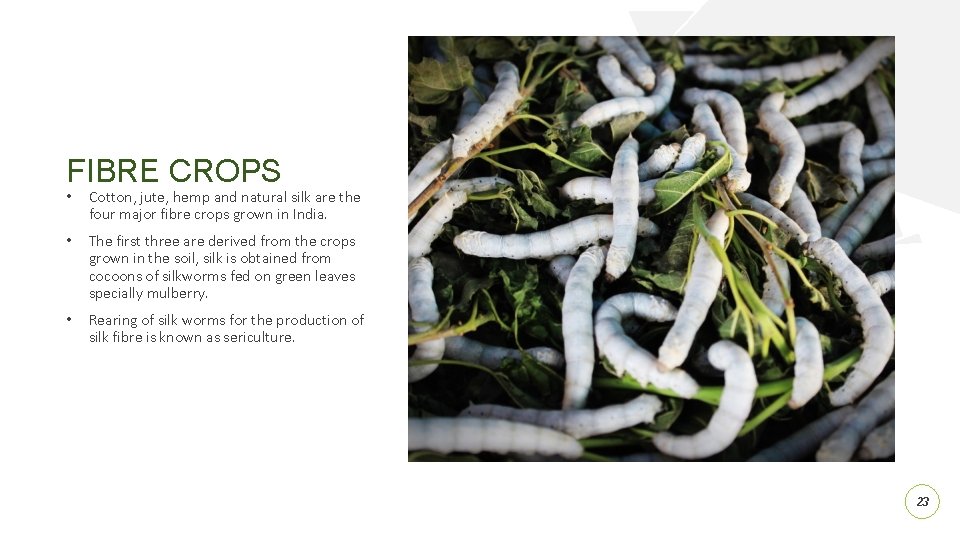
FIBRE CROPS • Cotton, jute, hemp and natural silk are the four major fibre crops grown in India. • The first three are derived from the crops grown in the soil, silk is obtained from cocoons of silkworms fed on green leaves specially mulberry. • Rearing of silk worms for the production of silk fibre is known as sericulture. 23
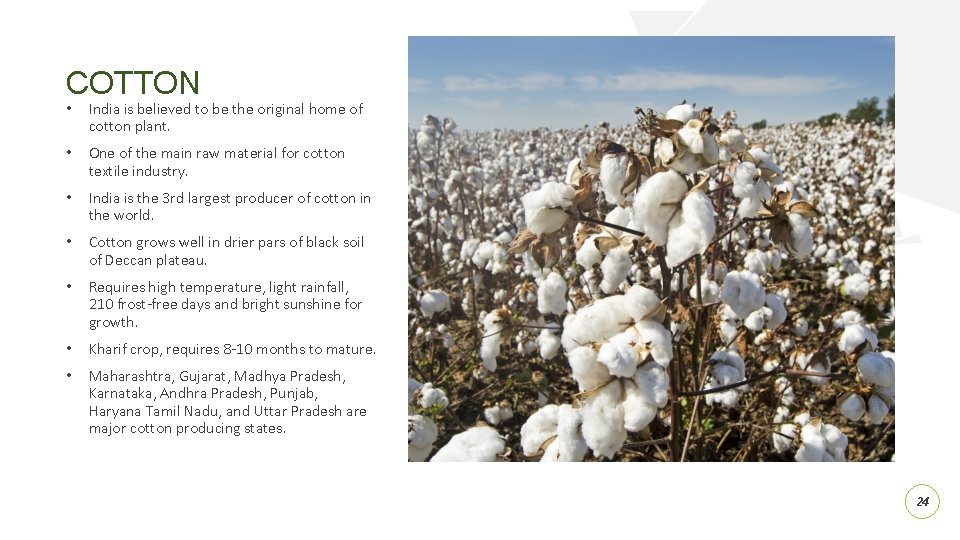
COTTON • India is believed to be the original home of cotton plant. • One of the main raw material for cotton textile industry. • India is the 3 rd largest producer of cotton in the world. • Cotton grows well in drier pars of black soil of Deccan plateau. • Requires high temperature, light rainfall, 210 frost-free days and bright sunshine for growth. • Kharif crop, requires 8 -10 months to mature. • Maharashtra, Gujarat, Madhya Pradesh, Karnataka, Andhra Pradesh, Punjab, Haryana Tamil Nadu, and Uttar Pradesh are major cotton producing states. 24
Technological and Institutional Reforms • Agriculture has been practised in India for thousands of years. Sustained uses of land without compatible technoinstitutional changes have hindered the pace of agricultural development. Why has India not improved in technical and institutional reforms in agriculture ? • In spite of development of sources of irrigation most of the farmers in large parts of the country, still depend upon monsoon and natural fertility in order to carry on their agriculture. • Agriculture needs serious technical and institutional reforms. • Collectivization, consolidation of holdings, cooperation and abolition of zamindari etc. were given priority to bring reforms in country after independence. • Land focus was the main focus of the First Five Year plan. • Right of inheritance had lead to fragmentation of land holdings. • Laws of land reforms were enacted but laws of implementation were lacking. 25
What were the steps taken by government in agricultural reforms? • Government of India embarked upon introducing agriculture reforms to improve Indian agriculture in the 1960 s and 1970 s. • Green Revolution based on use of package technology and White Revolution(Operation Flood) were some of the strategies initiated to improve Indian agriculture. • But this led to the concentration of development in few selected areas. • Therefore, in the 1980 s and 1990 s, a comprehensive land development program was initiated, which included both institutional and technical reforms. • Provisions for crop insurance against calamities, establishment of Grameen banks, cooperative societies and bank for providing loan facilities to he farmers at lower rates of interest were some steps taken. 26
Other steps taken : • Kissan Credit Card(KCC), Personal Accident Insurance Scheme(PAIS) are some other schemes introduced by the Government of India for the benefit of the farmers. • Moreover, special weather bulletins and agriculture programs for farmers were introduced on the radio and television. • The Government also announces minimum support price, remunerative and procurement prices for important crop to check the exploitation of farmers by speculators and middleman 27
BHOODAN - GRAMDAN Mahatma Gandhi declared Vinoba Bhave as his spiritual heir. He also participated in Satyagraha as one of the foremost satyagrahis. He supported Gandhiji’s concept of gram swarajya. After Gandhiji’s martyrdom, Vinoba Bhave undertook Padyatra to spread this message throughout the country. Once, when he was at Andhra Pradesh, some landless farmers demanded land for their economic wellbeing. He assured them to talk to the Indian Government for provision of land for them if they undertook cooperative farming. Shri Ram Chandra Reddy stood up and offered 80 acres of land to 80 land less farmers. This was known as Bhoodan. Later he introduced his ideas throughout India. Some Zamindars offered to distribute villages among the landless. This was known as Gramdan. However, many land owners chose to provide some part of their land to the poor farmers due to the fear of land ceiling act. This Bhoodan – Gramdan movement initiated by Vinoba Bhave is also known as Blood-less Revolution. 28
Contribution of Agriculture to the National Economy, Employment and Output • Agriculture has been the backbone of Indian economy though its share in the gross domestic product [GDP] has registered a declining trend from 1951 onwards; in 2010 -2011 about 52% of the total work force was employed by the farm sector. • Declining the share of agriculture in the GDP is the matter of serious concern because any decline and stagnation in agriculture will lead to a decline in a other spheres of economy having wider implications for society. • Establishment of Indian Council of Agricultural Research (ICAR), agricultural universities, veterinary services and animal breeding centers, horticulture development, research and development in the field of meteorology and weather forecast etc. were given priority for improving Indian agriculture. • Though GDP rate is increasing over the years, it is not generating sufficient employment opportunities in the country. • Growth in agriculture id decelerating. • Indian farmers are facing a big challenge from international competition and our government is going ahead with reduction in the public investment in agriculture sector. • Subsidy on fertilizers is decreased leading to increase in the cost of production. • Reduction in import duties on agricultural products have proved harmful to agriculture in the country. • Farmers are withdrawing their investment from agriculture causing a downfall in the employment in agriculture. 29
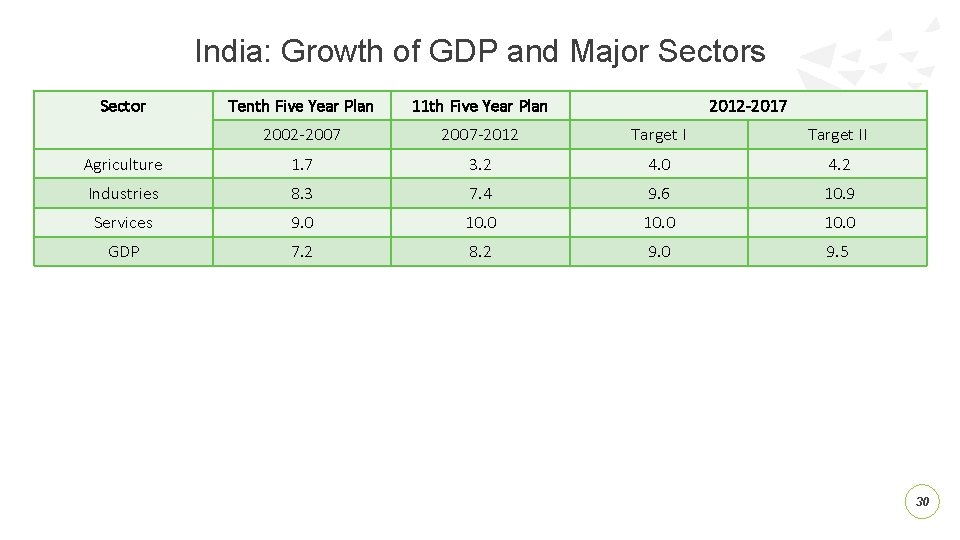
India: Growth of GDP and Major Sectors Sector Tenth Five Year Plan 11 th Five Year Plan 2012 -2017 2002 -2007 -2012 Target II Agriculture 1. 7 3. 2 4. 0 4. 2 Industries 8. 3 7. 4 9. 6 10. 9 Services 9. 0 10. 0 GDP 7. 2 8. 2 9. 0 9. 5 30
FOOD SECURITY What is food security system ? • In order to ensure availability of food to all sections of society, our government carefully designed a national food security system. • It consists of two components: buffer stock and public distribution system (PDS). • PDS is a program which provides food grains and other essential commodities at subsidized prices in rural and urban areas. • The primary objective of this policy is to ensure food grains to common people at affordable prices. • The policy focuses on growth in agriculture production and on fixing the support price for procurement of wheat and rice, to maintain the stock. • Food Corporation of India (FCI) procures and stocks food grains, whereas distribution is ensured by PDS. 31
How are food grains procured? What are the disadvantages and advantages of this method? • FCI procures food grains from the farmers at the Minimum Support Price (MSP). • The government used to provide subsidies on agricultural inputs like fertilizers, water etc. • But these have now reached sustainable levels and have also led to large scale inefficiencies in the use of these scarce inputs. • Excessive use of water and fertilizers have led to water logging, salinity and depletion of micronutrients in the soil. • The high MSP subsidies in input and committed FCI purchases have distorted the cropping pattern. • Wheat and paddy crops grown in Punjab and Haryana are for the MSP they get, which has created serious imbalance in inter-crop parities. 32
How are consumers divided? What are its drawbacks/disadvantages? • Consumers re divided into: below poverty line(BPL) and above poverty line(APL). • However this categorization is not perfect as a number of deserving poor are excluded from BPL category and some of the so called APL slip back to BPL, because of the failure of one crop and it is administratively difficult to accommodate such shifts. 33
How can we become self sufficient ? • Self sufficiency can be attained if government provides proper agricultural infrastructure, credit linkage and also encourages the use of latest techniques. • Instead of concentrating only on wheat or rice, the food crop with a better growth potential in that particular area mist be encouraged. • Creation of necessary infrastructure like irrigation facilities, availability of electricity etc. may also attract private investments in agriculture. • The focus on increasing food grain production which should be on a sustainable basis and also free trade in grains will create massive employment and reduce poverty in rural areas. 34
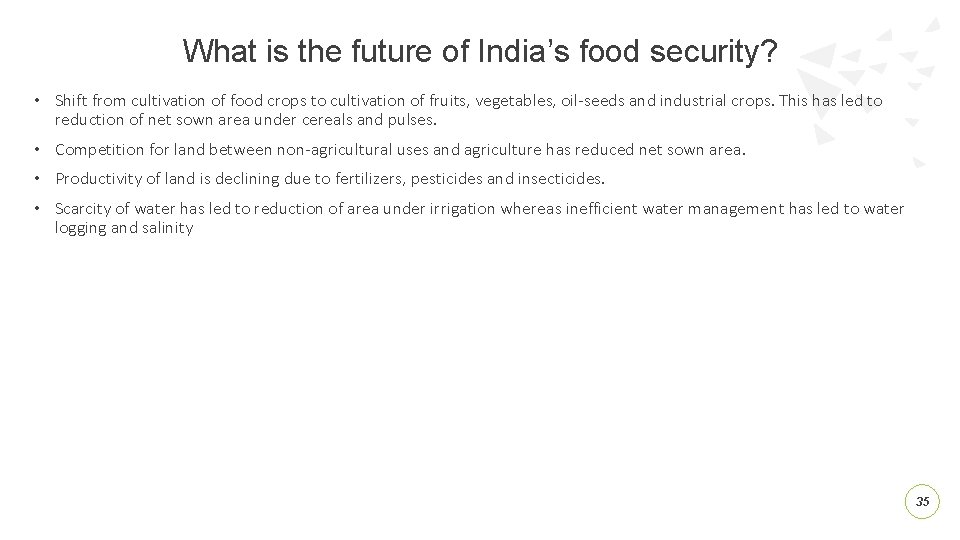
What is the future of India’s food security? • Shift from cultivation of food crops to cultivation of fruits, vegetables, oil-seeds and industrial crops. This has led to reduction of net sown area under cereals and pulses. • Competition for land between non-agricultural uses and agriculture has reduced net sown area. • Productivity of land is declining due to fertilizers, pesticides and insecticides. • Scarcity of water has led to reduction of area under irrigation whereas inefficient water management has led to water logging and salinity 35
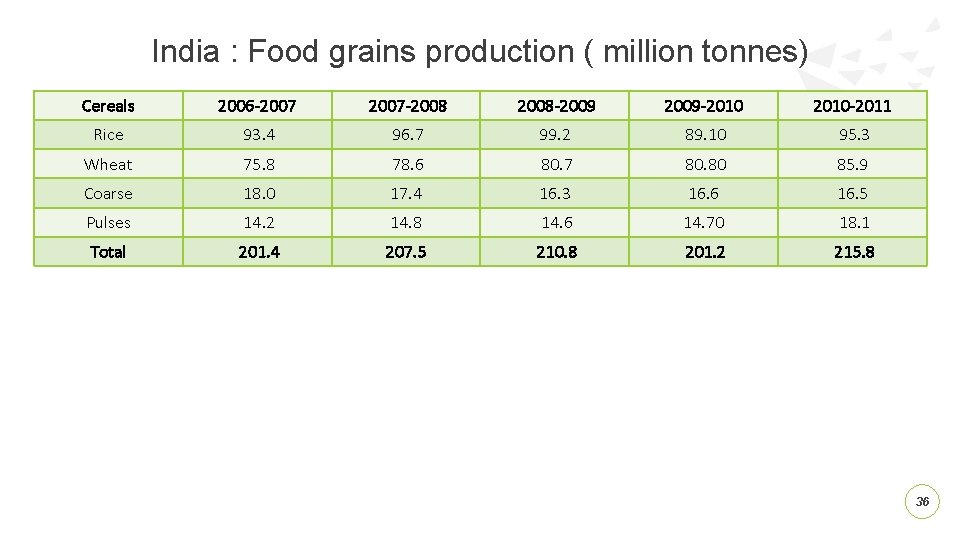
India : Food grains production ( million tonnes) Cereals 2006 -2007 -2008 -2009 -2010 -2011 Rice 93. 4 96. 7 99. 2 89. 10 95. 3 Wheat 75. 8 78. 6 80. 7 80. 80 85. 9 Coarse 18. 0 17. 4 16. 3 16. 6 16. 5 Pulses 14. 2 14. 8 14. 6 14. 70 18. 1 Total 201. 4 207. 5 210. 8 201. 2 215. 8 36
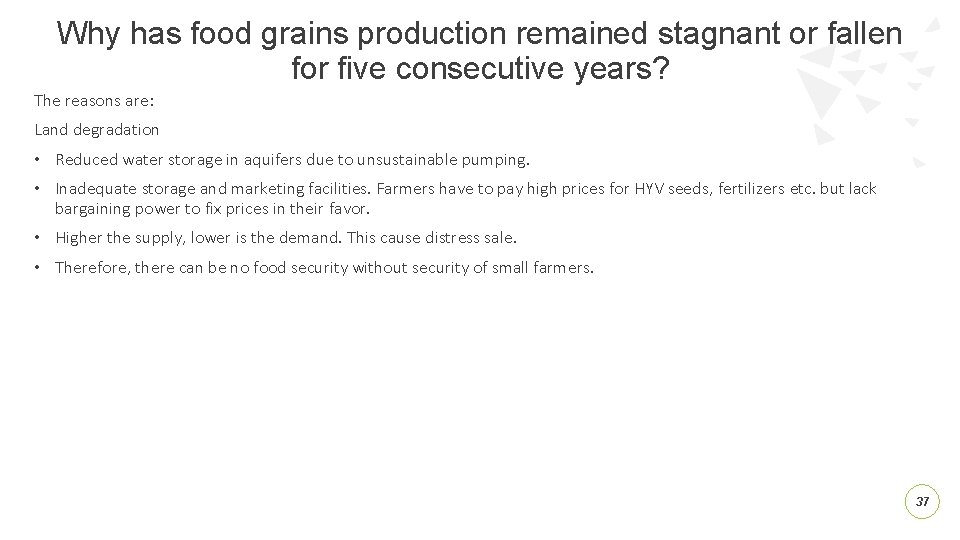
Why has food grains production remained stagnant or fallen for five consecutive years? The reasons are: Land degradation • Reduced water storage in aquifers due to unsustainable pumping. • Inadequate storage and marketing facilities. Farmers have to pay high prices for HYV seeds, fertilizers etc. but lack bargaining power to fix prices in their favor. • Higher the supply, lower is the demand. This cause distress sale. • Therefore, there can be no food security without security of small farmers. 37
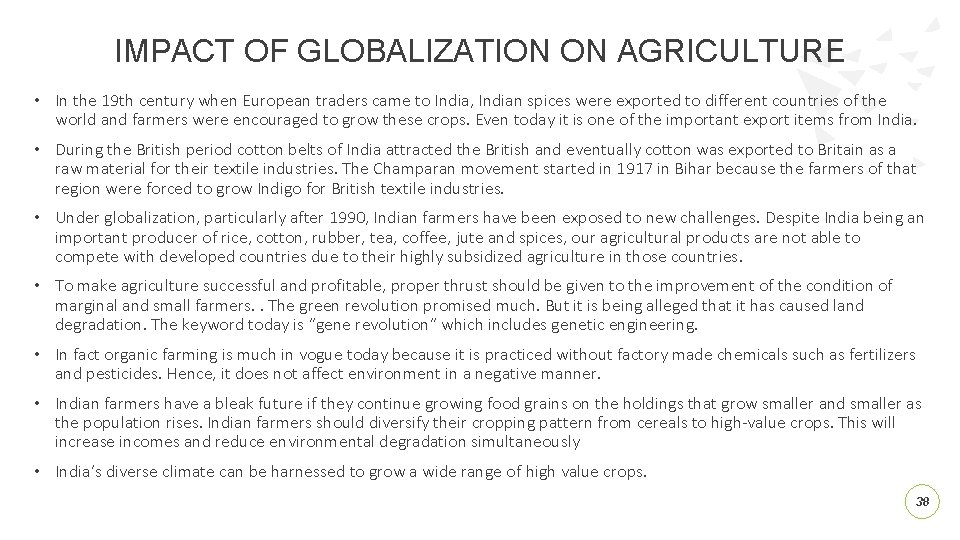
IMPACT OF GLOBALIZATION ON AGRICULTURE • In the 19 th century when European traders came to India, Indian spices were exported to different countries of the world and farmers were encouraged to grow these crops. Even today it is one of the important export items from India. • During the British period cotton belts of India attracted the British and eventually cotton was exported to Britain as a raw material for their textile industries. The Champaran movement started in 1917 in Bihar because the farmers of that region were forced to grow Indigo for British textile industries. • Under globalization, particularly after 1990, Indian farmers have been exposed to new challenges. Despite India being an important producer of rice, cotton, rubber, tea, coffee, jute and spices, our agricultural products are not able to compete with developed countries due to their highly subsidized agriculture in those countries. • To make agriculture successful and profitable, proper thrust should be given to the improvement of the condition of marginal and small farmers. . The green revolution promised much. But it is being alleged that it has caused land degradation. The keyword today is “gene revolution” which includes genetic engineering. • In fact organic farming is much in vogue today because it is practiced without factory made chemicals such as fertilizers and pesticides. Hence, it does not affect environment in a negative manner. • Indian farmers have a bleak future if they continue growing food grains on the holdings that grow smaller and smaller as the population rises. Indian farmers should diversify their cropping pattern from cereals to high-value crops. This will increase incomes and reduce environmental degradation simultaneously • India’s diverse climate can be harnessed to grow a wide range of high value crops. 38
Thank You Discover Agriculture discoveryofagriculture@email. com www. discoveragriculture. com
- Slides: 39