
CBOR Manifest Serialisation 1 Highlights Primary structure is
CBOR Manifest Serialisation 1
Highlights • Primary structure is array (not map) • Text is severable • Multiple payloads allowed • Resources (before installation) separated from assets (after installation) • Description of installation process in the manifest • Conditions divided into preconditions and postconditions • Added component identifier (replaces storage identifier) • Timestamp removed, added sequence number 2
WIP status • This serialization is still in development • There is ongoing discussion on the mailing list • See Open Issues for more information 3
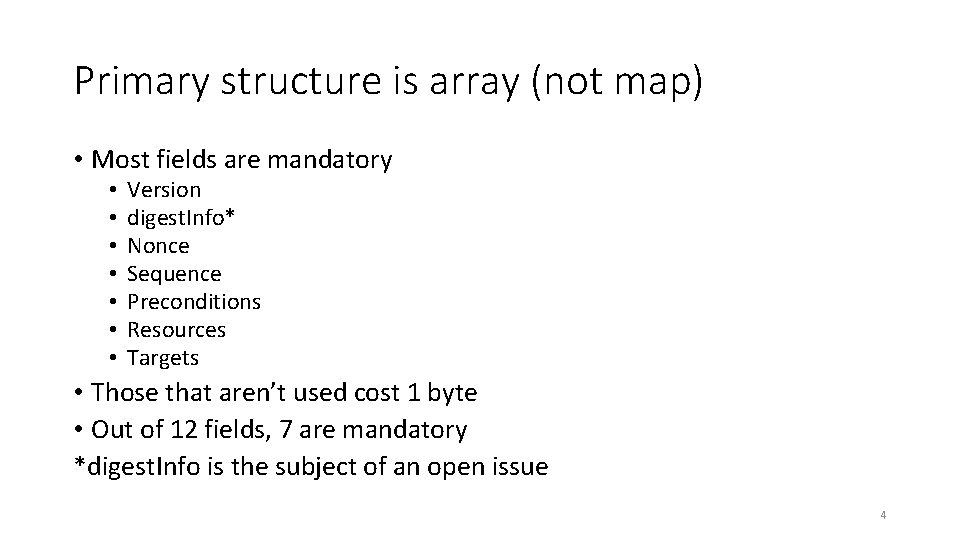
Primary structure is array (not map) • Most fields are mandatory • • Version digest. Info* Nonce Sequence Preconditions Resources Targets • Those that aren’t used cost 1 byte • Out of 12 fields, 7 are mandatory *digest. Info is the subject of an open issue 4
Severable Text • Text is for humans • Text is not used by devices to make decisions • Devices don’t need to receive text • Text is still needed in management systems 5
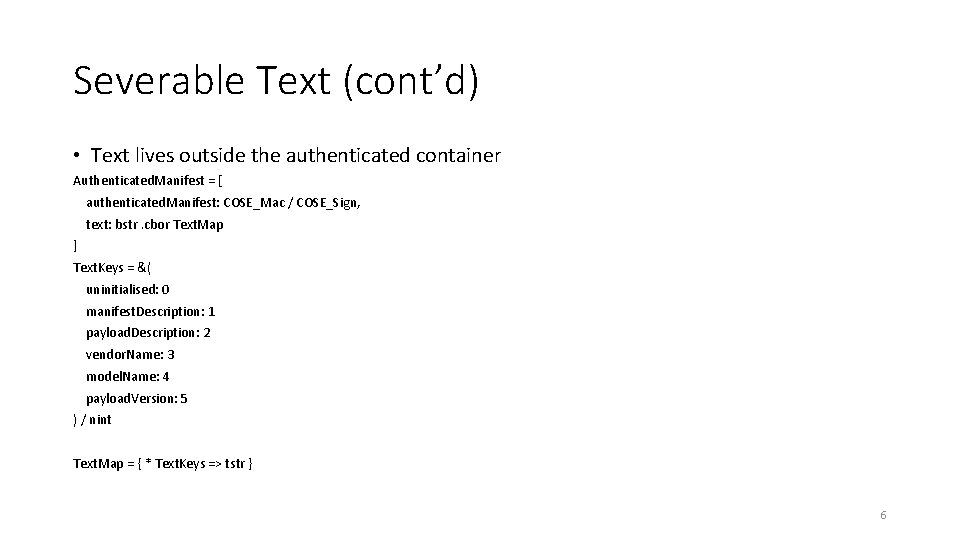
Severable Text (cont’d) • Text lives outside the authenticated container Authenticated. Manifest = [ authenticated. Manifest: COSE_Mac / COSE_Sign, text: bstr. cbor Text. Map ] Text. Keys = &( uninitialised: 0 manifest. Description: 1 payload. Description: 2 vendor. Name: 3 model. Name: 4 payload. Version: 5 ) / nint Text. Map = { * Text. Keys => tstr } 6
Severable Text (cont’d) • Inside the authenticated container, text is authenticated with a digest 7
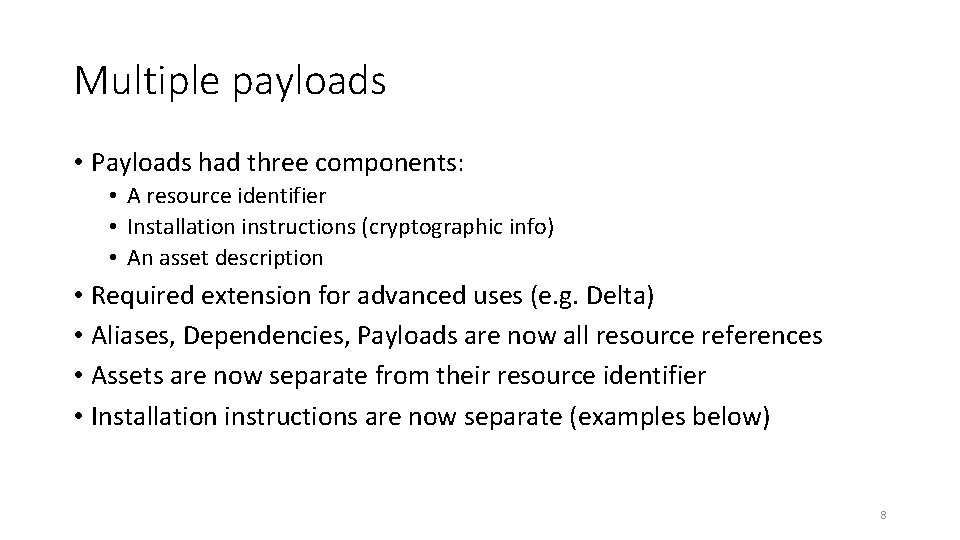
Multiple payloads • Payloads had three components: • A resource identifier • Installation instructions (cryptographic info) • An asset description • Required extension for advanced uses (e. g. Delta) • Aliases, Dependencies, Payloads are now all resource references • Assets are now separate from their resource identifier • Installation instructions are now separate (examples below) 8
Resources separated from assets • All resource references are effectively the same • No need to distinguish between alias, dependency, payload • Resources define a local or remote input • URI • Digest • Assets define an installed image: • Size • Digest • Location 9
Description of installation process in manifest • Why not leave container information in the payload(s)? • Reject early if unsupported • Important for low-bandwidth • Why not enums for aggregate formats? • Lots of specialized parameters. • Many possible configurations. • Registration space of accepted enums becomes large 10
Description of installation process in manifest • Example: • Raw binary payload: no arguments • Encrypted binary payload: • key identifier • algorithm identifier • Encrypted, compressed binary payload: • key identifier • encryption algorithm identifier • compression algorithm identifier • Encrypted, compressed, delta payload • • • key identifier encryption algorithm identifier compression algorithm identifier precursor digest precursor component ID, storage location delta algorithm identifier 11
Description of installation process in manifest • Each enum would need its own parameter structure • Easy to miss a reasonable combination of supported steps • Describe each step instead • Each step can have a defined structure • All steps can be represented in the same way • How is flow described? • Flow of data between steps is a tree, not a linear sequence • • Delta makes it clear that flow is at least a tree A resource shared between two steps makes it clear that flow is a graph Graphs make constrained processing hard Use multiple trees instead of a graph 12
Description of installation process in manifest • For each asset, a tree defines the installation process • To reduce nesting depth in the parser, the tree is encoded as a list, where • output identifiers are the index of the processor in the processor list • inputs are a map of indices into the processor list. • Resources are encoded as a processor with no inputs • Assets designate a single input node • Output nodes can be marked as non-overridable • Dependent manifests can override any installation tree not marked as nonoverridable 13
![Examples: • Raw Binary payload • Installation Information: • Component Identifier: [ bstr(0) ]](http://slidetodoc.com/presentation_image_h2/78f338f689b1539abb1d9e22aa0ef2ab/image-14.jpg "Examples: • Raw Binary payload • Installation Information: • Component Identifier: [ bstr(0) ]")
Examples: • Raw Binary payload • Installation Information: • Component Identifier: [ bstr(0) ] • Resource: • Parameters: List of URIs • Asset Information • Component Identifier: [ bstr(0) ] • Encoding: raw-binary 14
![Examples: • Delta payload • Installation Information: • Component Identifier: [ bstr(1) ] •](http://slidetodoc.com/presentation_image_h2/78f338f689b1539abb1d9e22aa0ef2ab/image-15.jpg "Examples: • Delta payload • Installation Information: • Component Identifier: [ bstr(1) ] •")
Examples: • Delta payload • Installation Information: • Component Identifier: [ bstr(1) ] • Processors: • Delta: {1 => 1, 2 => 2} • Resource: URIs • Resource: [ bstr(1) ] • Asset Information • Component Identifier: [ bstr(1) ] • Encoding: raw-binary • inode: bstr(2) 15
Conditions divided into preconditions and postconditions • Some conditions need to be checked before installation • Identifiers, time, precursors, custom • Some conditions need to be checked after installation • Content not identified by an asset digest, custom • Two choices: • Two lists • makes it easier for devices to know what to do in each step of the process • typically costs 1 byte • Duplicate condition identifiers • typically smaller serialization • duplication of identifiers may increase integer encoding size • more registration and maintenance with duplicate identifiers 16
Component Identifier • Storage Identifier may not be adequate for all use cases • Devices can be aggregates of one or more processors with two or more different storage systems • Component Identifier allows designating the storage system • Storage systems and hardware components can be nested • Component Identifier needs to be a list to handle this. • Storage Identifier can be merged into this list as the last element. 17
Open issues • Should one digest be used for the whole manifest, or is there a good reason to support more than one? • Should more sections be severable? • Should it be possible to encrypt severable sections? • Should the graph described in draft-moran-suit-manifest-02 be replaced with trees? • How are they overridden? • How are they represented? • Are there any use cases that break? • Should encryption of the manifest be addressed explicitly, or should that be handled one level higher? 18
Open Issues (Cont’d) • Encoding of Processing Step • Encoding of Directive • Encoding of Conditions • IANA implications for use of enums throughout the manifest • Extension encoding 19
- Slides: 19