
CBM for Progress Monitoring in Written Expression Elementary
CBM for Progress Monitoring in Written Expression Elementary Small Group Meeting Granite School District October – November 2011
Progress Monitoring • Progress monitoring (PM) is conducted frequently and is designed to: – Estimate rates of student improvement – Identify students who are not demonstrating adequate progress – Compare the efficacy of different forms of instruction and design more effective, individualized instructional programs for problem learners
What Is the Difference Between Traditional Assessments and PM? • Curriculum-Based Measurement (CBM) is one type of PM: – CBM provides an easy and quick method to gathering student progress – Teachers can analyze student scores and adjust student goals and instructional programs – Student data can be compared to teacher’s classroom or school district data
Curriculum-Based Assessment • CBM: – Measurement materials aligned with school curriculum – Measurement is frequent – Assessment information is used to formulate instructional decisions • CBM is one type of curriculum-based assessment
Basics of CBM • Monitors student progress across entire school year • Meaningful, accurate results can help quantify short- and long-term student gains • Probes are brief and easy to administer • Teachers quickly determine whether an intervention is helping a student
Steps for Conducting CBM • Step 1: Student Placement in Written Expression CBM for Progress Monitoring • Step 2: Materials Needed for Written Expression CBM • Step 3: Administering CBM Writing • Step 4: Scoring TWW & WSC
Steps for Conducting CBM • Step 5: How to Graph Scores • Step 6: How to Set Ambitious Goals • Step 7: How to Apply Decision Rules to Graphed Scores to Know When to Revise Programs and Increase Goals • Step 8: How to Use the CBM Database Qualitatively to Describe Students’ Strengths and Weaknesses • Step 6 -8 Will be covered in January 2012 Small Group Meeting
Step 1: Student Placement in Written Expression CBM for Progress Monitoring • To monitor writing fluency, use Written Expression CBM as soon as students can write sentences • Total Words Written (TWW) and Words Spelled Correctly (WSC) will be used for Progress Monitoring • Total Words Written (TWW) and Words Spelled Correctly (WSC) can be assessed using the same writing sample
Step 1: Student Placement in Written Expression CBM for Progress Monitoring • Story Starter Placement Levels • Primary Story Starters Grade 1 -3 • Intermediate Grade 4 -6 • The story starters should represent the experiences and background knowledge of the students
Step 2: Materials Needed for Written Expression CBM • CBM Writing Manual with story starters and scoring criteria • Story starter appropriate for the students grade level • Lined paper for student responses • Stop watch • Data recording sheet • Graph paper or graphing program
Step 3: Administering CBM Writing • Choose story starters appropriate to the students grade level • Primary Story Starters Grade 1 -3 • Intermediate Grade 4 -6 • Provide students with pencil and sheet of lined paper. Direct students to write their name and date at the top of the paper.
Step 3: Administering CBM Writing • Say these specific directions to the students: “You are going to write a story. First, I will read a sentence, and then you will write a story about what happens next. You will have 1 minute to think about what you will write, and 3 minutes to write your story. Remember to do your best work. If you don't know how to spell a word, you should guess. Are there any questions? (Pause). Put your pencils down and listen. • For the next minute, think about. . . “(insert story starter). ”
Step 3: Administering CBM Writing • After reading the story starter, begin your stopwatch and allow 1 minute for students to “think. ” (Monitor students so that they do not begin writing). After 30 seconds say: “You should be thinking about… (insert story starter). ”
Step 3: Administering CBM Writing • …Let 30 more seconds pass… • At the end of the 1 minute say: “Now begin writing. ” Restart your stopwatch (set for 3 minutes). • Monitor students' participation. If individual students pause for about 10 seconds or say they are done before the test is finished, move close to them and say “Keep writing the best story you can. ” This prompt can be repeated to students should they pause again.
Step 3: Administering CBM Writing • After 90 seconds say: “You should be writing about… (insert story starter). ” • At the end of 3 minutes say: “Stop. Put your pencils down. ” If students want to finish their story, they may do so on a separate piece of paper or continue on the same sheet after a slash mark has been inserted at the end of 3 minutes.
Step 3: Administering CBM Writing • Testing Considerations – Testing not teaching – Best vs. fastest – Monitor student performance – Do not answer questions
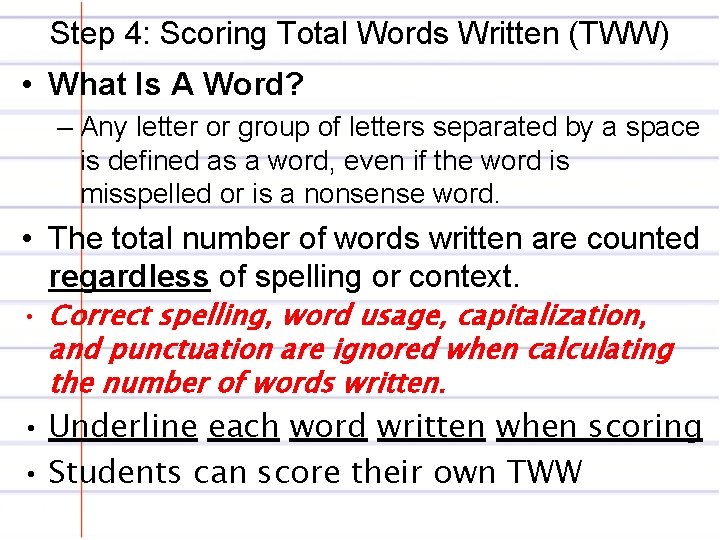
Step 4: Scoring Total Words Written (TWW) • What Is A Word? – Any letter or group of letters separated by a space is defined as a word, even if the word is misspelled or is a nonsense word. • The total number of words written are counted regardless of spelling or context. • Correct spelling, word usage, capitalization, and punctuation are ignored when calculating the number of words written. • Underline each word written when scoring • Students can score their own TWW
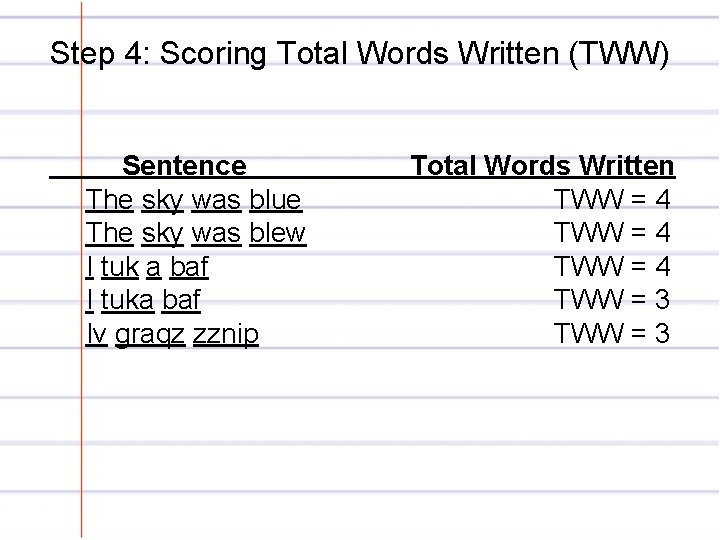
Step 4: Scoring Total Words Written (TWW) Sentence The sky was blue The sky was blew I tuk a baf I tuka baf Iv graqz zznip Total Words Written TWW = 4 TWW = 3
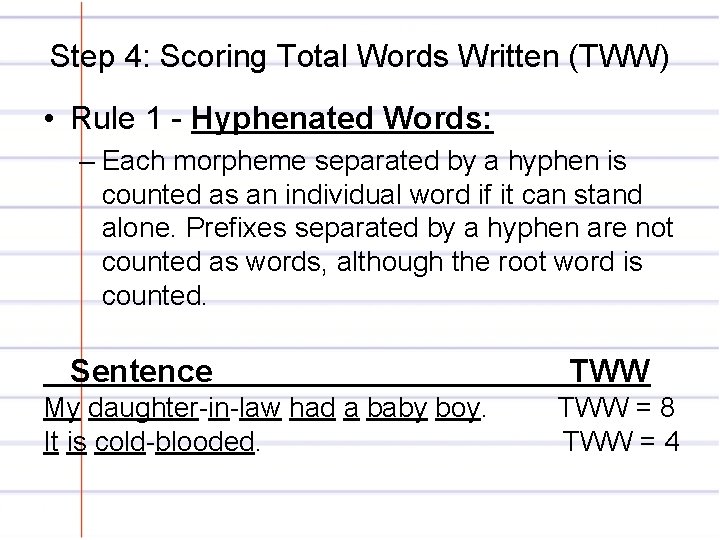
Step 4: Scoring Total Words Written (TWW) • Rule 1 - Hyphenated Words: – Each morpheme separated by a hyphen is counted as an individual word if it can stand alone. Prefixes separated by a hyphen are not counted as words, although the root word is counted. Sentence My daughter-in-law had a baby boy. It is cold-blooded. TWW = 8 TWW = 4
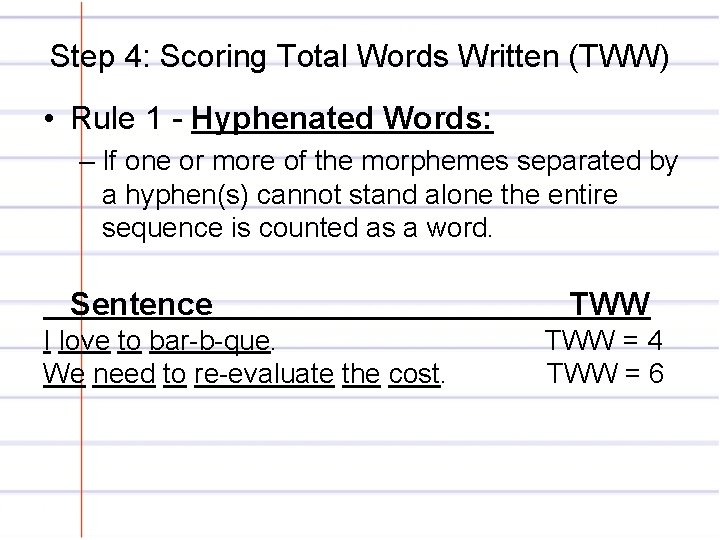
Step 4: Scoring Total Words Written (TWW) • Rule 1 - Hyphenated Words: – If one or more of the morphemes separated by a hyphen(s) cannot stand alone the entire sequence is counted as a word. Sentence I love to bar-b-que. We need to re-evaluate the cost. TWW = 4 TWW = 6
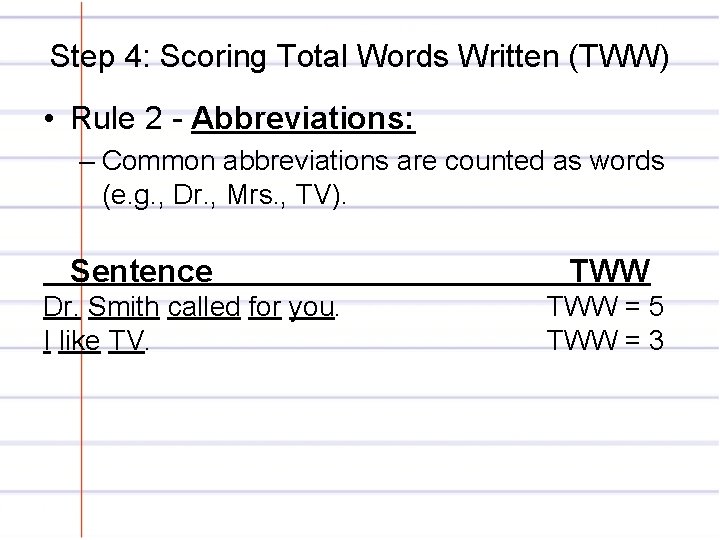
Step 4: Scoring Total Words Written (TWW) • Rule 2 - Abbreviations: – Common abbreviations are counted as words (e. g. , Dr. , Mrs. , TV). Sentence Dr. Smith called for you. I like TV. TWW = 5 TWW = 3
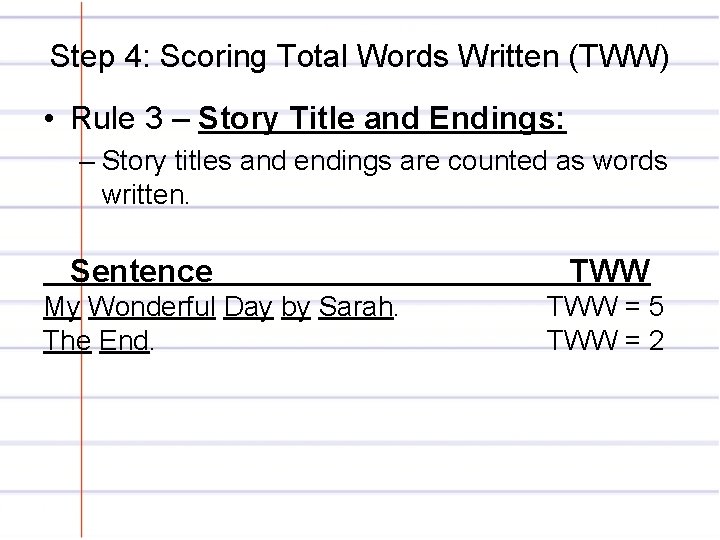
Step 4: Scoring Total Words Written (TWW) • Rule 3 – Story Title and Endings: – Story titles and endings are counted as words written. Sentence My Wonderful Day by Sarah. The End. TWW = 5 TWW = 2
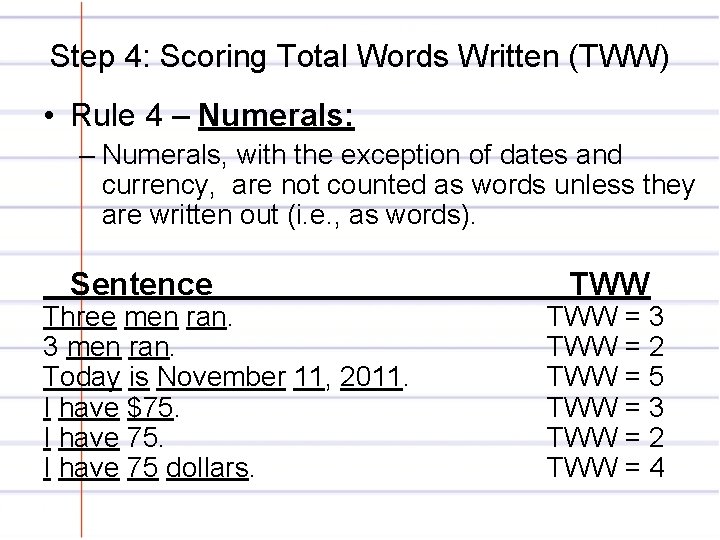
Step 4: Scoring Total Words Written (TWW) • Rule 4 – Numerals: – Numerals, with the exception of dates and currency, are not counted as words unless they are written out (i. e. , as words). Sentence Three men ran. 3 men ran. Today is November 11, 2011. I have $75. I have 75 dollars. TWW = 3 TWW = 2 TWW = 5 TWW = 3 TWW = 2 TWW = 4
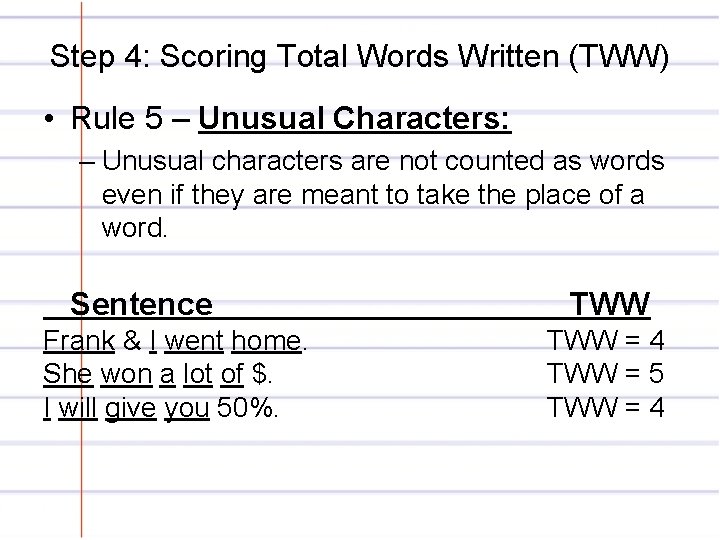
Step 4: Scoring Total Words Written (TWW) • Rule 5 – Unusual Characters: – Unusual characters are not counted as words even if they are meant to take the place of a word. Sentence Frank & I went home. She won a lot of $. I will give you 50%. TWW = 4 TWW = 5 TWW = 4
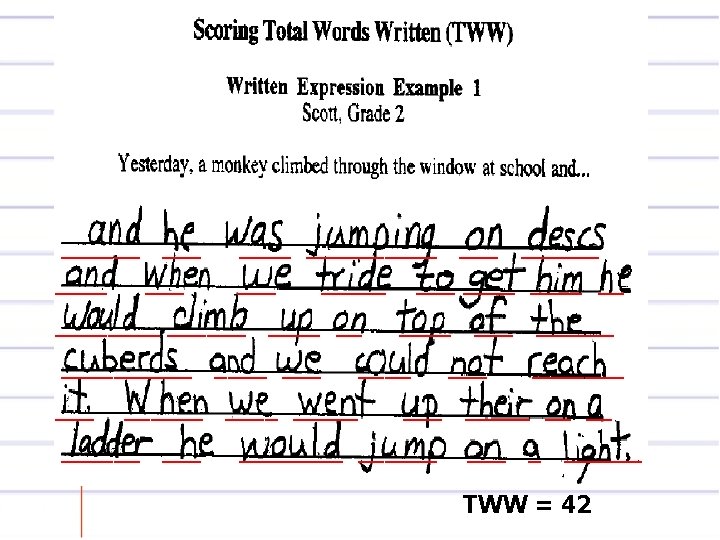
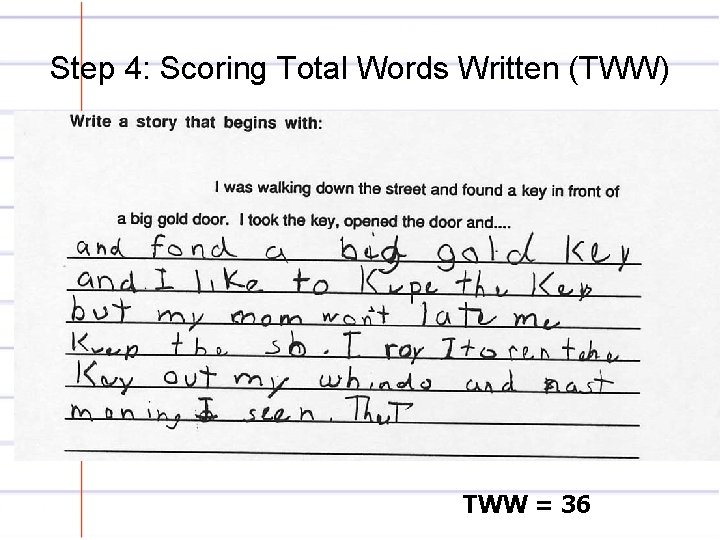
Step 4: Scoring Total Words Written (TWW) TWW = 36
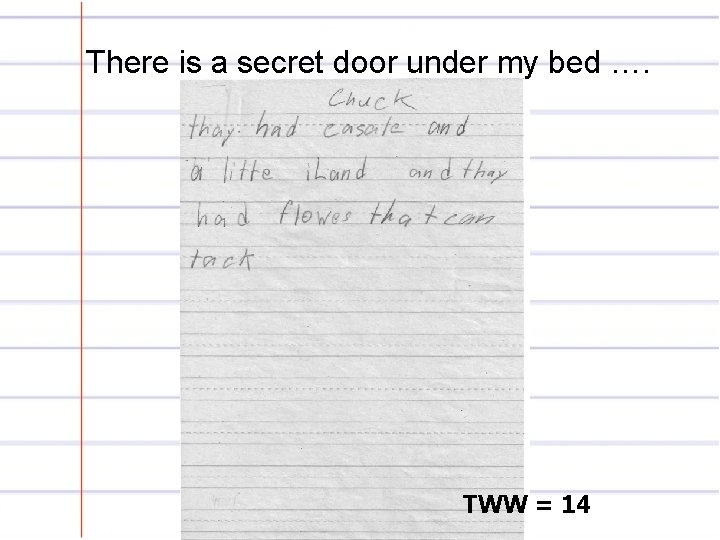
There is a secret door under my bed …. TWW = 14
Step 4: Scoring Words Spelled Correctly (WSC) • Number of correctly spelled words regardless of context • A word is counted correct if it can be found in the English language • Incorrectly spelled words are circled • WSC is calculated by subtracting the total number of circled words from the TWW • Teachers score the WSC
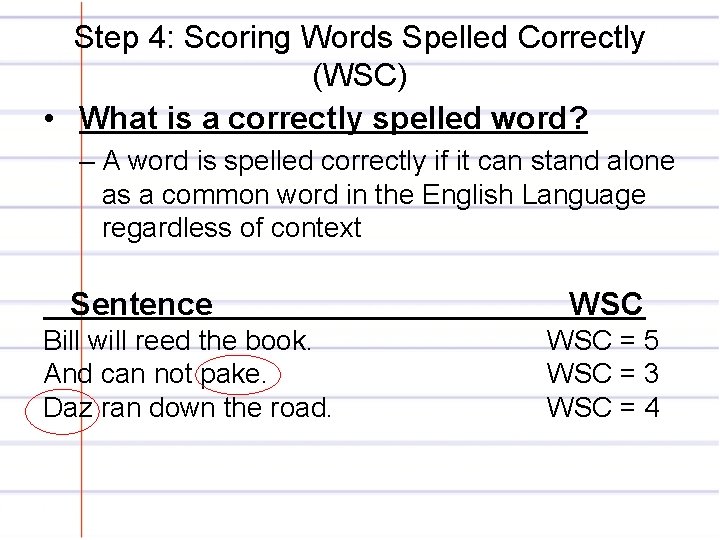
Step 4: Scoring Words Spelled Correctly (WSC) • What is a correctly spelled word? – A word is spelled correctly if it can stand alone as a common word in the English Language regardless of context Sentence Bill will reed the book. And can not pake. Daz ran down the road. WSC = 5 WSC = 3 WSC = 4
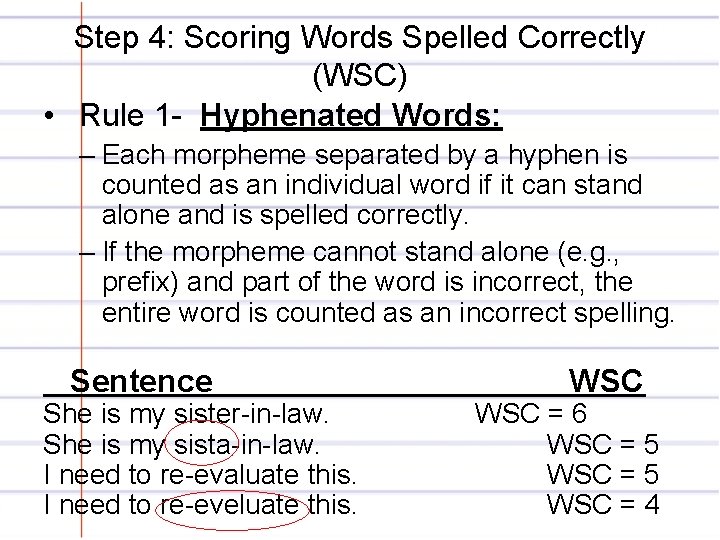
Step 4: Scoring Words Spelled Correctly (WSC) • Rule 1 - Hyphenated Words: – Each morpheme separated by a hyphen is counted as an individual word if it can stand alone and is spelled correctly. – If the morpheme cannot stand alone (e. g. , prefix) and part of the word is incorrect, the entire word is counted as an incorrect spelling. Sentence She is my sister-in-law. She is my sista-in-law. I need to re-evaluate this. I need to re-eveluate this. WSC = 6 WSC = 5 WSC = 4
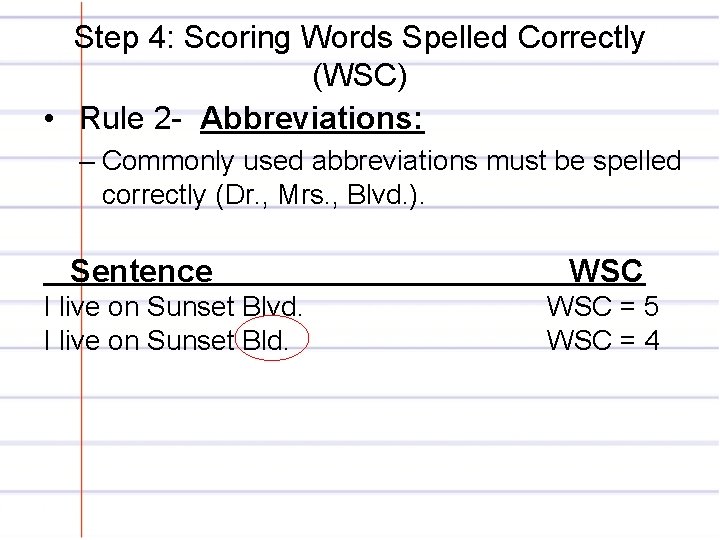
Step 4: Scoring Words Spelled Correctly (WSC) • Rule 2 - Abbreviations: – Commonly used abbreviations must be spelled correctly (Dr. , Mrs. , Blvd. ). Sentence I live on Sunset Blvd. I live on Sunset Bld. WSC = 5 WSC = 4
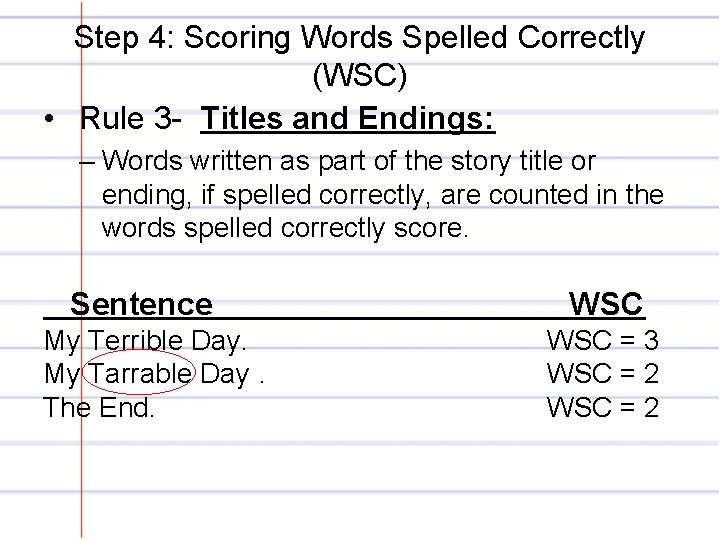
Step 4: Scoring Words Spelled Correctly (WSC) • Rule 3 - Titles and Endings: – Words written as part of the story title or ending, if spelled correctly, are counted in the words spelled correctly score. Sentence My Terrible Day. My Tarrable Day. The End. WSC = 3 WSC = 2
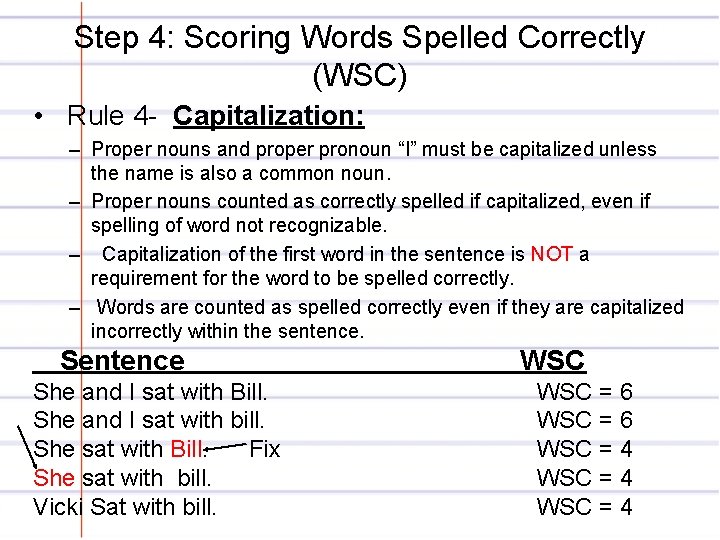
Step 4: Scoring Words Spelled Correctly (WSC) • Rule 4 - Capitalization: – Proper nouns and proper pronoun “I” must be capitalized unless the name is also a common noun. – Proper nouns counted as correctly spelled if capitalized, even if spelling of word not recognizable. – Capitalization of the first word in the sentence is NOT a requirement for the word to be spelled correctly. – Words are counted as spelled correctly even if they are capitalized incorrectly within the sentence. Sentence She and I sat with Bill. She and I sat with bill. She sat with Bill. Fix She sat with bill. Vicki Sat with bill. WSC = 6 WSC = 4
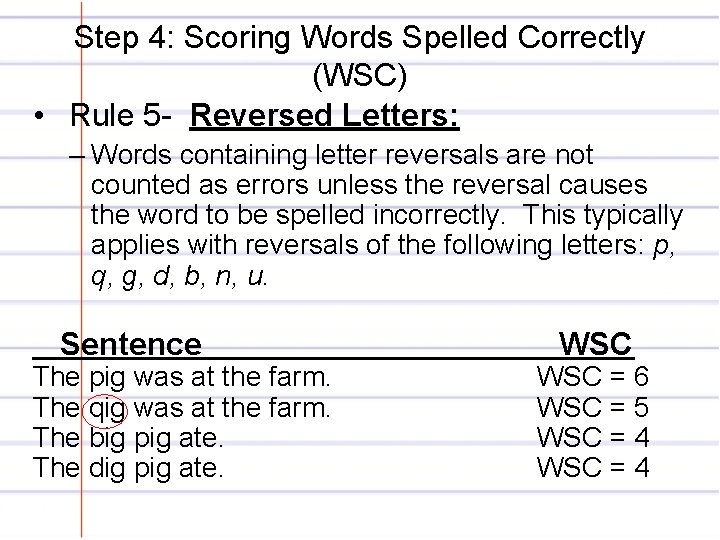
Step 4: Scoring Words Spelled Correctly (WSC) • Rule 5 - Reversed Letters: – Words containing letter reversals are not counted as errors unless the reversal causes the word to be spelled incorrectly. This typically applies with reversals of the following letters: p, q, g, d, b, n, u. Sentence The pig was at the farm. The qig was at the farm. The big pig ate. The dig pig ate. WSC = 6 WSC = 5 WSC = 4
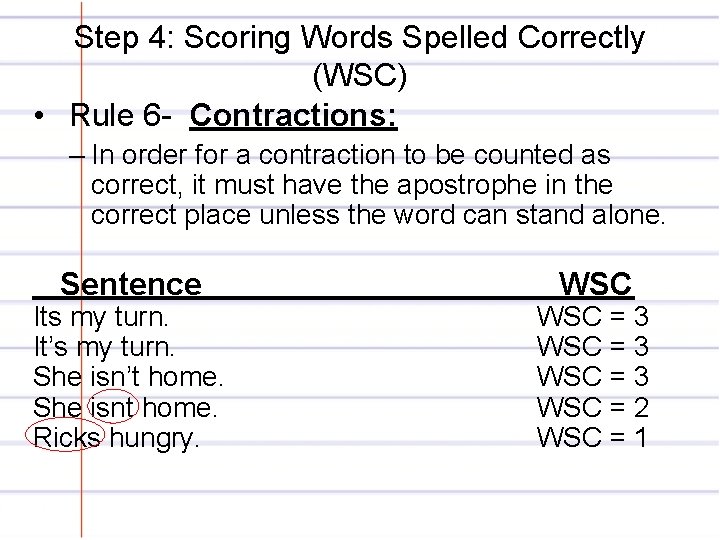
Step 4: Scoring Words Spelled Correctly (WSC) • Rule 6 - Contractions: – In order for a contraction to be counted as correct, it must have the apostrophe in the correct place unless the word can stand alone. Sentence Its my turn. It’s my turn. She isn’t home. She isnt home. Ricks hungry. WSC = 3 WSC = 2 WSC = 1
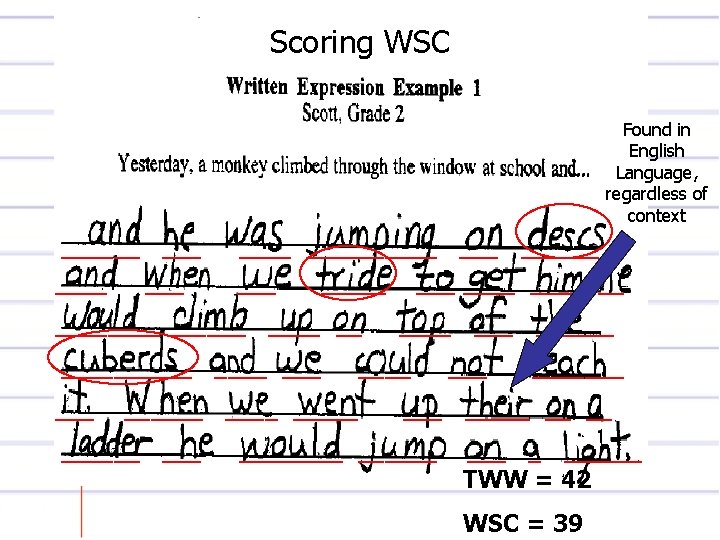
Scoring WSC Found in English Language, regardless of context ______ _____ ______ ___ ____ ______ ____ ___ ______ ___ _______ _____ ______ ______ TWW = 42 WSC = 39
Step 5. Graphing Scores • Record the scores on the paper provided • OPTIONAL – you can graph the scores on the graph paper provided or on a graph of your choosing. • We will practice graphing at the next meeting.
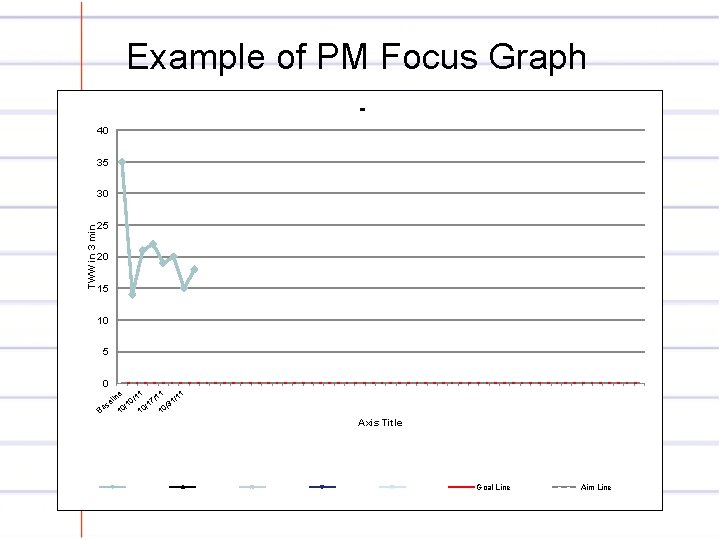
Example of PM Focus Graph 40 35 TWW in 3 min 30 25 20 15 10 5 0 el s Ba in e 1 /1 10 / 10 11 11 7/ 1/ /1 /3 0 0 1 1 Axis Title Goal Line Aim Line
- Slides: 38