
CBLite ChemBio Protection and Hazard Mitigation Program Overview
CBLite Chem-Bio Protection and Hazard Mitigation Program Overview Personnel Contamination Mitigation Dr. Charles Bass Division Chief Chemical and Biological Technologies Department Defense Threat Reduction Agency UNCLASSIFIED Hot Air Decon
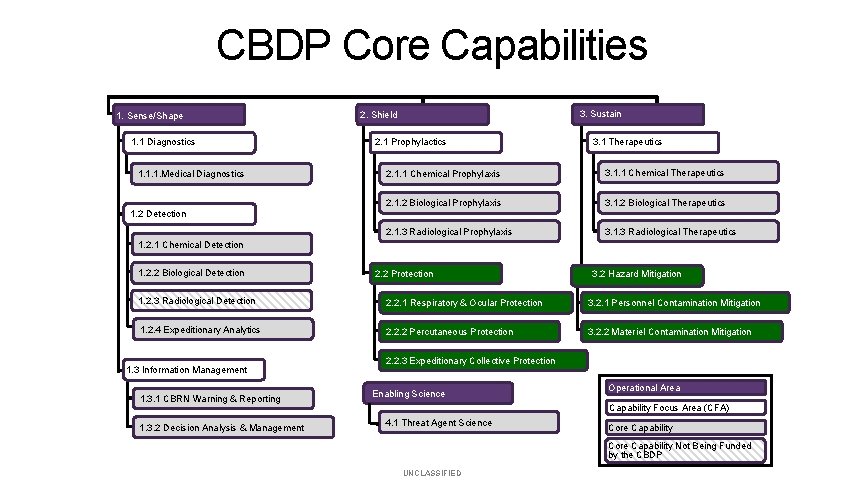
CBDP Core Capabilities 1. Sense/Shape 1. 1 Diagnostics 1. 1. 1. Medical Diagnostics 3. Sustain 2. Shield 2. 1 Prophylactics 3. 1 Therapeutics 2. 1. 1 Chemical Prophylaxis 3. 1. 1 Chemical Therapeutics 2. 1. 2 Biological Prophylaxis 3. 1. 2 Biological Therapeutics 2. 1. 3 Radiological Prophylaxis 3. 1. 3 Radiological Therapeutics 1. 2 Detection 1. 2. 1 Chemical Detection 1. 2. 2 Biological Detection 2. 2 Protection 3. 2 Hazard Mitigation 1. 2. 3 Radiological Detection 2. 2. 1 Respiratory & Ocular Protection 3. 2. 1 Personnel Contamination Mitigation 1. 2. 4 Expeditionary Analytics 2. 2. 2 Percutaneous Protection 3. 2. 2 Materiel Contamination Mitigation 1. 3 Information Management 1. 3. 1 CBRN Warning & Reporting 1. 3. 2 Decision Analysis & Management 2. 2. 3 Expeditionary Collective Protection Enabling Science Operational Area Capability Focus Area (CFA) 4. 1 Threat Agent Science Core Capability Not Being Funded by the CBDP UNCLASSIFIED

Lightweight CB Protection CBLITE Aer 0 5 g suit Compared to JSLIST: • 5 g liquid protection • Thermal burden same as duty uniform • Greatly improved mobility • 15 X vapor protection; 7 X aerosol protection UNCLASSIFIED

Lightweight CB Protection Tac. Haze is a close-fitting tactical suit with a combination Powered Air-Purifiying Respirator (PAPR) and Closed-Circuit Self-Contained Breathing Apparatus (CC-SCBA), with a cooling vest, and onboard diagnostics for thermal burden monitoring and management Tac. Haz. E provides: • • Level A/B personal protection Increased tactical capability Reduced weight (goal: 50%) Longer respiratory duration (8 hour PAPR/4 hour CC-SCBA) • Active cooling system • Improved functionality (mobility, vision) • Intended for 1994 National Fire Protection Association (NFPA) certification UNCLASSIFIED
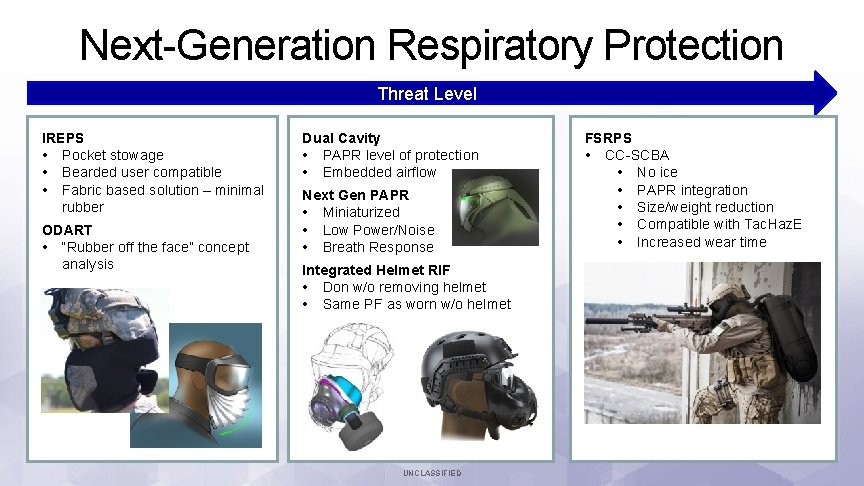
Next-Generation Respiratory Protection Threat Level IREPS • Pocket stowage • Bearded user compatible • Fabric based solution – minimal rubber ODART • “Rubber off the face” concept analysis Dual Cavity • PAPR level of protection • Embedded airflow Next Gen PAPR • Miniaturized • Low Power/Noise • Breath Response Integrated Helmet RIF • Don w/o removing helmet • Same PF as worn w/o helmet UNCLASSIFIED FSRPS • CC-SCBA • No ice • PAPR integration • Size/weight reduction • Compatible with Tac. Haz. E • Increased wear time
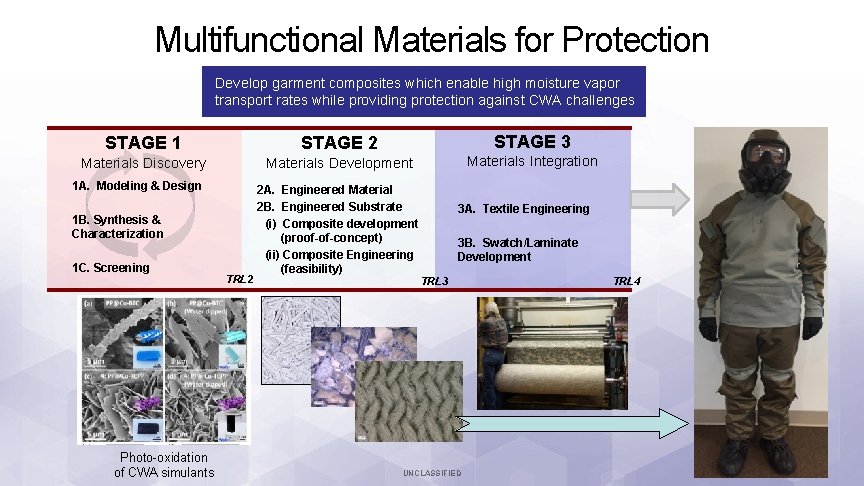
Multifunctional Materials for Protection Develop garment composites which enable high moisture vapor transport rates while providing protection against CWA challenges STAGE 1 STAGE 2 STAGE 3 Materials Discovery Materials Development Materials Integration 1 A. Modeling & Design 1 B. Synthesis & Characterization 1 C. Screening Photo-oxidation of CWA simulants TRL 2 2 A. Engineered Material 2 B. Engineered Substrate (i) Composite development (proof-of-concept) (ii) Composite Engineering (feasibility) 3 A. Textile Engineering 3 B. Swatch/Laminate Development TRL 3 UNCLASSIFIED TRL 4
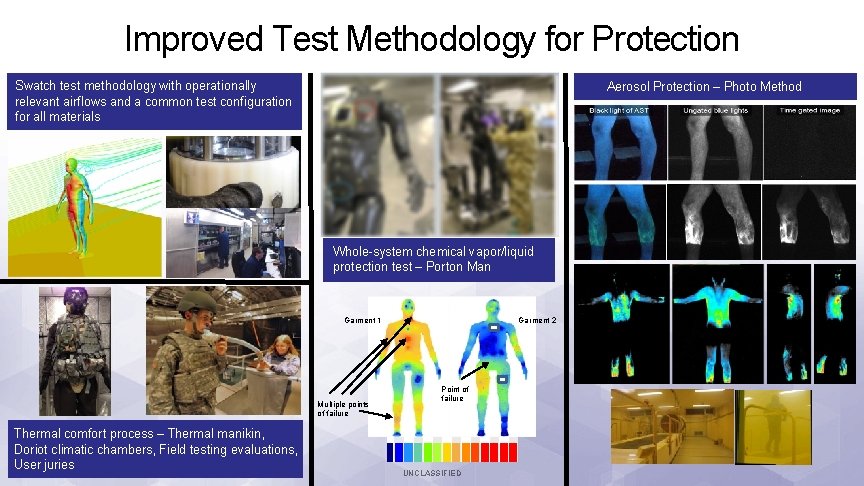
Improved Test Methodology for Protection Swatch test methodology with operationally relevant airflows and a common test configuration for all materials Aerosol Protection – Photo Method Whole-system chemical vapor/liquid protection test – Porton Man Garment 1 Multiple points of failure Thermal comfort process – Thermal manikin, Doriot climatic chambers, Field testing evaluations, User juries Garment 2 Point of failure UNCLASSIFIED
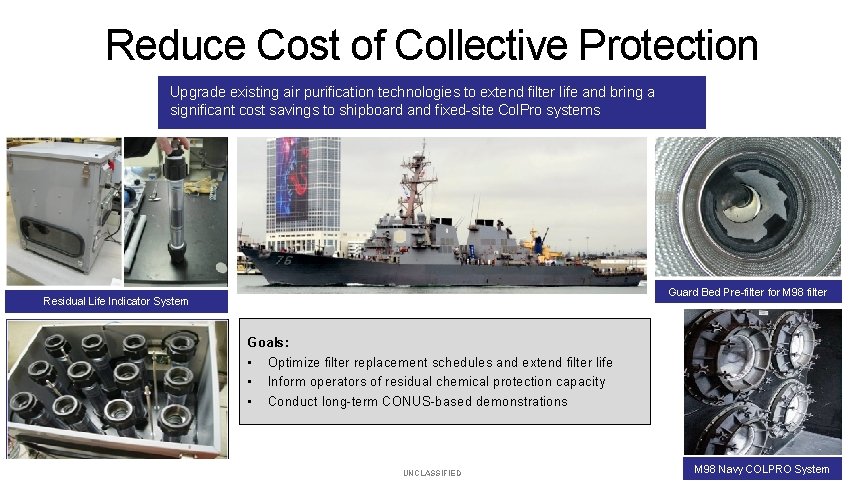
Reduce Cost of Collective Protection Upgrade existing air purification technologies to extend filter life and bring a significant cost savings to shipboard and fixed-site Col. Pro systems Guard Bed Pre-filter for M 98 filter Residual Life Indicator System Goals: • Optimize filter replacement schedules and extend filter life • Inform operators of residual chemical protection capacity • Conduct long-term CONUS-based demonstrations UNCLASSIFIED M 98 Navy COLPRO System
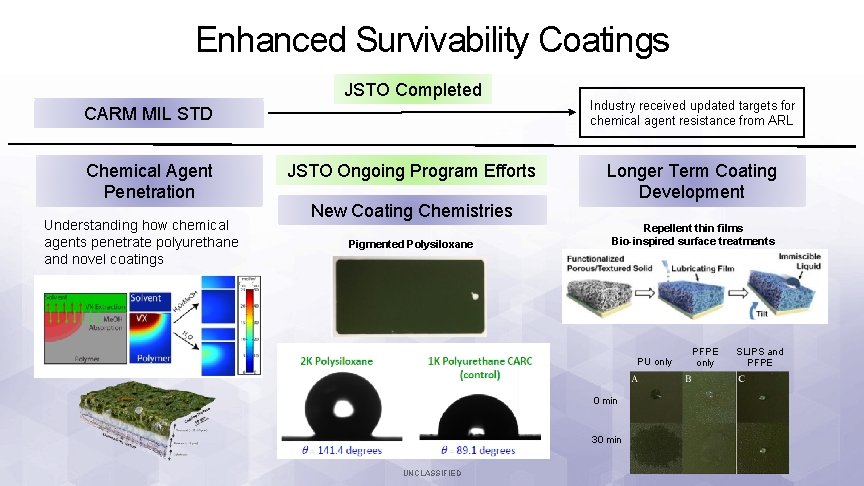
Enhanced Survivability Coatings JSTO Completed CARM MIL STD Chemical Agent Penetration Understanding how chemical agents penetrate polyurethane and novel coatings JSTO Ongoing Program Efforts New Coating Chemistries Pigmented Polysiloxane Industry received updated targets for chemical agent resistance from ARL Longer Term Coating Development Repellent thin films Bio-inspired surface treatments PU only 0 min 30 min UNCLASSIFIED PFPE only SLIPS and PFPE
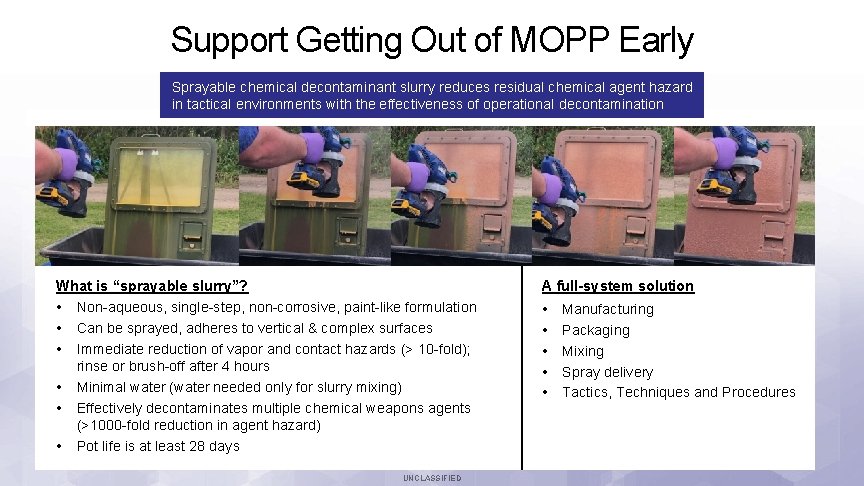
Support Getting Out of MOPP Early Sprayable chemical decontaminant slurry reduces residual chemical agent hazard in tactical environments with the effectiveness of operational decontamination What is “sprayable slurry”? • Non-aqueous, single-step, non-corrosive, paint-like formulation • Can be sprayed, adheres to vertical & complex surfaces • Immediate reduction of vapor and contact hazards (> 10 -fold); rinse or brush-off after 4 hours • Minimal water (water needed only for slurry mixing) • Effectively decontaminates multiple chemical weapons agents (>1000 -fold reduction in agent hazard) • Pot life is at least 28 days UNCLASSIFIED A full-system solution • • • Manufacturing Packaging Mixing Spray delivery Tactics, Techniques and Procedures
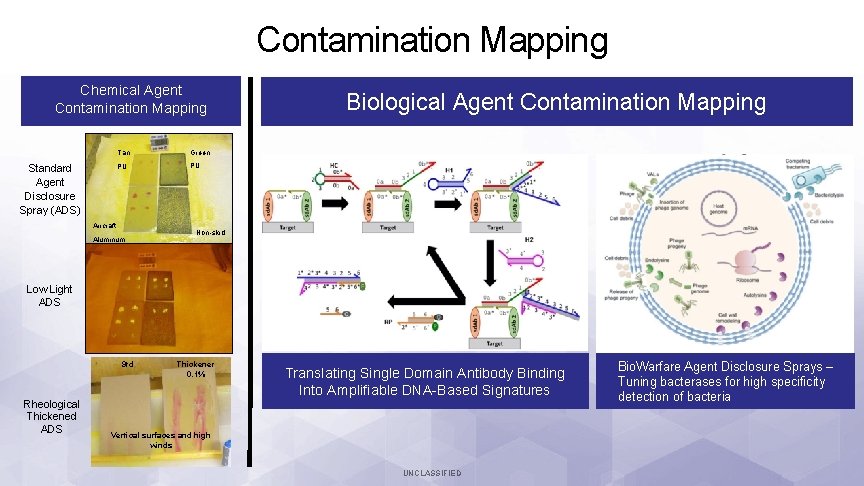
Contamination Mapping Chemical Agent Contamination Mapping Standard Agent Disclosure Spray (ADS) Tan Green PU PU Aircraft Aluminum Biological Agent Contamination Mapping Non-skid Low Light ADS Std Rheological Thickened ADS Thickener 0. 1% Translating Single Domain Antibody Binding Into Amplifiable DNA-Based Signatures Vertical surfaces and high winds UNCLASSIFIED Bio. Warfare Agent Disclosure Sprays – Tuning bacterases for high specificity detection of bacteria
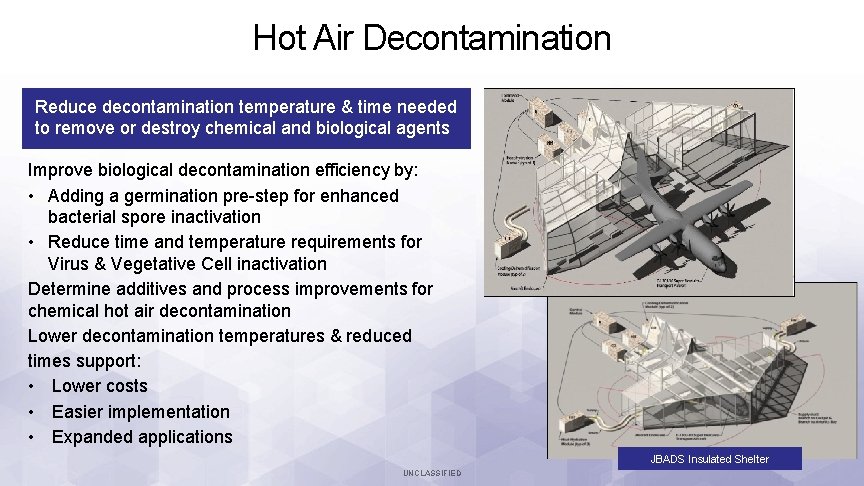
Hot Air Decontamination Reduce decontamination temperature & time needed to remove or destroy chemical and biological agents Improve biological decontamination efficiency by: • Adding a germination pre-step for enhanced bacterial spore inactivation • Reduce time and temperature requirements for Virus & Vegetative Cell inactivation Determine additives and process improvements for chemical hot air decontamination Lower decontamination temperatures & reduced times support: • Lower costs • Easier implementation • Expanded applications JBADS Insulated Shelter UNCLASSIFIED
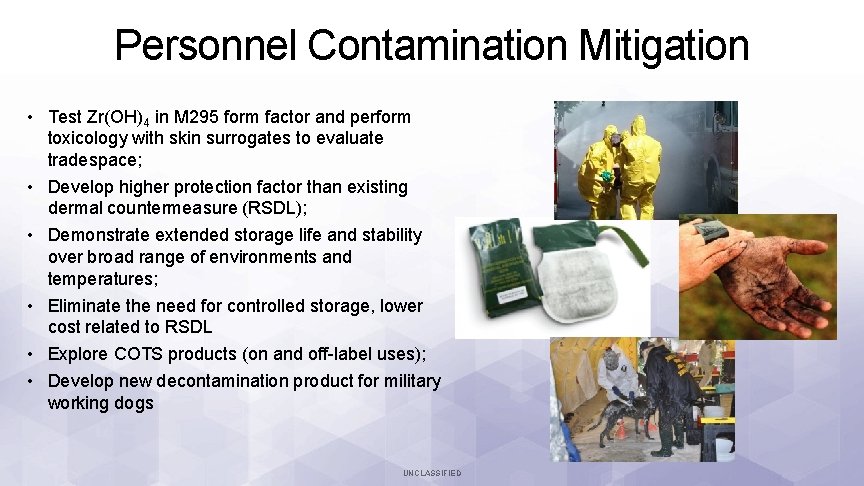
Personnel Contamination Mitigation • Test Zr(OH)4 in M 295 form factor and perform toxicology with skin surrogates to evaluate tradespace; • Develop higher protection factor than existing dermal countermeasure (RSDL); • Demonstrate extended storage life and stability over broad range of environments and temperatures; • Eliminate the need for controlled storage, lower cost related to RSDL • Explore COTS products (on and off-label uses); • Develop new decontamination product for military working dogs UNCLASSIFIED
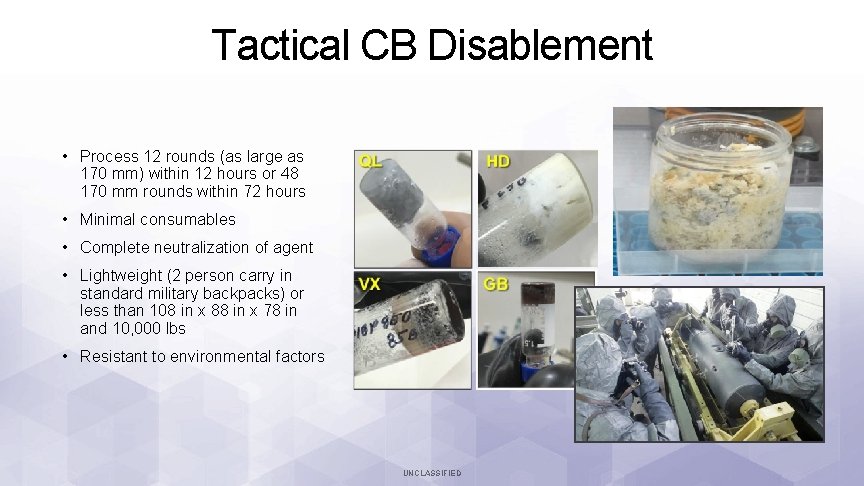
Tactical CB Disablement • Process 12 rounds (as large as 170 mm) within 12 hours or 48 170 mm rounds within 72 hours • Minimal consumables • Complete neutralization of agent • Lightweight (2 person carry in standard military backpacks) or less than 108 in x 88 in x 78 in and 10, 000 lbs • Resistant to environmental factors UNCLASSIFIED
- Slides: 14