
Cavity Enhanced Velocity Modulation Spectroscopy Brian Siller Michael
Cavity Enhanced Velocity Modulation Spectroscopy Brian Siller, Michael Porambo & Benjamin Mc. Call Chemistry Department University of Illinois at Urbana-Champaign
Ion Spectroscopy Applications ◦ Astrochemistry ◦ Fundamental physics Goals ◦ Completely general (direct absorption) ◦ High resolution
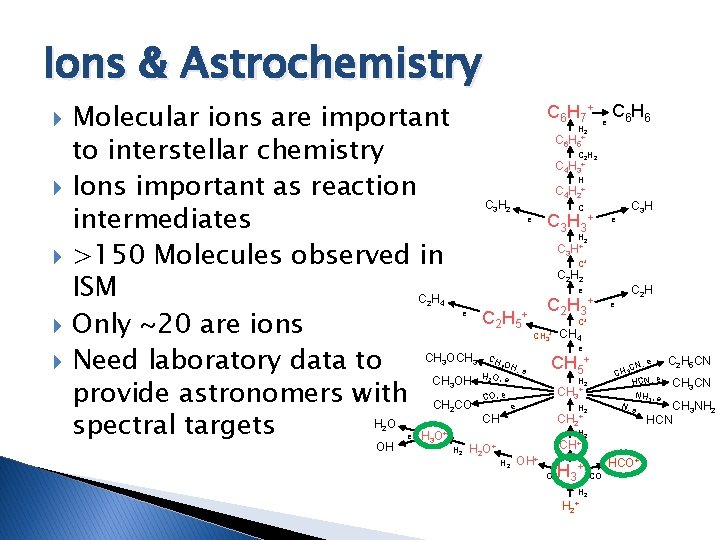
Ions & Astrochemistry Molecular ions are important to interstellar chemistry Ions important as reaction intermediates >150 Molecules observed in ISM CH Only ~20 are ions CH OCH Need laboratory data to CH OH provide astronomers with CH CO HO spectral targets HO 2 4 e 3 3 3 2 2 OH e 3 C 6 H 7 + H 2 C 6 H 6 C 6 H 5+ C 2 H 2 C 4 H 3+ H C 4 H 2+ C 3 H 2 C C 3 H 3 e + e C 3 H H 2 C 3 H+ C+ C 2 H 2 e C 2 H 5 + C 2 H 3 + e C 2 H C+ CH 3+ CH 4 e CH 3 OH , e H 2 O, e CH 5+ H 2 CH 3+ CO, e e H 2 CH 2+ CH e CN, CH 3 HCN, e NH 3, e N, e CH+ H 2 O+ H 2 OH+ O H 3 C + H 2+ C 2 H 5 CN CH 3 CN H 2 + H 2 e HCO+ CO CH 3 NH 2
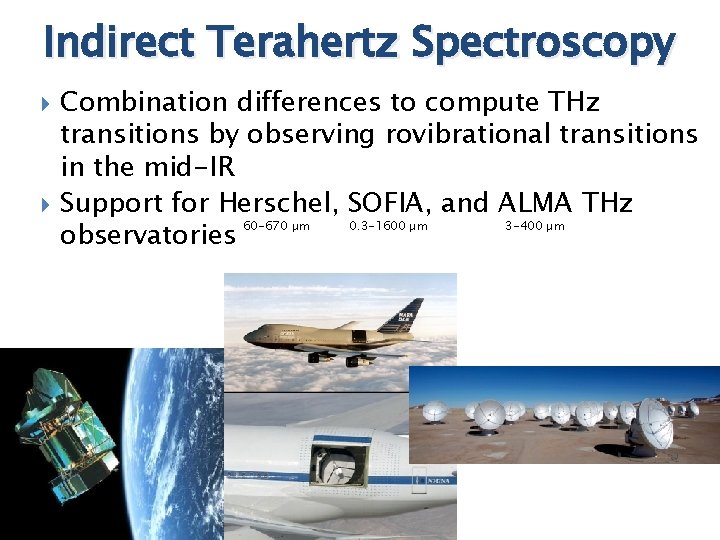
Indirect Terahertz Spectroscopy Combination differences to compute THz transitions by observing rovibrational transitions in the mid-IR Support for Herschel, SOFIA, and ALMA THz 60 -670 µm 0. 3 -1600 µm 3 -400 µm observatories
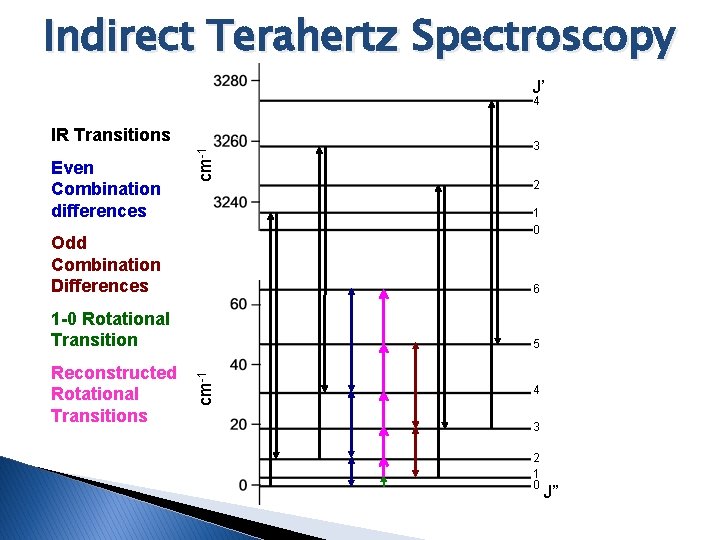
Indirect Terahertz Spectroscopy J’ 4 Even Combination differences cm-1 IR Transitions 2 1 0 Odd Combination Differences 6 1 -0 Rotational Transition 5 cm-1 Reconstructed Rotational Transitions 3 4 3 2 1 0 J”
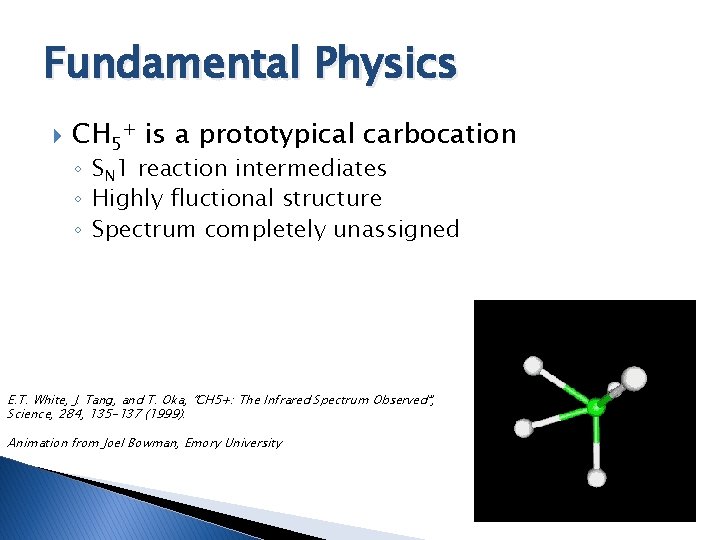
Fundamental Physics CH 5+ is a prototypical carbocation ◦ SN 1 reaction intermediates ◦ Highly fluctional structure ◦ Spectrum completely unassigned E. T. White, J. Tang, and T. Oka, “CH 5+: The Infrared Spectrum Observed”, Science, 284, 135 -137 (1999). Animation from Joel Bowman, Emory University

Direct Absorption Techniques Positive Column ◦ High ion density ◦ Simple setup Ion Beam ◦ Rigorous ion-neutral discrimination ◦ Mass-dependent Doppler shift
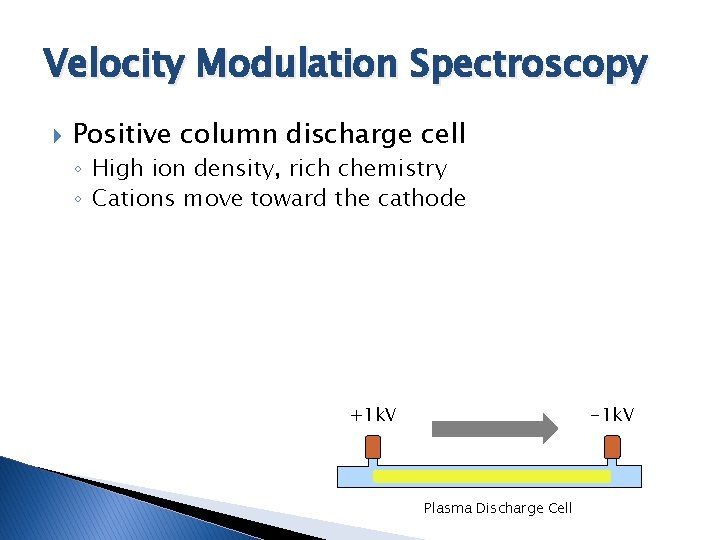
Velocity Modulation Spectroscopy Positive column discharge cell ◦ High ion density, rich chemistry ◦ Cations move toward the cathode +1 k. V -1 k. V Plasma Discharge Cell
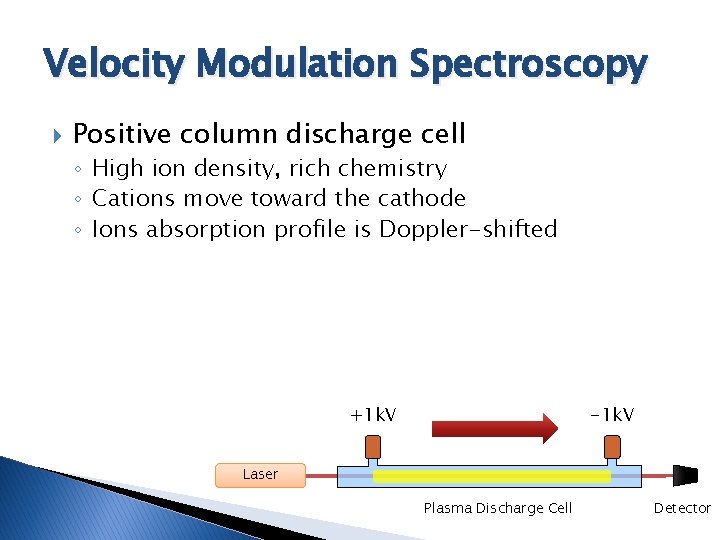
Velocity Modulation Spectroscopy Positive column discharge cell ◦ High ion density, rich chemistry ◦ Cations move toward the cathode ◦ Ions absorption profile is Doppler-shifted +1 k. V -1 k. V Laser Plasma Discharge Cell Detector

Velocity Modulation Spectroscopy Positive column discharge cell ◦ High ion density, rich chemistry ◦ Cations move toward the cathode ◦ Ions absorption profile is Doppler-shifted -1 k. V +1 k. V Laser Plasma Discharge Cell Detector
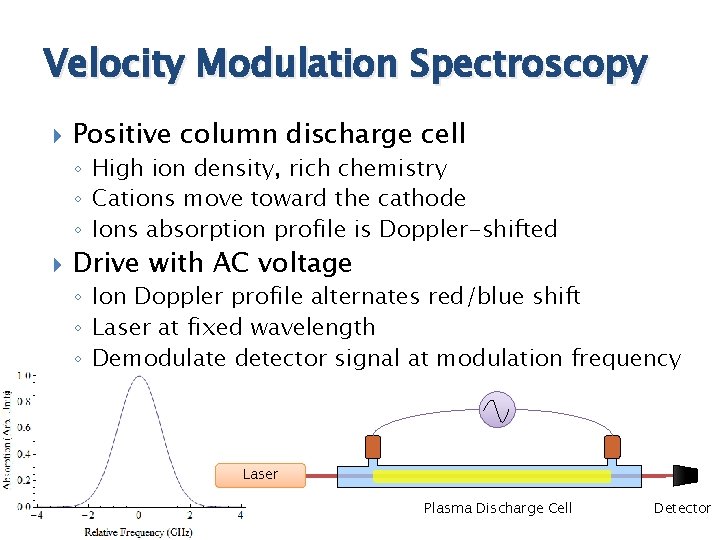
Velocity Modulation Spectroscopy Positive column discharge cell ◦ High ion density, rich chemistry ◦ Cations move toward the cathode ◦ Ions absorption profile is Doppler-shifted Drive with AC voltage ◦ Ion Doppler profile alternates red/blue shift ◦ Laser at fixed wavelength ◦ Demodulate detector signal at modulation frequency Laser Plasma Discharge Cell Detector
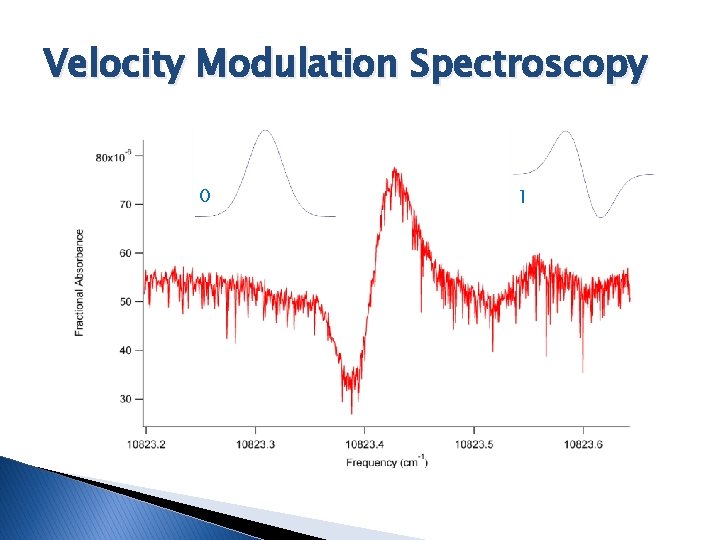
Velocity Modulation Spectroscopy 0 1

Velocity Modulation Spectroscopy Want strongest absorption possible Signal enhanced by modified White cell ◦ Laser passes through cell unidirectionally ◦ Can get up to ~8 passes through cell Laser Plasma Discharge Cell Detector Also want lowest noise possible, so combine with heterodyne spectroscopy

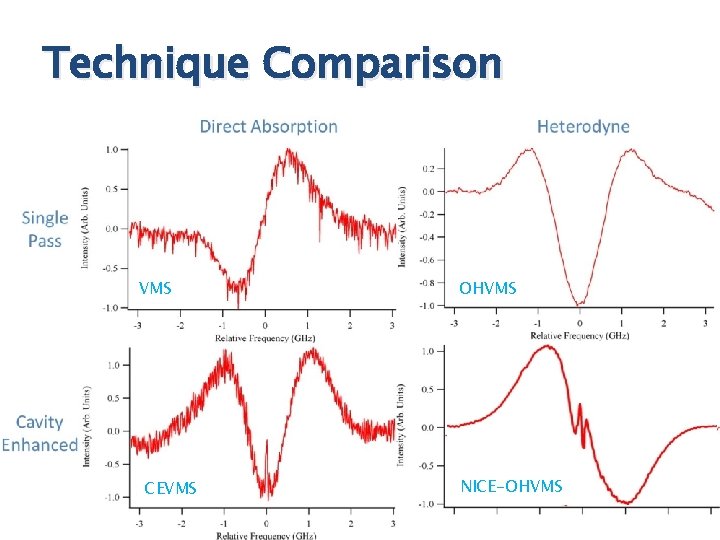
Velocity Modulation of N 2+ Single-pass direct absorption 0 1 Single-pass Heterodyne @ 1 GHz 2
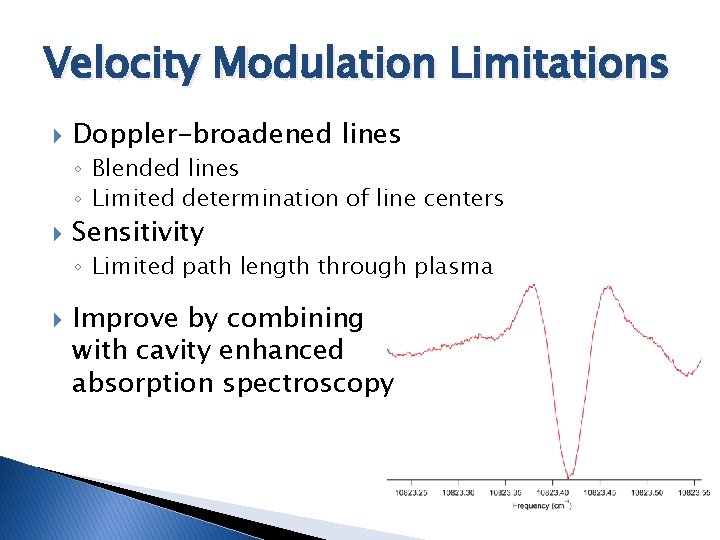
Velocity Modulation Limitations Doppler-broadened lines ◦ Blended lines ◦ Limited determination of line centers Sensitivity ◦ Limited path length through plasma Improve by combining with cavity enhanced absorption spectroscopy
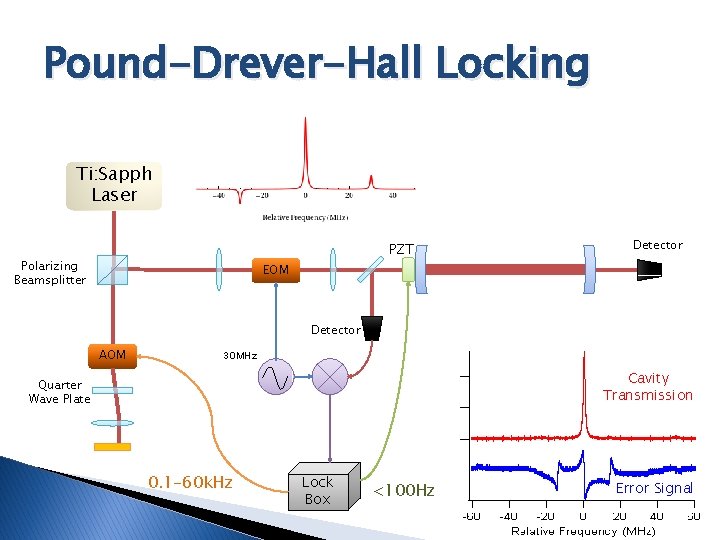
Pound-Drever-Hall Locking Ti: Sapph Laser PZT Polarizing Beamsplitter Detector EOM Detector AOM 30 MHz Cavity Transmission Quarter Wave Plate 0. 1 -60 k. Hz Lock Box <100 Hz Error Signal
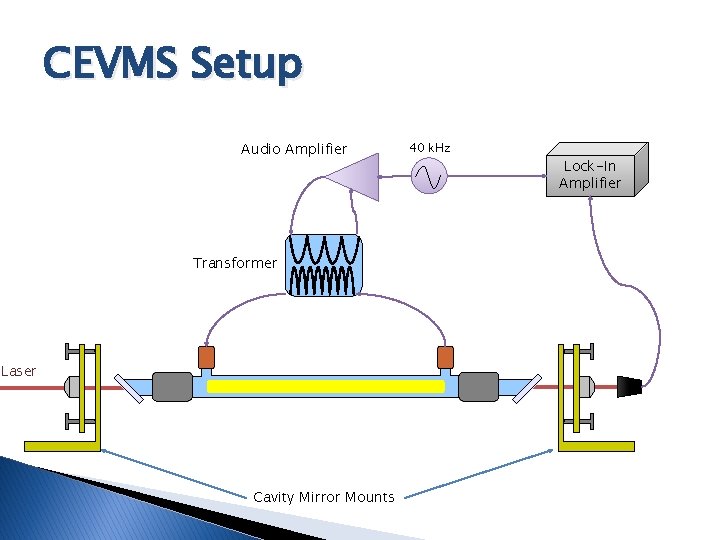
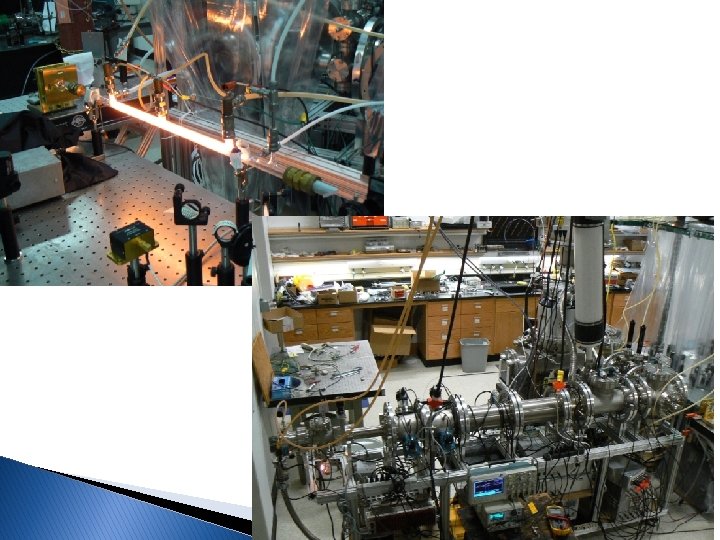
CEVMS Setup Audio Amplifier Transformer Laser Cavity Mirror Mounts 40 k. Hz Lock-In Amplifier

CEVMS Setup
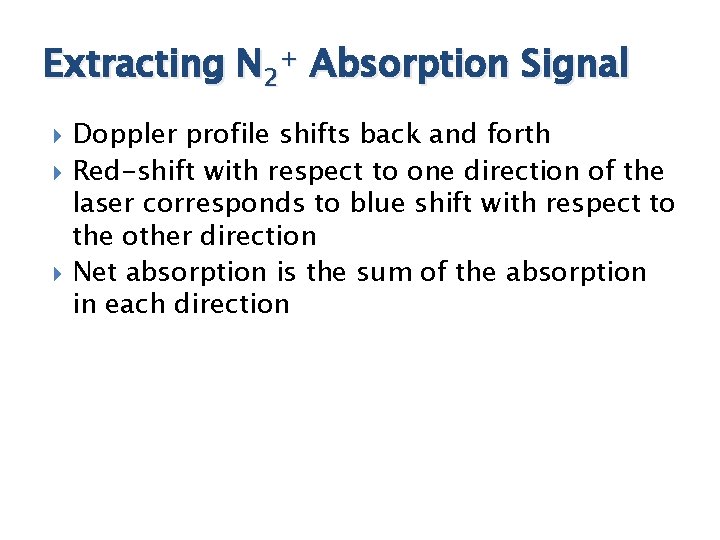
Extracting N 2+ Absorption Signal Absorption Strength (Arb. Units) Doppler profile shifts back and forth Red-shift with respect to one direction of the laser corresponds to blue shift with respect to the other direction Net absorption is the sum of the absorption in each direction Relative Frequency (GHz)
Extracting N 2+ Absorption Signal Demodulate detected signal at twice the modulation frequency (2 f) Can observe and distinguish ions and neutrals ◦ Ions are velocity modulated ◦ Excited neutrals are concentration modulated ◦ Ground state neutrals are not modulated at all Ions and excited neutrals are observed to be ~75° out of phase with one another
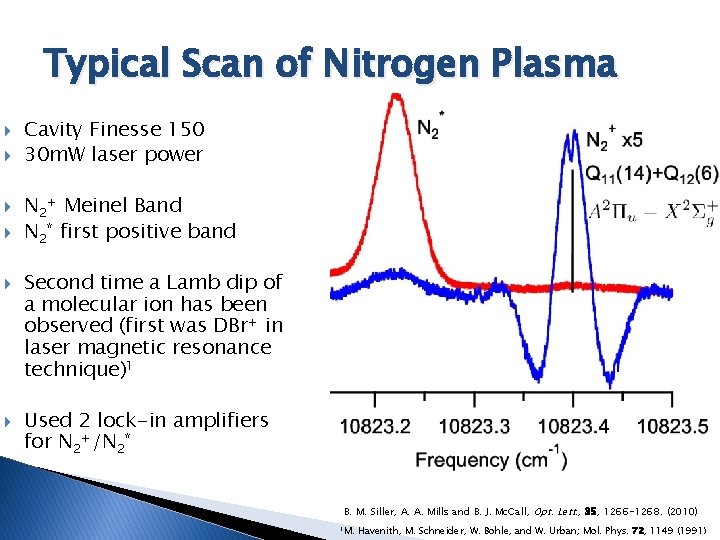
Typical Scan of Nitrogen Plasma Cavity Finesse 150 30 m. W laser power N 2+ Meinel Band N 2* first positive band Second time a Lamb dip of a molecular ion has been observed (first was DBr+ in laser magnetic resonance technique)1 Used 2 lock-in amplifiers for N 2+/N 2* B. M. Siller, A. A. Mills and B. J. Mc. Call, Opt. Lett. , 35, 1266 -1268. (2010) 1 M. Havenith, M. Schneider, W. Bohle, and W. Urban; Mol. Phys. 72, 1149 (1991)
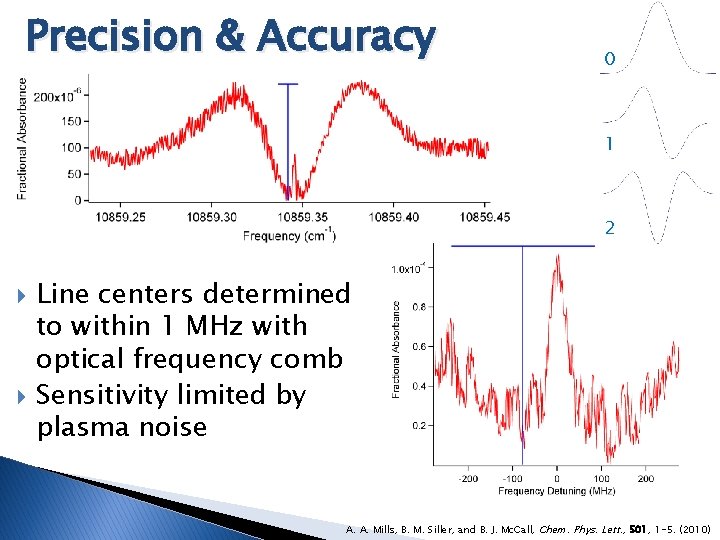
Precision & Accuracy 0 1 2 Line centers determined to within 1 MHz with optical frequency comb Sensitivity limited by plasma noise A. A. Mills, B. M. Siller, and B. J. Mc. Call, Chem. Phys. Lett. , 501, 1 -5. (2010)
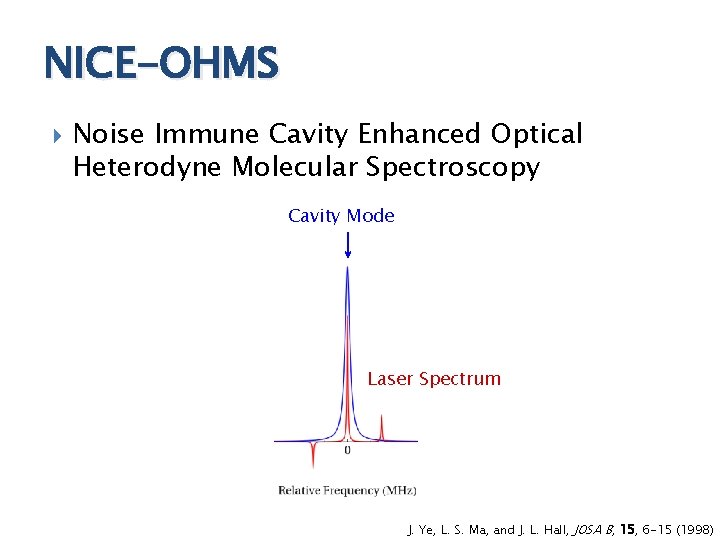
NICE-OHMS Noise Immune Cavity Enhanced Optical Heterodyne Molecular Spectroscopy Cavity Modes Laser Spectrum J. Ye, L. S. Ma, and J. L. Hall, JOSA B, 15, 6 -15 (1998)
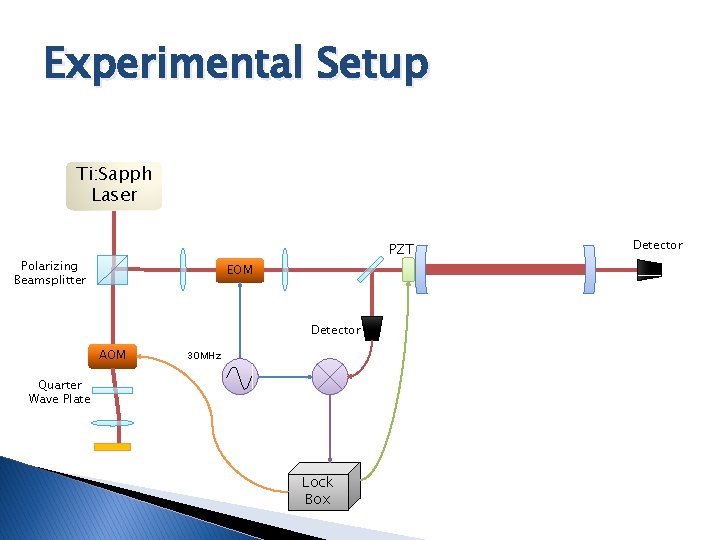
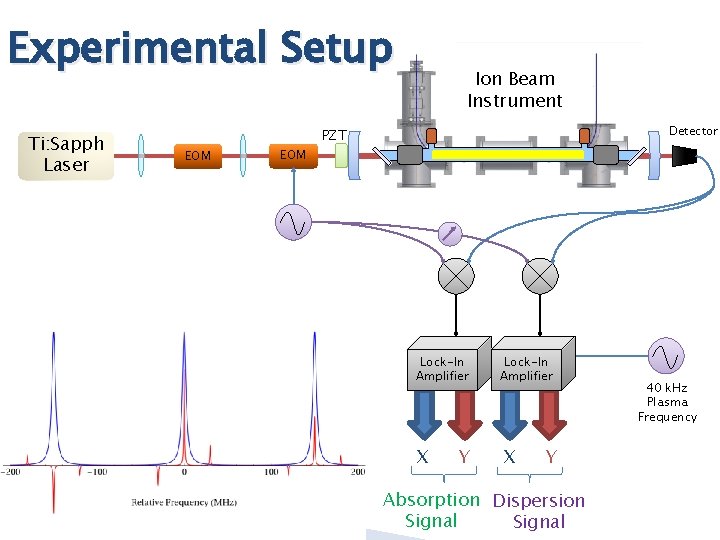
Experimental Setup Ti: Sapph Laser PZT Polarizing Beamsplitter EOM Detector AOM 30 MHz Quarter Wave Plate Lock Box Detector
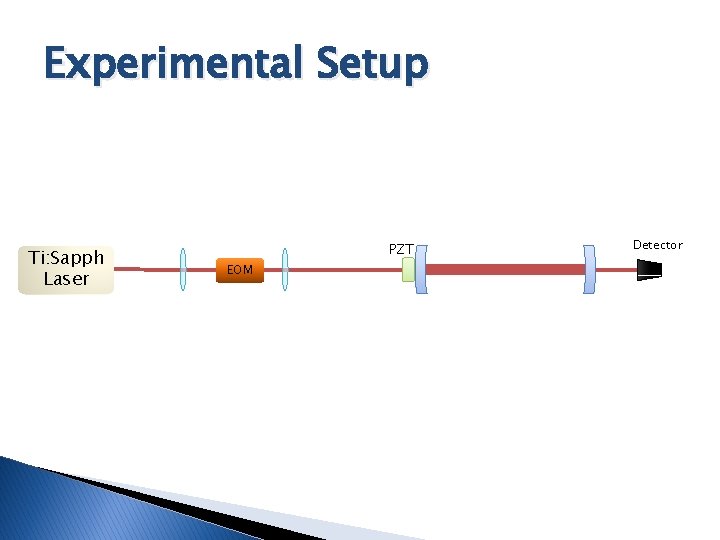
Experimental Setup Ti: Sapph Laser PZT EOM Detector
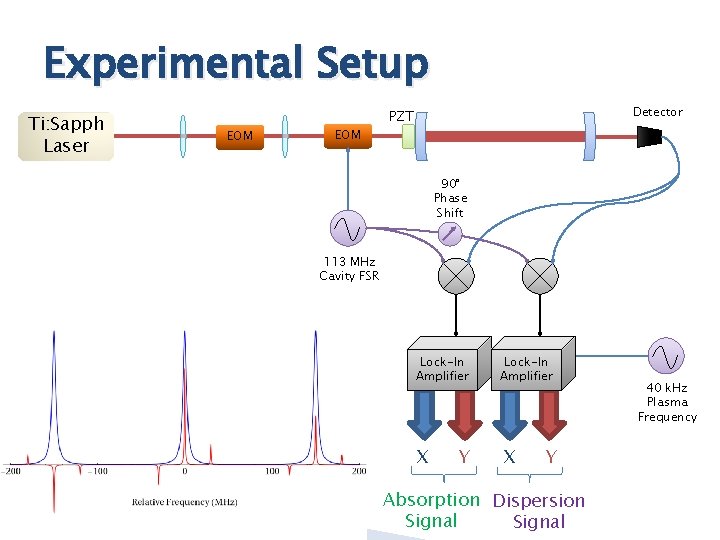
Experimental Setup Ti: Sapph Laser EOM Detector PZT 90° Phase Shift 113 MHz Cavity FSR Lock-In Amplifier X Y Absorption Dispersion Signal 40 k. Hz Plasma Frequency
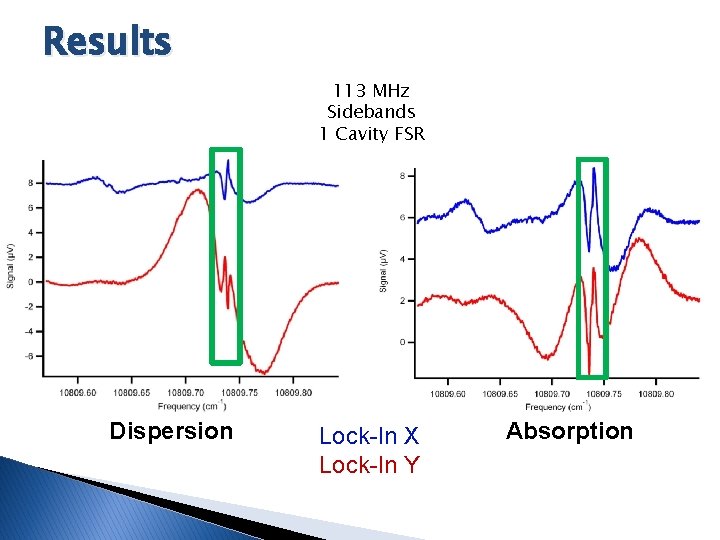
Results 113 MHz Sidebands 1 Cavity FSR Dispersion Lock-In X Lock-In Y Absorption
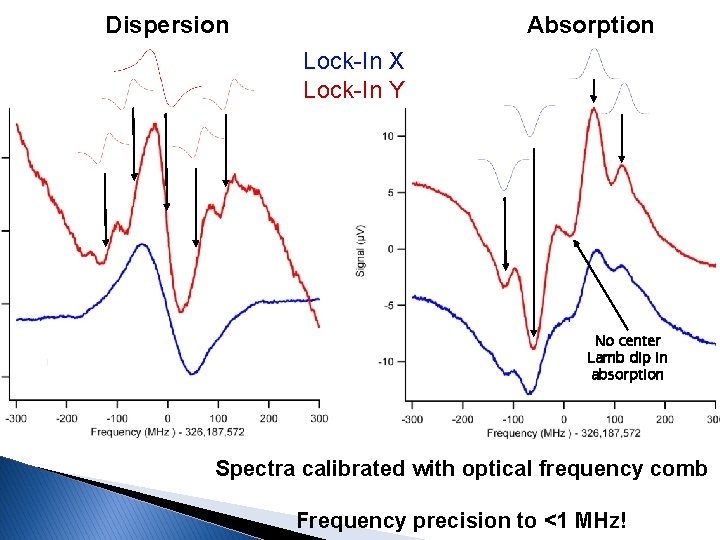
Dispersion Absorption Lock-In X Lock-In Y No center Lamb dip in absorption Spectra calibrated with optical frequency comb Frequency precision to <1 MHz!
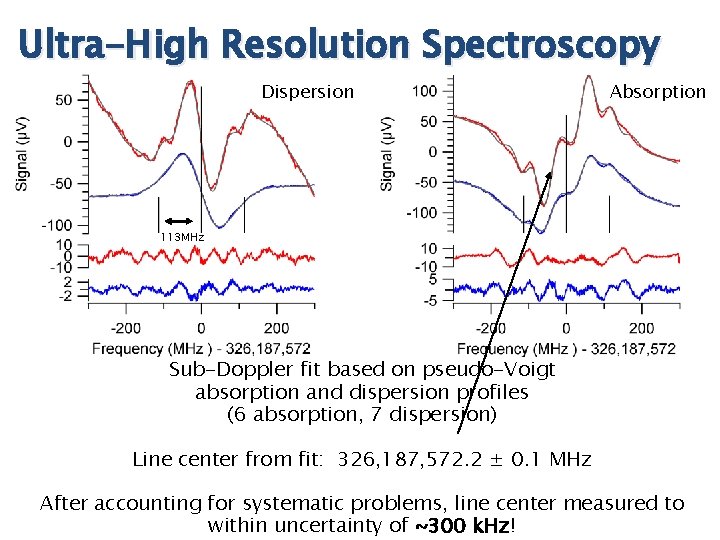
Ultra-High Resolution Spectroscopy Dispersion Absorption 113 MHz Sub-Doppler fit based on pseudo-Voigt absorption and dispersion profiles (6 absorption, 7 dispersion) Line center from fit: 326, 187, 572. 2 ± 0. 1 MHz After accounting for systematic problems, line center measured to within uncertainty of ~300 k. Hz!
Technique Comparison VMS CEVMS OHVMS NICE-OHVMS
NICE-OHVMS Summary Better sensitivity than traditional VMS ◦ Increased path length through plasma ◦ Decreased noise from heterodyne modulation Retained ion-neutral discrimination Sub-Doppler resolution ◦ Better precision & absolute accuracy with comb ◦ Resolve blended lines Can use same optical setup for ion beam spectroscopy
Experimental Setup Ti: Sapph Laser EOM Ion Beam Instrument Detector PZT Lock-In Amplifier X Y Absorption Dispersion Signal 40 k. Hz Plasma Frequency
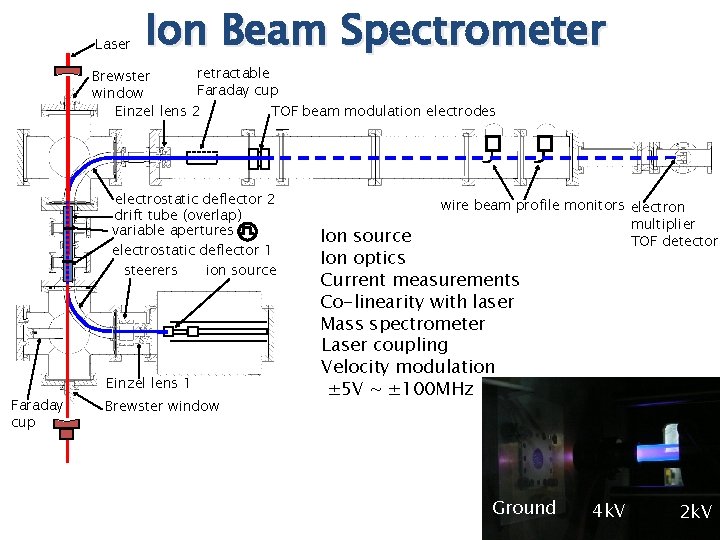
Laser Ion Spectrometer S Beam _ R I Be S retractable Brewster Faraday cup window Einzel lens 2 TOF beam modulation electrodes electrostatic deflector 2 drift tube (overlap) variable apertures electrostatic deflector 1 steerers ion source Einzel lens 1 Faraday cup Brewster window wire beam profile monitors electron multiplier TOF detector Ion source Ion optics Current measurements Co-linearity with laser Mass spectrometer Laser coupling Velocity modulation ± 5 V ~ ± 100 MHz Ground 4 k. V 2 k. V

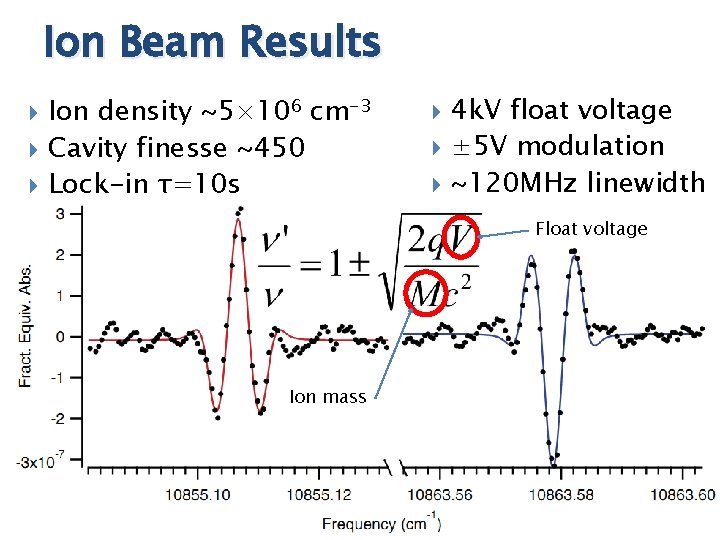
Ion Beam Results Ion density ~5× 106 cm-3 Cavity finesse ~450 Lock-in τ=10 s 4 k. V float voltage ± 5 V modulation ~120 MHz linewidth Float voltage Ion mass
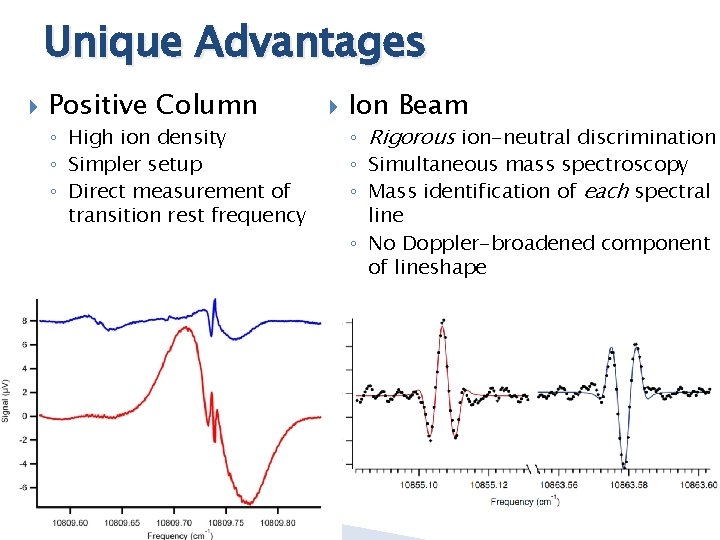
Unique Advantages Positive Column ◦ High ion density ◦ Simpler setup ◦ Direct measurement of transition rest frequency Ion Beam ◦ Rigorous ion-neutral discrimination ◦ Simultaneous mass spectroscopy ◦ Mass identification of each spectral line ◦ No Doppler-broadened component of lineshape
Current Work Positive Column ◦ Mid-IR OPO system ~1 W mid-IR idler power Pump and signal lasers referenced to optical frequency comb ◦ Liquid-N 2 cooled discharge cell Ion Beam ◦ Mid-IR DFG laser Ti: Sapph referenced to comb Nd: YAG locked to I 2 hyperfine transition ◦ Supersonic expansion discharge source
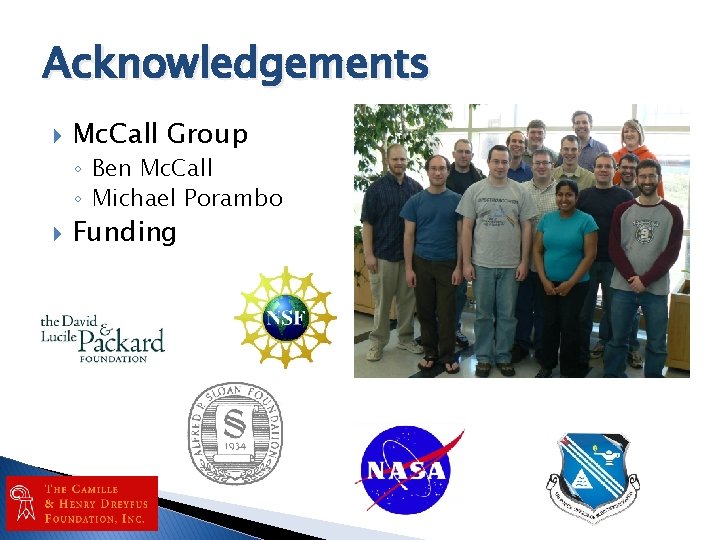
Acknowledgements Mc. Call Group ◦ Ben Mc. Call ◦ Michael Porambo Funding
- Slides: 39