
Cavity decay rate in presence of a SlowLight
- Slides: 36
Cavity decay rate in presence of a Slow-Light medium Laboratoire Aimé Cotton, Orsay, France Thomas Lauprêtre Fabienne Goldfarb Fabien Bretenaker School of Physical Sciences, Jawaharlal Nehru University, Delhi, India Rupamanjari Ghosh Santosh Kumar Thales R&T, Palaiseau, France Sylvain Schwartz 1
Outline • • • Issues: the ring laser gyro EIT and dispersion Experimental set-up Cavity decay rate Negative dispersion in He* 2
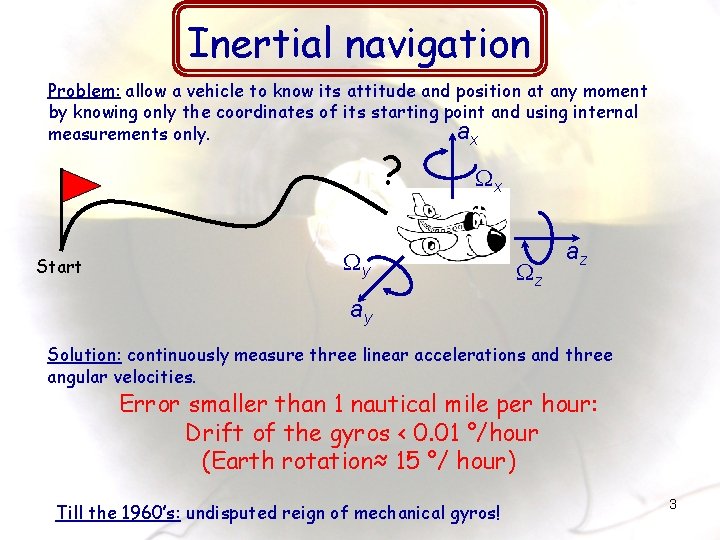
Inertial navigation Problem: allow a vehicle to know its attitude and position at any moment by knowing only the coordinates of its starting point and using internal ax measurements only. ? Start Wx Wy Wz az ay Solution: continuously measure three linear accelerations and three angular velocities. Error smaller than 1 nautical mile per hour: Drift of the gyros < 0. 01 °/hour (Earth rotation≈ 15 °/ hour) Till the 1960’s: undisputed reign of mechanical gyros! 3
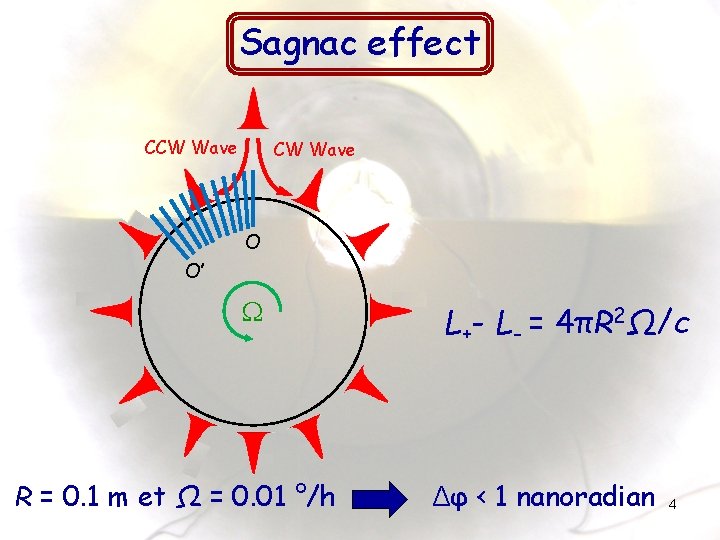
Sagnac effect CCW Wave O O’ W R = 0. 1 m et Ω = 0. 01 °/h L+- L- = 4πR 2Ω/c Δφ < 1 nanoradian 4
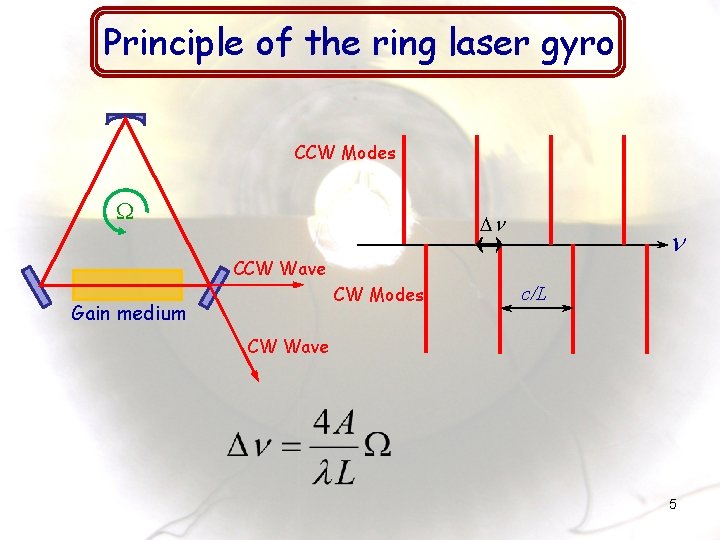
Principle of the ring laser gyro CCW Modes W Dn n CCW Wave CW Modes Gain medium c/L CW Wave 5
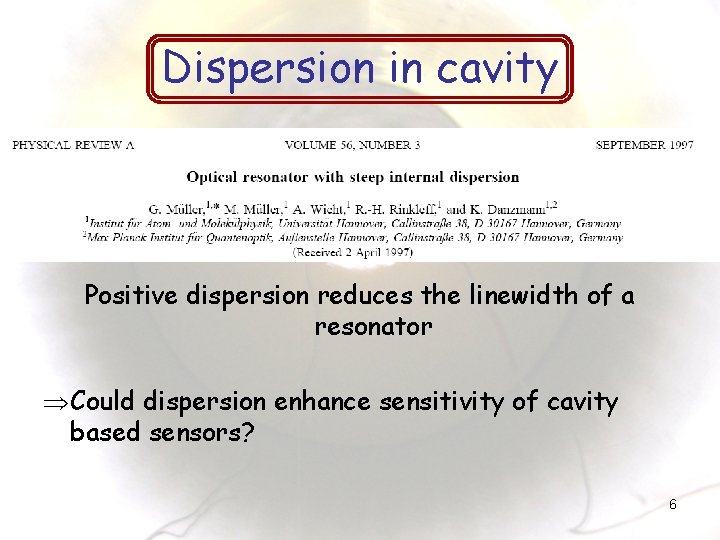
Dispersion in cavity Positive dispersion reduces the linewidth of a resonator Þ Could dispersion enhance sensitivity of cavity based sensors? 6
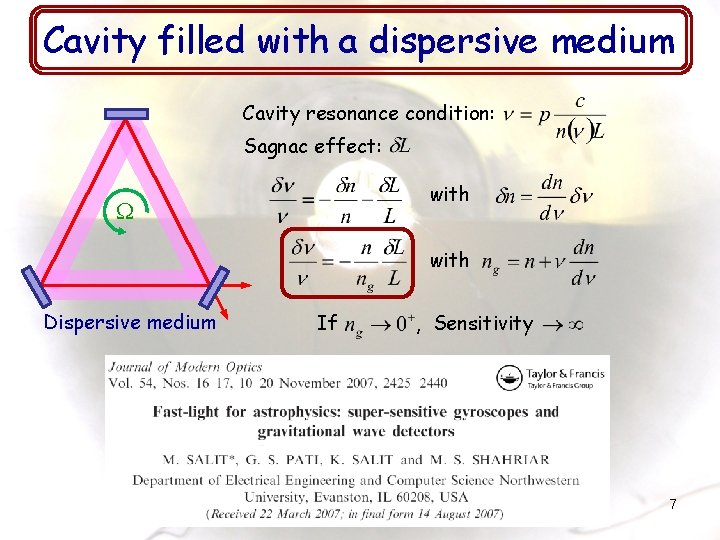
Cavity filled with a dispersive medium Cavity resonance condition: Sagnac effect: with W with Dispersive medium If , Sensitivity 7
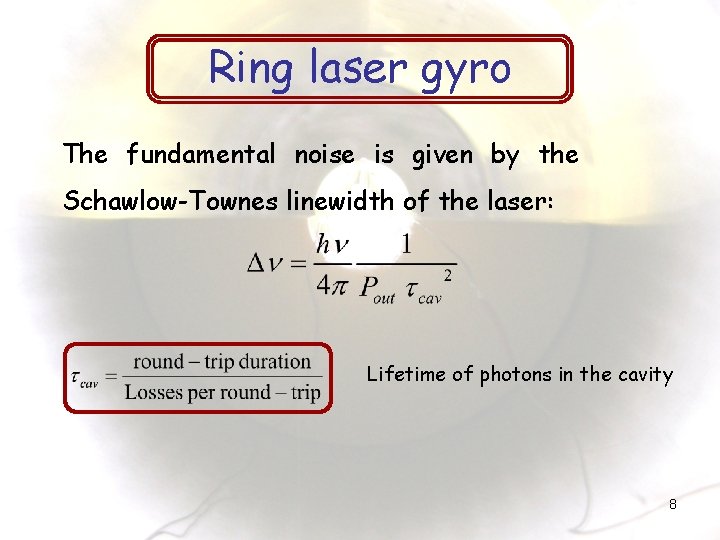
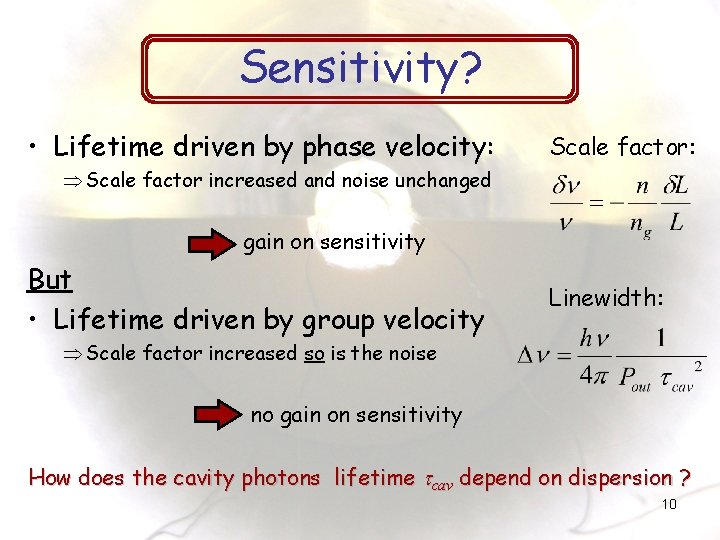
Ring laser gyro The fundamental noise is given by the Schawlow-Townes linewidth of the laser: Lifetime of photons in the cavity 8
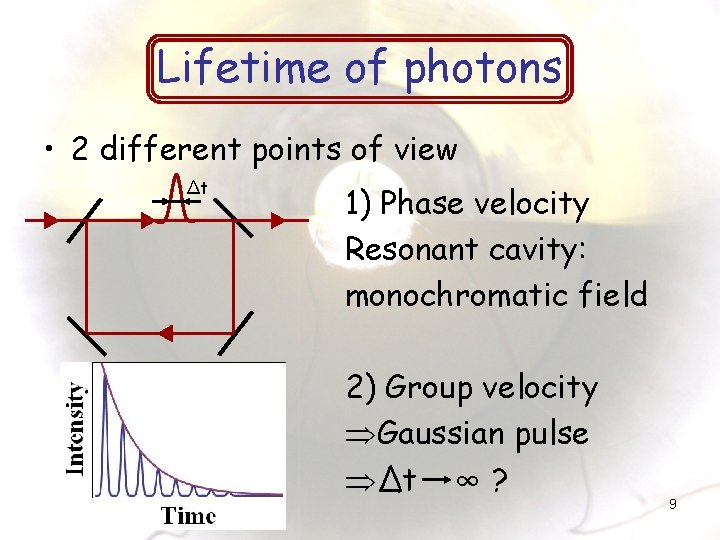
Lifetime of photons • 2 different points of view Δt 1) Phase velocity Resonant cavity: monochromatic field 2) Group velocity ÞGaussian pulse ÞΔt ∞ ? 9
Sensitivity? • Lifetime driven by phase velocity: Scale factor: Þ Scale factor increased and noise unchanged gain on sensitivity But • Lifetime driven by group velocity Linewidth: Þ Scale factor increased so is the noise no gain on sensitivity How does the cavity photons lifetime tcav depend on dispersion ? 10
Outline • • • Issues: the ring laser gyro EIT and dispersion Experimental set-up Cavity decay rate Negative dispersion in He* 11
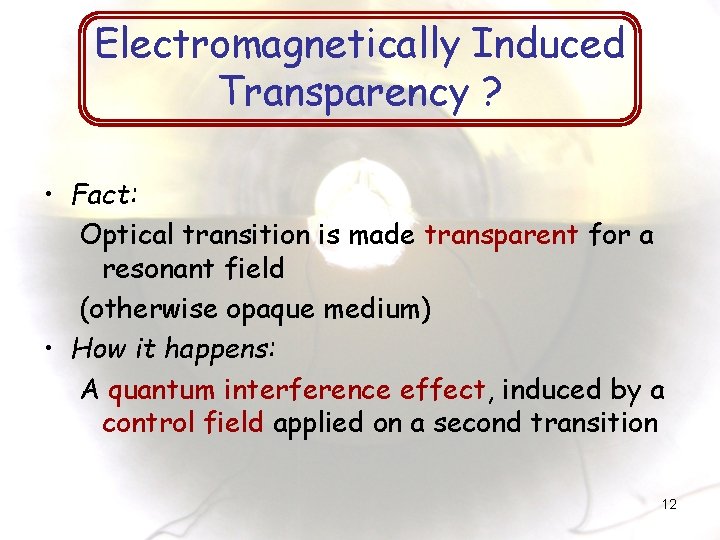
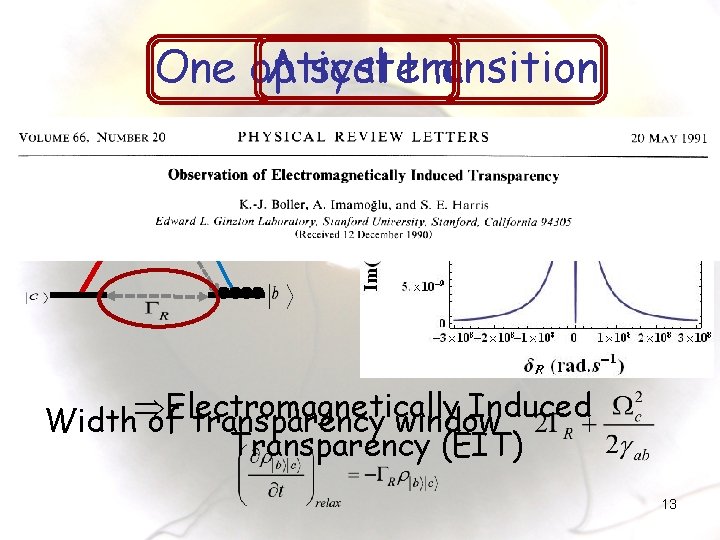
Electromagnetically Induced Transparency ? • Fact: Optical transition is made transparent for a resonant field (otherwise opaque medium) • How it happens: A quantum interference effect, induced by a control field applied on a second transition 12
One optical transition Λ system Induced WidthÞ of. Electromagnetically transparency window Transparency (EIT) 13
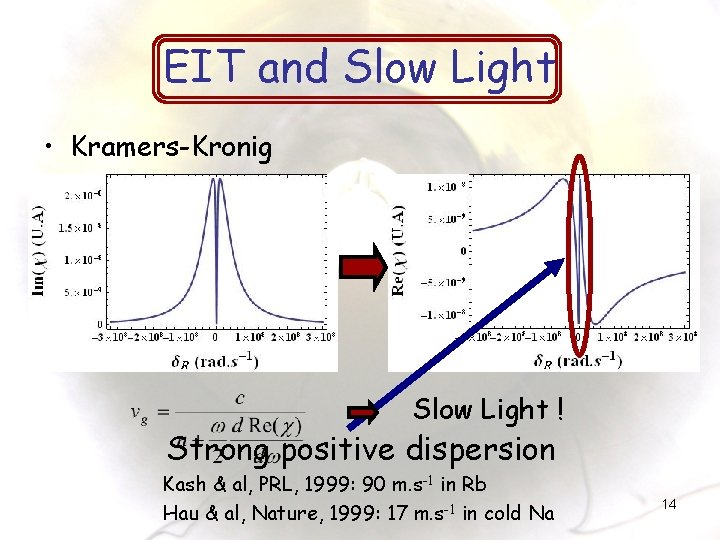
EIT and Slow Light • Kramers-Kronig Slow Light ! Strong positive dispersion Kash & al, PRL, 1999: 90 m. s-1 in Rb Hau & al, Nature, 1999: 17 m. s-1 in cold Na 14
Outline • • • Issues: the ring laser gyro EIT and dispersion Experimental set-up Cavity decay rate Negative dispersion in He* 15
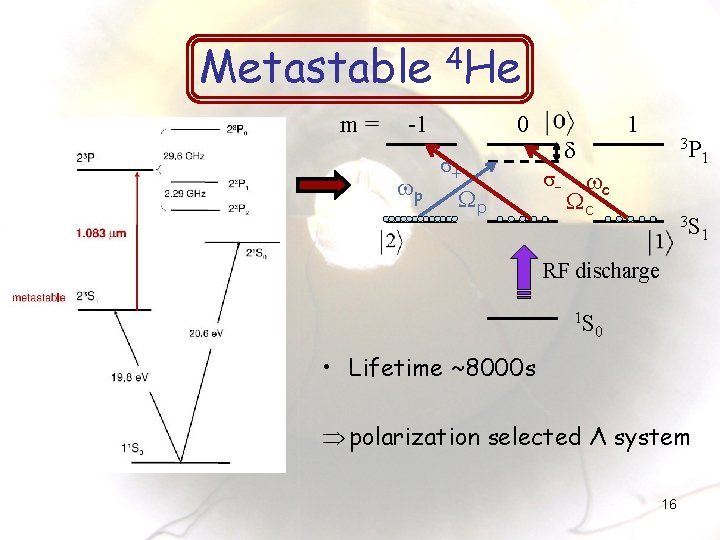
Metastable 4 He m= -1 wp 0 s+ Wp 1 d s- 3 P 1 3 S 1 wc Wc RF discharge 1 S 0 • Lifetime ~8000 s Þ polarization selected Λ system 16
Room temperature 4 He* • Spin conservation through collisions with He M. Pinard and F. Laloë, J. Physique 41 799 (1980) • Almost no Penning ionization (thanks to optical pumping) Shlyapnikov & al, PRL 73 3247 (1994) No loss of coherence time 17
Benefits of collisions • Possibility to pump over the entire Doppler width through Velocity Changing Collisions (VCCs) • Atoms are confined into the laser beam (diffusive transit instead of ballistic transit) - Increase of coherence time - Co-propagating beams 18
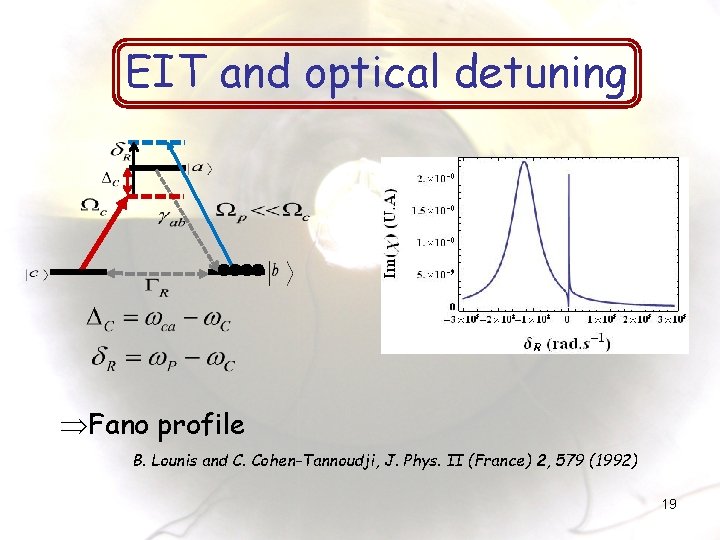
EIT and optical detuning ÞFano profile B. Lounis and C. Cohen-Tannoudji, J. Phys. II (France) 2, 579 (1992) 19
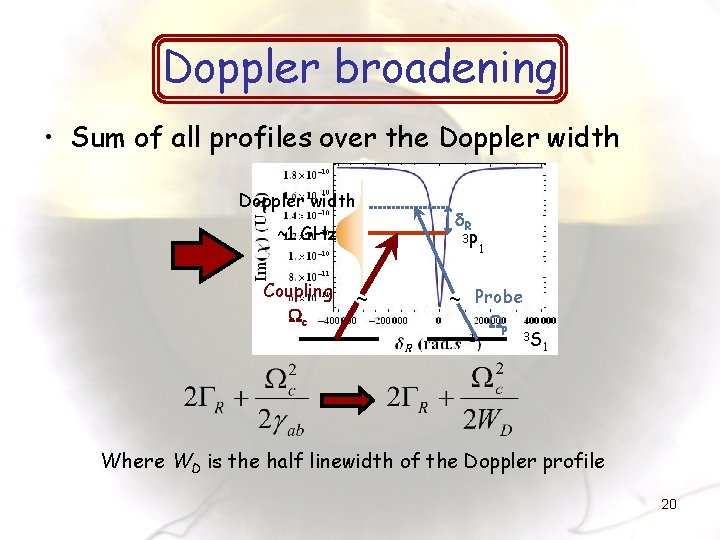
Doppler broadening • Sum of all profiles over the Doppler width d. R 3 P 1 ~1 GHz Coupling Wc ~ ~ Probe Wp 3 S 1 Where WD is the half linewidth of the Doppler profile 20
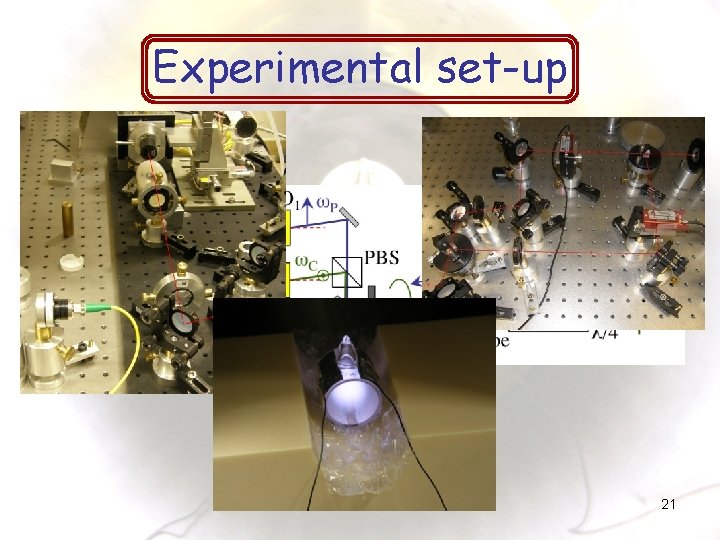
Experimental set-up 21
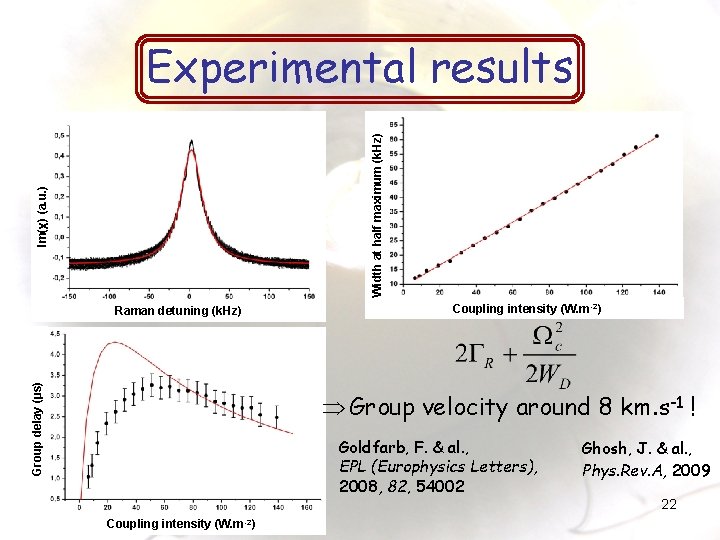
Im(χ) (a. u. ) Width at half maximum (k. Hz) Experimental results Group delay (µs) Raman detuning (k. Hz) Coupling intensity (W. m -2) Þ Group velocity around 8 km. s-1 ! Goldfarb, F. & al. , EPL (Europhysics Letters), 2008, 82, 54002 Coupling intensity (W. m -2) Ghosh, J. & al. , Phys. Rev. A, 2009 22
Outline • • • Issues: the ring laser gyro EIT and dispersion Experimental set-up Cavity decay rate Negative dispersion in He* 23
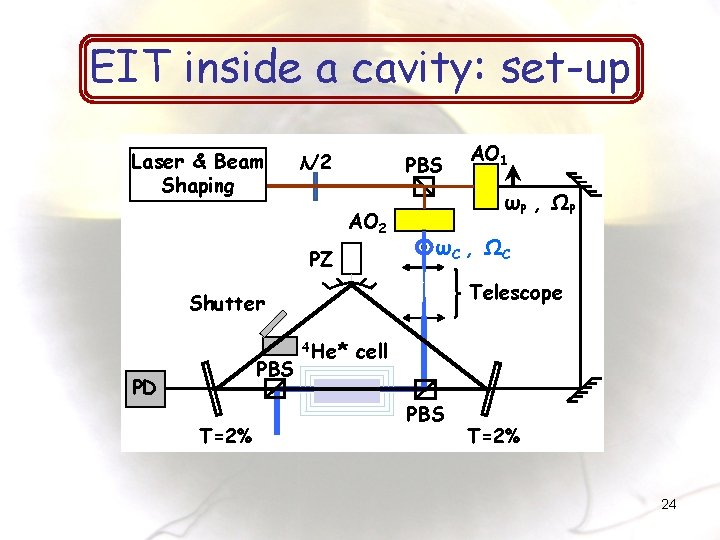
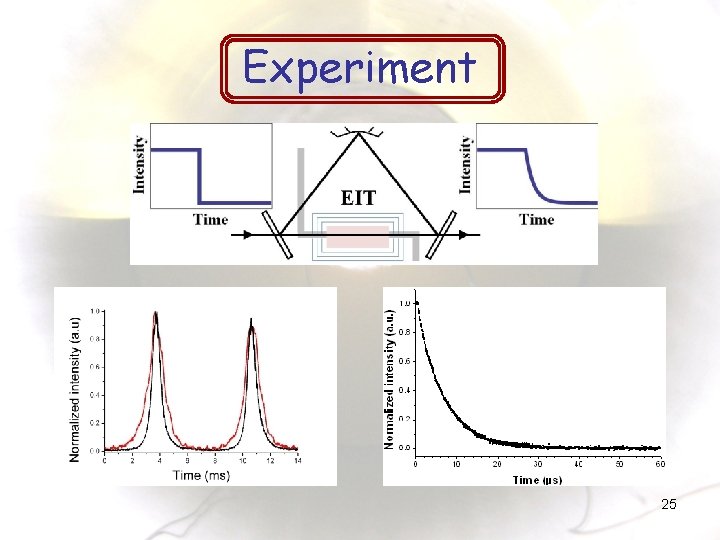
EIT inside a cavity: set-up Laser & Beam Shaping λ/2 PBS AO 2 PZ ωP , Ω P ωC , Ω C Telescope Shutter PBS PD T=2% AO 1 4 He* cell PBS T=2% 24
Experiment 25
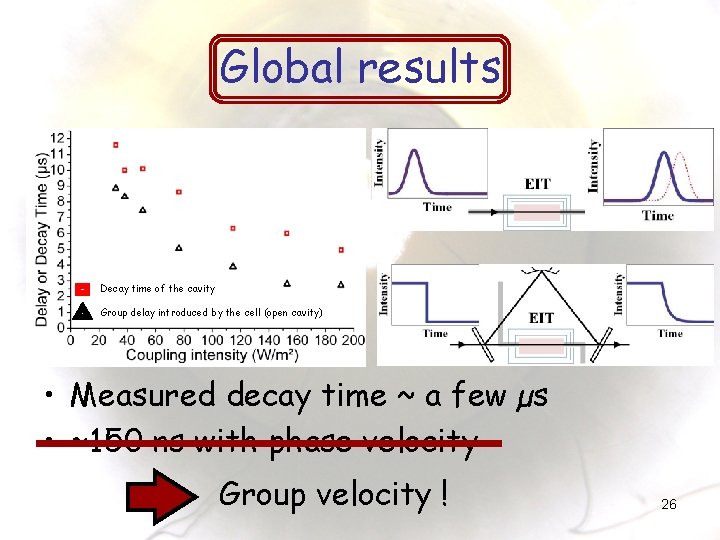
Global results Decay time of the cavity Group delay introduced by the cell (open cavity) • Measured decay time ~ a few µs • ~150 ns with phase velocity Group velocity ! 26
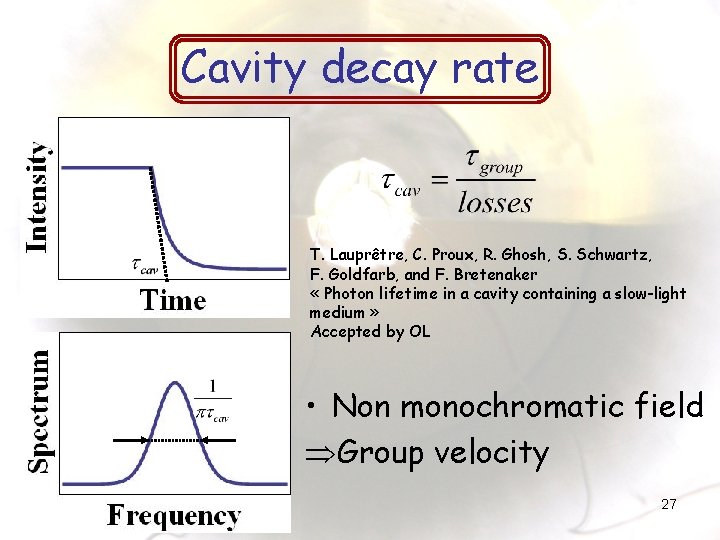
Cavity decay rate T. Lauprêtre, C. Proux, R. Ghosh, S. Schwartz, F. Goldfarb, and F. Bretenaker « Photon lifetime in a cavity containing a slow-light medium » Accepted by OL • Non monochromatic field ÞGroup velocity 27
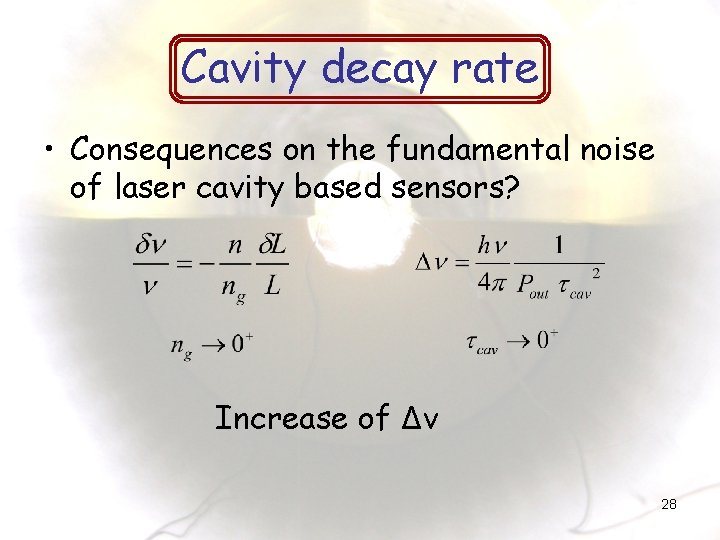
Cavity decay rate • Consequences on the fundamental noise of laser cavity based sensors? Increase of Δν 28
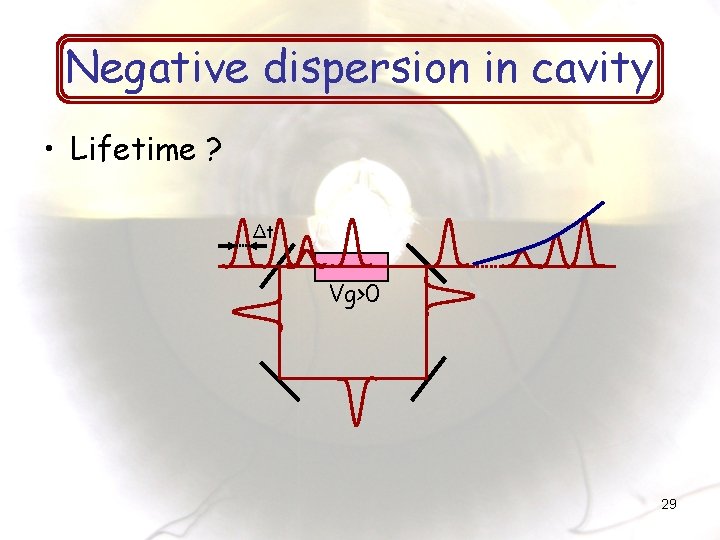
Negative dispersion in cavity • Lifetime ? Δt Vg>0 29
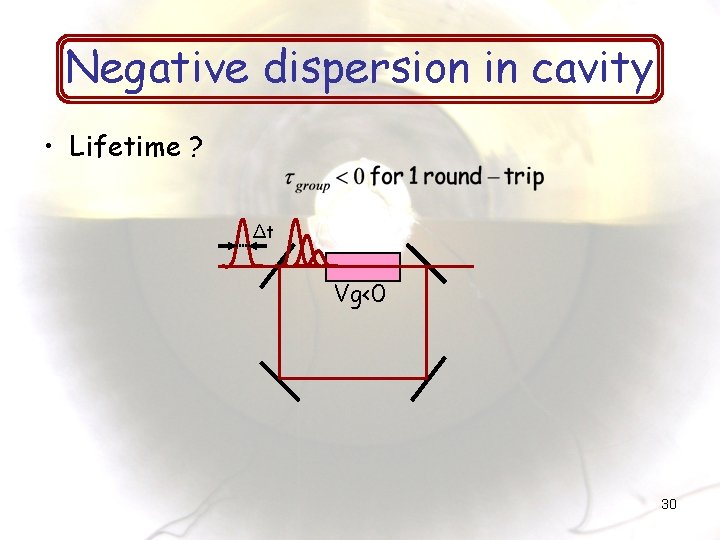
Negative dispersion in cavity • Lifetime ? Δt Vg<0 30
Outline • • • Issues: the ring laser gyro EIT and dispersion Experimental set-up Cavity decay rate Negative dispersion in He* 31
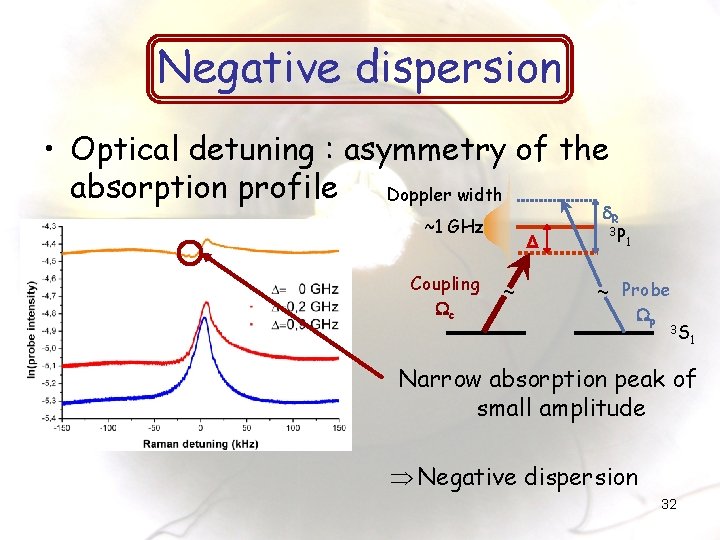
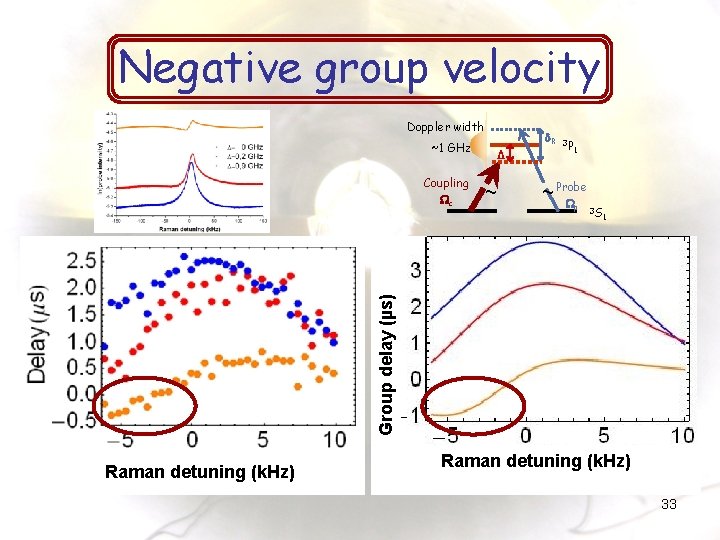
Negative dispersion • Optical detuning : asymmetry of the absorption profile Doppler width ~1 GHz Coupling Wc Δ ~ d. R 3 P 1 ~ Probe Wp 3 S 1 Narrow absorption peak of small amplitude Þ Negative dispersion 32
Negative group velocity Doppler width d. R ~1 GHz ~ 3 P 1 ~ Probe Wp 3 S 1 Group delay (µs) Coupling Wc Δ Raman detuning (k. Hz) 33
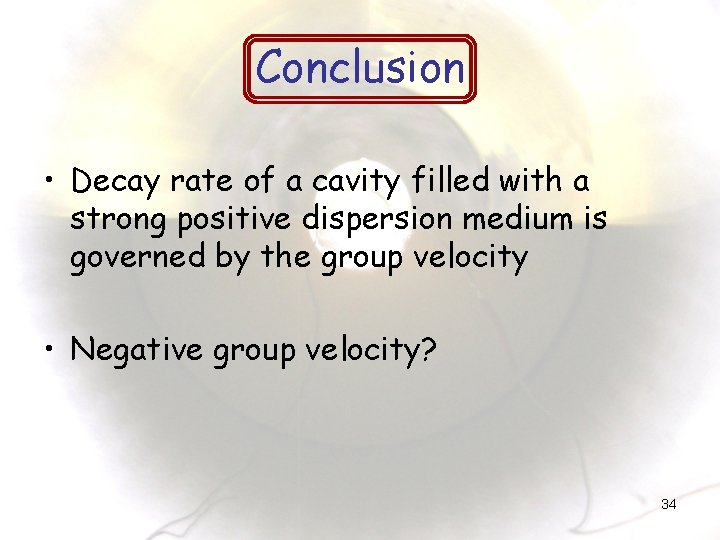
Conclusion • Decay rate of a cavity filled with a strong positive dispersion medium is governed by the group velocity • Negative group velocity? 34
Advertisment Poster session: Tu-P 15 S. Kumar, T. Lauprêtre, F. Bretenaker, R. Ghosh, and F. Goldfarb Interacting dark resonances in a tripod system of room temperature 4 He* 35
Thank you! 36