
Caustic Esophageal Injury in Adults Joint Hospital Grand

- Slides: 24
Caustic Esophageal Injury in Adults Joint Hospital Grand Round 14 th December, 2019 Kwong Wah Hospital Dr Alex Yeung Pat Chung
Suicidal patient Background Caustic agent Rare and Devastating event
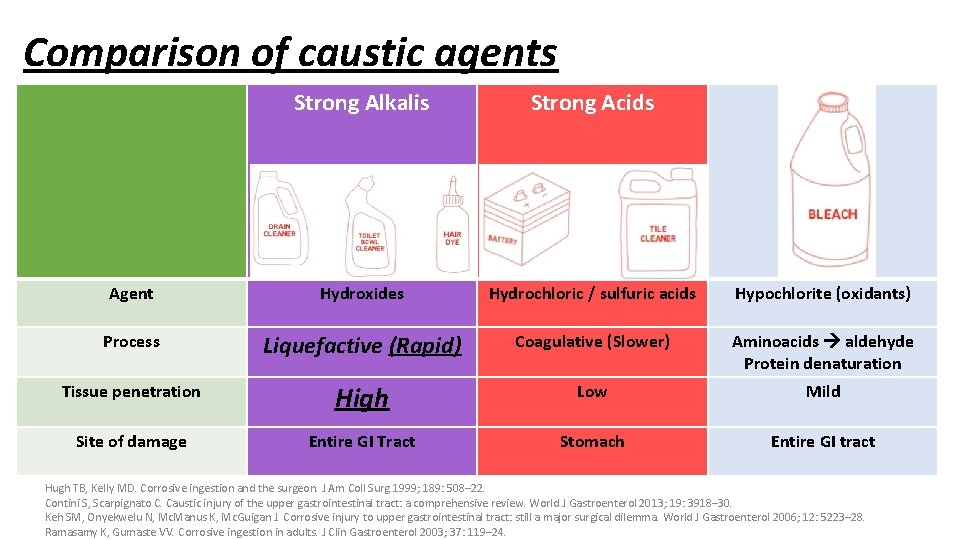
Comparison of caustic agents Strong Alkalis Strong Acids Agent Hydroxides Hydrochloric / sulfuric acids Hypochlorite (oxidants) Process Liquefactive (Rapid) Coagulative (Slower) Aminoacids aldehyde Protein denaturation Tissue penetration High Low Mild Site of damage Entire GI Tract Stomach Entire GI tract Hugh TB, Kelly MD. Corrosive ingestion and the surgeon. J Am Coll Surg 1999; 189: 508– 22. Contini S, Scarpignato C. Caustic injury of the upper gastrointestinal tract: a comprehensive review. World J Gastroenterol 2013; 19: 3918– 30. Keh SM, Onyekwelu N, Mc. Manus K, Mc. Guigan J. Corrosive injury to upper gastrointestinal tract: still a major surgical dilemma. World J Gastroenterol 2006; 12: 5223– 28. Ramasamy K, Gumaste VV. Corrosive ingestion in adults. J Clin Gastroenterol 2003; 37: 119– 24.
Granulation tissue Pathophysiology and sequelae • Post ingestion days 2 -4 • Perforation Collagen deposition and fibrogenesis • Post ingestion 2 -3 weeks • Esophageal strictures Hugh TB, Kelly MD. Corrosive ingestion and the surgeon. J Am Coll Surg 1999; 189: 508– 22.
History Initial assessment • Identify corrosive agent • Timing of ingestion and amount • Co-ingestion of other drugs / alcohol Physical exam • Upper airway obstruction • Signs of GI perforation • Rebound tenderness • Surgical emphysema • Hemodynamic instability Contini S, Scarpignato C. Caustic injury of the upper gastrointestinal tract: a comprehensive review. World J Gastroenterol 2013; 19: 3918– 30. Keh SM, Onyekwelu N, Mc. Manus K, Mc. Guigan J. Corrosive injury to upper gastrointestinal tract: still a major surgical dilemma. World J Gastroenterol 2006; 12: 5223– 28.
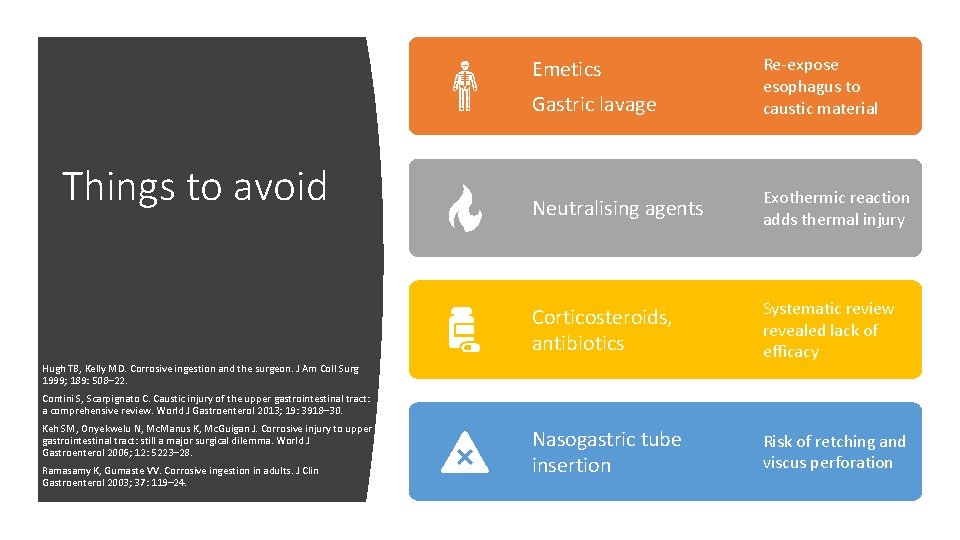
Gastric lavage Re-expose esophagus to caustic material Neutralising agents Exothermic reaction adds thermal injury Corticosteroids, antibiotics Systematic review revealed lack of efficacy Nasogastric tube insertion Risk of retching and viscus perforation Emetics Things to avoid Hugh TB, Kelly MD. Corrosive ingestion and the surgeon. J Am Coll Surg 1999; 189: 508– 22. Contini S, Scarpignato C. Caustic injury of the upper gastrointestinal tract: a comprehensive review. World J Gastroenterol 2013; 19: 3918– 30. Keh SM, Onyekwelu N, Mc. Manus K, Mc. Guigan J. Corrosive injury to upper gastrointestinal tract: still a major surgical dilemma. World J Gastroenterol 2006; 12: 5223– 28. Ramasamy K, Gumaste VV. Corrosive ingestion in adults. J Clin Gastroenterol 2003; 37: 119– 24.
Oesophagogastroduodenoscopy • Early (3 -48 hours) assessment of extent and severity of caustic injury • Safely repeated in the first 3 weeks without increasing risk of perforation • Zargar classification – wide acceptance and is used in most centres Hugh TB, Kelly MD. Corrosive ingestion and the surgeon. J Am Coll Surg 1999; 189: 508– 22. Contini S, Scarpignato C. Caustic injury of the upper gastrointestinal tract: a comprehensive review. World J Gastroenterol 2013; 19: 3918– 30. Ramasamy K, Gumaste VV. Corrosive ingestion in adults. J Clin Gastroenterol 2003; 37: 119– 24. Zargar SA, Kochhar R, Mehta SK. The role of fiberoptic endoscopy in the management of corrosive ingestion and modified endoscopic classification of burns. Gastrointest Endosc 1991; 37: 165– 69.
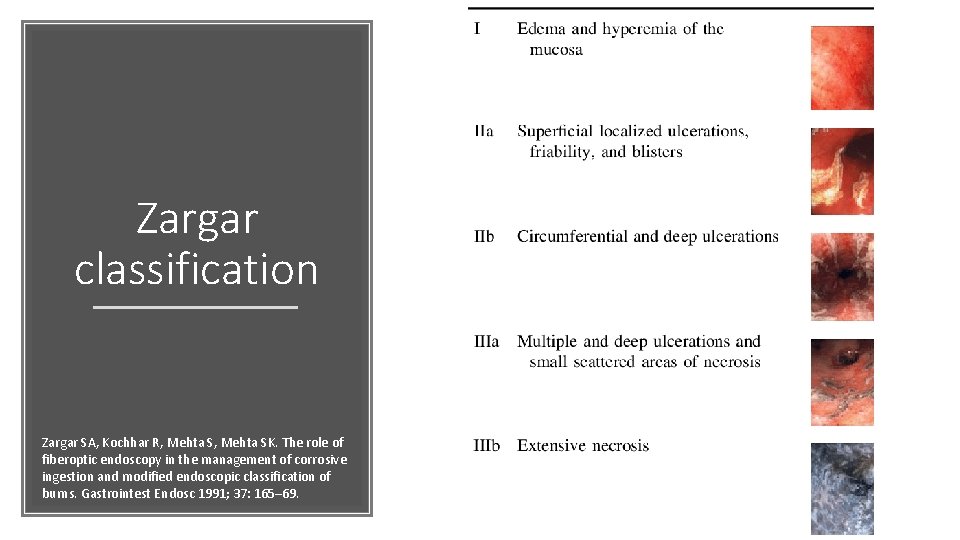
Zargar classification Zargar SA, Kochhar R, Mehta SK. The role of fiberoptic endoscopy in the management of corrosive ingestion and modified endoscopic classification of burns. Gastrointest Endosc 1991; 37: 165– 69.
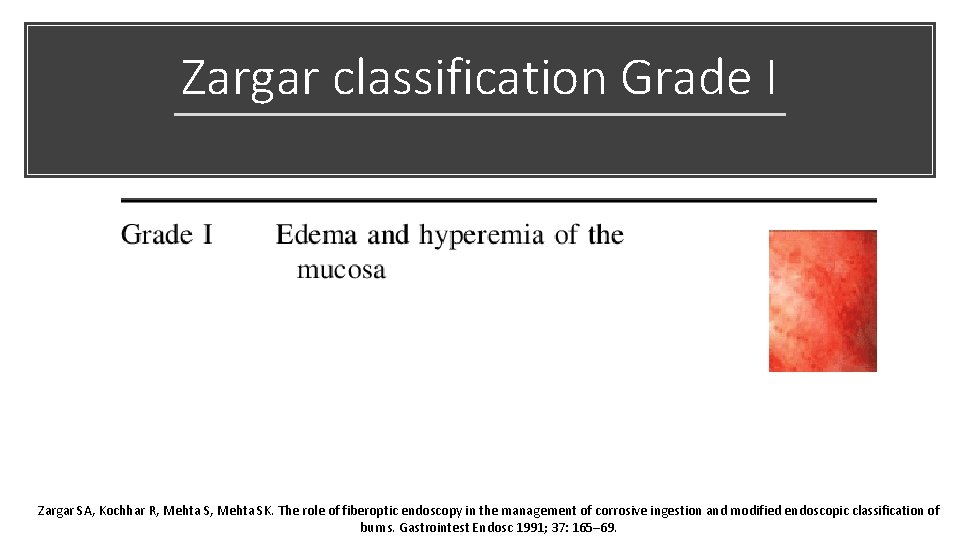
Zargar classification Grade I Zargar SA, Kochhar R, Mehta SK. The role of fiberoptic endoscopy in the management of corrosive ingestion and modified endoscopic classification of burns. Gastrointest Endosc 1991; 37: 165– 69.
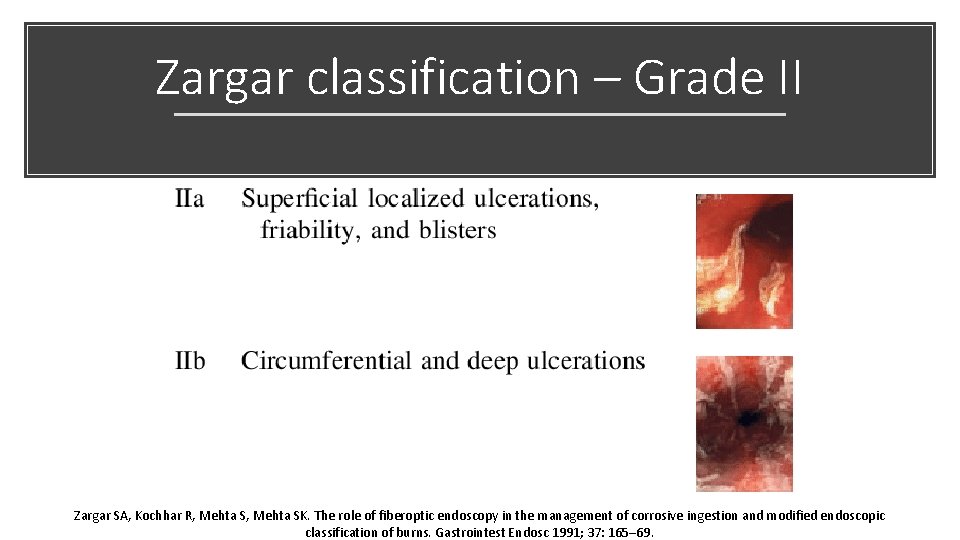
Zargar classification – Grade II Zargar SA, Kochhar R, Mehta SK. The role of fiberoptic endoscopy in the management of corrosive ingestion and modified endoscopic classification of burns. Gastrointest Endosc 1991; 37: 165– 69.
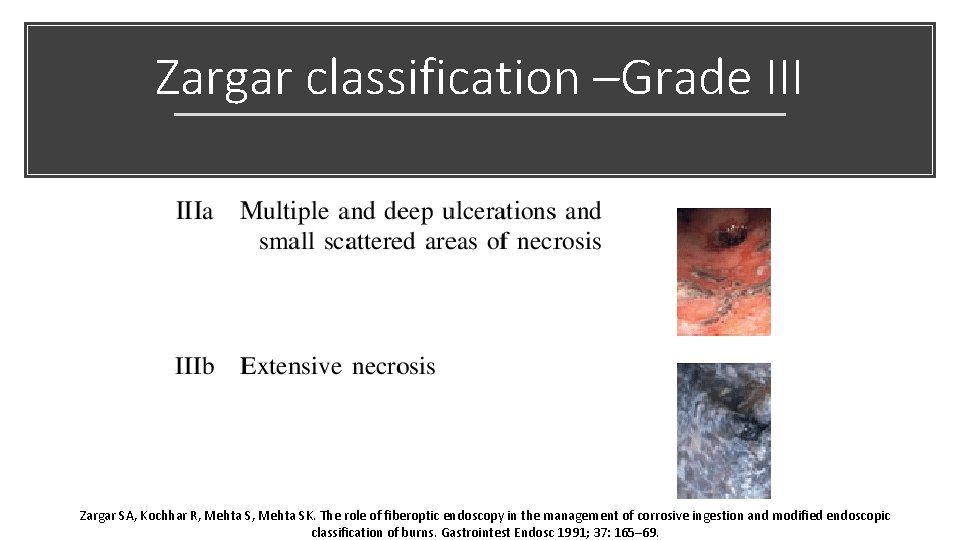
Zargar classification –Grade III Zargar SA, Kochhar R, Mehta SK. The role of fiberoptic endoscopy in the management of corrosive ingestion and modified endoscopic classification of burns. Gastrointest Endosc 1991; 37: 165– 69.
Endoscopy - Prediction of esophageal stricture • Reliably predicts future development of esophageal stricture, nutritional autonomy and long-term survival • Grade 1 - 2 a rarely causes strictures • Grade 3 b – 80% risk of stricture development Chirica M, Resche-Rigon M, Bongrand NM, et al. Surgery for caustic injuries of the upper gastrointestinal tract. Ann Surg 2012; 256: 994– 1001. Andreoni B, Farina ML, Biffi R, Crosta C. Esophageal perforation and caustic injury: emergency management of caustic ingestion. Dis Esophagus 1997; 10: 95– 100. Estrera A, Taylor W, Mills LJ, Platt MR. Corrosive burns of the esophagus and stomach: a recommendation for an aggressive surgical approach. Ann Thorac Surg 1986; 41: 276– 83.
Drawback of OGD • Unable to accurately predict the depth of necrosis • Leads to inappropriate non-operative management or unnecessary resective surgery • Observer dependent • Potential misinterpretation if performed beyond 48 h after ingestion • Due to increased submucosal haemorrhages and edema Chirica M, Resche-Rigon M, Bongrand NM, et al. Surgery for caustic injuries of the upper gastrointestinal tract. Ann Surg 2012; 256: 994– 1001. Andreoni B, Farina ML, Biffi R, Crosta C. Esophageal perforation and caustic injury: emergency management of caustic ingestion. Dis Esophagus 1997; 10: 95– 100. Estrera A, Taylor W, Mills LJ, Platt MR. Corrosive burns of the esophagus and stomach: a recommendation for an aggressive surgical approach. Ann Thorac Surg 1986; 41: 276– 83.
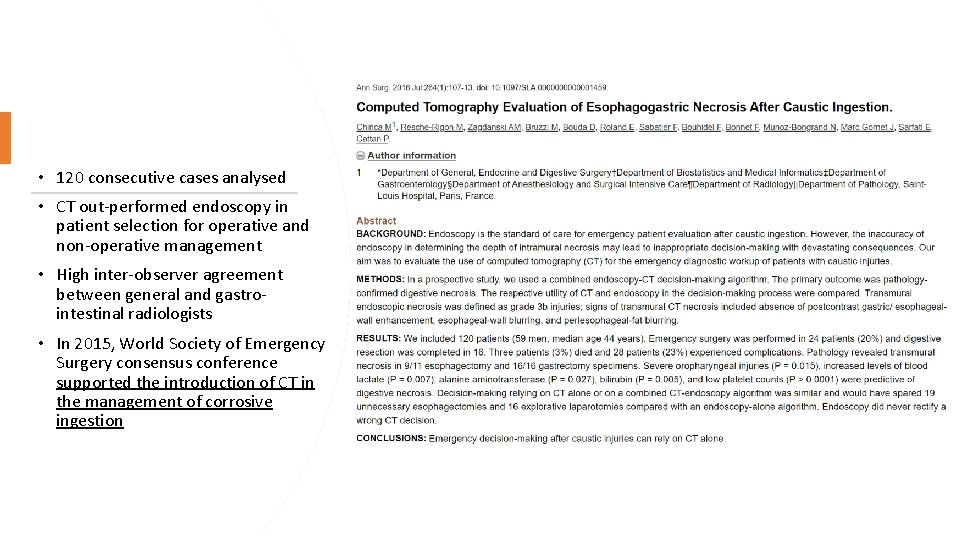
• 120 consecutive cases analysed • CT out-performed endoscopy in patient selection for operative and non-operative management • High inter-observer agreement between general and gastrointestinal radiologists • In 2015, World Society of Emergency Surgery consensus conference supported the introduction of CT in the management of corrosive ingestion
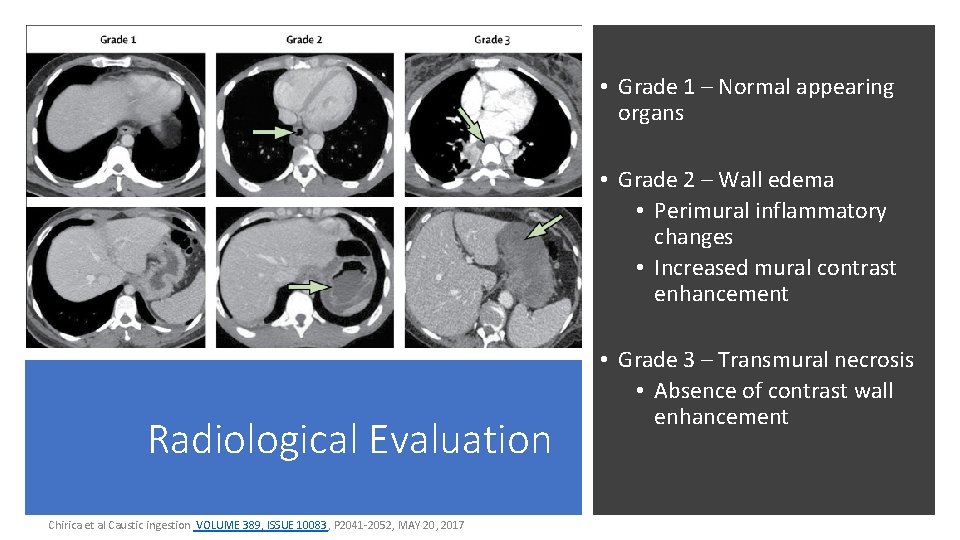
• Grade 1 – Normal appearing organs • Grade 2 – Wall edema • Perimural inflammatory changes • Increased mural contrast enhancement Radiological Evaluation Chirica et al Caustic ingestion VOLUME 389, ISSUE 10083, P 2041 -2052, MAY 20, 2017 • Grade 3 – Transmural necrosis • Absence of contrast wall enhancement
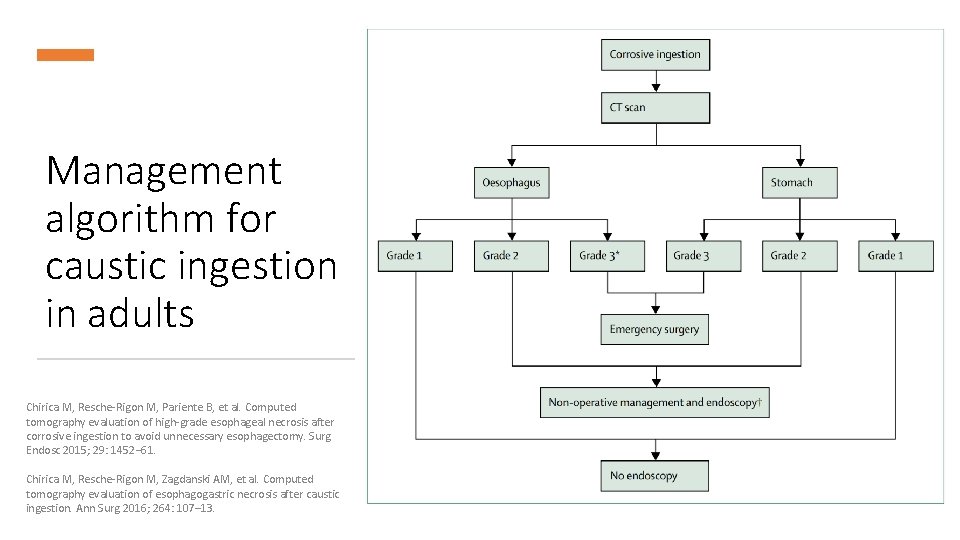
Management algorithm for caustic ingestion in adults Chirica M, Resche-Rigon M, Pariente B, et al. Computed tomography evaluation of high-grade esophageal necrosis after corrosive ingestion to avoid unnecessary esophagectomy. Surg Endosc 2015; 29: 1452– 61. Chirica M, Resche-Rigon M, Zagdanski AM, et al. Computed tomography evaluation of esophagogastric necrosis after caustic ingestion. Ann Surg 2016; 264: 107– 13.
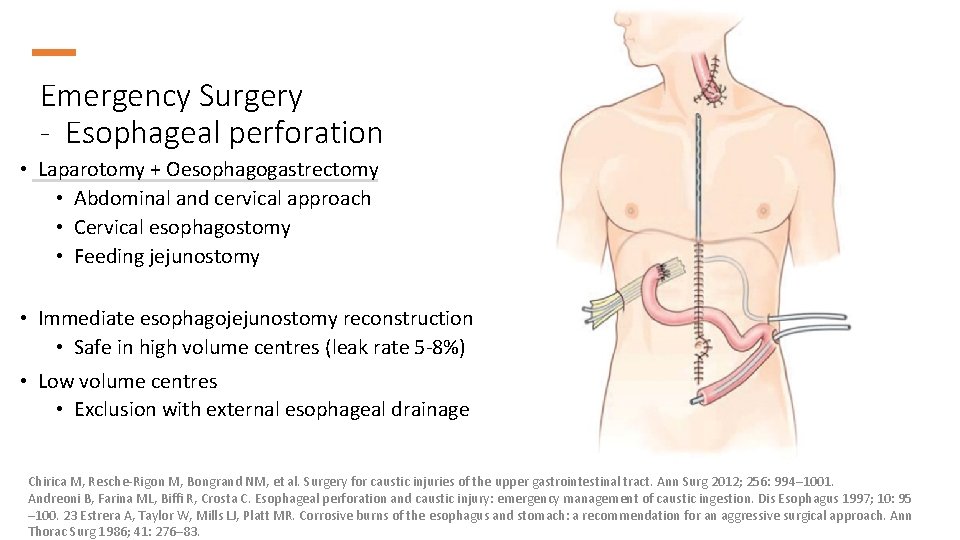
Emergency Surgery - Esophageal perforation • Laparotomy + Oesophagogastrectomy • Abdominal and cervical approach • Cervical esophagostomy • Feeding jejunostomy • Immediate esophagojejunostomy reconstruction • Safe in high volume centres (leak rate 5 -8%) • Low volume centres • Exclusion with external esophageal drainage Chirica M, Resche-Rigon M, Bongrand NM, et al. Surgery for caustic injuries of the upper gastrointestinal tract. Ann Surg 2012; 256: 994– 1001. Andreoni B, Farina ML, Biffi R, Crosta C. Esophageal perforation and caustic injury: emergency management of caustic ingestion. Dis Esophagus 1997; 10: 95 – 100. 23 Estrera A, Taylor W, Mills LJ, Platt MR. Corrosive burns of the esophagus and stomach: a recommendation for an aggressive surgical approach. Ann Thorac Surg 1986; 41: 276– 83.
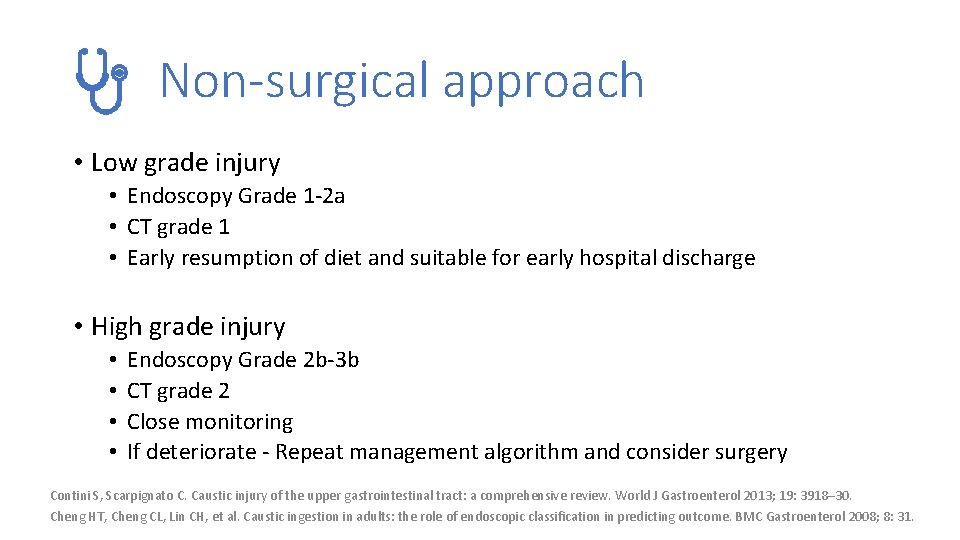
Non-surgical approach • Low grade injury • Endoscopy Grade 1 -2 a • CT grade 1 • Early resumption of diet and suitable for early hospital discharge • High grade injury • • Endoscopy Grade 2 b-3 b CT grade 2 Close monitoring If deteriorate - Repeat management algorithm and consider surgery Contini S, Scarpignato C. Caustic injury of the upper gastrointestinal tract: a comprehensive review. World J Gastroenterol 2013; 19: 3918– 30. Cheng HT, Cheng CL, Lin CH, et al. Caustic ingestion in adults: the role of endoscopic classification in predicting outcome. BMC Gastroenterol 2008; 8: 31.
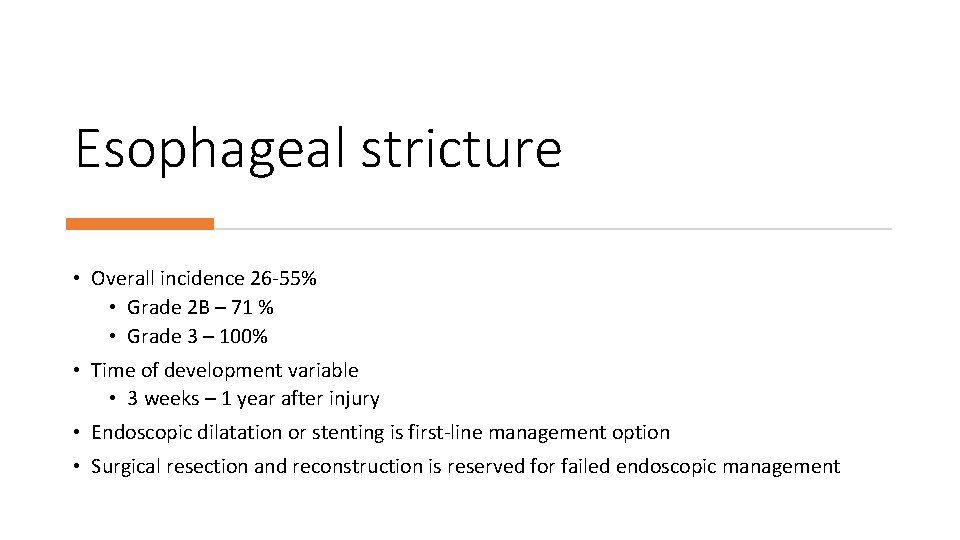
Esophageal stricture • Overall incidence 26 -55% • Grade 2 B – 71 % • Grade 3 – 100% • Time of development variable • 3 weeks – 1 year after injury • Endoscopic dilatation or stenting is first-line management option • Surgical resection and reconstruction is reserved for failed endoscopic management
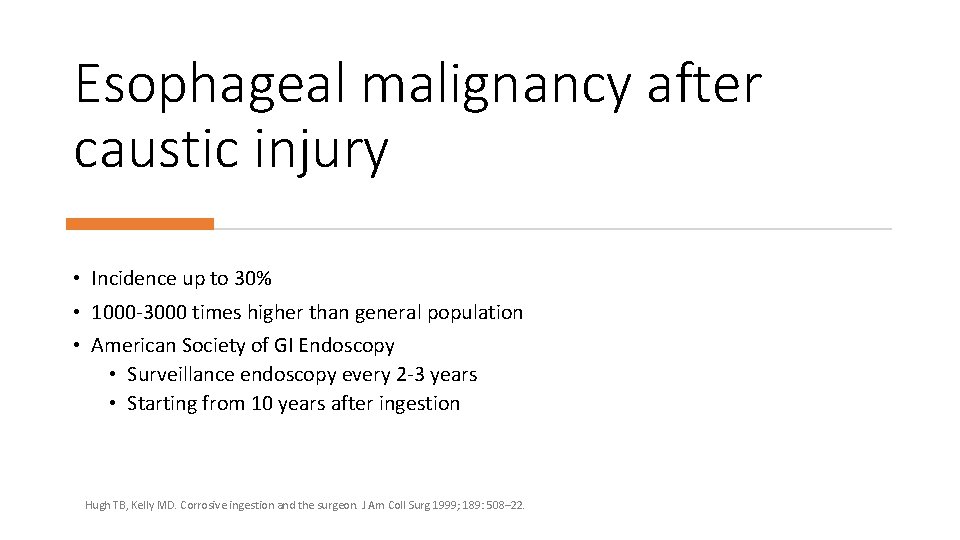
Esophageal malignancy after caustic injury • Incidence up to 30% • 1000 -3000 times higher than general population • American Society of GI Endoscopy • Surveillance endoscopy every 2 -3 years • Starting from 10 years after ingestion Hugh TB, Kelly MD. Corrosive ingestion and the surgeon. J Am Coll Surg 1999; 189: 508– 22.
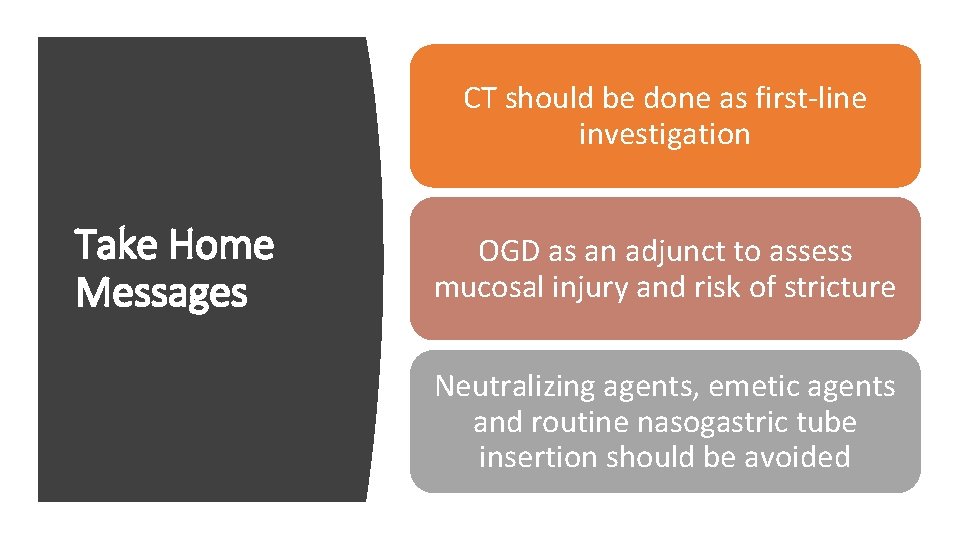
CT should be done as first-line investigation Take Home Messages OGD as an adjunct to assess mucosal injury and risk of stricture Neutralizing agents, emetic agents and routine nasogastric tube insertion should be avoided
References 1. Chirica M, Resche-Rigon M, Bongrand NM, et al. Surgery for caustic injuries of the upper gastrointestinal tract. Ann Surg 2012; 256: 994– 1001. 2. Hugh TB, Kelly MD. Corrosive ingestion and the surgeon. J Am Coll Surg 1999; 189: 508– 22. 3. Contini S, Scarpignato C. Caustic injury of the upper gastrointestinal tract: a comprehensive review. World J Gastroenterol 2013; 19: 3918– 30. 4. Mowry JB, Spyker DA, Cantilena LR Jr, Mc. Millan N, Ford M. 2013 Annual Report of the American Association of Poison Control Centers’ National Poison Data System (NPDS): 31 st Annual Report. Clin Toxicol (Phila) 2014; 52: 1032– 283. 5. Bonnici KS, Wood DM, Dargan PI. Should computerised tomography replace endoscopy in the evaluation of symptomatic ingestion of corrosive substances? Clin Toxicol (Phila) 2014; 52: 911– 25. 6. Temiz A, Oguzkurt P, Ezer SS, Ince E, Hicsonmez A. Predictability of outcome of caustic ingestion by esophagogastroduodenoscopy in children. World J Gastroenterol 2012; 18: 1098– 103. 7. Riffat F, Cheng A. Pediatric caustic ingestion: 50 consecutive cases and a review of the literature. Dis Esophagus 2009; 22: 89– 94. 8. Betalli P, Falchetti D, Giuliani S, et al. Caustic ingestion in children: is endoscopy always indicated? The results of an Italian multicenter observational study. Gastrointest Endosc 2008; 68: 434– 39. Cheng HT, Cheng CL, Lin CH, et al. Caustic ingestion in adults: the role of endoscopic classification in predicting outcome. BMC Gastroenterol 2008; 8: 31. 10. Chang JM, Liu NJ, Pai BC, et al. The role of age in predicting the outcome of caustic ingestion in adults: a retrospective analysis. BMC Gastroenterol 2011; 11: 72. 11. Keh SM, Onyekwelu N, Mc. Manus K, Mc. Guigan J. Corrosive injury to upper gastrointestinal tract: still a major surgical dilemma. World J Gastroenterol 2006; 12: 5223– 28. 12. Ramasamy K, Gumaste VV. Corrosive ingestion in adults. J Clin Gastroenterol 2003; 37: 119– 24. 13. Zargar SA, Kochhar R, Mehta SK. The role of fiberoptic endoscopy in the management of corrosive ingestion and modified endoscopic classification of burns. Gastrointest Endosc 1991; 37: 165– 69. 14 Ryu HH, Jeung KW, Lee BK, et al. Caustic injury: can CT grading system enable prediction of esophageal stricture? Clin Toxicol (Phila) 2010; 48: 137– 42. 15. Mamede RC, De Mello Filho FV. Treatment of caustic ingestion: an analysis of 239 cases. Dis Esophagus 2002; 15: 210– 13. 16. Chirica M, Resche-Rigon M, Pariente B, et al. Computed tomography evaluation of high-grade esophageal necrosis after corrosive ingestion to avoid unnecessary esophagectomy. Surg Endosc 2015; 29: 1452– 61. 17. Chirica M, Resche-Rigon M, Zagdanski AM, et al. Computed tomography evaluation of esophagogastric necrosis after caustic ingestion. Ann Surg 2016; 264: 107– 13. 18. Lahoti D, Broor SL, Basu PP, Gupta A, Sharma R, Pant CS. Corrosive esophageal strictures: predictors of response to endoscopic dilation. Gastrointest Endosc 1995; 41: 196– 200. 19. Repici A, Vleggaar FP, Hassan C, et al. Efficacy and safety of biodegradable stents for refractory benign esophageal strictures: the BEST (Biodegradable Esophageal Stent) study. Gastrointest Endosc 2010; 72: 927– 34. 20. Atabek C, Surer I, Demirbag S, Caliskan B, Ozturk H, Cetinkursun S. Increasing tendency in caustic esophageal burns and long-term polytetrafluorethylene stenting in severe cases: 10 years experience. J Pediatr Surg 2007; 42: 636– 40. 21. Tokar JL, Banerjee S, Barth BA, et al. Drug-eluting/biodegradable stents. Gastrointest Endosc 2011; 74: 954– 58. 22. Knezevic JD, Radovanovic NS, Simic AP, et al. Colon interposition in the treatment of esophageal caustic strictures: 40 years of experience. Dis Esophagus 2007; 20: 530– 34.
Endoscopic dilatation for esophageal stricture • First-line treatment option • Safe to start between 3 -6 weeks • Later management can compromise outcome due to severe esophageal wall fibrosis and collagen deposition • Perforation rate – 4 -17% • Significantly higher than dilatation of benign strictures (0. 1 -0. 4%) • Success rate – 50% • Significantly lower than benign stricture (75 -80%) • Cut off of 5 -7 failed sessions has been proposed for consideration of reconstructive surgery Contini S, Scarpignato C. Caustic injury of the upper gastrointestinal tract: a comprehensive review. World J Gastroenterol 2013; 19: 3918– 30. Lahoti D, Broor SL, Basu PP, Gupta A, Sharma R, Pant CS. Corrosive esophageal strictures: predictors of response to endoscopic dilation. Gastrointest Endosc 1995; 41: 196– 200. Chirica M, Veyrie N, Munoz-Bongrand N, et al. Late morbidity after colon interposition for corrosive esophageal injury: risk factors, management, and outcome. A 20 -years experience. Ann Surg 2010; 252: 271– 80.
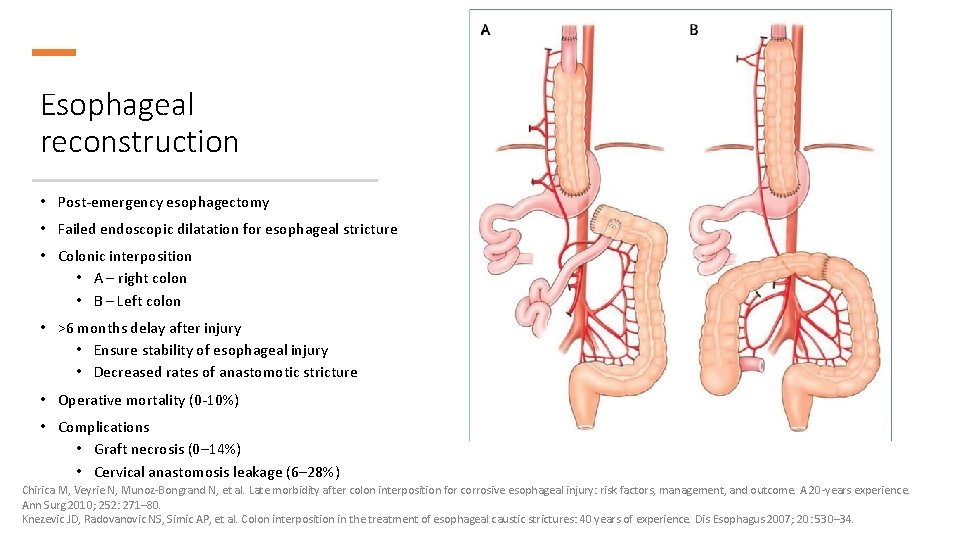
Esophageal reconstruction • Post-emergency esophagectomy • Failed endoscopic dilatation for esophageal stricture • Colonic interposition • A – right colon • B – Left colon • >6 months delay after injury • Ensure stability of esophageal injury • Decreased rates of anastomotic stricture • Operative mortality (0 -10%) • Complications • Graft necrosis (0– 14%) • Cervical anastomosis leakage (6– 28%) Chirica M, Veyrie N, Munoz-Bongrand N, et al. Late morbidity after colon interposition for corrosive esophageal injury: risk factors, management, and outcome. A 20 -years experience. Ann Surg 2010; 252: 271– 80. Knezevic JD, Radovanovic NS, Simic AP, et al. Colon interposition in the treatment of esophageal caustic strictures: 40 years of experience. Dis Esophagus 2007; 20: 530– 34.