
Causes of World War I 1890 1914 Chapter
- Slides: 26
Causes of World War I 1890 -1914 Chapter 10
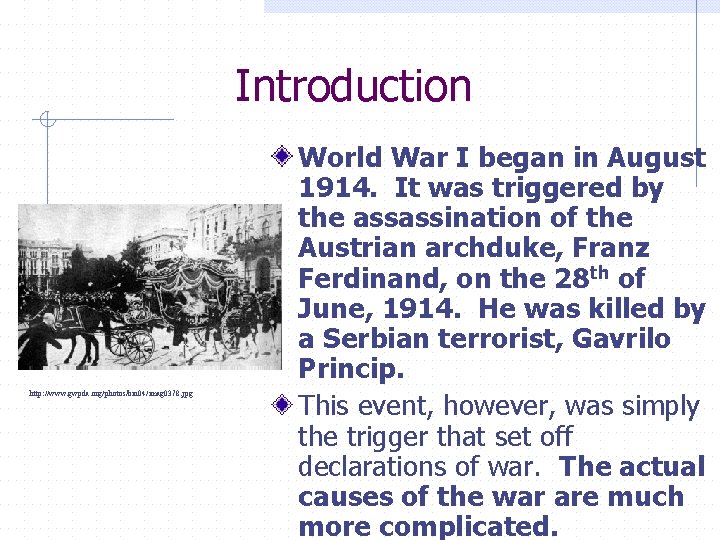
Introduction http: //www. gwpda. org/photos/bin 04/imag 0378. jpg World War I began in August 1914. It was triggered by the assassination of the Austrian archduke, Franz Ferdinand, on the 28 th of June, 1914. He was killed by a Serbian terrorist, Gavrilo Princip. This event, however, was simply the trigger that set off declarations of war. The actual causes of the war are much more complicated.
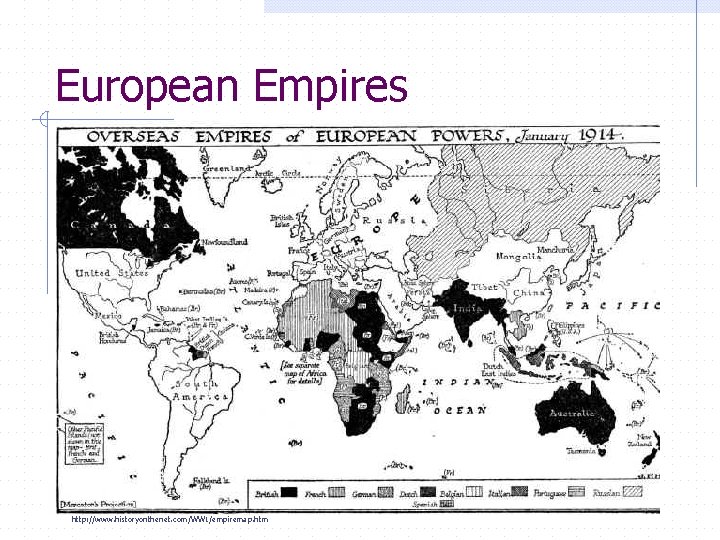
Imperialism is when a country takes over new lands or countries and makes them subject to their rule. By 1900 the British Empire extended over five continents and France had a large control of Africa. The amount of lands ‘owned’ by Britain and France increased tension and created rivalries with Germany.
European Empires http: //www. historyonthenet. com/WW 1/empiremap. htm
Moroccan Crisis In 1904, Morocco had been given to France by Britain, but Moroccans wanted their independence. In 1905, Germany announced their support for Moroccan independence. War was narrowly avoided by a conference which allowed France to retain possession of Morocco. In 1911, the Germans were again protesting French rule in Morocco. Britain supported France and Germany was persuaded to back down for part of the French Congo.
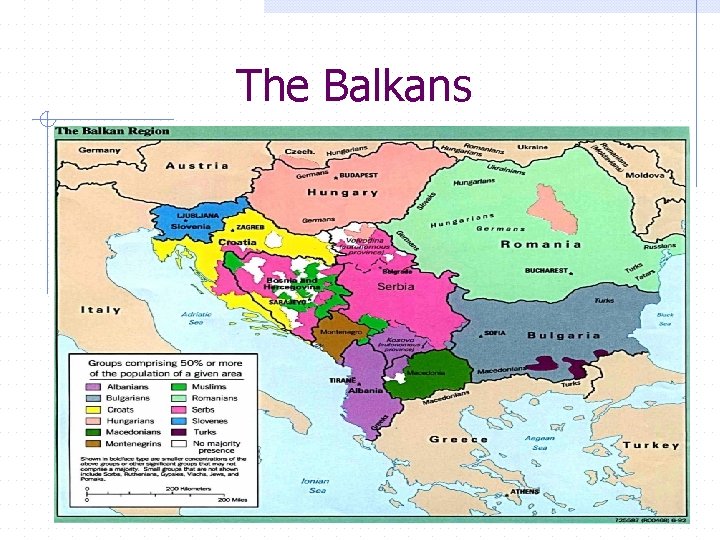
Bosnian Crisis of 1908 Another conflict began when Austria. Hungary annexed the former Turkish province of Bosnia in 1908. Serbia wanted to unite all Slavic people in the Balkans and threaten war on Austria Hungary. Russia pledged their support for Serbia but when Germany stepped up to support Austria-Hungary the war was postponed because Russia backed down.
The Balkans
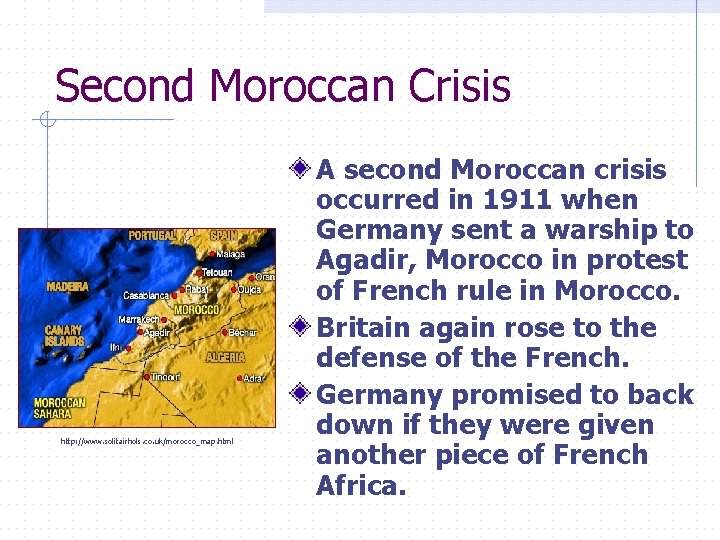
Second Moroccan Crisis http: //www. solitairhols. co. uk/morocco_map. html A second Moroccan crisis occurred in 1911 when Germany sent a warship to Agadir, Morocco in protest of French rule in Morocco. Britain again rose to the defense of the French. Germany promised to back down if they were given another piece of French Africa.
Nationalism is having great pride for one’s country. In the Congress of Vienna in 1815, held after Napoleon’s exile, the principle of nationalism was ignored in favor of preserving the peace. Germany and Italy became divided states, but strong nationalist movements and revolutions led to the unification of Italy in 1861 and that of Germany in 1871.
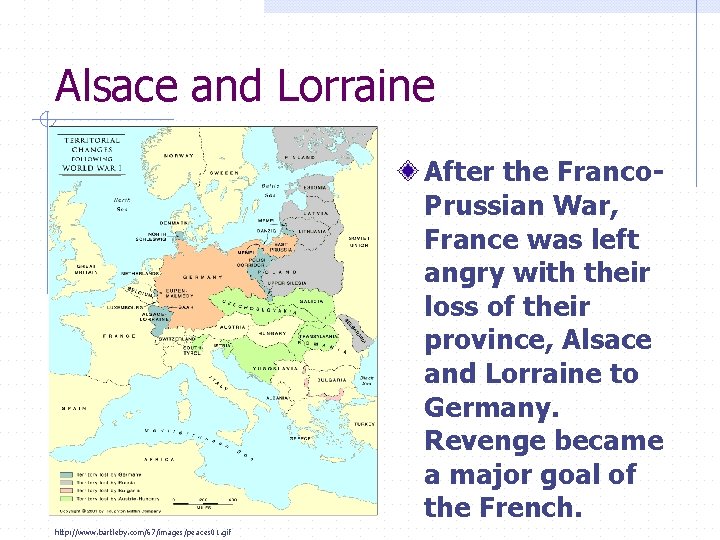
Alsace and Lorraine After the Franco. Prussian War, France was left angry with their loss of their province, Alsace and Lorraine to Germany. Revenge became a major goal of the French. http: //www. bartleby. com/67/images/peaces 01. gif
Pan-Slavism vs. Pan-Germanism Nationalism also posed a problem for Austria-Hungary and the Balkans, areas made up of many conflicting national groups. Germany was attempting to bring all German speaking people together in the area. This was called the Pan. German Movement. Russians were attempting to bring all Slavic speaking people together. This was called the Pan-Slavic movement.
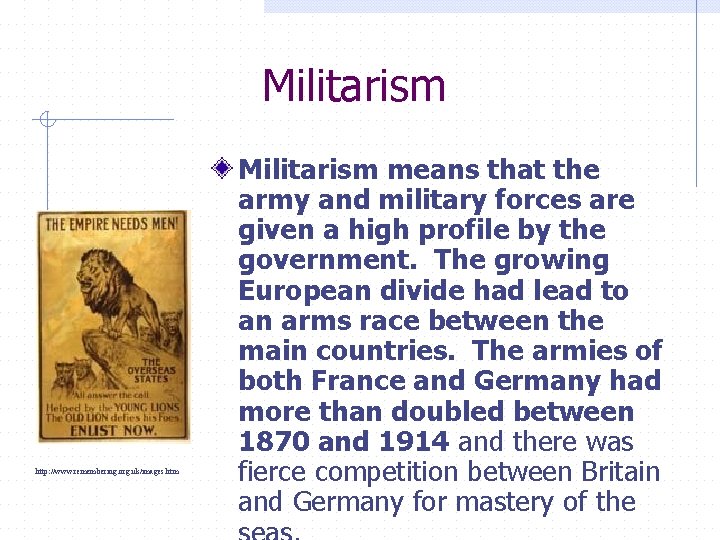
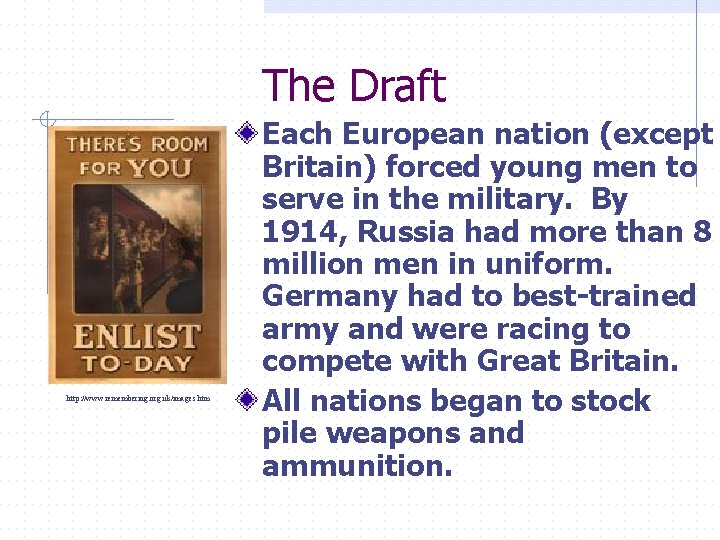
Militarism http: //www. remembering. org. uk/images. htm Militarism means that the army and military forces are given a high profile by the government. The growing European divide had lead to an arms race between the main countries. The armies of both France and Germany had more than doubled between 1870 and 1914 and there was fierce competition between Britain and Germany for mastery of the
The Draft http: //www. remembering. org. uk/images. htm Each European nation (except Britain) forced young men to serve in the military. By 1914, Russia had more than 8 million men in uniform. Germany had to best-trained army and were racing to compete with Great Britain. All nations began to stock pile weapons and ammunition.
Alliances An alliance is an agreement made between two or more countries to give each other help if it is needed. When an alliance is signed, those countries become known as allies. A number of alliances had been signed by countries between the years 1879 and 1914. These were important because they meant that some countries had no option but to declare war if one of their allies declared war first.
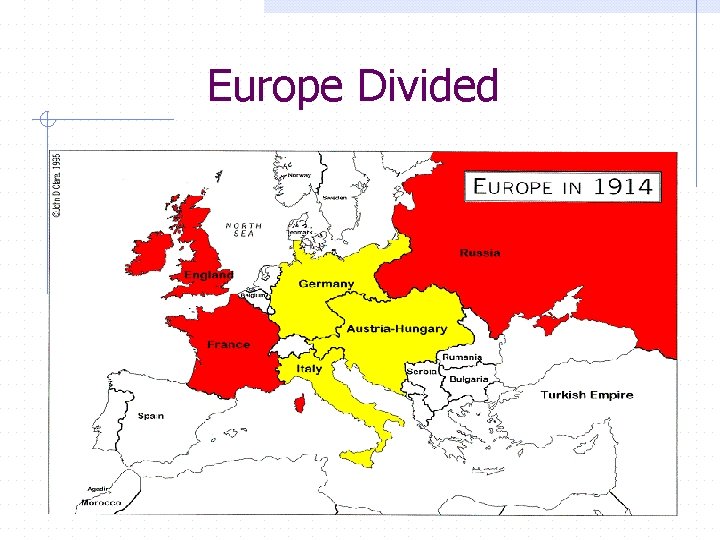
Triple Alliance vs. Triple Entente Under the pressures of nationalism, imperialism, and militarism, the nations of Europe formed alliances to maintain a balance of power. Germany joined Austria-Hungary and Italy in the Triple Alliance. France, Russia, and Great Britain formed the Triple Entente. In both cases, the countries agreed to aid their allies in a crisis. These agreements, designed to keep the peace, ultimately destroyed it.
Europe Divided
Archduke Visiting Bosnia Archduke Francis Ferdinand of Austria. Hungary planned to visit Sarajevo, the capital of Bosnia on the 28 th of June. Serbians were outraged to learn about this since June 28 th was the date that Serbia had been conquered by the Ottoman Empire. On the very same date in 1912, Serbia had at last freed itself from Turkish rule. But Bosnia, home to many Serbs, was still ruled by Austria-Hungary. Serbians were outraged that this was the date that the Archduke had planned to visit Bosnia.
Gavrilo Princip Among one revolutionary group was a young man of 19 named Gavrilo Princip. He came from a family of Serb Farmers who made a meager living in Bosnia. He felt that he must take action against Bosnia. Princip joined the Unity of Death, a terrorist group commonly known as the Black Hand. Their goal was to unify all Slavic people into one nation. On June 28 th, Gavrilo would be waiting for the Archduke in the streets of Sarajevo.
Sarajevo Francis Ferdinand was not a supporter of democracy. Yet he recognized how nationalism was threatening his empire. He even anticipated making some concessions to the Slavs. The Archduke ignored warning of anti. Austrian unrest in Sarajevo. On the morning of June 28 th he arrived in Sarajevo.
The Assasination A few hours later, the royal motorcade drove through the streets of Sarajevo, where seven members of the Black Hands were waiting. The first two conspirators lost their nerve as the cars passed. The third conspirator hurled his bomb at the car but missed. The motorcade decided to continue on. Gavrilo held firm to the plan. As the motorcade was in reverse he seized his opportunity and fired twice into the Archduke’s car.
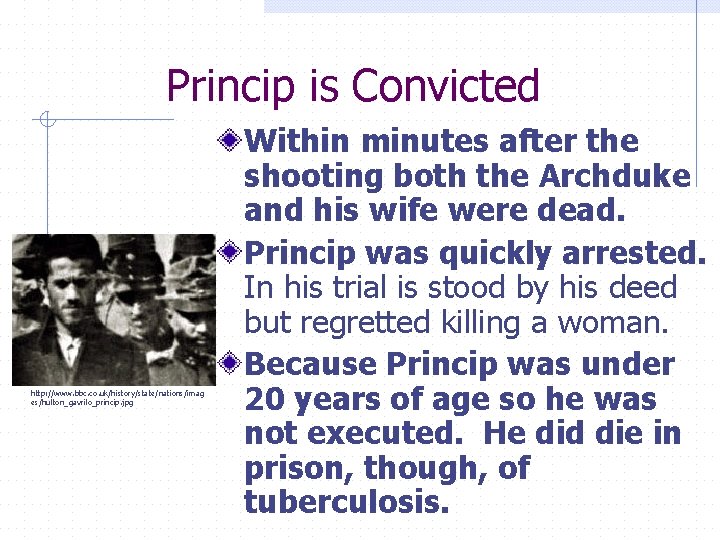
Princip is Convicted http: //www. bbc. co. uk/history/state/nations/imag es/hulton_gavrilo_princip. jpg Within minutes after the shooting both the Archduke and his wife were dead. Princip was quickly arrested. In his trial is stood by his deed but regretted killing a woman. Because Princip was under 20 years of age so he was not executed. He did die in prison, though, of tuberculosis.
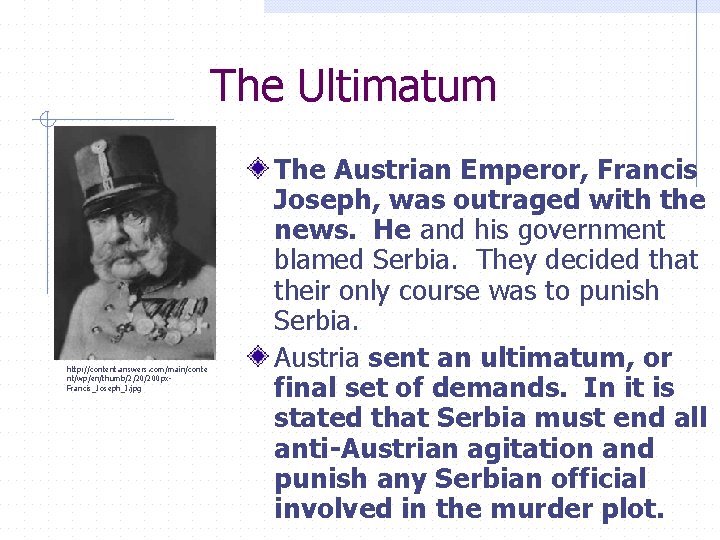
The Ultimatum http: //content. answers. com/main/conte nt/wp/en/thumb/2/20/200 px. Francis_Joseph_I. jpg The Austrian Emperor, Francis Joseph, was outraged with the news. He and his government blamed Serbia. They decided that their only course was to punish Serbia. Austria sent an ultimatum, or final set of demands. In it is stated that Serbia must end all anti-Austrian agitation and punish any Serbian official involved in the murder plot.
World War I Begins http: //www. sideshowtoy. com/placed/060104_5 thmarine_01. jpg Serbia agreed to most of the ultimatum, but did not allow Austria to take part in the investigation, which was also a part of the terms. This partial refusal gave Austria the opportunity to take decisive action. On July 28 th, 1914 Austria declared war of Serbia.
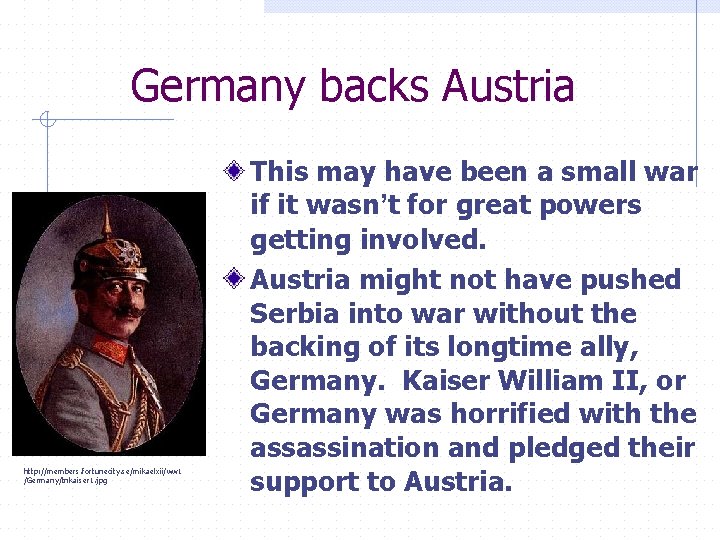
Germany backs Austria http: //members. fortunecity. se/mikaelxii/ww 1 /Germany/tnkaiser 1. jpg This may have been a small war if it wasn’t for great powers getting involved. Austria might not have pushed Serbia into war without the backing of its longtime ally, Germany. Kaiser William II, or Germany was horrified with the assassination and pledged their support to Austria.
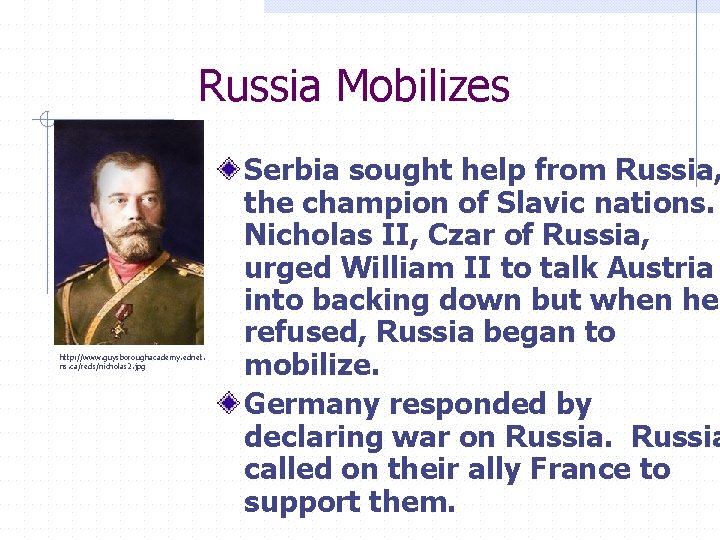
Russia Mobilizes http: //www. guysboroughacademy. ednet. ns. ca/reds/nicholas 2. jpg Serbia sought help from Russia, the champion of Slavic nations. Nicholas II, Czar of Russia, urged William II to talk Austria into backing down but when he refused, Russia began to mobilize. Germany responded by declaring war on Russia called on their ally France to support them.
France Joins In France was ready to avenge their defeat in the Franco-Prussian war. France gave the same kind of backing to Russia that Germany gave to Austria. When Germany demanded that France remain neutral, France refused. Germany then declared war on France.