
Causes of US Imperialism End of the Frontier

- Slides: 11
Causes of US Imperialism • End of the Frontier • Foreign trade becoming increasingly important to American economy • Desire to compete with Europe for overseas empires
End of the Frontier • In 1890, the nation had expanded from sea to shining sea and the government issued a report announcing the end of the frontier. • To many Americans this lack of a frontier was alarming and they began to look beyond America’s boarders (expansionism) expansionism for a new frontier with the goal of expanding trade and to compete for political influence.
Expand or Explode • Some feared existing resources in US might eventually dry up • Panic of 1893 convinced some businessmen industry had over expanded resulting in overproduction and under consumption • Overseas markets a possible safety value for US internal pressures.
Foreign Trade • Very important to American economy • Americans considered acquiring new colonies to expand markets further.
Desire to compete with Europe for overseas empires • We sought international status for US like Great European Powers • Europeans had taken over 1/5 of land 1/10 of population of the world • Germany became our foe and largely spurred US into imperialism
Proponents of expansion • • • Alfred T. Mahan Josiah Strong Theodore Roosevelt and Henry Cabot Lodge Senator Albert Beveridge William Seward
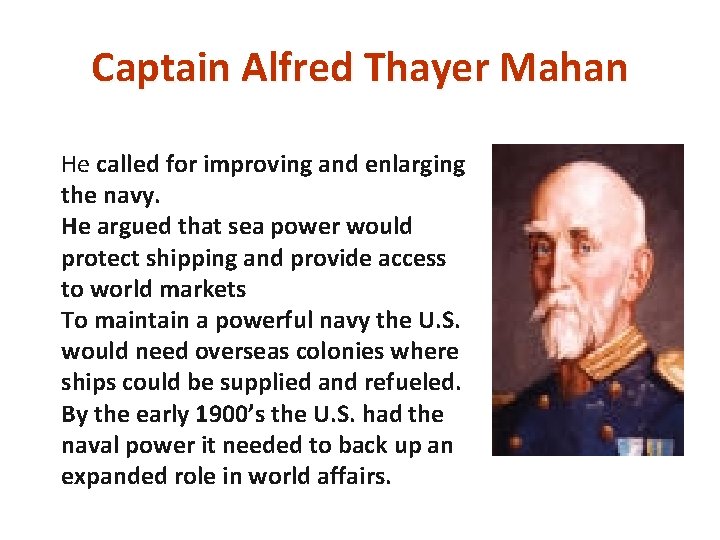
Captain Alfred Thayer Mahan He called for improving and enlarging the navy. He argued that sea power would protect shipping and provide access to world markets To maintain a powerful navy the U. S. would need overseas colonies where ships could be supplied and refueled. By the early 1900’s the U. S. had the naval power it needed to back up an expanded role in world affairs.
Theodore Roosevelt and Henry Cabot Lodge • Social Darwinism meant earth belonged to the strong & fit---Stronger nations dominating weak ones was part of natural law • If US was to survive in competition of modern states, it too would have to become an imperial power.
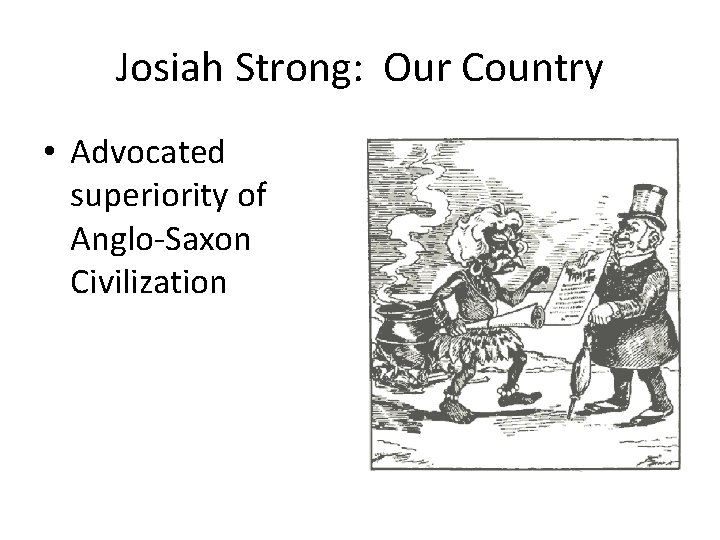
Josiah Strong: Our Country • Advocated superiority of Anglo-Saxon Civilization
A Sense of Mission Some Americans had a belief they could lift up people they considered “uncivilized” by sharing Christianity and Western Civilization with the rest of the world. Josiah Strong proposed missionaries be sent to teach Christian religious beliefs and Western culture to the uncivilized peoples of the world especially in Latin America A sense that there was a “White Man’s Burden” existed in many nonsectarian citizens who looked for America to help civilize her savage
Senator Albert Beveridge • Justify the conquest of new territories • He believed that we are advanced races and we are superior to the “primitive” societies that we conquered • It is very noble to save those who might otherwise never had encountered such ideas. • The American Republic is part of the movement of a superior race, ordained by GOD.