
Causes of troubles and failures in power transformers
Causes of troubles and failures in power transformers and preventive actions PRESENTED BY PROF. VG PATEL
TRANSFORMER ENCYCLOPAEDIA TRANSFORMER - FAILURE AND CAUSES The transformer is one item of electrical equipment which is least subject to breakdown. However, faults do occur from time to time due to various causes. The faults that frequently occur in a transformer can be broadly classified as follows: (a) Failures in the magnetic circuit. (b) Failures in the windings. (c) Failures in oil and major insulation. (d) Structural and other failures. Saturday, October 16, 2021 VG 2
TRANSFORMER ENCYCLOPAEDIA TRANSFORMER - FAILURE AND CAUSES (a)Magnetic Circuit Failures: Failure of the insulation around the clamping bolts inserted through the cores and yokes causes local short circuits between the laminations which produce intense local eddy currents. Failure of the insulation between laminations and of the insulation between the yokes and yoke clamping plates also produce large circulating eddy currents. The amount of heat generated by failures of this type is sometimes sufficient to distort the whole core and the heat generated may also damage the coil insulation resulting in a short-circuit between turns of the adjacent winding. Intense local eddy currents are also produced due to the blurring of the edges of the core and yoke laminations during manufacture and also due to the presence of metallic filings or small turnings between the laminations. Saturday, October 16, 2021 VG 3
TRANSFORMER ENCYCLOPAEDIA TRANSFORMER - FAILURE AND CAUSES High flux density in the magnetic circuit very often causes large magnetizing in-rushes when a transformer is switched into a circuit on no-load. Although the current in-rushes die down rapidly, large electromagnetic forces are developed which considerably strain the windings mechanically. Repeated switching in of a transformer, particularly the transformers located nearer the genera-ting station, may ultimately cause mechanical distortion of the windings. High flux density in the magnetic circuit also produces higher harmonics of voltage and current of appreciable magnitudes which cause considerable increase in core losses. This overheating of the core will in time cause deterioration of the coil and core insulation and, if allowed to continue, will produce severe sludging of the transformer oil. Saturday, October 16, 2021 VG 4
TRANSFORMER ENCYCLOPAEDIA TRANSFORMER - FAILURE AND CAUSES In the case of the transformers providing a mid-wire or neutral for use as a D. C. neutral, if the windings are not carefully balanced, the core becomes saturated during one half cycle and correspondingly less magnetized in the next half cycle due to the D. C. ampere-turns. This causes overheating of the core and this extra heating in time would adversely affect the coil insulation and would also cause sludging of the coil. (b) Winding Failures: If moisture penetrates the insulation of the coils, turn to turn short circuit will occur sooner or later. The coils which are insufficiently impregnated are prone to this type of faults. Again, if the dry out operation of a transformer is unduly shortened and, if normal voltage is applied while the insulation resistance of the windings is still low, turn to turn short circuit may occur due to the presence of the moisture vapour. Saturday, October 16, 2021 VG 5
TRANSFORMER ENCYCLOPAEDIA TRANSFORMER - FAILURE AND CAUSES Turn to turn or winding to earth faults may occur due to transient over voltages such as lightning surges, switching surges, current chopping, dynamic over voltages etc. Often faults occur at the open-ended tappings due to the excessive voltages set up by the surges at these points. Badly made joints between coils may overheat on load causing local carbonization of the oil. The heat generated at the joint may partially carbonize the insulation around the conductors resulting in an eventual turn to turn short circuit. Sustained heavy overload causes large temperature rise throughout the transformer. This makes the coil insulation brittle which in time may flake off the conductors in places producing short circuits between turns. Sludging of the oil aggravates these problems. Saturday, October 16, 2021 VG 6
TRANSFORMER ENCYCLOPAEDIA TRANSFORMER - FAILURE AND CAUSES If a transformer vibrates on load due to looseness of core-bolts or if it receives repeated heavy electromagnetic shocks, then breakdown may occur due to two reasons. Firstly, the sharp edges on the copper conductors, if present, may cut through the insulation causing turn to turn fault. Secondly, abrasion of the insulation between turns which are dislodged either by heavy external short-circuit or by excessive pressure applied to the adjustable coil clamping may cause a short circuit between turns. The mechanical pressure on the insulation between turns alternately increases and decreases, if a transformer is subjected to rapidly fluctuating loads. As a result, the windings become more susceptible to failure because the dielectric strength of most solid insulation material decreases with increasing mechanical pressure. Saturday, October 16, 2021 VG 7
TRANSFORMER ENCYCLOPAEDIA TRANSFORMER - FAILURE AND CAUSES (c) Insulation Failures: Due to improper breathing action moisture may enter the oil which greatly reduces its dielectric strength. Prolonged overloading of the transformer also causes deterioration of the dielectric strength of oil due to the formation of sludge, water and acids. These may cause breakdowns from coils to core or terminal leads to tank. Flashovers between terminal leads or from terminal leads to tank or core often take place due to the presence of suspended conducting particles which have a tendency to line up between two metallic parts having a potential difference between them. The oil level of the transformer may fall during operation. If the oil is not filled up to the correct working level then there is every possibility of insulation failure. Corona discharges often take place from sharp edges present in the conducting parts as the electric stresses at these edges become excessively high. Saturday, October 16, 2021 VG 8
TRANSFORMER ENCYCLOPAEDIA TRANSFORMER - FAILURE AND CAUSES These corona discharges may ultimately lead to insulation failure. In a transformer two or more dielectrics having different permittivity are used in series and, unless their thicknesses are correctly designed, they may be subjected to abnormally high electric stresses. If the electric stress in any one dielectric exceeds the maximum permissible limit, then that dielectric followed by the others will fail resulting in complete breakdown. Short circuits between the phases may occur due to insufficient clearance between the phases. Insulating parts, such as cylinders, tubes and terminal boards or the coil insub 1 ions may have their surfaces contaminated during the manufacturing process which is often responsible for the surface flash - over of these insulations. Depending on the configuration of the high voltage and the low voltage windings, some-times large amounts of surge voltage are transferred to the low voltage winding from the high voltage winding through capacitive coupling which may cause insulation failure of the low voltage winding. Saturday, October 16, 2021 VG 9
TRANSFORMER ENCYCLOPAEDIA TRANSFORMER - FAILURE AND CAUSES (d) Failures Due to Structural and Other Imperfections: Flashovers of the bushing insulators are often caused by ordinary dust, industrial dust or salt spray deposited on the exposed surfaces of the bushings. Poor quality dielectric materials used in condenser bushing result in very high dielectric loss which generates sufficient heat to char the dielectric which in time may cause complete breakdown of the bushings. If the transformer tank has porous welding or leaky fittings, there will be oil leakage and consequent overheating and breakdown of the transformer if not taken care of properly. Excessive temperature rise of the forced cooled oil immersed transformers may occur due to some failure in the auxiliary cooling equipment resulting in stoppage of oil circulation. Saturday, October 16, 2021 VG 10
TRANSFORMER ENCYCLOPAEDIA TRANSFORMER - FAILURE AND CAUSES In water cooled transformers the water tubes may become clogged due to lime and other deposits. The tubes should be cleaned periodically to maintain proper water flow which will keep the temperature rise within safe limits. In water cooled transformers, sometimes failures may occur due to the leakage of water into the oil caused by either leaky tubes or the corrosion of the cooling tubes. While housing the transformer sufficient space around the transformer should be left for proper dissipation of losses. A transformer should not be placed too near to another unit or to the walls which will cause excessive temperature rise of the transformer endangering the coil insulation and the condition of the oil. The vapour at the top of the tank of oil immersed transformers may be of an explosive nature; hence, a naked light must not be used for the purpose of examination of connections etc. Malfunctioning of the Buchholz relay will result if the oil level falls below the relay level during operation. In such an event a fault within the transformer will not be protected by the Buchholz relay. Saturday, October 16, 2021 VG 11
TRANSFORMER ENCYCLOPAEDIA TRANSFORMER - FAILURE AND CAUSES Over and above four abnormalities discussed in previous slides, transformer may get damage due to • Natural calamities like Flooding, Earth-quack, etc. – transformer can be protected from damage to some extent by providing appropriate means. • Mechanical damage and fire because of bursting of near-by equipment/apparatus. Large transformers in sub-station which are open to sky, following may be considered as remedial action; As per IS/IEC guide-lines, if the center to center distance between transformers in sub-station is v 15 Mt or more, baffle wall is not mandatory (for transformers having 20000 litres or more oil). v 8 Mt or more, baffle wall is not mandatory (for transformers having less than 20000 litres oil). For any voltage rating of switch-yard, maintaining the safe distance between equipments as per IS/IEC guidelines, is the best solution to avoid such mechanical damages. Saturday, October 16, 2021 VG 12
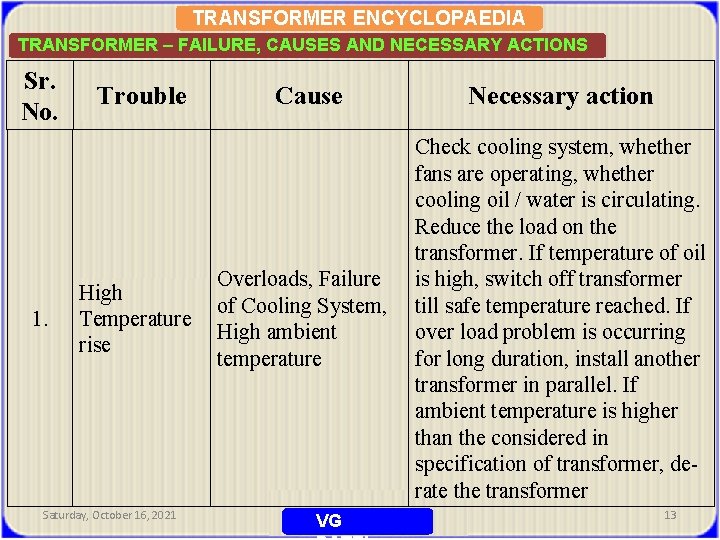
TRANSFORMER ENCYCLOPAEDIA TRANSFORMER – FAILURE, CAUSES AND NECESSARY ACTIONS Sr. No. 1. Trouble High Temperature rise Saturday, October 16, 2021 Cause Necessary action Overloads, Failure of Cooling System, High ambient temperature Check cooling system, whether fans are operating, whether cooling oil / water is circulating. Reduce the load on the transformer. If temperature of oil is high, switch off transformer till safe temperature reached. If over load problem is occurring for long duration, install another transformer in parallel. If ambient temperature is higher than the considered in specification of transformer, derate the transformer VG 13
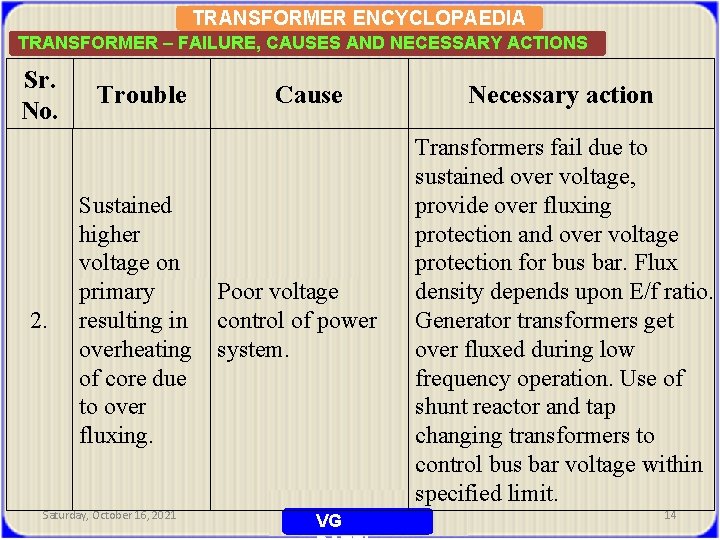
TRANSFORMER ENCYCLOPAEDIA TRANSFORMER – FAILURE, CAUSES AND NECESSARY ACTIONS Sr. No. 2. Trouble Sustained higher voltage on primary resulting in overheating of core due to over fluxing. Saturday, October 16, 2021 Cause Poor voltage control of power system. VG Necessary action Transformers fail due to sustained over voltage, provide over fluxing protection and over voltage protection for bus bar. Flux density depends upon E/f ratio. Generator transformers get over fluxed during low frequency operation. Use of shunt reactor and tap changing transformers to control bus bar voltage within specified limit. 14
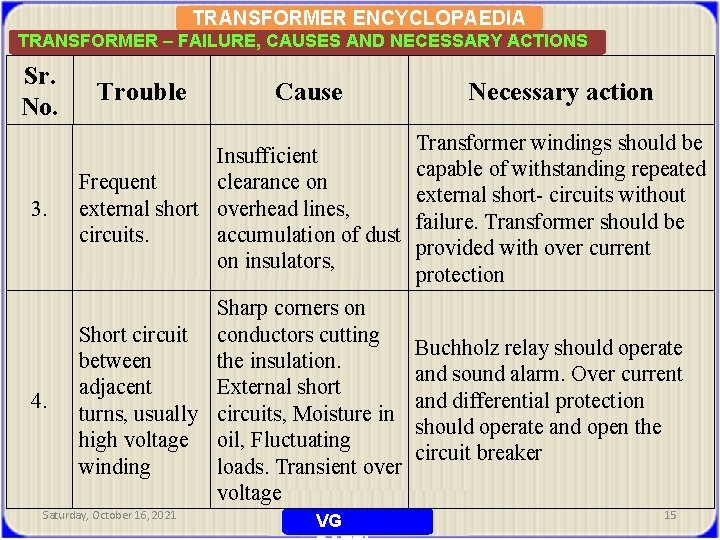
TRANSFORMER ENCYCLOPAEDIA TRANSFORMER – FAILURE, CAUSES AND NECESSARY ACTIONS Sr. No. Trouble Cause Necessary action 3. Insufficient Frequent clearance on external short overhead lines, circuits. accumulation of dust on insulators, Transformer windings should be capable of withstanding repeated external short- circuits without failure. Transformer should be provided with over current protection 4. Sharp corners on Short circuit conductors cutting between the insulation. adjacent External short turns, usually circuits, Moisture in high voltage oil, Fluctuating winding loads. Transient over voltage Buchholz relay should operate and sound alarm. Over current and differential protection should operate and open the circuit breaker Saturday, October 16, 2021 VG 15
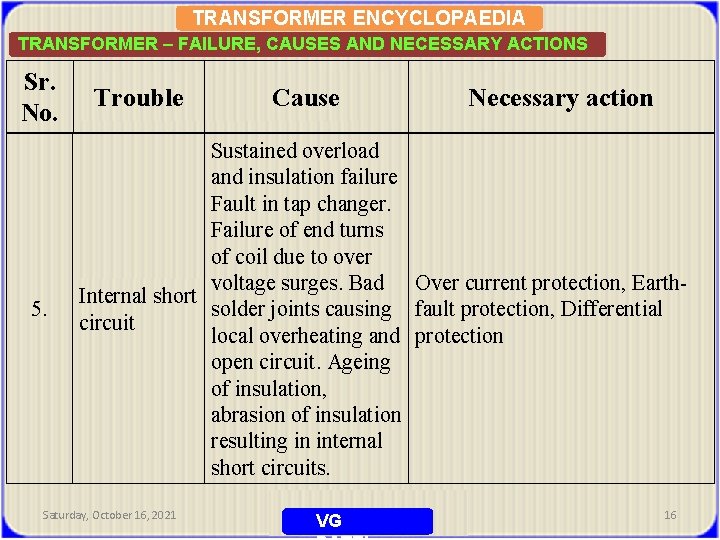
TRANSFORMER ENCYCLOPAEDIA TRANSFORMER – FAILURE, CAUSES AND NECESSARY ACTIONS Sr. No. 5. Trouble Cause Necessary action Sustained overload and insulation failure Fault in tap changer. Failure of end turns of coil due to over voltage surges. Bad Over current protection, Earth. Internal short solder joints causing fault protection, Differential circuit local overheating and protection open circuit. Ageing of insulation, abrasion of insulation resulting in internal short circuits. Saturday, October 16, 2021 VG 16
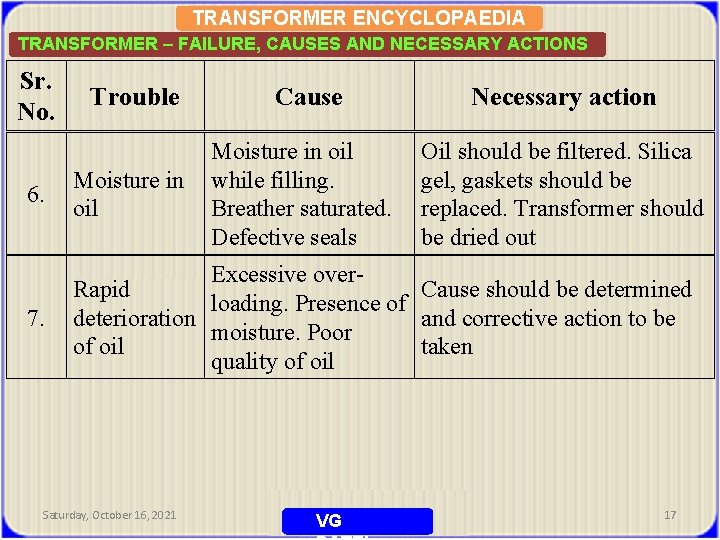
TRANSFORMER ENCYCLOPAEDIA TRANSFORMER – FAILURE, CAUSES AND NECESSARY ACTIONS Sr. No. Trouble Cause Moisture in oil while filling. Breather saturated. Defective seals Necessary action Oil should be filtered. Silica gel, gaskets should be replaced. Transformer should be dried out 6. Moisture in oil 7. Excessive over. Rapid Cause should be determined loading. Presence of deterioration and corrective action to be moisture. Poor of oil taken quality of oil Saturday, October 16, 2021 VG 17
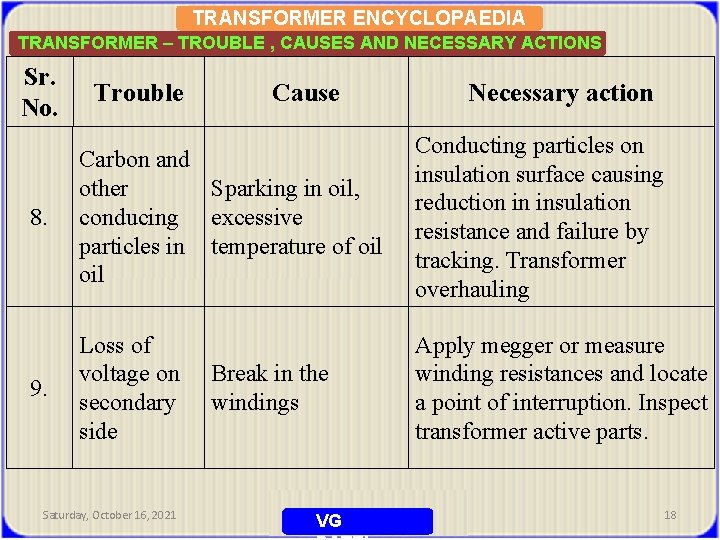
TRANSFORMER ENCYCLOPAEDIA TRANSFORMER – TROUBLE , CAUSES AND NECESSARY ACTIONS Sr. No. Trouble Cause Necessary action 8. Carbon and other Sparking in oil, conducing excessive particles in temperature of oil Conducting particles on insulation surface causing reduction in insulation resistance and failure by tracking. Transformer overhauling 9. Loss of voltage on secondary side Apply megger or measure winding resistances and locate a point of interruption. Inspect transformer active parts. Saturday, October 16, 2021 Break in the windings VG 18
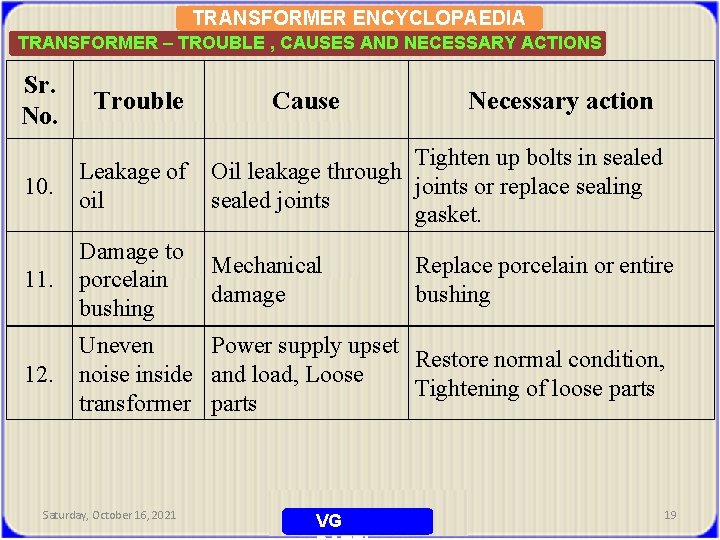
TRANSFORMER ENCYCLOPAEDIA TRANSFORMER – TROUBLE , CAUSES AND NECESSARY ACTIONS Sr. No. Trouble 10. Leakage of oil Tighten up bolts in sealed Oil leakage through joints or replace sealing sealed joints gasket. 11. Damage to porcelain bushing Mechanical damage 12. Uneven Power supply upset Restore normal condition, noise inside and load, Loose Tightening of loose parts transformer parts Saturday, October 16, 2021 Cause VG Necessary action Replace porcelain or entire bushing 19
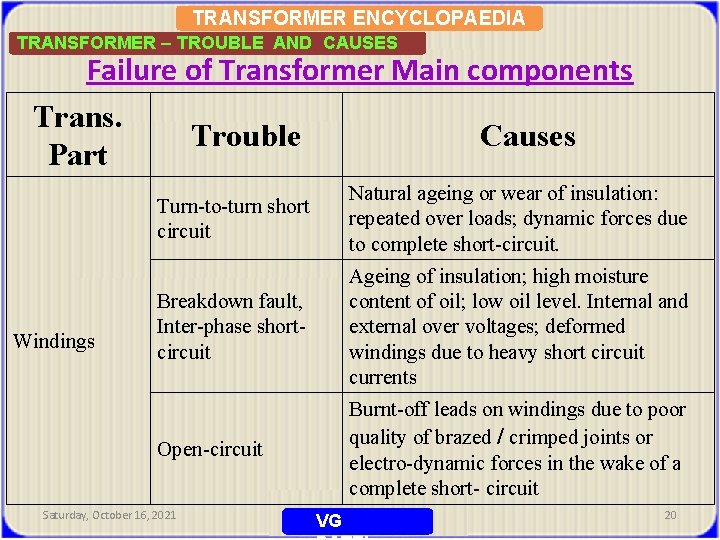
TRANSFORMER ENCYCLOPAEDIA TRANSFORMER – TROUBLE AND CAUSES Failure of Transformer Main components Trans. Trouble Causes Part Windings Turn-to-turn short circuit Natural ageing or wear of insulation: repeated over loads; dynamic forces due to complete short-circuit. Breakdown fault, Inter-phase shortcircuit Ageing of insulation; high moisture content of oil; low oil level. Internal and external over voltages; deformed windings due to heavy short circuit currents Open-circuit Burnt-off leads on windings due to poor quality of brazed / crimped joints or electro-dynamic forces in the wake of a complete short- circuit Saturday, October 16, 2021 VG 20
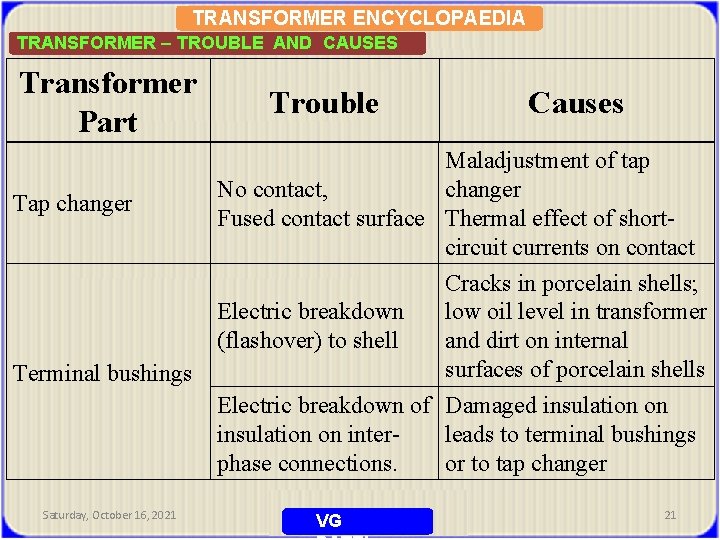
TRANSFORMER ENCYCLOPAEDIA TRANSFORMER – TROUBLE AND CAUSES Transformer Part Trouble Causes Tap changer Maladjustment of tap No contact, changer Fused contact surface Thermal effect of shortcircuit currents on contact Terminal bushings Cracks in porcelain shells; Electric breakdown low oil level in transformer (flashover) to shell and dirt on internal surfaces of porcelain shells Electric breakdown of Damaged insulation on interleads to terminal bushings phase connections. or to tap changer Saturday, October 16, 2021 VG 21
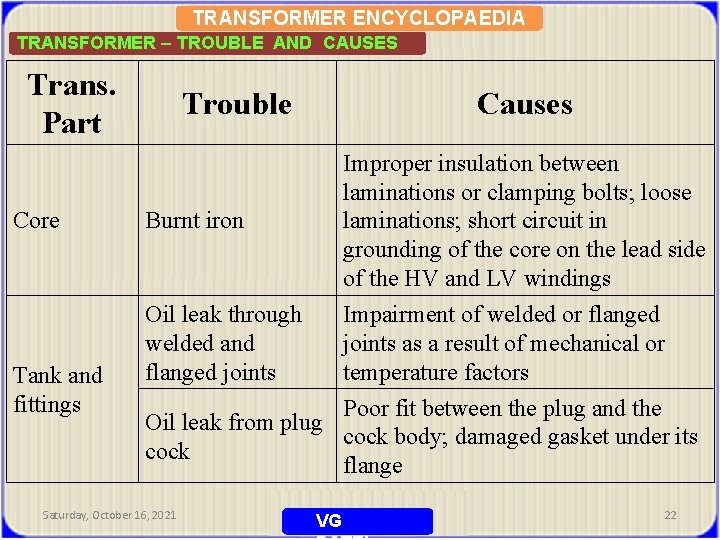
TRANSFORMER ENCYCLOPAEDIA TRANSFORMER – TROUBLE AND CAUSES Trans. Part Core Tank and fittings Trouble Causes Burnt iron Improper insulation between laminations or clamping bolts; loose laminations; short circuit in grounding of the core on the lead side of the HV and LV windings Oil leak through welded and flanged joints Impairment of welded or flanged joints as a result of mechanical or temperature factors Poor fit between the plug and the Oil leak from plug cock body; damaged gasket under its cock flange Saturday, October 16, 2021 VG 22

TRANSFORMER ENCYCLOPAEDIA OPEN FORUM Saturday, October 16, 2021 23
TRANSFORMER ENCYCLOPAEDIA THANQ Saturday, October 16, 2021 24
- Slides: 24