
Causes of Mishaps of Engg Structures Discuss with
- Slides: 16
Causes of Mishaps of Engg Structures • Discuss with following hedaings/topics • Lithology = hard, competent, incom, cavernous, cavity • Weathering = degree • Structures = folds, faults (active, passive), Joints/ discon = orientation, spacing • Bearing capacity = settlement, subsidence
Mishaps • • • Mechanical pro of soil/rock mass Foundation geology Material failure = alkali cement reactions Mineralogy = hard, soft Text = interlocking, silica cement Groundwater = poro, per
MASS MOVEMENTS Gravity External and Internal causes of slope failure MASS MOVEMENTS Falls Slides Flows Subsides
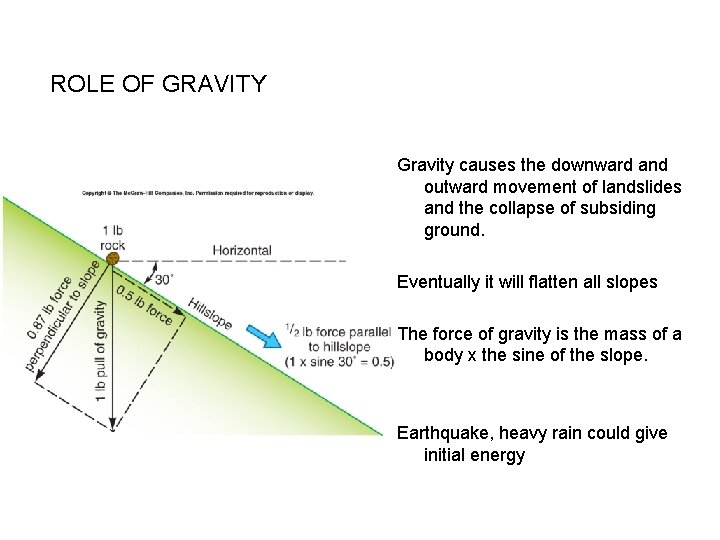
ROLE OF GRAVITY Gravity causes the downward and outward movement of landslides and the collapse of subsiding ground. Eventually it will flatten all slopes The force of gravity is the mass of a body x the sine of the slope. Earthquake, heavy rain could give initial energy
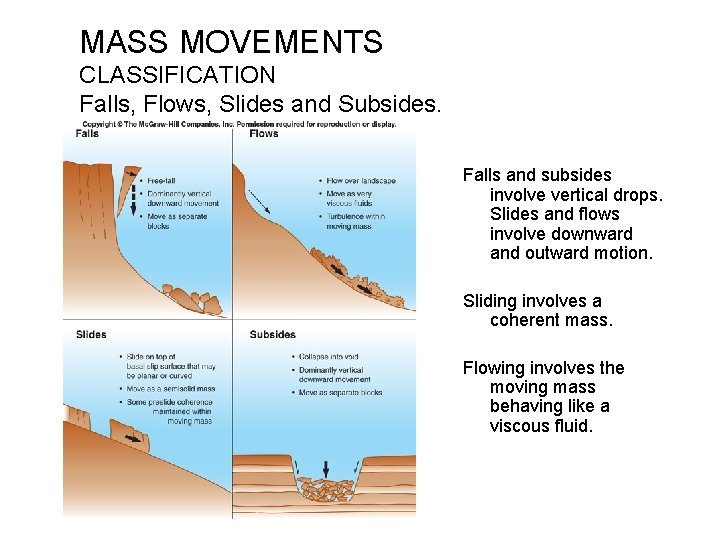
MASS MOVEMENTS CLASSIFICATION Falls, Flows, Slides and Subsides. Falls and subsides involve vertical drops. Slides and flows involve downward and outward motion. Sliding involves a coherent mass. Flowing involves the moving mass behaving like a viscous fluid.
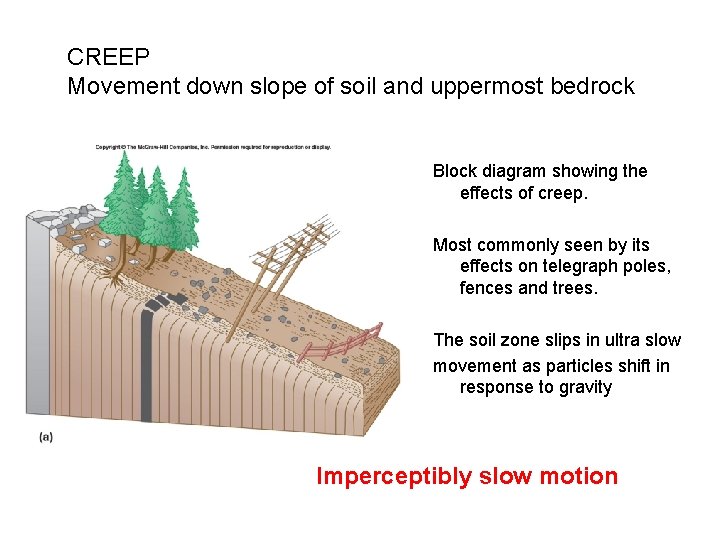
CREEP Movement down slope of soil and uppermost bedrock Block diagram showing the effects of creep. Most commonly seen by its effects on telegraph poles, fences and trees. The soil zone slips in ultra slow movement as particles shift in response to gravity Imperceptibly slow motion
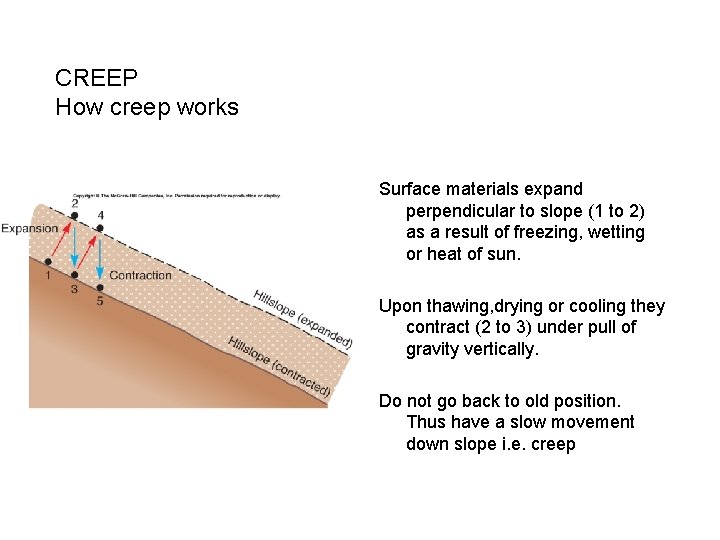
CREEP How creep works Surface materials expand perpendicular to slope (1 to 2) as a result of freezing, wetting or heat of sun. Upon thawing, drying or cooling they contract (2 to 3) under pull of gravity vertically. Do not go back to old position. Thus have a slow movement down slope i. e. creep
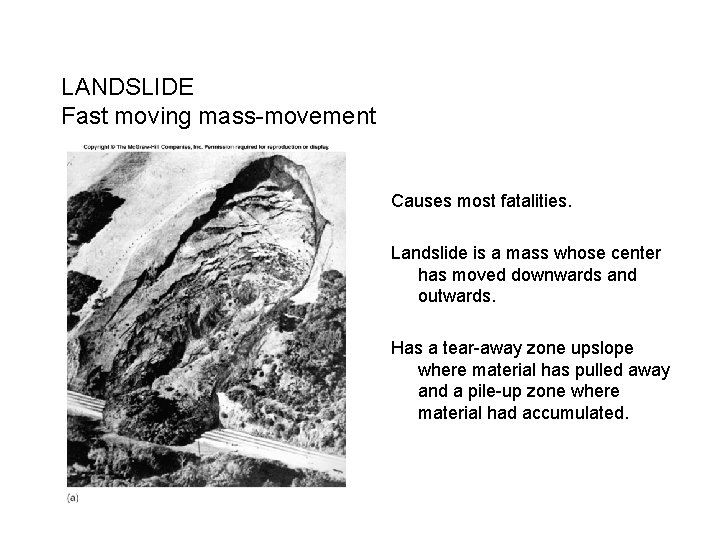
LANDSLIDE Fast moving mass-movement Causes most fatalities. Landslide is a mass whose center has moved downwards and outwards. Has a tear-away zone upslope where material has pulled away and a pile-up zone where material had accumulated.
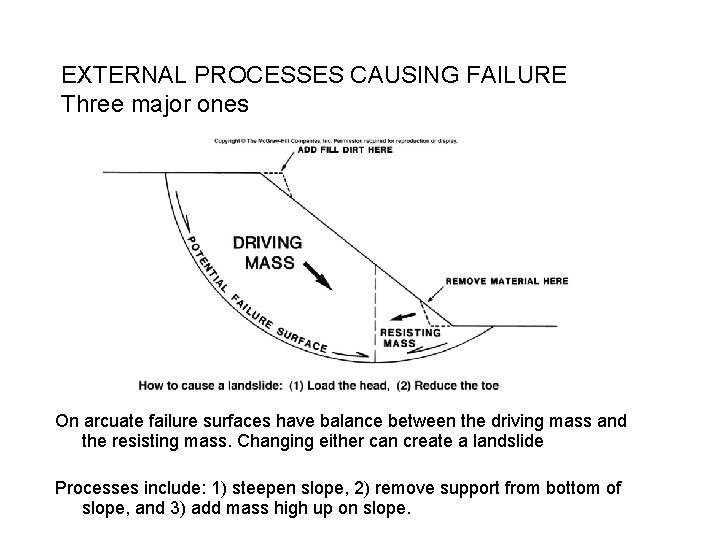
EXTERNAL PROCESSES CAUSING FAILURE Three major ones On arcuate failure surfaces have balance between the driving mass and the resisting mass. Changing either can create a landslide Processes include: 1) steepen slope, 2) remove support from bottom of slope, and 3) add mass high up on slope.
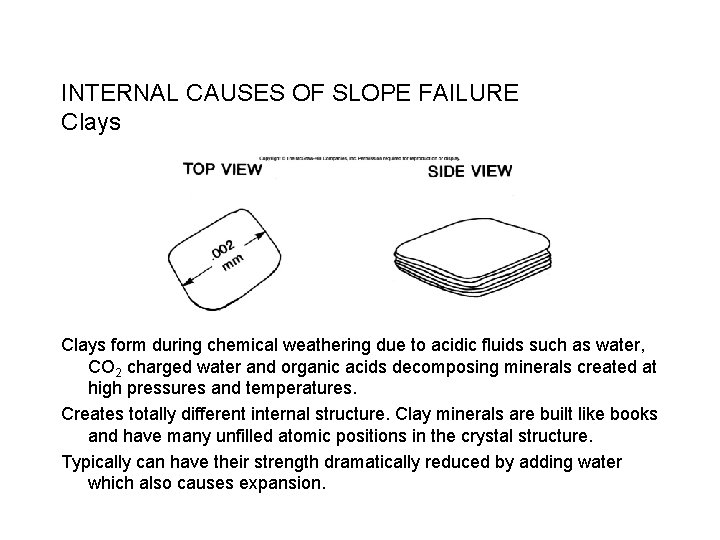
INTERNAL CAUSES OF SLOPE FAILURE Clays form during chemical weathering due to acidic fluids such as water, CO 2 charged water and organic acids decomposing minerals created at high pressures and temperatures. Creates totally different internal structure. Clay minerals are built like books and have many unfilled atomic positions in the crystal structure. Typically can have their strength dramatically reduced by adding water which also causes expansion.
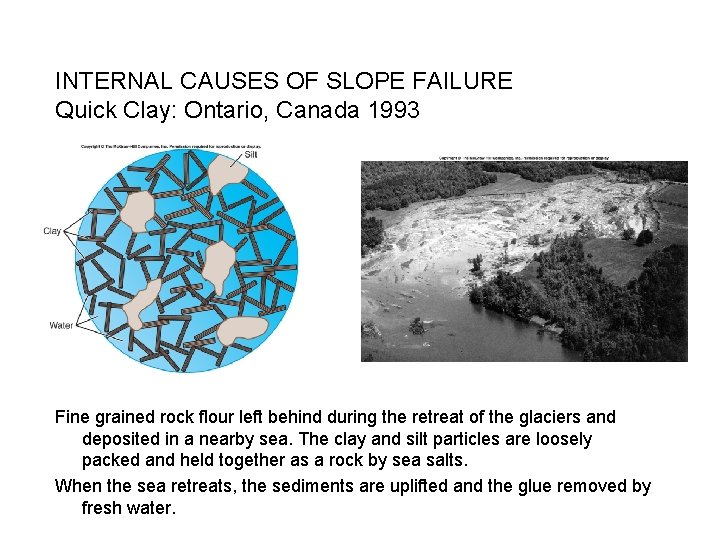
INTERNAL CAUSES OF SLOPE FAILURE Quick Clay: Ontario, Canada 1993 Fine grained rock flour left behind during the retreat of the glaciers and deposited in a nearby sea. The clay and silt particles are loosely packed and held together as a rock by sea salts. When the sea retreats, the sediments are uplifted and the glue removed by fresh water.
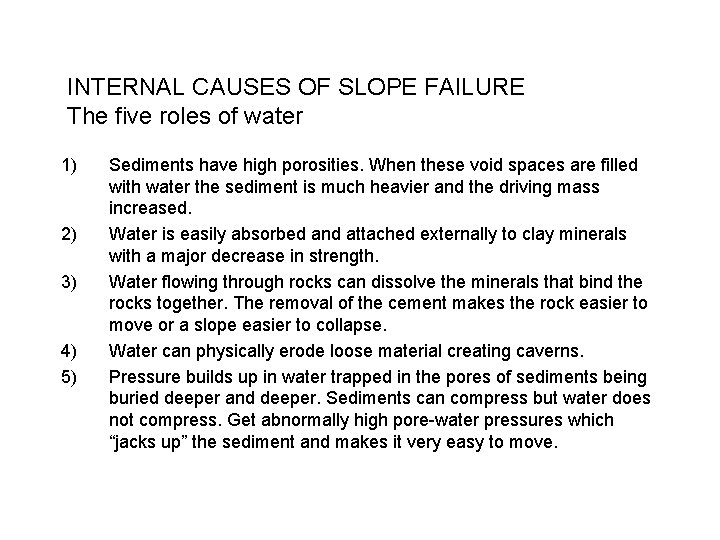
INTERNAL CAUSES OF SLOPE FAILURE The five roles of water 1) 2) 3) 4) 5) Sediments have high porosities. When these void spaces are filled with water the sediment is much heavier and the driving mass increased. Water is easily absorbed and attached externally to clay minerals with a major decrease in strength. Water flowing through rocks can dissolve the minerals that bind the rocks together. The removal of the cement makes the rock easier to move or a slope easier to collapse. Water can physically erode loose material creating caverns. Pressure builds up in water trapped in the pores of sediments being buried deeper and deeper. Sediments can compress but water does not compress. Get abnormally high pore-water pressures which “jacks up” the sediment and makes it very easy to move.
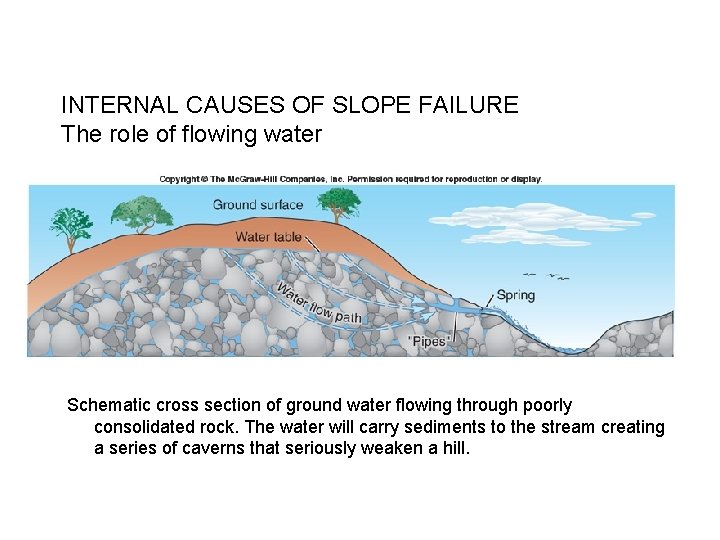
INTERNAL CAUSES OF SLOPE FAILURE The role of flowing water Schematic cross section of ground water flowing through poorly consolidated rock. The water will carry sediments to the stream creating a series of caverns that seriously weaken a hill.
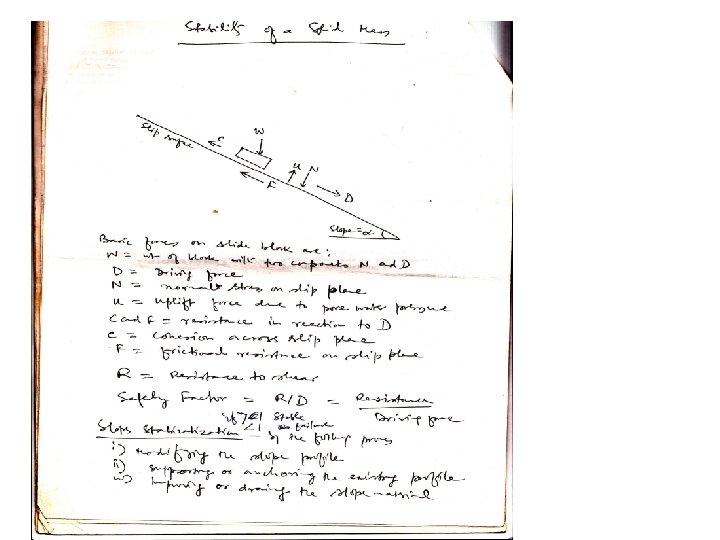
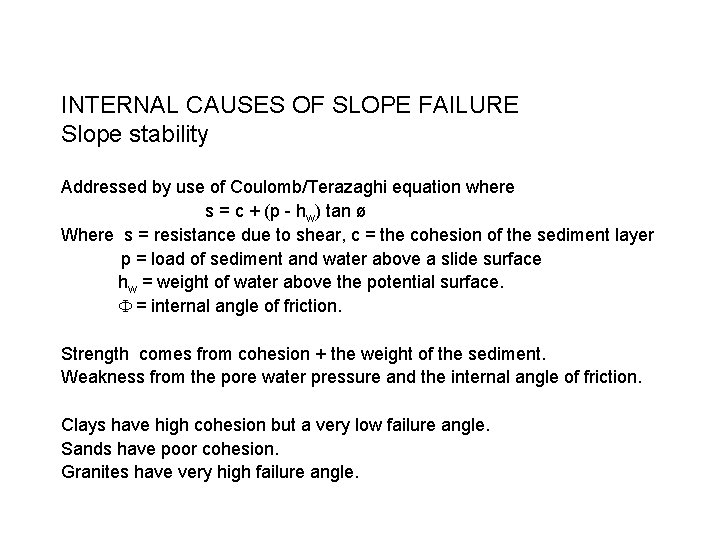
INTERNAL CAUSES OF SLOPE FAILURE Slope stability Addressed by use of Coulomb/Terazaghi equation where s = c + (p - hw) tan ø Where s = resistance due to shear, c = the cohesion of the sediment layer p = load of sediment and water above a slide surface hw = weight of water above the potential surface. F = internal angle of friction. Strength comes from cohesion + the weight of the sediment. Weakness from the pore water pressure and the internal angle of friction. Clays have high cohesion but a very low failure angle. Sands have poor cohesion. Granites have very high failure angle.
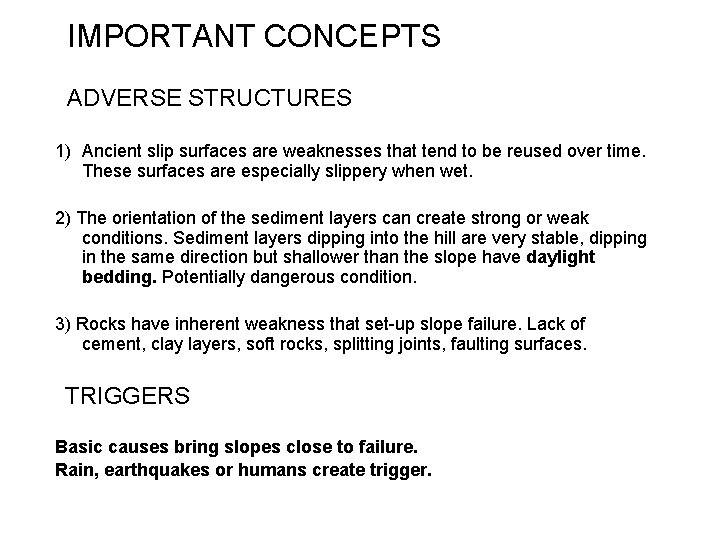
IMPORTANT CONCEPTS ADVERSE STRUCTURES 1) Ancient slip surfaces are weaknesses that tend to be reused over time. These surfaces are especially slippery when wet. 2) The orientation of the sediment layers can create strong or weak conditions. Sediment layers dipping into the hill are very stable, dipping in the same direction but shallower than the slope have daylight bedding. Potentially dangerous condition. 3) Rocks have inherent weakness that set-up slope failure. Lack of cement, clay layers, soft rocks, splitting joints, faulting surfaces. TRIGGERS Basic causes bring slopes close to failure. Rain, earthquakes or humans create trigger.