
Causes of Disease Epidemiology Causes of Disease Identifying
- Slides: 36
Causes of Disease Epidemiology
Causes of Disease � Identifying causes of disease and the mechanisms by which they spread remains a primary focus of epidemiology � Etiology: Science and study of the causes of disease and their mode of operation
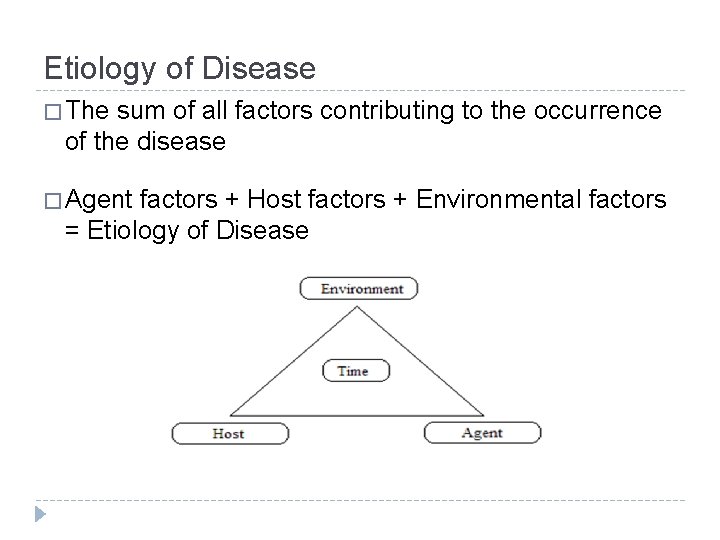
Etiology of Disease � The sum of all factors contributing to the occurrence of the disease � Agent factors + Host factors + Environmental factors = Etiology of Disease
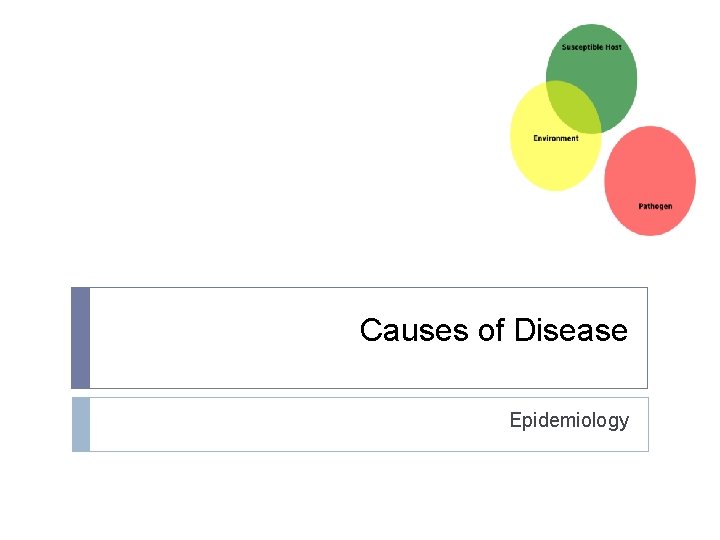
Triangle is based on the communicable disease model � Agent: the cause of the disease � Host: an organism, usually a human or an animal, that harbors a disease � Environment: those surroundings and conditions external to the human or animal that cause or allow disease transmission � Time: accounts for incubation periods, life expectancy of host or pathogen, and duration of the course of the illness or condition.
How can epidemics be stopped? � At least one of elements of triangle must be: � (1) interfered with � (2) altered � (3) changed, or � (4) removed from existence, so that disease no longer continues in mode of transmission and routes of infection � How? Clean up environment, change behavior, vaccinate, medicine, etc.
Other important Epi terms � Invasiveness: ability to get into a susceptible host and cause disease � Virulence: disease-evoking power of a pathogen � Communicability- ability of a disease to be transmitted from one individual to another or to spread in a population
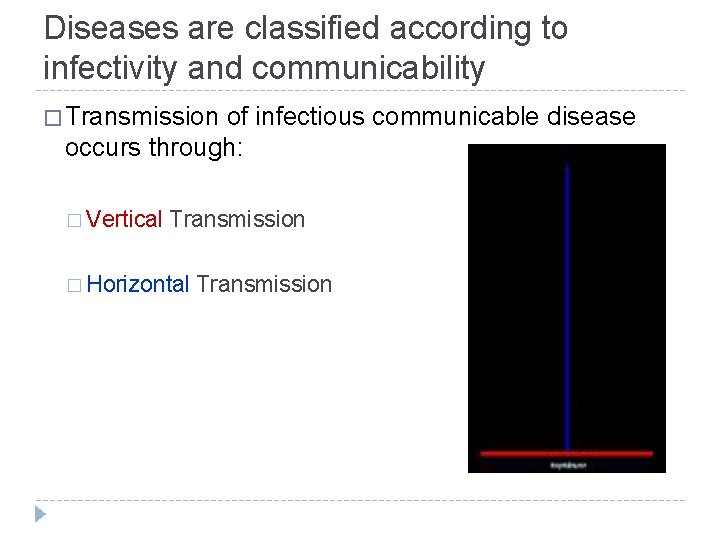
Diseases are classified according to infectivity and communicability � Transmission of infectious communicable disease occurs through: � Vertical Transmission � Horizontal Transmission
Vertical transmission of infectious communicable diseases � Transmission from an individual to its offspring through sperm, breastmilk, placenta, or vaginal fluids � Examples: � yeast infection, hepatitis B, C, rabies
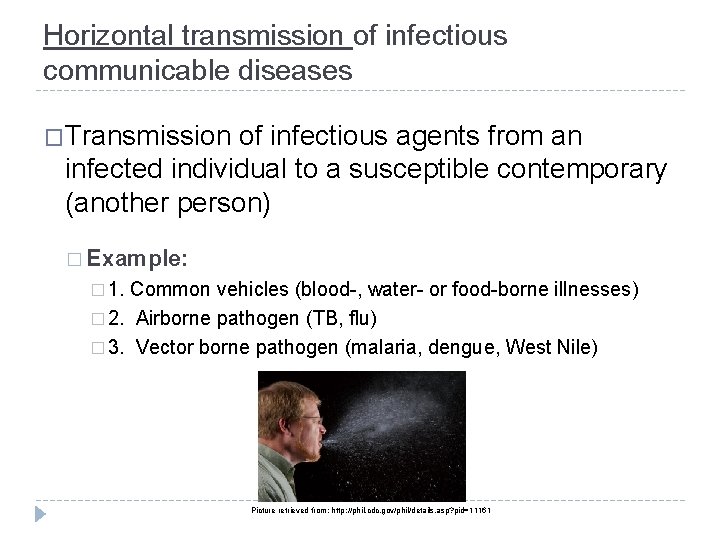
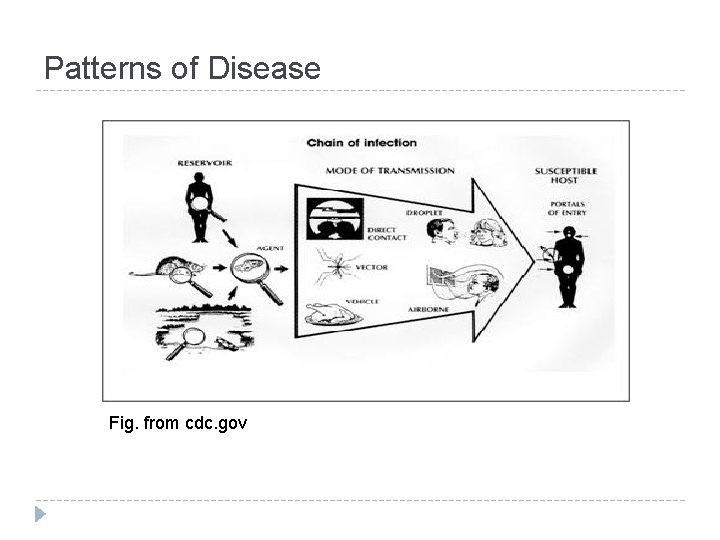
Horizontal transmission of infectious communicable diseases �Transmission of infectious agents from an infected individual to a susceptible contemporary (another person) � Example: � 1. Common vehicles (blood-, water- or food-borne illnesses) � 2. Airborne pathogen (TB, flu) � 3. Vector borne pathogen (malaria, dengue, West Nile) Picture retrieved from: http: //phil. cdc. gov/phil/details. asp? pid=11161
�Direct and indirect transmission
1. Direct transmission: � Disease transmitted by direct physical contact Examples: � Touching with contaminated hands � Skin-to-skin contact � Kissing
2. Indirect transmission: � Disease transmitted when pathogens or agents are transferred or carried by some intermediate item, organism, means, or process to a susceptible host, resulting in disease Examples: � fomites � vectors � air currents � dust particles � water droplets � water or food � oral-fecal contact
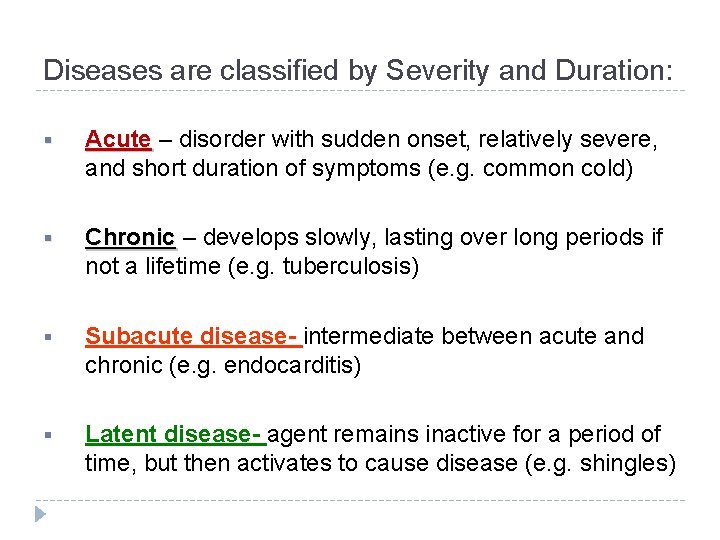
Diseases are classified by Severity and Duration: § Acute – disorder with sudden onset, relatively severe, and short duration of symptoms (e. g. common cold) § Chronic – develops slowly, lasting over long periods if not a lifetime (e. g. tuberculosis) § Subacute disease- intermediate between acute and chronic (e. g. endocarditis) § Latent disease- agent remains inactive for a period of time, but then activates to cause disease (e. g. shingles)
Patterns of Disease Fig. from cdc. gov
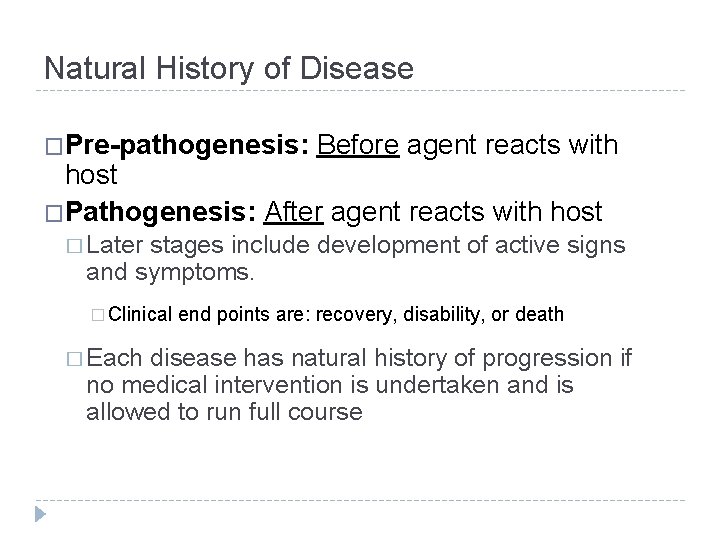
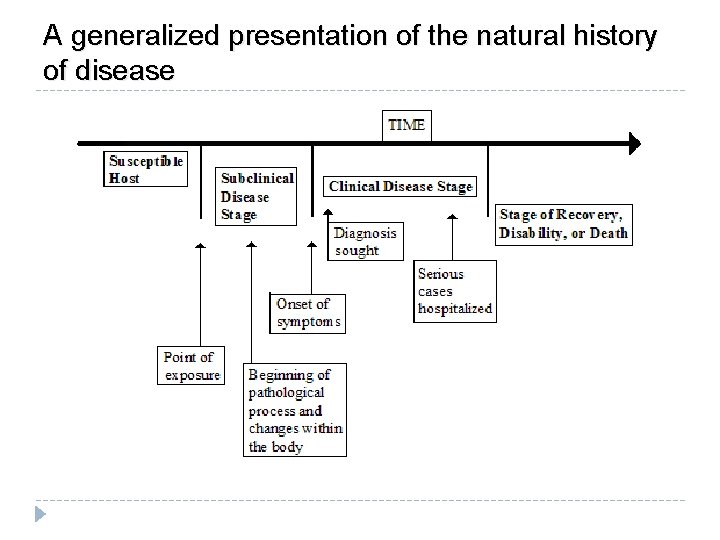
Natural History of Disease �Pre-pathogenesis: Before agent reacts with host �Pathogenesis: After agent reacts with host � Later stages include development of active signs and symptoms. � Clinical � Each end points are: recovery, disability, or death disease has natural history of progression if no medical intervention is undertaken and is allowed to run full course
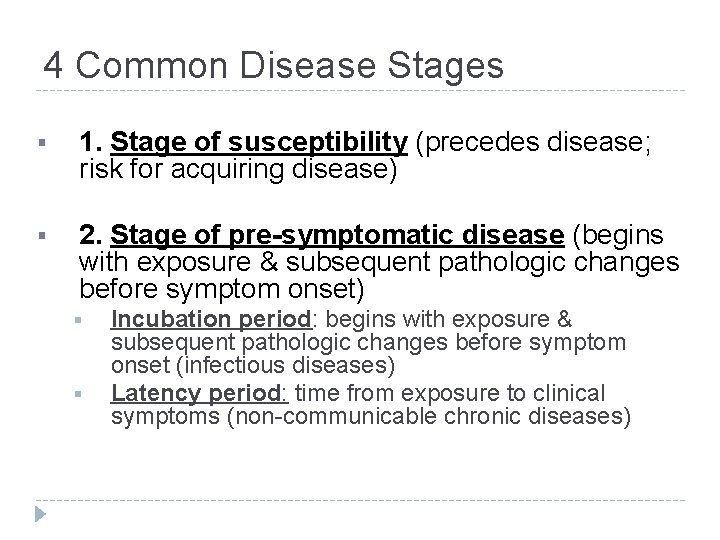
4 Common Disease Stages § 1. Stage of susceptibility (precedes disease; risk for acquiring disease) § 2. Stage of pre-symptomatic disease (begins with exposure & subsequent pathologic changes before symptom onset) § § Incubation period: begins with exposure & subsequent pathologic changes before symptom onset (infectious diseases) Latency period: time from exposure to clinical symptoms (non-communicable chronic diseases)
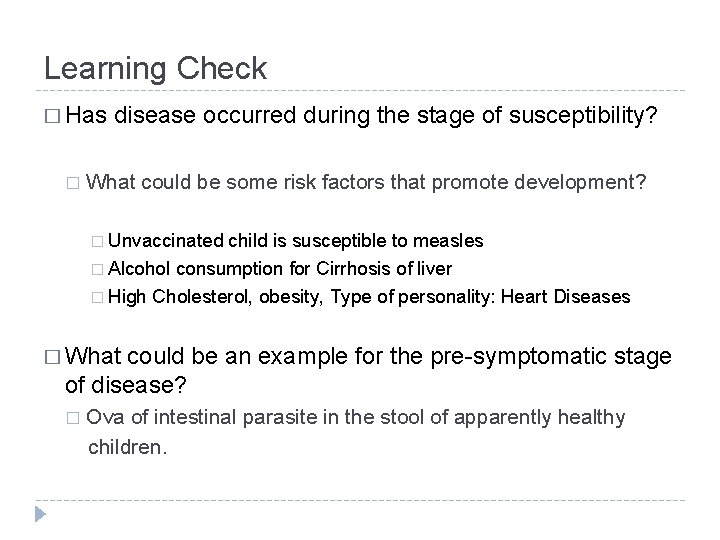
Learning Check � Has � disease occurred during the stage of susceptibility? What could be some risk factors that promote development? � Unvaccinated child is susceptible to measles � Alcohol consumption for Cirrhosis of liver � High Cholesterol, obesity, Type of personality: Heart Diseases � What could be an example for the pre-symptomatic stage of disease? � Ova of intestinal parasite in the stool of apparently healthy children.
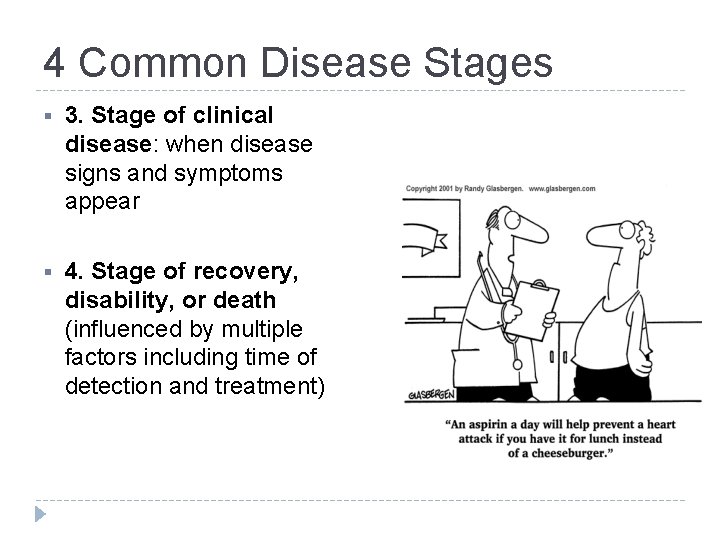
4 Common Disease Stages § 3. Stage of clinical disease: when disease signs and symptoms appear § 4. Stage of recovery, disability, or death (influenced by multiple factors including time of detection and treatment)
Learning Check � What would be an example of the stage of clinical disease? � Common cold has a short and mild clinical stage and almost everyone recovers quickly � If a common cold lasts for a short period of time and a person recovers fairly quickly, how would you classify its severity and duration?
A generalized presentation of the natural history of disease
Identification of Cases �A case is a person who has been diagnosed as having a disease, disorder, injury, or condition
Primary case, index case � The first disease case in the population is the primary case. � The first disease case brought to the attention of the epidemiologist is the index case. � Note: index case is not always the primary case.
Secondary cases �Persons who become infected and ill once a disease has been introduced into a population �Those who become infected from contact with the primary case �Ex: MDR TB case (primary) from Chiapas who spread disease to family members (secondary) after visiting them in Los Angeles.
Different levels of diagnosis for Cases �Suspect �Probable �Confirmed � Suspect: individual or group who have all of the signs and symptoms of a disease/ condition but haven’t been id’ed as having disease, nor have cause of the symptoms been yet connected to a suspected pathogen
Different levels of diagnosis � As more info (such as lab results) becomes available to the physician, he/she generally upgrades his/her diagnosis � When all criteria are met and they meet the case definition, the case is classified as a confirmed case.
Categories of Disease Carriers
5 major types of carriers � 1. Active carrier: persons who have been exposed to and who harbor a pathogen (diseasecausing organism) � Has done so for some time even though may have recovered from the disease � 2. Convalescent carrier: persons who harbor a pathogen and who are in the recovery phase of the course of a disease but are still infectious
Types of carriers � 3. Healthy (or passive) carrier: persons who have been exposed to and harbor a pathogen but still haven’t become ill nor shown any of the symptoms of the disease. [Often referred to as a subclinical case] � 4. Incubatory carrier: persons who have been exposed to and who harbor a pathogen, are showing symptoms, and have ability to transmit the disease
Types of carriers � 5. Intermittent carrier: persons who have been exposed to and harbor a pathogen and who can spread the disease at different places or intervals
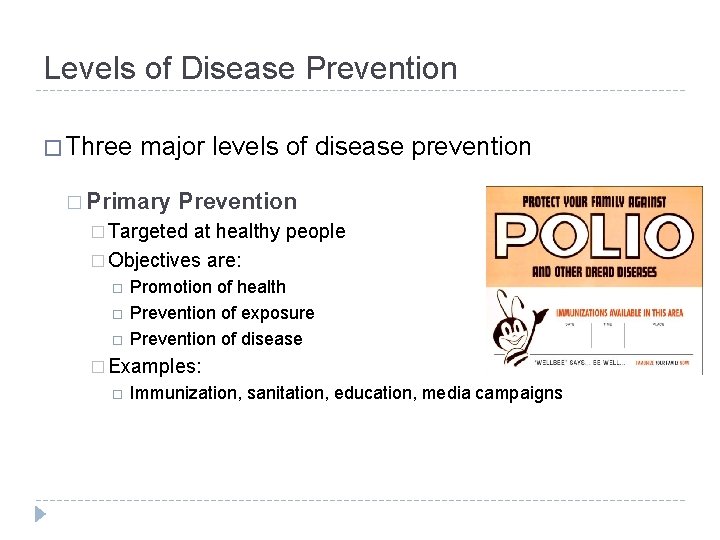
Levels of Disease Prevention � Three major levels of disease prevention � Primary Prevention � Targeted at healthy people � Objectives are: Promotion of health Prevention of exposure Prevention of disease � Examples: Immunization, sanitation, education, media campaigns
Level of Disease Prevention � Secondary � Targeted at sick individuals � Objective Prevention is to: Stop or slow the progression of disease and to prevent limit permanent damage through early detection and treatment
Level of Disease Prevention � Tertiary Prevention � Targeted at people with chronic diseases and disabilities that can’t be cured � Objective is to: Prevent further disability or death and limit impacts of disability through rehabilitation
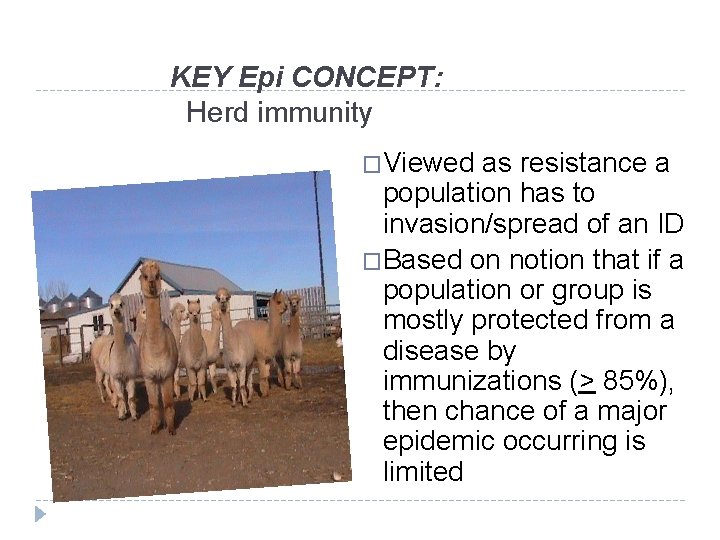
KEY Epi CONCEPT: Herd immunity �Viewed as resistance a population has to invasion/spread of an ID �Based on notion that if a population or group is mostly protected from a disease by immunizations (> 85%), then chance of a major epidemic occurring is limited
Herd Immunity � Herd immunity provides barrier to direct transmission of infections through population � Lack of susceptible persons stops spread of a disease throughout group
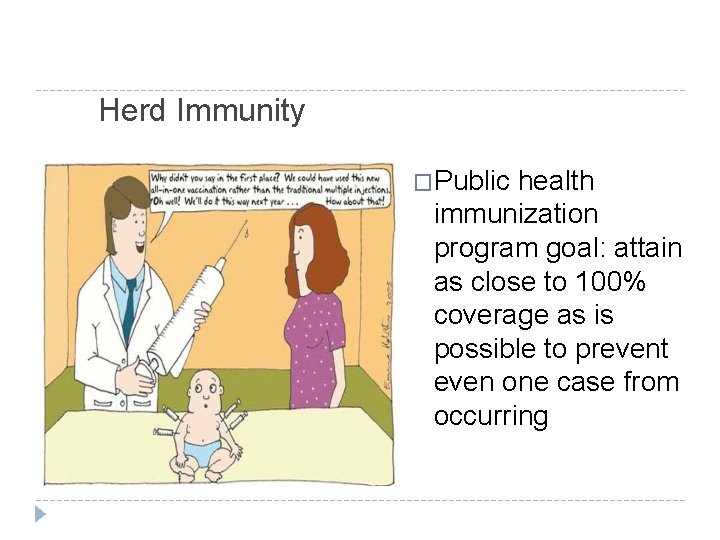
Herd Immunity �Public health immunization program goal: attain as close to 100% coverage as is possible to prevent even one case from occurring
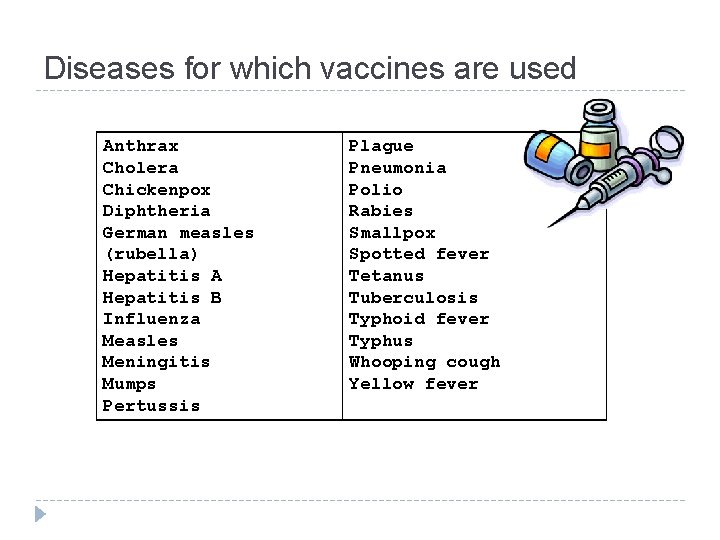
Diseases for which vaccines are used Anthrax Cholera Chickenpox Diphtheria German measles (rubella) Hepatitis A Hepatitis B Influenza Measles Meningitis Mumps Pertussis Plague Pneumonia Polio Rabies Smallpox Spotted fever Tetanus Tuberculosis Typhoid fever Typhus Whooping cough Yellow fever