
Causes impacts and sustainability issues of dryland salinity
Causes, impacts, and sustainability issues of dryland salinity on wetlands in Australia SWES 574 W. J. Ward 12/09/2003
Mining and Agriculture Anthropogenic Salinisation ØDryland salinities result from: • Diverted inflows for irrigation and other uses • Excessive clearance of natural, deep rooted vegetation from catchments • Discharge of saline agricultural wastewater • Rising saline groundwater • Mining and discharge of brine waters Ø Salinity rising in: Mono Lake, CA. , Pyramid Lake, NV. , Aral Sea, Asia, Qinghai Hu, China, Lake Qarum, Egypt, Lake Corangamite, AUS. and rivers Syr, Amu darya, Asia, Blackwood, AUS.
Anthropogenic Salinisation (cont. ) Ø Salinisation common in semi-arid regions of annual rainfall of 25 -500 mm Ø 43 -47 % of all irrigated land has been effected by salinisation Ø Potential to cause irreversible damage to arid land rivers and wetlands Ø In Australia lost agricultural production is $ 50 mil/yr U. S. and degradation of infrastructure is an additional $ 90 mil/yr. U. S. Ø Vegetation death is caused by toxic levels of bicarbonate, magnesium, sulphate, sodium, and chloride Ø Loss of species and species diversity Ø Waters become unusable for irrigation or drinking
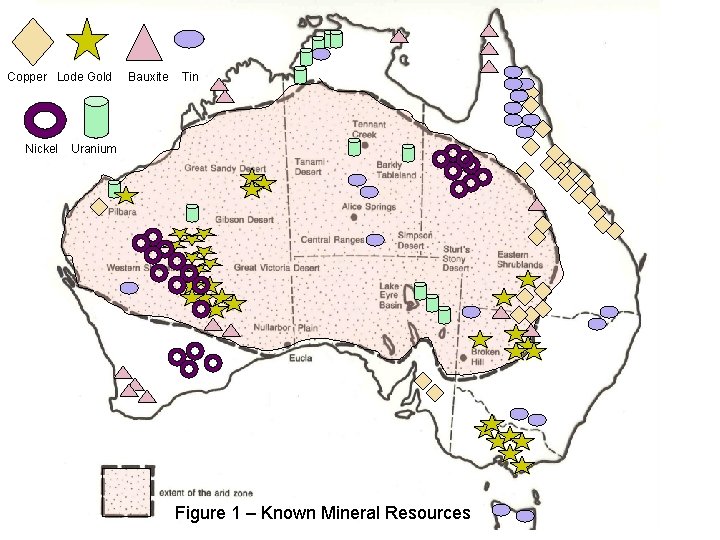
Copper Lode Gold Nickel Bauxite Tin Uranium Figure 1 – Known Mineral Resources
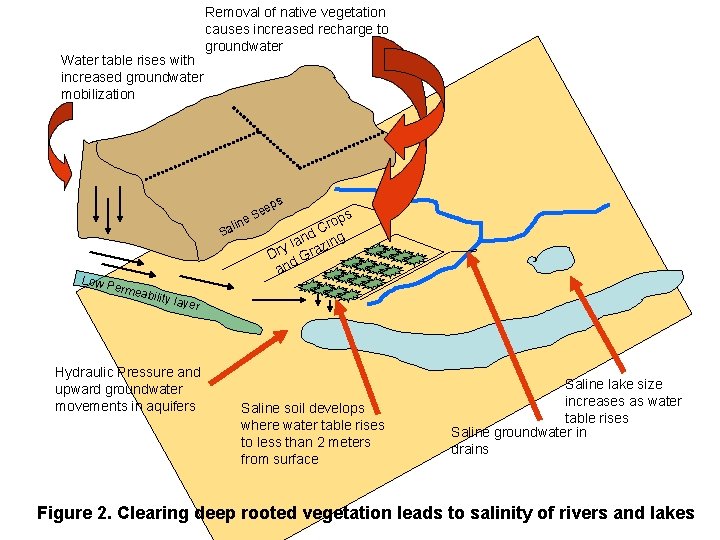
Water table rises with increased groundwater mobilization Removal of native vegetation causes increased recharge to groundwater s ep Se e n ali S Low P erme ability s rop C nd ing a l z Dry Gra d an layer Hydraulic Pressure and upward groundwater movements in aquifers Saline soil develops where water table rises to less than 2 meters from surface Saline lake size increases as water table rises Saline groundwater in drains Figure 2. Clearing deep rooted vegetation leads to salinity of rivers and lakes
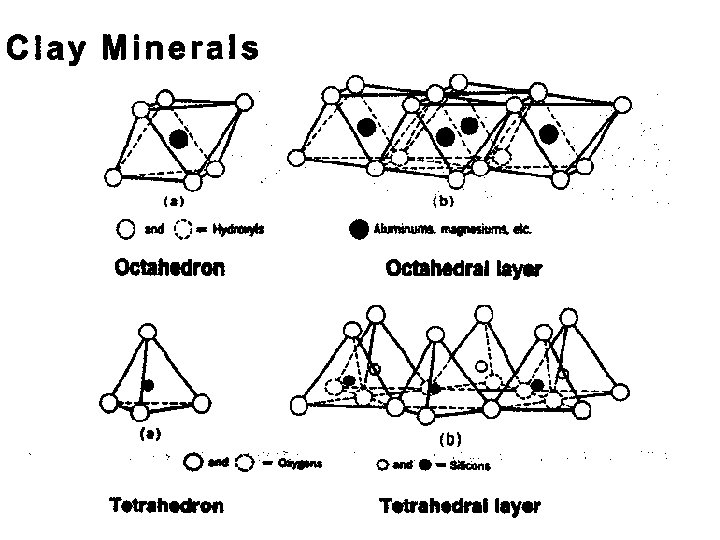
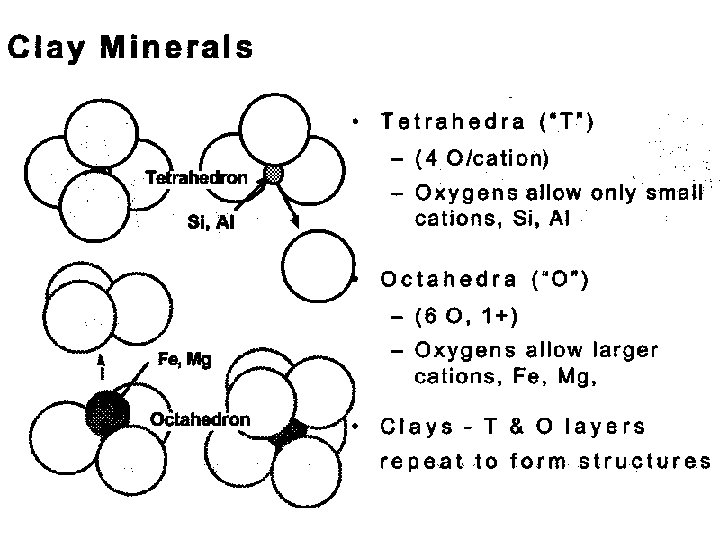
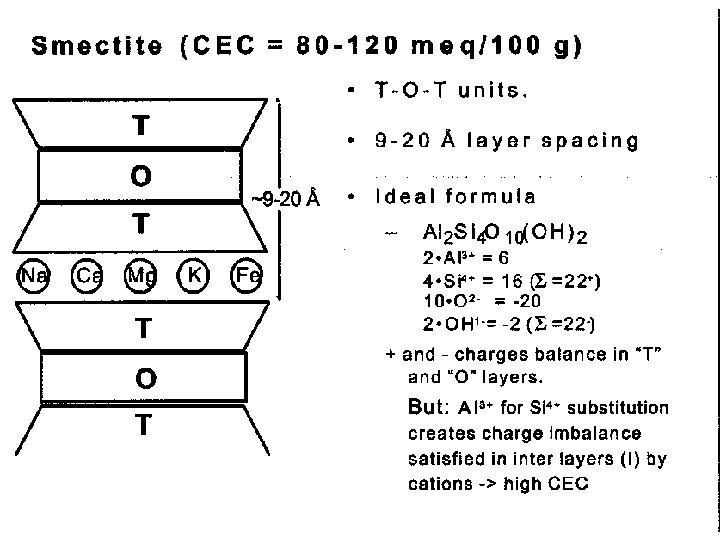
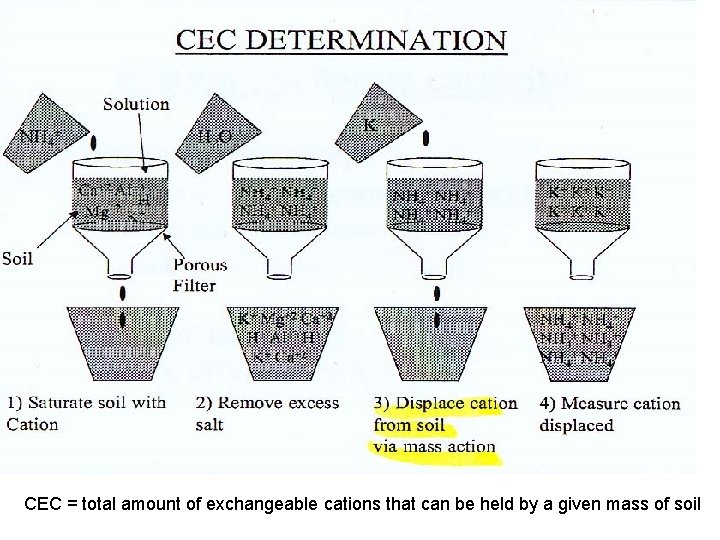
CEC = total amount of exchangeable cations that can be held by a given mass of soil
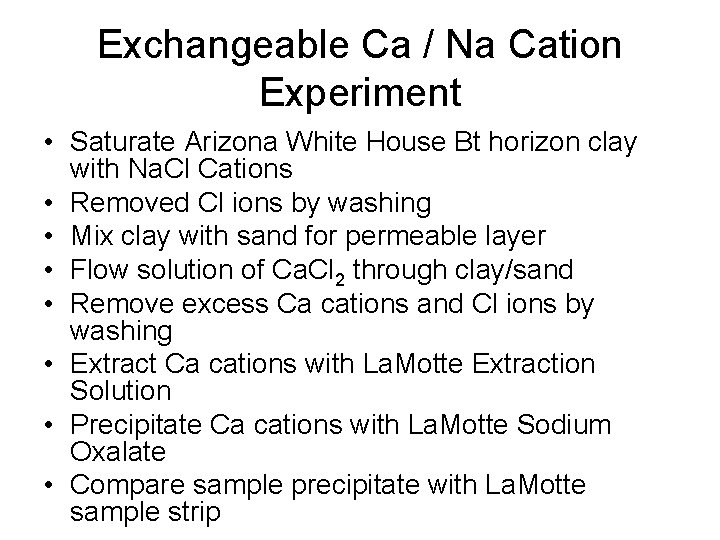
Exchangeable Ca / Na Cation Experiment • Saturate Arizona White House Bt horizon clay with Na. Cl Cations • Removed Cl ions by washing • Mix clay with sand for permeable layer • Flow solution of Ca. Cl 2 through clay/sand • Remove excess Ca cations and Cl ions by washing • Extract Ca cations with La. Motte Extraction Solution • Precipitate Ca cations with La. Motte Sodium Oxalate • Compare sample precipitate with La. Motte sample strip
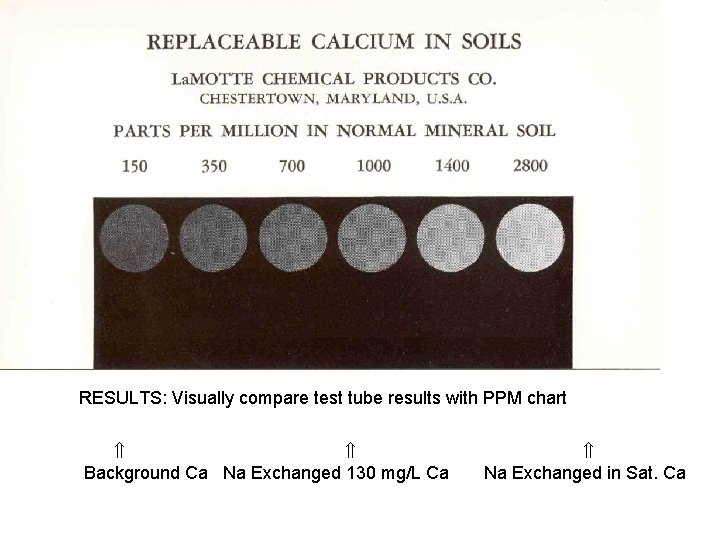
RESULTS: Visually compare test tube results with PPM chart Background Ca Na Exchanged 130 mg/L Ca Na Exchanged in Sat. Ca
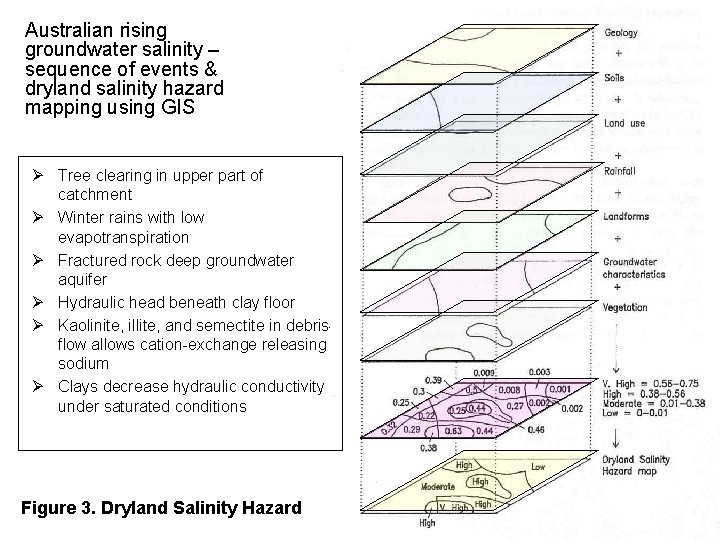
Australian rising groundwater salinity – sequence of events & dryland salinity hazard mapping using GIS Ø Tree clearing in upper part of catchment Ø Winter rains with low evapotranspiration Ø Fractured rock deep groundwater aquifer Ø Hydraulic head beneath clay floor Ø Kaolinite, illite, and semectite in debrisflow allows cation-exchange releasing sodium Ø Clays decrease hydraulic conductivity under saturated conditions Figure 3. Dryland Salinity Hazard
Summary • Early mining timber use and early settlement and agriculture land clearing degraded long term sustainability • Increased recharge creates valley area groundwater discharge through clay debris flow. • Discharge cation exchange causes increased salinity of surface waters negatively impacting lakes and wetlands
Summary (cont. ) • Column experiment simulated the cation exchange between Ca & Na in high CEC clays • Cation exchange occurring in Yass River Catchment, New South Wales, Australia causing rising salinity in rivers, lakes, and wetlands • Mapping salinity and remediation to prevent excess infiltration is key to further damage
Reference List • • • • Blinn, D. W. and Bailey, P. C. E. (2001). "Land-use influence on stream water quality and diatom communities in Victoria, Australia: a response to secondary salinization. " Hydrobiologia , 466(1 -3), 231 -244. Bradd, J. M. , Milne-Home, W. A. , and Gates, G. (1997). "Overview of Factors Leading to Dryland Salinity and its Potential Hazard in New South Wales, Australia. " Hydrogeology Journal, 5(1), 51 -67. Davis, J. A. and Froend, R. (1999). "Loss and degradation of wetlands in southwestern Australia: underlying causes, consequences and solutions. " Wetlands Ecology and Management, 7(1 -2), 13 -23. George, R. , Mc. Farlane, D. , and Nulsen, B. (1997). "Salinity Threatens the Viability of Agriculture and Ecosystems in Western Australia. " Hydrogeology Journal, 5(1), 6 -21. Hendricks, D. M. (1985). Arizona Soils, Roswell Bookbinding, University of Arizona. Jankowski, J. and Acworth, I. R. (1997). "Impact of Debris-Flow Deposits on Hydrogeochemical Processes and the Developement of Dryland Salinity in the Yass River Catchment, New South Wales, Australia. " Hydrogeology Journal, 5(4), 71 -88. Johnson, R. H. and Bush, P. W. (2002). "Summary of the Hydrology of the Floridan Aquifer System In Florida and In Parts of Georgia, South Carolina, and Alabama. " USGS Professional Papers, 1403 -I. Lemay, T. (2001). "Groundwater Chemistry in the Athabasca In Situ Oil Sands Area, Northeast Alberta. " Rocks Chips, Publication of the Alberta Geological Survey, 1 -4. Markewitz, D. , Davidson, E. A. , de O. Figueiredo, R. , Victoria, R. L. , and Krusche, A. V. (2001). "Control of cation concentrations in stream waters by surface soil processes in an Amazonian watershed. " Nature, 410, 802 -805. Mc. Bride, M. B. (1994). Environmental Chemistry of Soils, Oxford. Nabhan, G. (1985). Gathering the Desert, University of Arizona Press, Tucson, Arizona. Rolls, E. C. (1999). "Land of Grass: The Loss of Australia's Grasslands. " Australian Geographical Studies, 197. Tickell, S. J. (1997). "Mapping Dryland-Salinity Hazard, Northern Territory, Australia. " Hydrogeology Journal, 5(1), 109 -117. Williams, W. D. (1999). "Salinisation: A major threat to water resources in the arid and semiarid regions of the world. " Lakes & Reservoirs: Research and Management , 4(3 -4), 85. Williams, W. D. (2001). "Anthropogenic salinisation of inland waters. " Hydrobiologia, 466(13), 329 -337.
- Slides: 17