
Causes Drivers of Climate Change Part II 1
- Slides: 21
Causes (“Drivers”) of Climate Change? Part II 1
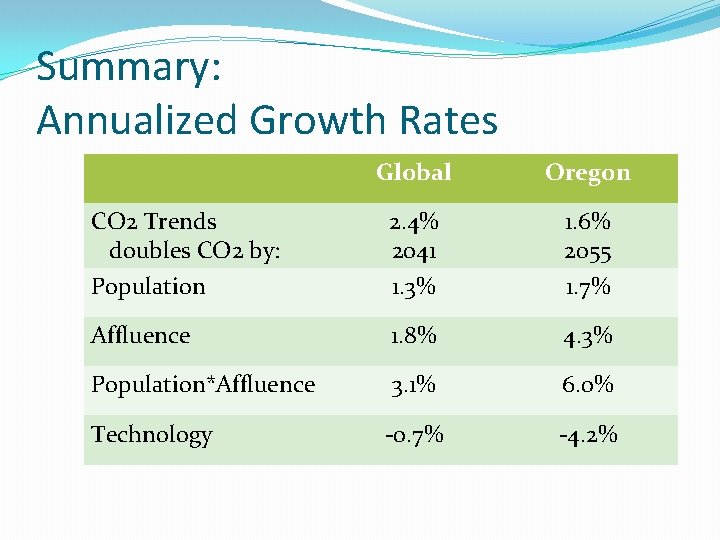
Summary: Annualized Growth Rates Global Oregon CO 2 Trends doubles CO 2 by: Population 2. 4% 2041 1. 3% 1. 6% 2055 1. 7% Affluence 1. 8% 4. 3% Population*Affluence 3. 1% 6. 0% -0. 7% -4. 2% Technology
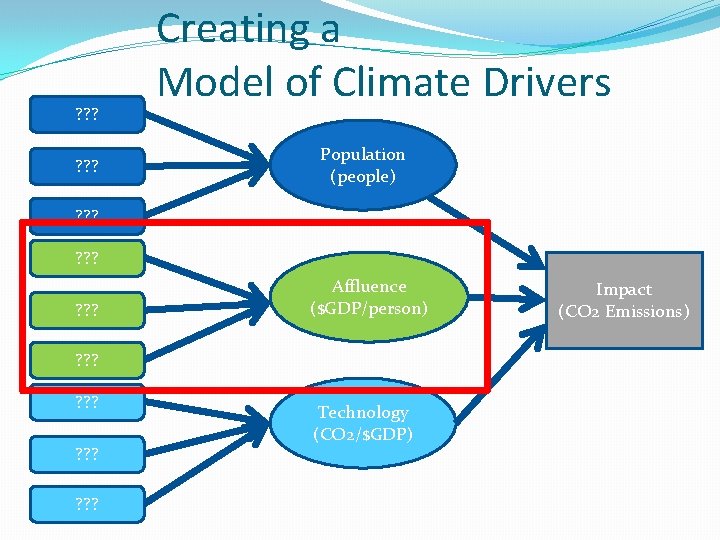
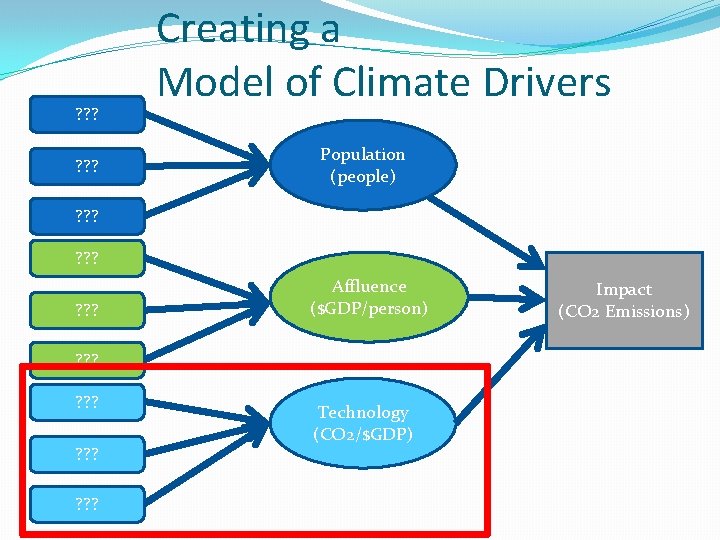
Creating a Model of Climate Drivers �What factors lead to P, A, and T? �Personal factors, as identified above �Structural factors �Understand processes that lead to emissions to identify points for “policy intervention”
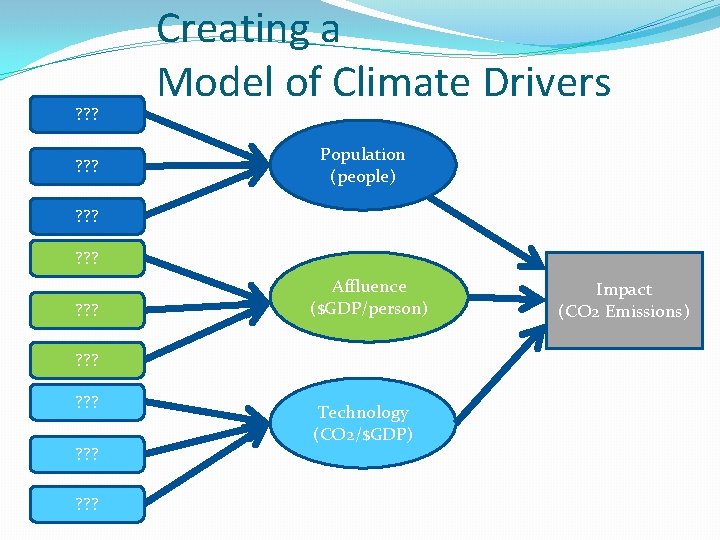
? ? ? Creating a Model of Climate Drivers Population (people) ? ? ? ? ? Affluence ($GDP/person) ? ? ? Technology (CO 2/$GDP) Impact (CO 2 Emissions)
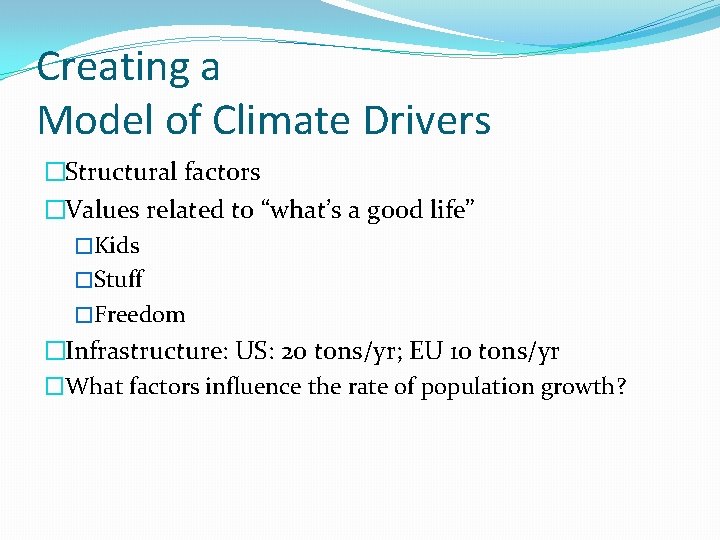
Creating a Model of Climate Drivers �Structural factors �Values related to “what’s a good life” �Kids �Stuff �Freedom �Infrastructure: US: 20 tons/yr; EU 10 tons/yr �What factors influence the rate of population growth?
? ? ? Creating a Model of Climate Drivers Population (people) ? ? ? ? ? Affluence ($GDP/person) ? ? ? Technology (CO 2/$GDP) Impact (CO 2 Emissions)
Determinants of Affluence Growth �Discussion �What are the determinants? �Why is it so hard to change? �How does it relate to CO 2 emissions?
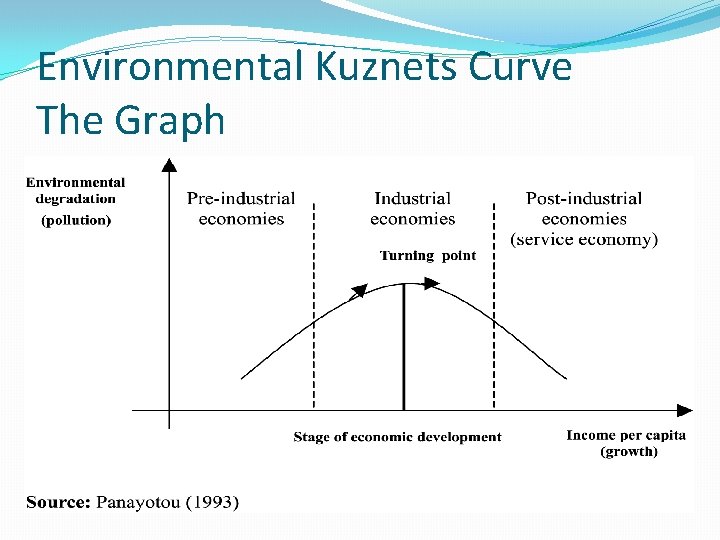
Environmental Kuznets Curve The Graph �Graph of the relationship between increasing affluence (income: GDP per capita) and pollution levels �What do you expect it to be?
Environmental Kuznets Curve The Graph
Environmental Kuznets Curve The Logic �As people get richer, three competing things happen: �People have more money and so buy more stuff and so pollution/emissions increase �But, after a certain point, this is more than offset by the fact that as people have more money, they start caring more about the environment and demand government protection of it �And, more money correlates with service economy which “displaces” or “offshores” the pollution
Changing Affluence Growth �Some policies do influence consumption patterns �Buddhist monks �Jewish observance of Shabbat �Mormon tithing �Voluntary simplicity: “frugality of consumption” �So do social norms �“More, More said the baby. ” �“I want a better life for my kids. ” �“I need a raise. ” �“I need a vacation. ” �Yet affluence also appears “off limits” politically (though see “Confronting Consumption”) Source: http: //www. simpleliving. net/voluntary_simplicity_part_1. asp
? ? ? Creating a Model of Climate Drivers Population (people) ? ? ? ? ? Affluence ($GDP/person) ? ? ? Technology (CO 2/$GDP) Impact (CO 2 Emissions)
Determinants of Technology Growth �Discussion �What are the determinants? �Why is it so hard to change? �How does it relate to CO 2 emissions?
The Jevons Paradox �Jevons Paradox: technological progress that increases efficiency of a resource being used leads to MORE of that resource being used. “Technological improvements that increased the efficiency of coaluse led to the increased consumption of coal [and therefore] could not be relied upon to reduce fuel consumption” (Wikipedia) �York (UO Sociology Prof) showed in most countries for past 50 years, each unit of nonfossil-fuel energy displaced less than ¼ unit of fossil-fuel energy and each unit of nonfossil-fuel electricity displaced less than 1/10 th” (York 2013).
Jevons Paradox The Logic �As technology becomes more efficient, the price of that technology declines and two competing things happen. �Pollution per unit goes down �Number of units used goes up, because they are cheaper �York’s point is that �We might expect people to shift to renewables but actually, it lowers the overall prices of energy and we end
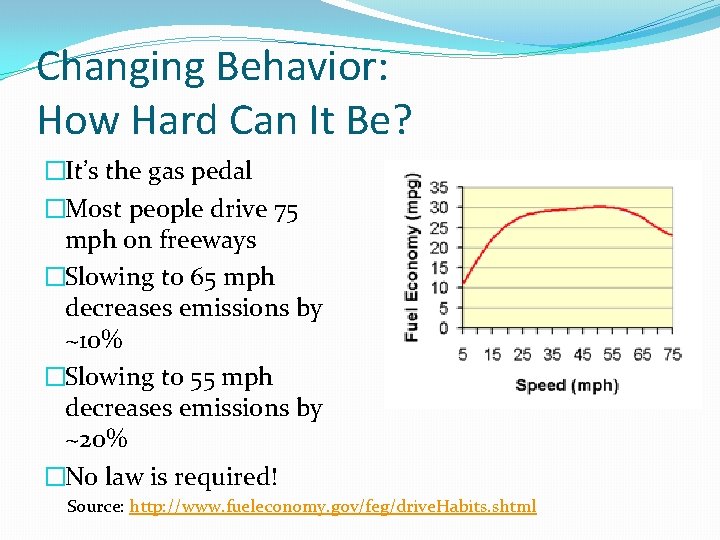
Changing Behavior: How Hard Can It Be? �If I told you I had a new technology that could increase your car’s fuel efficiency by 20% and reduce your CO 2 emissions by 20%, would you use it? �How much would you pay for it?
Changing Behavior: How Hard Can It Be? �It’s the gas pedal �Most people drive 75 mph on freeways �Slowing to 65 mph decreases emissions by ~10% �Slowing to 55 mph decreases emissions by ~20% �No law is required! Source: http: //www. fueleconomy. gov/feg/drive. Habits. shtml
Which of these drivers are we addressing?
We are not addressing two of the drivers �Population - No �Affluence - No �Technology – Yes �I don’t think improving technology alone can get us there �Can we invent new technology? �If we do, can we get people to use it?
Population and affluence: the role of government �Population and affluence reflect deep-seated values �Democracies usually see values as inputs to government policy not targets of government policy �Democracies tend NOT to see “shaping values” as an appropriate role for government
Population and affluence: alternatives to government �Many people DO see “shaping values” as an appropriate role for other institutions �Religions �Families �Corporations �Social movements �Conscious communities