
Causes and Impacts of Climate Change in East

- Slides: 26
Causes and Impacts of Climate Change in East Africa: Links to Crops, Livestock, Natural Ecosystems, and Health Jennifer Olson And Gopal Alagarswamy, Jeff Andresen, David Campbell, Declan Conway, Ruth Doherty, Jianjun Ge, Clair Hanson, Sarah Hession, Marianne Huebner, Brent Lofgren, Dave Lusch, Stephen Magezi, Joseph Maitima, Joseph Messina, Salome Misana, Nathan Moore, Sam Mugisha, John Nganga, John Kaneene, Bryan Pijanowski, Jiaguo Qi, Philip Thornton, Nate Torbick, Jing Wang, Pius Yanda, Lijian Yang NSF Awards 0308420 & 0308420, NIH Award 5 R 21 GM 084714 -02 University of Nairobi 1
Climate Change Causes Comparing relative importance of causes – • Greenhouse Gases (GHG) from the global scale, • Land use change from the local to regional scale 2
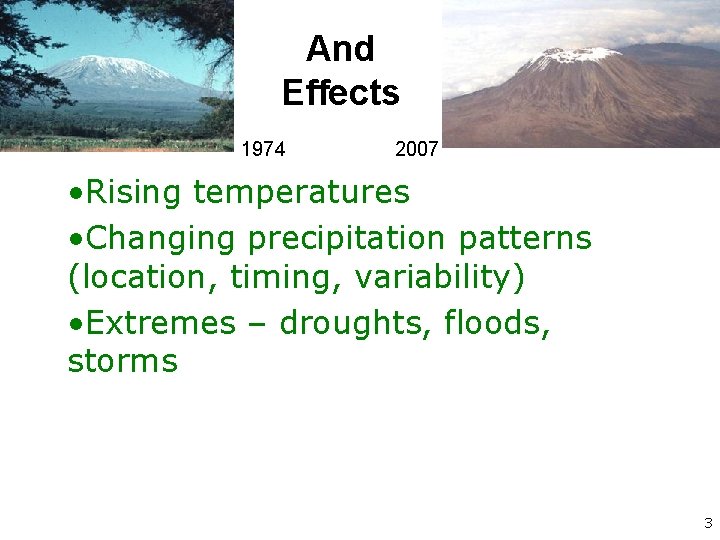
And Effects 1974 2007 • Rising temperatures • Changing precipitation patterns (location, timing, variability) • Extremes – droughts, floods, storms 3
Methodology • Identify recent trends in climate • Calibrate regional climate model RAMS for East Africa using climate and land surface data. – Higher resolution, better topography and landscape than global circulation models; • Develop/calibrate land use change & crop models; • Couple climate, land use & crop models to simulate future climate (2050), compare climate vs. land use effects, and • Identify impacts on crop yields, savanna vegetation, livestock productivity, households, and zoonotic diseases through ecological & socioeconomic field work, modeling. 4
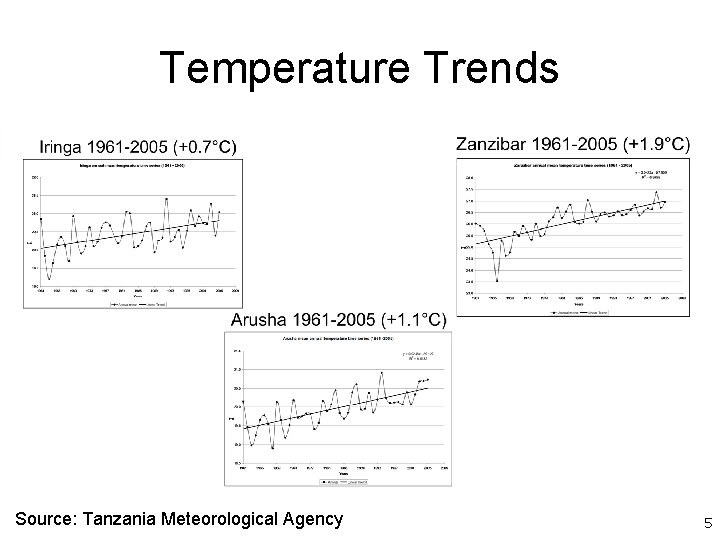
Temperature Trends Source: Tanzania Meteorological Agency 5
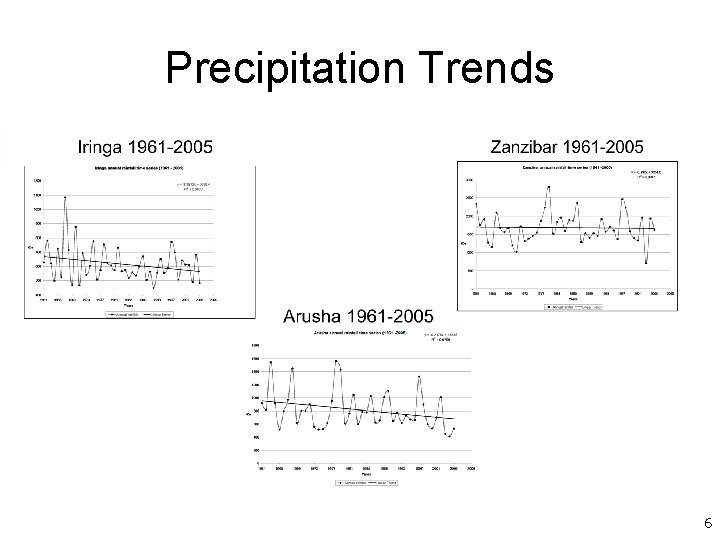
Precipitation Trends 6
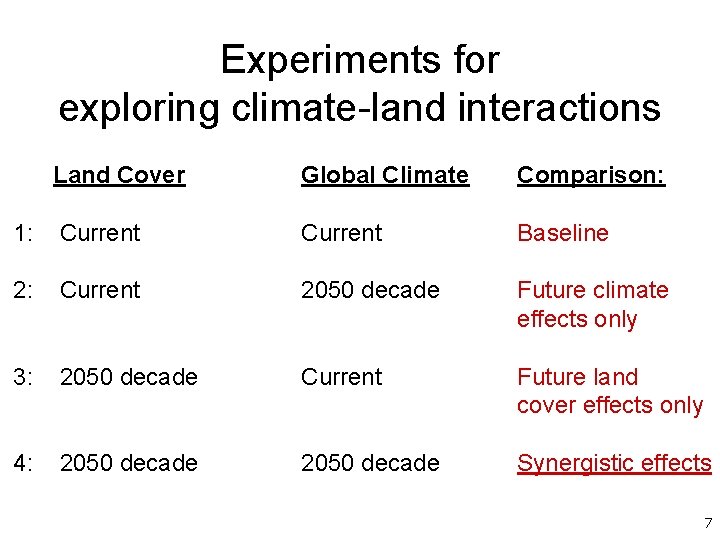
Experiments for exploring climate-land interactions Land Cover Global Climate Comparison: 1: Current Baseline 2: Current 2050 decade Future climate effects only 3: 2050 decade Current Future land cover effects only 4: 2050 decade Synergistic effects 7
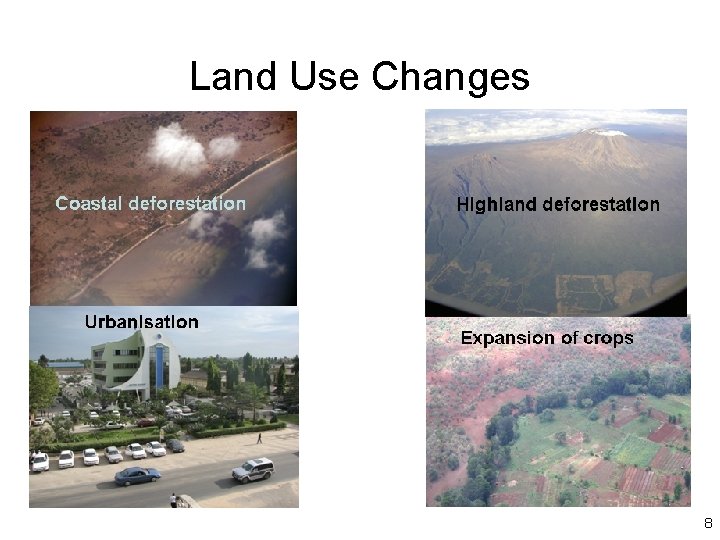
Land Use Changes 8
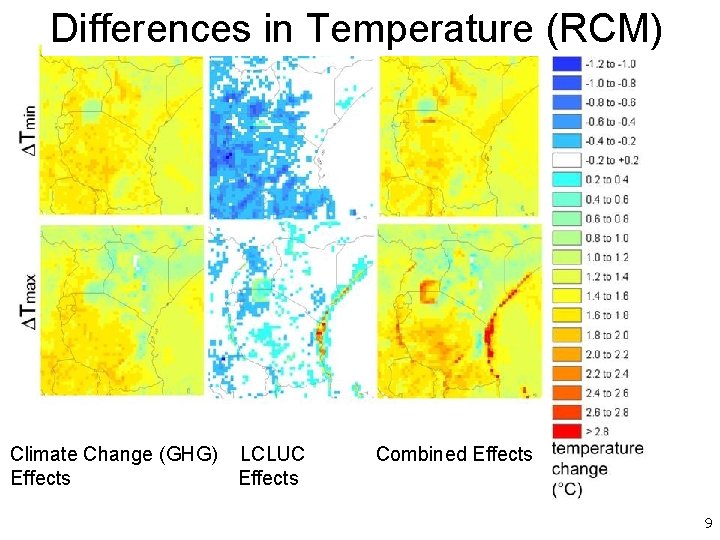
Differences in Temperature (RCM) Climate Change (GHG) LCLUC Effects Combined Effects 9
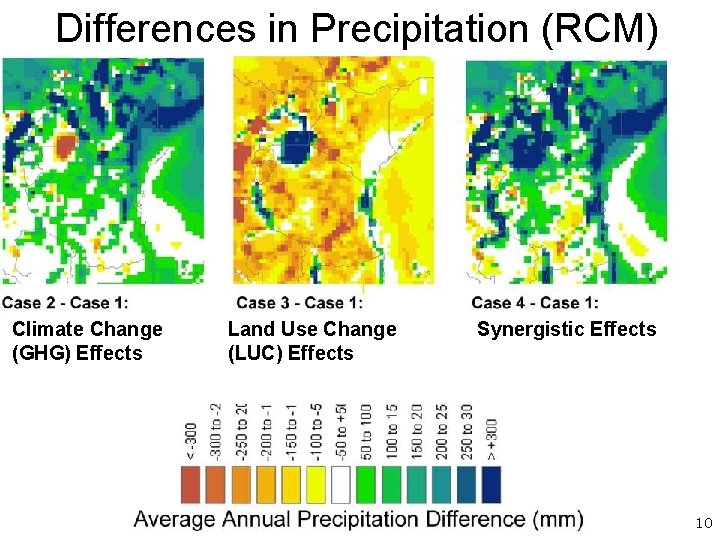
Differences in Precipitation (RCM) Climate Change (GHG) Effects Land Use Change (LUC) Effects Synergistic Effects 10
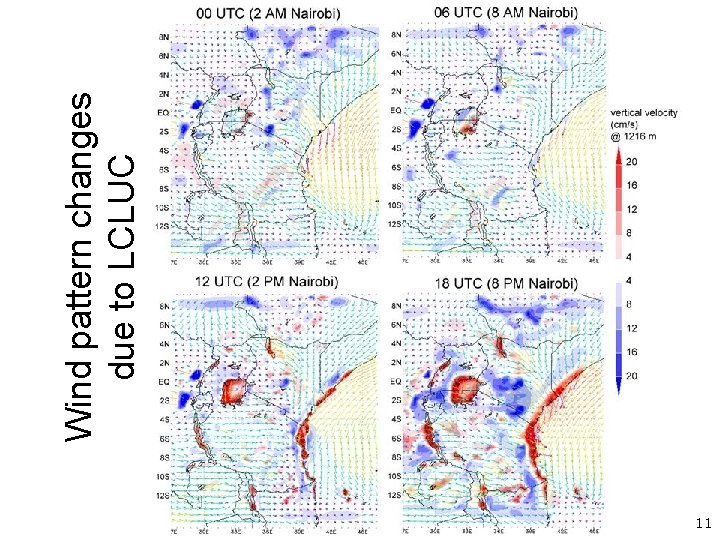
11 Wind pattern changes due to LCLUC
Summary of Projected Future • Near large bodies of water, rainfall changes due to LUC are of similar magnitude to that associated with GHG. Farther from water, gains in rainfall from GHG may be offset by reduced rainfall due to LUC; • All areas will see increases in variability of rainfall—intense storms, droughts and floods— due to GHG; • CLIP results suggest the importance of subregional factors affecting climate and resulting impacts. 12
Impacts 1. Agricultural systems 2. Natural ecosystems 3. Health 13
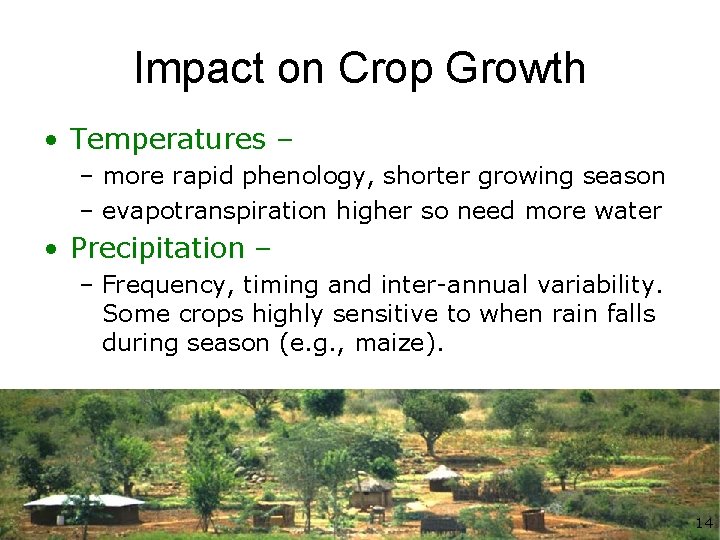
Impact on Crop Growth • Temperatures – – more rapid phenology, shorter growing season – evapotranspiration higher so need more water • Precipitation – – Frequency, timing and inter-annual variability. Some crops highly sensitive to when rain falls during season (e. g. , maize). 14
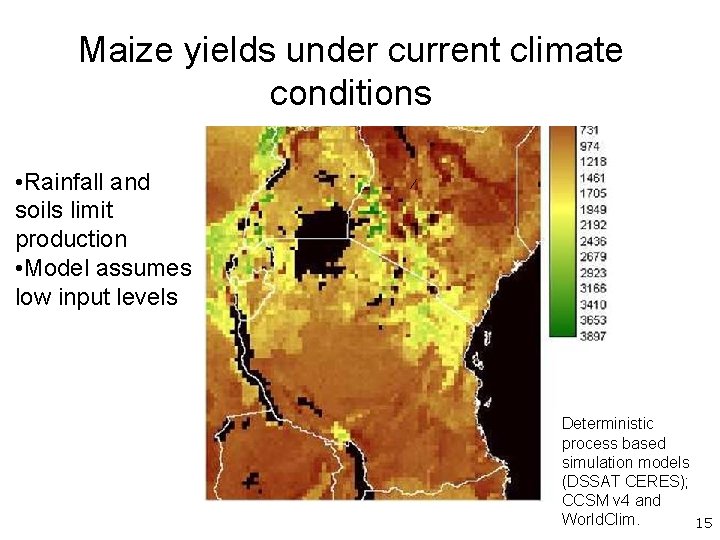
Maize yields under current climate conditions • Rainfall and soils limit production • Model assumes low input levels Deterministic process based simulation models (DSSAT CERES); CCSM v 4 and World. Clim. 15
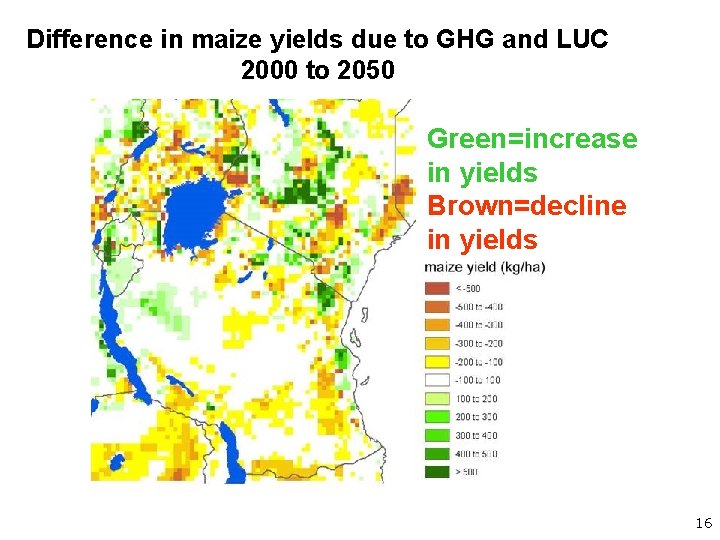
Difference in maize yields due to GHG and LUC 2000 to 2050 Green=increase in yields Brown=decline in yields 16
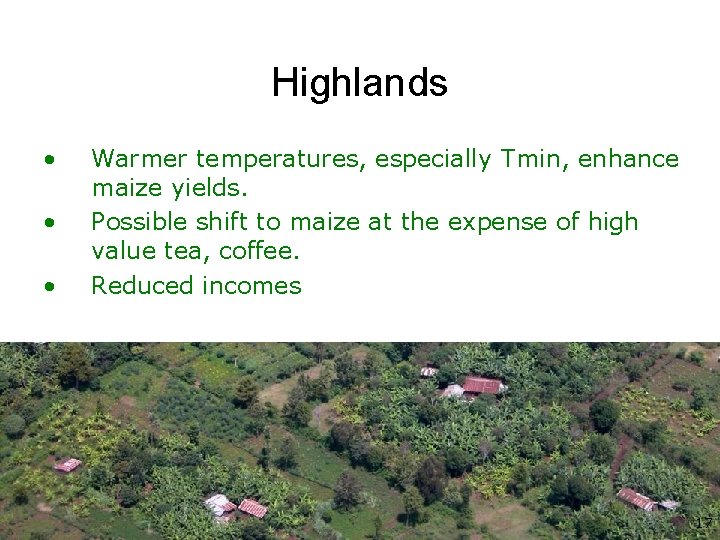
Highlands • • • Warmer temperatures, especially Tmin, enhance maize yields. Possible shift to maize at the expense of high value tea, coffee. Reduced incomes 17
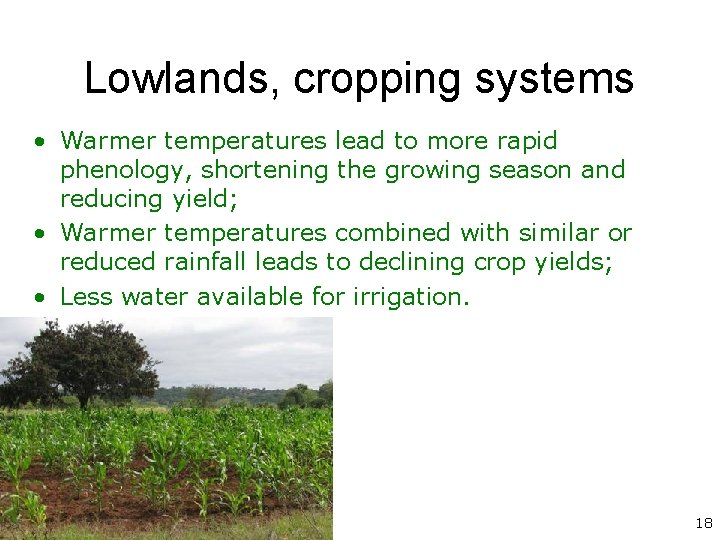
Lowlands, cropping systems • Warmer temperatures lead to more rapid phenology, shortening the growing season and reducing yield; • Warmer temperatures combined with similar or reduced rainfall leads to declining crop yields; • Less water available for irrigation. 18
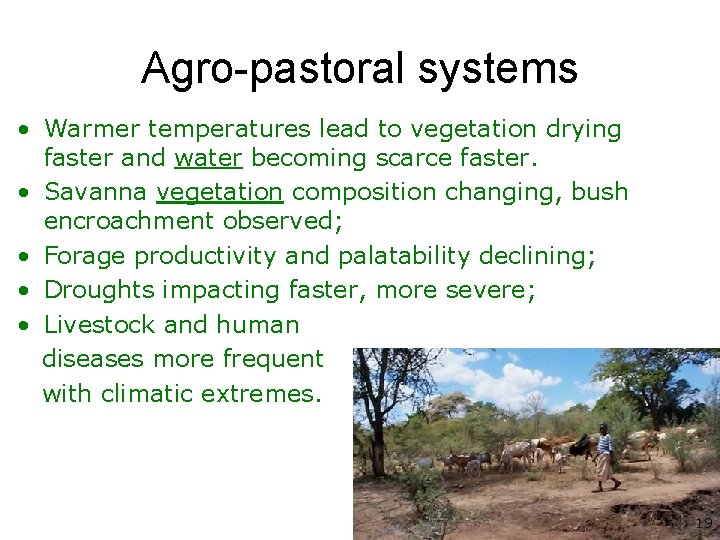
Agro-pastoral systems • Warmer temperatures lead to vegetation drying faster and water becoming scarce faster. • Savanna vegetation composition changing, bush encroachment observed; • Forage productivity and palatability declining; • Droughts impacting faster, more severe; • Livestock and human diseases more frequent with climatic extremes. 19
Adaptations, Agro-Pastoralists • Changing livestock breeds – More camels, goats – New goat and cattle breeds from Somalia • Distance traveled daily to water, forage longer, herding patterns changing • Reduced burning (less biomass) • More pastoralists are cropping to cope with frequent drought (but some fields abandoned due to failure of short rains) 20
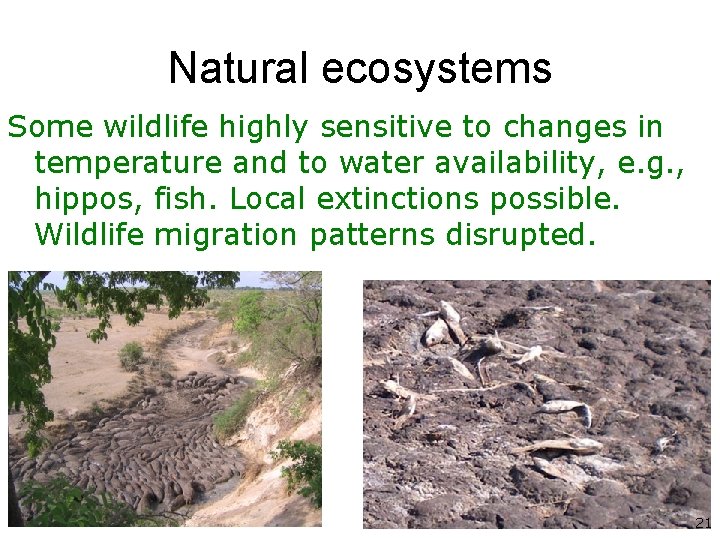
Natural ecosystems Some wildlife highly sensitive to changes in temperature and to water availability, e. g. , hippos, fish. Local extinctions possible. Wildlife migration patterns disrupted. 21
Highly Vulnerable Ecosystems (1) • Wetlands: surface water will decline, yet usage will intensify. High concentrations of livestock and wildlife lead to land degradation. • Highlands: rapid climate changes towards warmer temperatures. Risk of increased fire, loss of glaciers, altered vegetation composition. 22
Highly Vulnerable Ecosystems (2) • Coasts: higher rainfall, stronger storms and waves, sea level rise lead to erosion, inundation, salt water intrusion. Urban infrastructure affected. • Coral reefs: ocean surface water warming fast, bleaching. 23
Impacts on Zoonotic Diseases 1. Impacts of climate and land use change on Trypanosomiasis (sleeping sickness) distribution: A Dynamic Ecological Simulation Model of Tsetse transmitted Trypanosomiasis in Kenya (NIH) 2. Impacts of climate, land use and management change on Bovine TP: Modeling the Ecological and Socioeconomic Determinants of Tuberculosis Transmission in Humans, Livestock and Wildlife 24
Educational Links • Capacity building of teachers/ lecturers, and new curriculum modules for university / K-12 levels (science, math, social studies, etc. ). Implemented by US and East African professors & teachers, will be online and distributed at state & national levels. • New internet connected, computer assisted technologies in schools and communities in Tanzania (ICT Global Corps). 25
http: //clip. msu. edu http: //eaclipse. msu. edu Contact (Olson): olsonjj@msu. edu j. olson@cgiar. org 26