
Causes and Effects of Trade Tensions Andrew K
- Slides: 14
Causes and Effects of Trade Tensions Andrew K. Rose NUS-Business Berkeley-Haas, ABFER, CEPR and NBER Financial Times/Citi, Singapore Jan 2020
Declining Trade Growth: Long Run Causes • Not all barriers to trade are “artificial” impediments (protectionism) • Some are “natural” … and all are persistent 1. Slowing Growth of Tradeables • Most trade is in goods (finished or not) • Productivity gains in secondary production have slowed 2. Demand shifts from goods to services as income rises • Especially true as populations age • Many services are hard to trade, very hard to liberalize/harmonize/regulate 3. Stalled technological progress in transportation costs reduction • Few significant changes since containerization
Long Run Causes, more Three Notes 1. A striking long run omission: declining “artificial” trade barriers • Protectionism trended down from 1945 on … no more! • Not JUST Trump … Doha never completed … 2. Climate Change could also raise transport costs 3. Savings Glut from Germany, China, … • Global imbalances mean global trade tensions
Short Run Causes of Trade Woes 1. Under-appreciated: absence of serious recent liberalization • Trade liberalization is like riding a bicycle (Bergsten) 2. Rise of US dollar (Gopinath) • US fiscal expansion; issuer of safe assets; European, Asian woes • When US $ appreciates, trade tends to shrink • US $ appreciated since 2015
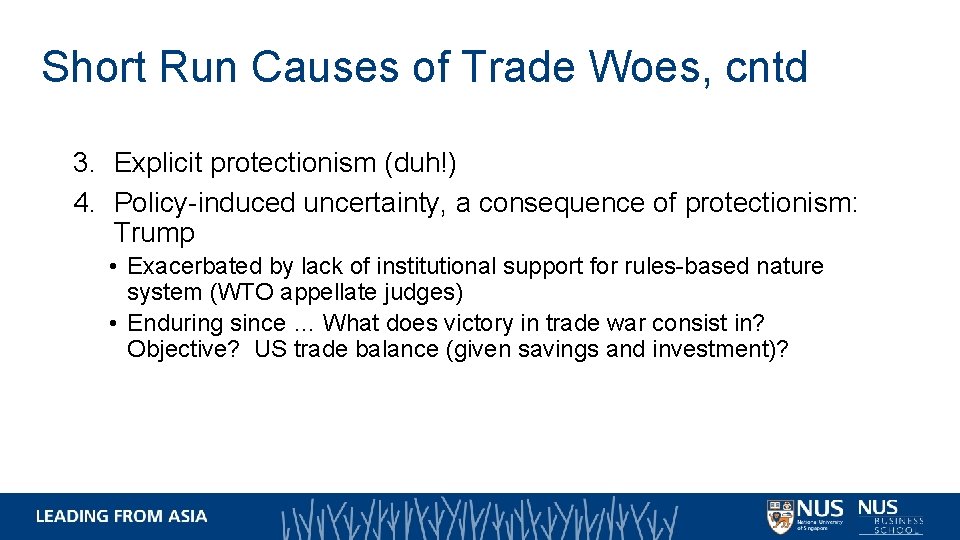
Short Run Causes of Trade Woes, cntd 3. Explicit protectionism (duh!) 4. Policy-induced uncertainty, a consequence of protectionism: Trump • Exacerbated by lack of institutional support for rules-based nature system (WTO appellate judges) • Enduring since … What does victory in trade war consist in? Objective? US trade balance (given savings and investment)?
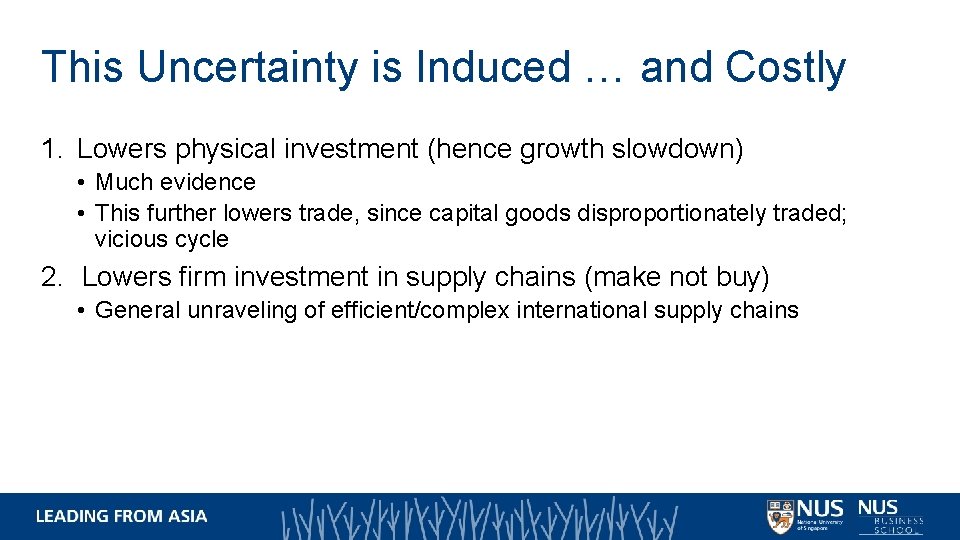
This Uncertainty is Induced … and Costly 1. Lowers physical investment (hence growth slowdown) • Much evidence • This further lowers trade, since capital goods disproportionately traded; vicious cycle 2. Lowers firm investment in supply chains (make not buy) • General unraveling of efficient/complex international supply chains
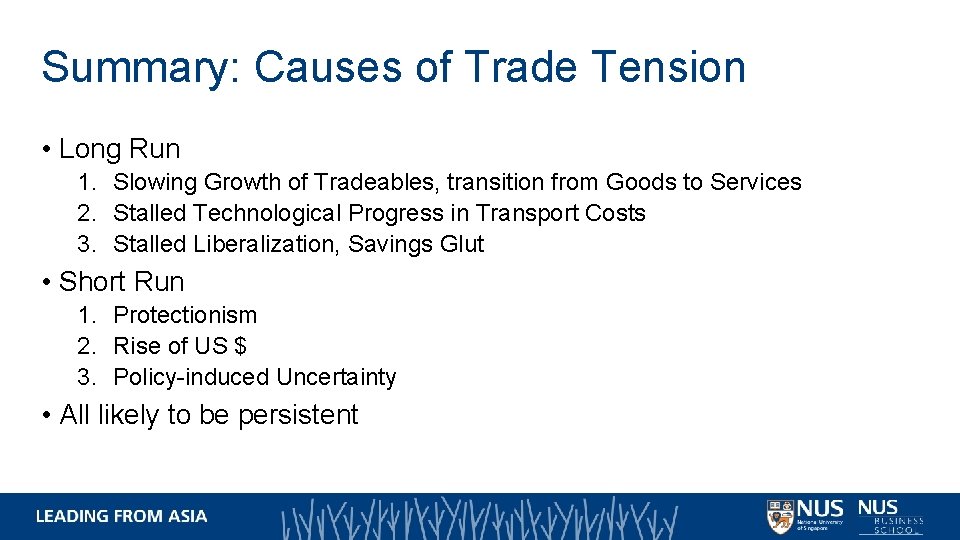
Summary: Causes of Trade Tension • Long Run 1. Slowing Growth of Tradeables, transition from Goods to Services 2. Stalled Technological Progress in Transport Costs 3. Stalled Liberalization, Savings Glut • Short Run 1. Protectionism 2. Rise of US $ 3. Policy-induced Uncertainty • All likely to be persistent
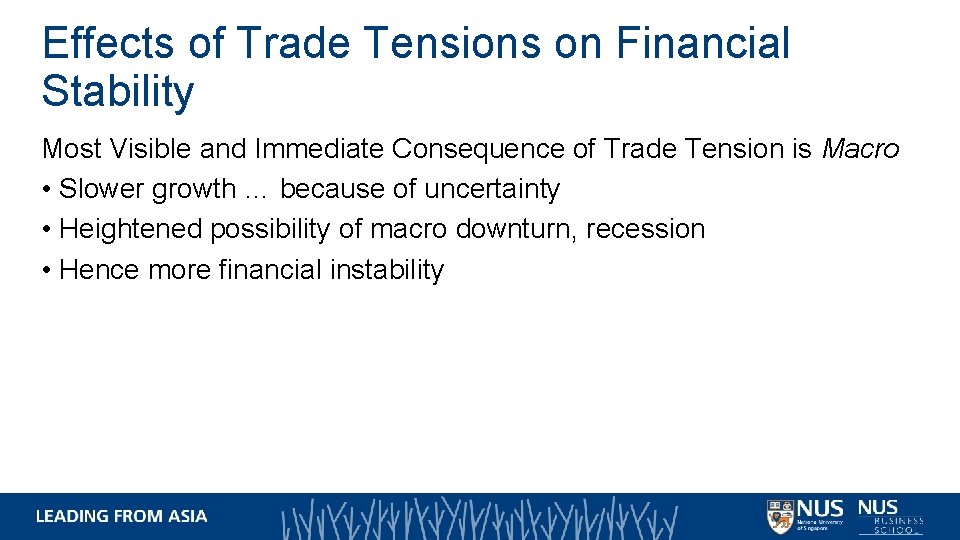
Effects of Trade Tensions on Financial Stability Most Visible and Immediate Consequence of Trade Tension is Macro • Slower growth … because of uncertainty • Heightened possibility of macro downturn, recession • Hence more financial instability
Persistent Costs of Trade Reduction • Lower trade integration is costly in income, productivity, welfare • Mostly small now • Costs are mostly in long run supply-side because of foregone productivity and competition (also foregone consumer variety) • Likely to cumulate (consider quasi-autarkies: Cuba, North Korea, Venezuela) • Tangent: current protectionism is NOT counter-cyclic • US perpetrating during long boom with low unemployment and inflation • Unleashed protectionist pressures may be MUCH higher during next recession • Could lead to bigger future negative welfare consequences
Two Other Consequences of Slowing Trade 1. Business Cycle Synchronization 2. Financial Stability • Both Longer Run
Business Cycle Synchronization is Endogenous • BCS is affected by trade (Frankel-Rose) • More trade leads to higher BCS in practice • Less trade integration means more idiosyncratic business cycles, more diversifiable risk
Also, Financial Integration follows Real Integration • In theory and practice, real integration precedes, causes financial • Empirically overwhelming: liberalize goods markets before services; both before factor markets (capital and labor) • Mc. Kinnon’s sequencing: international financial liberalization the final step • Financial integration a result of policy choices, typically following real integration • So a world with less real (G&S) integration is likely to also be less financially integrated
Financial Integration Falls with Trade Tensions • As with goods and services, less integration has its costs • Savings flow less efficiently to good investments • Risks can’t be spread as widely across borders • But considerable skepticism about size of benefits • Also, considerable risk (contagion) • Different from trade integration
Effects of Trade Tension on Financial Stability 1. Short Run, Bad: higher likelihood of recession, raising financial instability 2. Long Run, Bad and Good: less trade, lower income and welfare • But may enhance real and financial stability • Import fewer real shocks; financial repression bad for welfare but good for stability 3. Long Run, Good: less globally coordinated business cycles • More easily diversifiable risk 4. Long Run, Arguable: less financial integration • Fewer gains from integration (uncertain magnitudes) • Fewer risks from contagion