
Caudal Regression Syndrome a case report Veronica Goitia
- Slides: 1
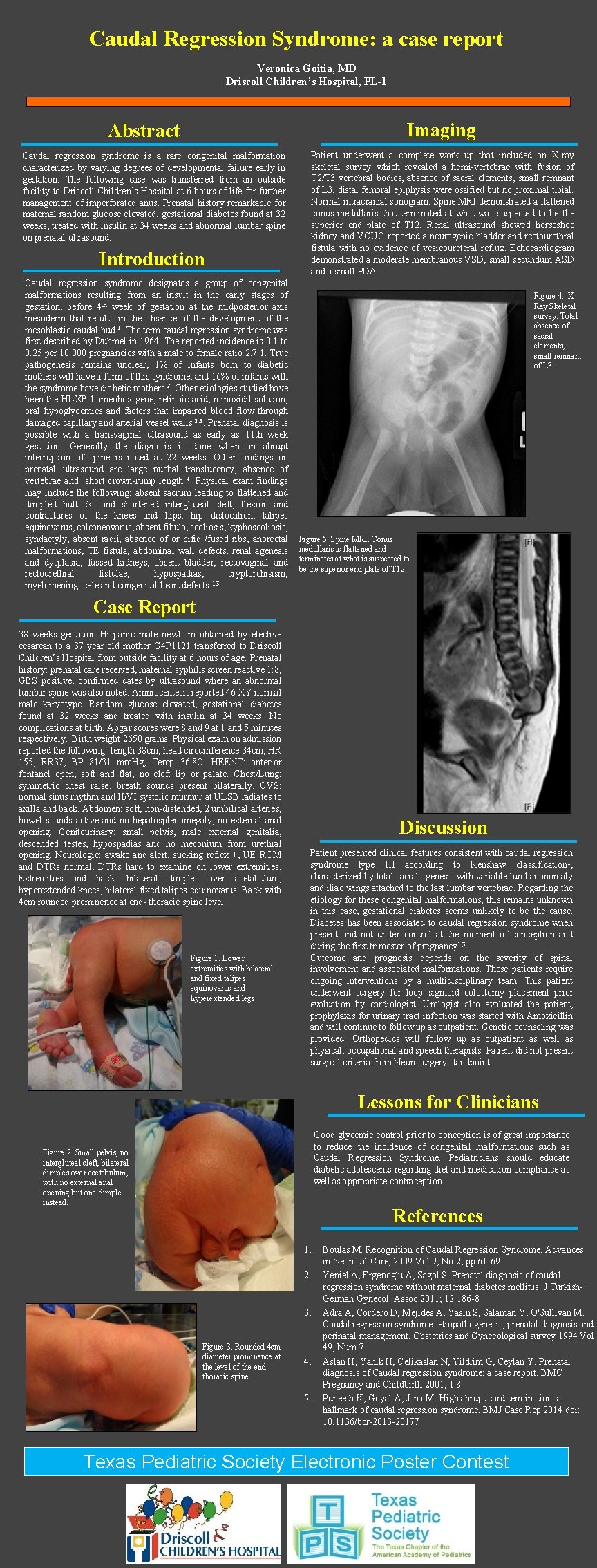
Caudal Regression Syndrome: a case report Veronica Goitia, MD Driscoll Children’s Hospital, PL-1 Imaging Abstract Caudal regression syndrome is a rare congenital malformation characterized by varying degrees of developmental failure early in gestation. The following case was transferred from an outside facility to Driscoll Children’s Hospital at 6 hours of life for further management of imperforated anus. Prenatal history remarkable for maternal random glucose elevated, gestational diabetes found at 32 weeks, treated with insulin at 34 weeks and abnormal lumbar spine on prenatal ultrasound. Introduction Caudal regression syndrome designates a group of congenital malformations resulting from an insult in the early stages of gestation, before 4 th week of gestation at the midposterior axis mesoderm that results in the absence of the development of the mesoblastic caudal bud 1. The term caudal regression syndrome was first described by Duhmel in 1964. The reported incidence is 0. 1 to 0. 25 per 10. 000 pregnancies with a male to female ratio 2. 7: 1. True pathogenesis remains unclear, 1% of infants born to diabetic mothers will have a form of this syndrome, and 16% of infants with the syndrome have diabetic mothers 2. Other etiologies studied have been the HLXB homeobox gene, retinoic acid, minoxidil solution, oral hypoglycemics and factors that impaired blood flow through damaged capillary and arterial vessel walls 2, 3. Prenatal diagnosis is possible with a transvaginal ultrasound as early as 11 th week gestation. Generally the diagnosis is done when an abrupt interruption of spine is noted at 22 weeks. Other findings on prenatal ultrasound are large nuchal translucency, absence of vertebrae and short crown-rump length 4. Physical exam findings may include the following: absent sacrum leading to flattened and dimpled buttocks and shortened intergluteal cleft, flexion and contractures of the knees and hips, hip dislocation, talipes equinovarus, calcaneovarus, absent fibula, scoliosis, kyphoscoliosis, syndactyly, absent radii, absence of or bifid /fused ribs, anorectal malformations, TE fistula, abdominal wall defects, renal agenesis and dysplasia, fussed kidneys, absent bladder, rectovaginal and rectourethral fistulae, hypospadias, cryptorchisism, 1, 3 myelomeningocele and congenital heart defects. Patient underwent a complete work up that included an X-ray skeletal survey which revealed a hemi-vertebrae with fusion of T 2/T 3 vertebral bodies, absence of sacral elements, small remnant of L 3, distal femoral epiphysis were ossified but no proximal tibial. Normal intracranial sonogram. Spine MRI demonstrated a flattened conus medullaris that terminated at what was suspected to be the superior end plate of T 12. Renal ultrasound showed horseshoe kidney and VCUG reported a neurogenic bladder and rectourethral fistula with no evidence of vesicoureteral reflux. Echocardiogram demonstrated a moderate membranous VSD, small secundum ASD and a small PDA. Figure 4. XRay Skeletal survey. Total absence of sacral elements, small remnant of L 3. Figure 5. Spine MRI. Conus medullaris is flattened and terminates at what is suspected to be the superior end plate of T 12. Case Report 38 weeks gestation Hispanic male newborn obtained by elective cesarean to a 37 year old mother G 4 P 1121 transferred to Driscoll Children’s Hospital from outside facility at 6 hours of age. Prenatal history: prenatal care received, maternal syphilis screen reactive 1: 8, GBS positive, confirmed dates by ultrasound where an abnormal lumbar spine was also noted. Amniocentesis reported 46 XY normal male karyotype. Random glucose elevated, gestational diabetes found at 32 weeks and treated with insulin at 34 weeks. No complications at birth. Apgar scores were 8 and 9 at 1 and 5 minutes respectively. Birth weight 2650 grams. Physical exam on admission reported the following: length 38 cm, head circumference 34 cm, HR 155, RR 37, BP 81/31 mm. Hg, Temp 36. 8 C. HEENT: anterior fontanel open, soft and flat, no cleft lip or palate. Chest/Lung: symmetric chest raise, breath sounds present bilaterally. CVS: normal sinus rhythm and II/VI systolic murmur at ULSB radiates to axilla and back. Abdomen: soft, non-distended, 2 umbilical arteries, bowel sounds active and no hepatosplenomegaly, no external anal opening. Genitourinary: small pelvis, male external genitalia, descended testes, hypospadias and no meconium from urethral opening. Neurologic: awake and alert, sucking reflex +, UE ROM and DTRs normal, DTRs hard to examine on lower extremities. Extremities and back: bilateral dimples over acetabulum, hyperextended knees, bilateral fixed talipes equinovarus. Back with 4 cm rounded prominence at end- thoracic spine level. Figure 1. Lower extremities with bilateral and fixed talipes equinovarus and hyperextended legs Discussion Patient presented clinical features consistent with caudal regression syndrome type III according to Renshaw classification 1, characterized by total sacral agenesis with variable lumbar anomaly and iliac wings attached to the last lumbar vertebrae. Regarding the etiology for these congenital malformations, this remains unknown in this case, gestational diabetes seems unlikely to be the cause. Diabetes has been associated to caudal regression syndrome when present and not under control at the moment of conception and during the first trimester of pregnancy 1, 3. Outcome and prognosis depends on the severity of spinal involvement and associated malformations. These patients require ongoing interventions by a multidisciplinary team. This patient underwent surgery for loop sigmoid colostomy placement prior evaluation by cardiologist. Urologist also evaluated the patient, prophylaxis for urinary tract infection was started with Amoxicillin and will continue to follow up as outpatient. Genetic counseling was provided. Orthopedics will follow up as outpatient as well as physical, occupational and speech therapists. Patient did not present surgical criteria from Neurosurgery standpoint. Lessons for Clinicians Good glycemic control prior to conception is of great importance to reduce the incidence of congenital malformations such as Caudal Regression Syndrome. Pediatricians should educate diabetic adolescents regarding diet and medication compliance as well as appropriate contraception. Figure 2. Small pelvis, no intergluteal cleft, bilateral dimples over acetabulum, with no external anal opening but one dimple instead. References 1. 2. 3. Figure 3. Rounded 4 cm diameter prominence at the level of the endthoracic spine. 4. 5. Boulas M. Recognition of Caudal Regression Syndrome. Advances in Neonatal Care, 2009 Vol 9, No 2, pp 61 -69 Yeniel A, Ergenoglu A, Sagol S. Prenatal diagnosis of caudal regression syndrome without maternal diabetes mellitus. J Turkish. German Gynecol Assoc 2011; 12: 186 -8 Adra A, Cordero D, Mejides A, Yasin S, Salaman Y, O'Sullivan M. Caudal regression syndrome: etiopathogenesis, prenatal diagnosis and perinatal management. Obstetrics and Gynecological survey 1994 Vol 49, Num 7 Aslan H, Yanik H, Celikaslan N, Yildrim G, Ceylan Y. Prenatal diagnosis of Caudal regression syndrome: a case report. BMC Pregnancy and Childbirth 2001, 1: 8 Puneeth K, Goyal A, Jana M. High abrupt cord termination: a hallmark of caudal regression syndrome. BMJ Case Rep 2014 doi: 10. 1136/bcr-2013 -20177 Texas Pediatric Society Electronic Poster Contest