
Catholic Educational Association of the Philippines CEAP First


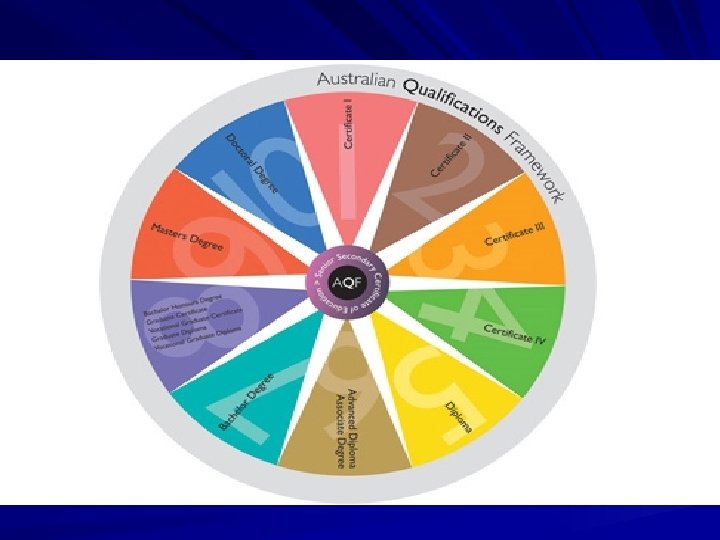



- Slides: 74
Catholic Educational Association of the Philippines (CEAP) First Catholic Higher Education Institutions (CHEI) Conference November 20, 2014 Updates on the Philippine Qualifications Framework (PQF) Jose Y. Cueto Jr. , MD, FPCS, FPSGS, MHPEd Professional Regulatory Board of Medicine Overall Technical Coordinator for the PQF
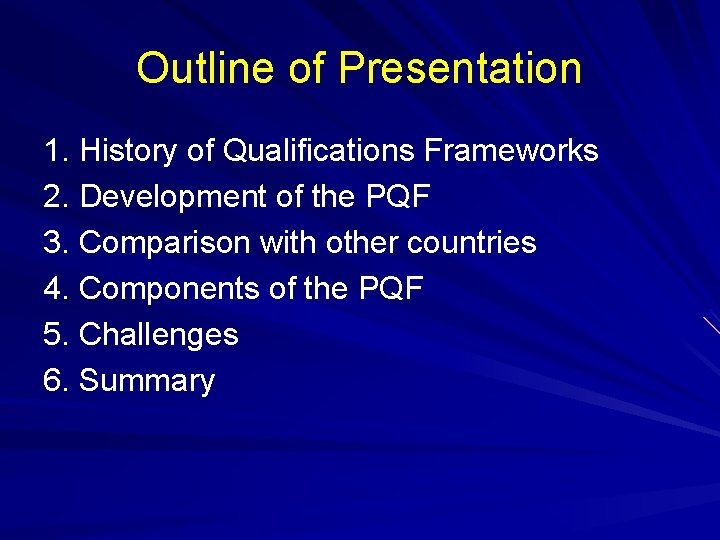
Outline of Presentation 1. History of Qualifications Frameworks 2. Development of the PQF 3. Comparison with other countries 4. Components of the PQF 5. Challenges 6. Summary
Background 1. History of Qualifications Frameworks
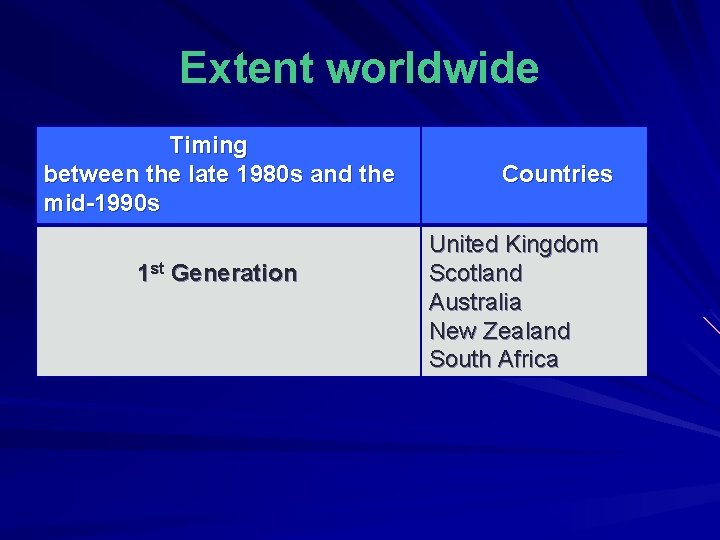
Extent worldwide Timing between the late 1980 s and the mid-1990 s 1 st Generation Countries United Kingdom Scotland Australia New Zealand South Africa
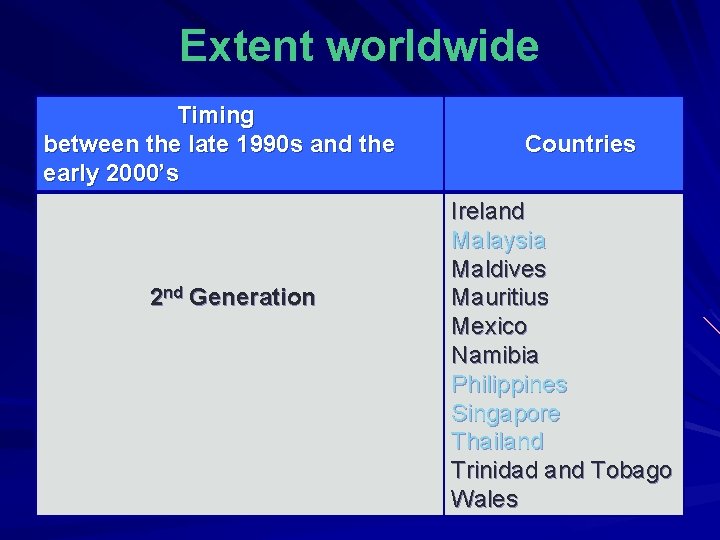
Extent worldwide Timing between the late 1990 s and the early 2000’s 2 nd Generation Countries Ireland Malaysia Maldives Mauritius Mexico Namibia Philippines Singapore Thailand Trinidad and Tobago Wales
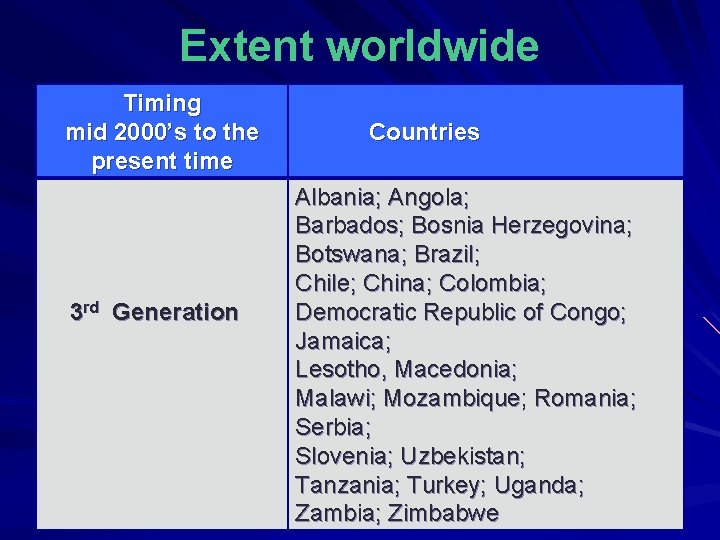
Extent worldwide Timing mid 2000’s to the present time 3 rd Generation Countries Albania; Angola; Barbados; Bosnia Herzegovina; Botswana; Brazil; Chile; China; Colombia; Democratic Republic of Congo; Jamaica; Lesotho, Macedonia; Malawi; Mozambique; Romania; Serbia; Slovenia; Uzbekistan; Tanzania; Turkey; Uganda; Zambia; Zimbabwe
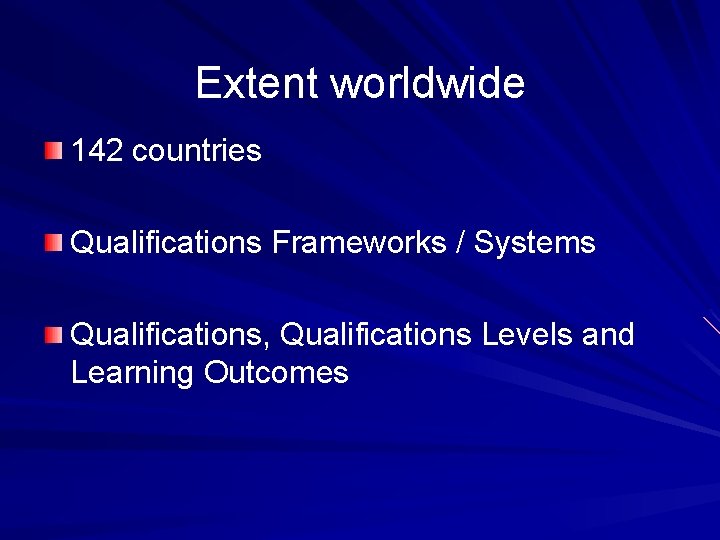
Extent worldwide 142 countries Qualifications Frameworks / Systems Qualifications, Qualifications Levels and Learning Outcomes
2. Development of the Philippine Qualifications Framework
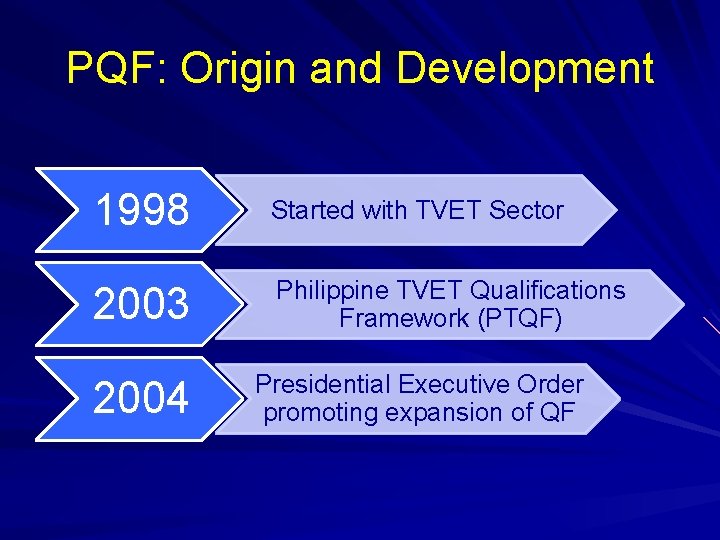
PQF: Origin and Development 1998 Started with TVET Sector 2003 Philippine TVET Qualifications Framework (PTQF) 2004 Presidential Executive Order promoting expansion of QF
His Excellency Benigno S. Aquino III, President of the Republic of the Philippines, signed the Executive Order No. 83 dated October 1, 2012 INSTITUTIONALIZATION OF THE PHILIPPINE QUALIFICATIONS FRAMEWORK FROM THE PRESIDENT’S SONA 2011
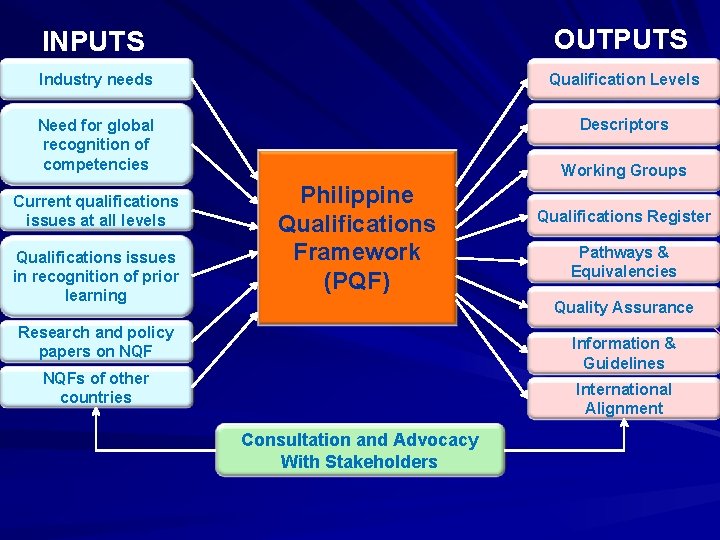
INPUTS OUTPUTS Industry needs Qualification Levels Need for global recognition of competencies Descriptors Current qualifications issues at all levels Qualifications issues in recognition of prior learning Working Groups Philippine Qualifications Framework (PQF) Qualifications Register Pathways & Equivalencies Quality Assurance Research and policy papers on NQF Information & Guidelines NQFs of other countries International Alignment Consultation and Advocacy With Stakeholders
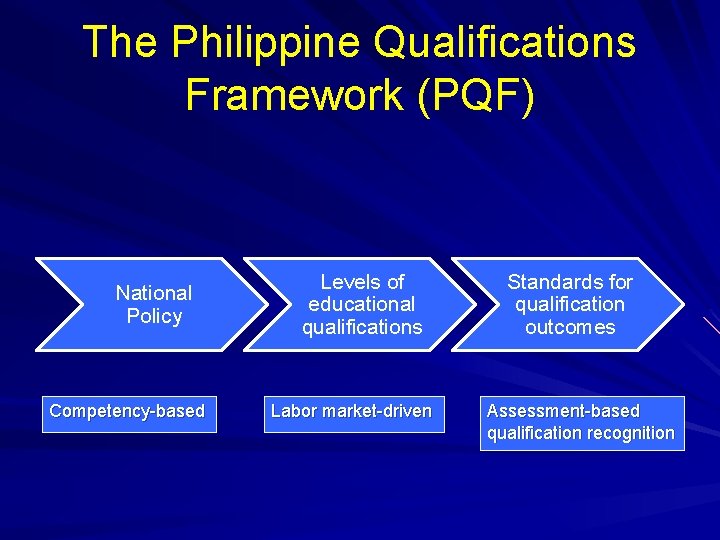
The Philippine Qualifications Framework (PQF) National Policy Competency-based Levels of educational qualifications Labor market-driven Standards for qualification outcomes Assessment-based qualification recognition
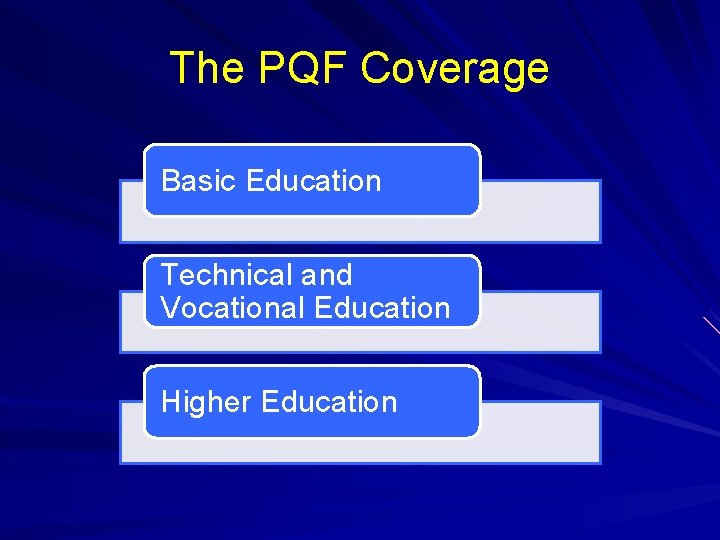
The PQF Coverage Basic Education Technical and Vocational Education Higher Education
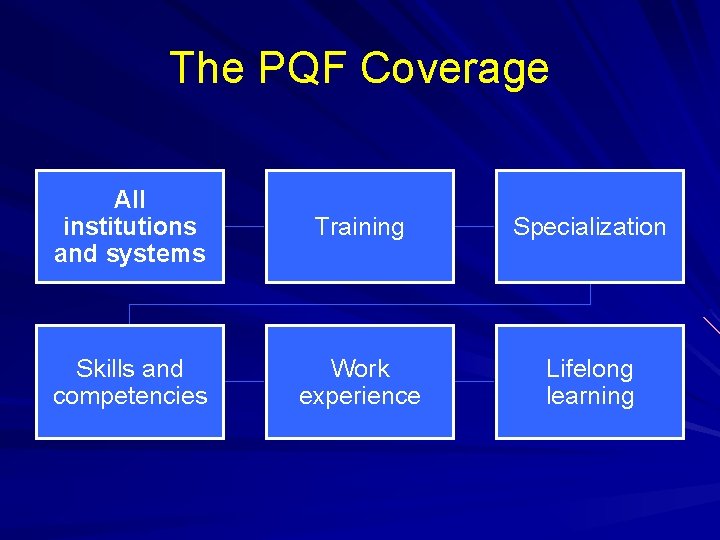
The PQF Coverage All institutions and systems Training Specialization Skills and competencies Work experience Lifelong learning
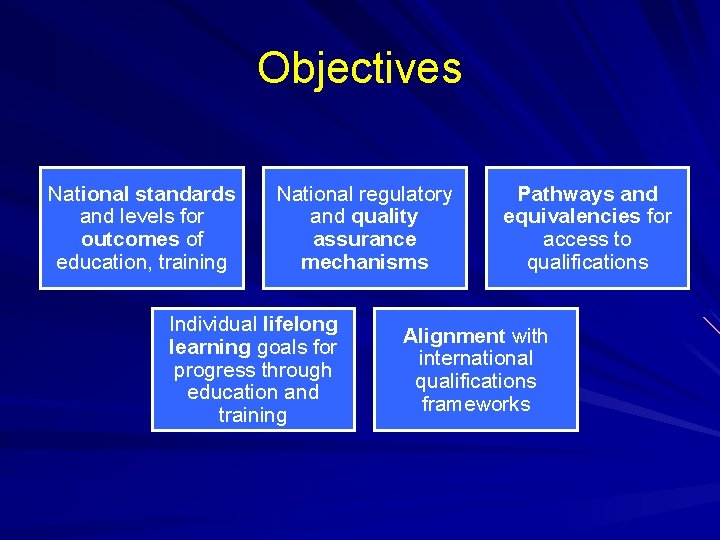
Objectives National standards and levels for outcomes of education, training National regulatory and quality assurance mechanisms Individual lifelong learning goals for progress through education and training Pathways and equivalencies for access to qualifications Alignment with international qualifications frameworks
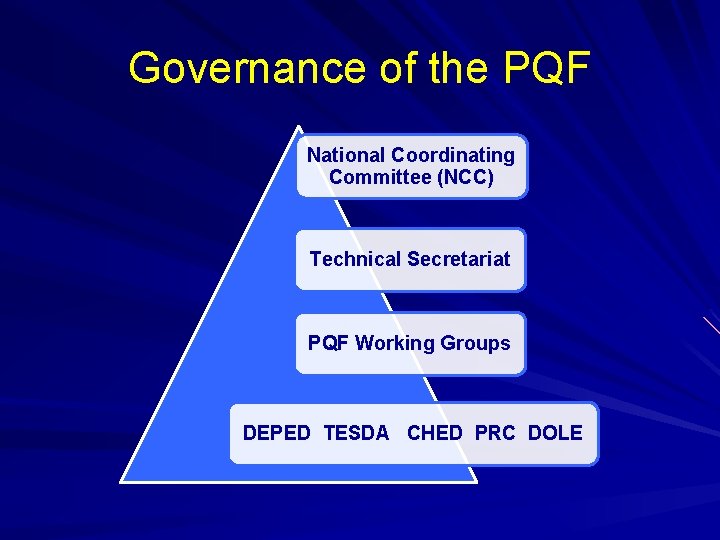
Governance of the PQF National Coordinating Committee (NCC) Technical Secretariat PQF Working Groups DEPED TESDA CHED PRC DOLE
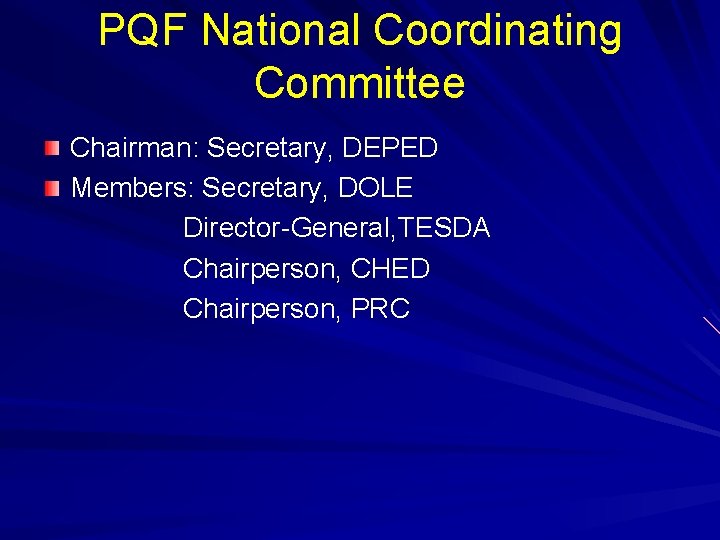
PQF National Coordinating Committee Chairman: Secretary, DEPED Members: Secretary, DOLE Director-General, TESDA Chairperson, CHED Chairperson, PRC
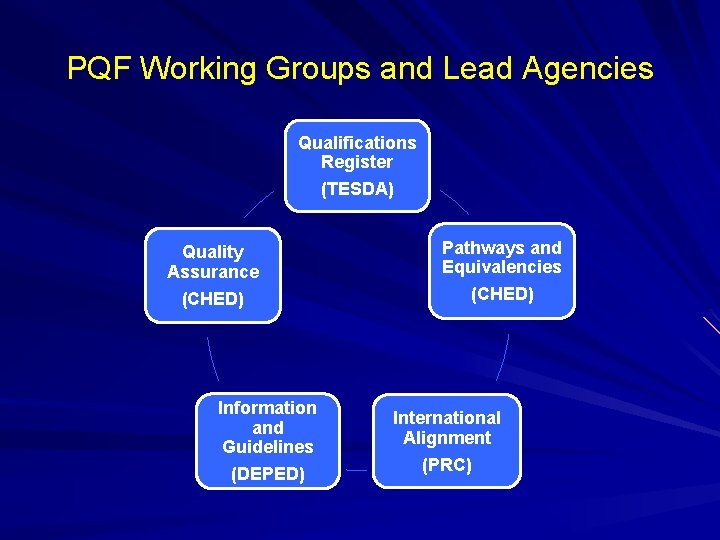
PQF Working Groups and Lead Agencies Qualifications Register (TESDA) Quality Assurance (CHED) Information and Guidelines (DEPED) Pathways and Equivalencies (CHED) International Alignment (PRC)
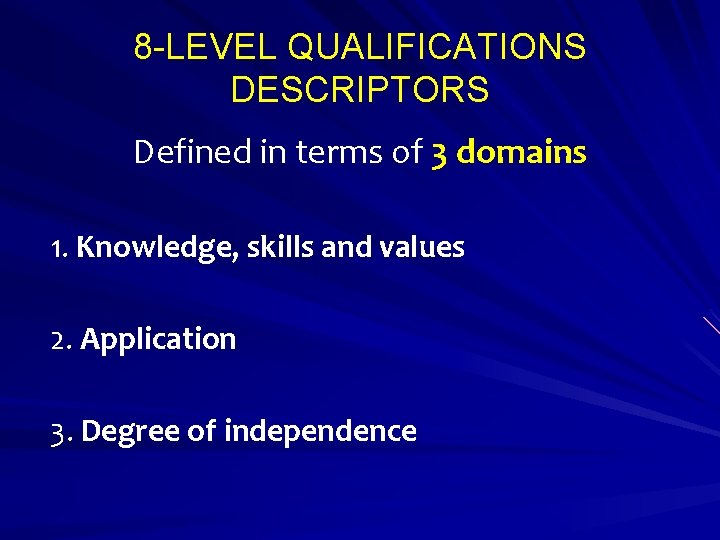
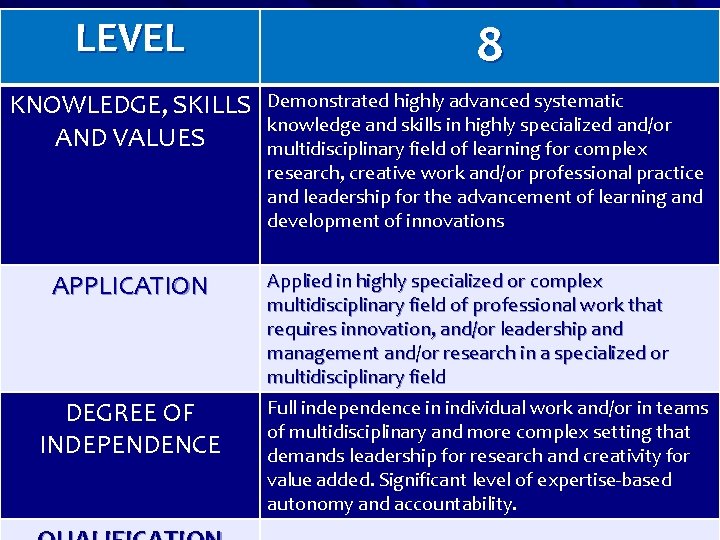
8 -LEVEL QUALIFICATIONS DESCRIPTORS Defined in terms of 3 domains 1. Knowledge, skills and values 2. Application 3. Degree of independence
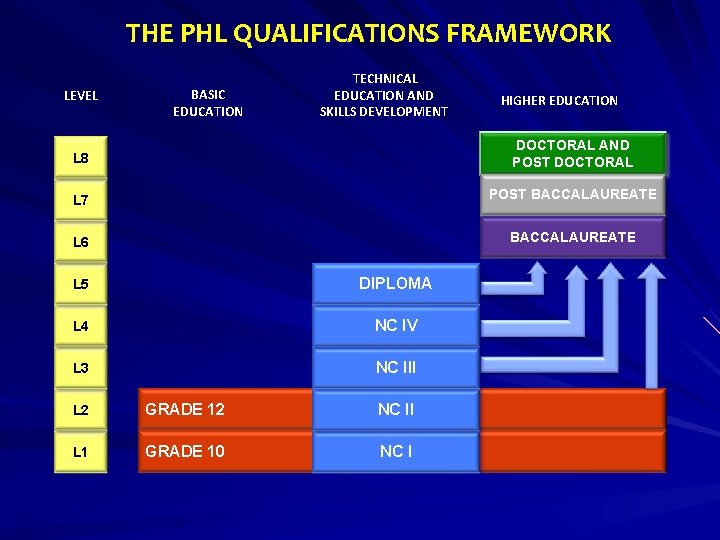
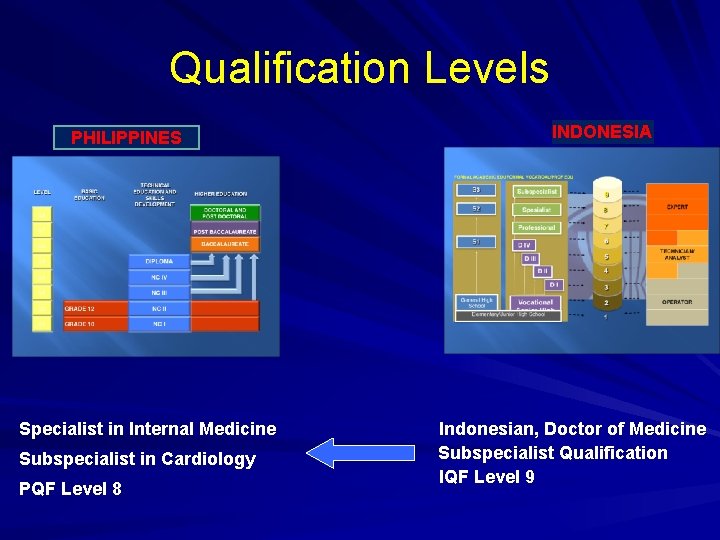
THE PHL QUALIFICATIONS FRAMEWORK LEVEL BASIC EDUCATION TECHNICAL EDUCATION AND SKILLS DEVELOPMENT HIGHER EDUCATION L 8 DOCTORAL AND POST DOCTORAL L 7 POST BACCALAUREATE L 6 L 5 DIPLOMA L 4 NC IV IV NC L 3 NC III L 2 GRADE 12 NC II L 1 GRADE 10 NC I
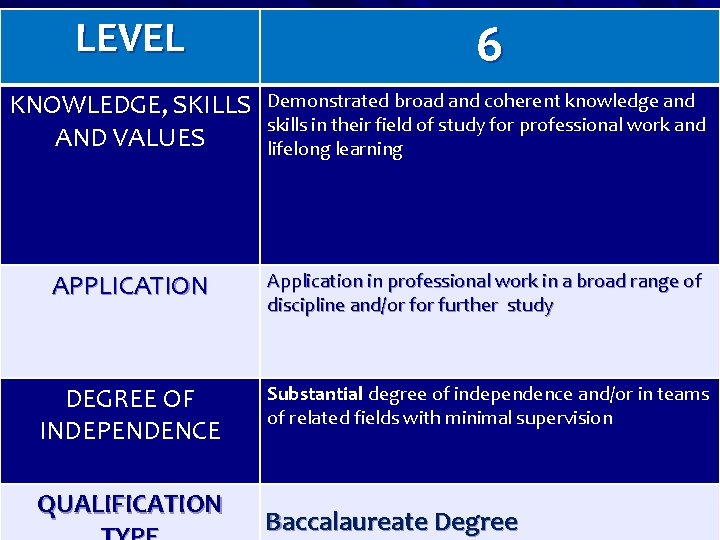
LEVEL 6 KNOWLEDGE, SKILLS AND VALUES Demonstrated broad and coherent knowledge and skills in their field of study for professional work and lifelong learning APPLICATION Application in professional work in a broad range of discipline and/or further study DEGREE OF INDEPENDENCE Substantial degree of independence and/or in teams of related fields with minimal supervision QUALIFICATION Baccalaureate Degree
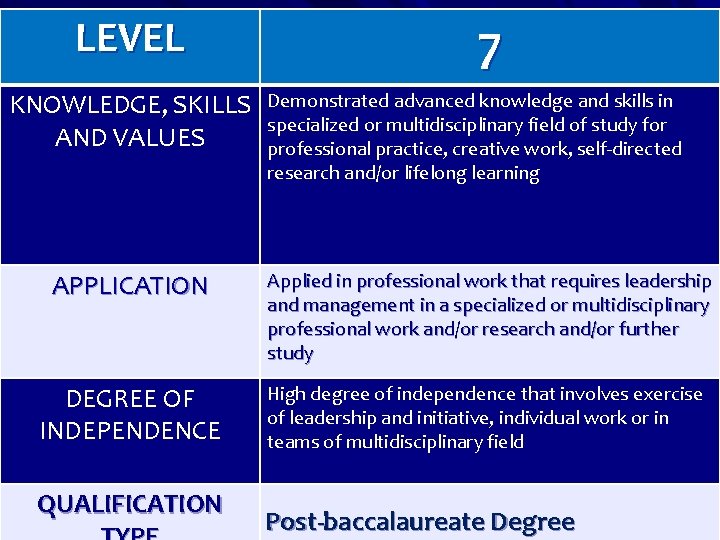
LEVEL KNOWLEDGE, SKILLS AND VALUES 7 Demonstrated advanced knowledge and skills in specialized or multidisciplinary field of study for professional practice, creative work, self-directed research and/or lifelong learning APPLICATION Applied in professional work that requires leadership and management in a specialized or multidisciplinary professional work and/or research and/or further study DEGREE OF INDEPENDENCE High degree of independence that involves exercise of leadership and initiative, individual work or in teams of multidisciplinary field QUALIFICATION Post-baccalaureate Degree
LEVEL 8 KNOWLEDGE, SKILLS AND VALUES Demonstrated highly advanced systematic knowledge and skills in highly specialized and/or multidisciplinary field of learning for complex research, creative work and/or professional practice and leadership for the advancement of learning and development of innovations APPLICATION DEGREE OF INDEPENDENCE Applied in highly specialized or complex multidisciplinary field of professional work that requires innovation, and/or leadership and management and/or research in a specialized or multidisciplinary field Full independence in individual work and/or in teams of multidisciplinary and more complex setting that demands leadership for research and creativity for value added. Significant level of expertise-based autonomy and accountability.
3. Comparison with International Qualifications Frameworks
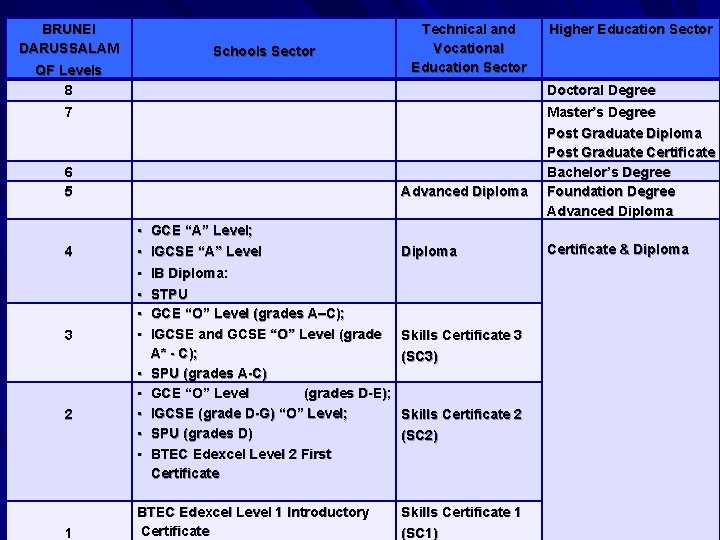
BRUNEI DARUSSALAM Schools Sector QF Levels 8 Technical and Vocational Education Sector Doctoral Degree 7 6 5 4 3 2 1 Higher Education Sector Advanced Diploma • • • GCE “A” Level; IGCSE “A” Level IB Diploma: STPU GCE “O” Level (grades A–C); IGCSE and GCSE “O” Level (grade A* - C); SPU (grades A-C) GCE “O” Level (grades D-E); IGCSE (grade D-G) “O” Level; SPU (grades D) BTEC Edexcel Level 2 First Certificate BTEC Edexcel Level 1 Introductory Certificate Diploma Skills Certificate 3 (SC 3) Skills Certificate 2 (SC 2) Skills Certificate 1 (SC 1) Master’s Degree Post Graduate Diploma Post Graduate Certificate Bachelor’s Degree Foundation Degree Advanced Diploma Certificate & Diploma
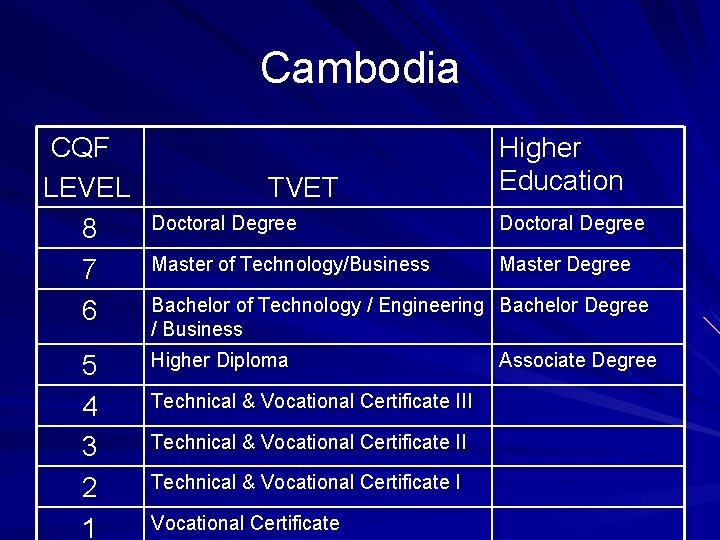
Cambodia CQF LEVEL 8 7 6 5 4 3 2 1 TVET Higher Education Doctoral Degree Master of Technology/Business Master Degree Bachelor of Technology / Engineering Bachelor Degree / Business Higher Diploma Technical & Vocational Certificate III Technical & Vocational Certificate I Vocational Certificate Associate Degree
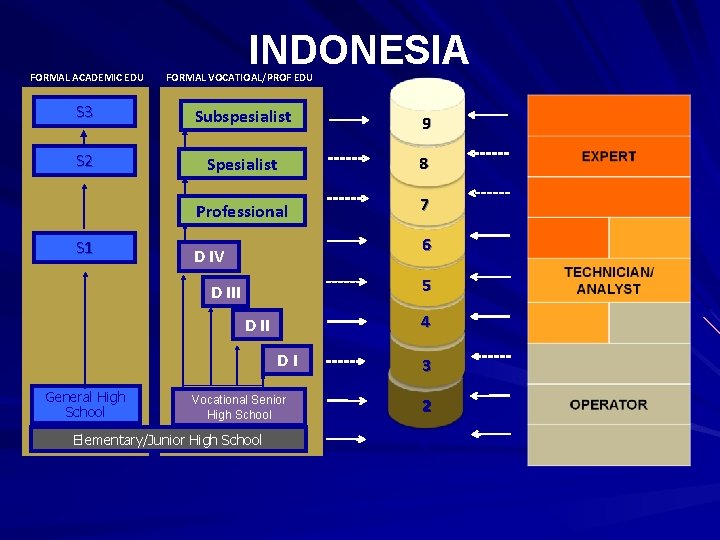
INDONESIA FORMAL ACADEMIC EDU FORMAL VOCATIOAL/PROF EDU S 3 Subspesialist 9 S 2 Spesialist 8 Professional 7 S 1 6 D IV 5 D III 4 D II DI General High School Vocational Senior High School Elementary/Junior High School 3 2 1
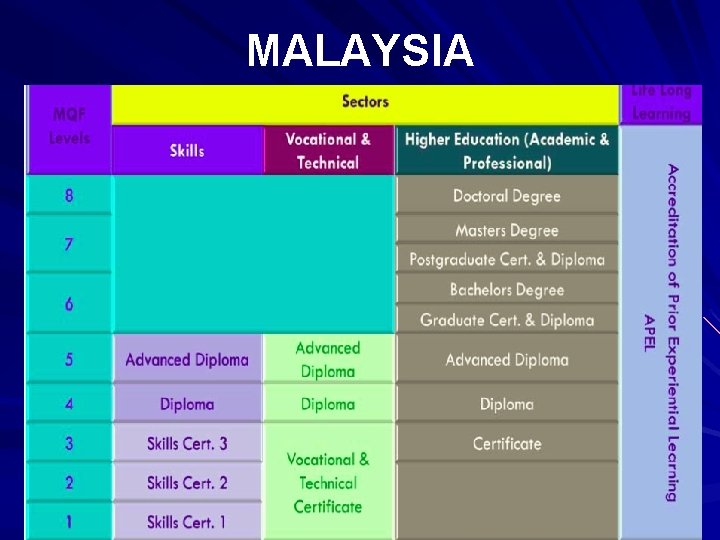
MALAYSIA
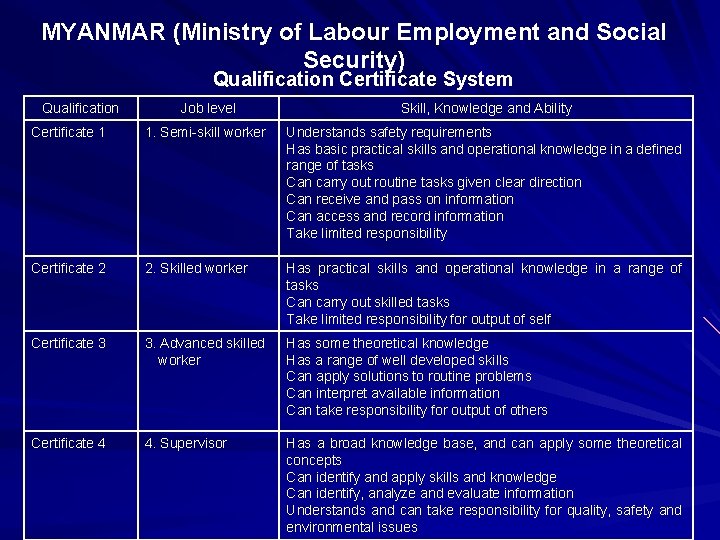
MYANMAR (Ministry of Labour Employment and Social Security) Qualification Certificate System Qualification Job level Skill, Knowledge and Ability Certificate 1 1. Semi-skill worker Understands safety requirements Has basic practical skills and operational knowledge in a defined range of tasks Can carry out routine tasks given clear direction Can receive and pass on information Can access and record information Take limited responsibility Certificate 2 2. Skilled worker Has practical skills and operational knowledge in a range of tasks Can carry out skilled tasks Take limited responsibility for output of self Certificate 3 3. Advanced skilled worker Has some theoretical knowledge Has a range of well developed skills Can apply solutions to routine problems Can interpret available information Can take responsibility for output of others Certificate 4 4. Supervisor Has a broad knowledge base, and can apply some theoretical concepts Can identify and apply skills and knowledge Can identify, analyze and evaluate information Understands and can take responsibility for quality, safety and environmental issues
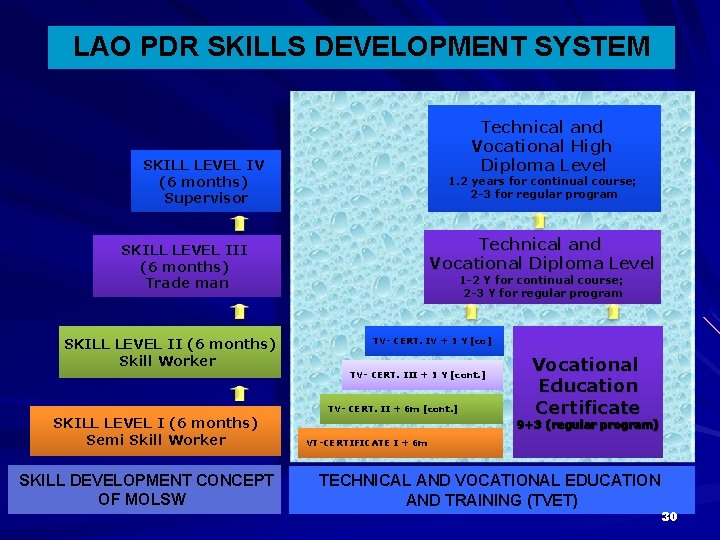
LAO PDR SKILLS DEVELOPMENT SYSTEM Technical and Vocational High Diploma Level SKILL LEVEL IV (6 months) Supervisor 1. 2 years for continual course; 2 -3 for regular program Technical and Vocational Diploma Level SKILL LEVEL III (6 months) Trade man SKILL LEVEL II (6 months) Skill Worker 1 -2 Y for continual course; 2 -3 Y for regular program TV- CERT. IV + 1 Y [co] TV- CERT. III + 1 Y [cont. ] SKILL LEVEL I (6 months) Semi Skill Worker SKILL DEVELOPMENT CONCEPT OF MOLSW TV- CERT. II + 6 m [cont. ] Vocational Education Certificate 9+3 (regular program) VT-CERTIFICATE I + 6 m TECHNICAL AND VOCATIONAL EDUCATION AND TRAINING (TVET) 30
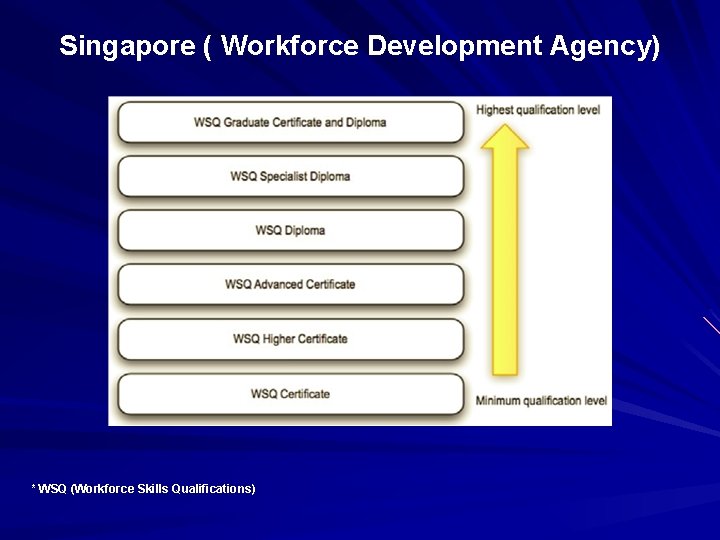
Singapore ( Workforce Development Agency) * WSQ (Workforce Skills Qualifications)
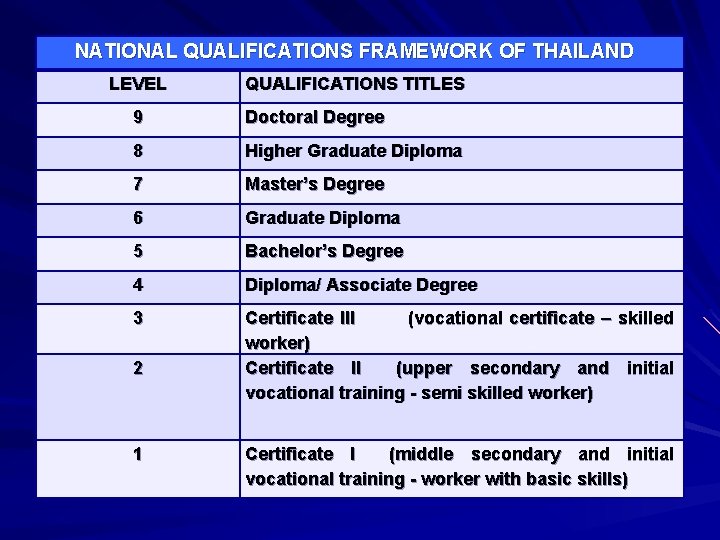
NATIONAL QUALIFICATIONS FRAMEWORK OF THAILAND LEVEL QUALIFICATIONS TITLES 9 Doctoral Degree 8 Higher Graduate Diploma 7 Master’s Degree 6 Graduate Diploma 5 Bachelor’s Degree 4 Diploma/ Associate Degree 3 Certificate III (vocational certificate – skilled worker) Certificate II (upper secondary and initial vocational training - semi skilled worker) 2 1 Certificate I (middle secondary and initial vocational training - worker with basic skills)
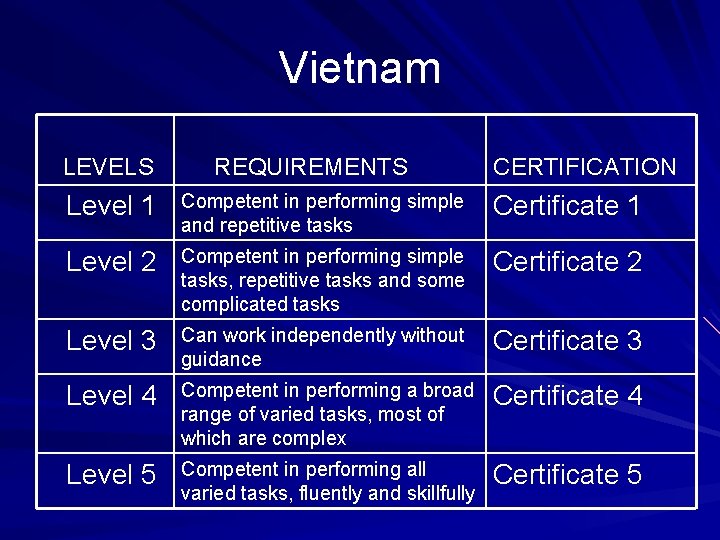
Vietnam LEVELS REQUIREMENTS CERTIFICATION Level 1 Competent in performing simple and repetitive tasks Certificate 1 Level 2 Competent in performing simple tasks, repetitive tasks and some complicated tasks Certificate 2 Level 3 Can work independently without guidance Certificate 3 Level 4 Competent in performing a broad range of varied tasks, most of which are complex Certificate 4 Level 5 Competent in performing all varied tasks, fluently and skillfully Certificate 5
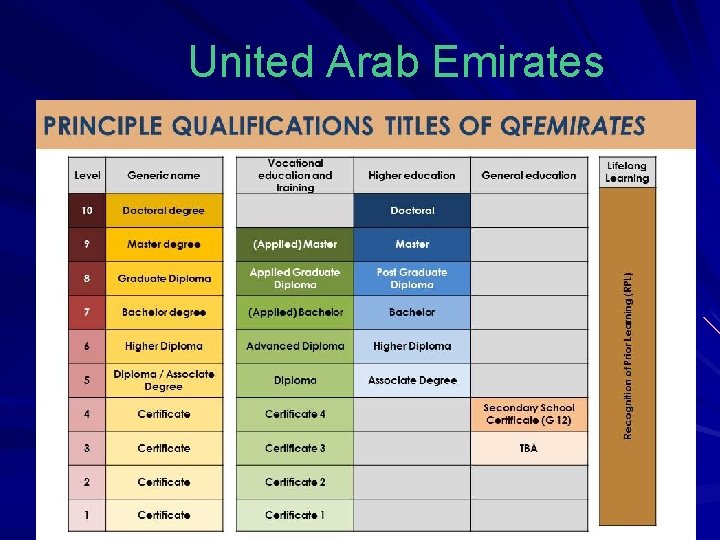
United Arab Emirates
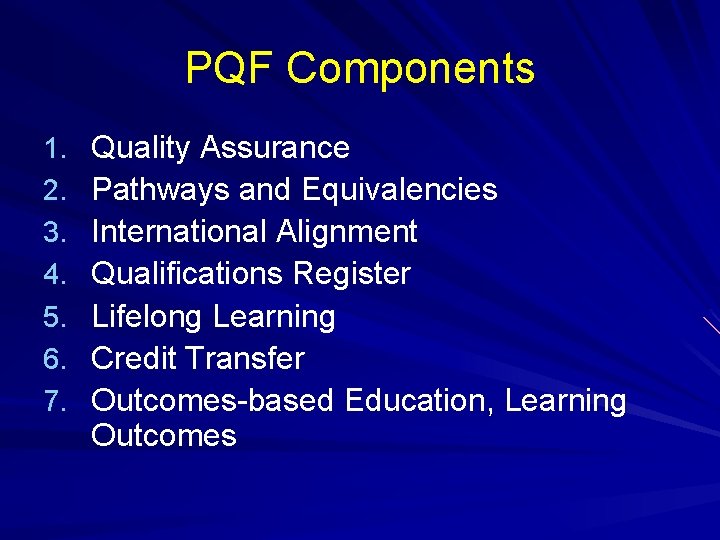
PQF Components 1. 2. 3. 4. 5. 6. 7. Quality Assurance Pathways and Equivalencies International Alignment Qualifications Register Lifelong Learning Credit Transfer Outcomes-based Education, Learning Outcomes
1. Quality Assurance
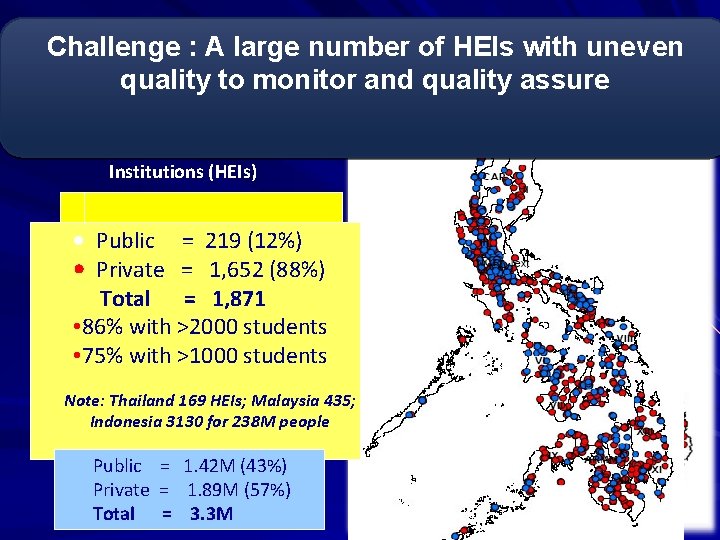
HALLENGE Challenge : A large number of HEIs with uneven quality to monitor and quality assure Distribution of Higher Education Institutions (HEIs) • Public = 219 (12%) (excluding satellite • Private=442 =219 1, 652 (88%) • Public (12%) campuses) • Private = 1, 652 (88%) Total = 1, 871 • 86% with >2000 students • 75% with >1000 students Distribution of Students Note: Thailand 169 HEIs; Malaysia 435; Public = 1. 42 M (43%) Private 3130 = for 1. 89 M Indonesia 238 M(57%) people Public = 1. 42 M (43%) Private = 1. 89 M (57%) Total = 3. 3 M
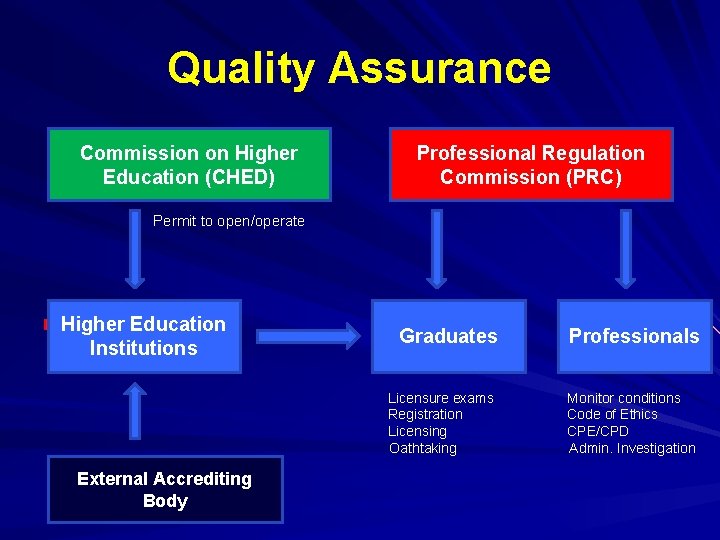
Quality Assurance Commission on Higher Education (CHED) Professional Regulation Commission (PRC) Permit to open/operate Higher Education Institutions External Accrediting Body Graduates Professionals Licensure exams Registration Licensing Oathtaking Monitor conditions Code of Ethics CPE/CPD Admin. Investigation
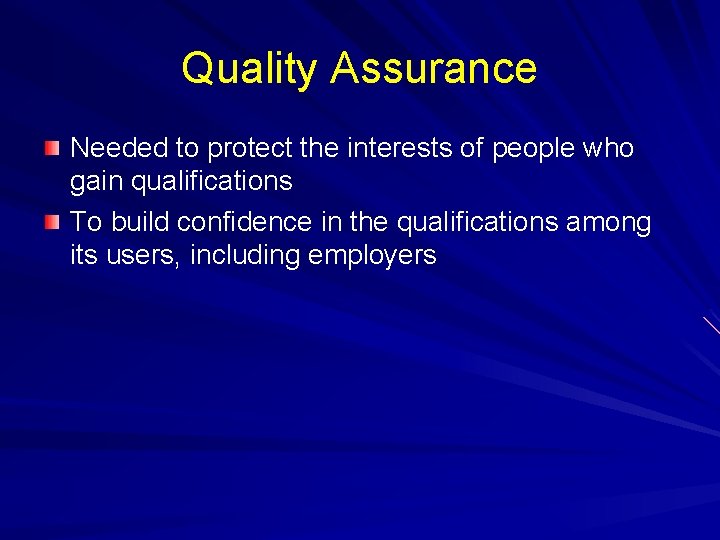
Quality Assurance Needed to protect the interests of people who gain qualifications To build confidence in the qualifications among its users, including employers
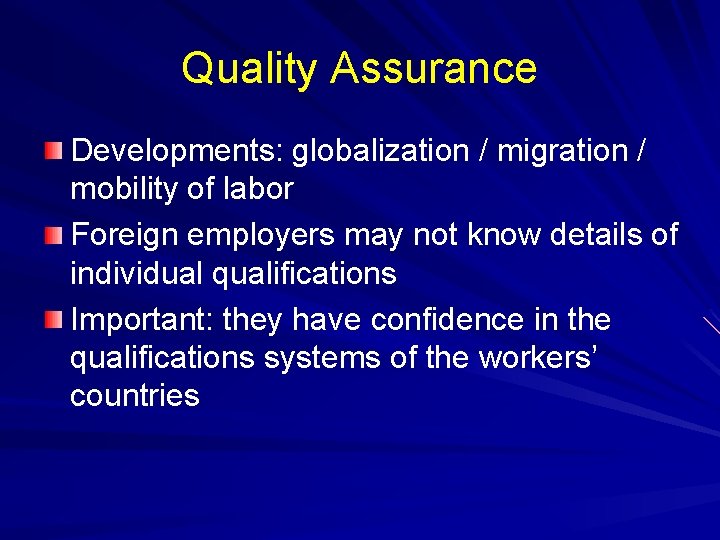
Quality Assurance Developments: globalization / migration / mobility of labor Foreign employers may not know details of individual qualifications Important: they have confidence in the qualifications systems of the workers’ countries
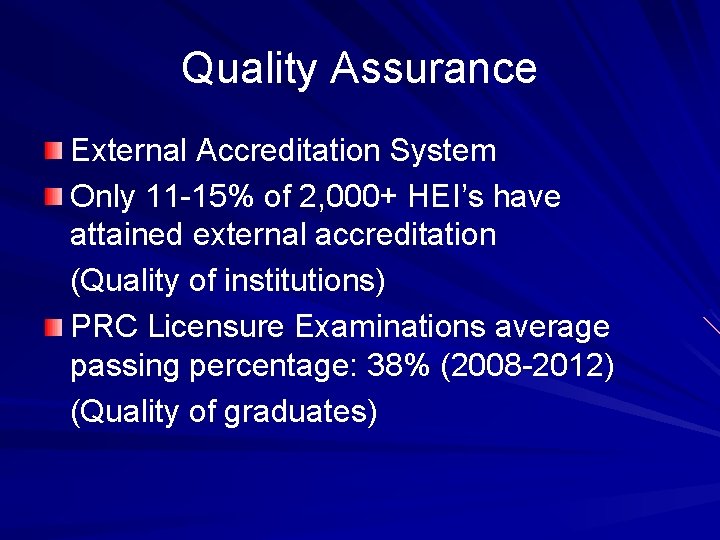
Quality Assurance External Accreditation System Only 11 -15% of 2, 000+ HEI’s have attained external accreditation (Quality of institutions) PRC Licensure Examinations average passing percentage: 38% (2008 -2012) (Quality of graduates)
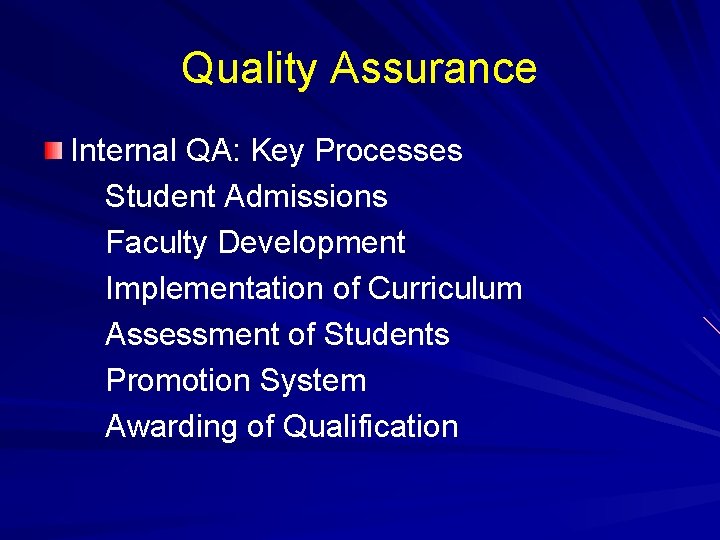
Quality Assurance Internal QA: Key Processes Student Admissions Faculty Development Implementation of Curriculum Assessment of Students Promotion System Awarding of Qualification
Quality Assurance For Regulated Professions Only institutions with a passing percentage equal to or higher than the national passing average can apply for accreditation
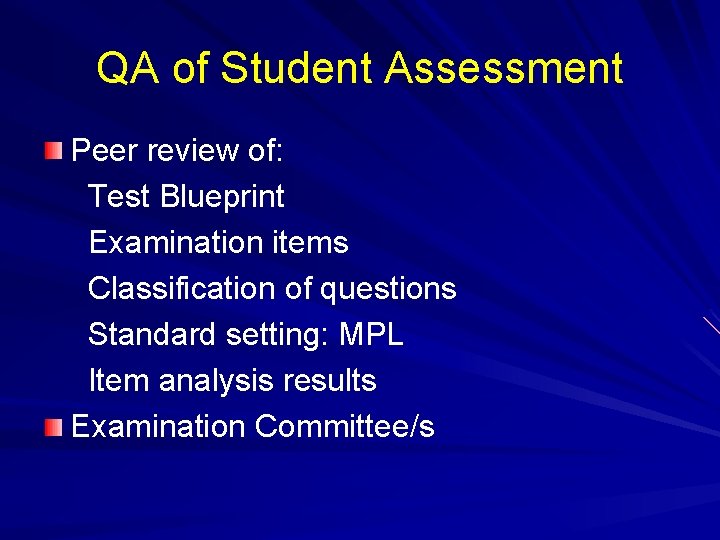
QA of Student Assessment Peer review of: Test Blueprint Examination items Classification of questions Standard setting: MPL Item analysis results Examination Committee/s
2. Pathways and Equivalencies To enable qualifications and learning to relate across areas and levels allowing people to move from one program of learning to another Alternative Learning Systems Expanded Tertiary Education Equivalency and Accreditation Program
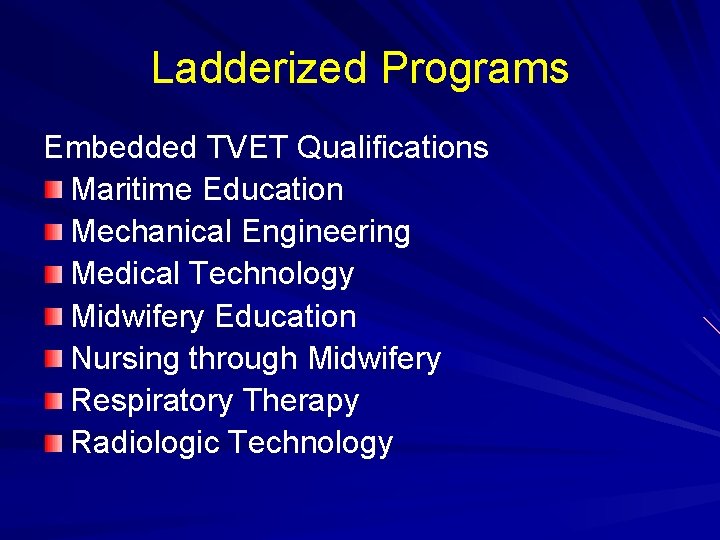
Ladderized Programs Embedded TVET Qualifications Maritime Education Mechanical Engineering Medical Technology Midwifery Education Nursing through Midwifery Respiratory Therapy Radiologic Technology
Linked with Credit Transfer Transition and progression from one course or program to another without duplication of learning under the mechanism of credit accumulation and transfer Philippine Credit Transfer System
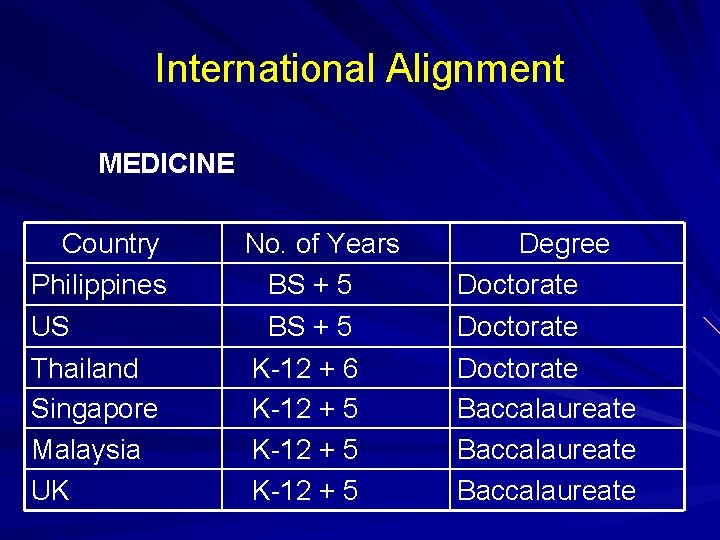
3. International Alignment Three Levels: 1. Education 2. Practice of the Profession 3. Qualifications Frameworks
International Alignment MEDICINE Country Philippines US Thailand Singapore Malaysia UK No. of Years BS + 5 K-12 + 6 K-12 + 5 Degree Doctorate Baccalaureate
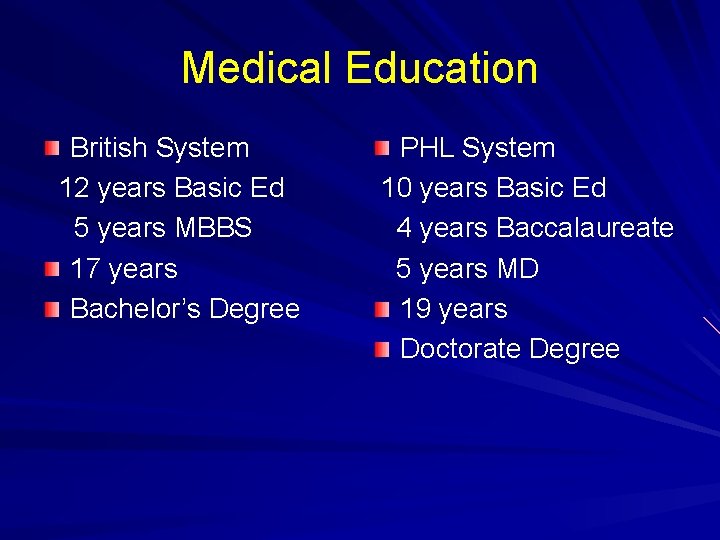
Medical Education British System 12 years Basic Ed 5 years MBBS 17 years Bachelor’s Degree PHL System 10 years Basic Ed 4 years Baccalaureate 5 years MD 19 years Doctorate Degree
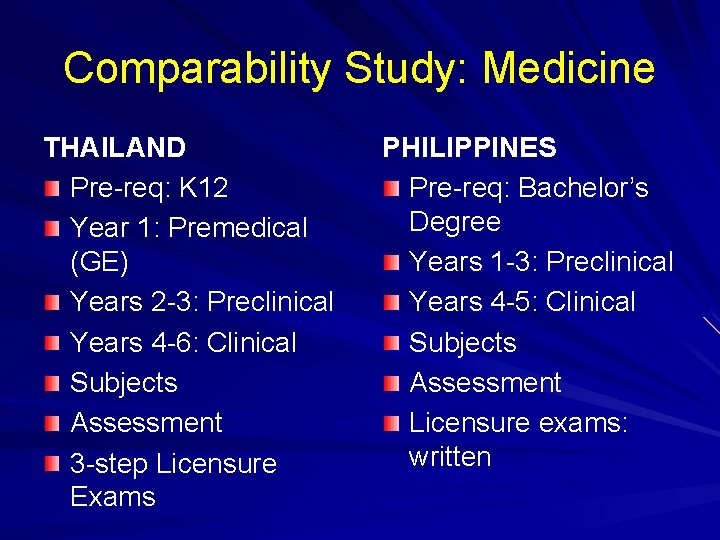
Comparability Study: Medicine THAILAND Pre-req: K 12 Year 1: Premedical (GE) Years 2 -3: Preclinical Years 4 -6: Clinical Subjects Assessment 3 -step Licensure Exams PHILIPPINES Pre-req: Bachelor’s Degree Years 1 -3: Preclinical Years 4 -5: Clinical Subjects Assessment Licensure exams: written
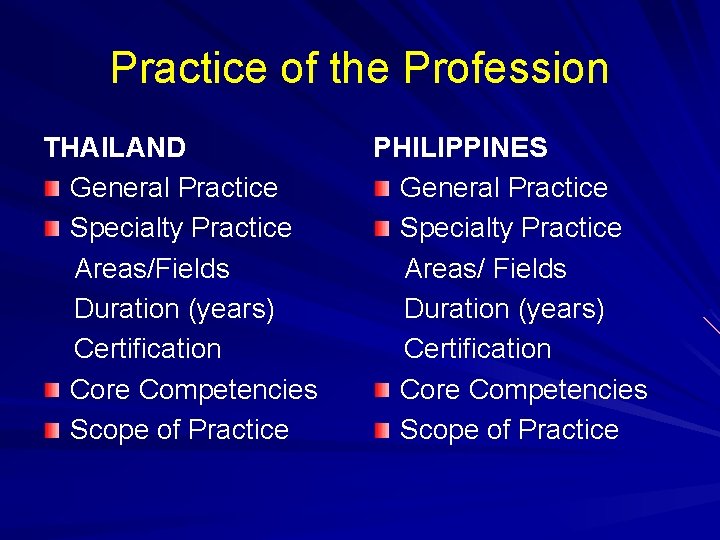
Practice of the Profession THAILAND General Practice Specialty Practice Areas/Fields Duration (years) Certification Core Competencies Scope of Practice PHILIPPINES General Practice Specialty Practice Areas/ Fields Duration (years) Certification Core Competencies Scope of Practice
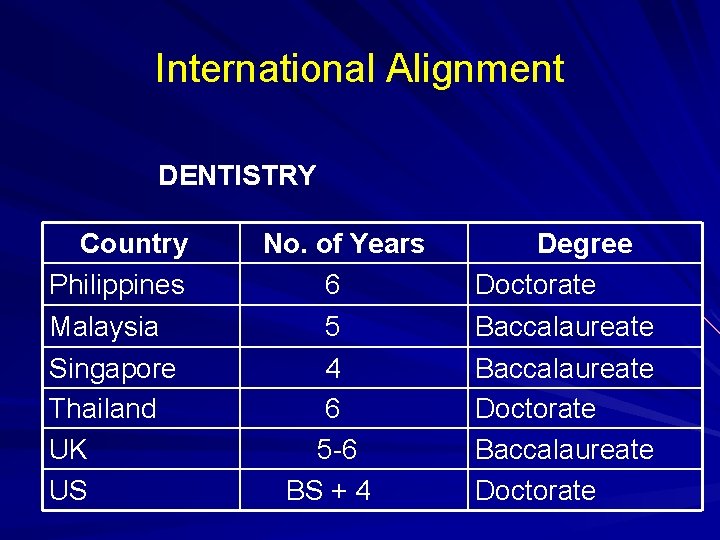
International Alignment DENTISTRY Country Philippines Malaysia Singapore Thailand UK US No. of Years 6 5 4 6 5 -6 BS + 4 Degree Doctorate Baccalaureate Doctorate
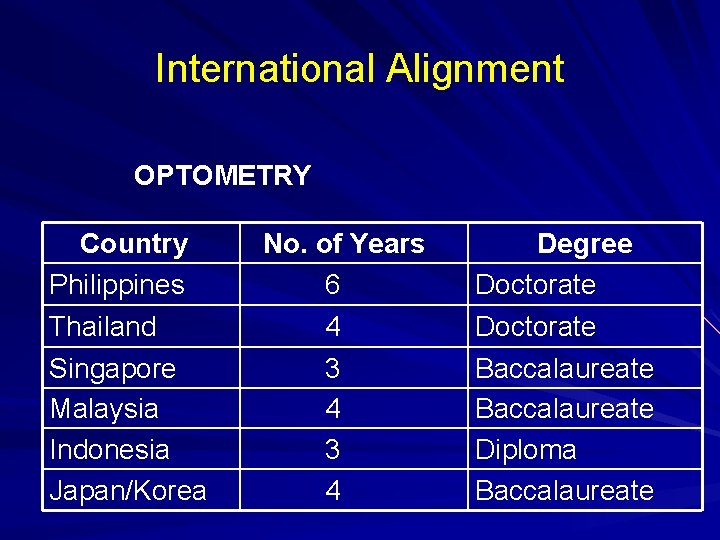
International Alignment OPTOMETRY Country Philippines Thailand Singapore Malaysia Indonesia Japan/Korea No. of Years 6 4 3 4 Degree Doctorate Baccalaureate Diploma Baccalaureate
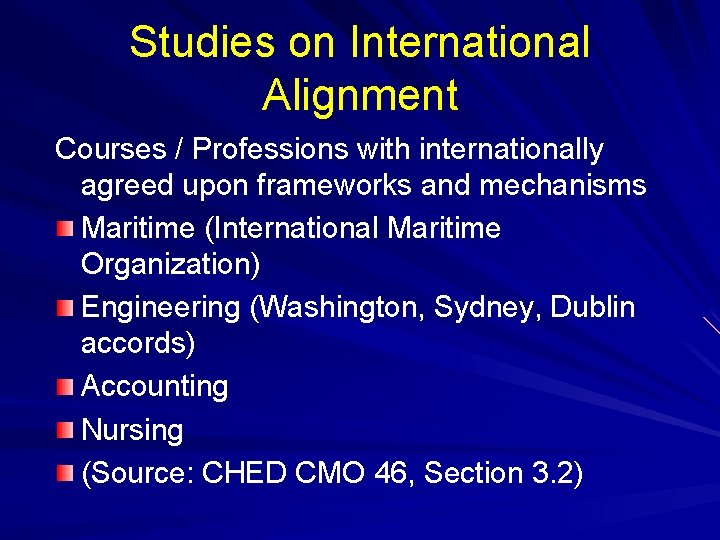
Studies on International Alignment Courses / Professions with internationally agreed upon frameworks and mechanisms Maritime (International Maritime Organization) Engineering (Washington, Sydney, Dublin accords) Accounting Nursing (Source: CHED CMO 46, Section 3. 2)
4. Qualifications Register
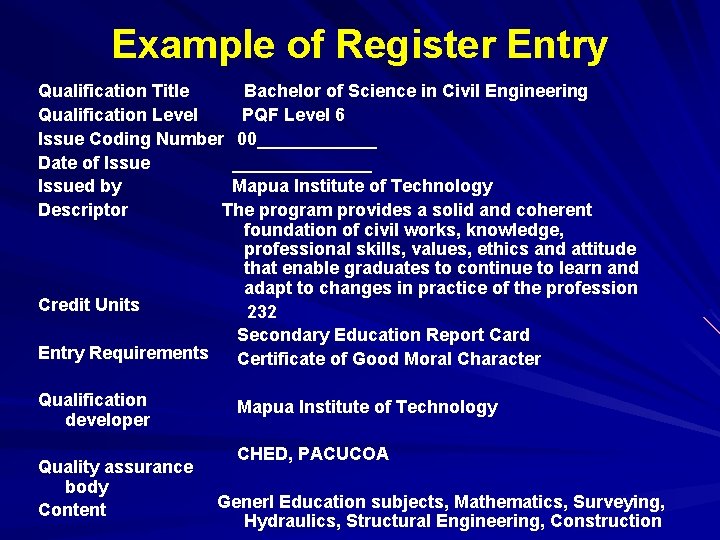
Example of Register Entry Qualification Title Bachelor of Science in Civil Engineering Qualification Level PQF Level 6 Issue Coding Number 00______ Date of Issue _______ Issued by Mapua Institute of Technology Descriptor The program provides a solid and coherent foundation of civil works, knowledge, professional skills, values, ethics and attitude that enable graduates to continue to learn and adapt to changes in practice of the profession Credit Units 232 Secondary Education Report Card Entry Requirements Certificate of Good Moral Character Qualification developer Quality assurance body Content Mapua Institute of Technology CHED, PACUCOA Generl Education subjects, Mathematics, Surveying, Hydraulics, Structural Engineering, Construction
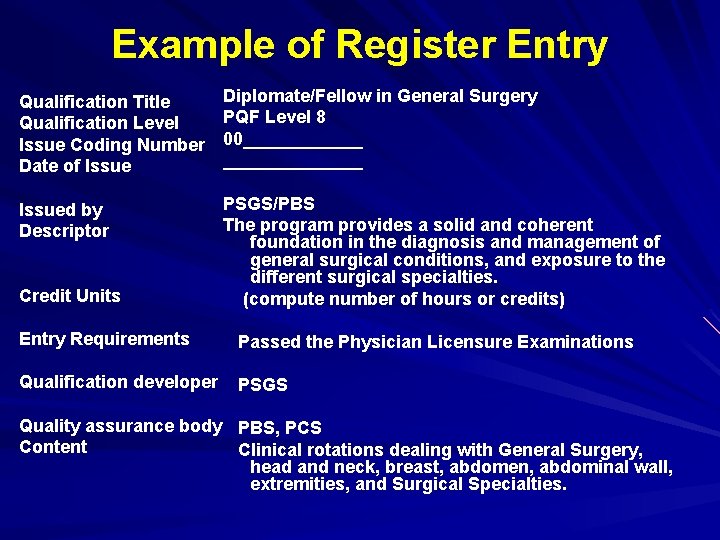
Example of Register Entry Qualification Title Qualification Level Issue Coding Number Date of Issue Diplomate/Fellow in General Surgery PQF Level 8 00_______ Issued by Descriptor PSGS/PBS The program provides a solid and coherent foundation in the diagnosis and management of general surgical conditions, and exposure to the different surgical specialties. (compute number of hours or credits) Credit Units Entry Requirements Passed the Physician Licensure Examinations Qualification developer PSGS Quality assurance body PBS, PCS Content Clinical rotations dealing with General Surgery, head and neck, breast, abdomen, abdominal wall, extremities, and Surgical Specialties.
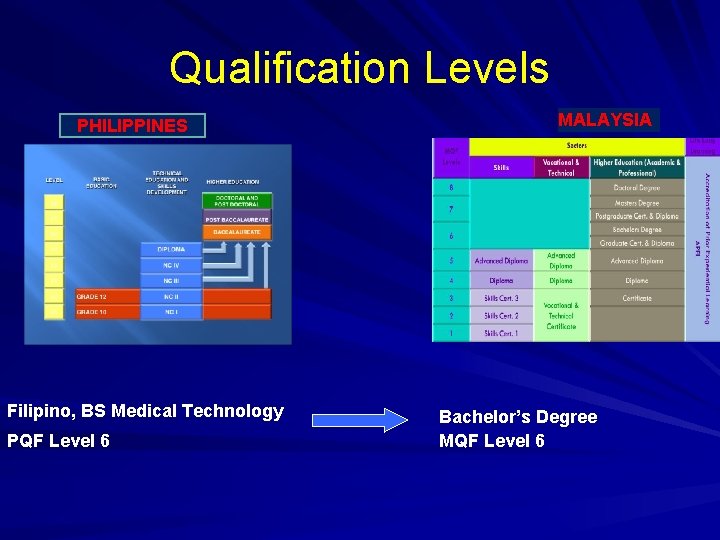
Qualification Levels PHILIPPINES Filipino, BS Medical Technology PQF Level 6 MALAYSIA Bachelor’s Degree MQF Level 6
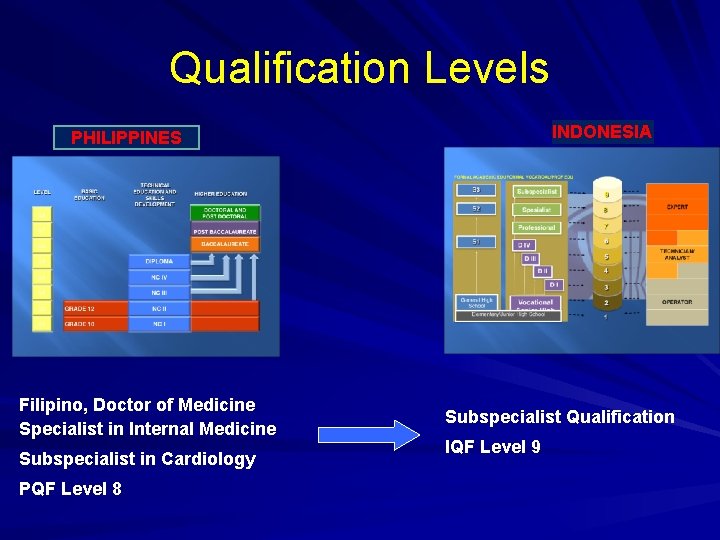
Qualification Levels INDONESIA PHILIPPINES Filipino, Doctor of Medicine Specialist in Internal Medicine Subspecialist in Cardiology PQF Level 8 Subspecialist Qualification IQF Level 9
Qualification Levels PHILIPPINES Specialist in Internal Medicine Subspecialist in Cardiology PQF Level 8 INDONESIA Indonesian, Doctor of Medicine Subspecialist Qualification IQF Level 9
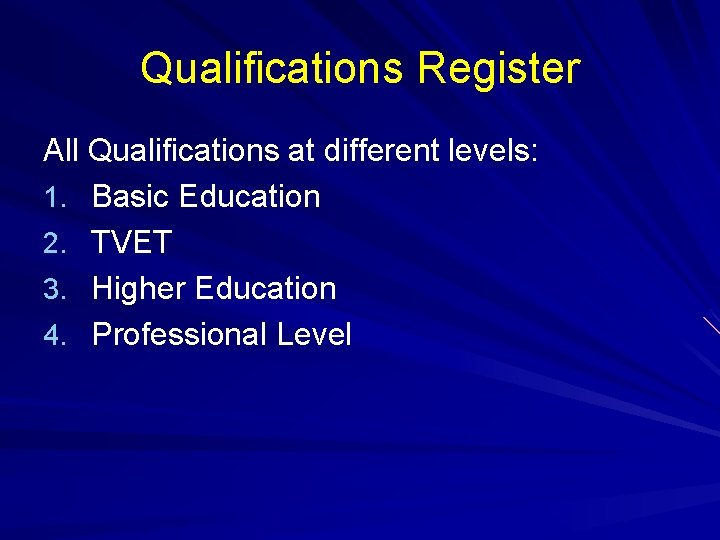
Qualifications Register All Qualifications at different levels: 1. Basic Education 2. TVET 3. Higher Education 4. Professional Level
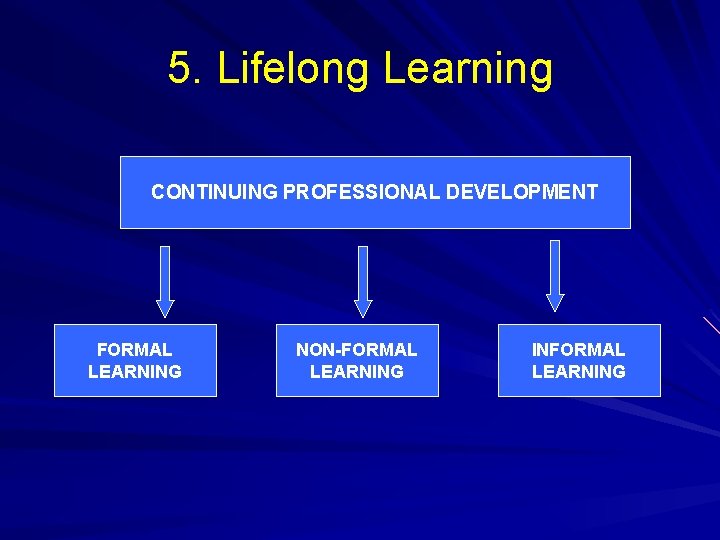
5. Lifelong Learning CONTINUING PROFESSIONAL DEVELOPMENT FORMAL LEARNING NON-FORMAL LEARNING INFORMAL LEARNING
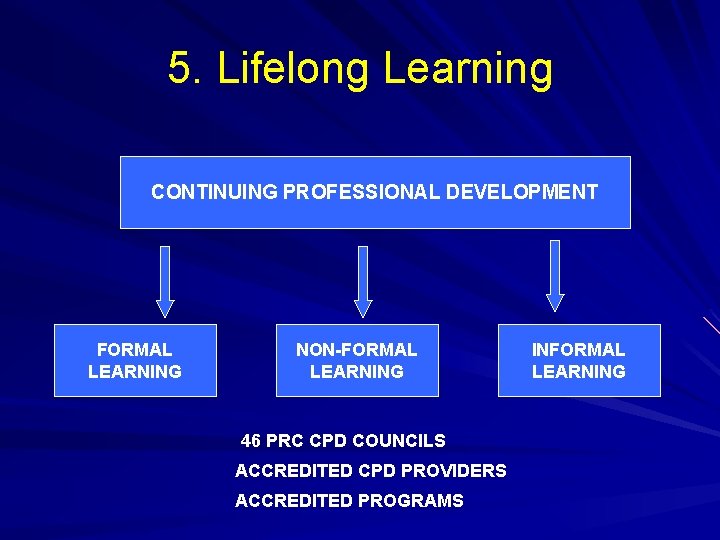
5. Lifelong Learning CONTINUING PROFESSIONAL DEVELOPMENT FORMAL LEARNING NON-FORMAL LEARNING 46 PRC CPD COUNCILS ACCREDITED CPD PROVIDERS ACCREDITED PROGRAMS INFORMAL LEARNING
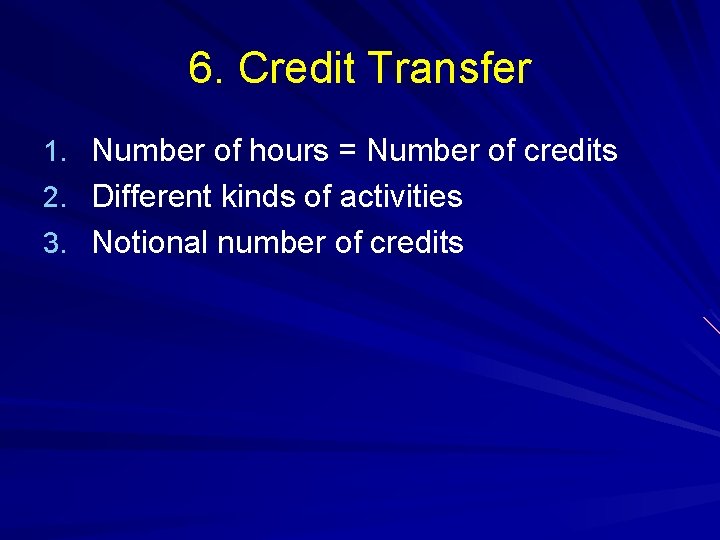
6. Credit Transfer 1. Number of hours = Number of credits 2. Different kinds of activities 3. Notional number of credits
7. Outcomes-based Education
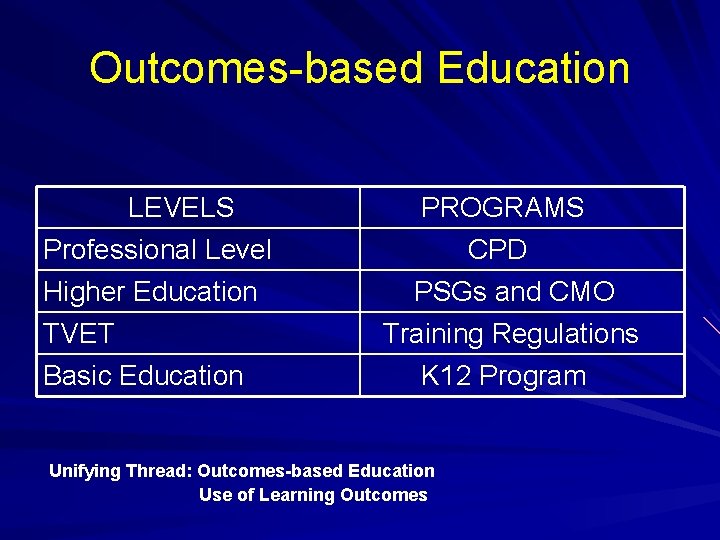
Outcomes-based Education LEVELS Professional Level Higher Education TVET Basic Education PROGRAMS CPD PSGs and CMO Training Regulations K 12 Program Unifying Thread: Outcomes-based Education Use of Learning Outcomes
FUTURE INITIATIVES
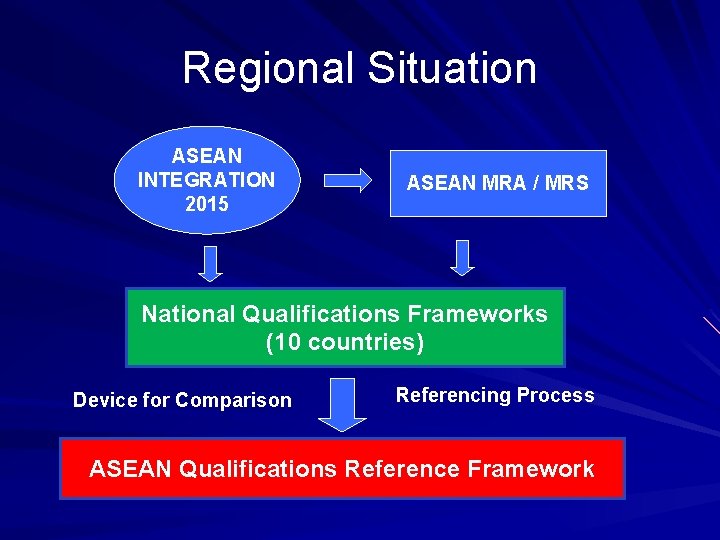
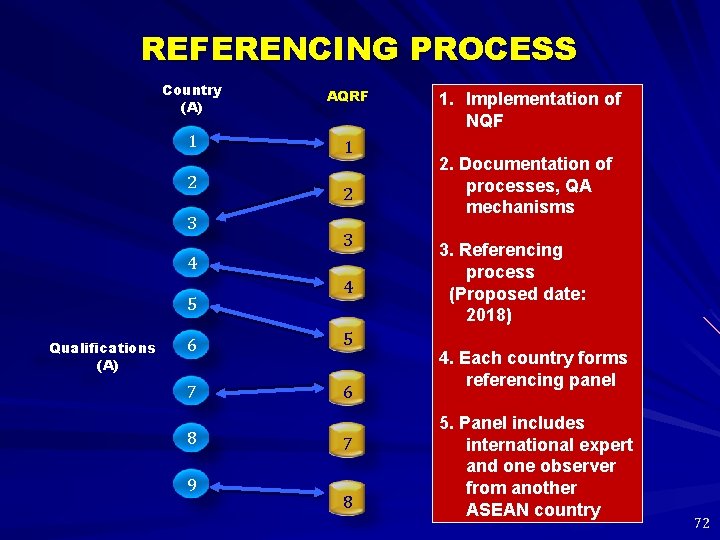
Regional Situation ASEAN INTEGRATION 2015 ASEAN MRA / MRS National Qualifications Frameworks (10 countries) Device for Comparison Referencing Process ASEAN Qualifications Reference Framework
REFERENCING PROCESS Country (A) AQRF 1 1 2 3 4 5 Qualifications (A) 4 6 5 7 6 8 9 7 8 1. Implementation of NQF 2. Documentation of processes, QA mechanisms 3. Referencing process (Proposed date: 2018) 4. Each country forms referencing panel 5. Panel includes international expert and one observer from another ASEAN country 72
SUMMARY
THANK YOU FOR YOUR KIND ATTENTION! Email: jcuetomd@gmail. com