
Catering Theory and Practical N 4 Module 1
- Slides: 65
Catering Theory and Practical N 4
Module 1 – Introduction RECIPES Recipes are basically scientifically balanced ingredient lists with the accompanying step-by-step instructions. Recipes must be written in an easily understandable format, accurately portraying information. Although recipes differ in layout, the most common format include two main components: the ingredient list and the method. www. futuremanagers. com
Module 1 – Introduction (continued) MEASUREMENT There are two important types of measurements in the kitchen: • Ingredient measurement; and • Portion measurement and portion control. www. futuremanagers. com
Module 1 – Introduction (continued) SMALL EQUIPMENT AND KNIVES The correct selection of equipment is essential in the production of a successful, good quality product. Things to consider for cooking and baking equipment includes: • Materials; • Budget; • Quality; and • Heat resistance. www. futuremanagers. com
Module 1 – Introduction (continued) COOKING METHODS A wide variety of cooking methods are available. These can be classified into: • Moist heat methods such as simmering and poaching; • Dry heat methods such as baking and grilling; and • Combination methods such as stir-frying and pot-roasting. www. futuremanagers. com
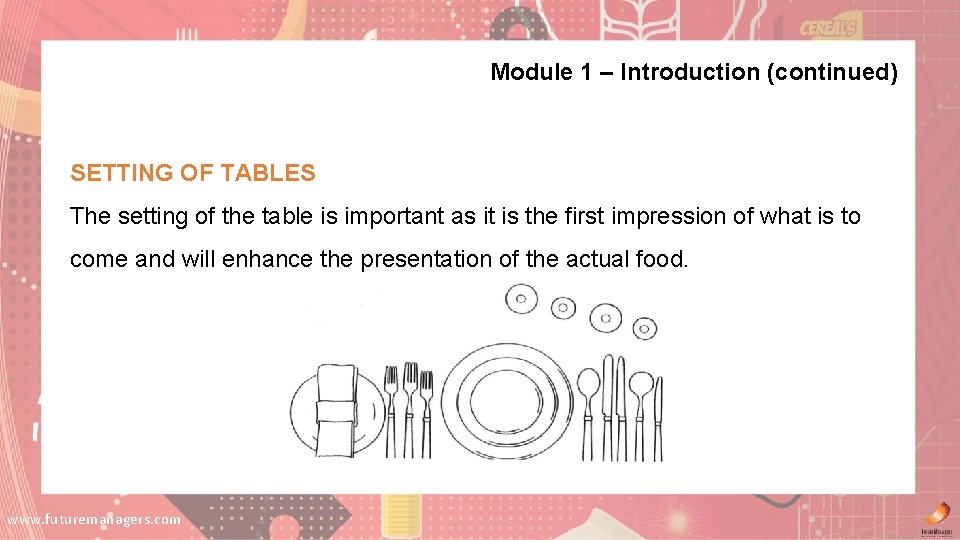
Module 1 – Introduction (continued) SETTING OF TABLES The setting of the table is important as it is the first impression of what is to come and will enhance the presentation of the actual food. www. futuremanagers. com
Module 2 – Food groups: Plant foods FIVE BASIC FOOD GROUPS The five basic food groups are: • Breads and cereals; • Fats and oils; • Milk and dairy products; • Meat and meat alternatives; and • Fruit and vegetables. www. futuremanagers. com
Module 2 – Food groups: Plant foods (continued) FRUIT Fruit is the edible seed-bearing portion of some cultivated or wild shrubs, trees and plants. Fruits can be classified into the following categories: • Hard fruit; • Stone fruit; • Berry/soft fruit’ • Citrus fruit; • Tropical fruit and exotic fruit. www. futuremanagers. com
Module 2 – Food groups: Plant foods (continued) VEGETABLES We eat vegetables mainly for the vitamin and mineral content which promotes holistic well-being. Vegetables can be classified into three categories: • Family; • Colour, flavour and nutrient value; and • Edible parts. www. futuremanagers. com
Module 2 – Food groups: Plant foods (continued) PULSES Pulses are the dried seeds of the legume plant family, which include beans, peas and lentils. Pulses or dried peas and beans, play an important role in low-income diets. www. futuremanagers. com
Module 2 – Food groups: Plant foods (continued) SALADS Salads can be warm or cold and normally consists of a raw or cooked mixture of fruits or vegetables. A traditional salad is made up of 4 components: • Basis – normally a bed of lettuce • Structure – the main ingredient (fruit, meat, vegetables) • Salad dressing – serves as flavouring ingredient (mayonnaise, vinaigrette) • Garnish – to end off the “picture”. www. futuremanagers. com
Module 2 – Food groups: Plant foods (continued) NUTS Nuts are the edible part of seeds from a tree or plant. Nuts are very popular because of their diversity and nutrient value. They are however an expensive ingredient and some people are allergic to them. www. futuremanagers. com
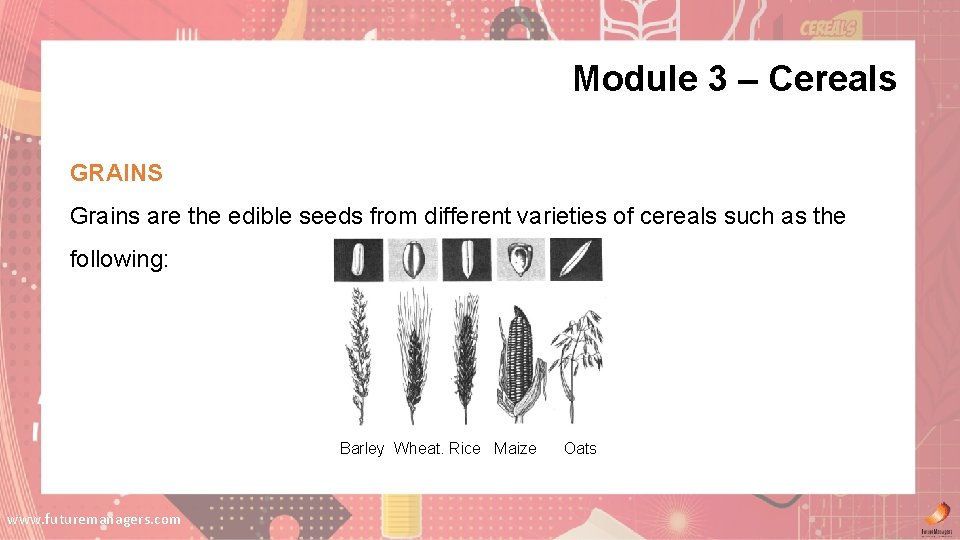
Module 3 – Cereals GRAINS Grains are the edible seeds from different varieties of cereals such as the following: Barley Wheat. Rice Maize www. futuremanagers. com Oats
Module 3 – Cereals (continued) THE IMPORTANCE OF CEREALS Cereals are important in your diet because they are: • Grown in many parts of the world and form the basis of many cultures’ staple food; • Very popular on a menu; • Easy to prepare; • Economic compared to animal products and likely to have a long shelf life; • A source of carbohydrates, proteins, minerals and Vitamin B. www. futuremanagers. com
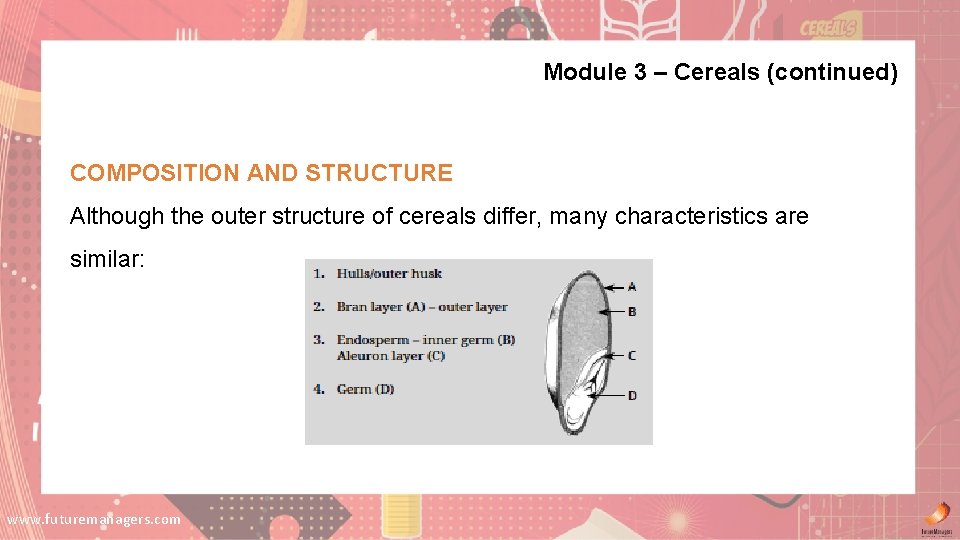
Module 3 – Cereals (continued) COMPOSITION AND STRUCTURE Although the outer structure of cereals differ, many characteristics are similar: www. futuremanagers. com
Module 3 – Cereals (continued) FORMS OF CEREALS • Whole grain – Brown rice, wheat, barley; • Flaked – Samp, pearl barley, mealie rice; • Rolled – Oats; • Shredded – Oats so easy, 1 min oats; • Puffed – Rice Krispies, puffed wheat; • Coarsely ground – Maize meal, semolina; • Finely ground – Flour, maizena. www. futuremanagers. com
Module 3 – Cereals (continued) DIFFERENT TYPES OF CEREALS • Wheat; • Barley; • Rice; • Maize; • Oats; and • Rye. www. futuremanagers. com
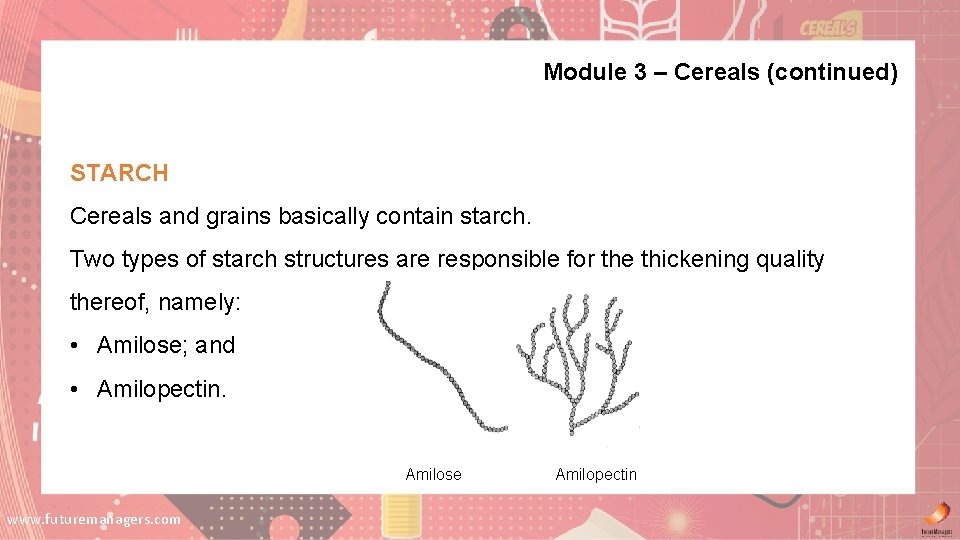
Module 3 – Cereals (continued) STARCH Cereals and grains basically contain starch. Two types of starch structures are responsible for the thickening quality thereof, namely: • Amilose; and • Amilopectin. Amilose www. futuremanagers. com Amilopectin
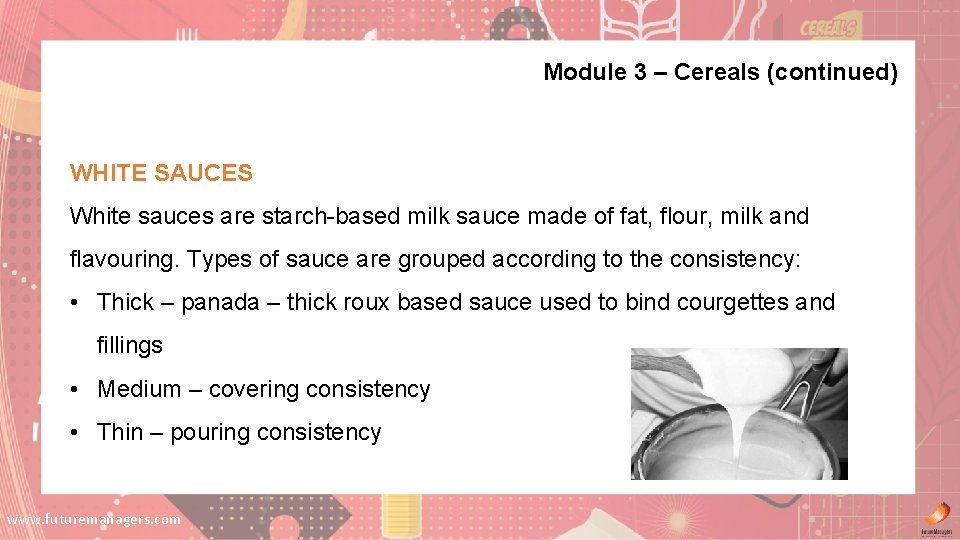
Module 3 – Cereals (continued) WHITE SAUCES White sauces are starch-based milk sauce made of fat, flour, milk and flavouring. Types of sauce are grouped according to the consistency: • Thick – panada – thick roux based sauce used to bind courgettes and fillings • Medium – covering consistency • Thin – pouring consistency www. futuremanagers. com
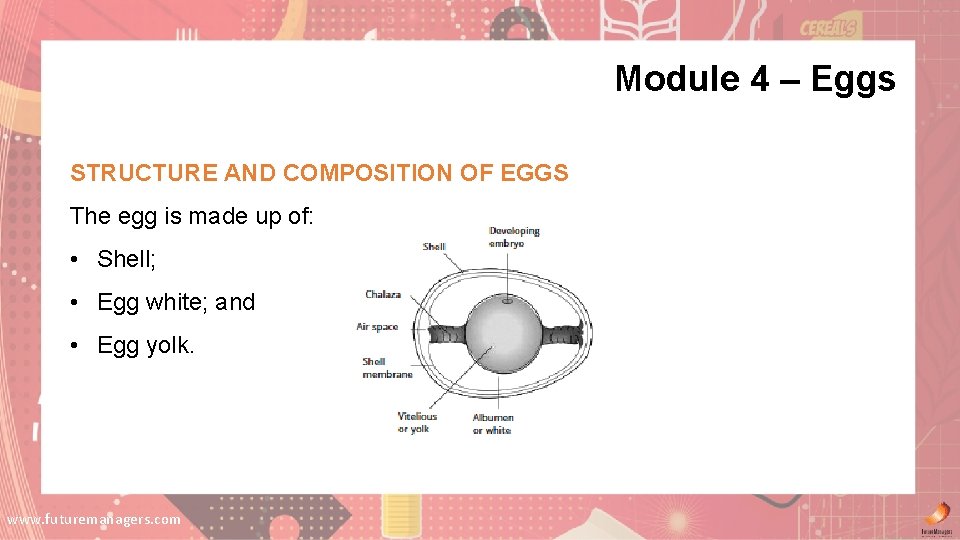
Module 4 – Eggs STRUCTURE AND COMPOSITION OF EGGS The egg is made up of: • Shell; • Egg white; and • Egg yolk. www. futuremanagers. com
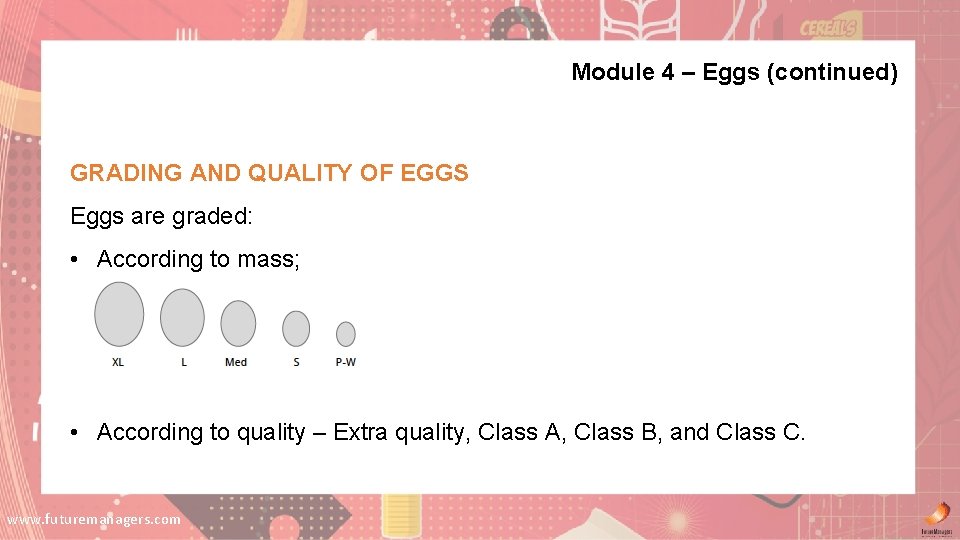
Module 4 – Eggs (continued) GRADING AND QUALITY OF EGGS Eggs are graded: • According to mass; • According to quality – Extra quality, Class A, Class B, and Class C. www. futuremanagers. com
Module 4 – Eggs (continued) TERMS • Denaturation – change in condition from the natural or original form: Takes place due to change in temperatures, change in p. H, and salt. • Coagulation – is the change of a fluid to an elastic, more solid state, because of the application of heat or mechanical stirring. www. futuremanagers. com
Module 4 – Eggs (continued) FUNCTIONS OF EGGS IN THE PREPARATION OF FOOD • Trapping air • Glazing • Thickening • Enriching • Emulsifying • Garnishing • Coating • Clarifying • Binding www. futuremanagers. com
Module 4 – Eggs (continued) STORAGE • Eggs must be stored in their packing trays blunt end upwards. Cover with the cardboard to prevent moisture loss. • Store in a dry, cool place. • Do not store close to strongly smelling foods. • Eggs will normally stay in good condition when stored for 2 -3 weeks. www. futuremanagers. com
Module 4 – Eggs (continued) EFFECTS OF HEAT ON EGGS • Protein coagulates; • Protein shrinks; • Carbonisation; and • Colour changes. www. futuremanagers. com
Module 4 – Eggs (continued) EGG FOAMS Egg foam is obtained by beating eggs which coagulates the egg. Foam is the suspension of air bubbles in a viscous liquid like egg white. Types: • Whole egg foam, • Egg yolk foam, and • Egg white foam. www. futuremanagers. com
Module 4 – Eggs (continued) COOKING METHOD FOR EGG • Poached • Baked • Hard-boiled • Fried • Boiled • Deep-fried • Soft-boiled • Omelette • In cocotte • Scrambled www. futuremanagers. com
Module 4 – Eggs (continued) CUSTARDS Custard forms the base of many sauces and desserts. The main ingredients are egg, milk and flavouring. If it is a sweet custard, sugar is added. There are two types of custard: • The soft, pouring custard; and • The gel-type baked custard. www. futuremanagers. com
Module 4 – Eggs (continued) SOUFFLÉ Soufflé means “blown” or “breath”. Soufflé is the same as puffy omelette. The only difference is that it has a starch-thickened base. To make a soufflé the eggs are separated and yellow is folded into the white sauce/custard sauce. The whites are beaten to soft peak stage and then added to the rest of the mixture. www. futuremanagers. com
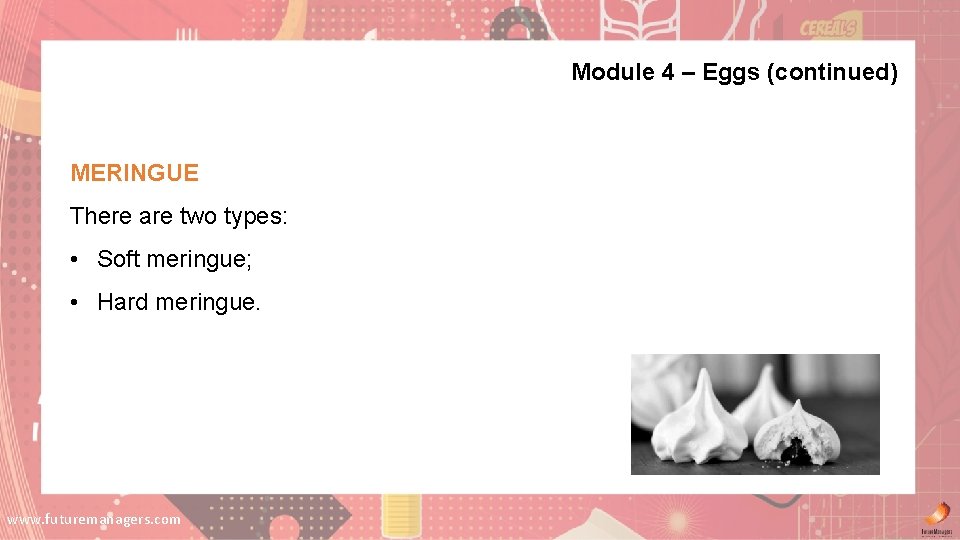
Module 4 – Eggs (continued) MERINGUE There are two types: • Soft meringue; • Hard meringue. www. futuremanagers. com
Module 4 – Eggs (continued) PRESERVATION OF EGGS Processed eggs retain their cooking functions and nutritive values and ensure uniformity in the prepared food products. Preservation methods: • Pasteurisation; • Freezing; and • Drying. www. futuremanagers. com
Module 5 – Dairy DAIRY PRODUCTS – AU LAIT Milk and milk products are known as dairy foods. The main milk products are butter, cream, cheese and yoghurt. Milk is seen as a complete food, because it contains all the nutrients. Milk plays an important role in the diets of children, expecting and breastfeeding mothers. www. futuremanagers. com
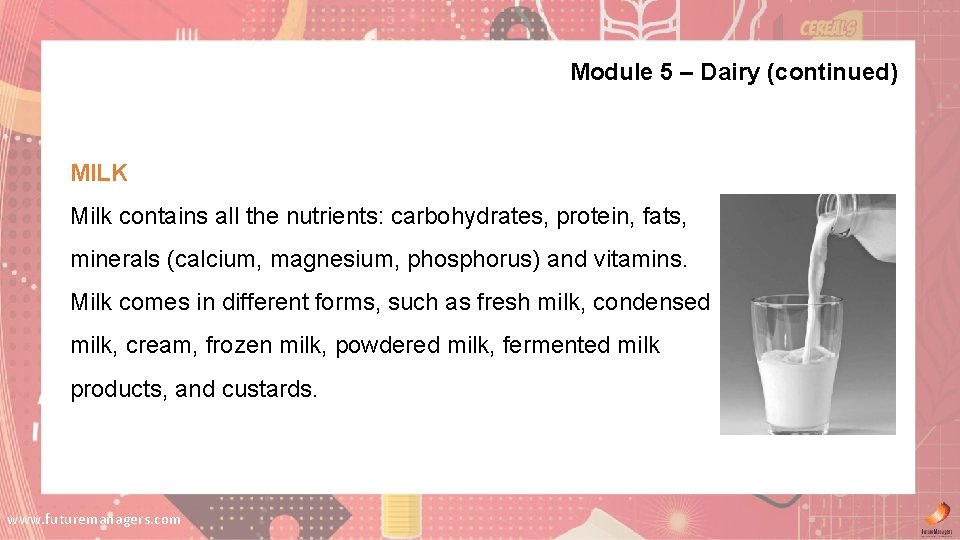
Module 5 – Dairy (continued) MILK Milk contains all the nutrients: carbohydrates, protein, fats, minerals (calcium, magnesium, phosphorus) and vitamins. Milk comes in different forms, such as fresh milk, condensed milk, cream, frozen milk, powdered milk, fermented milk products, and custards. www. futuremanagers. com
Module 5 – Dairy (continued) CHEESE (FROMAGE) Cheese is made from the milk of cows, goats, sheep, buffalo, donkeys and camels. Most cheeses are manufactured from either cow’s, goat’s or sheep’s milk. Cheese can be arranged according to three categories, and when purchasing cheese, one should consider the following: • Price; • Eating quality; and • Reaction processes during heating. www. futuremanagers. com
Module 6 – Fish CLASSIFICATION OF FISH Seafood is usually classified according to anatomy. There are two main groups: • Vertebrate (fish with a skeleton); and • Invertebrate (fish without a skeleton). Shellfish is divided into two groups: • Molluscs; and • Crustaceans. www. futuremanagers. com
Module 6 – Fish (continued) COMMON SOUTH AFRICAN FISH AND SEAFOOD Vertebrates: • Saltwater oily: Black Fish/Galjoen, Snoek, Anchovy; • Saltwater moderately oily: Codfish, Cape Salmon, Mullet; • Saltwater white fish: Sole, Hake, Kingklip; • Freshwater: Trout/Salmon, Cape, Mackerel. www. futuremanagers. com
Module 6 – Fish (continued) COMMON SOUTH AFRICAN FISH AND SEAFOOD Invertebrates: • Shellfish: • Molluscs: Arniston, Periwinkle, Mussels; • Crustaceans: Crab, Lobster, Crayfish. www. futuremanagers. com
Module 6 – Fish (continued) QUALITY SELECTION POINTS Pay attention to the following: • Whole fresh fish: Smell, scales, eyes, gills, flesh, skin; • Cuts of fish: Good colour, firm to the touch, no sickness, pleasant smell; • Frozen: Unthawed, enhanced coating of ice, no dryness & discolouration, sturdy packaging, no freezer burn, no ice crystal in wrapping; • Smoked: Flesh firm, flesh dry but not brittle, smoked smell. www. futuremanagers. com
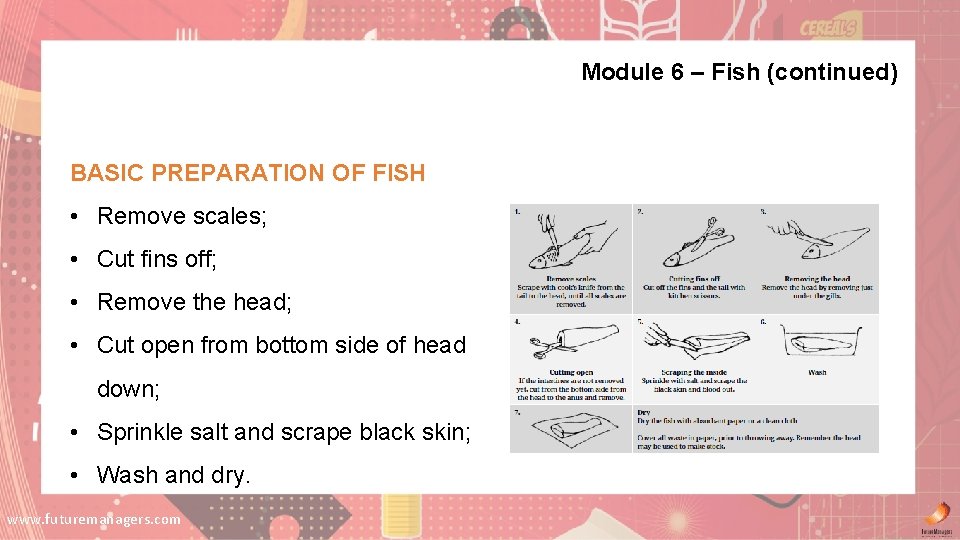
Module 6 – Fish (continued) BASIC PREPARATION OF FISH • Remove scales; • Cut fins off; • Remove the head; • Cut open from bottom side of head down; • Sprinkle salt and scrape black skin; • Wash and dry. www. futuremanagers. com
Module 6 – Fish (continued) COOKING OF FISH Fish is mainly cooked to develop its flavour. It is important not to overcook fish as the protein easily become tough and the flesh dry. Usually the cooking method is chosen according to the fat content of the fish. Fish with high fat content is usually cooked by dry heat methods while it is better to use a moist heating method to cook white fish. www. futuremanagers. com
Module 6 – Fish (continued) GARNISHES AND ACCOMPANIMENTS The garnish must be chosen not only to enhance the appearance, but also to bring out the flavour of the dish, and to complement the texture of the dish. For fish, lemon and parsley are essential garnishes. There is no limit to the sauces that can be served with fish as accompaniments. www. futuremanagers. com
Module 6 – Fish (continued) CUTS AND FORMS IN WHICH FISH ARE SOLD • Fresh fish; • Pickled fish; and • Frozen; • Processed fish. • Salted and dried fish; • Smoked fish; • Canned fish; • Soused fish; www. futuremanagers. com
Module 7 – Poultry COMPOSITION The basic structure of the meat of poultry is the same as that of red meat; that is bone, connective tissue, muscle, and fat. The meat of poultry is mainly composed of water, protein and fat. www. futuremanagers. com
Module 7 – Poultry (continued) CLASSIFICATION Chickens are classified by growth, age, sex and mainly weight. There are: • Spring chickens; • Roasters; • Capons; and • Boilers. www. futuremanagers. com
Module 7 – Poultry (continued) QUALITY AND CHOICE Frozen poultry is readily available and is cheaper and more standard than fresh. Some weight loss occurs on thawing. Fresh poultry is considered to be of a better quality and should be used if your customers are prepared to pay a little more for the dish. www. futuremanagers. com
Module 7 – Poultry (continued) MARKETING FORMS Poultry may be bought in one of the following forms: • Whole; • Processed; and • Halves and sometimes quarters; • Giblets. • Portions; • Frozen crumbed or battered portions; • Patties; www. futuremanagers. com
Module 7 – Poultry (continued) STORAGE All poultry is highly perishable. Care should be taken during cleaning, preparing, cooking, cooling and storing to prevent unnecessary growth of micro-organisms. Raw poultry can be kept refrigerated for two days in the coldest part of refrigerator otherwise it should be frozen. Poultry must be frozen in sealed, air-tight containers. www. futuremanagers. com
Module 7 – Poultry (continued) WORK ORGANISATION, HYGIENE AND SAFETY In general, armature windings can be divided into two groups, depending on the manner in which the windings (coils) are connected to the commutator. The two groups are: • Lap windings; and • Wave windings. www. futuremanagers. com
Module 7 – Poultry (continued) GENERAL PREPARATION OF POULTRY • Cleaning; • Stuffing; • Trussing; • Cooking; and • Carving. www. futuremanagers. com
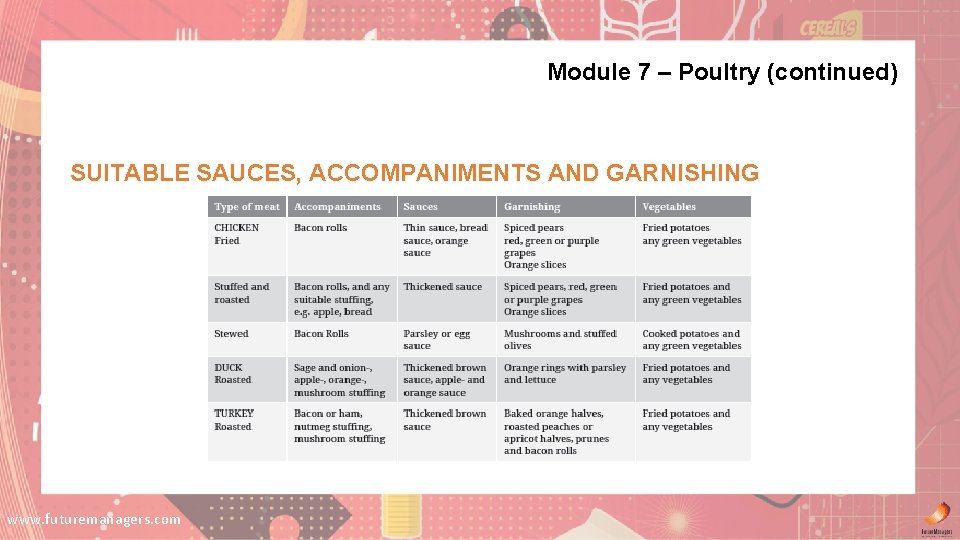
Module 7 – Poultry (continued) SUITABLE SAUCES, ACCOMPANIMENTS AND GARNISHING www. futuremanagers. com
Module 8 – Meat MEAT DEFINITION Different terms are used when it comes to meat: , such as: • Grain – The coarseness of the fibres in a muscle; • Marbling – When fat is deposited in the muscles between the fibres; • Boning – This is to remove the bones from the meat; • Larding – Cuts of meat which are not well-marbles and fat is inserted into the meat. • Barding – To wrap fat or bacon around lean meat; www. futuremanagers. com
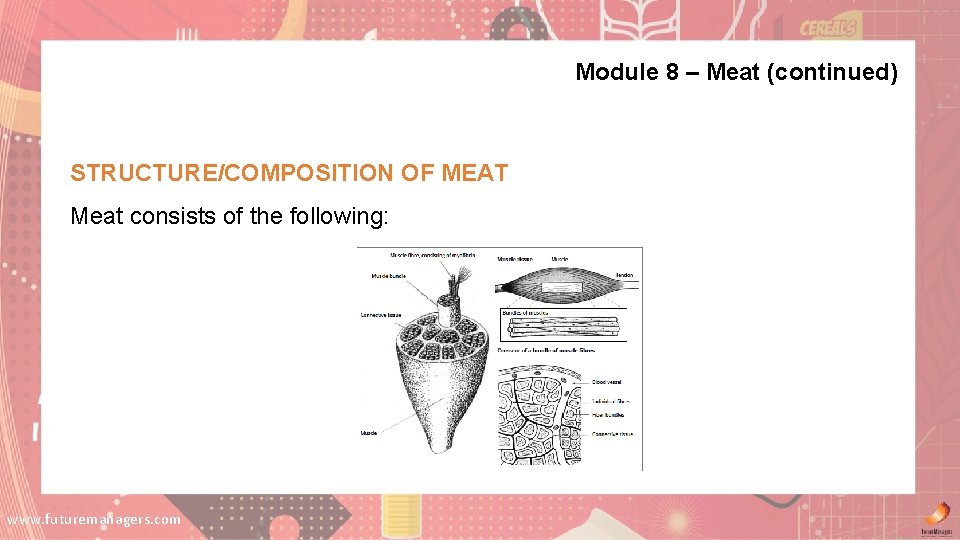
Module 8 – Meat (continued) STRUCTURE/COMPOSITION OF MEAT Meat consists of the following: www. futuremanagers. com
Module 8 – Meat (continued) NUTRITIVE VALUE OF MEAT Meat consists mainly of water, protein, fat and minerals. The liver also contains carbohydrates (glycogen). Muscle fibres contain approximately 75% water and 20% protein. The most important proteins present are myosin and actin, which are essential for the contraction of muscles. www. futuremanagers. com
Module 8 – Meat (continued) QUALITY OF MEAT Good quality meat is related to: • Colour of the lean meat; • Fineness of the grain; • Colour, texture and distribution of fat; and • Smooth, satiny surface when cut. www. futuremanagers. com
Module 8 – Meat (continued) COOKING METHODS Applicable cooking methods for meat include: • Dry-heat cooking methods (oven roasting, pan-frying and grilling); • Moist heat cooking methods (simmering, stewing and casserole); and • Combination methods (pot roasting and braising). www. futuremanagers. com
Module 8 – Meat (continued) CHOOSING AND PURCHASING OF MEAT The following three qualities of meat are important characteristics to look for when buying meat: • Size; • Thickness of fibres and connective tissue; and • The presence of fat. www. futuremanagers. com
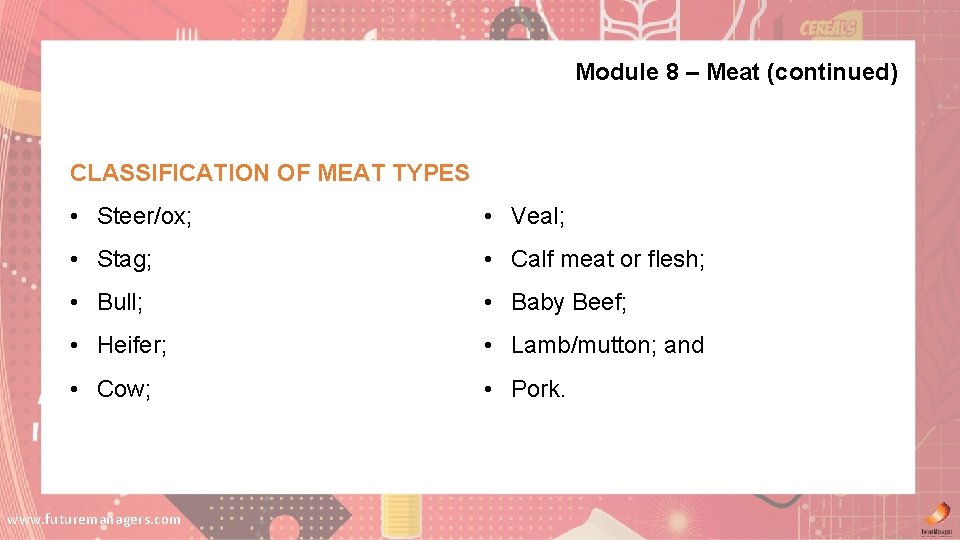
Module 8 – Meat (continued) CLASSIFICATION OF MEAT TYPES • Steer/ox; • Veal; • Stag; • Calf meat or flesh; • Bull; • Baby Beef; • Heifer; • Lamb/mutton; and • Cow; • Pork. www. futuremanagers. com
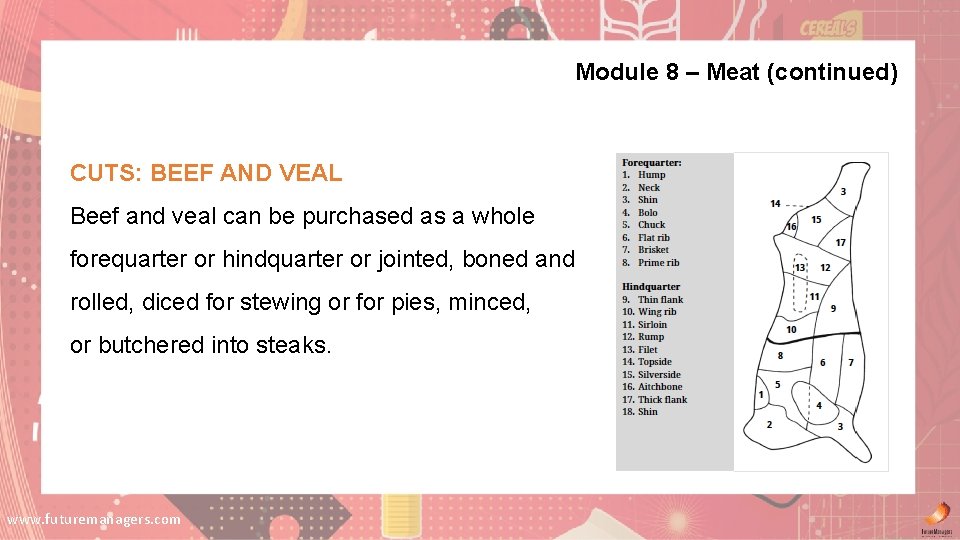
Module 8 – Meat (continued) CUTS: BEEF AND VEAL Beef and veal can be purchased as a whole forequarter or hindquarter or jointed, boned and rolled, diced for stewing or for pies, minced, or butchered into steaks. www. futuremanagers. com
Module 8 – Meat (continued) MUTTON/LAMB Lamb can be purchased whole, jointed, butchered into cutlets and chops, or as one of the special catering cuts such as baron or crown roast. When purchasing whole carcasses, the menus must be carefully planned to make use of the less tender joints only suitable for stewing. www. futuremanagers. com
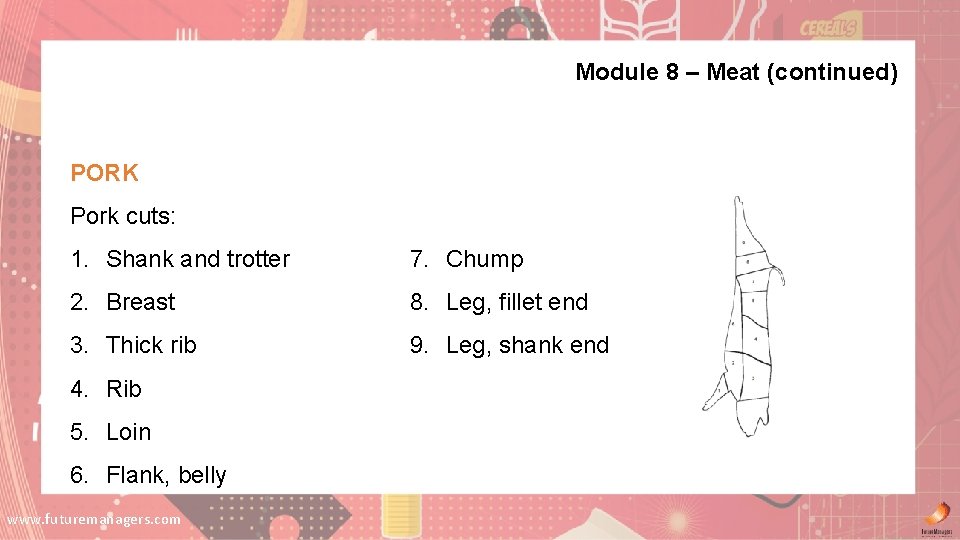
Module 8 – Meat (continued) PORK Pork cuts: 1. Shank and trotter 7. Chump 2. Breast 8. Leg, fillet end 3. Thick rib 9. Leg, shank end 4. Rib 5. Loin 6. Flank, belly www. futuremanagers. com
Module 8 – Meat (continued) OFFAL Offal is the innards and extremities of the animals we eat, ranging from familiar liver and kidneys to more adventurous parts. Types of offal are: • Liver; • Heart; • Kidneys; • Tongue; • Sweetbreads; • Ox-tail; and • Brains; • Tripe. www. futuremanagers. com
Module 9 – Fats and emulsions ANIMAL FATS Types of animal fat are: • Butter; • Lard; • Suet; and • Dripping. www. futuremanagers. com
Module 9 – Fats and emulsions (continued) VEGETABLE FATS Types of vegetable fats are: • Margarine; and • Oils. www. futuremanagers. com
Module 9 – Fats and emulsions (continued) TERMS • Hydrogenation is the process where oil (liquid) changes to fat (solid). • Rancidity is caused by the reaction of the enzyme lipase with oxygen and it gives fat and oil an “off” flavour and taste. • Emulsions consist of two liquids usually not able to combine when mixed, such as oil and water. www. futuremanagers. com
Module 9 – Fats and emulsions (continued) HOW TO MAKE YOUR OIL LAST LONGER • Fry at the correct temperatures; • Regularly check thermostats; • Prepare foods correctly; • Use the correct ratio of oil to foods: 1 part of food to 6 parts of oil; • Do not season foods prior to frying; • Keep the oil covered after use; and • Filter the oil daily to prolong the shelf life. www. futuremanagers. com