
Category Theory Institutions Jagadeeswaran Thangaraj CS POP NUIM


- Slides: 18
Category Theory & Institutions Jagadeeswaran Thangaraj CS - POP –NUIM 19 Nov 2013
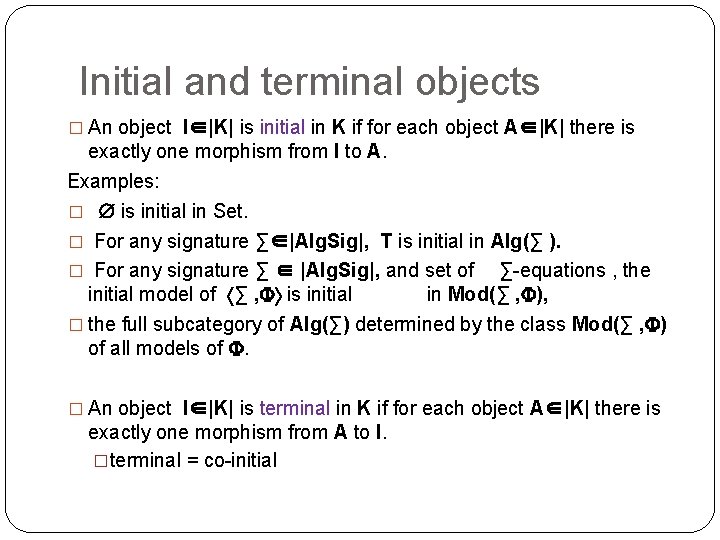
Initial and terminal objects � An object I∈|K| is initial in K if for each object A∈|K| there is exactly one morphism from I to A. Examples: � is initial in Set. � For any signature ∑∈|Alg. Sig|, T is initial in Alg(∑ ). � For any signature ∑ ∈ |Alg. Sig|, and set of ∑-equations , the initial model of ∑ , is initial in Mod(∑ , ), � the full subcategory of Alg(∑) determined by the class Mod(∑ , ) of all models of . � An object I∈|K| is terminal in K if for each object A∈|K| there is exactly one morphism from A to I. �terminal = co-initial
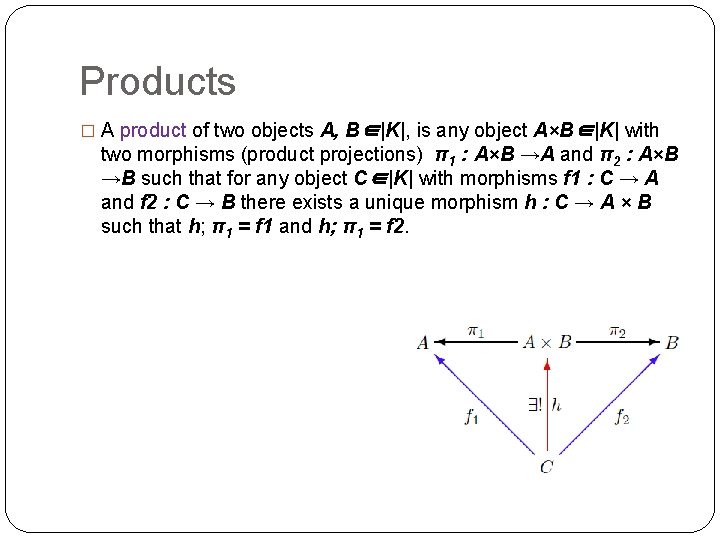
Products � A product of two objects A, B∈|K|, is any object A×B∈|K| with two morphisms (product projections) π1 : A×B →A and π2 : A×B →B such that for any object C∈|K| with morphisms f 1 : C → A and f 2 : C → B there exists a unique morphism h : C → A × B such that h; π1 = f 1 and h; π1 = f 2.
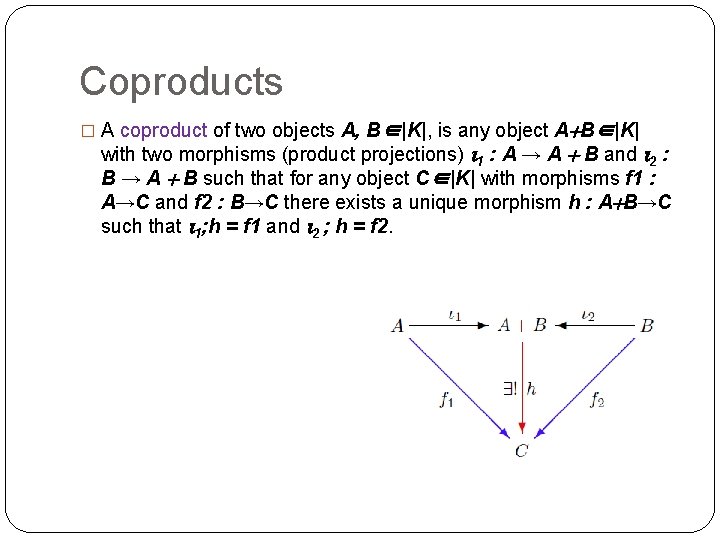
Coproducts � A coproduct of two objects A, B∈|K|, is any object A B∈|K| with two morphisms (product projections) 1 : A → A B and 2 : B → A B such that for any object C∈|K| with morphisms f 1 : A→C and f 2 : B→C there exists a unique morphism h : A B→C such that 1; h = f 1 and 2 ; h = f 2.
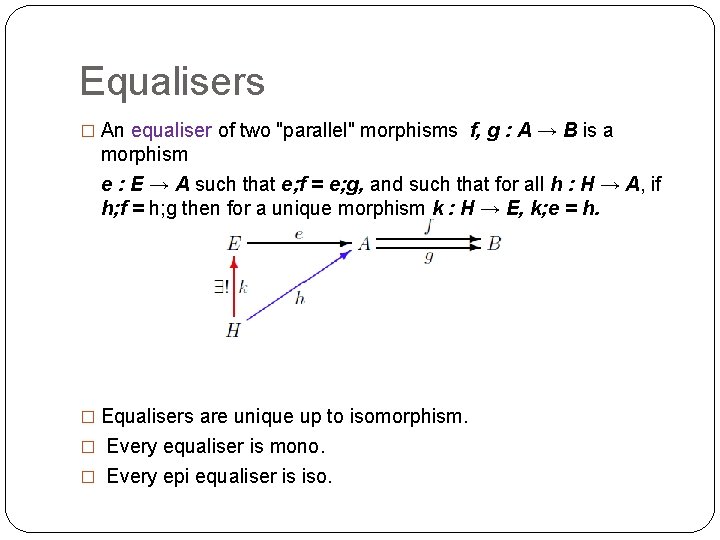
Equalisers � An equaliser of two "parallel" morphisms f, g : A → B is a morphism e : E → A such that e; f = e; g, and such that for all h : H → A, if h; f = h; g then for a unique morphism k : H → E, k; e = h. � Equalisers are unique up to isomorphism. � Every equaliser is mono. � Every epi equaliser is iso.
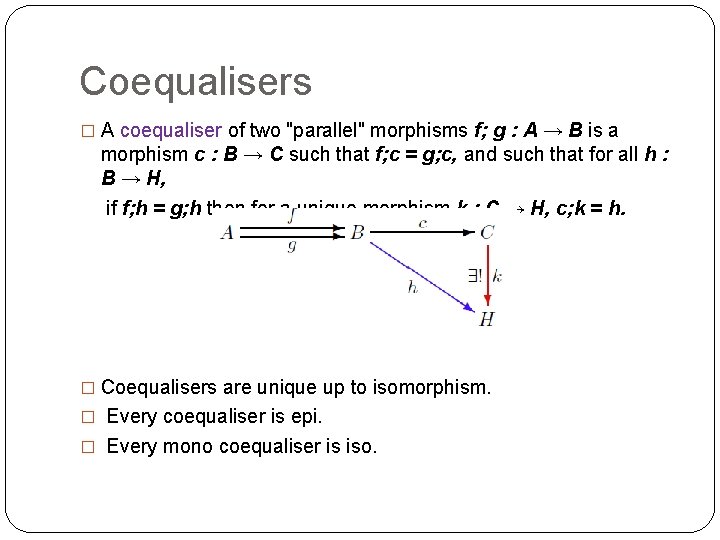
Coequalisers � A coequaliser of two "parallel" morphisms f; g : A → B is a morphism c : B → C such that f; c = g; c, and such that for all h : B → H, if f; h = g; h then for a unique morphism k : C → H, c; k = h. � Coequalisers are unique up to isomorphism. � Every coequaliser is epi. � Every mono coequaliser is iso.
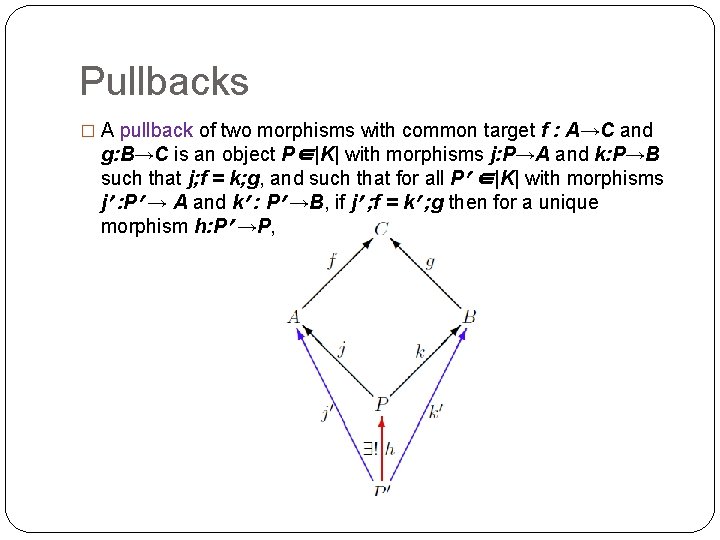
Pullbacks � A pullback of two morphisms with common target f : A→C and g: B→C is an object P∈|K| with morphisms j: P→A and k: P→B such that j; f = k; g, and such that for all P ∈|K| with morphisms j : P → A and k : P →B, if j ; f = k ; g then for a unique morphism h: P →P, h; j = j and h; k = k.
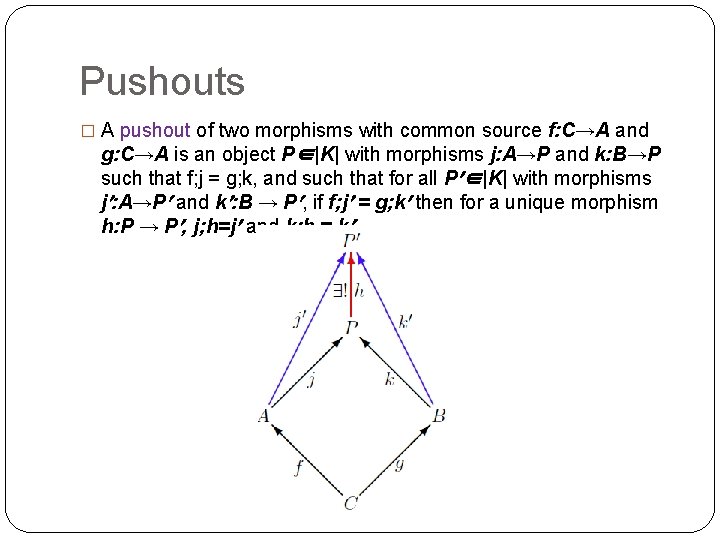
Pushouts � A pushout of two morphisms with common source f: C→A and g: C→A is an object P∈|K| with morphisms j: A→P and k: B→P such that f; j = g; k, and such that for all P ∈|K| with morphisms j : A→P and k : B → P , if f; j = g; k then for a unique morphism h: P → P , j; h=j and k; h = k.
Institutions Jagadeeswaran Thangaraj CS - POP –NUIM 19 Nov 2013
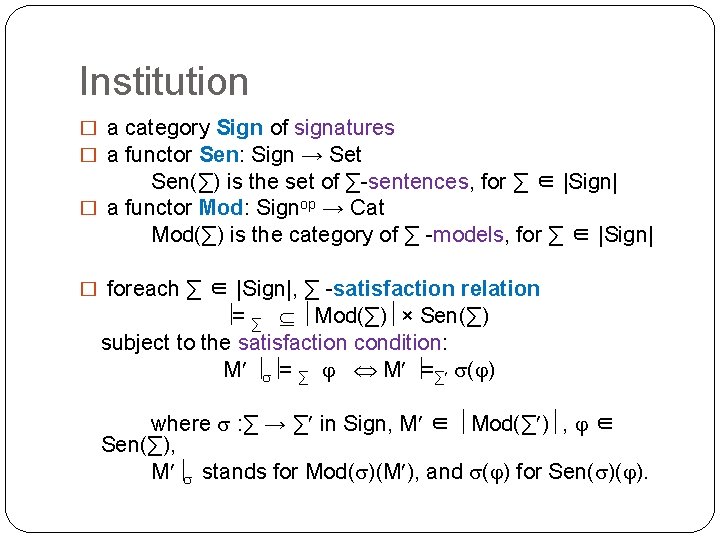
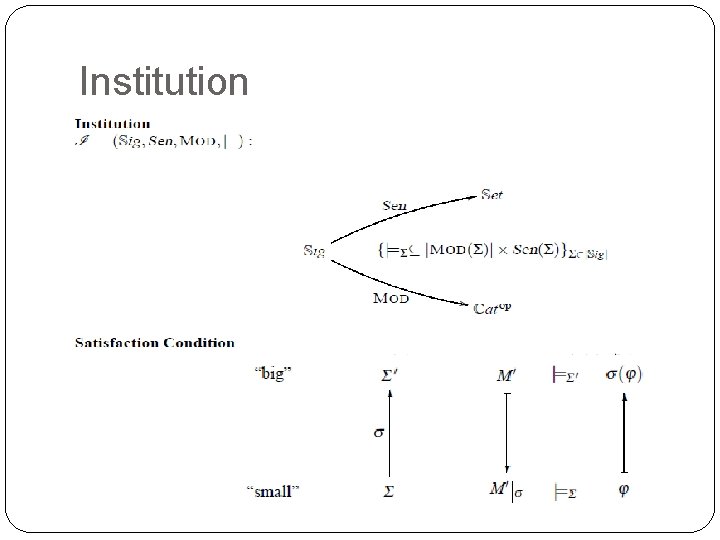
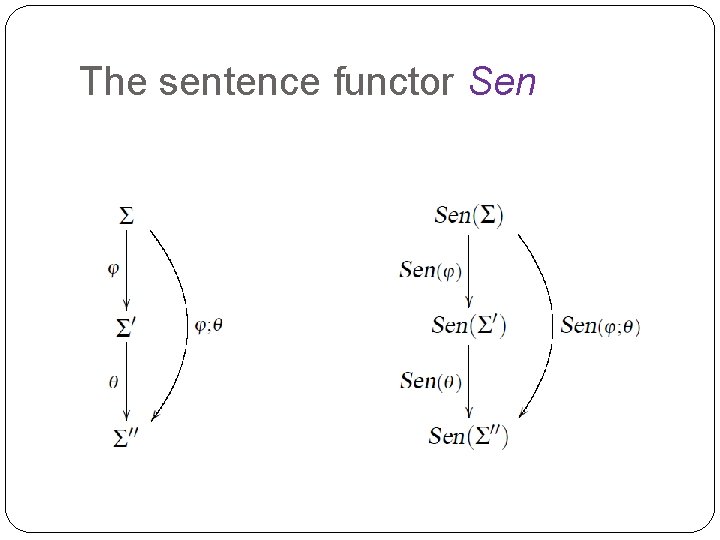
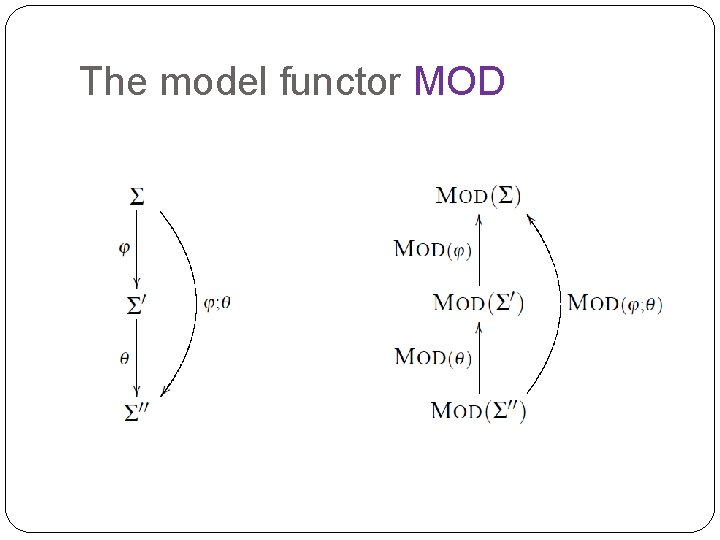
Institution � a category Sign of signatures � a functor Sen: Sign → Set Sen(∑) is the set of ∑-sentences, for ∑ ∈ |Sign| � a functor Mod: Signop → Cat Mod(∑) is the category of ∑ -models, for ∑ ∈ |Sign| � foreach ∑ ∈ |Sign|, ∑ -satisfaction relation = ∑ Mod(∑) × Sen(∑) subject to the satisfaction condition: M = ∑ M =∑ ( ) where : ∑ → ∑ in Sign, M ∈ Mod(∑ ) , ∈ Sen(∑), M stands for Mod( )(M ), and ( ) for Sen( )( ).
Institution
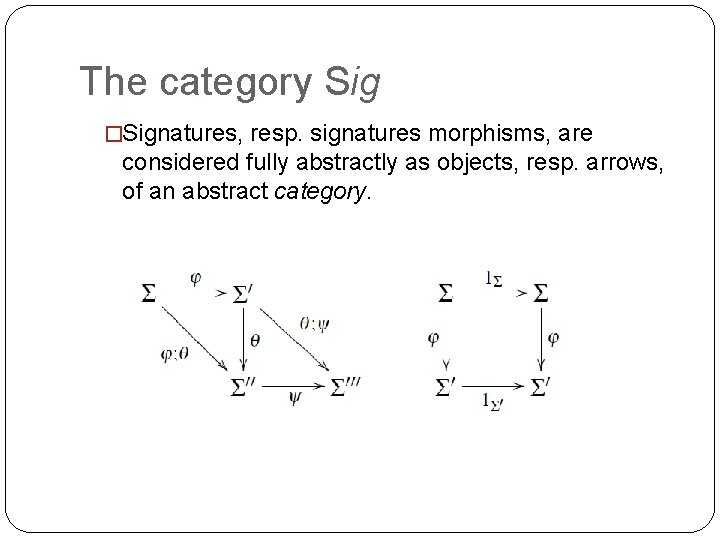
The category Sig �Signatures, resp. signatures morphisms, are considered fully abstractly as objects, resp. arrows, of an abstract category.
The sentence functor Sen
The model functor MOD
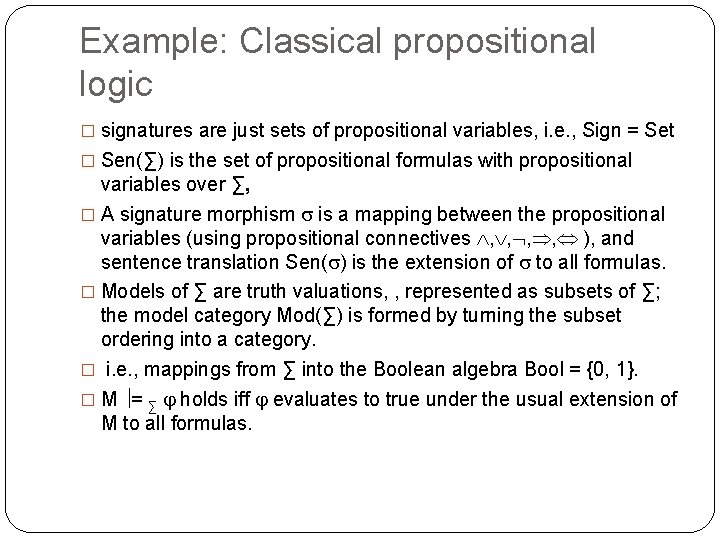
Example: Classical propositional logic � signatures are just sets of propositional variables, i. e. , Sign = Set � Sen(∑) is the set of propositional formulas with propositional variables over ∑, � A signature morphism is a mapping between the propositional variables (using propositional connectives , , ), and sentence translation Sen( ) is the extension of to all formulas. � Models of ∑ are truth valuations, , represented as subsets of ∑; the model category Mod(∑) is formed by turning the subset ordering into a category. � i. e. , mappings from ∑ into the Boolean algebra Bool = {0, 1}. � M = ∑ holds iff evaluates to true under the usual extension of M to all formulas.
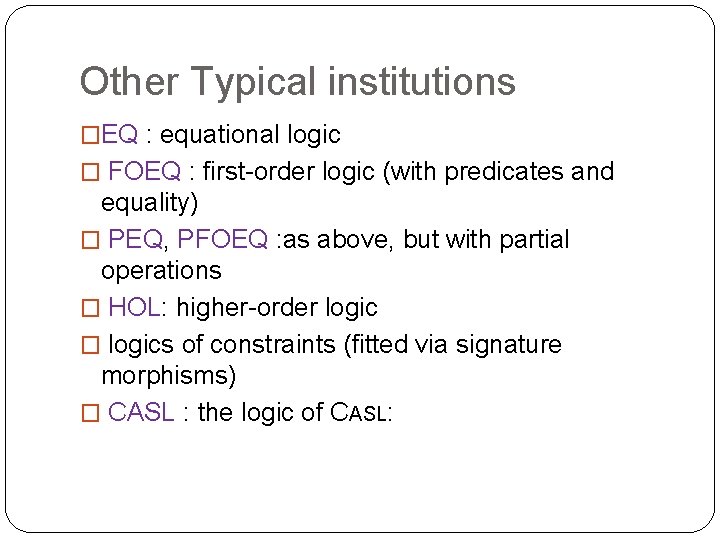
Other Typical institutions �EQ : equational logic � FOEQ : first-order logic (with predicates and equality) � PEQ, PFOEQ : as above, but with partial operations � HOL: higher-order logic � logics of constraints (fitted via signature morphisms) � CASL : the logic of CASL:
Trivial Institutions � no sentences � no signatures �no models �trivial satisfaction relations
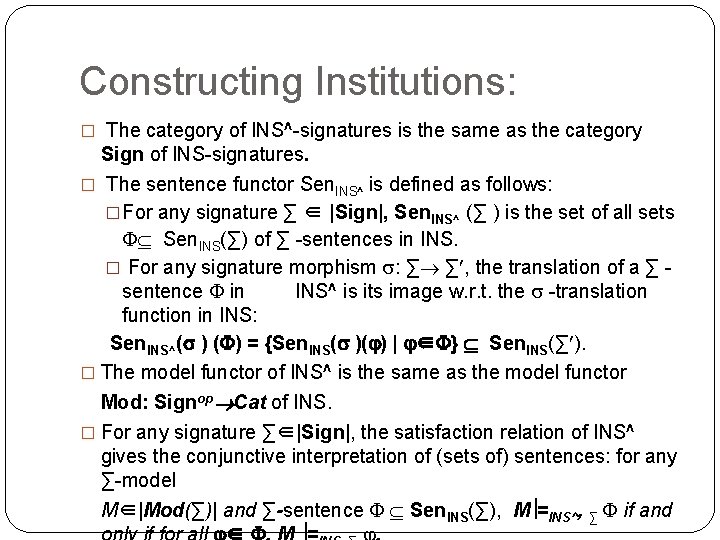
Constructing Institutions: � The category of INS^-signatures is the same as the category Sign of INS-signatures. � The sentence functor Sen. INS^ is defined as follows: �For any signature ∑ ∈ |Sign|, Sen. INS^ (∑ ) is the set of all sets Sen. INS(∑) of ∑ -sentences in INS. � For any signature morphism : ∑ ∑ , the translation of a ∑ sentence in INS^ is its image w. r. t. the -translation function in INS: Sen. INS^( ) = {Sen. INS( )( ) | ∈ } Sen. INS(∑ ). � The model functor of INS^ is the same as the model functor Mod: Signop Cat of INS. � For any signature ∑∈|Sign|, the satisfaction relation of INS^ gives the conjunctive interpretation of (sets of) sentences: for any ∑-model M∈|Mod(∑)| and ∑-sentence Sen. INS(∑), M =INS^, ∑ if and