
CATEGORY MANAGEMENT Session Objectives Define Category Management CM
CATEGORY MANAGEMENT
Session Objectives: Define Category Management (CM) l Describe Category Management as a Business Process l l Discuss Critical Issues Related to Successfully Developing a Category Management System Category Management Process Category Management Issues

Bringing Better Value to the Consumer is the Primary Focus of Category Management. “A Retailer-Supplier process of managing categories as Strategic Business Units, producing improved sales and profit results by focusing on satisfying consumer needs and delivering consumer value. ” Source: ECR Best Practices Report Definition
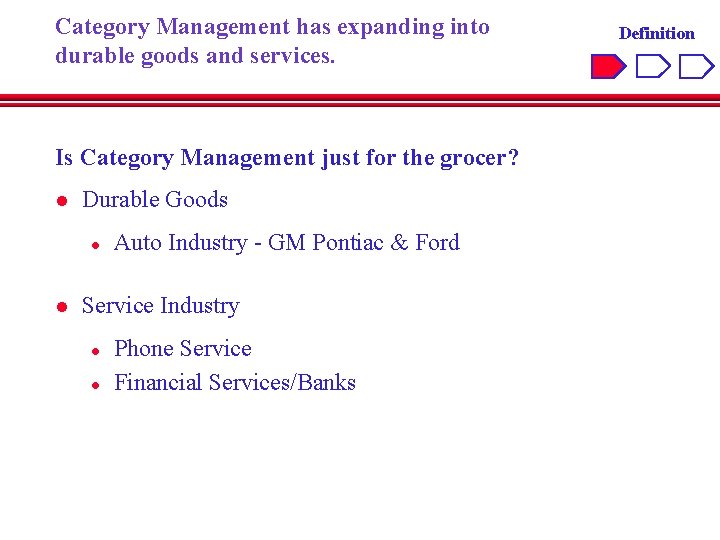
Category Management has expanding into durable goods and services. Is Category Management just for the grocer? l Durable Goods l l Auto Industry - GM Pontiac & Ford Service Industry l l Phone Service Financial Services/Banks Definition
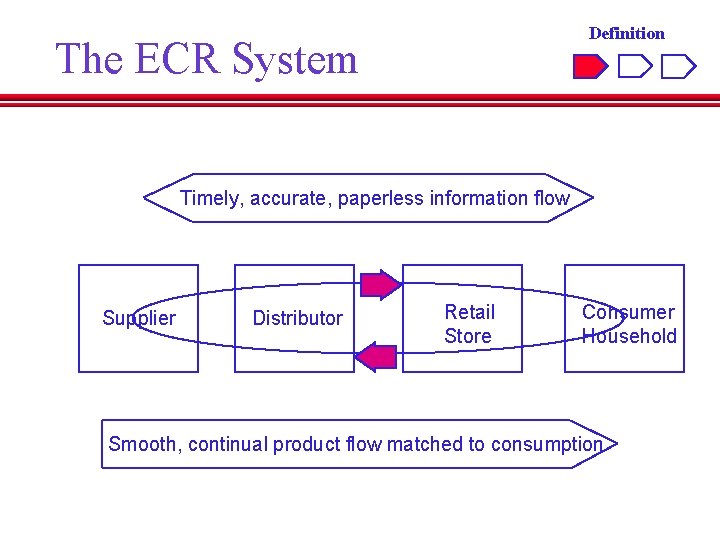
Definition The ECR System Timely, accurate, paperless information flow Supplier Distributor Retail Store Consumer Household Smooth, continual product flow matched to consumption
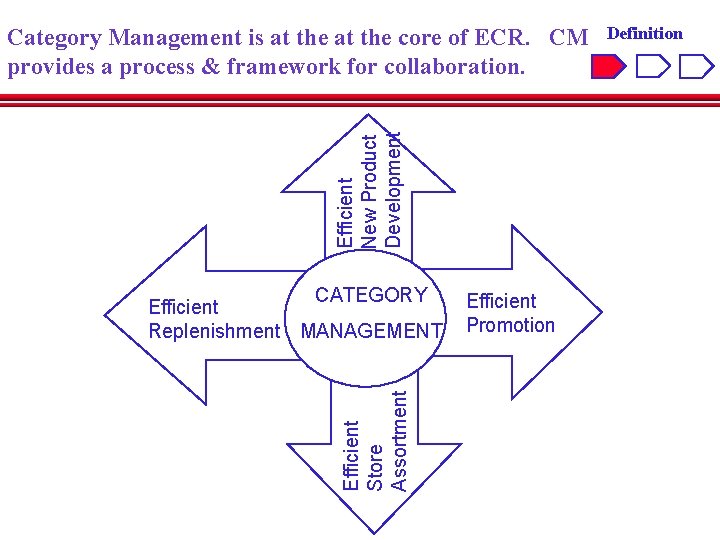
Efficient New Product Development Category Management is at the core of ECR. CM provides a process & framework for collaboration. Efficient Store Assortment CATEGORY Efficient Replenishment MANAGEMENT Efficient Promotion Definition
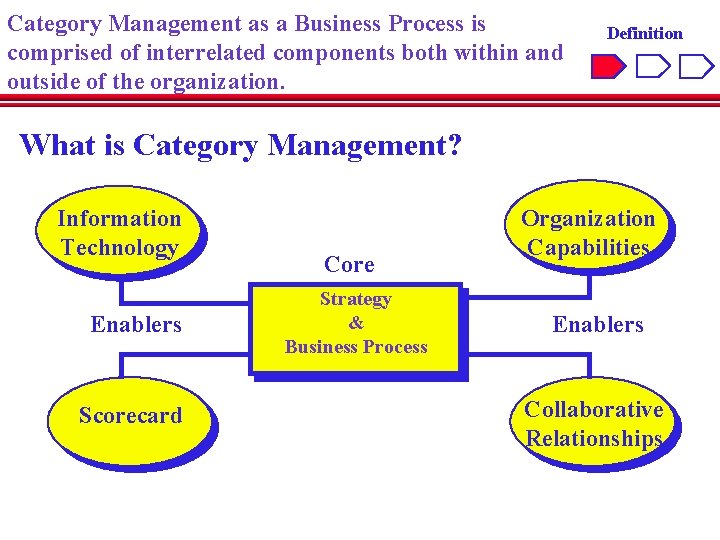
Category Management as a Business Process is comprised of interrelated components both within and outside of the organization. Definition What is Category Management? Information Technology Enablers Scorecard Core Strategy & Business Process Organization Capabilities Enablers Collaborative Relationships
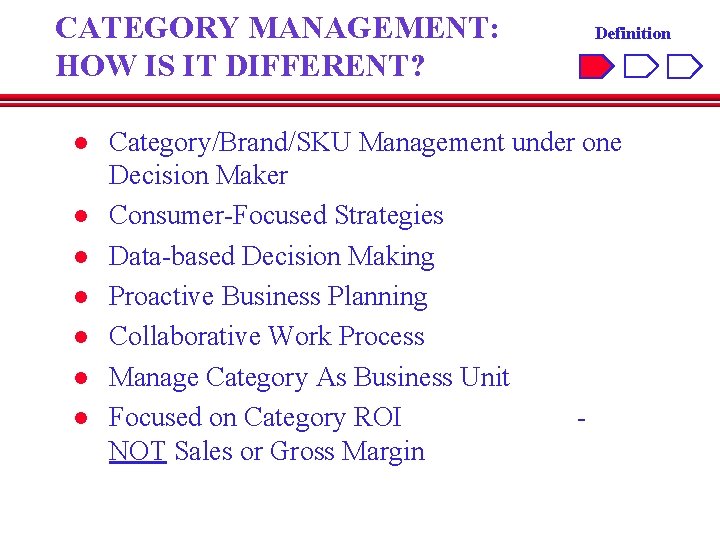
CATEGORY MANAGEMENT: HOW IS IT DIFFERENT? l l l l Definition Category/Brand/SKU Management under one Decision Maker Consumer-Focused Strategies Data-based Decision Making Proactive Business Planning Collaborative Work Process Manage Category As Business Unit Focused on Category ROI NOT Sales or Gross Margin

SKILLS NEEDED TO BUILD BUSINESS THROUGH CATEGORY MANAGEMENT l l l Data analysis and technical mastery Shopper and consumer understanding Strategy development Financial and logistics expertise Innovation Total Systems Focus Definition
Why is it beneficial for Retailers and Manufacturers to Invest in Category Management? Helps Retailers l Define customer needs l Determine strategic issues l Enhance category and store profits Definition
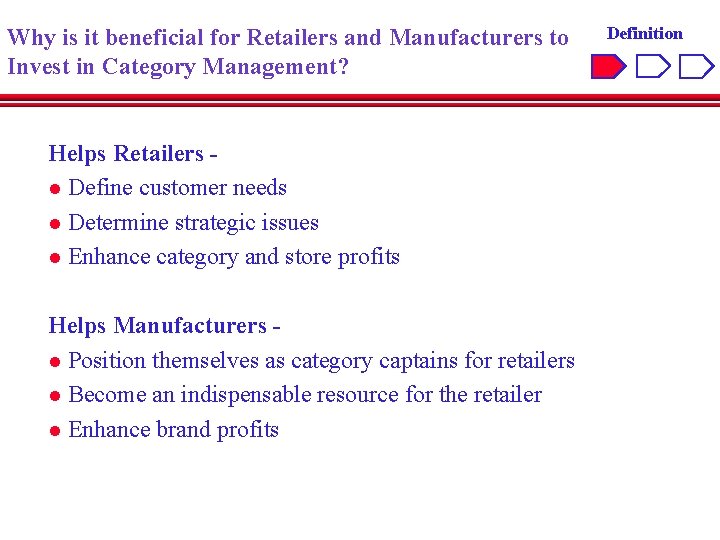
Why is it beneficial for Retailers and Manufacturers to Invest in Category Management? Helps Retailers l Define customer needs l Determine strategic issues l Enhance category and store profits Helps Manufacturers l Position themselves as category captains for retailers l Become an indispensable resource for the retailer l Enhance brand profits Definition
Road Map Define Category Management as a Business Process Category Management Issues
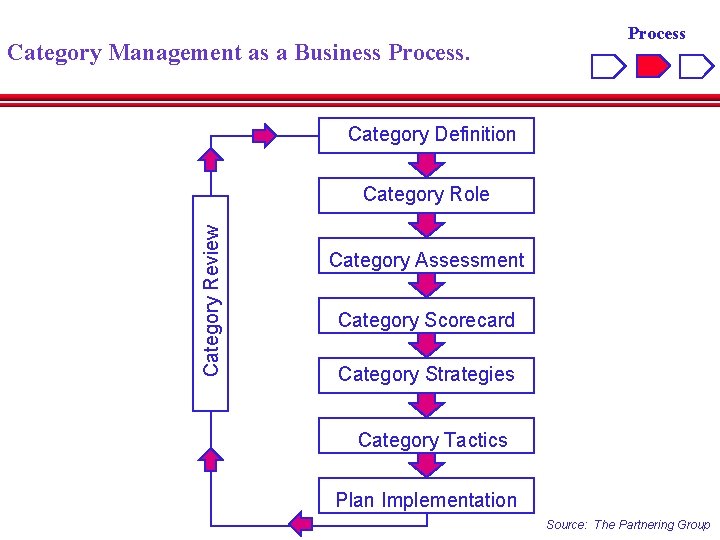
Category Management as a Business Process Category Definition Category Review Category Role Category Assessment Category Scorecard Category Strategies Category Tactics Plan Implementation Source: The Partnering Group
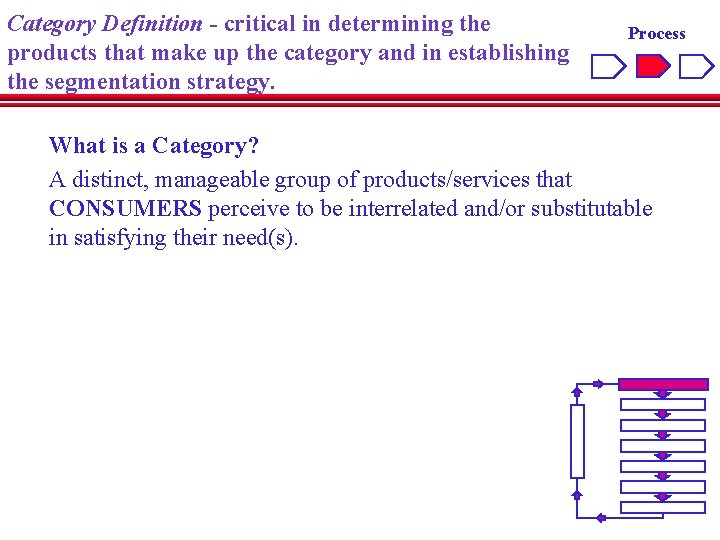
Category Definition - critical in determining the products that make up the category and in establishing the segmentation strategy. Process What is a Category? A distinct, manageable group of products/services that CONSUMERS perceive to be interrelated and/or substitutable in satisfying their need(s).

Category Definition - critical in determining the products that make up the category and in establishing the segmentation strategy. Process What is a Category? A distinct, manageable group of products/services that CONSUMERS perceive to be interrelated and/or substitutable in satisfying their need(s). How does defining a category help? l Produces better retailer/manufacturer alignment with the consumer l Creates better manufacturer-retailer alignment l Gives new perspectives on how to view a product and/or category
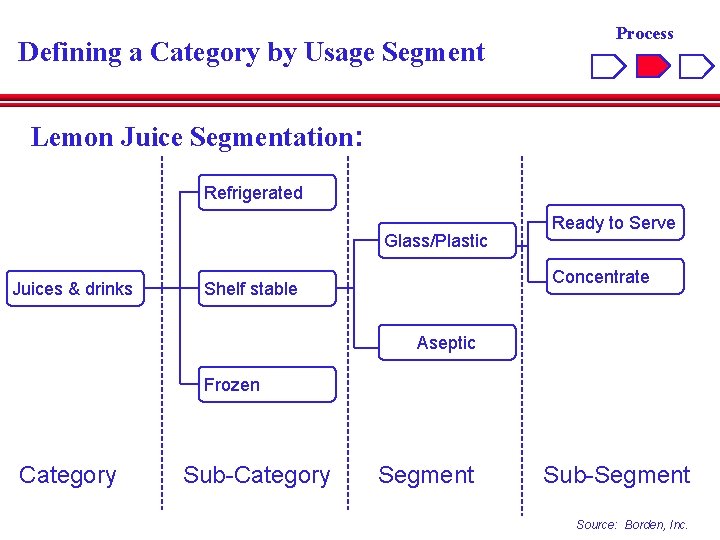
Defining a Category by Usage Segment Process Lemon Juice Segmentation: Refrigerated Glass/Plastic Juices & drinks Ready to Serve Concentrate Shelf stable Aseptic Frozen Category Sub-Category Segment Sub-Segment Source: Borden, Inc.
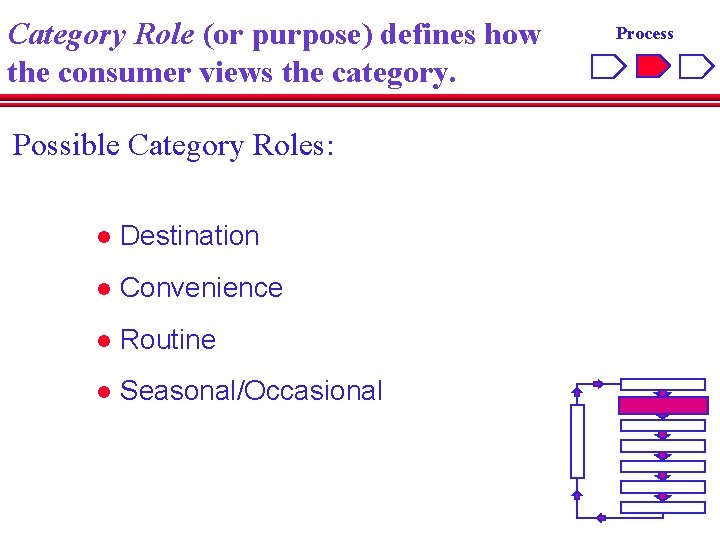
Category Role (or purpose) defines how the consumer views the category. Possible Category Roles: l Destination l Convenience l Routine l Seasonal/Occasional Process
Category Assessment involves conducting a complete analysis of the category by investigating it’s subcategories, user-segments, brands, and SKUs. Such an analysis must be based on current consumer, distributor, supplier and market information. Process
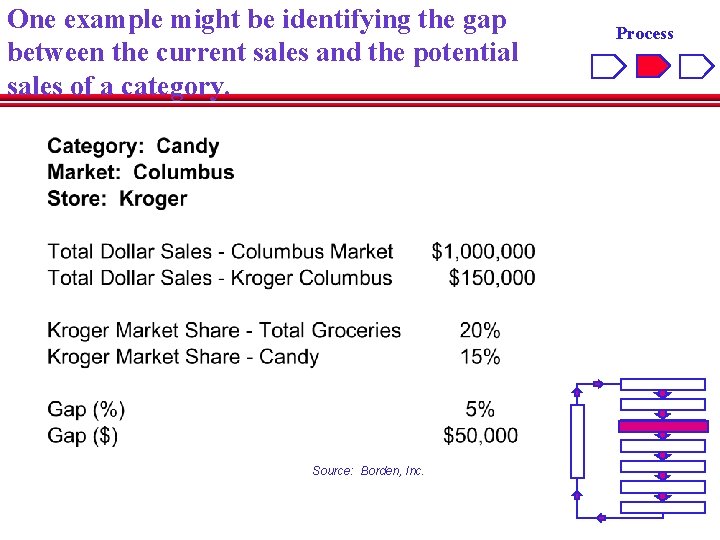
One example might be identifying the gap between the current sales and the potential sales of a category. Source: Borden, Inc. Process
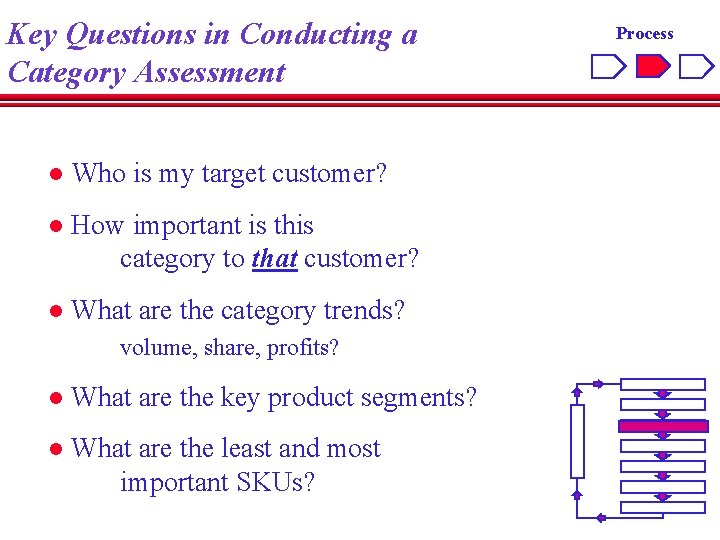
Key Questions in Conducting a Category Assessment l Who is my target customer? l How important is this category to that customer? l What are the category trends? volume, share, profits? l What are the key product segments? l What are the least and most important SKUs? Process
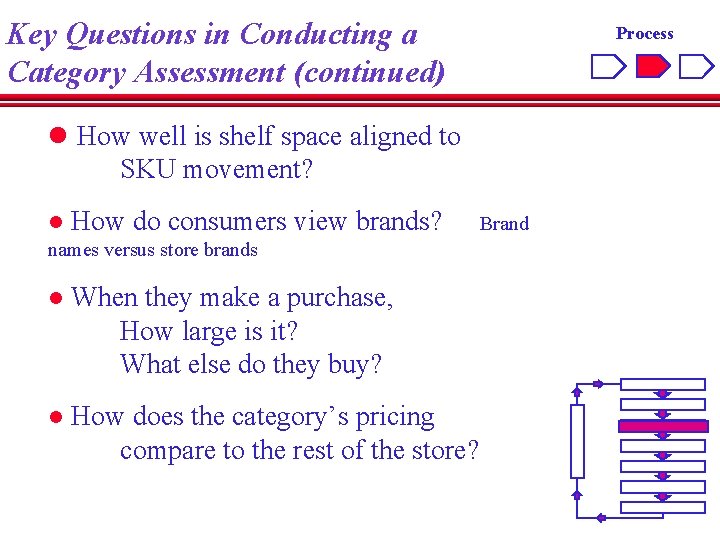
Key Questions in Conducting a Category Assessment (continued) Process l How well is shelf space aligned to SKU movement? l How do consumers view brands? names versus store brands l When they make a purchase, How large is it? What else do they buy? l How does the category’s pricing compare to the rest of the store? Brand
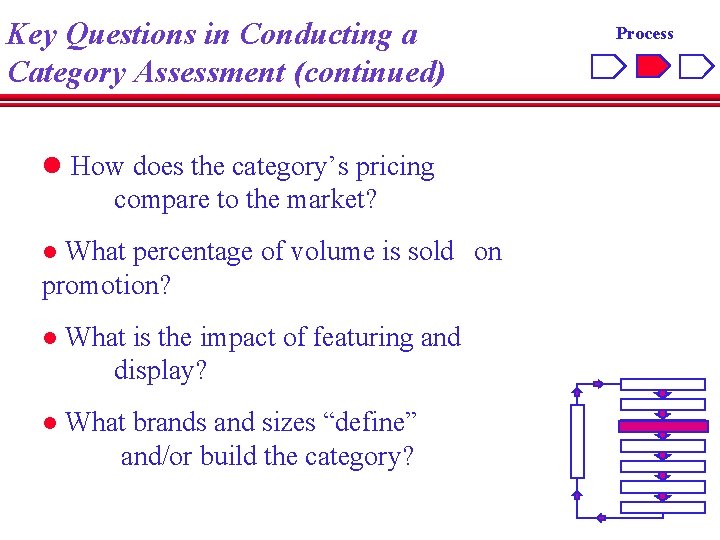
Key Questions in Conducting a Category Assessment (continued) l How does the category’s pricing compare to the market? What percentage of volume is sold on promotion? l l What is the impact of featuring and display? l What brands and sizes “define” and/or build the category? Process
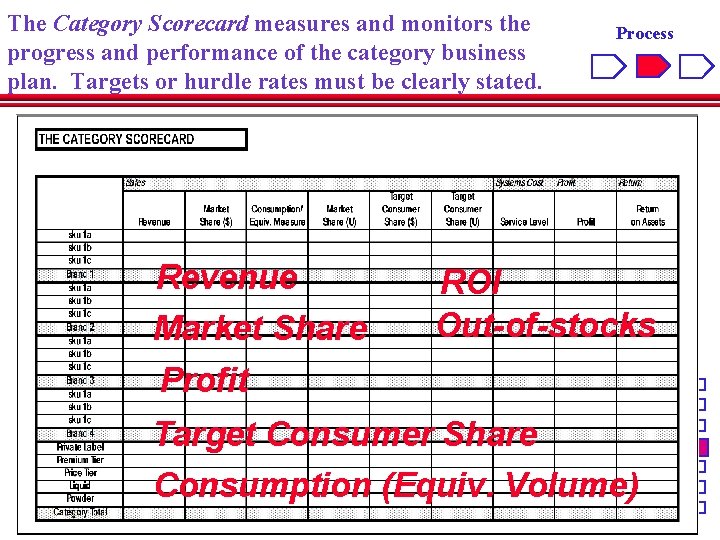
The Category Scorecard measures and monitors the progress and performance of the category business plan. Targets or hurdle rates must be clearly stated. Revenue Market Share Process ROI Out-of-stocks Profit Target Consumer Share Consumption (Equiv. Volume)
Category Strategies define the marketing, product supply, and in store service required to meet targets or hurdle rates. Types of strategies: l Transaction Efficiency/Traffic Builder l Shopping/Information l Entertainment Source: Robert C. Blattberg, 1996 Process
Category Tactics are the actions taken to implement the category strategies. Transaction efficiency/Traffic Builder > Low price/convenience > Category shop-ability Source: Robert C. Blattberg, 1996 Process
Category Tactics are the actions taken to implement the category strategies. Transaction efficiency/Traffic Builder > Low price/convenience > Category shop-ability Shopping/information > Unique offerings/high service > Easy access to product information Source: Robert C. Blattberg, 1996 Process
Category Tactics are the actions taken to implement the category strategies. Transaction efficiency/Traffic Builder > Low price/convenience > Category shop-ability Shopping/information > Unique offerings/high service > Easy access to product information Entertainment > Stimulation/excitement > Creative marketing/broad assortment > Changing variety of products Source: Robert C. Blattberg, 1996 Process
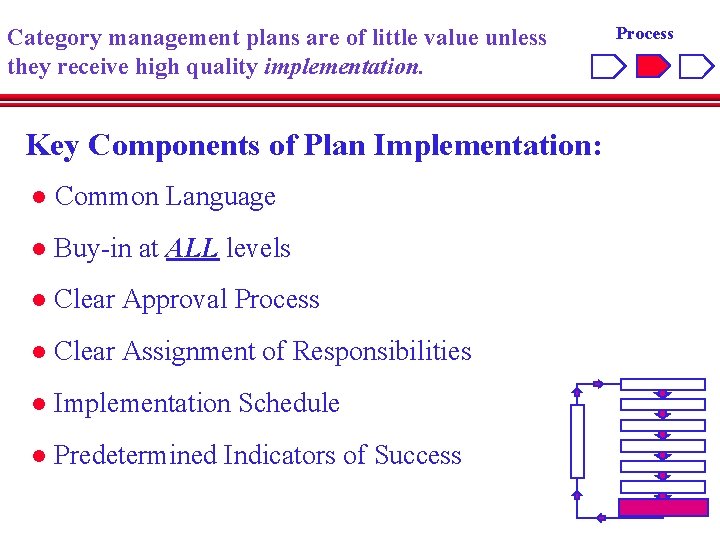
Category management plans are of little value unless they receive high quality implementation. Key Components of Plan Implementation: l Common Language l Buy-in at ALL levels l Clear Approval Process l Clear Assignment of Responsibilities l Implementation Schedule l Predetermined Indicators of Success Process
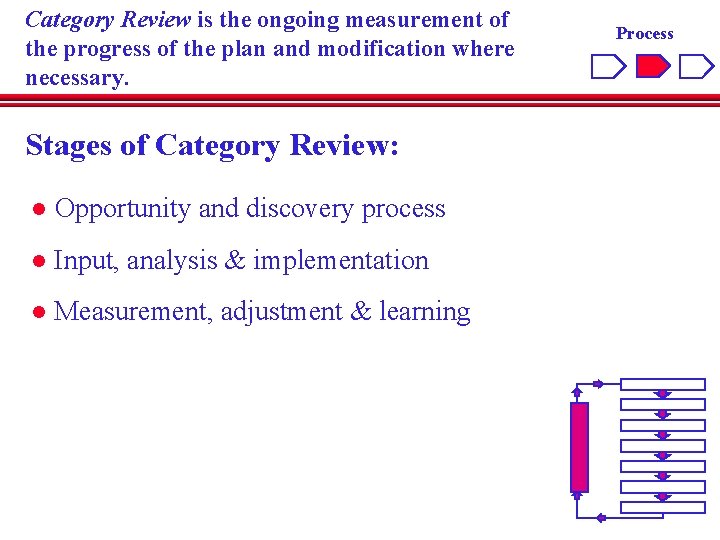
Category Review is the ongoing measurement of the progress of the plan and modification where necessary. Stages of Category Review: l Opportunity and discovery process l Input, analysis & implementation l Measurement, adjustment & learning Process
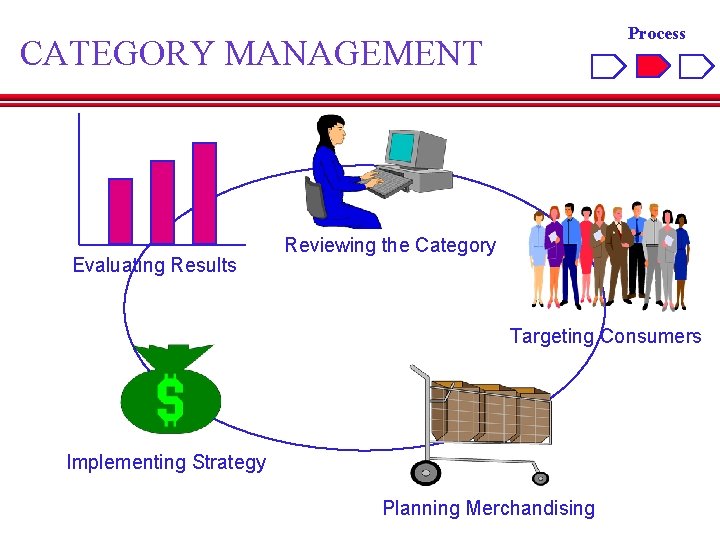
Process CATEGORY MANAGEMENT Evaluating Results Reviewing the Category Targeting Consumers Implementing Strategy Planning Merchandising
Road Map Category Management Definition Category Management Process Category Management Issues
Category Management is a source of competitive advantage. Issues If it is so easy to do and everyone is doing it, where is the advantage? Category Management is about strategic choices. The quality of the implementation and execution will determine the degree of competitive advantage gained.
Category Management is a dynamic, evolving practice. Issues Is there one approach? … no. l Fundamental principles and processes. l Implementation depends upon the capabilities and current practices of the organizations. l Today’s practices are tomorrow’s foundations for improvement.
Successful Category Management helps to define a partnership. Issues l Ability and commitment to develop the category l A vision of the potential of the category l Adequate information technology capability and sharing information l Multifunctional team support capabilities l Buy-in from top management l Clearly defines the role of the manufacturer with regard to Category Management l Trust
How to develop a successful Category Management relationship. Issues Develop a common language for Category Management l Translate the goals of the partnership into a usable and measurable plan the utilizes fact-based CM decisions and practices. l Educate everyone involved, buyers and suppliers, on the approach being taken for growing the category. l Develop fact-based presentations representing the entire category. l Develop a system of regular reports and monitoring for catching category trends and opportunities. IRI 1995
Issues Common Obstacles to Successful Category Management. l Mistaken belief that the organization is already Category Management. doing l Lack of management commitment. l Lack of timely and easy to use information for assessment. l Inadequate knowledge or misinformation about the consumer characteristics/demand for the category. l Managerial lack of training or abilities. l Non-standard product or pricing for the category
The Manufacturer should keep their Category Management analysis honest. l l l Issues Manufacturer often does the initial analysis. l Financial resources l Potential benefit Initial indicators may bode poorly for the manufacturer’s product - but must accept losses. Solution: l Get Marketing and others involved. l Talk with your distributor and buy some time. l Fix the product. If the analysis is right, something needs to change to address the shortcomings perceived by the consumers.
CATEGORY MANAGEMENT Questions?
- Slides: 38