
Category Management Course Objectives Explain What is a
Category Management
Course Objectives • Explain What is a Category • Define Category Management • Explain What is Category Management • Describe the Basic Principles of Category Management • Explain the Components of Category Management • Explain the Steps of Category Management Business Process • Describe the Components of Category Role • Describe the Components of Category Strategy • Explain the Various Sub-category Strategies • Explain the Steps for Category Tactics and Execution • Describe How to Successfully Implement Category Strategy • Explain What is a Tactogram • Explain What are Category Captains • List the Benefits of a Category Manager • Describe the Important Meetings of Category Management
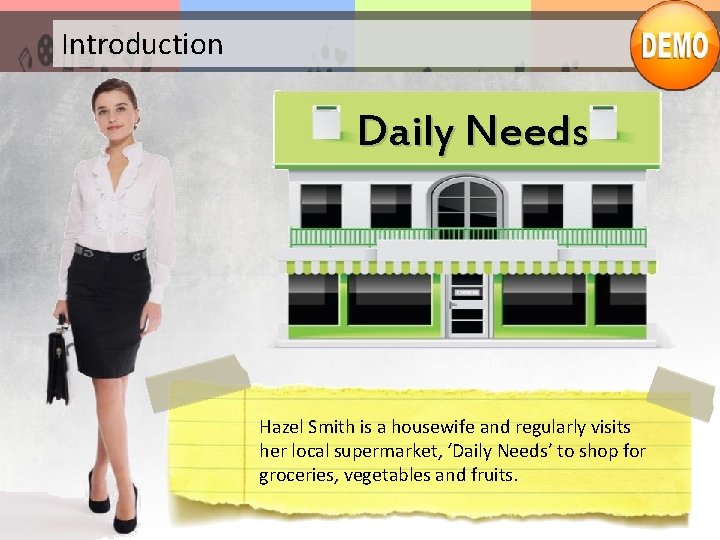
Introduction Daily Needs Hazel Smith is a housewife and regularly visits her local supermarket, ‘Daily Needs’ to shop for groceries, vegetables and fruits.
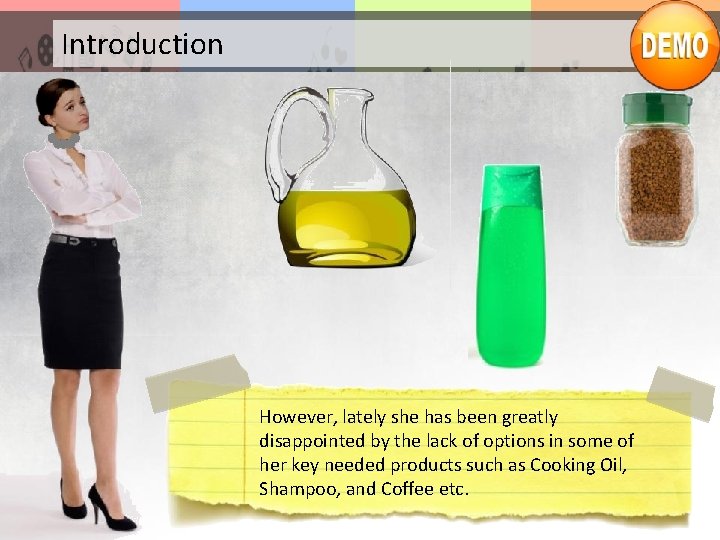
Introduction However, lately she has been greatly disappointed by the lack of options in some of her key needed products such as Cooking Oil, Shampoo, and Coffee etc.
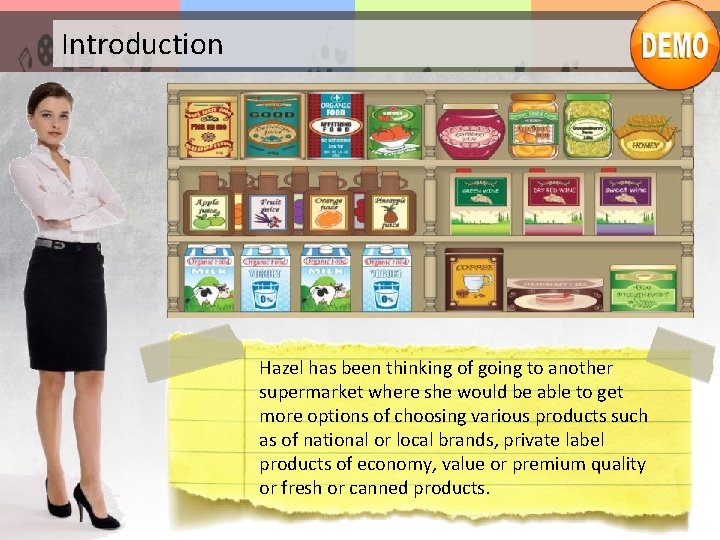
Introduction Hazel has been thinking of going to another supermarket where she would be able to get more options of choosing various products such as of national or local brands, private label products of economy, value or premium quality or fresh or canned products.

Introduction Super World Her neighbor, Janet suggests another newly opened supermarket ‘Super World’ that is close by in their neighborhood.
Introduction Super World Hazel decides to give ‘Super World’, the new supermarket a try. Hazel visits ‘Super World’ for her next grocery shopping.
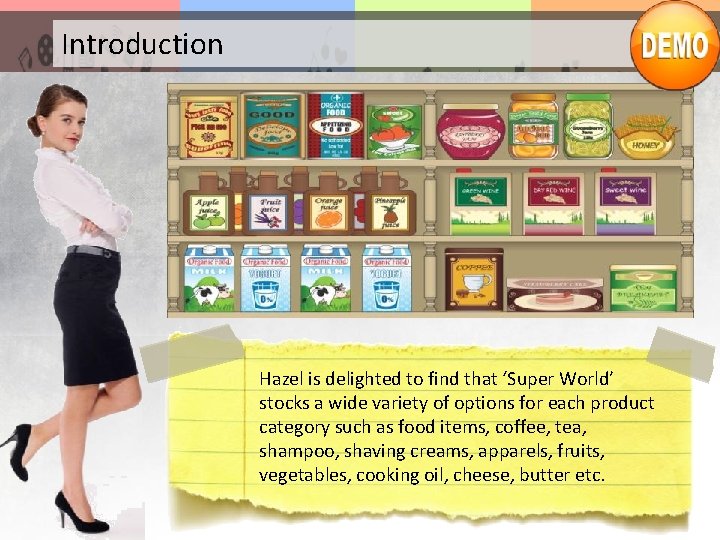
Introduction Hazel is delighted to find that ‘Super World’ stocks a wide variety of options for each product category such as food items, coffee, tea, shampoo, shaving creams, apparels, fruits, vegetables, cooking oil, cheese, butter etc.
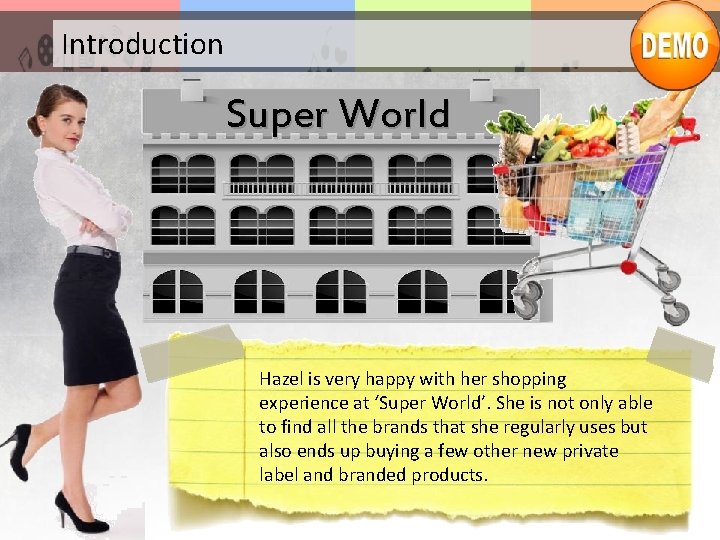
Introduction Super World Hazel is very happy with her shopping experience at ‘Super World’. She is not only able to find all the brands that she regularly uses but also ends up buying a few other new private label and branded products.
Introduction Yes, the key difference between ‘Daily Needs’ and ‘Super World’ is that though both of them are supermarkets, ‘Super World’ makes a good and strong effort to cater to the needs of its customers.
Introduction ‘Super World’ has an effective ‘category management’ strategy that helps to satisfy and please its customers.
Introduction Daily Needs On the other hand, ‘Daily Needs’ does not cater to the needs of its customers. It buys products and brands based on the retailer bias rather than based on customer needs and opinions.
Introduction Let us learn about ‘Category Manageme nt’ in detail. Category Management is a process of maximizing sales and profits while enhancing product value and customer experience. Thus, ‘Category Management’ is crucial for any retailer’s success.
Definition of Category Management can Category Management be defined as: r “The distributor/supplie les process of maximizing sa cing and profits while enhan mer product value and custo experience by managing categories as SBUs and producing enhanced sing business results by focu on delivering customer value”.
What is Category Management? 1 • • So, ‘Category Management’ is a process of maximizing sales and profits while enhancing product value and customer experience. The main aim of category management is to gain a better understanding of consumer needs which would ultimately form the basis for retailers’ & suppliers’ strategies, goal and work processes. 2
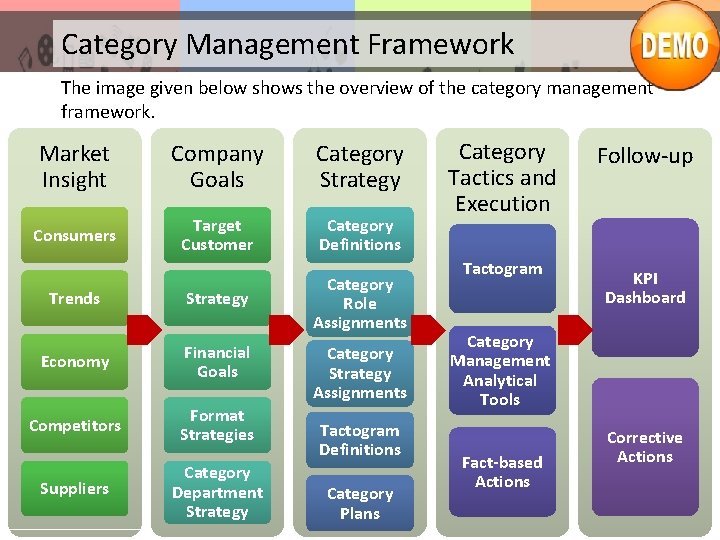
Category Management Framework The image given below shows the overview of the category management framework. Market Insight Company Goals Category Strategy Consumers Target Customer Category Definitions Trends Strategy Economy Financial Goals Competitors Format Strategies Suppliers Category Department Strategy Category Role Assignments Category Strategy Assignments Tactogram Definitions Category Plans Category Tactics and Execution Tactogram Follow-up KPI Dashboard Category Management Analytical Tools Fact-based Actions Corrective Actions
Step 1: Category Definition: • • In this step, the retailer defines the Category, that is, what products are to be included/excluded etc. So, the retailer has to identify a distinct, manageable group of products/services that consumers perceive to be interrelated/substitutable in order to meet consumer needs.
Step 4: Category Scorecard: • In this step, the retailer sets objectives and targets for the category.
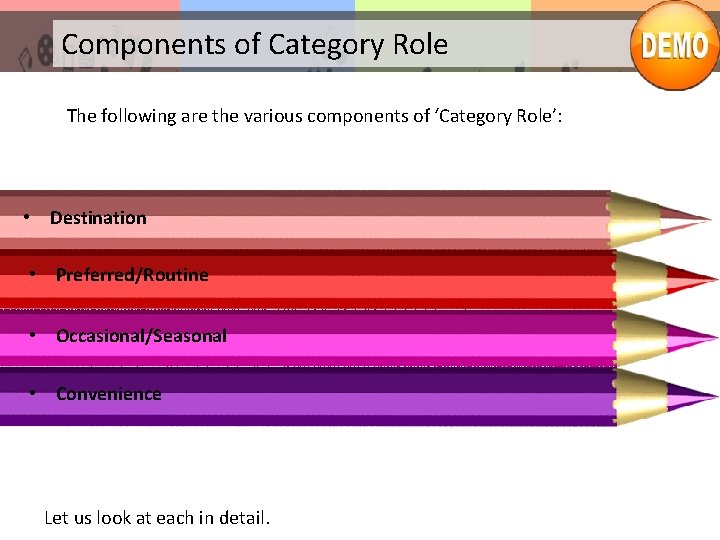
Components of Category Role The following are the various components of ‘Category Role’: • Destination • Preferred/Routine • Occasional/Seasonal • Convenience Let us look at each in detail.
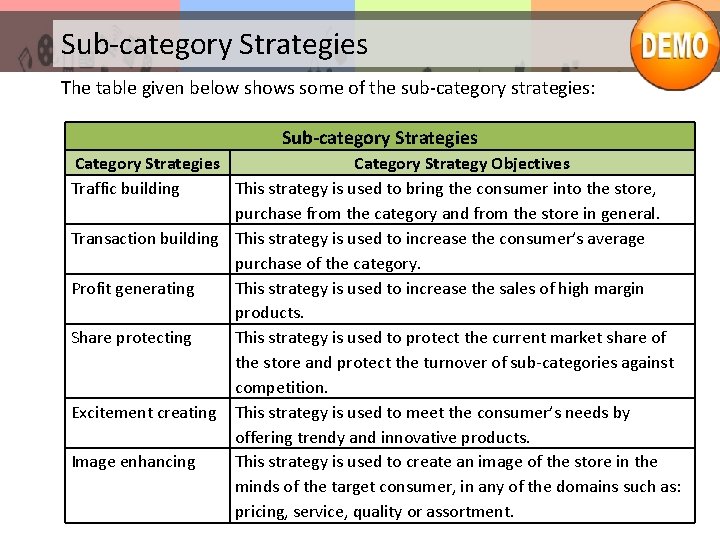
Sub-category Strategies The table given below shows some of the sub-category strategies: Sub-category Strategies Category Strategy Objectives Traffic building This strategy is used to bring the consumer into the store, purchase from the category and from the store in general. Transaction building This strategy is used to increase the consumer’s average purchase of the category. Profit generating This strategy is used to increase the sales of high margin products. Share protecting This strategy is used to protect the current market share of the store and protect the turnover of sub-categories against competition. Excitement creating This strategy is used to meet the consumer’s needs by offering trendy and innovative products. Image enhancing This strategy is used to create an image of the store in the minds of the target consumer, in any of the domains such as: pricing, service, quality or assortment.
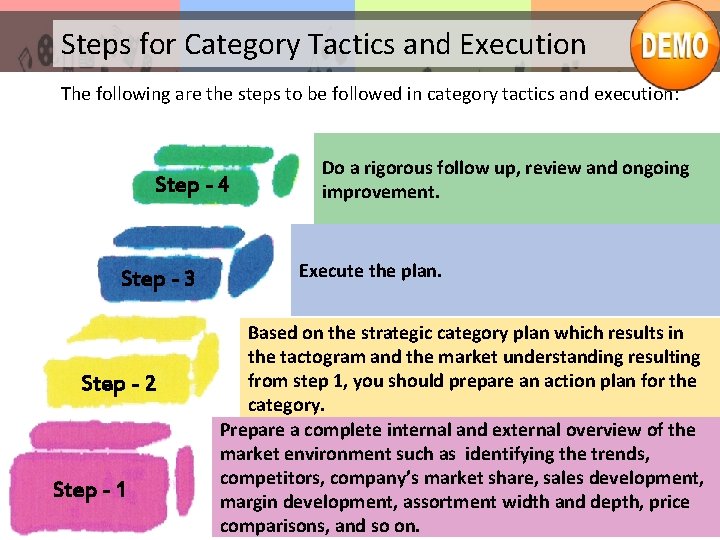
Steps for Category Tactics and Execution The following are the steps to be followed in category tactics and execution: Step - 4 Step - 3 Step - 2 Step - 1 Do a rigorous follow up, review and ongoing improvement. Execute the plan. Based on the strategic category plan which results in the tactogram and the market understanding resulting from step 1, you should prepare an action plan for the category. Prepare a complete internal and external overview of the market environment such as identifying the trends, competitors, company’s market share, sales development, margin development, assortment width and depth, price comparisons, and so on.
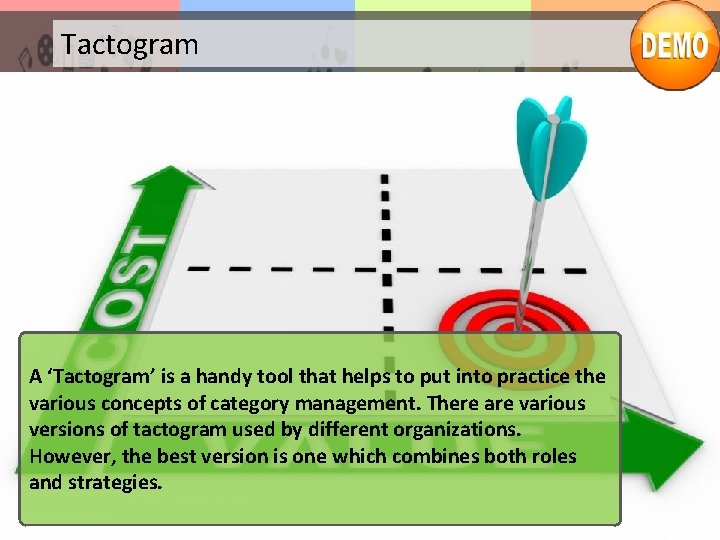
Tactogram A ‘Tactogram’ is a handy tool that helps to put into practice the various concepts of category management. There are various versions of tactogram used by different organizations. However, the best version is one which combines both roles and strategies.
Management. Study. Guide. com This is a DEMO Course On – Category Management. Join MSG Today and Get Access to Unlimited Courses. What You Get: 1. View All Courses Online. 2. Download Powerpoint Presentation for Each Course. 3. Do the Knowledge Checks for Each Course.
- Slides: 23