
Category Inferior leads Lateral leads Septal leads Anterior
- Slides: 4
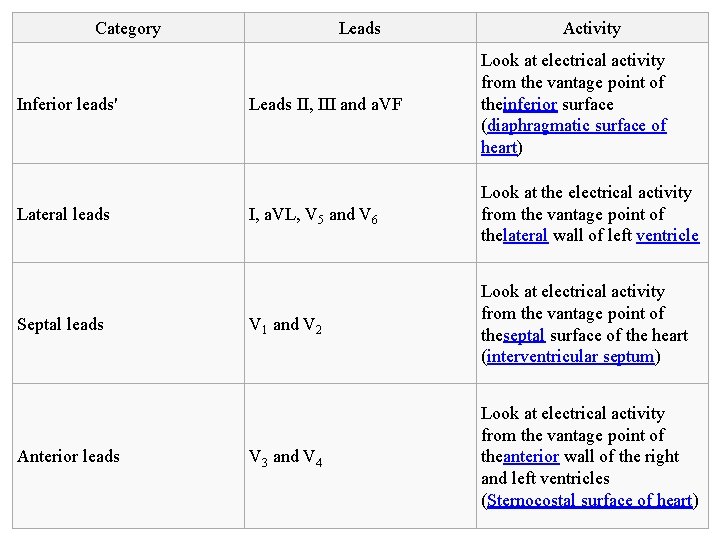
Category Inferior leads' Lateral leads Septal leads Anterior leads Leads Activity Leads II, III and a. VF Look at electrical activity from the vantage point of theinferior surface (diaphragmatic surface of heart) I, a. VL, V 5 and V 6 Look at the electrical activity from the vantage point of thelateral wall of left ventricle V 1 and V 2 Look at electrical activity from the vantage point of theseptal surface of the heart (interventricular septum) V 3 and V 4 Look at electrical activity from the vantage point of theanterior wall of the right and left ventricles (Sternocostal surface of heart)
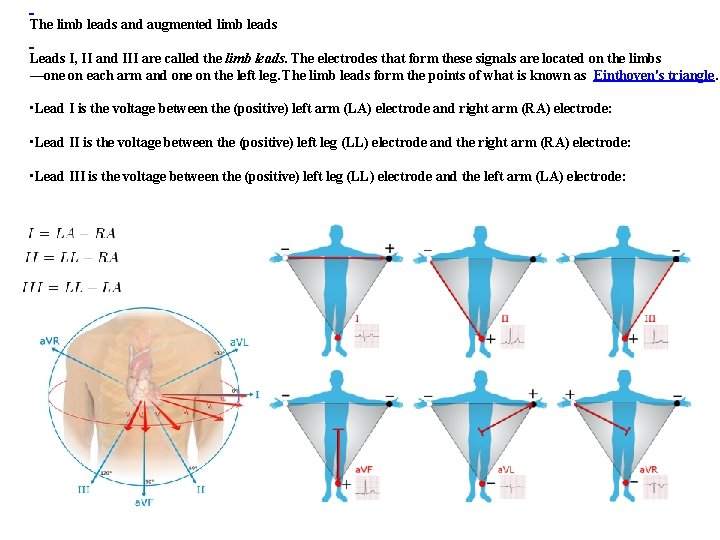
The limb leads and augmented limb leads Leads I, II and III are called the limb leads. The electrodes that form these signals are located on the limbs —one on each arm and one on the left leg. The limb leads form the points of what is known as Einthoven's triangle. • Lead I is the voltage between the (positive) left arm (LA) electrode and right arm (RA) electrode: • Lead II is the voltage between the (positive) left leg (LL) electrode and the right arm (RA) electrode: • Lead III is the voltage between the (positive) left leg (LL) electrode and the left arm (LA) electrode:
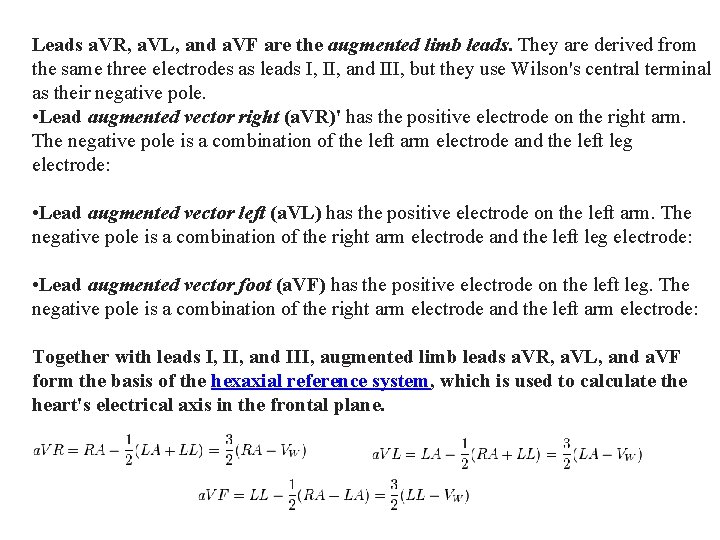
Leads a. VR, a. VL, and a. VF are the augmented limb leads. They are derived from the same three electrodes as leads I, II, and III, but they use Wilson's central terminal as their negative pole. • Lead augmented vector right (a. VR)' has the positive electrode on the right arm. The negative pole is a combination of the left arm electrode and the left leg electrode: • Lead augmented vector left (a. VL) has the positive electrode on the left arm. The negative pole is a combination of the right arm electrode and the left leg electrode: • Lead augmented vector foot (a. VF) has the positive electrode on the left leg. The negative pole is a combination of the right arm electrode and the left arm electrode: Together with leads I, II, and III, augmented limb leads a. VR, a. VL, and a. VF form the basis of the hexaxial reference system, which is used to calculate the heart's electrical axis in the frontal plane.
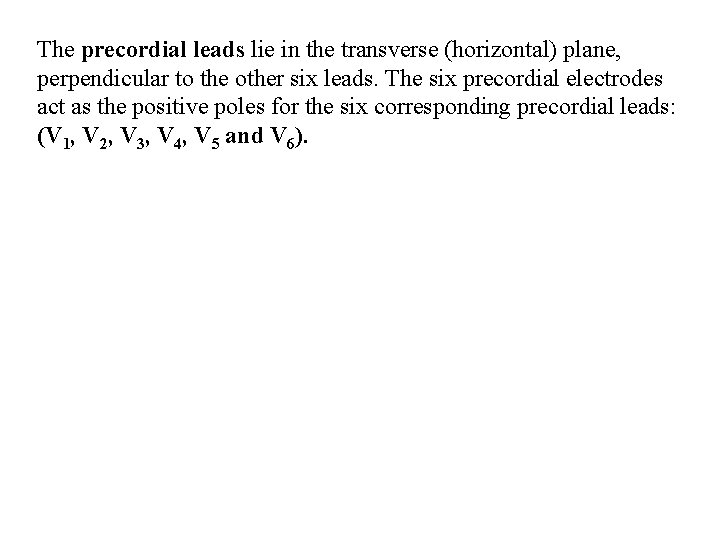
The precordial leads lie in the transverse (horizontal) plane, perpendicular to the other six leads. The six precordial electrodes act as the positive poles for the six corresponding precordial leads: (V 1, V 2, V 3, V 4, V 5 and V 6).