
Categories of the Verbs can be classified according
Categories of the Verbs can be classified according to two criteria: 1 - according to the elements following them (Complements, objects, and adverbials) Or 2 -according to whether or not they admit the progressive aspect (can be used with the be+ v-ing or not)

In terms of the first classification verbs are either followed by: A- complement or obligatory Adverbial B- other elements on no (obligatory) elements In A the verb is intensive. These are verb ‘be’ or L. V. In B the verb is extensive. In B the verb can be followed by: 1 - nothing, or only optional adverbials called extensive and intransitive 2 - by one object called extensive mono-transitive 3 - two objects called extensive di-transitive 4 - an object + an object complement extensive complex transitive
According to the second classification a verb that permits the simple- progressive contrast is called dynamic. E. g. I wrote a poem. > I was writing a poem. A verb that sticks to the simple and cannot be used with the progressive is called stative. E. g. I knew the answer. > * I was knowing the answer.
Verbs Types and Sentence Patterns Below are the sentence patterns and the verb types they contain: 1 -S+V (+A. s) > Extensive & Intransitive verb 2 - S+V+Cs(+A. s) > Intensive verb 3 -S+V+A(place)(+A. s) > Intensive verb 4 -S+V+ O(+A. s) > Extensive & mono-transitive verb 5 - S+V+O+A(+A. s) >Extensive& mono-transitive = 6 - S+V+O+O (+A. s) > Extensive & di-transitive = 7 - S+V+O+Co(+A. s) > Extensive & complex trans. = Examples are below:
1 - Jack travelled ( by his car to Canada last week). 2 -a- Jack is an engineer (in a big company now). b-Jack became the party spokesman(two days ago). 3 - Jack has been there (since April). 4 - Jack delivered a speech(last month). 5 - Jack put his glasses on the desk (a while ago). 6 - Jack told me a secret (because he trusts me). 7 - Jack considers me his best friend (for ever).
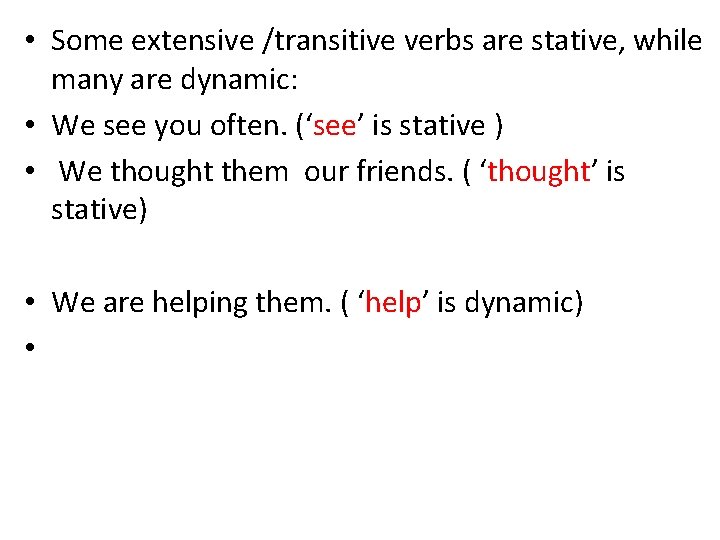
• Some extensive /transitive verbs are stative, while many are dynamic: • We see you often. (‘see’ is stative ) • We thought them our friends. ( ‘thought’ is stative) • We are helping them. ( ‘help’ is dynamic) •
- Slides: 6