
Cataract Surgery Using Biaspheric IOLs in Patients With
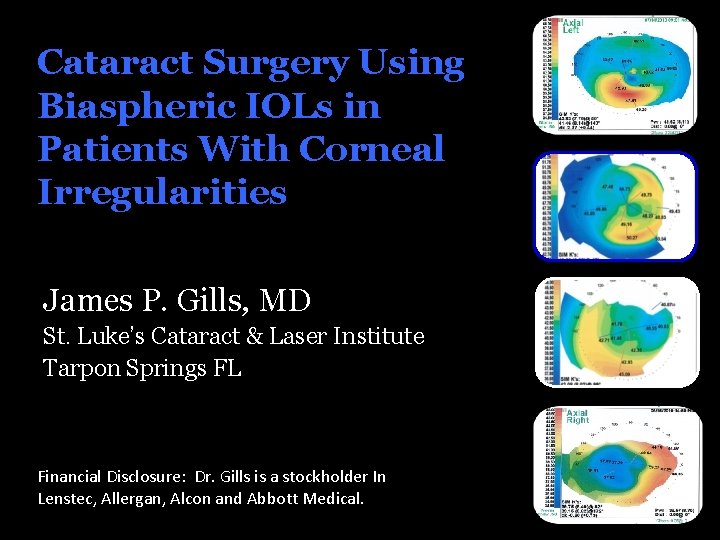
Cataract Surgery Using Biaspheric IOLs in Patients With Corneal Irregularities James P. Gills, MD St. Luke’s Cataract & Laser Institute Tarpon Springs FL Financial Disclosure: Dr. Gills is a stockholder In Lenstec, Allergan, Alcon and Abbott Medical.
Purpose To present case reports of patients with pre-existing corneal irregularities who underwent routine cataract surgery with an aberration free, biaspheric IOL between May and October 2010.
What is Paraxial Focus? Why is it important to the biaspheric lens design? • The strategy of the lens design is to reduce spherical aberrations by controlling the paraxial ray of light so that it intersects at the paraxial focal point instead of in front or behind it.
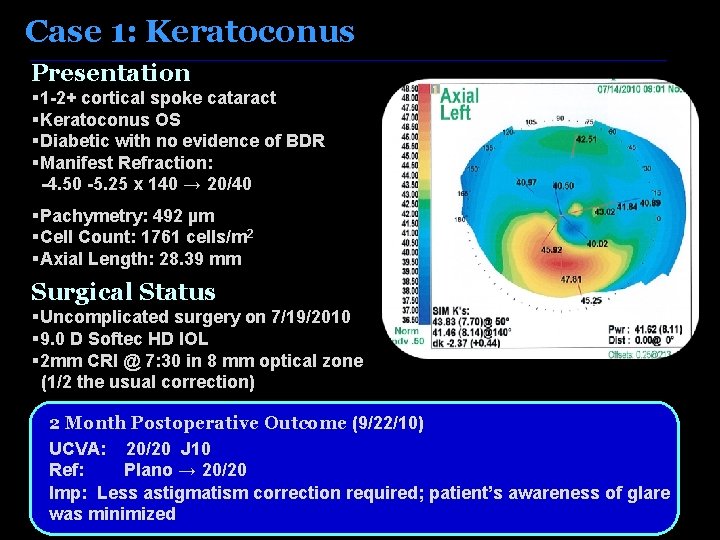
Case 1: Keratoconus Presentation § 1 -2+ cortical spoke cataract §Keratoconus OS §Diabetic with no evidence of BDR §Manifest Refraction: -4. 50 -5. 25 x 140 → 20/40 §Pachymetry: 492 µm §Cell Count: 1761 cells/m 2 §Axial Length: 28. 39 mm Surgical Status §Uncomplicated surgery on 7/19/2010 § 9. 0 D Softec HD IOL § 2 mm CRI @ 7: 30 in 8 mm optical zone (1/2 the usual correction) 2 Month Postoperative Outcome (9/22/10) UCVA: 20/20 J 10 Ref: Plano → 20/20 Imp: Less astigmatism correction required; patient’s awareness of glare was minimized
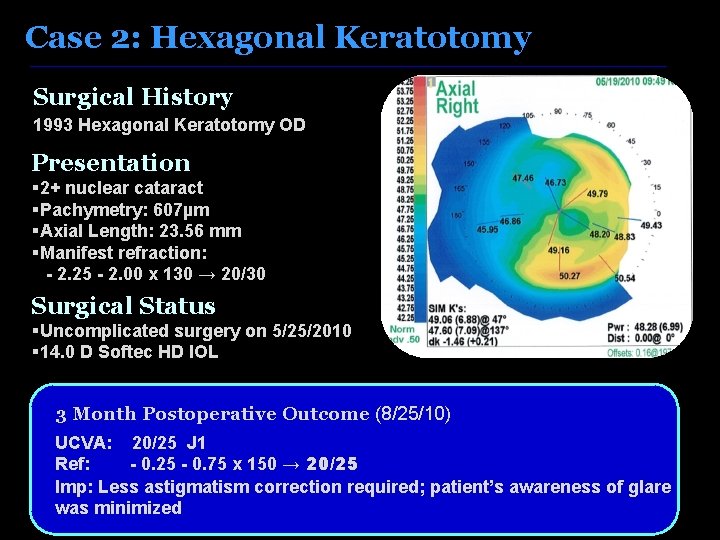
Case 2: Hexagonal Keratotomy Surgical History 1993 Hexagonal Keratotomy OD Presentation § 2+ nuclear cataract §Pachymetry: 607µm §Axial Length: 23. 56 mm §Manifest refraction: - 2. 25 - 2. 00 x 130 → 20/30 Surgical Status §Uncomplicated surgery on 5/25/2010 § 14. 0 D Softec HD IOL 3 Month Postoperative Outcome (8/25/10) UCVA: 20/25 J 1 Ref: - 0. 25 - 0. 75 x 150 → 20/25 Imp: Less astigmatism correction required; patient’s awareness of glare was minimized
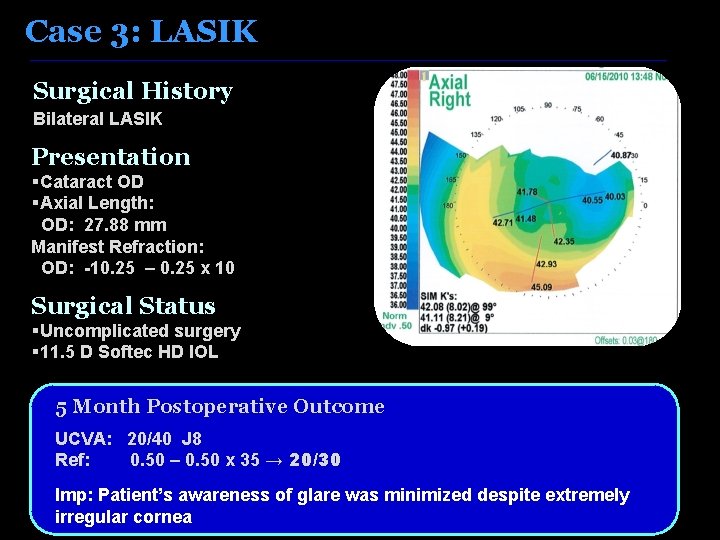
Case 3: LASIK Surgical History Bilateral LASIK Presentation §Cataract OD §Axial Length: OD: 27. 88 mm Manifest Refraction: OD: -10. 25 – 0. 25 x 10 Surgical Status §Uncomplicated surgery § 11. 5 D Softec HD IOL 5 Month Postoperative Outcome UCVA: 20/40 J 8 Ref: 0. 50 – 0. 50 x 35 → 20/30 Imp: Patient’s awareness of glare was minimized despite extremely irregular cornea
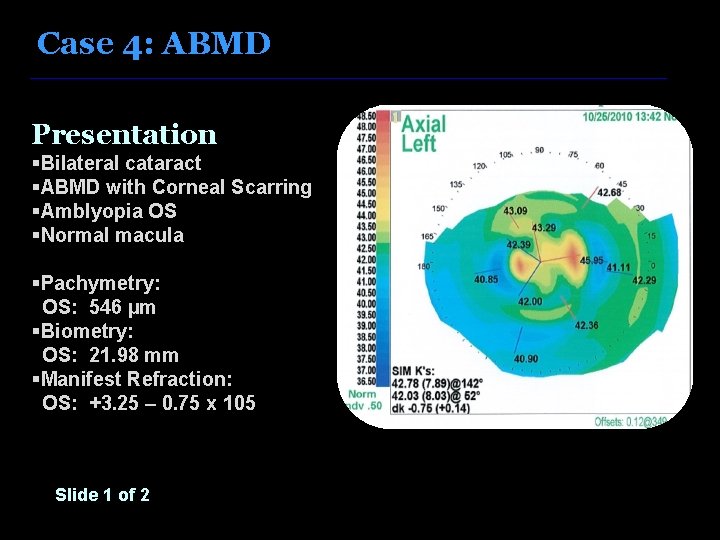
Case 4: ABMD Presentation §Bilateral cataract §ABMD with Corneal Scarring §Amblyopia OS §Normal macula §Pachymetry: OS: 546 µm §Biometry: OS: 21. 98 mm §Manifest Refraction: OS: +3. 25 – 0. 75 x 105 Slide 1 of 2
Case 4: ABMD Continued Surgical Status §Planned monovision: -2. 0 D Target with 30. 0 D Softec HD IOL OS §Uncomplicated surgery §LRIs: OS: 7 mm @ 4: 45 OS: 5 mm @ 10: 30 and 4: 30 enhancement Postoperative Outcome 3 Month Postoperative OS UCVA: 20/200 J 1+ Ref: -2. 50 – 0. 75 x 10 → 20/25 Imp: Patient’s awareness of glare was minimal; improved quality of vision post-operatively despite corneal irregularities
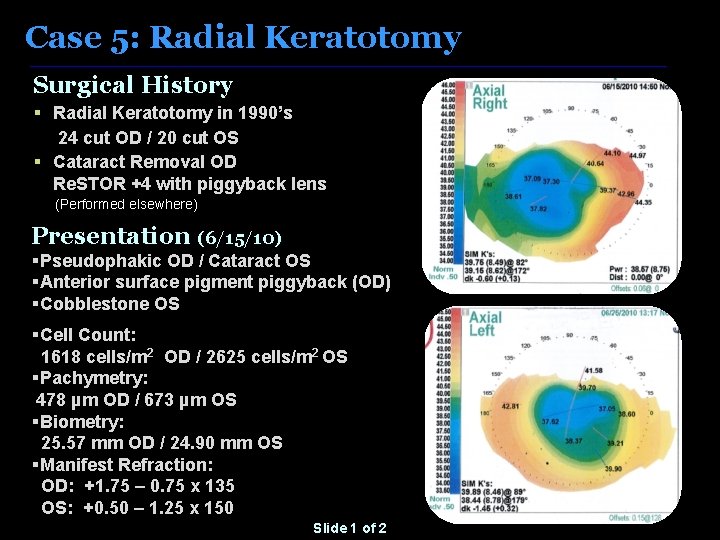
Case 5: Radial Keratotomy Surgical History § Radial Keratotomy in 1990’s 24 cut OD / 20 cut OS § Cataract Removal OD Re. STOR +4 with piggyback lens (Performed elsewhere) Presentation (6/15/10) §Pseudophakic OD / Cataract OS §Anterior surface pigment piggyback (OD) §Cobblestone OS §Cell Count: 1618 cells/m 2 OD / 2625 cells/m 2 OS §Pachymetry: 478 µm OD / 673 µm OS §Biometry: 25. 57 mm OD / 24. 90 mm OS §Manifest Refraction: OD: +1. 75 – 0. 75 x 135 OS: +0. 50 – 1. 25 x 150 Slide 1 of 2
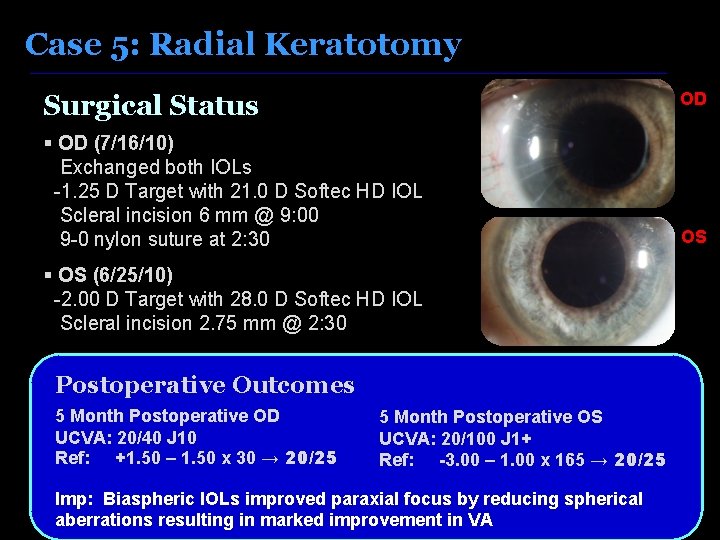
Case 5: Radial Keratotomy OD Surgical Status § OD (7/16/10) Exchanged both IOLs -1. 25 D Target with 21. 0 D Softec HD IOL Scleral incision 6 mm @ 9: 00 9 -0 nylon suture at 2: 30 § OS (6/25/10) -2. 00 D Target with 28. 0 D Softec HD IOL Scleral incision 2. 75 mm @ 2: 30 Postoperative Outcomes 5 Month Postoperative OD UCVA: 20/40 J 10 Ref: +1. 50 – 1. 50 x 30 → 20/25 5 Month Postoperative OS UCVA: 20/100 J 1+ Ref: -3. 00 – 1. 00 x 165 → 20/25 Imp: Biaspheric IOLs improved paraxial focus by reducing spherical aberrations resulting in marked improvement in VA OS
Conclusion § As demonstrated, the aberration free, biaspheric IOL is preferred for patients with corneal irregularities. § Compared with conventional spherical IOL cases, those presented here require approximately half as much astigmatic correction and reported little or no glare. § This phenomena may be attributed to the aberration free, biaspheric optic of the reported IOL. §The paraxial focus that is associated with this IOL appears to primarily use the central cornea. § This paraxial focus appears to reduce spherical and optical aberrations, thus improving pseudophakic vision.
- Slides: 11