
Catalytic degradation of Natural Organic Matter NOM by
Catalytic degradation of Natural Organic Matter (NOM) by Advanced Oxidation Technologies Ana María García 1, *, Ricardo A. Torres-Palma 2, Miguel-Ángel Vicente 3, Antonio Gil 4 and Luis-Alejandro Galeano 1, * 1 Research Group on Functional Materials and Catalysis (GIMFC), Nariño University, Department of Chemistry, Colombia 2 Research Group on Environmental Remediation and Biocatalysis, Antioquia University, Colombia 3 Salamanca University Department of Inorganic Chemistry, Spain 4 Public University of Navarre, Campus Arrosadía, Spain (*) Presenting Author’s E-mail: ana. garcia 11@udea. edu. co (*) Corresponding Author´s E-mail: alejandrogaleano@udenar. edu. co

INTRODUCTION 2
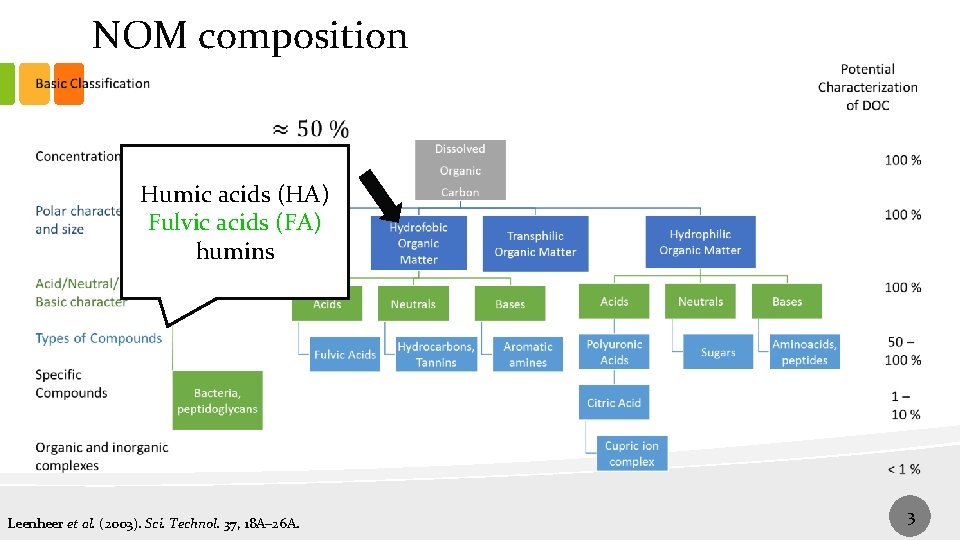
NOM composition Humic acids (HA) Fulvic acids (FA) humins Leenheer et al. (2003). Sci. Technol. 37, 18 A– 26 A. 3
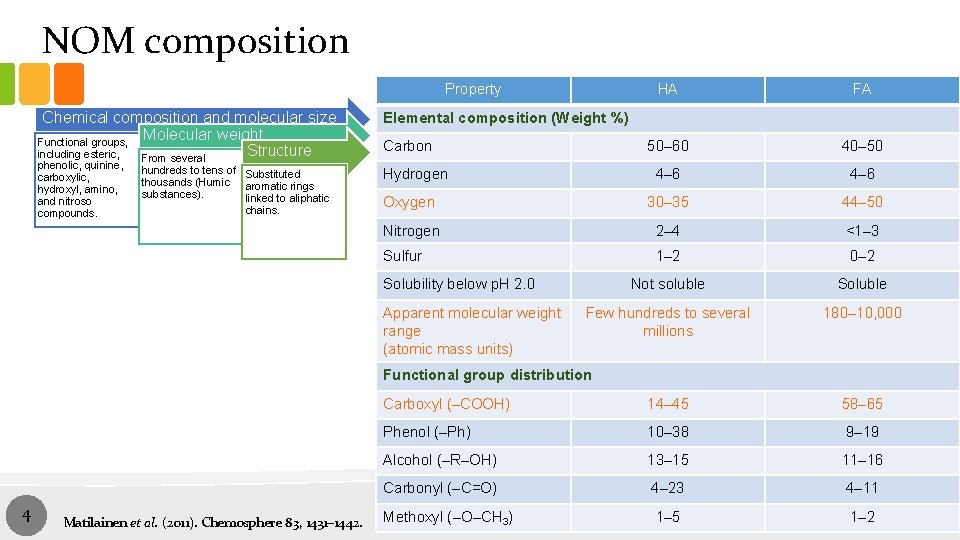
NOM composition Property Chemical composition and molecular size Molecular weight Functional groups, Structure including esteric, From several phenolic, quinine, carboxylic, hydroxyl, amino, and nitroso compounds. hundreds to tens of Substituted thousands (Humic aromatic rings substances). linked to aliphatic chains. HA FA 50– 60 40– 50 4– 6 Oxygen 30– 35 44– 50 Nitrogen 2– 4 <1– 3 Sulfur 1– 2 0– 2 Not soluble Soluble Few hundreds to several millions 180– 10, 000 Elemental composition (Weight %) Carbon Hydrogen Solubility below p. H 2. 0 Apparent molecular weight range (atomic mass units) Functional group distribution 4 Matilainen et al. (2011). Chemosphere 83, 1431– 1442. Carboxyl (–COOH) 14– 45 58– 65 Phenol (–Ph) 10– 38 9– 19 Alcohol (–R–OH) 13– 15 11– 16 Carbonyl (–C=O) 4– 23 4– 11 Methoxyl (–O–CH 3) 1– 5 1– 2 4
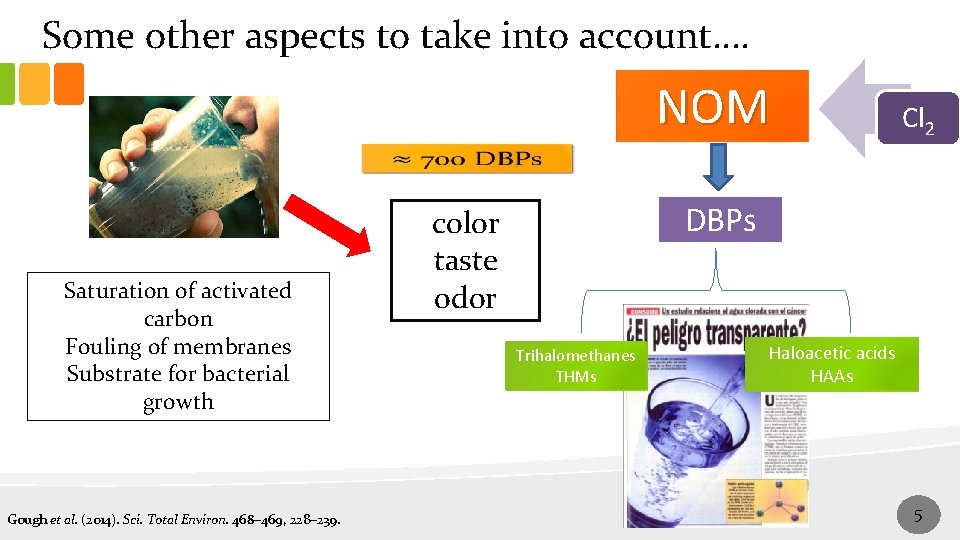
Some other aspects to take into account…. NOM Cl 2 Saturation of activated carbon Fouling of membranes Substrate for bacterial growth Gough et al. (2014). Sci. Total Environ. 468– 469, 228– 239. DBPs color taste odor Trihalomethanes THMs Haloacetic acids HAAs 5
![Typical NOM concentrations in real water sources [VALOR] 0 [VALOR] % HPO HPI TPI](http://slidetodoc.com/presentation_image/6e707c34d6aeecb0dabdbf182e8cc250/image-6.jpg "Typical NOM concentrations in real water sources [VALOR] 0 [VALOR] % HPO HPI TPI")
Typical NOM concentrations in real water sources [VALOR] 0 [VALOR] % HPO HPI TPI 0 [VALOR] % Effluent of wastewater treatment plant [VALOR] 0 [VALOR] % % [VALOR] % Effluent of aeration followed by activated 0 sludge [VALOR] TOC (mg/L) [VALOR] % % [VALOR] % HPI: Hydrophilic fraction HPO: Hydrophobic fraction TPI: Transphilic fraction Secondary effluent from a water Effluent of pre-treatment with activated sludge, coagulation and regeneration plant sand filtration Gong et al. (2008). Water Res. 42, 1238 -1244. Jarusutthirak et al. (2002). Desalination 145, 247 -255. . Hu et al. (2003). Water Res. 37, 4801 -4809. Zhang et al. (2009) J. Hazard. Mater. 164, 1433 -1438 6 6
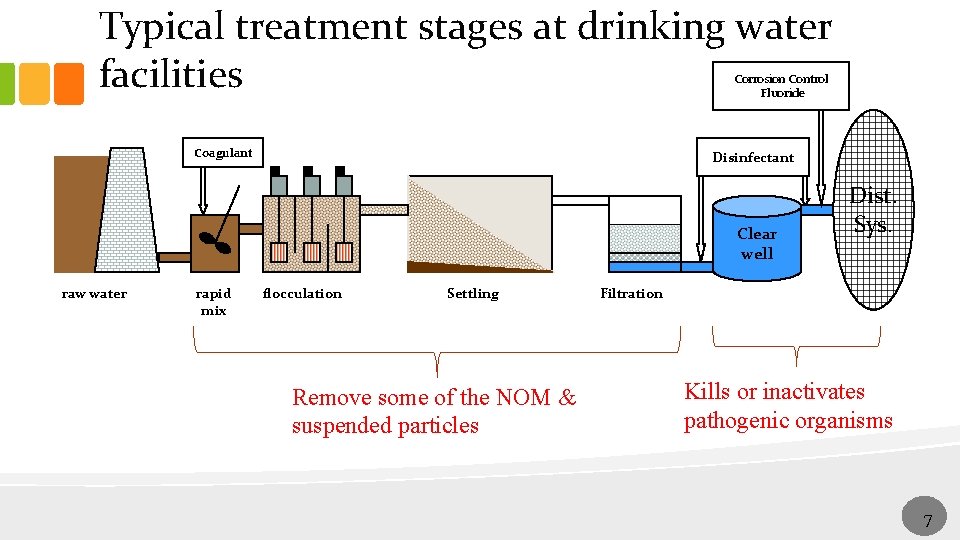
Typical treatment stages at drinking water facilities Corrosion Control Fluoride Coagulant Disinfectant Clear well raw water rapid mix flocculation Settling Remove some of the NOM & suspended particles Dist. Sys. Filtration Kills or inactivates pathogenic organisms 77

AOTs CWPO Fe, Cu-catalysts Ti. O 2/hn/O 2 Photocatalytic Mn 2+/Oxalic H 2 O 2/Fe 2+ (Fenton) H 2 O 2/Fe 3+ (Fenton - like) HO • acid/O 3 H 2 O 2/Fe 3+- oxalate H 2 O 2/UV O 3/H 2 O 2 GOAL NOM H 2 O 2/Fe 2+ (Fe 3+) /UV (Photoassisted Fenton) + H 2 O 2 MINERALIZATION O 3/UV HO. Eº = 2, 80 CO 2 + H 2 O and by-products 88
2. AOTs FOR NOM DEGRADATION O H O H O H 9
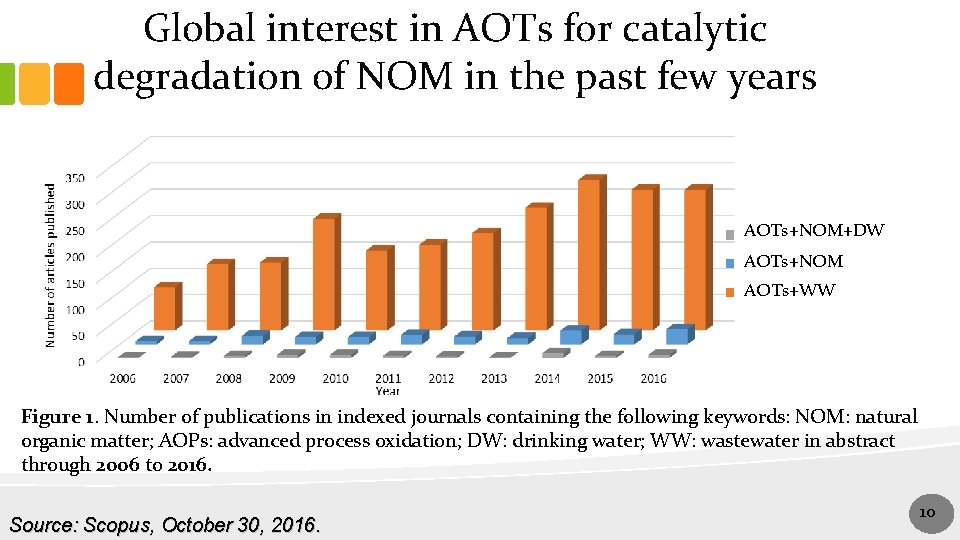
Global interest in AOTs for catalytic degradation of NOM in the past few years AOTs+NOM+DW AOTs+NOM AOTs+WW Figure 1. Number of publications in indexed journals containing the following keywords: NOM: natural organic matter; AOPs: advanced process oxidation; DW: drinking water; WW: wastewater in abstract through 2006 to 2016. Source: Scopus, October 30, 2016. 1010
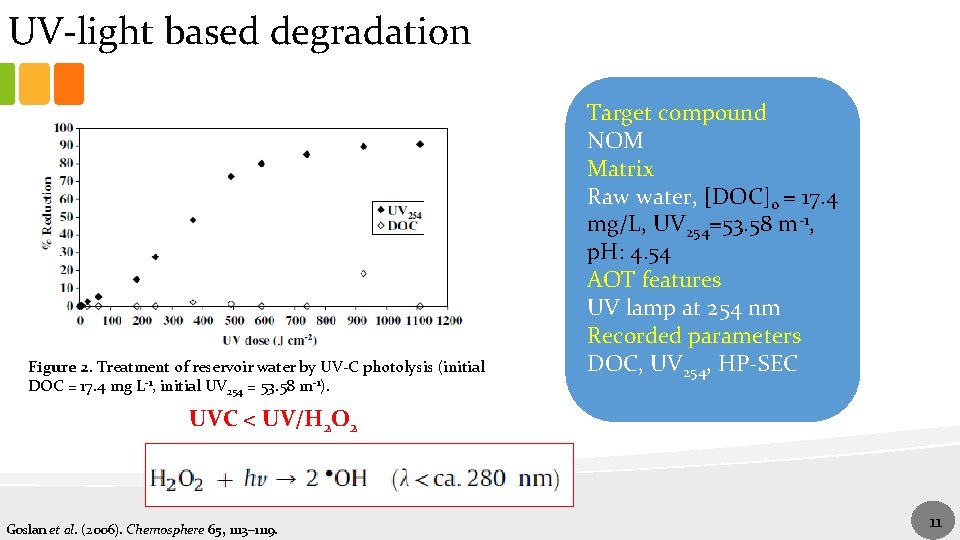
UV-light based degradation Figure 2. Treatment of reservoir water by UV-C photolysis (initial DOC = 17. 4 mg L-1, initial UV 254 = 53. 58 m-1). Target compound NOM Matrix Raw water, [DOC]0 = 17. 4 mg/L, UV 254=53. 58 m-1, p. H: 4. 54 AOT features UV lamp at 254 nm Recorded parameters DOC, UV 254, HP-SEC UVC < UV/H 2 O 2 Goslan et al. (2006). Chemosphere 65, 1113– 1119. 11
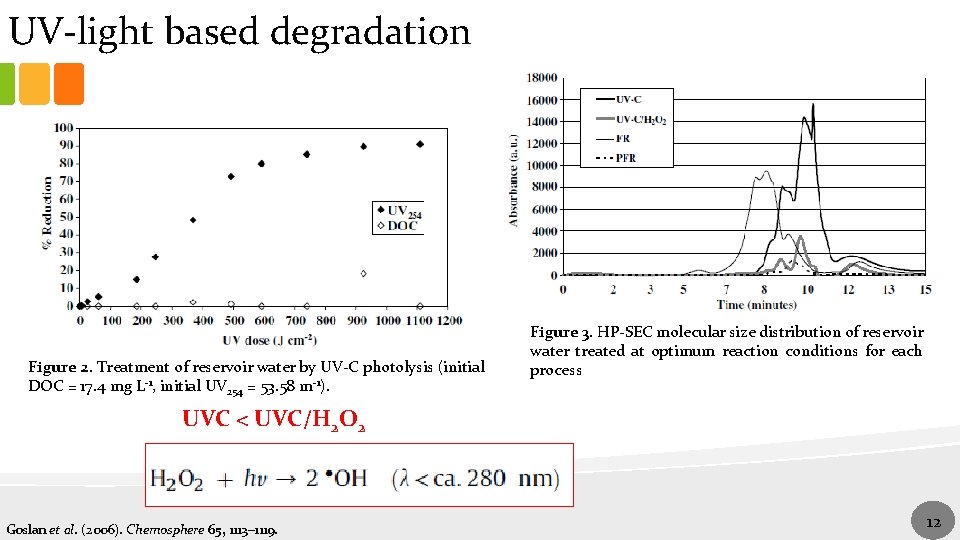
UV-light based degradation Figure 2. Treatment of reservoir water by UV-C photolysis (initial DOC = 17. 4 mg L-1, initial UV 254 = 53. 58 m-1). Figure 3. HP-SEC molecular size distribution of reservoir water treated at optimum reaction conditions for each process UVC < UVC/H 2 O 2 Goslan et al. (2006). Chemosphere 65, 1113– 1119. 12
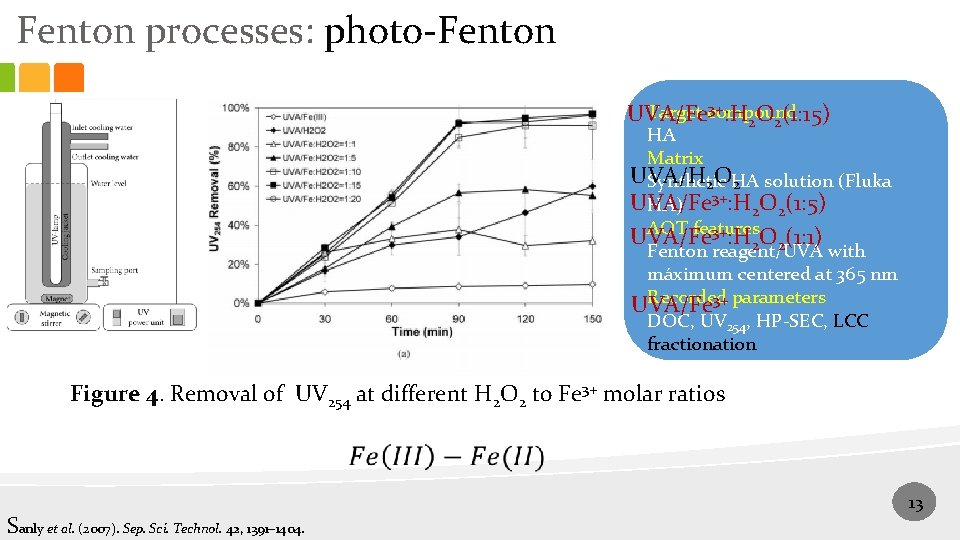
Fenton processes: photo-Fenton 3+: H O (1: 15) Target compound UVA/Fe 2 2 HA Matrix UVA/H Synthetic HA solution (Fluka 2 O 2 UVA/Fe HA) 3+: H 2 O 2(1: 5) AOT features 3+: H O (1: 1) UVA/Fe 2 2 Fenton reagent/UVA with máximum centered at 365 nm Recorded parameters 3+ UVA/Fe DOC, UV 254, HP-SEC, LCC fractionation Figure 4. Removal of UV 254 at different H 2 O 2 to Fe 3+ molar ratios Sanly et al. (2007). Sep. Sci. Technol. 42, 1391– 1404. 13
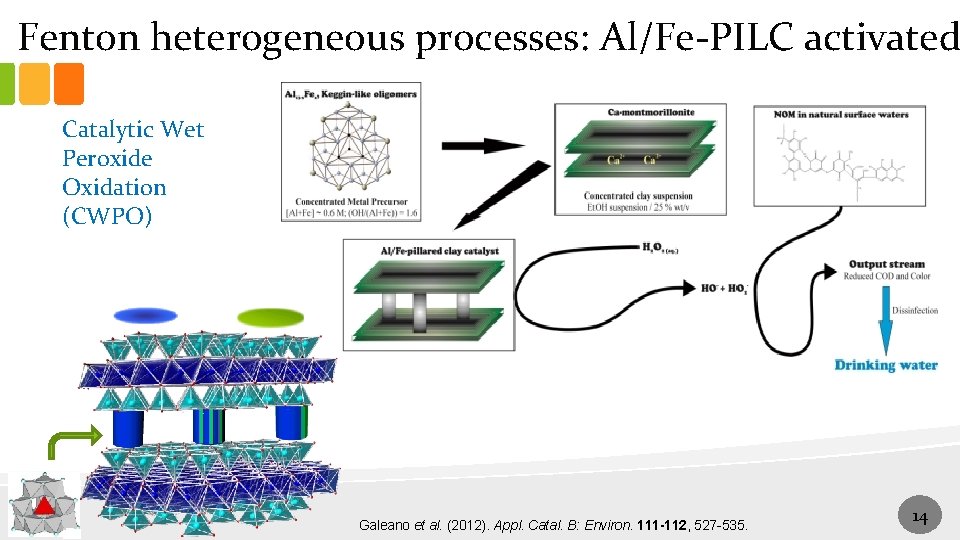
Fenton heterogeneous processes: Al/Fe-PILC activated Catalytic Wet Peroxide Oxidation (CWPO) Galeano et al. (2012). Appl. Catal. B: Environ. 111 -112, 527 -535. 14
![Catalytic Wet Peroxide Oxidation (CWPO): color removal [Fe]leach. ≤ 0. 5 mg/dm 3 Target](http://slidetodoc.com/presentation_image/6e707c34d6aeecb0dabdbf182e8cc250/image-15.jpg "Catalytic Wet Peroxide Oxidation (CWPO): color removal [Fe]leach. ≤ 0. 5 mg/dm 3 Target")
Catalytic Wet Peroxide Oxidation (CWPO): color removal [Fe]leach. ≤ 0. 5 mg/dm 3 Target compound NOM Matrix Surface water, [COD]0 = 40. 14 mg O 2/dm 3 [Color 455]0 = 42 PCU AOP features [Catalyst] = 0. 5 g/dm 3 [H 2 O 2]ad. = 0. 047 mol/dm 3 H 2 O 2 veloc. = 6. 0 cm 3/h [H 2 O 2]/[COD]0 = 1. 0 p. H = 3. 7 T = 291 ± 2. 0 K P = 72 k. Pa Recorded parameters COD, Color removal Figure 5. Color 455 removals from raw surface PCU: Pt-Co units water displayed by the clay catalysts. Galeano et al. (2012). Appl. Catal. B: Environ. 111 -112, 527 -535. 15
![Photocatalysis CB Photon VB Target compound NOM Matrix Surface water, [DOC]0 = 2 mg/L,](http://slidetodoc.com/presentation_image/6e707c34d6aeecb0dabdbf182e8cc250/image-16.jpg "Photocatalysis CB Photon VB Target compound NOM Matrix Surface water, [DOC]0 = 2 mg/L,")
Photocatalysis CB Photon VB Target compound NOM Matrix Surface water, [DOC]0 = 2 mg/L, UV 254=0. 081 cm-1, p. H: 6. 5 AOT features Degussa Cu/Ti. O 2 Recorded parameters SEC, DOC Ban d gap Figure 6. Control experiments for the inhibiting effect of added Cu 2+. 16 Espinoza et al. (2011). Water Res. 45, 1039– 1048.
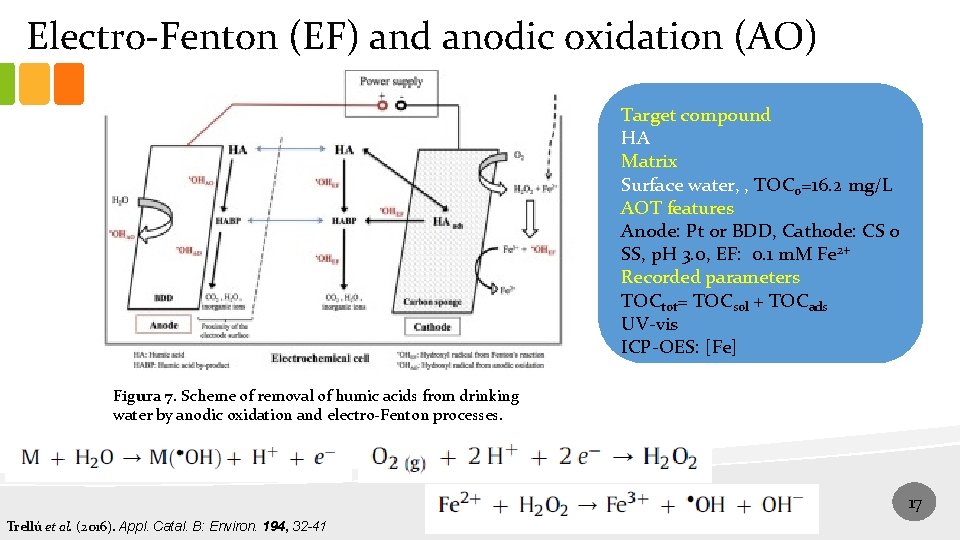
Electro-Fenton (EF) and anodic oxidation (AO) Target compound HA Matrix Surface water, , TOC 0=16. 2 mg/L AOT features Anode: Pt or BDD, Cathode: CS o SS, p. H 3. 0, EF: 0. 1 m. M Fe 2+ Recorded parameters TOCtot= TOCsol + TOCads UV-vis ICP-OES: [Fe] Figura 7. Scheme of removal of humic acids from drinking water by anodic oxidation and electro-Fenton processes. 17 Trellú et al. (2016). Appl. Catal. B: Environ. 194, 32 -41
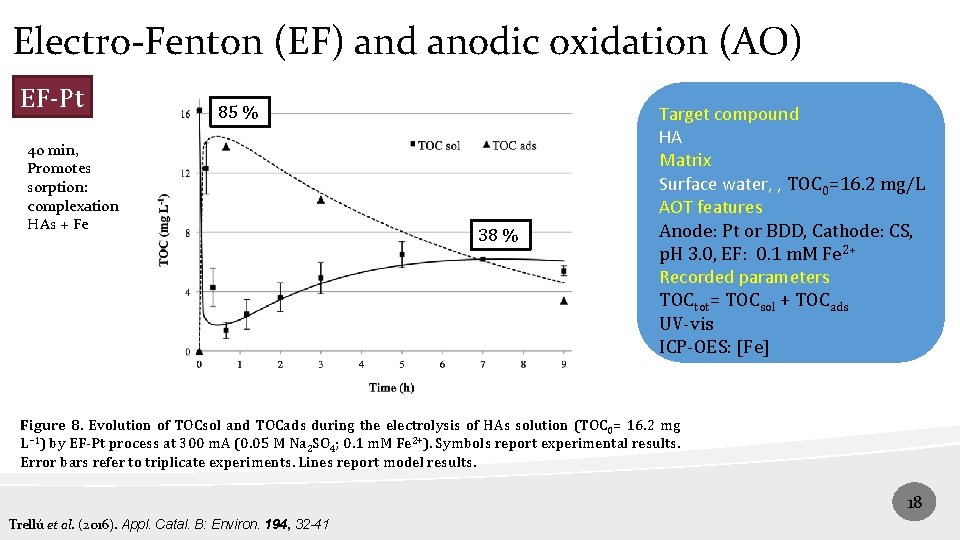
Electro-Fenton (EF) and anodic oxidation (AO) EF-Pt 85 % 40 min, Promotes sorption: complexation HAs + Fe 38 % Target compound HA Matrix Surface water, , TOC 0=16. 2 mg/L AOT features Anode: Pt or BDD, Cathode: CS, p. H 3. 0, EF: 0. 1 m. M Fe 2+ Recorded parameters TOCtot= TOCsol + TOCads UV-vis ICP-OES: [Fe] Figure 8. Evolution of TOCsol and TOCads during the electrolysis of HAs solution (TOC 0= 16. 2 mg L− 1) by EF-Pt process at 300 m. A (0. 05 M Na 2 SO 4; 0. 1 m. M Fe 2+). Symbols report experimental results. Error bars refer to triplicate experiments. Lines report model results. 18 Trellú et al. (2016). Appl. Catal. B: Environ. 194, 32 -41

THANK YOU 19
- Slides: 19