
Catalyst Project Delivering Open Cloud Ecosystems for Digital
- Slides: 14
Catalyst Project : Delivering Open Cloud Ecosystems for Digital SMEs – TMF API Reuse © 2016 TM Forum Live! 2016 | 1
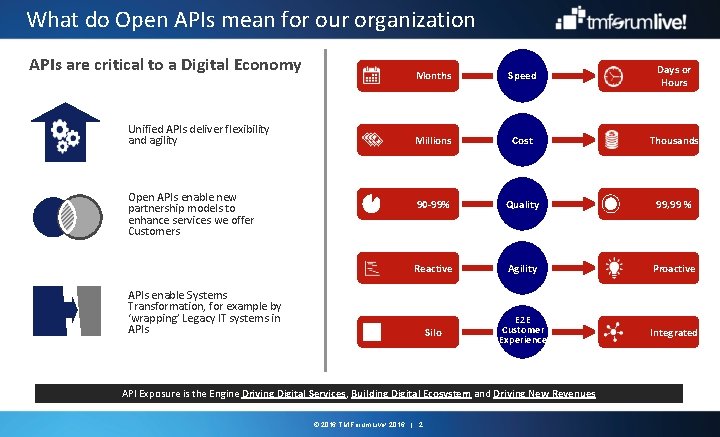
What do Open APIs mean for our organization APIs are critical to a Digital Economy Unified APIs deliver flexibility and agility Open APIs enable new partnership models to enhance services we offer Customers Months Speed Days or Hours Millions Cost Thousands 90 -99% Quality 99, 99 % Reactive Agility Proactive Silo E 2 E Customer Experience Integrated APIs enable Systems Transformation, for example by ‘wrapping’ Legacy IT systems in APIs API Exposure is the Engine Driving Digital Services, Building Digital Ecosystem and Driving New Revenues © 2016 TM Forum Live! 2016 | 2
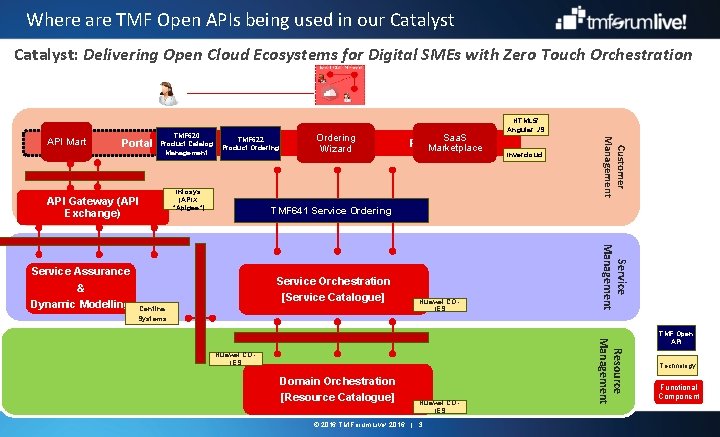
Where are TMF Open APIs being used in our Catalyst: Delivering Open Cloud Ecosystems for Digital SMEs with Zero Touch Orchestration Portal TMF 620 Product Catalog Management Infosys (APIX “Apigee”) API Gateway (API Exchange) Ordering Wizard Saa. S Portal Marketplace Invercloud TMF 641 Service Ordering Service Orchestration [Service Catalogue] Centina Huawei CO IES Service Management Service Assurance & Dynamic Modelling TMF 622 Product Ordering Customer Management API Mart HTML 5/ Angular JS Systems Domain Orchestration [Resource Catalogue] Huawei CO IES © 2016 TM Forum Live! 2016 | 3 Resource Management Huawei CO IES TMF Open API Technology Functional Component
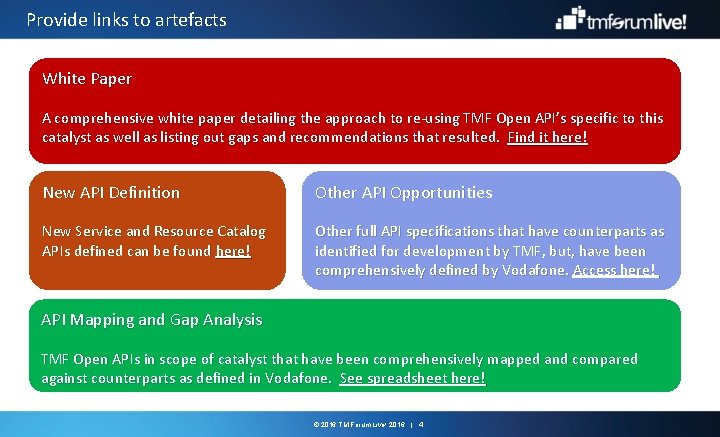
Provide links to artefacts White Paper A comprehensive white paper detailing the approach to re-using TMF Open API’s specific to this catalyst as well as listing out gaps and recommendations that resulted. Find it here! New API Definition Other API Opportunities New Service and Resource Catalog APIs defined can be found here! Other full API specifications that have counterparts as identified for development by TMF, but, have been comprehensively defined by Vodafone. Access here! API Mapping and Gap Analysis TMF Open APIs in scope of catalyst that have been comprehensively mapped and compared against counterparts as defined in Vodafone. See spreadsheet here! © 2016 TM Forum Live! 2016 | 4
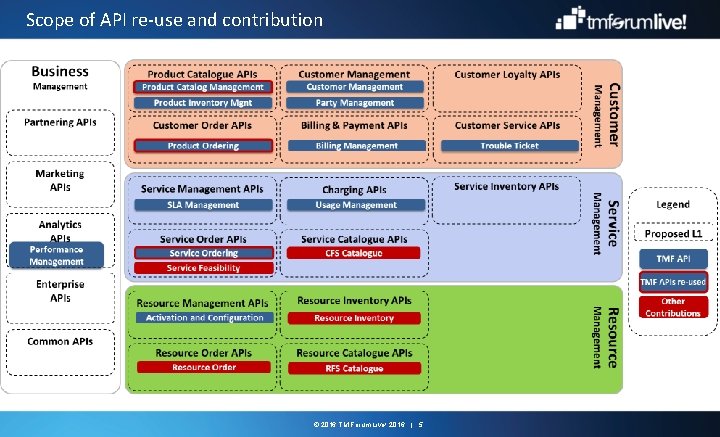
Scope of API re-use and contribution © 2016 TM Forum Live! 2016 | 5
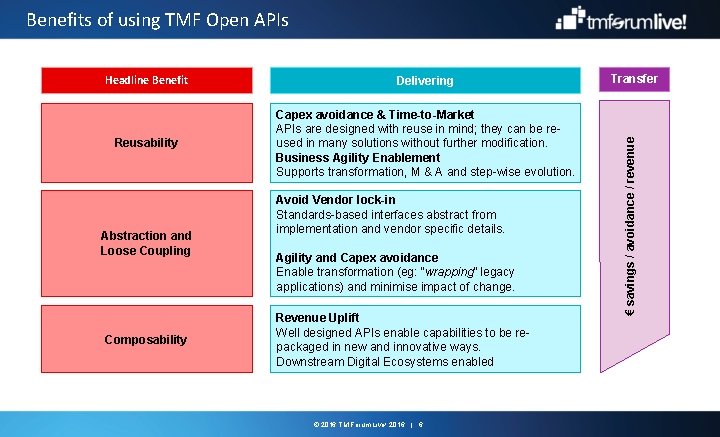
Benefits of using TMF Open APIs Delivering Reusability Capex avoidance & Time-to-Market APIs are designed with reuse in mind; they can be reused in many solutions without further modification. Business Agility Enablement Supports transformation, M & A and step-wise evolution. Abstraction and Loose Coupling Composability Avoid Vendor lock-in Standards-based interfaces abstract from implementation and vendor specific details. Agility and Capex avoidance Enable transformation (eg: “wrapping” legacy applications) and minimise impact of change. Revenue Uplift Well designed APIs enable capabilities to be repackaged in new and innovative ways. Downstream Digital Ecosystems enabled © 2016 TM Forum Live! 2016 | 6 Transfer € savings / avoidance / revenue Headline Benefit
Hypermedia extensions for TMF APIs © 2016 TM Forum Live! 2016 | 7
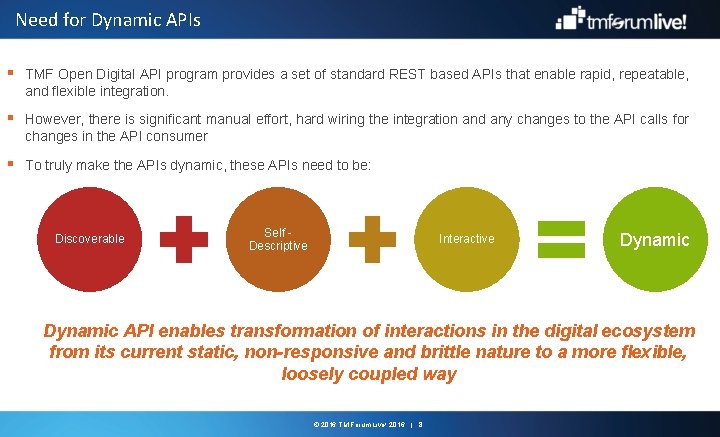
Need for Dynamic APIs § TMF Open Digital API program provides a set of standard REST based APIs that enable rapid, repeatable, and flexible integration. § However, there is significant manual effort, hard wiring the integration and any changes to the API calls for changes in the API consumer § To truly make the APIs dynamic, these APIs need to be: Discoverable Self Descriptive Interactive Dynamic API enables transformation of interactions in the digital ecosystem from its current static, non-responsive and brittle nature to a more flexible, loosely coupled way © 2016 TM Forum Live! 2016 | 8
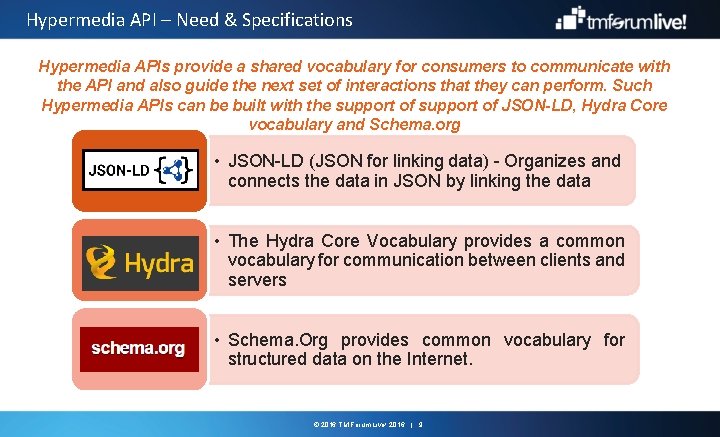
Hypermedia API – Need & Specifications Hypermedia APIs provide a shared vocabulary for consumers to communicate with the API and also guide the next set of interactions that they can perform. Such Hypermedia APIs can be built with the support of JSON-LD, Hydra Core vocabulary and Schema. org • JSON-LD (JSON for linking data) - Organizes and connects the data in JSON by linking the data • The Hydra Core Vocabulary provides a common vocabulary for communication between clients and servers • Schema. Org provides common vocabulary for structured data on the Internet. © 2016 TM Forum Live! 2016 | 9
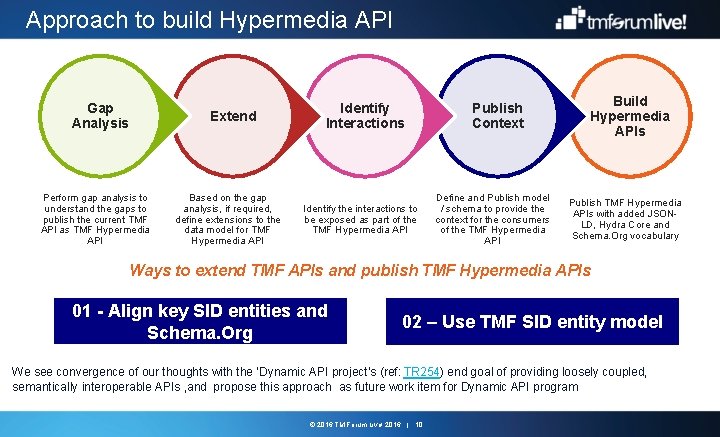
Approach to build Hypermedia API Gap Analysis Perform gap analysis to understand the gaps to publish the current TMF API as TMF Hypermedia API Extend Based on the gap analysis, if required, define extensions to the data model for TMF Hypermedia API Identify Interactions Identify the interactions to be exposed as part of the TMF Hypermedia API Publish Context Define and Publish model / schema to provide the context for the consumers of the TMF Hypermedia API Build Hypermedia APIs Publish TMF Hypermedia APIs with added JSONLD, Hydra Core and Schema. Org vocabulary Ways to extend TMF APIs and publish TMF Hypermedia APIs 01 - Align key SID entities and Schema. Org 02 – Use TMF SID entity model We see convergence of our thoughts with the ‘Dynamic API project’s (ref: TR 254) end goal of providing loosely coupled, semantically interoperable APIs , and propose this approach as future work item for Dynamic API program © 2016 TM Forum Live! 2016 | 10
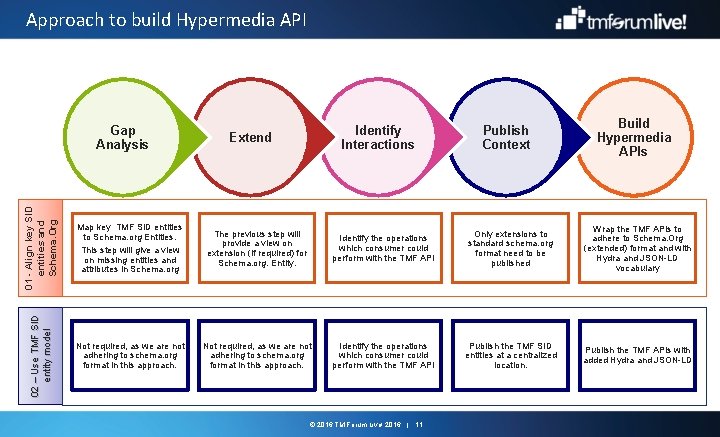
Approach to build Hypermedia API Identify Interactions Build Hypermedia APIs 01 - Align key SID entities and Schema. Org Extend Publish Context Map key TMF SID entities to Schema. org Entities. This step will give a view on missing entities and attributes in Schema. org The previous step will provide a view on extension (if required) for Schema. org. Entity. Identify the operations which consumer could perform with the TMF API Only extensions to standard schema. org format need to be published Wrap the TMF APIs to adhere to Schema. Org (extended) format and with Hydra and JSON-LD vocabulary 02 – Use TMF SID entity model Gap Analysis Not required, as we are not adhering to schema. org format in this approach. Identify the operations which consumer could perform with the TMF API Publish the TMF SID entities at a centralized location. Publish the TMF APIs with added Hydra and JSON-LD © 2016 TM Forum Live! 2016 | 11
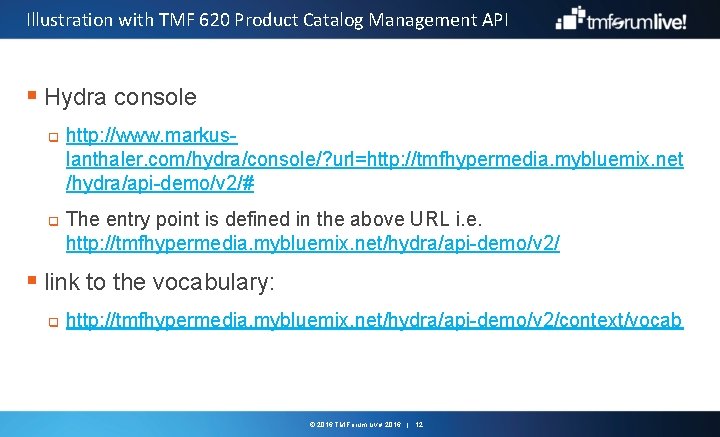
Illustration with TMF 620 Product Catalog Management API § Hydra console q http: //www. markuslanthaler. com/hydra/console/? url=http: //tmfhypermedia. mybluemix. net /hydra/api-demo/v 2/# q The entry point is defined in the above URL i. e. http: //tmfhypermedia. mybluemix. net/hydra/api-demo/v 2/ § link to the vocabulary: q http: //tmfhypermedia. mybluemix. net/hydra/api-demo/v 2/context/vocab © 2016 TM Forum Live! 2016 | 12
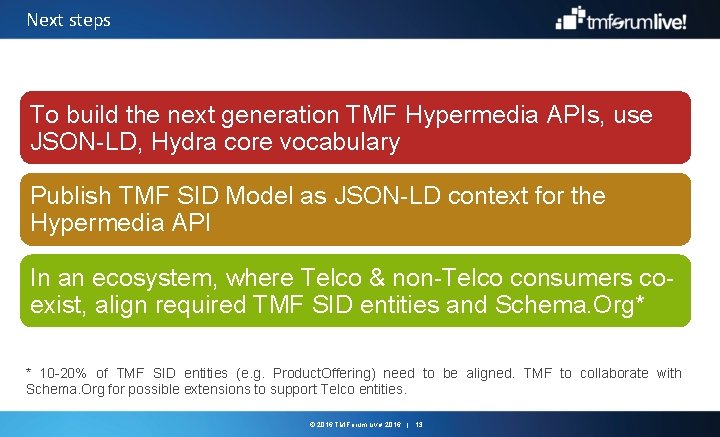
Next steps To build the next generation TMF Hypermedia APIs, use JSON-LD, Hydra core vocabulary Publish TMF SID Model as JSON-LD context for the Hypermedia API In an ecosystem, where Telco & non-Telco consumers coexist, align required TMF SID entities and Schema. Org* * 10 -20% of TMF SID entities (e. g. Product. Offering) need to be aligned. TMF to collaborate with Schema. Org for possible extensions to support Telco entities. © 2016 TM Forum Live! 2016 | 13
TMF Open APIs @Corp deepanshu. motani@vodafone. com © 2016 TM Forum Live! 2016 | 14