
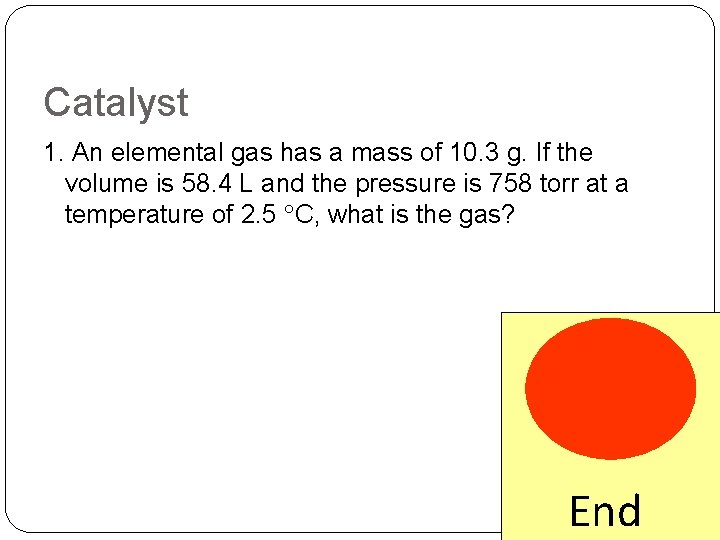
Catalyst 1 An elemental gas has a mass



- Slides: 21
Catalyst 1. An elemental gas has a mass of 10. 3 g. If the volume is 58. 4 L and the pressure is 758 torr at a temperature of 2. 5 C, what is the gas? End
ANNOUNCEMENT! If you need a letter of recommendation from me, you must ask by October 31 st Please submit a formal request either in person or in writing (preferred) by this date and I will do my best to accommodate your needs I give my AP Chemistry students priority in accepting letter of recommendation requests, but this is a hard deadline.
Who Did It?
Lecture 4. 4 – Diffusion, Effusion, and Real Gases
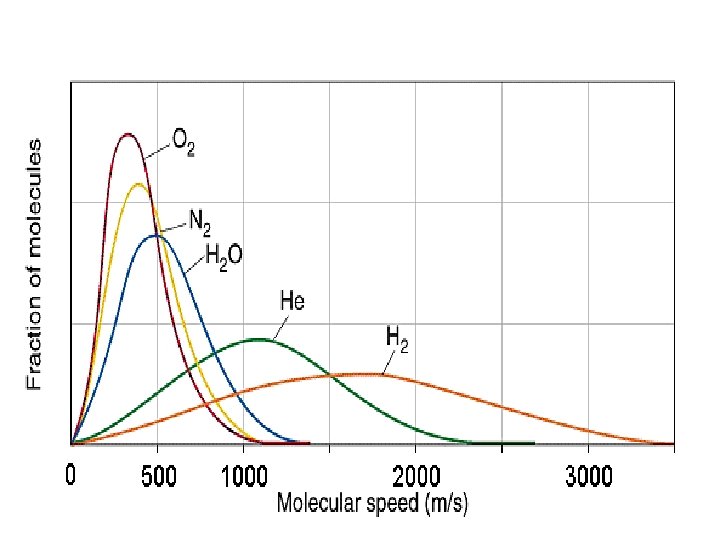
Today’s Learning Targets LT 4. 6 – I can discuss what diffusion and effusion are and calculate the rate of diffusion/effusion for a particular gas. LT 4. 7 – I can compare and contrast ideal and real gases. I can discuss how the Van der Walls equation corrects for these deviations from ideality.
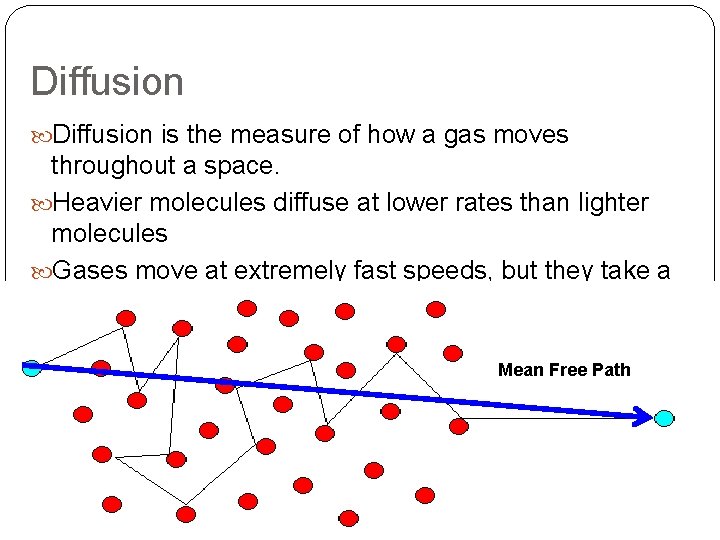
Diffusion is the measure of how a gas moves throughout a space. Heavier molecules diffuse at lower rates than lighter molecules Gases move at extremely fast speeds, but they take a long time to diffuse through a space due to collisions Mean Free Path
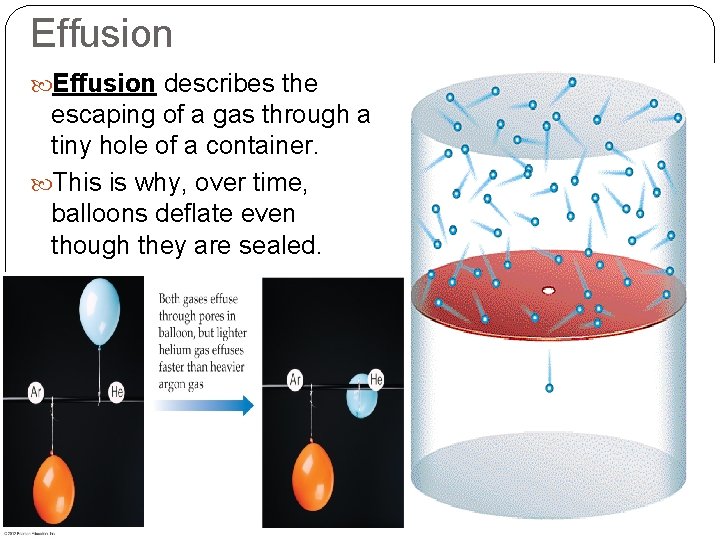
Effusion describes the escaping of a gas through a tiny hole of a container. This is why, over time, balloons deflate even though they are sealed.
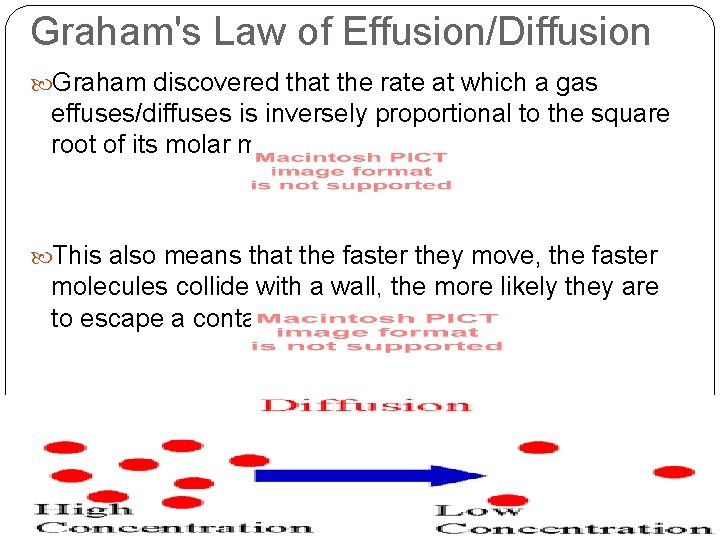
Graham's Law of Effusion/Diffusion Graham discovered that the rate at which a gas effuses/diffuses is inversely proportional to the square root of its molar mass This also means that the faster they move, the faster molecules collide with a wall, the more likely they are to escape a container.
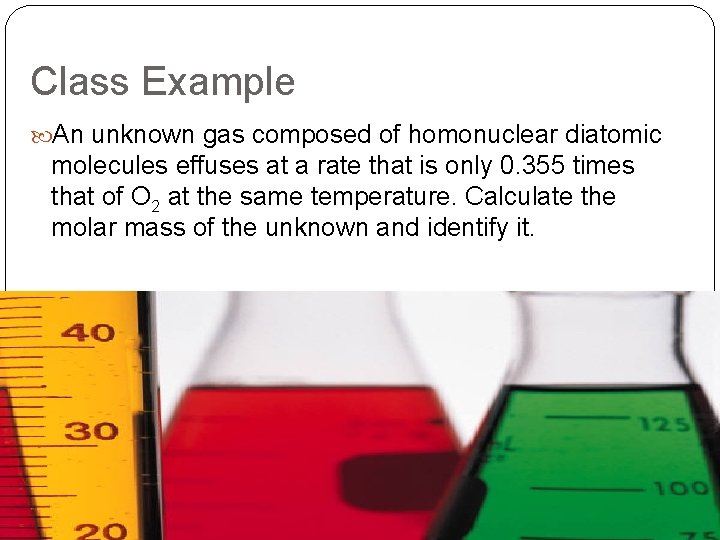
Class Example An unknown gas composed of homonuclear diatomic molecules effuses at a rate that is only 0. 355 times that of O 2 at the same temperature. Calculate the molar mass of the unknown and identify it.
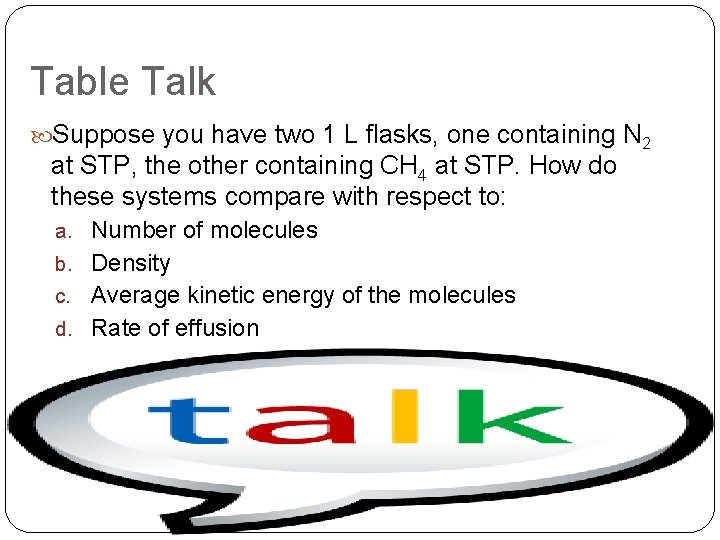
Table Talk Suppose you have two 1 L flasks, one containing N 2 at STP, the other containing CH 4 at STP. How do these systems compare with respect to: a. Number of molecules b. Density c. Average kinetic energy of the molecules d. Rate of effusion
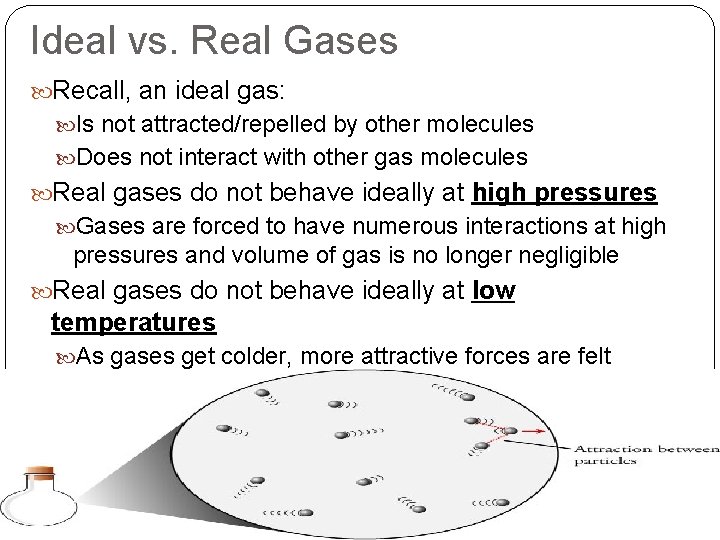
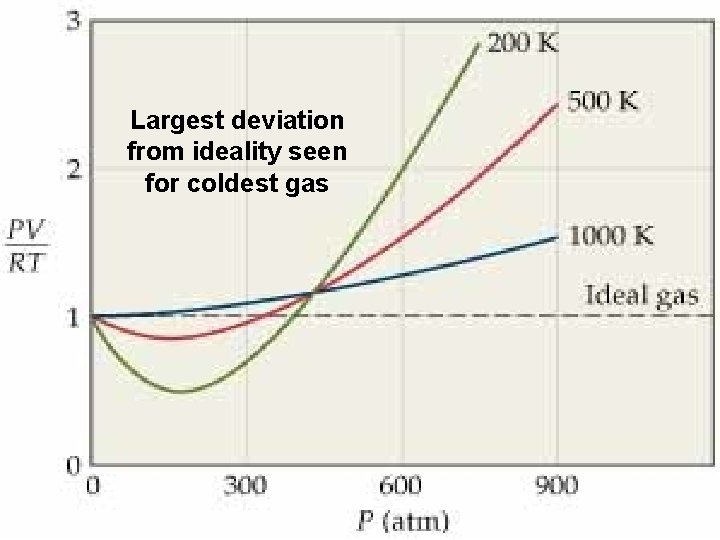
Ideal vs. Real Gases Recall, an ideal gas: Is not attracted/repelled by other molecules Does not interact with other gas molecules Real gases do not behave ideally at high pressures Gases are forced to have numerous interactions at high pressures and volume of gas is no longer negligible Real gases do not behave ideally at low temperatures As gases get colder, more attractive forces are felt between molecules
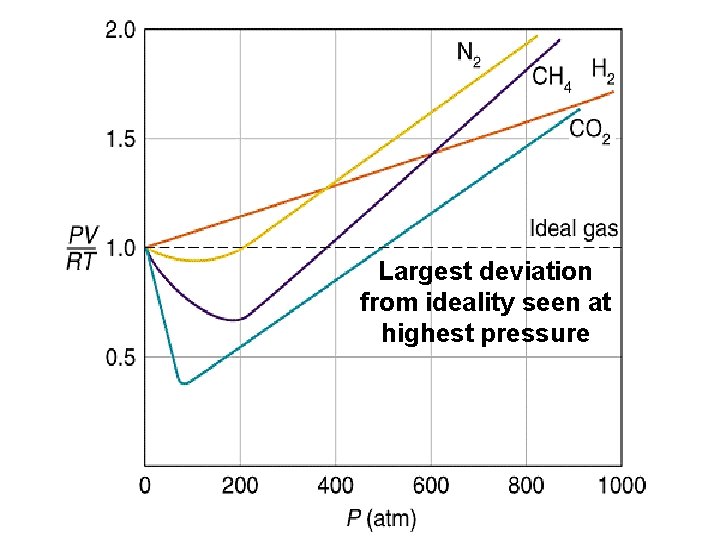
Largest deviation from ideality seen at highest pressure
Largest deviation from ideality seen for coldest gas
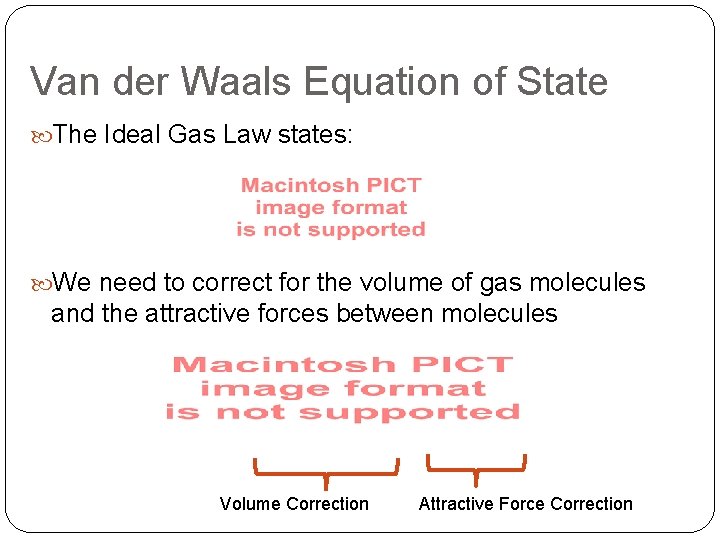
Van der Waals Equation of State The Ideal Gas Law states: We need to correct for the volume of gas molecules and the attractive forces between molecules Volume Correction Attractive Force Correction
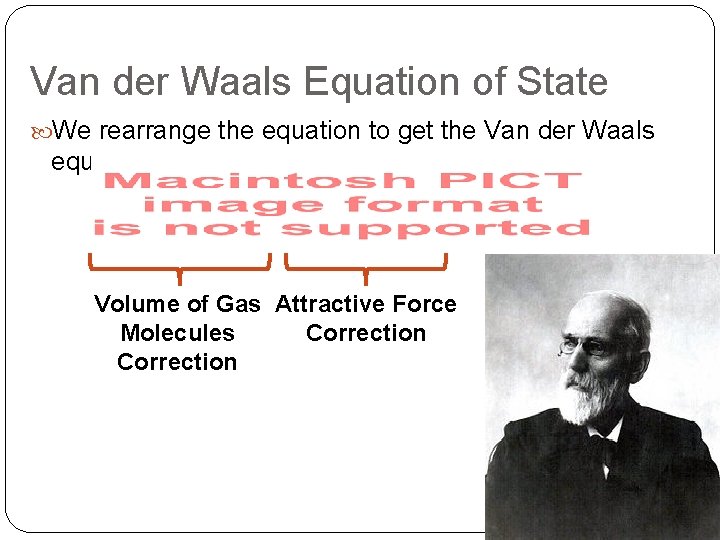
Van der Waals Equation of State We rearrange the equation to get the Van der Waals equation: Volume of Gas Attractive Force Molecules Correction
Class Example If 1. 000 mol of an ideal gas were confined to 22. 41 L at 0. 0 o. C, it would exert a pressure of 1. 000 atm. Use the Van der Waals equation to estimate the pressure exerted by 1. 00 mol of CI 2 in 22. 41 L at 0. 0 o. C. (a = 6. 49 L 2 atm/mol 2; b = 0. 0562 L/mol)
Model Cards On the handout, provide an answer to the problem that you are working out and the reasoning behind your answer. Complete all the problems, ask your table partners if you need help on the reasoning!
Lab 9 – Carbonate Analysis by Gas Evolution
Closing Time Lab 8 and Lab 9 are due Monday/Tuesday