
Catacombe di Roma The Catacombs of Rome Itinerary
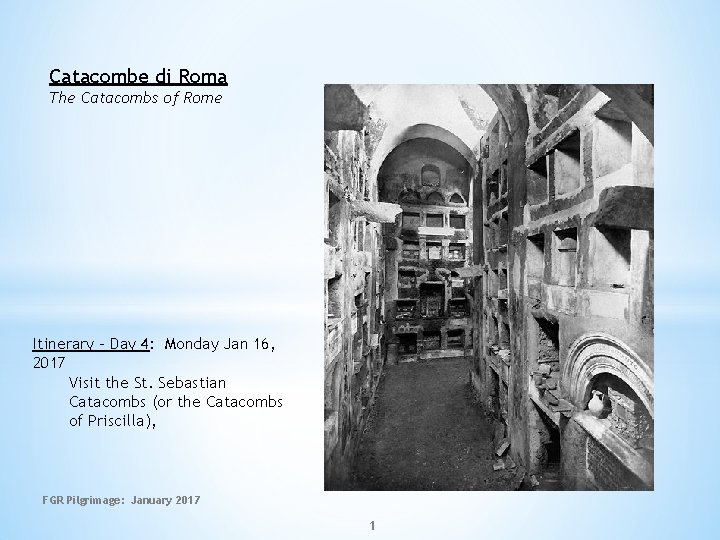
Catacombe di Roma The Catacombs of Rome Itinerary - Day 4: Monday Jan 16, 2017 Visit the St. Sebastian Catacombs (or the Catacombs of Priscilla), FGR Pilgrimage: January 2017 1
The Catacombs • Catacombs were used for roman burials from the 2 nd thru 5 th centuries. Although they were most famous for Christian burials, people of all religions have used them. • Roman law prohibited burying of the dead inside the old city walls, for sanitary reasons. The catacombs were located outside of Rome. • Most Christians believed that they should be ready for the Resurrection, so they chose to be buried in the catacombs and not cremated as was the tradition of the time. • More than 60 catacombs around Rome, and it is thought there are six and a half million burials. FGR Pilgrimage: January 2017 2

Latin terms Loculi: Burial niches or graves carved into stone, generally laid out vertically Tufo: soft lava/volcanic rock, highly suited for carving Ambulacra: underground passages Cubicula: burial rooms built for wealthier families, usually containing frescoes, similar to a chapel Cryptae: chapels decorated with frescoes, found in catacomb passages FGR Pilgrimage: January 2017 3
The Catacombs • Once a body was wrapped in a linen shroud and soaked with lye (to stave off risk of contamination), they were then deposited in niches inside the cave walls. • There approximately 1, 000 kms of catacomb tunnels below Rome, some are up to 5 levels deep, with huge stairs and air vents. • It is a common myth that Christians sought refuge from persecution in the catacombs, but scholars agree that they were not hiding places. The Romans knew where the catacombs were, and these burial sites were actually protected by Roman law. • By the 6 th century, catacombs were no longer used to bury the dead. Church cemeteries were the preferred method of burials. They were soon forgotten, and only accidently re-discovered in 1578. • The current maintenance of the catacombs are the responsibility of the papacy. FGR Pilgrimage: January 2017 4
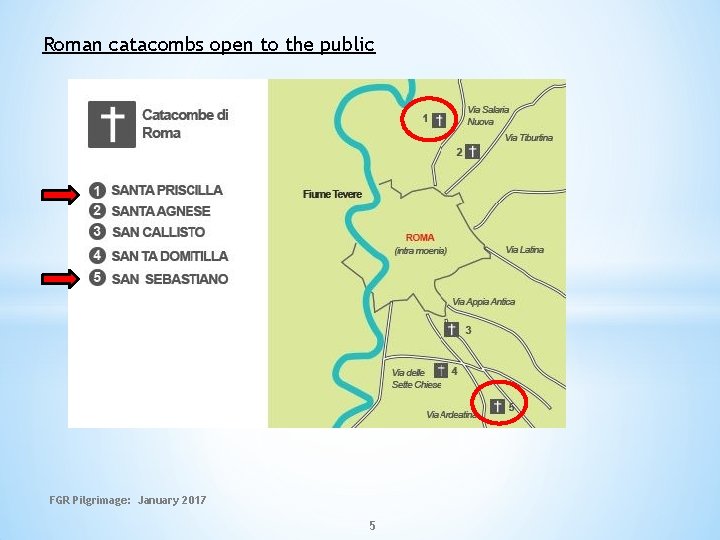
Roman catacombs open to the public FGR Pilgrimage: January 2017 5
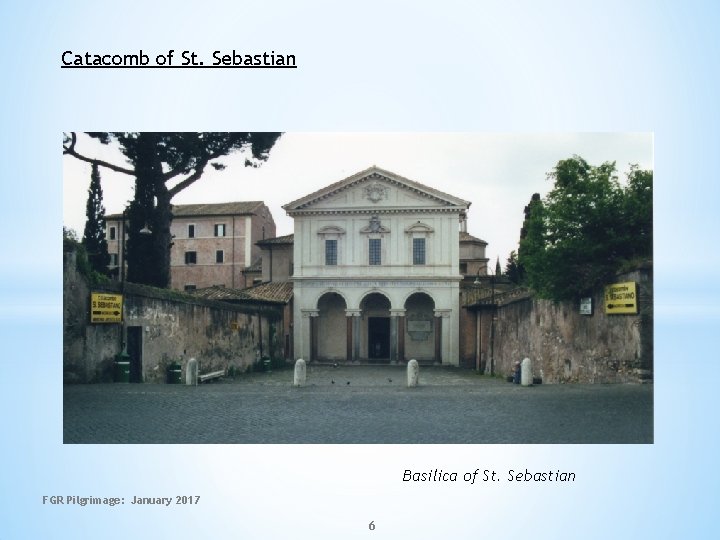
Catacomb of St. Sebastian Basilica of St. Sebastian FGR Pilgrimage: January 2017 6
Catacomb of St. Sebastian • St. Sebastian was a Christian convert. In 286 AD Emperor Diocletian scolded Sebastian for converting, and ordered him to be killed by having him tied to a stake on a training field and used as target practice. Believed to be dead, he was recovered and nursed back to health. After recovering, he returned back to the emperor to criticize him. The emperor ordered Sebastian to be clubbed to death. His body was recovered by a Christian woman, named Lucina, and she secretly buried him in the catacombs beneath Rome. • In the seventeenth century, Cardinal Scipione Borghese had the current baroque basilica of St. Sebastian built. The catacomb was named for the martyr Sebastian. • This basilica still holds the remains of St. Sebastian. Today, his tomb is located inside the basilica, but his original resting place was in the catacombs underneath it. Along with St. Sebastian, the martyr Eutychius is also buried there. Saint Eutychius was thought to be a disciple of St John the Baptist. • The venerable bones of Saints Peter and Paul were once hidden here for safekeeping. Later, the apostles’ remains were moved to their respective basilica of today. FGR Pilgrimage: January 2017 7
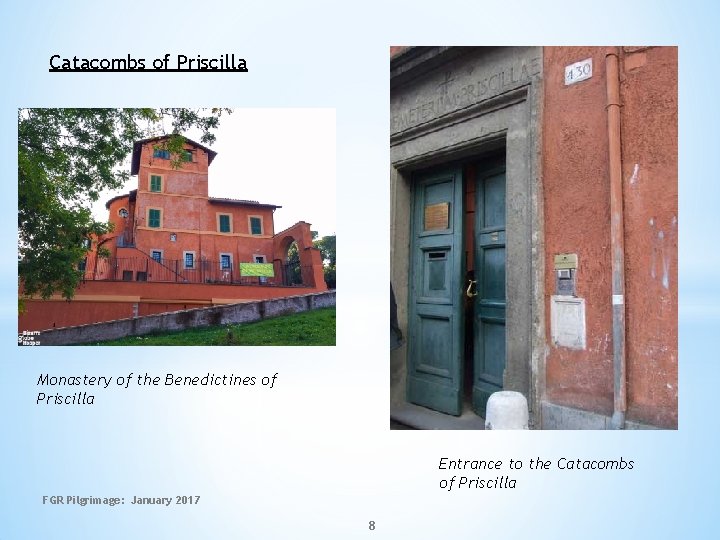
Catacombs of Priscilla Monastery of the Benedictines of Priscilla Entrance to the Catacombs of Priscilla FGR Pilgrimage: January 2017 8
Catacombs of Priscilla • The Catacomb of Priscilla derived its name from the noblewoman Priscilla, who granted the Church use of the family’s property. The catacomb is looked after by the Benedictine nuns of Priscilla. • The modern entrance to the catacomb is on the Via Salaria through the cloister of the monastery of the Benedictines of Priscilla. The Catacombs of Priscilla are divided into three principal areas: an arenarium, a cryptoportico from a large Roman villa, and the underground burial area of the ancient Roman family, the Acilius Glabrio. • Two popes were buried in the Catacomb of Priscilla: Pope Marcellinus (296 - 304) and Pope Marcellus I (308 - 309). FGR Pilgrimage: January 2017 9
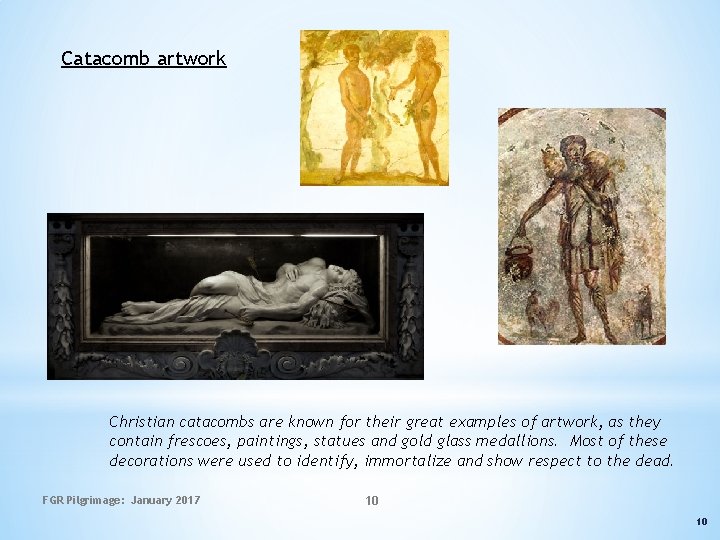
Catacomb artwork Christian catacombs are known for their great examples of artwork, as they contain frescoes, paintings, statues and gold glass medallions. Most of these decorations were used to identify, immortalize and show respect to the dead. FGR Pilgrimage: January 2017 10 10
- Slides: 10