
Caste The Development of the Caste System The
- Slides: 7
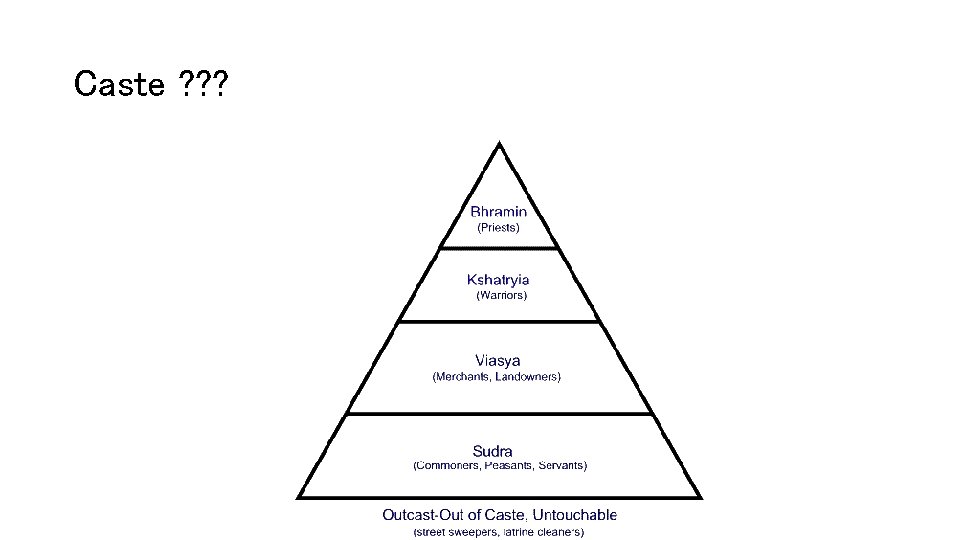
Caste ? ? ?
• The Development of the Caste System: • The term caste—a social class of hereditary and unchangeable status—was first used in India by Portuguese merchants and mariners during the 16 th century CE when they observed sharp social distinctions among the Indian people. • The Aryans used the term varna, a Sanskrit word meaning “color, ” to refer to their social classes.
• Brahmins: the highest social classes were the priests and scholars, who sprang from Purusha’s mouth, and represented intellect, knowledge, and wisdom. • Brahmins were the “lightest” in skin color. • Kshatriyas: the warrior-aristocracy, the rulers and government officials who came from the arms of Purusha.
SCRİPTURES OF HİNDUİSM Sruti in Sanskrit means "that which is heard. " Thus the Vedas are the eternal truths that the Vedic seers, called rishis, are said to have heard during their deep meditations. The Vedas are not considered the works of the human mind, but an expression of what has been realized through intuitive perception by Vedic rishis, who had powers to see beyond the physical phenomena. As such, Vedas are considered of divine origin. The Vedic truths were originally transmitted by the rishis to their disciples over thousands of years. At a later date, these were compiled by Sage Vyasa for the benefit of future generations. India's teachings are not speculative. They are based on divine revelations. Indeed, the revelations are so cosmic that they approach more closely the findings of physics and astronomy than the pious pronouncements of preachers. The rishis made claims so cosmic that even modern physics seems only to be catching up with them and realizing, after every scientific breakthrough, that the ancients were there long before them. Sruti include the Vedas (Rig, Yajur, Sama and Atharva) and the Bhagavad Gita. The Vedas are the primary scriptures of Hinduism. Each of the four Vedas consists of four parts: Samhitas, Brahmanas, Aranyakas, and Upanishads.
Smriti means "that which is remembered. " Smriti scriptures are derived from the Vedas and are considered to be of human origin and not of divine origin. They were written to explain and elaborate the Vedas, making them understandable and more meaningful to the general population. All authoritative writings outside the Vedas are collectively referred to as Smriti inlcude the Dharma Shastras, Nibhandas, Puranas, The Epics, Agamas or Tantras, Darshanas and Vedangas (Upa Vedas). According to Alain Danielou distingused Orientalist, " The Puranas provide genealogies, which go back to the sixth millennium B. C. E. and are probably largely authentic. The stories and descriptions of the various regions of the earth and the various civilizations living on the "seven continents" provide priceless documentation on the world's oldest civilization. « The Smriti are considered the secondary scriptures of Hinduism. These scriptures are classified in the following diagram:
Dharmaśāstra (������ ) is a genre of Sanskrit texts, and refers to the treatises (shastras) of Hinduismm on Dharma. There are many Dharmashastras, variously estimated to be 18 to about 100, with different and conflicting points of view. The textual corpus of Dharmaśāstra were composed in poetic verses, are part of the Hindu Smritis, constituting divergent commentaries and treatises on duties, responsibilities and ethics to oneself, to family and as a member of society. The texts include discussion of ashrama (stages of life), varna (social classes), purushartha (proper goals of life), personal virtues and duties such as ahimsa (non-violence) against all living beings, rules of just war, and other topics. Bhagavadgita, 18: 42 śamo damas tapaḥ śaucaṁ /kṣāntir ārjavam eva ca jñānaṁ vijñānam āstikyaṁ / brahma-karma svabhāva-jam Peacefulness, self-control, austerity, purity, tolerance, honesty, wisdom, knowledge, and religiousnessthese are the qualities by which the brāhmaṇas work.
The word Puranas (Sanskrit: ����� , purāṇa) literally means "ancient, old", and it is a vast genre of Indian literature about a wide range of topics, particularly myths, legends and other traditional lore. Composed primarily in Sanskrit, but also in regional languages, several of these texts are named after major Hindu deities such as Vishnu, Shiva and Devi. They have been influential in the Hindu culture, inspiring major national and regional annual festivals of Hinduism.