
Caste System Caste System Caste System Caste System







- Slides: 34
Caste System
Caste System
Caste System
Caste System
Caste System
Caste System
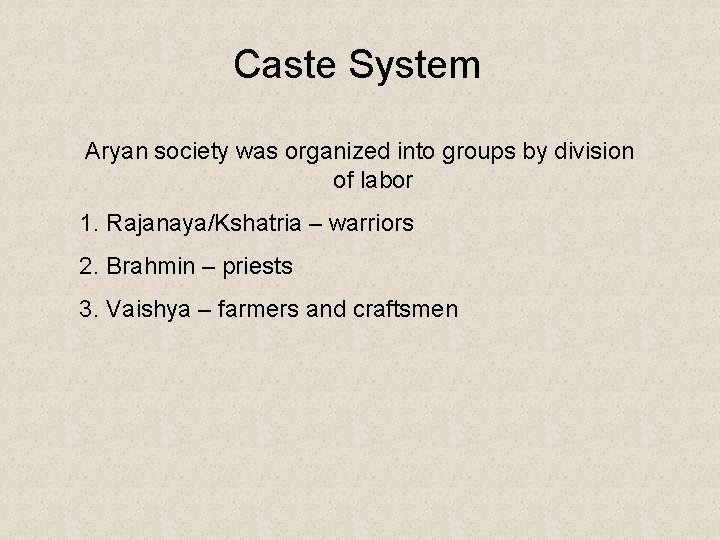
Caste System Aryan society was organized into groups by division of labor 1. Rajanaya/Kshatria – warriors 2. Brahmin – priests 3. Vaishya – farmers and craftsmen
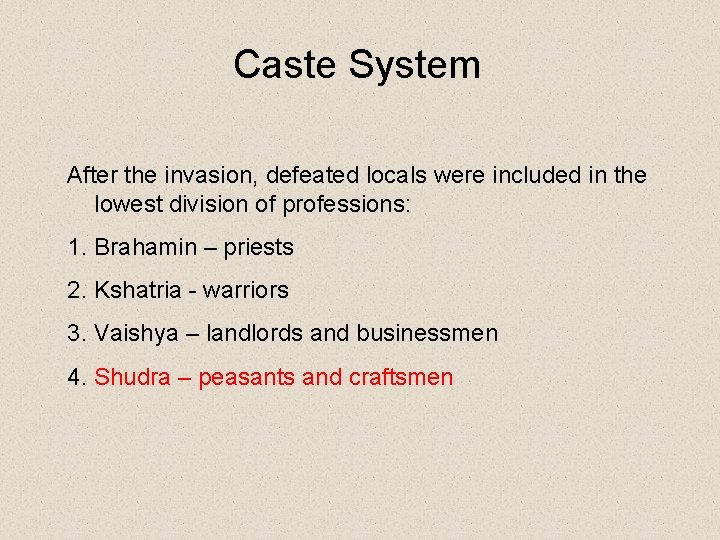
Caste System After the invasion, defeated locals were included in the lowest division of professions: 1. Brahamin – priests 2. Kshatria - warriors 3. Vaishya – landlords and businessmen 4. Shudra – peasants and craftsmen
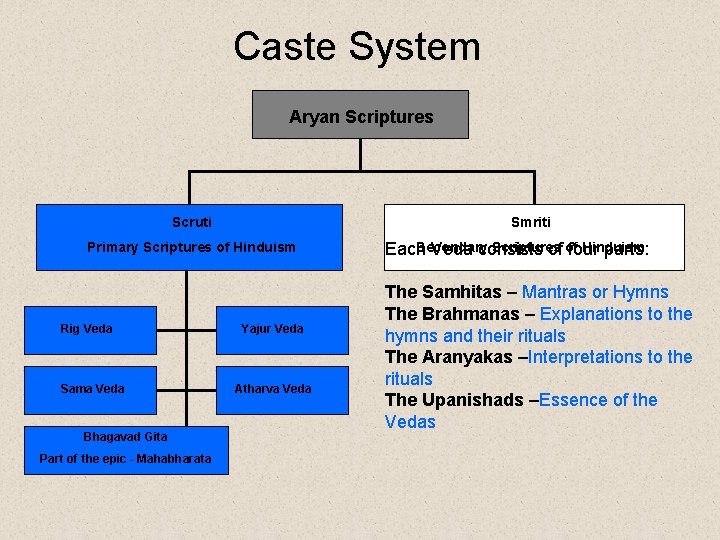
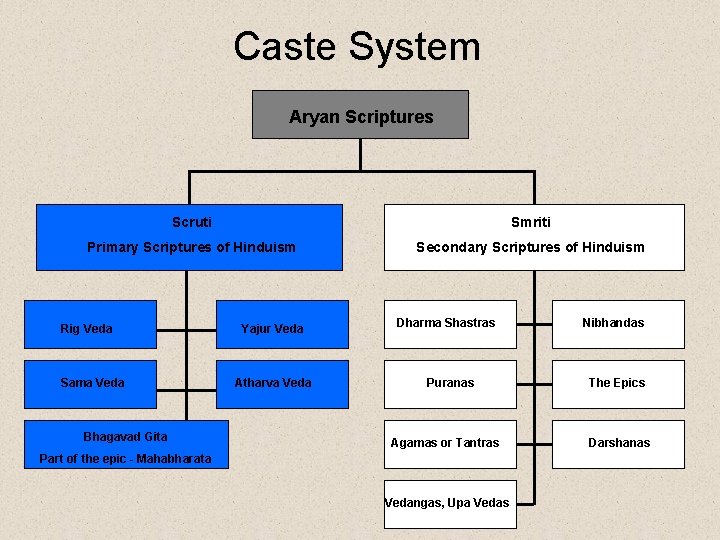
Caste System Aryan Scriptures Scruti Smriti Primary Scriptures of Hinduism Rig Veda Sama Veda Bhagavad Gita Part of the epic - Mahabharata Yajur Veda Atharva Veda Secondary Scriptures Hinduism Each Veda consists of of four parts: The Samhitas – Mantras or Hymns The Brahmanas – Explanations to the hymns and their rituals The Aranyakas –Interpretations to the rituals The Upanishads –Essence of the Vedas
Caste System Aryan Scriptures Scruti Smriti Primary Scriptures of Hinduism Secondary Scriptures of Hinduism Rig Veda Sama Veda Bhagavad Gita Yajur Veda Atharva Veda Dharma Shastras Puranas Agamas or Tantras Part of the epic - Mahabharata Vedangas, Upa Vedas Nibhandas The Epics Darshanas
Caste System
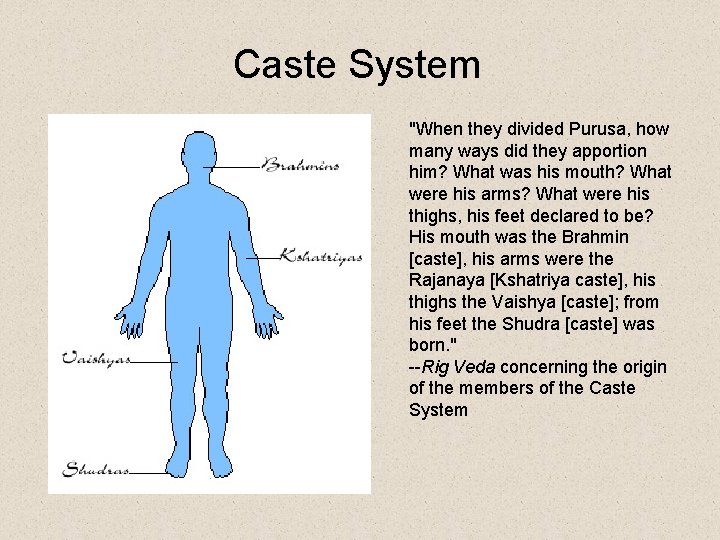
Caste System "When they divided Purusa, how many ways did they apportion him? What was his mouth? What were his arms? What were his thighs, his feet declared to be? His mouth was the Brahmin [caste], his arms were the Rajanaya [Kshatriya caste], his thighs the Vaishya [caste]; from his feet the Shudra [caste] was born. " --Rig Veda concerning the origin of the members of the Caste System
Caste System Different kinds of labor duties were allowed different classes of people based on their aptitude and ability: 1. Mouth – Brahmins were in charge of spiritual and intellectual matters 2. Arms – political management and military defense were given to the Kshatriyas 3. Thighs – supplying food and managing business activities were entrusted to the Vaisyas 4. Feet – menial service work was completed by the Shudras
Caste System Varna literally means "color". • Refers to the different class qualities (guna) that each of the four profession groups have in their hearts and minds. • Four different qualities of human beings - white, red, yellow, black.
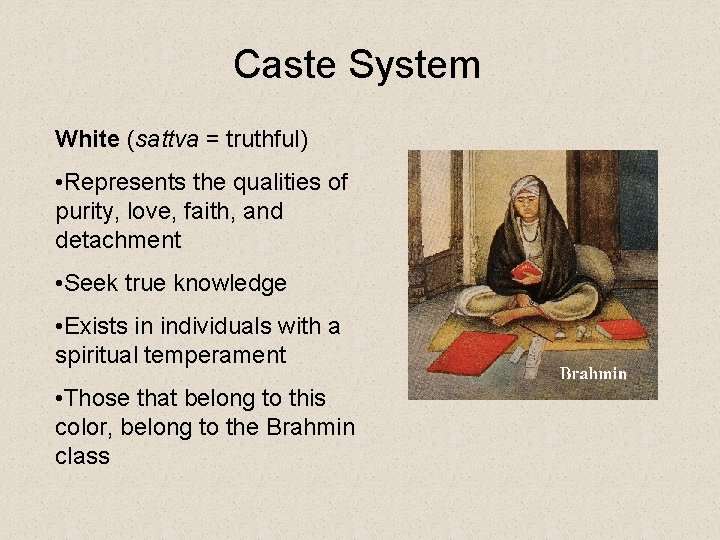
Caste System White (sattva = truthful) • Represents the qualities of purity, love, faith, and detachment • Seek true knowledge • Exists in individuals with a spiritual temperament • Those that belong to this color, belong to the Brahmin class
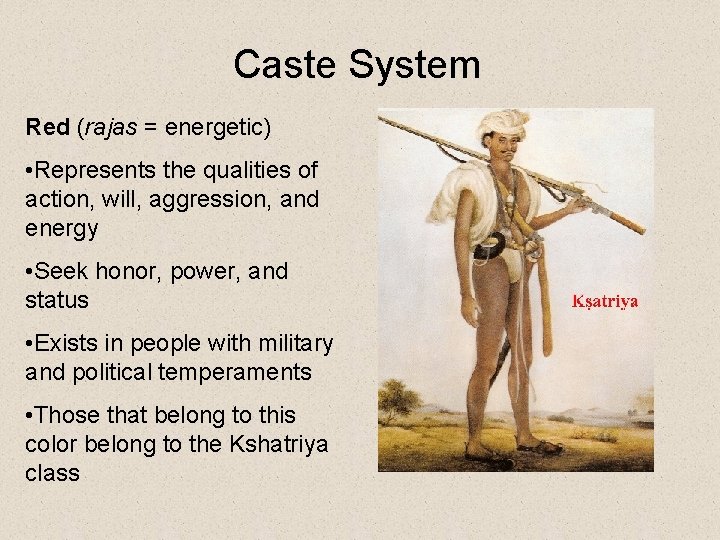
Caste System Red (rajas = energetic) • Represents the qualities of action, will, aggression, and energy • Seek honor, power, and status • Exists in people with military and political temperaments • Those that belong to this color belong to the Kshatriya class
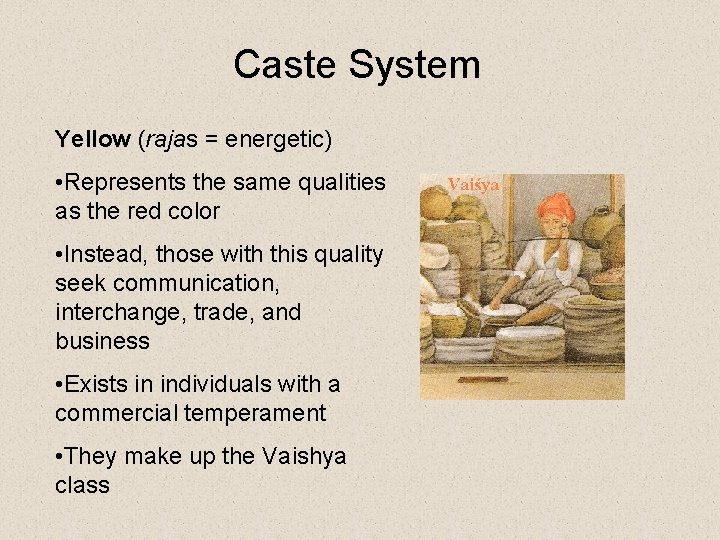
Caste System Yellow (rajas = energetic) • Represents the same qualities as the red color • Instead, those with this quality seek communication, interchange, trade, and business • Exists in individuals with a commercial temperament • They make up the Vaishya class
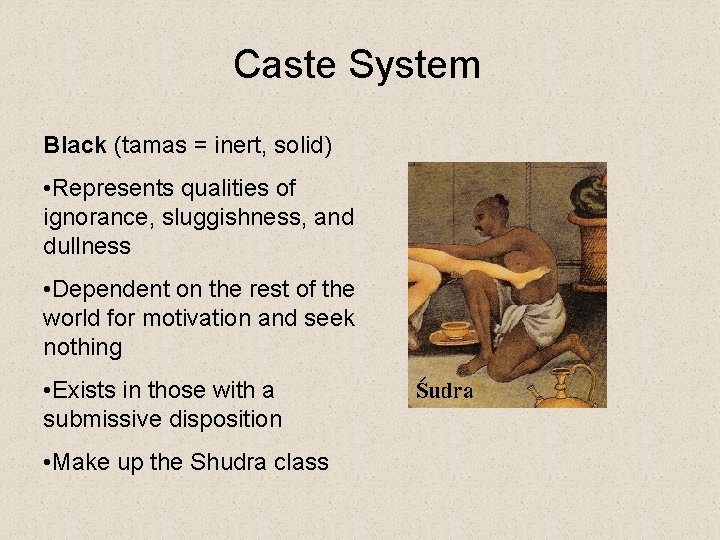
Caste System Black (tamas = inert, solid) • Represents qualities of ignorance, sluggishness, and dullness • Dependent on the rest of the world for motivation and seek nothing • Exists in those with a submissive disposition • Make up the Shudra class
Caste System Each caste grouping was subdivided into hundreds of categories: Aravttokkalu Brahmins Audichya Brahmins Babburkamme Smartha Brahmins Bhumihar Brahmins Daivajna Brahmins Deshastha Brahmins Dhima Brahmins Gaur Brahmins Gouda Saraswat Brahmins Gurukkal or Shivacharya Brahmins Havyaka Brahmins Hebbar Iyengars Hoysala Karnataka Brahmins Iyers Kandavara Brahmins Kanyakubj Brahmins Karhada or Karade Brahmins Kashmiri Saraswats or Kashmiri Pundits Kayastha Brahmins Khajuria or Dogra Brahmins of Jammu Khandelwal Brahmins Konkanastha or Chitpavan Brahmins Konkani Saraswat Brahmins Kota Brahmins Koteshwara Brahmins Kudaldeshkar Brahmins Madras Iyengars Madhwa Brahmins Maithili Brahmins Mandyam Iyengars Modh Brahmins Mohyal Brahmins Muluknadu Brahmins Nagar Brahmins Namboothiri Brahmins Niyogi Brahmins Padia Brahmins Punjabi Saraswat Brahmins Rajapur Saraswat Brahmins Sakaldwipi Brahmins Sanketi Brahmins Sarypari Brahmins of Eastern Uttar Pradesh and Madhya Pradesh Sirinadu Smartha Brahmins Sthanika Brahmins Shrimali Brahmins Shivalli Brahmins Saklapuri Brahmins Thenkalai Iyengars Tuluva Brahmins Vadagalai Iyengars Vadama Brahmins Vaidiki Brahmins Vaishnava Brahmins
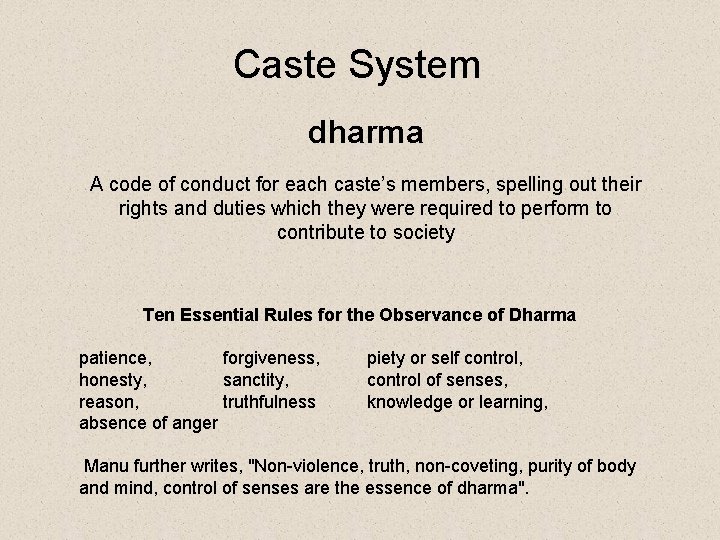
Caste System dharma A code of conduct for each caste’s members, spelling out their rights and duties which they were required to perform to contribute to society Ten Essential Rules for the Observance of Dharma patience, forgiveness, honesty, sanctity, reason, truthfulness absence of anger piety or self control, control of senses, knowledge or learning, Manu further writes, "Non-violence, truth, non-coveting, purity of body and mind, control of senses are the essence of dharma".
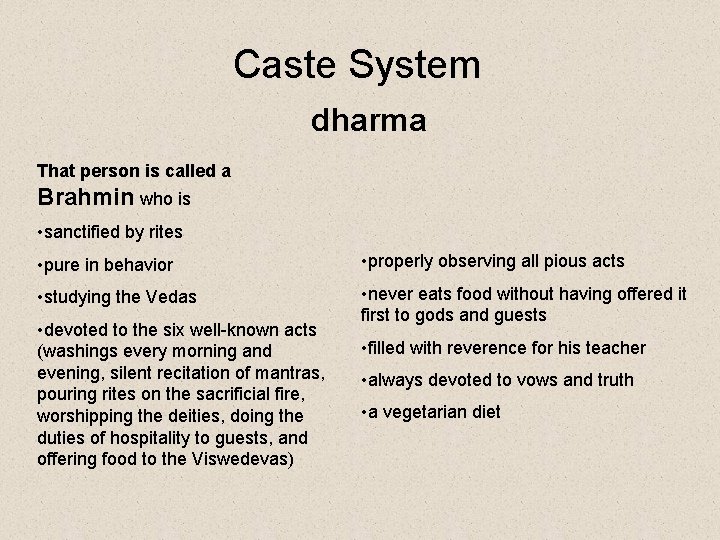
Caste System dharma That person is called a Brahmin who is • sanctified by rites • pure in behavior • properly observing all pious acts • studying the Vedas • never eats food without having offered it first to gods and guests • devoted to the six well-known acts (washings every morning and evening, silent recitation of mantras, pouring rites on the sacrificial fire, worshipping the deities, doing the duties of hospitality to guests, and offering food to the Viswedevas) • filled with reverence for his teacher • always devoted to vows and truth • a vegetarian diet
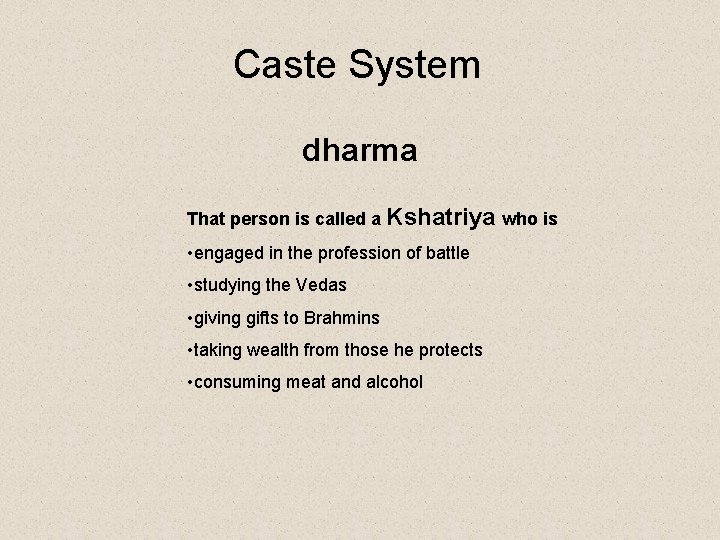
Caste System dharma That person is called a Kshatriya who is • engaged in the profession of battle • studying the Vedas • giving gifts to Brahmins • taking wealth from those he protects • consuming meat and alcohol
Caste System dharma That person is called a Vaishya who is • earning fame from keeping cattle • employed in agriculture and the means of acquiring wealth • pure in behaviour • studying the Vedas
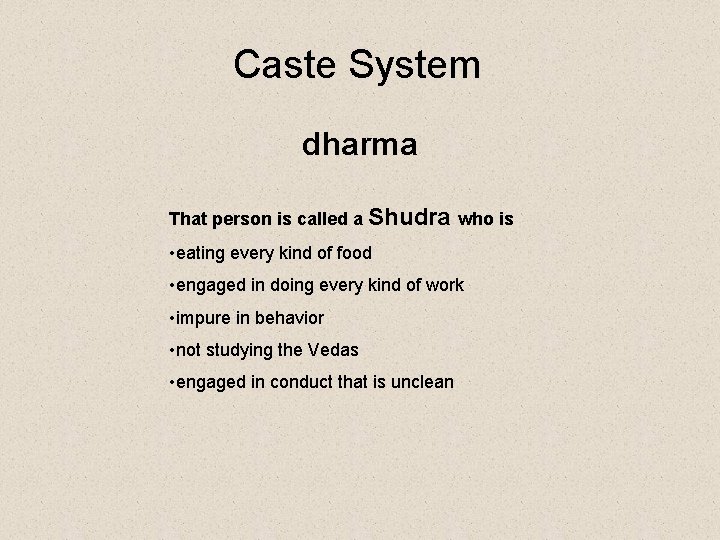
Caste System dharma That person is called a Shudra who is • eating every kind of food • engaged in doing every kind of work • impure in behavior • not studying the Vedas • engaged in conduct that is unclean
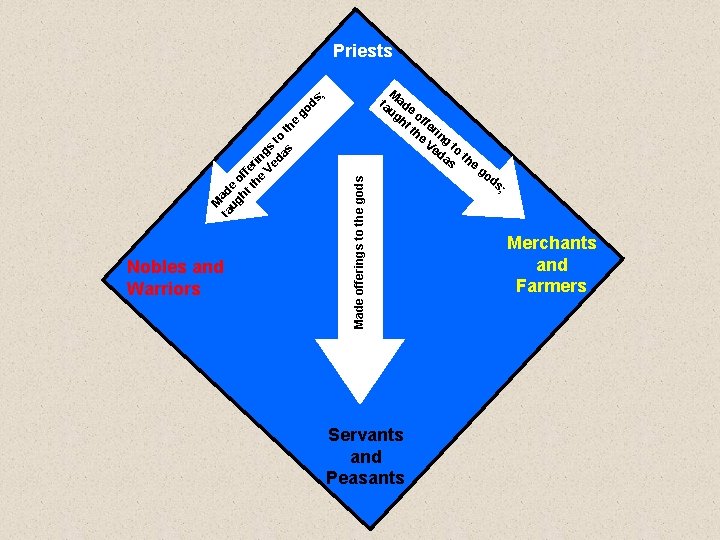
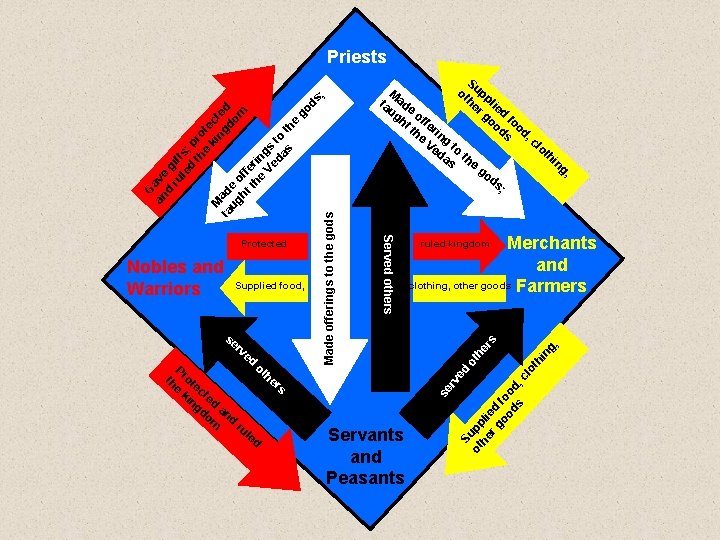
Priests Nobles and Warriors Made offerings to the gods M ta ad ug e o ht ff th eri e ng Ve s da to s th e go ds ; M ta ade ug o ht ffe th rin e Ve g to da th s e Servants and Peasants go ds ; Merchants and Farmers
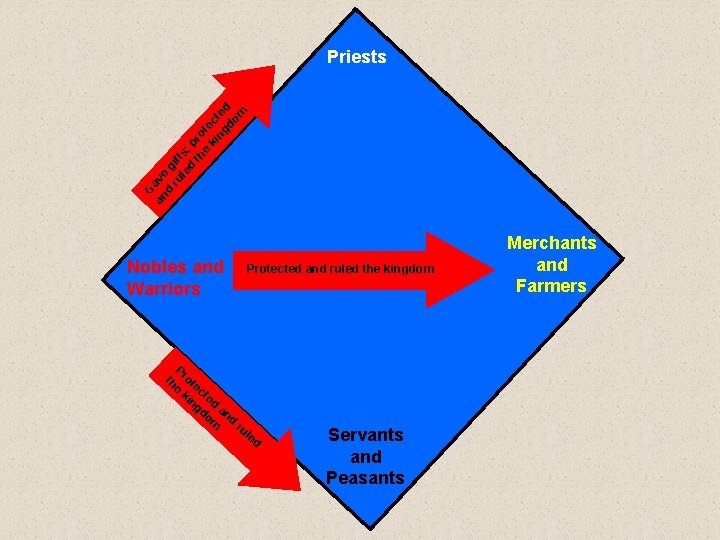
G an ave d ru gift le s; d th pro e te ki ct ng ed do m Priests Nobles and Warriors P th rote e ki cte ng d do an m d Protected and ruled the kingdom ru le d Servants and Peasants Merchants and Farmers
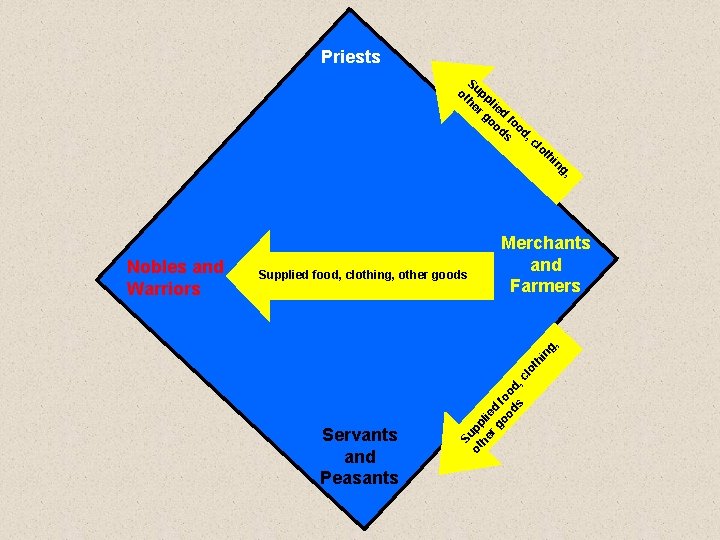
Priests S ot upp he li r g ed oo fo ds od , c lo th i ng , lo t hi ng , Supplied food, clothing, other goods Servants and Peasants S ot upp he li r g ed oo fo ds od , c Nobles and Warriors Merchants and Farmers
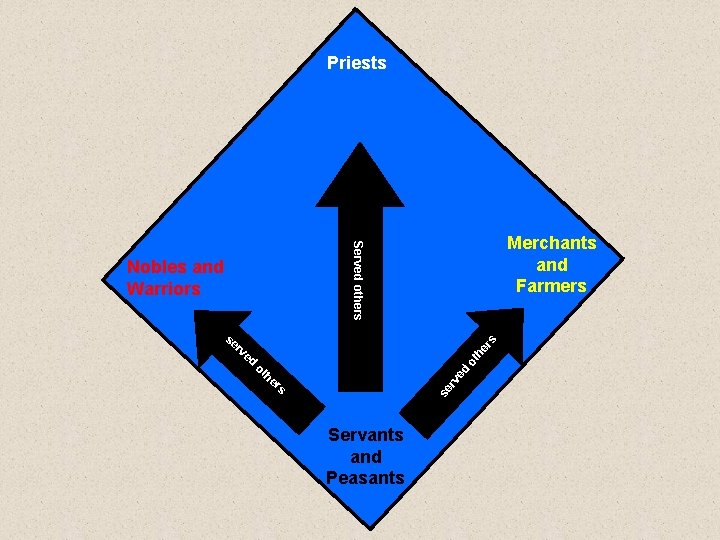
Priests Served others Merchants and Farmers Nobles and Warriors se he ot ed he rs rv ot se ed rs rv Servants and Peasants
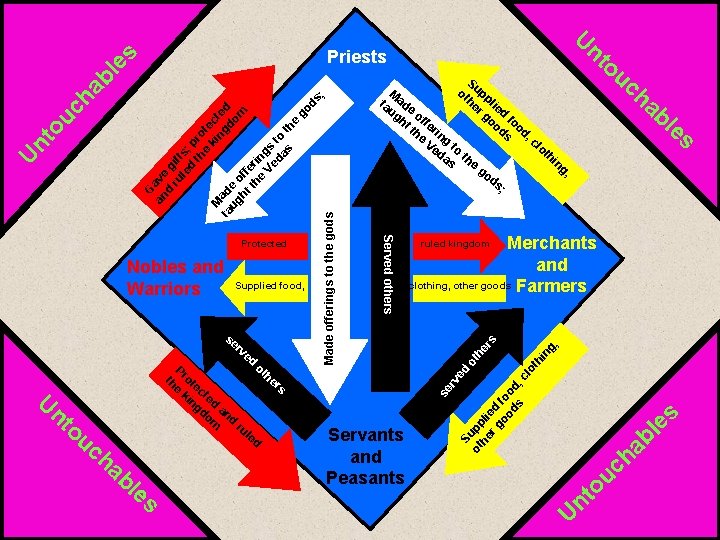
Priests ru ot le d he ot p he he pli rs r g ed f oo o ds od , c lo th in g, th ote e ki cte ng d do an m d ed ed Pr rs Servants and Peasants ot rv rv se Su Supplied food, Merchants and clothing, other goods Farmers ruled kingdom se Nobles and Warriors Served others Protected Made offerings to the gods G an ave d ru gift le s; d th pro e te ki ct M ng ed ta ad do ug e o m ht ff th eri e ng Ve s da to s th e go ds ; S ot upp M he li ta ade r g ed ug o ht ffe oo fo th rin ds od , c e g Ve to lo th da th in s e g, go ds ;
Caste System People who did not live by the rights and duties (dharma) of their caste were out of caste 1. Outcastes 2. Untouchables
U le s ed rv ab Servants and Peasants ch es rs ou bl le d he nt ch a ru ot U ou th ote e ki cte ng d do an m d ed se Pr Merchants and clothing, other goods Farmers ruled kingdom ot rv le ot p he he pli rs r g ed f oo o ds od , c lo th in g, ; se Made offerings to the gods G an ave d ru gift le s; d th pro e te ki ct M ng ed ta ad do ug e o m ht ff th eri e ng Ve s da to s th e go ds Supplied food, ch ab Su es bl ch a ou nt U Nobles and Warriors ou S ot upp M he li ta ade r g ed ug o ht ffe oo fo th rin ds od , c e g Ve to lo th da th in s e g, go ds ; Served others Protected U nt nt Priests s
Caste System Untouchables • polluting people • their dwellings were at a distance from the settlements • were not allowed to touch people from the four Varnas • were not allowed to enter houses of the higher Varnas • were not allowed to enter the temples • were not allowed to use the same wells used by the Varnas • were compelled to sit at a distance from the four Varnas • even contact with their shadow was seen as polluting • deal with the bodies of dead animals or unclaimed dead humans • tanning leather, from dead animals, and manufacturing leather goods • clean up human and animal waste
Caste System Analysis: • Stable, traditional organization of Indian society • Caste discrimination • Untouchables • Lack of upward social and economic movement through generations • Caste violence • Human nature • Combined with religion to form Hinduism
Caste System Analysis: • Stable, traditional organization of Indian society • Human nature • Caste discrimination • Untouchables • Lack of upward social and economic movement through generations • Caste violence • Combined with religion to form Hinduism