
Cast vs Forged Rims a presentation by Blair
Cast vs. Forged Rims a presentation by Blair Bracewell & Chris Lee Engineering 45 Materials Santa Rosa Junior College Younes Ataiiyan Spring 2009
Introduction • • • What is Casting? The Pros & Cons of Casting What is Forging? The Pros & Cons of Forging Summary Sources to find more information

What is Casting? • Forms of Casting: Investment, Sand, Pressure • Casting is the procedure by which a liquid metal is poured into a wheel mold or cast and allowed to cool to a near final state. Final machining is required for a finished product. • Casting is a simple and fast method to create wheels with greater detail than that of other methods. • Pressure casting is the best way to cast a wheel because it reduces void percentage. • Typically used for daily driving.
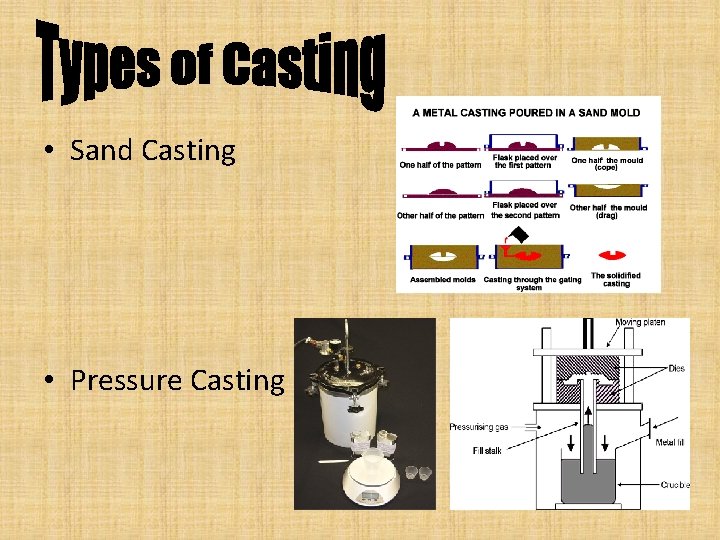
• Sand Casting • Pressure Casting

Pros & Cons of Casting Low cost, $125 each Before Track Day After Track Day Easy to mass produce Less material waste during production Cannot withstand as much pressure or frequency of impact as forged can • More impurities and voids due to the production of wheels through a molten state • •

What is Forging? • Starts as billet, then cut into the right length, heated to a T 6 condition to get the right mix of strength and ductility, and pressed into shape undergoing 6 -12000 tons of pressure. • Forging puts energy into the metal and changes the internal grain structure (crystalline) and this change in the grain structure is what gives a forging additional strength in comparison to the original billet rod. • “A forged aluminum wheel has a higher specific strength as well as higher toughness in comparison to a casting. This allows an engineer to design a wheel that is lighter, stiffer and less susceptible to cracking under impact and with better fatigue properties than a casting product. ” 1 • Elongation of grain structure with alignment of the shape of the wheel. • Used in racing applications.

Pros & Cons of Forging • • • Cast Steel Forged Aluminum Light weight, more economical Higher strength, safer in applications High cost for products, $500 each Longer process to make than casting Waste of excess material The wheel on the right withstands a load of 71, 200 kg before it deforms by 5 cm. The steel wheel on the left can only withstand 13, 600 kg when it also deforms by 5 cm. This means that the wheel on the right is 5 X as strong.

Summary of Cast is heavier. Cast vs. Forged • • Forged is stronger and has more resistance to fatigue and impact • In comparison to forgings, castings are made by pouring molten metal into a mold and have considerably lower strength, ductility, and fatigue resistance. Castings often suffer from defects in the form of voids or porosity. The main trait of castings are their low cost and ability to be produced in high volumes but at the expense of strength and weight.
1. HRE Wheels www. hrewheels. com/technology/materials/ 2. Motor Archive www. motoractive. com. au/wheels. htm 3. Alcoa www. alcoa. com/alcoawheels/europe/en/benefits_forged. asp 4. GM www. gmaccessorydealer. com/wheels/forgedversuscast. asp 5. Google www. jepsculpture. com/art/ben-casting. jpg 6. Motor Trend www. motortrend. com/f/motorsports/bmw
- Slides: 9