
CASPIAN Phase III Study of Firstline Durvalumab Tremelimumab
CASPIAN: Phase III Study of First-line Durvalumab + Tremelimumab + EP vs Durvalumab + EP vs EP Alone in Extensive-Stage SCLC CCO Independent Conference Coverage* Highlights of the 2020 ASCO Virtual Scientific Meeting, May 29 -31, 2020 *CCO is an independent medical education company that provides state-of-the-art medical information to healthcare professionals through conference coverage and other educational programs. This activity is provided by Clinical Care Options, LLC Supported by educational grants from Astra. Zeneca; Daiichi Sankyo, Inc. ; Ipsen Pharma; Jazz Pharmaceuticals, Inc. ; and Merck Sharp & Dohme Corp.
About These Slides § Please feel free to use, update, and share some or all of these slides in your noncommercial presentations to colleagues or patients § When using our slides, please retain the source attribution: Slide credit: clinicaloptions. com § These slides may not be published, posted online, or used in commercial presentations without permission. Please contact permissions@clinicaloptions. com for details

CASPIAN: Background § Etoposide + platinum chemotherapy (EP) was the established standard first-line therapy for patients with extensive-stage SCLC § Combination of EP with PD-L 1–targeted therapy (atezolizumab or durvalumab) approved as first-line treatment for extensive-stage SCLC in US and elsewhere based on phase III data showing OS benefit[1, 2] ‒ Previous results from CASPIAN demonstrated statistically significant improvement in OS with durvalumab + EP with choice of cisplatin or carboplatin vs EP alone (HR: 0. 73; 95% CI: 0. 59 -0. 91; P =. 0047)[1] § Current analysis sought to determine if adding tremelimumab to durvalumab + EP can further improve outcomes in first-line extensive-stage SCLC, and updates the OS analysis for durvalumab + EP vs EP in phase III CASPIAN study[3] 1. Paz-Ares. Lancet. 2019; 394: 1929. 2. Horn. NEJM. 2018; 379: 2220. 3. Paz-Ares. ASCO 2020. Abstr 9002. Slide credit: clinicaloptions. com

CASPIAN: Study Design § Randomized, open-label, multicenter phase III study Stratified by planned carboplatin vs cisplatin Treatment-naive, extensive-stage SCLC, WHO PS 0/1, measurable disease per RECIST v 1. 1, life expectancy ≥ 12 wks, asymptomatic or treated and stable brain metastases (N = 805) § Primary endpoint: OS Durvalumab + Tremelimumab + EP* Q 3 W x 4 cycles (n = 268) Durvalumab Q 4 W Durvalumab + EP* Q 3 W x 4 cycles (n = 268) Durvalumab Q 4 W EP* Q 3 W x 4 -6 cycles† (n = 269) Optional PCI† Progressive Disease *Etoposide 80 -100 mg/m 2 with either carboplatin AUC 5 -6 or cisplatin 75 -80 mg/m 2, durvalumab 1500 mg, tremelimumab 75 mg. †Per investigator discretion, additional 2 cycles of EP (6 cycles total) and PCI § Secondary endpoints: PFS and ORR (investigator-assessed per RECIST v 1. 1), safety and tolerability, PROs Paz-Ares. ASCO 2020. Abstr 9002. Slide credit: clinicaloptions. com
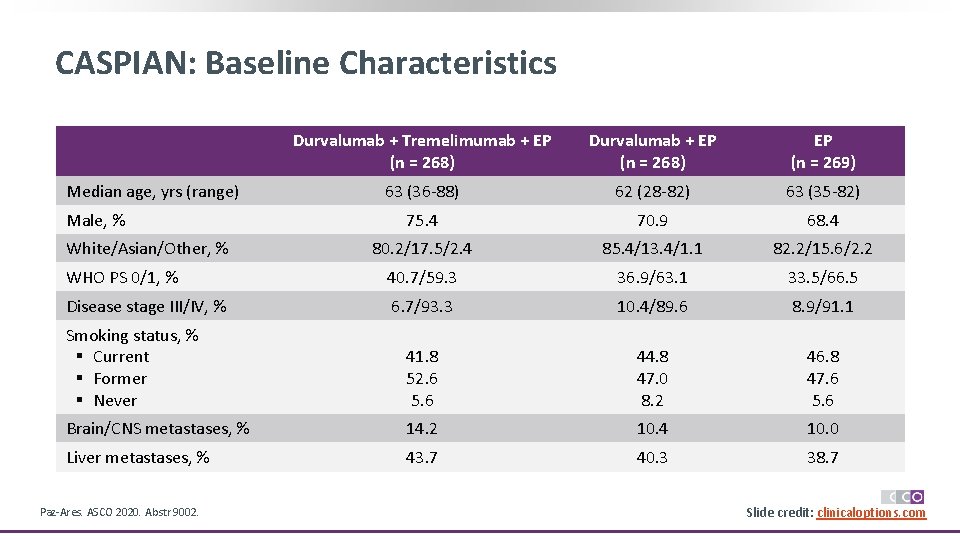
CASPIAN: Baseline Characteristics Durvalumab + Tremelimumab + EP (n = 268) Durvalumab + EP (n = 268) EP (n = 269) 63 (36 -88) 62 (28 -82) 63 (35 -82) 75. 4 70. 9 68. 4 80. 2/17. 5/2. 4 85. 4/13. 4/1. 1 82. 2/15. 6/2. 2 WHO PS 0/1, % 40. 7/59. 3 36. 9/63. 1 33. 5/66. 5 Disease stage III/IV, % 6. 7/93. 3 10. 4/89. 6 8. 9/91. 1 Smoking status, % § Current § Former § Never 41. 8 52. 6 5. 6 44. 8 47. 0 8. 2 46. 8 47. 6 5. 6 Brain/CNS metastases, % 14. 2 10. 4 10. 0 Liver metastases, % 43. 7 40. 3 38. 7 Median age, yrs (range) Male, % White/Asian/Other, % Paz-Ares. ASCO 2020. Abstr 9002. Slide credit: clinicaloptions. com
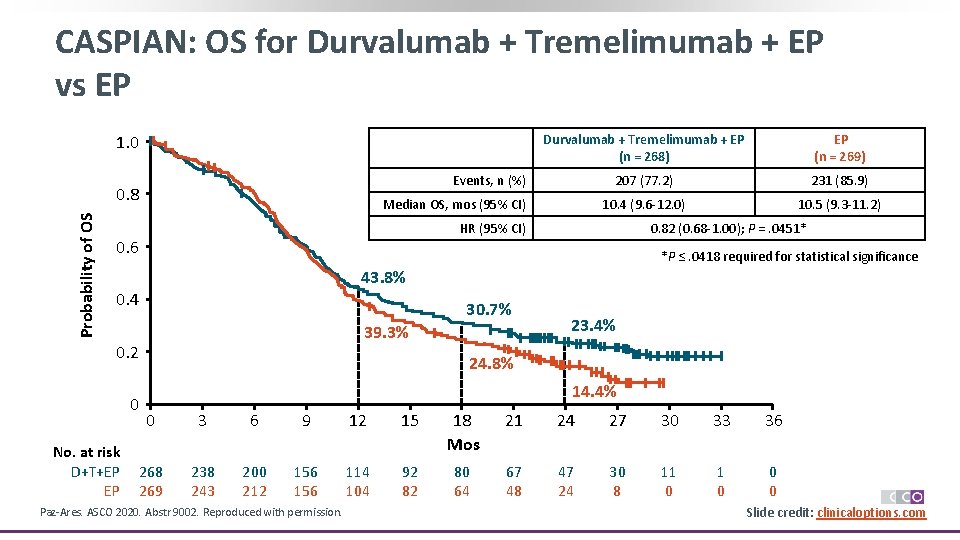
CASPIAN: OS for Durvalumab + Tremelimumab + EP vs EP 1. 0 EP (n = 269) 207 (77. 2) 231 (85. 9) 10. 4 (9. 6 -12. 0) 10. 5 (9. 3 -11. 2) Events, n (%) 0. 8 Probability of OS Durvalumab + Tremelimumab + EP (n = 268) Median OS, mos (95% CI) HR (95% CI) 0. 6 0. 82 (0. 68 -1. 00); P =. 0451* *P ≤. 0418 required for statistical significance 43. 8% 0. 4 30. 7% 39. 3% 0. 2 0 No. at risk D+T+EP EP 23. 4% 24. 8% 14. 4% 0 3 6 9 12 15 18 Mos 21 24 27 30 33 36 268 269 238 243 200 212 156 114 104 92 82 80 64 67 48 47 24 30 8 11 0 0 0 Paz-Ares. ASCO 2020. Abstr 9002. Reproduced with permission. Slide credit: clinicaloptions. com

CASPIAN: Subgroup OS Analysis for Durvalumab + Tremelimumab + EP vs EP All patients (n = 537) Planned platinum agent Carboplatin (n = 401) Cisplatin (n = 136) < 65 years (n = 311) Age ≥ 65 years (n = 226) Male (n = 386) Sex Female (n = 151) 0 (n = 199) Performance status 1 (n = 338) Smoker (n = 507) Smoking status Non-smoker (n = 30) Yes (n = 65) Brian/CNS metastases No (n = 472) Yes (n = 221) Liver metastases* No (n = 316) AJCC disease stage at diagnosis Stage III (n = 42) Stage IV (n = 495) Asian (n = 89) Race Non-Asian (n = 447) Region Asia (n = 84) Europe (n = 404) North and South America (n = 49) 0. 25 *Post hoc analysis; all other subgroups were prespecified Paz-Ares. ASCO 2020. Abstr 9002. Reproduced with permission. 0. 5 Favors D+T+EP 1 2 Favors EP HR (95% CI) 0. 82 (0. 68 -1. 00) 0. 84 (0. 67 -1. 04) 0. 79 (0. 55 -1. 15) 0. 76 (0. 59 -0. 97) 0. 92 (0. 69 -1. 22) 0. 83 (0. 66 -1. 03) 0. 76 (0. 52 -1. 10) 0. 79 (0. 58 -1. 09) 0. 87 (0. 69 -1. 10) 0. 86 (0. 70 -1. 04) 0. 43 (0. 17 -1. 02) 0. 91 (0. 53 -1. 59) 0. 81 (0. 66 -0. 98) 0. 90 (0. 68 -1. 20) 0. 74 (0. 58 -0. 96) 0. 96 (0. 47 -1. 88) 0. 81 (0. 67 -0. 99) 0. 86 (0. 53 -1. 38) 0. 81 (0. 66 -1. 00) 0. 90 (0. 55 -1. 46) 0. 78 (0. 62 -0. 96) 1. 08 (0. 58 -2. 03) Slide credit: clinicaloptions. com
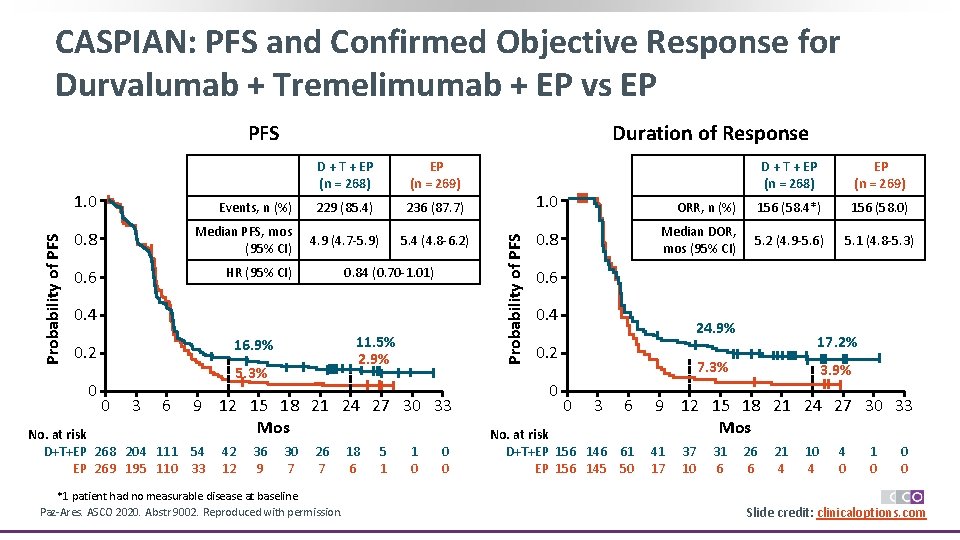
CASPIAN: PFS and Confirmed Objective Response for Durvalumab + Tremelimumab + EP vs EP Duration of Response 1. 0 Events, n (%) 0. 8 Median PFS, mos (95% CI) 0. 6 HR (95% CI) D + T + EP (n = 268) EP (n = 269) 229 (85. 4) 236 (87. 7) 1. 0 4. 9 (4. 7 -5. 9) 5. 4 (4. 8 -6. 2) 0. 84 (0. 70 -1. 01) 0. 4 16. 9% 0. 2 0 11. 5% 2. 9% 5. 3% 0 3 6 9 12 15 18 21 24 27 30 33 Mos No. at risk D+T+EP 268 204 111 54 EP 269 195 110 33 42 12 36 9 30 7 26 7 *1 patient had no measurable disease at baseline. Paz-Ares. ASCO 2020. Abstr 9002. Reproduced with permission. 18 6 5 1 1 0 0 0 Probability of PFS PFS D + T + EP (n = 268) EP (n = 269) ORR, n (%) 156 (58. 4*) 156 (58. 0) Median DOR, mos (95% CI) 5. 2 (4. 9 -5. 6) 5. 1 (4. 8 -5. 3) 0. 6 0. 4 24. 9% 0. 2 0 17. 2% 7. 3% 0 3 6 No. at risk D+T+EP 156 146 61 EP 156 145 50 3. 9% 9 12 15 18 21 24 27 30 33 Mos 41 17 37 10 31 6 26 6 21 4 10 4 4 0 1 0 0 0 Slide credit: clinicaloptions. com
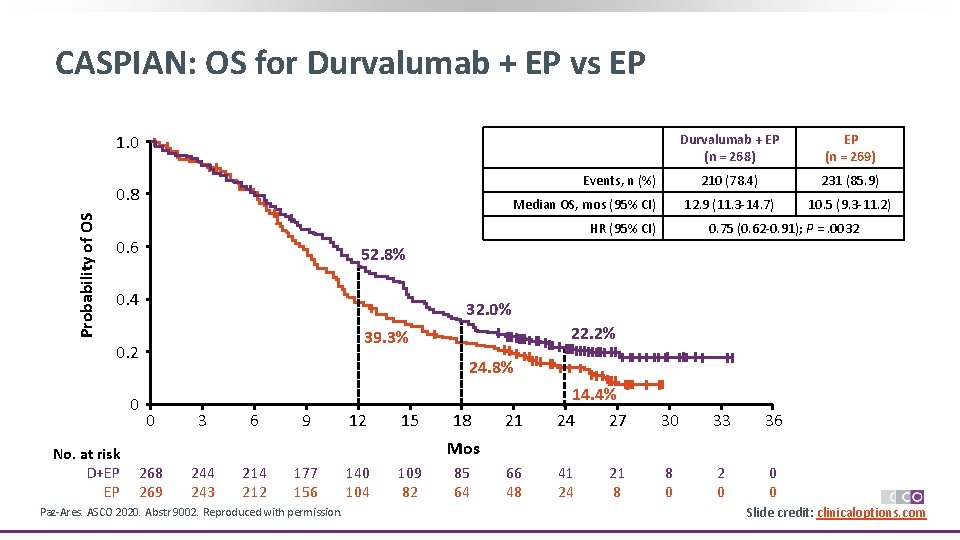
CASPIAN: OS for Durvalumab + EP vs EP 1. 0 Events, n (%) Probability of OS 0. 8 Median OS, mos (95% CI) HR (95% CI) 0. 6 210 (78. 4) 231 (85. 9) 12. 9 (11. 3 -14. 7) 10. 5 (9. 3 -11. 2) 0. 75 (0. 62 -0. 91); P =. 0032 32. 0% 22. 2% 39. 3% 0. 2 No. at risk D+EP EP EP (n = 269) 52. 8% 0. 4 0 Durvalumab + EP (n = 268) 24. 8% 0 3 6 9 12 15 18 21 14. 4% 24 27 30 33 36 66 48 41 24 8 0 2 0 0 0 Mos 268 269 244 243 214 212 177 156 Paz-Ares. ASCO 2020. Abstr 9002. Reproduced with permission. 140 104 109 82 85 64 21 8 Slide credit: clinicaloptions. com
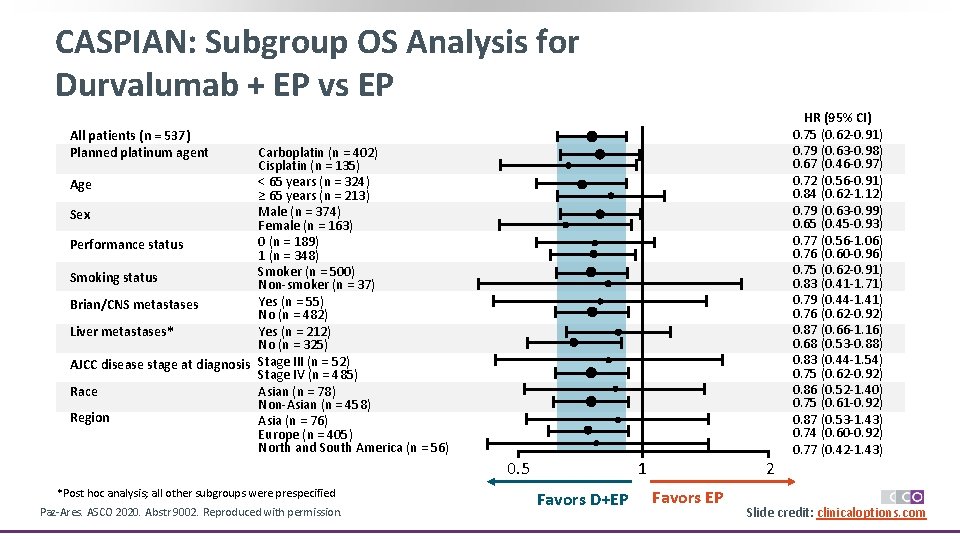
CASPIAN: Subgroup OS Analysis for Durvalumab + EP vs EP All patients (n = 537) Planned platinum agent Carboplatin (n = 402) Cisplatin (n = 135) < 65 years (n = 324) Age ≥ 65 years (n = 213) Male (n = 374) Sex Female (n = 163) 0 (n = 189) Performance status 1 (n = 348) Smoker (n = 500) Smoking status Non-smoker (n = 37) Yes (n = 55) Brian/CNS metastases No (n = 482) Yes (n = 212) Liver metastases* No (n = 325) AJCC disease stage at diagnosis Stage III (n = 52) Stage IV (n = 485) Asian (n = 78) Race Non-Asian (n = 458) Region Asia (n = 76) Europe (n = 405) North and South America (n = 56) 0. 5 *Post hoc analysis; all other subgroups were prespecified Paz-Ares. ASCO 2020. Abstr 9002. Reproduced with permission. 1 Favors D+EP 2 Favors EP HR (95% CI) 0. 75 (0. 62 -0. 91) 0. 79 (0. 63 -0. 98) 0. 67 (0. 46 -0. 97) 0. 72 (0. 56 -0. 91) 0. 84 (0. 62 -1. 12) 0. 79 (0. 63 -0. 99) 0. 65 (0. 45 -0. 93) 0. 77 (0. 56 -1. 06) 0. 76 (0. 60 -0. 96) 0. 75 (0. 62 -0. 91) 0. 83 (0. 41 -1. 71) 0. 79 (0. 44 -1. 41) 0. 76 (0. 62 -0. 92) 0. 87 (0. 66 -1. 16) 0. 68 (0. 53 -0. 88) 0. 83 (0. 44 -1. 54) 0. 75 (0. 62 -0. 92) 0. 86 (0. 52 -1. 40) 0. 75 (0. 61 -0. 92) 0. 87 (0. 53 -1. 43) 0. 74 (0. 60 -0. 92) 0. 77 (0. 42 -1. 43) Slide credit: clinicaloptions. com
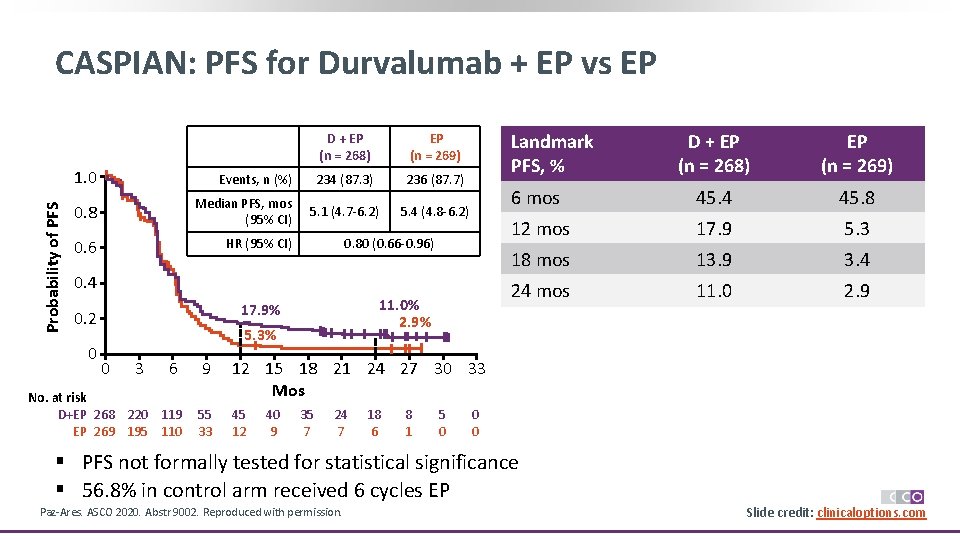
Probability of PFS CASPIAN: PFS for Durvalumab + EP vs EP 1. 0 Events, n (%) 0. 8 Median PFS, mos (95% CI) 0. 6 HR (95% CI) D + EP (n = 268) EP (n = 269) 234 (87. 3) 236 (87. 7) 5. 1 (4. 7 -6. 2) 5. 4 (4. 8 -6. 2) Landmark PFS, % 0. 80 (0. 66 -0. 96) 0. 4 17. 9% 0. 2 0 11. 0% 2. 9% 5. 3% 0 3 6 No. at risk D+EP 268 220 119 EP 269 195 110 9 12 15 18 21 24 27 30 33 Mos 55 33 45 12 40 9 35 7 24 7 18 6 8 1 5 0 D + EP (n = 268) EP (n = 269) 6 mos 45. 4 45. 8 12 mos 17. 9 5. 3 18 mos 13. 9 3. 4 24 mos 11. 0 2. 9 0 0 § PFS not formally tested for statistical significance § 56. 8% in control arm received 6 cycles EP Paz-Ares. ASCO 2020. Abstr 9002. Reproduced with permission. Slide credit: clinicaloptions. com
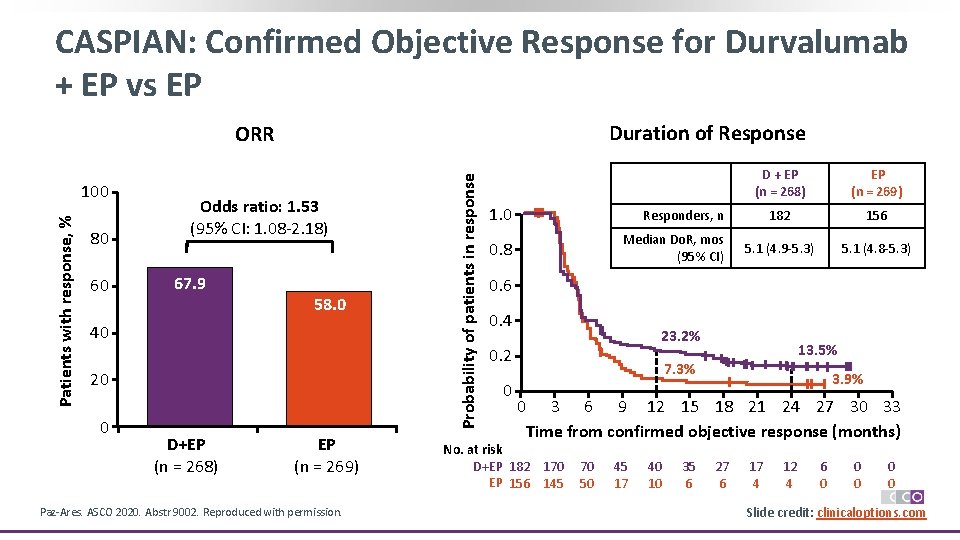
CASPIAN: Confirmed Objective Response for Durvalumab + EP vs EP Duration of Response Patients with response, % 100 80 60 Odds ratio: 1. 53 (95% CI: 1. 08 -2. 18) 67. 9 58. 0 40 20 0 D+EP (n = 268) EP (n = 269) Paz-Ares. ASCO 2020. Abstr 9002. Reproduced with permission. Probability of patients in response ORR 1. 0 Responders, n 0. 8 Median Do. R, mos (95% CI) D + EP (n = 268) EP (n = 269) 182 156 5. 1 (4. 9 -5. 3) 5. 1 (4. 8 -5. 3) 0. 6 0. 4 23. 2% 0. 2 0 13. 5% 7. 3% 3. 9% 0 3 6 9 12 15 18 21 24 27 30 33 Time from confirmed objective response (months) No. at risk D+EP 182 170 EP 156 145 70 50 45 17 40 10 35 6 27 6 17 4 12 4 6 0 0 0 Slide credit: clinicaloptions. com
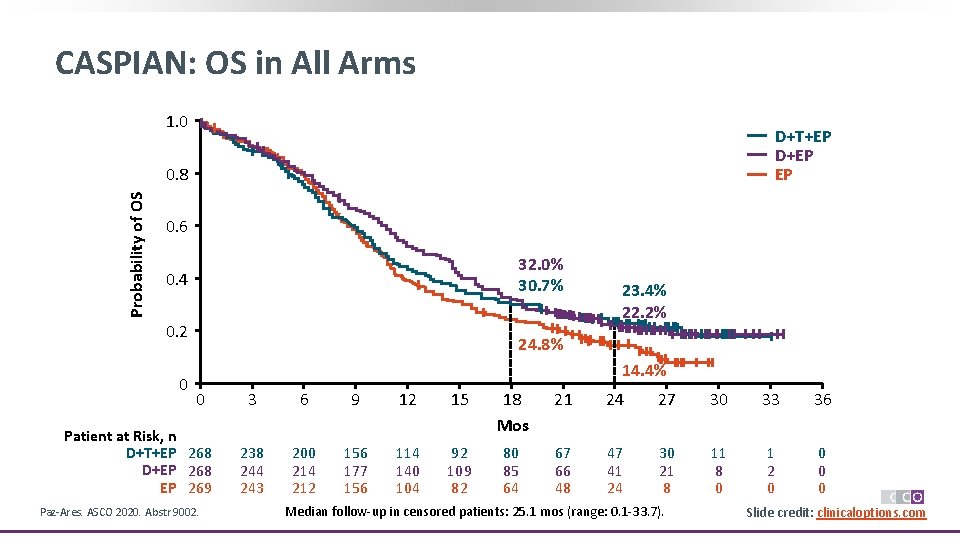
CASPIAN: OS in All Arms 1. 0 D+T+EP D+EP EP Probability of OS 0. 8 0. 6 32. 0% 30. 7% 0. 4 0. 2 0 23. 4% 22. 2% 24. 8% 14. 4% 0 Patient at Risk, n D+T+EP 268 D+EP 268 EP 269 Paz-Ares. ASCO 2020. Abstr 9002. 3 6 9 12 15 18 Mos 21 24 27 30 33 36 238 244 243 200 214 212 156 177 156 114 140 104 92 109 82 80 85 64 67 66 48 47 41 24 30 21 8 11 8 0 1 2 0 0 Median follow-up in censored patients: 25. 1 mos (range: 0. 1 -33. 7). Slide credit: clinicaloptions. com
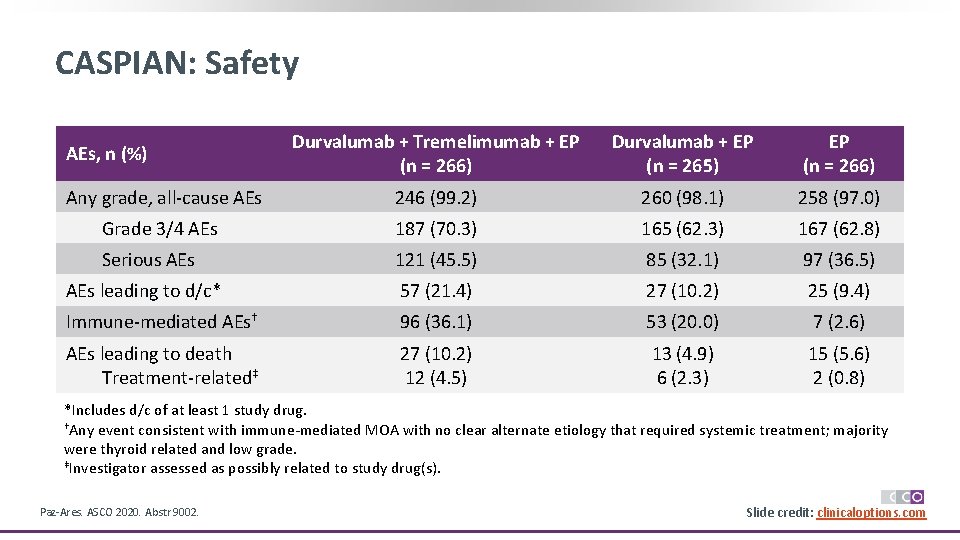
CASPIAN: Safety Durvalumab + Tremelimumab + EP (n = 266) Durvalumab + EP (n = 265) EP (n = 266) Any grade, all-cause AEs 246 (99. 2) 260 (98. 1) 258 (97. 0) Grade 3/4 AEs 187 (70. 3) 165 (62. 3) 167 (62. 8) Serious AEs 121 (45. 5) 85 (32. 1) 97 (36. 5) AEs leading to d/c* 57 (21. 4) 27 (10. 2) 25 (9. 4) Immune-mediated AEs† 96 (36. 1) 53 (20. 0) 7 (2. 6) AEs leading to death Treatment-related‡ 27 (10. 2) 12 (4. 5) 13 (4. 9) 6 (2. 3) 15 (5. 6) 2 (0. 8) AEs, n (%) *Includes d/c of at least 1 study drug. †Any event consistent with immune-mediated MOA with no clear alternate etiology that required systemic treatment; majority were thyroid related and low grade. ‡Investigator assessed as possibly related to study drug(s). Paz-Ares. ASCO 2020. Abstr 9002. Slide credit: clinicaloptions. com
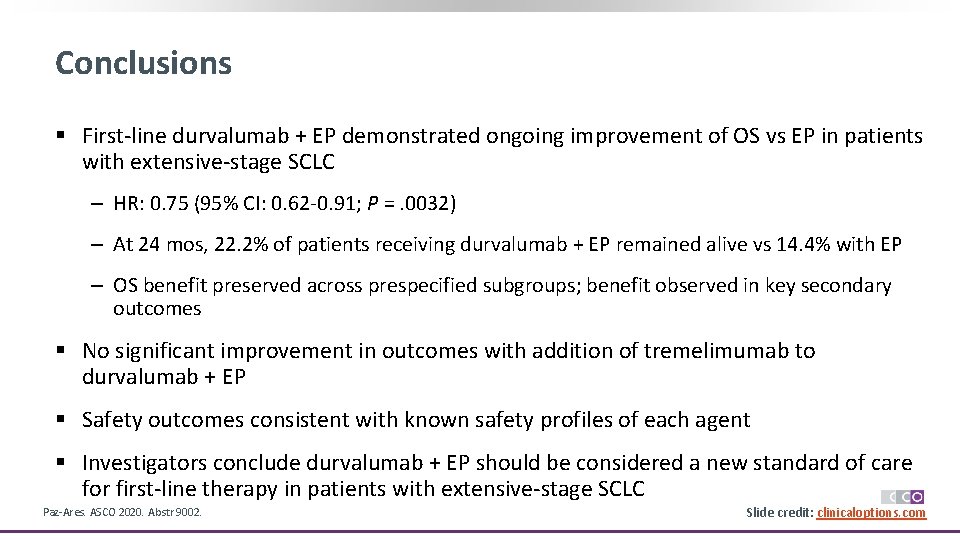
Conclusions § First-line durvalumab + EP demonstrated ongoing improvement of OS vs EP in patients with extensive-stage SCLC ‒ HR: 0. 75 (95% CI: 0. 62 -0. 91; P =. 0032) ‒ At 24 mos, 22. 2% of patients receiving durvalumab + EP remained alive vs 14. 4% with EP ‒ OS benefit preserved across prespecified subgroups; benefit observed in key secondary outcomes § No significant improvement in outcomes with addition of tremelimumab to durvalumab + EP § Safety outcomes consistent with known safety profiles of each agent § Investigators conclude durvalumab + EP should be considered a new standard of care for first-line therapy in patients with extensive-stage SCLC Paz-Ares. ASCO 2020. Abstr 9002. Slide credit: clinicaloptions. com
Go Online for More CCO Coverage of ASCO 2020! Short slideset summaries and additional CME-certified analyses with expert faculty commentary on key studies in: § Breast cancer § Gynecologic cancers § Gastrointestinal cancers § Hematologic malignancies § Genitourinary cancers § Lung cancer clinicaloptions. com/oncology
- Slides: 16