
CASL Common Algebraic Specification Language Overview Peter D
CASL Common Algebraic Specification Language Overview Peter D. Mosses (BRICS, Aarhus, Denmark) External Relations Coordinator of COFI: The Common Framework Initiative for algebraic specification and development 1
Plan Background CASL – basic specifications – structured specifications – architectural specifications – libraries of specifications Foreground 2
Background Lack of a common framework meant – industrial acceptance: discouraged – dissemination: hindered – tool applicability: limited Why not agree on a common framework? – concepts – language – methodologies 3
Aims a common framework—a collaborative effort for algebraic specification & development attractive – short term: to researchers; long term: for use in industry providing a common specification language – syntax: uniform, user-friendly; semantics: straightforward subsuming many previous frameworks good documentation & tool support free—but protected! 4
Scope specifying functional requirements formal development & verification of software relation of specifications to: – informal requirements – implemented code prototyping, theorem-proving libraries, reuse, evolution providing tool interoperability 5
CASL: Common Algebraic Specification Language critical selection of existing constructs expressive, simple, pragmatic specifying requirements and design for conventional software packages restrictions to sub-languages extensions to higher-order, state-based, concurrent, … 6
CASL Design Process design started: September 1995 design proposed: May 1997 – summary, abstract syntax, semantics – tentatively approved by IFIP WG 1. 3 design v 1. 0 finalized: October 1998 – language documentation available » summary, formal semantics, rationale, design notes » user’s manual in preparation (draft by Sept. 1999) – tools are being developed (parsers, provers, …) 7

Parts of CASL Basic specifications – declarations, definitions, axioms Structured specifications – translations, reductions, unions, extensions, freeness – named specifications, generic specifications, views Architectural specifications – implementation units, composition Specification libraries – distributed 8
Aspects of CASL design Design issues – methodology, tools, aesthetics Semantic concepts – formal (institutions, environments) – informal (expansions, scopes) Language constructs – abstract syntax (structure, annotations) – concrete syntax (input, display) 9
Design issues: basic specifications Partial and total functions Logic and predicates Classes of models Overloading Subsorts Datatype constructors/selectors 10
Partial and total functions error propagation implicit (strictness) – any argument undefined result undefined totality an important special case – all arguments defined result defined domain of definition may be implicit – not always a natural sort/subsort equations may require definedness or not – existential equations require it, strong do not 11
Logic and predicates classical 2 -valued first-order logic – standard interpretation of connectives predicates – better than (total) Boolean functions! – any argument undefined unsatisfied quantification, connectives – expressiveness – restrictions in sublanguages 12
Classes of models all models – loose semantics generated models – only expressible values considered – induction proofs sound initial (and freely-generated) models – minimal satisfaction, definedness – may not exist (disjunction, negation, . . . ) 13
Overloading declaration – same symbol, various profiles (arg/result sorts) » e. g. ‘ ’ on integers, reals, strings, … use – intended profile determined by context – disambiguation when needed by specifying profile (or result sort) of applications 14
Subsorts embeddings – not necessarily inclusions (e. g. Int values represented differently from Real values) commute with overloaded functions – values independent of profiles – 2+2=4 (natural numbers, integers, …) no ‘regularity’ conditions on declarations – for simplicity, modularity 15
Datatype constructors/selectors frequently needed – correspond to (unions of) record types, enumeration types abbreviate tedious declarations, axioms – for constructors and selectors may be loose, generated, or free 16
Semantic concepts: basic specifications Signatures Models Sentences Satisfaction Sort generation constraints Institution Semantic functions 17
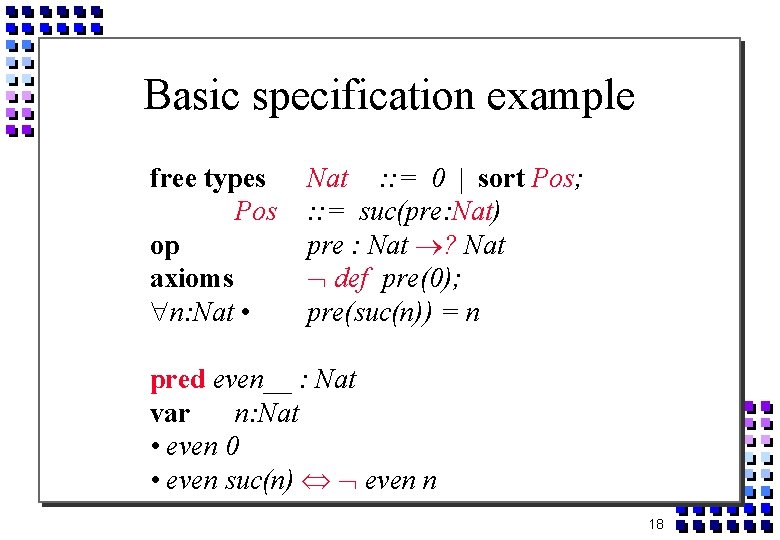
Basic specification example free types Pos op axioms n: Nat • Nat : : = 0 sort Pos; : : = suc(pre: Nat) pre : Nat ? Nat def pre(0); pre(suc(n)) = n pred even__ : Nat var n: Nat • even 0 • even suc(n) even n 18
Design issues: structured specifications No model structure Names of symbols Generic extension 19
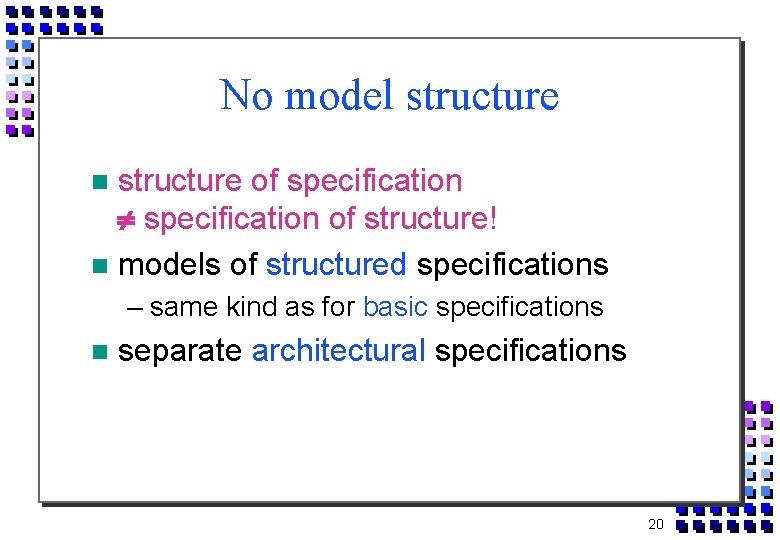
No model structure of specification of structure! models of structured specifications – same kind as for basic specifications separate architectural specifications 20
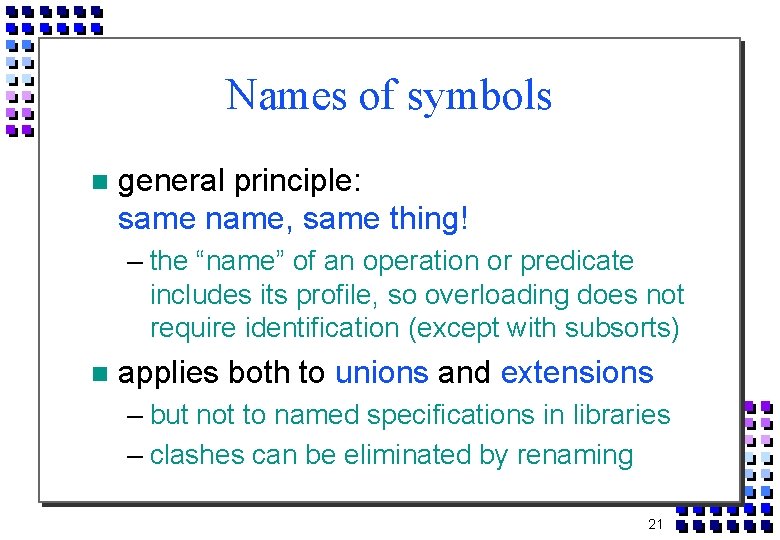
Names of symbols general principle: same name, same thing! – the “name” of an operation or predicate includes its profile, so overloading does not require identification (except with subsorts) applies both to unions and extensions – but not to named specifications in libraries – clashes can be eliminated by renaming 21
Names of symbols… auxiliary symbols are to be hidden – hidden symbols are irrelevant – revealed symbols are significant tools may warn about duplicate declarations – no problem when same origin 22
Generic extension specification definitions – reuse by reference to name generic parameters – parameters intended to vary – reuse requires instantiation – not intended for defining arbitrary functions on specifications (macros) 23
Semantic concepts: structured specifications signature, class of models – as for basic specifications institution-independent structure – many-sorted, subsorted, … – reduct homomorphisms local environment – visible symbol declarations 24
![Structured specification example spec LIST_WITH_ORDER [PARTIAL_ORDER] = free type List[Elem] : : = nil](http://slidetodoc.com/presentation_image_h/09308aa6d150a11f5f4bb1555c675ad7/image-25.jpg "Structured specification example spec LIST_WITH_ORDER [PARTIAL_ORDER] = free type List[Elem] : : = nil")
Structured specification example spec LIST_WITH_ORDER [PARTIAL_ORDER] = free type List[Elem] : : = nil | cons(hd: ? Elem; tl: ? List[Elem]) then local op insert : Elem List[Elem]; vars x, y : Elem; l : List[Elem] axioms insert(x, nil) = cons(x, nil); x y insert(x, cons(y, l)) = cons(x, insert(y, l)); (x y) insert(x, cons(y, l)) = cons(y, insert(x, l)) within op order[__ __] : List[Elem] vars x : Elem; l : List[Elem] axioms order[__ __](nil) = nil; order[__ __](cons(x, l)) = insert(x, order[__ __](l)) end 25
Design issues: architectural specifications Reusability Interfaces Decomposition of tasks – composition of results 26
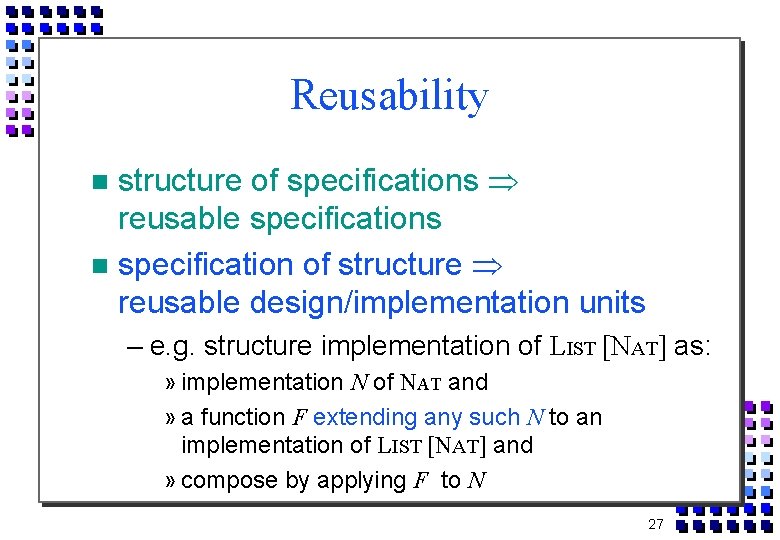
Reusability structure of specifications reusable specifications specification of structure reusable design/implementation units – e. g. structure implementation of LIST [NAT] as: » implementation N of NAT and » a function F extending any such N to an implementation of LIST [NAT] and » compose by applying F to N 27
Interfaces explicit assumptions that parts of the implementation make about others explicit guarantees about results under the given assumptions 28
Decomposition/composition architectural specifications specify decomposition of implementation development task into sub-tasks also how to compose results of sub-tasks into result of main task 29
Semantic concepts: architectural specifications model of architectural specification: – collection of (named) unit constructors – unit (constructor) resulting from composition unit constructors: – constants – functions from units to units » persistent, extending arguments » arguments must be compatible 30
![Architectural specification example spec LIST[ELEM] = free type List[Elem] : : = nil cons(Elem;](http://slidetodoc.com/presentation_image_h/09308aa6d150a11f5f4bb1555c675ad7/image-31.jpg "Architectural specification example spec LIST[ELEM] = free type List[Elem] : : = nil cons(Elem;")
Architectural specification example spec LIST[ELEM] = free type List[Elem] : : = nil cons(Elem; List[Elem]) arch spec CN_LIST = units C : CHAR N : NAT ; F : ELEM LIST[ELEM] result F[C fit Elem | Char] and F[N fit Elem | Nat] 31
Design issues: libraries visibility of symbols between specifications – none visibility of specification names – linear distributed libraries on Internet – indirect links – explicit downloading version control 32
Semantic concepts: libraries global environment – mapping specification names to their denotations directory of registered libraries – mapping library names to their registered URLs – giving access to previous versions of libraries state of the universe (Internet, local files) 33
Foreground: Co. FI Working Group Language design tasks Semantics tasks Tools tasks Methodology tasks Reactive system tasks Overall coordination: – Don Sannella (Edinburgh) Sep 98 – … – Peter D. Mosses (Aarhus) Sep 95 – Aug 98 34
Language design tasks coordination: – Bernd Krieg-Brückner (Bremen) publication of CASL Language Summary sub-languages – total, many-sorted, equational, … extensions – higher-order, state-based, … 35
Semantics tasks coordination: – Andrzej Tarlecki (Warsaw) publication of formal semantics for CASL choice of proof system for CASL 36
Methodology tasks coordination: – Michel Bidoit (Cachan) user’s guide case studies relation of specifications to requirements and code development processes 37
Tools tasks coordination: – Hélène Kirchner (Nancy) parsers – 3 prototypes implemented interoperability of existing tools formatting (LATEX package, HTML filter) static analysis, proof tools – HOL/Isabelle interface for CASL implemented 38
Reactive system tasks coordination: – Egidio Astesiano (Genova) extensions of CASL for reactive system specification combination of CASL with concurrency 39
External relations tasks coordination: – Peter D. Mosses (Aarhus) relation to existing languages – ASF+SDF, CAFEOBJ, LSL (so far superficially) – help needed from experts! liaison with IFIP WG 1. 3 web presentation of COFI tutorial 40
Join now! all task groups welcome new participants – contact the coordinators all cofi- mailing lists open to subscription – moderated – administered by Majordomo program – cofi-list@brics. dk: low-volume, announcements only all documents available on the web/ftp 41
References COFI Home Page – http: //www. brics. dk/Projects/Co. FI/ CASL Summary – …/Documents/CASL/Summary/ COFI Rationale, CASL Guided Tour – EATCS Bulletin 59, June 1996 – Proc. TAPSOFT’ 97, LNCS 1214, 1997 – Proc. WADT’ 98, LNCS 1589, 1999 42
- Slides: 42